Why Automation in Sales is the Future: The Shift to Agentic AI

Executive Summary
- The Problem: Reps only sell for 28% of their week [Salesforce].
- The Shift: We are moving from "Copilots" (assistants) to "Agents" (workers).
- The Future: By 2028, 15% of work decisions will be autonomous [Gartner].
- The Risk: 40% of AI projects will fail due to "Agent Washing" [Gartner].
If you look at your sales team's calendar right now, you’re going to get angry.
I guarantee it.
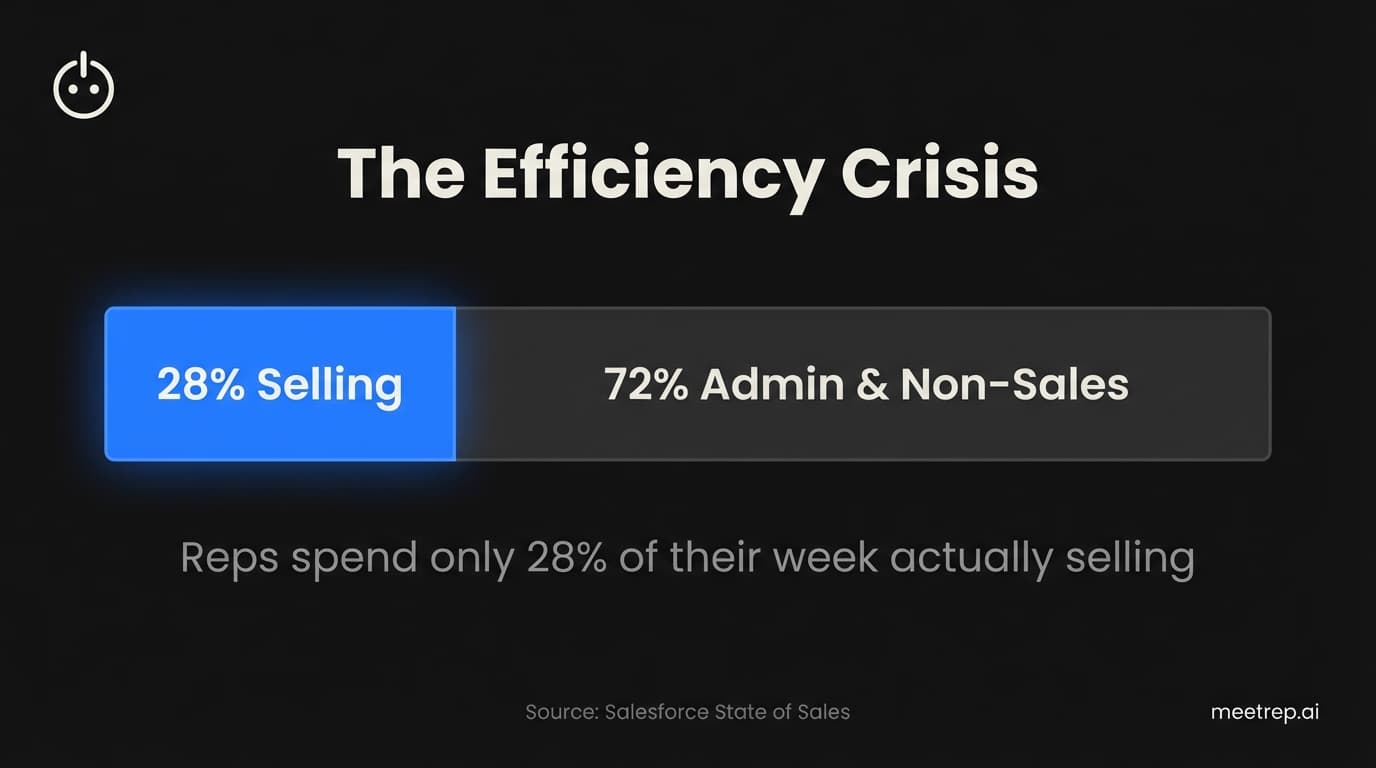
Because despite all the tools, all the "efficiency" promises, and all the budget we’ve poured into the tech stack over the last five years, the data tells a depressing story. According to Salesforce, sales reps still spend only 28% of their week actually selling.
The other 72%? It’s admin. It’s CRM data entry. It’s scheduling. It’s internal meetings about meetings.
When we founded GoCustomer.ai, we thought better workflows were the answer. We were wrong. "Better workflows" just meant allowing reps to do data entry slightly faster. Now, building Rep, I realized the problem isn't that reps need help doing the work.
The problem is that reps shouldn't be doing that work at all.
This is the shift for 2026. We are moving from automation in sales (scripts that follow rules) to Agentic AI (systems that make decisions).
The State of Automation in Sales (2026)
Automation in sales is the use of software to handle manual tasks within the sales cycle. But in 2026, this definition has expanded to include "Agentic AI"—systems that can autonomously plan, execute workflows, and make decisions without human intervention.
For the last decade, "automation" meant "sequences." If a prospect downloads a PDF, send Email A. If they click, send Email B.
Simple. Rigid. And honestly? It created a lot of noise.
But the mandate for 2026 is different. Gartner identifies "growth at a reasonable cost" as the #1 threat facing CSOs this year. You can’t just hire more heads. You have to fix the math.
And the math is brutal.
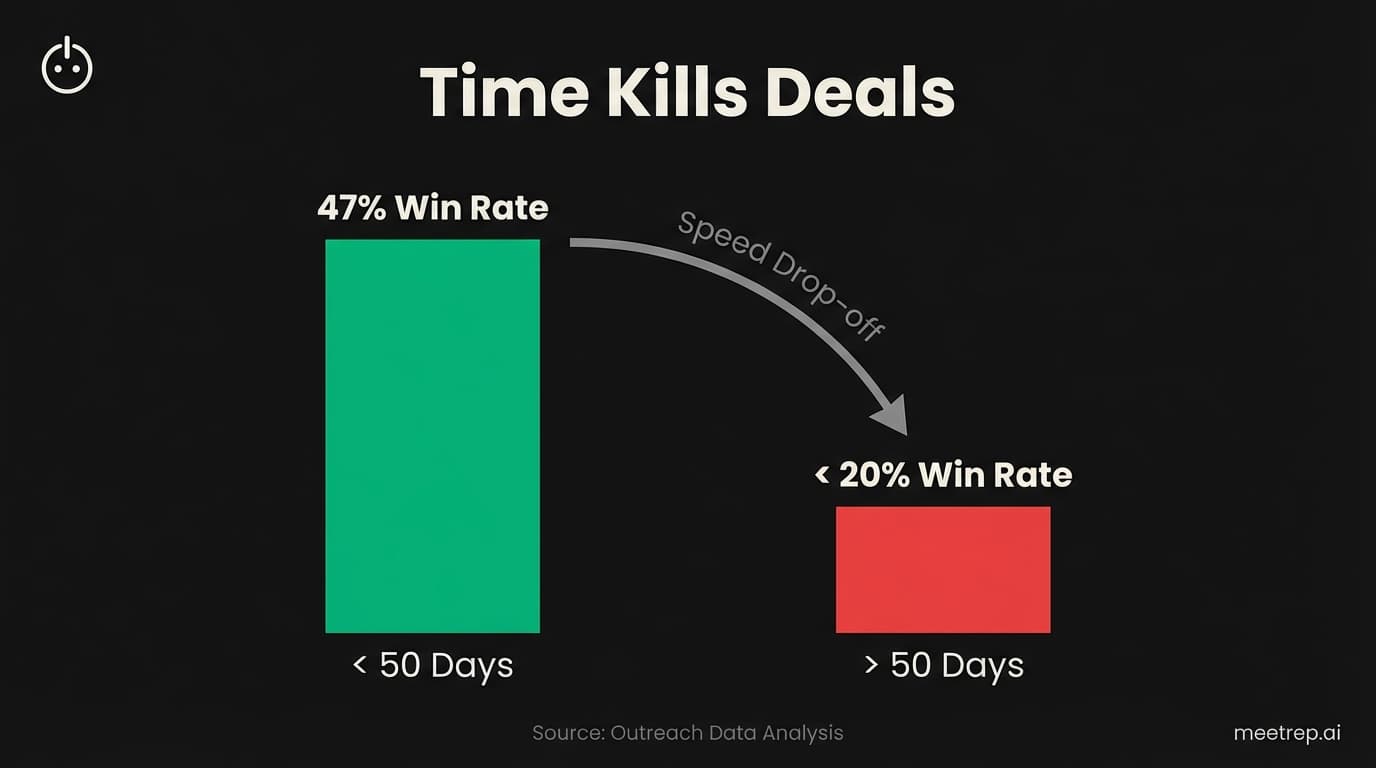
The Data: Opportunities closed within 50 days have a 47% win rate. Once you drag past that 50-day mark? Win rates drop to <20%. Speed isn't just nice to have; it's the only variable you can control. — Source: Outreach Data Analysis
This is why the old model of automation fails. It waits for a human to trigger it. But humans sleep. Humans get sick. Humans take vacations. While your rep is waiting for Monday morning to reply to a demo request, your competitor's agent has already qualified, demoed, and moved the deal to proposal.
From "Copilots" to "Agents": The 15% Shift
There is a massive difference between a tool that helps you write an email and a tool that sends the email for you.
This is the distinction between Generative AI (Copilots) and Agentic AI (Agents). And if you want to survive the next two years, you need to understand this difference.
Gartner predicts that by 2028, 15% of day-to-day work decisions will be made autonomously by agentic AI. That’s up from 0% in 2024.
We aren't just automating tasks anymore. We are automating decisions.
Key Insight: A "Copilot" sits in the passenger seat and gives directions. An "Agent" takes the wheel so your rep can sleep in the back—or better yet, be in a different car closing a bigger deal.
Here is the shift:
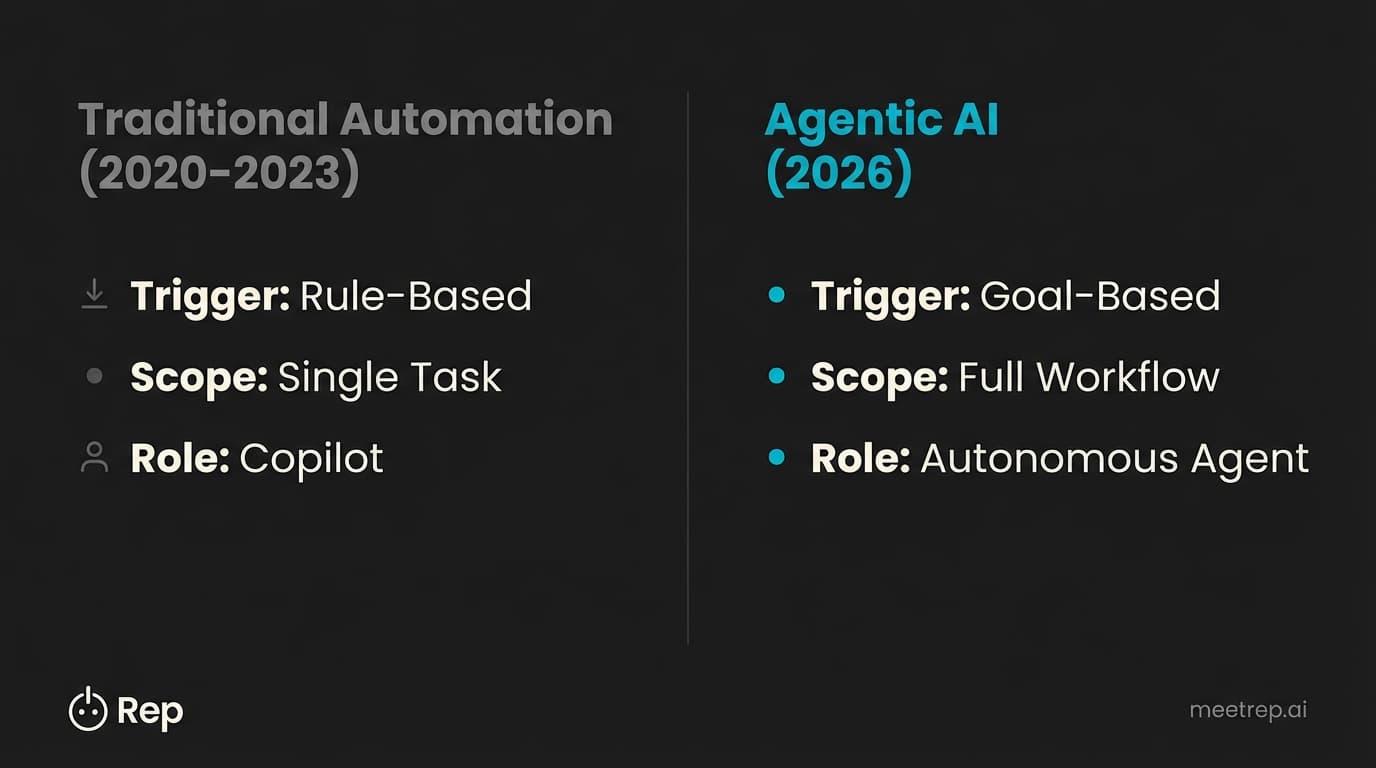
| Feature | Traditional Automation (2020-2023) | Agentic AI (2026) |
|---|---|---|
| Trigger | Rule-based (If X, then Y) | Goal-based (Achieve X) |
| Flexibility | Rigid; breaks if context changes | Adaptive; learns and pivots |
| Scope | Single task (e.g., send email) | Multi-step workflow (Research → Email → CRM) |
| Human Role | Operator | Supervisor |
| Example | Email Sequence | Rep (Autonomous Demo Agent) |
Why We Built Rep as an Agent
When we architected Rep, we had a choice. We could have built a "demo assistant" that pops up on the screen and tells the rep what to say.
But that doesn't solve the core problem: Availability.
If a prospect wants to see the product at 8 PM on a Tuesday, and your rep is at dinner, you lose. By building Rep as an autonomous agent—one that joins the video call, shares its screen, and actually talks—we solved the availability problem. We didn't just make the rep faster; we decoupled the demo from the rep's calendar entirely.
The "Buyer Enablement" Revolution
Stop trying to "enable" your sellers. Start enabling your buyers.
I know, that sounds like marketing fluff. But look at the numbers. According to Gartner, 80% of B2B sales interactions will occur in digital channels by 2025.
Buyers are voting with their clicks. They don't want to talk to a human for "discovery." They don't want to wait three days for a qualification call just to see the product.
The Data:72% of buyers prefer a rep-free experience for initial discovery. They want to learn on their own terms, not on your sales team's timeline.
This is why Digital Sales Rooms (DSRs) and autonomous demos are exploding. They meet the buyer where they are.
At GoCustomer, we saw this shift starting. Buyers would ignore emails but engage with interactive content. Now, at Rep, we see it daily. Prospects engage with autonomous demos at 2 AM, 6 AM, and on weekends.
If your automation strategy is just "sending more emails to get them on a call," you are fighting human nature. You will lose.
Navigating the Hype: The "Agent Washing" Problem
Here is the part where I have to be the bearer of bad news.
Because "Agentic AI" is the buzzword of 2026, every vendor is slapping the word "Agent" on their old chatbots. This is called Agent Washing.
And it’s dangerous.
Gartner predicts that 40% of agentic AI projects will be canceled by 2027 due to unclear value or cost.
Common Mistake: Don't buy a "Generalist Agent." There is no AI today that can "run your sales cycle." It doesn't exist.
Instead, hire "Specialist Agents."
- Need outbound? Get an SDR agent like 11x.
- Need live demos? Get a demo agent like Rep.
- Need pipeline analysis? Get a revenue agent like Gong.
The companies that fail are the ones trying to replace their entire sales team with a black box. The ones that win are the ones finding the high-friction bottlenecks—like TOFU qualification—and handing those specific jobs to an agent.
Case Studies: Who Is Winning Right Now?
You might be thinking, "This sounds great for the future, but who is doing it today?"
The gap between the "AI Haves" and "Have Nots" is already here. High-performing sales teams are 4.9x more likely to use AI than underperformers.
Here is what that looks like in practice:
1. HubSpot (via SuperAGI)
HubSpot didn't just add a chatbot. They used agentic frameworks to transform their pipeline management.
- Result: Increased sales velocity by 30%.
- Revenue: Generated $1.20 million in additional revenue.
- Source: MarketsandMarkets AI Report
2. Vodafone (via Anaplan)
Planning sales targets usually takes months. It’s a nightmare of spreadsheets and arguments. Vodafone handed this workflow to an automated system.
- Result: 50% faster sales planning.
- Impact: Shaved six weeks off the planning cycle.
- Source: Nuvia Case Study
3. Razorpay
They were drowning in inbound leads. Humans couldn't call them fast enough, so they implemented ML-based lead scoring (a precursor to agentic qualification).
- Result: 50% increase in Gross Merchandise Value (GMV).
- Efficiency: 70% reduction in human team effort.
- Source: Nuvia AI Report
The Gap Is Widening
We are past the point of "experimenting."
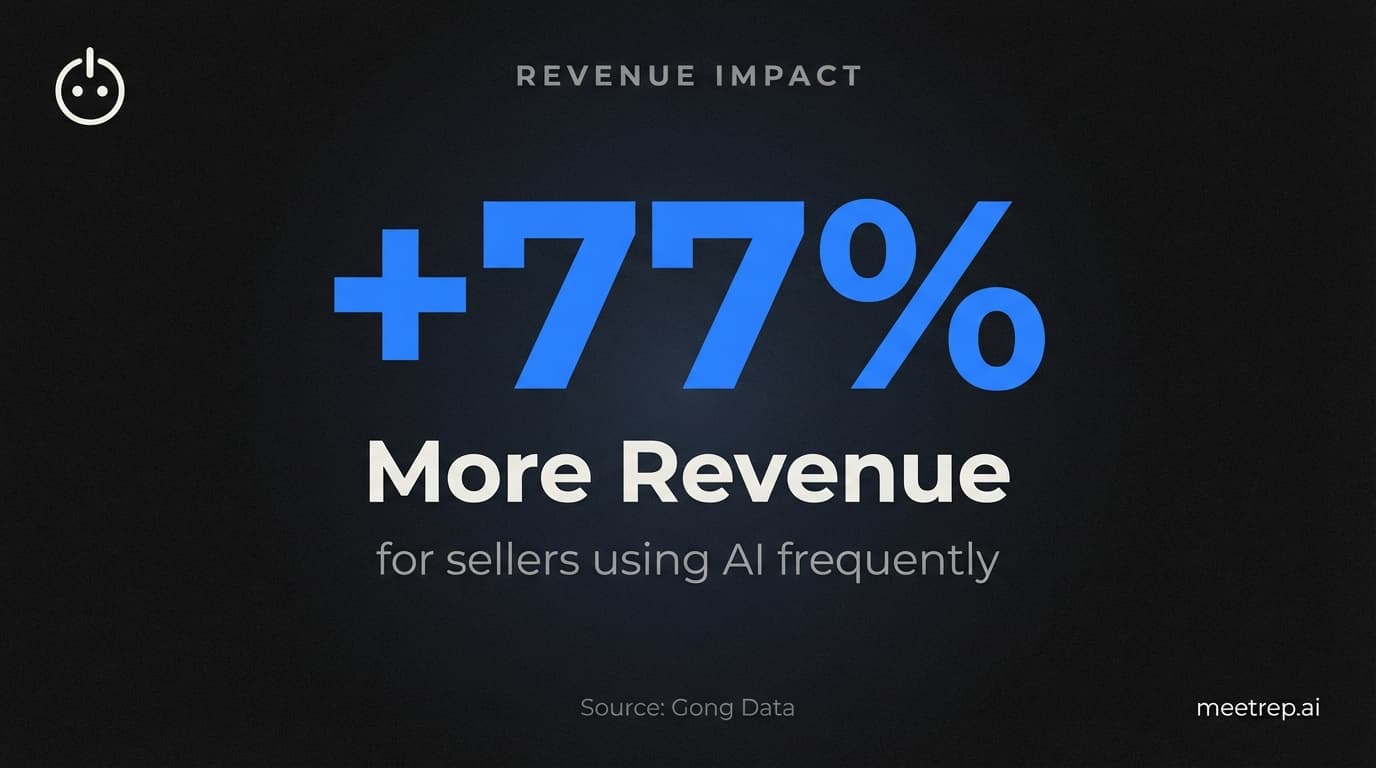
The data from Gong is clear: sellers who frequently use AI generate 77% more revenue than those who don't.
That isn't a small edge. That is a career-defining gap.
If you are a VP of Sales in 2026, you have two choices. You can keep paying your expensive humans to do robot work—data entry, scheduling, reciting the same standard demo script for the 500th time. Or you can hire agents to handle the grunt work, and let your humans do what they were actually hired to do: sell.
My advice? Start with the bottleneck. If your reps are bogged down giving intro demos to unqualified leads, let's fix that first.
See how Rep handles autonomous demos.Book a demo with our agent here.

Nadeem Azam
Founder
Software engineer & architect with 10+ years experience. Previously founded GoCustomer.ai.
Nadeem Azam is the Founder of Rep (meetrep.ai), building AI agents that give live product demos 24/7 for B2B sales teams. He writes about AI, sales automation, and the future of product demos.
Frequently Asked Questions
Table of Contents
- The State of Automation in Sales (2026)
- From "Copilots" to "Agents": The 15% Shift
- The "Buyer Enablement" Revolution
- Navigating the Hype: The "Agent Washing" Problem
- Case Studies: Who Is Winning Right Now?
- The Gap Is Widening
Ready to automate your demos?
Join the Rep Council and be among the first to experience AI-powered demos.
Get Early AccessRelated Articles
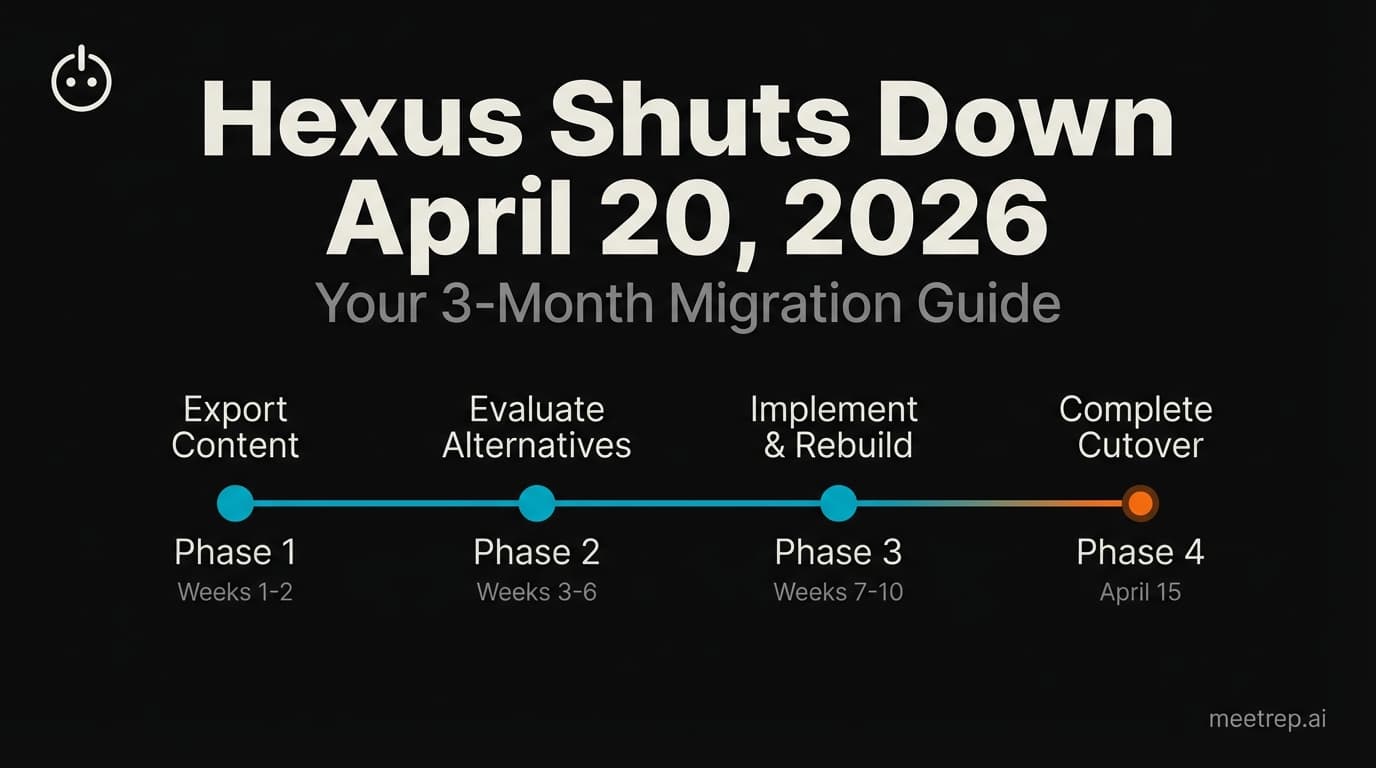
Hexus Acquired by Harvey AI: Congrats & What It Means for Demo Automation Teams
Hexus is shutting down following its acquisition by Harvey AI. Learn how to manage your migration and discover the best demo automation alternatives before April 2026.
Why the "Software Demo" is Broken—and Why AI Agents Are the Future
The traditional software demo is dead. Discover why 94% of B2B buyers rank vendors before calling sales and how AI agents are replacing manual demos to scale revenue.
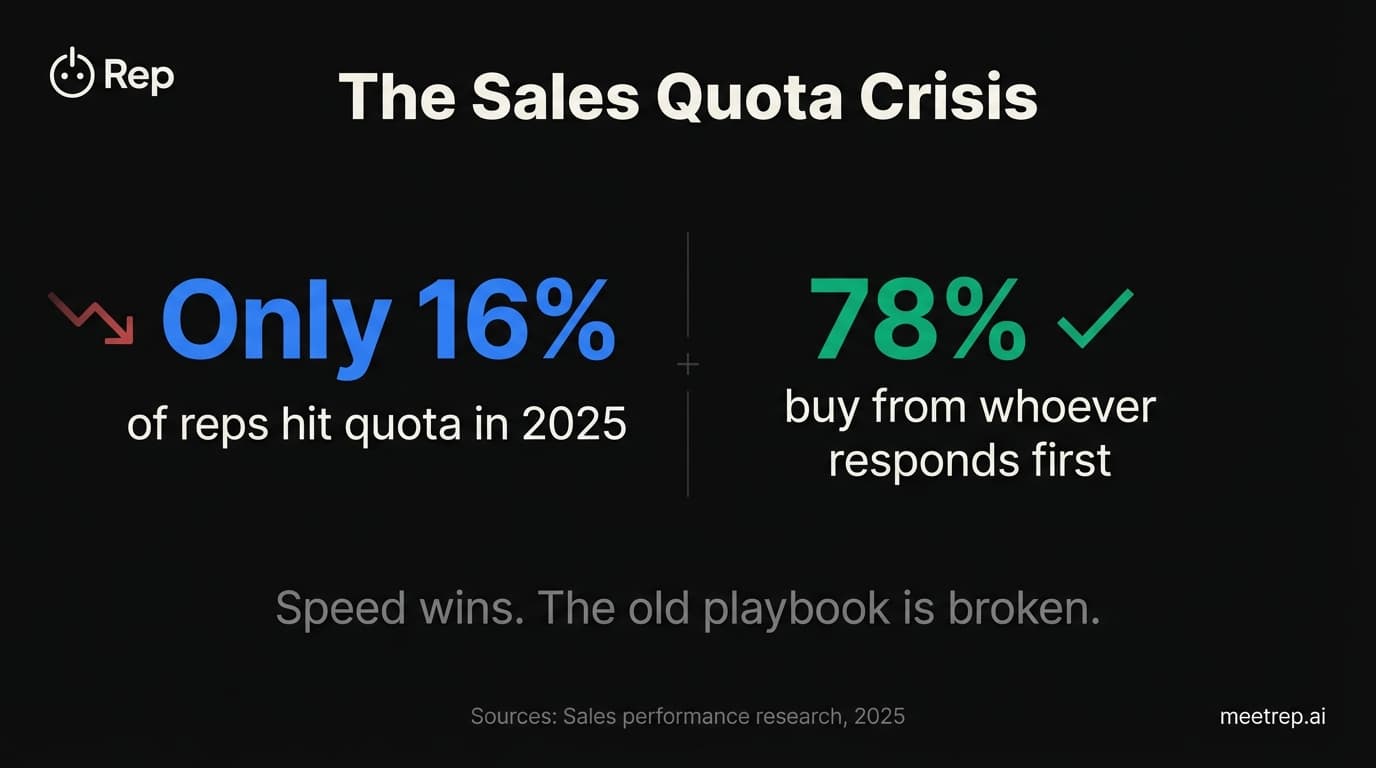
Why Autonomous Sales Software is the Future of B2B Sales (And Why the Old Playbook is Dead)
B2B sales is at a breaking point with quota attainment at 46%. Discover why autonomous 'Agentic AI' is the new standard for driving revenue and meeting the demand for rep-free buying.