Voice Over Scripts for Demos: Templates and Examples That Actually Convert

Executive Summary
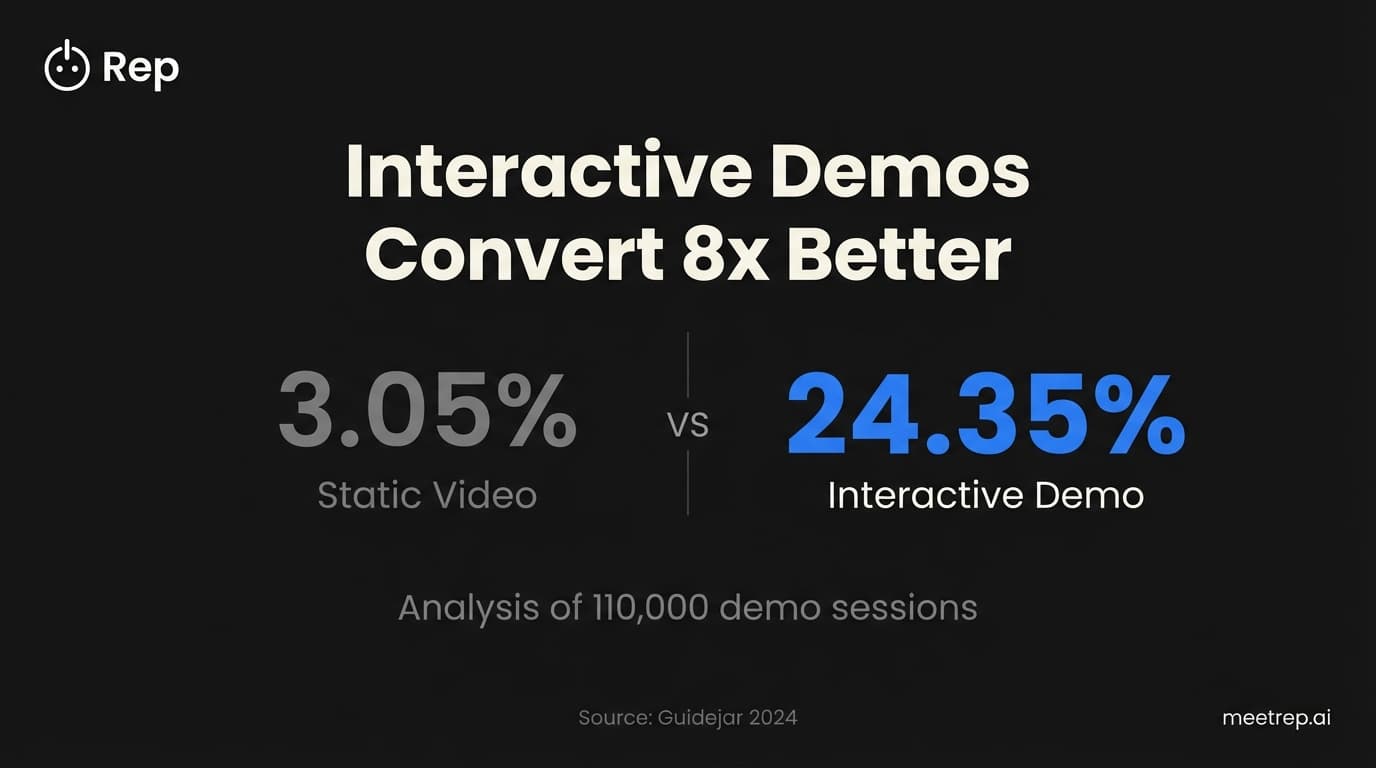
- Interactive demos convert at 24.35% vs 3.05% for static video—nearly 8x better
- Write for 120-150 words per minute; anything faster feels rushed
- Voice over adds 11% more engagement than videos without (73% vs 62%)
- AI voice scripts need conversational design: short chunks, barge-in points, sub-500ms responses
Most voice over scripts for demos sound terrible. You know the type—stiff, robotic, loaded with feature-speak that nobody actually talks like. And here's the uncomfortable truth: even if your script sounds great, you might be writing for the wrong format entirely.
I've been building AI voice products for years. First at GoCustomer.ai, now at Rep, where we're creating AI agents that give live product demos. What I've learned is that the definition of a "voice over script" has fundamentally shifted. It's no longer just a monologue for someone to read. It's conversational design for interactive experiences.
This guide gives you templates that work—for traditional video, for interactive demos, and for the AI voice agents that are rapidly changing how demos happen.
What is a voice over script (and why it's changed)
A voice over script is a written document providing the exact words, directions, and timing cues for narration in video content. It guides what gets said, when it gets said, and how it should sound—including pronunciation guides, emotional direction, and sync points with on-screen visuals.
But that definition is from 2019. Today? Voice over scripts have evolved into something more complex.
The shift happened because of how buyers behave. According to Wyzowl's 2026 Video Marketing Statistics, 96% of people have watched explainer videos to learn about products. And 85% say they've been convinced to buy after watching a video. Demos matter.
But here's what changed: Guidejar's analysis of 110,000 sessions found that interactive demos convert at 24.35% while static linear videos convert at just 3.05%. That's nearly 8x the effectiveness.
Key Insight: If you're writing voice over scripts only for passive video playback, you're optimizing for a format that converts at 3.05%. Every static video demo is leaving 21 percentage points of conversion on the table.
So what does a modern voice over script look like? It depends on your format:
| Format | Script Type | Key Characteristic |
|---|---|---|
| Linear Video | Traditional monologue | One-way narration, timed to visuals |
| Interactive Tour | Guided narrative | Branches based on user clicks |
| AI Voice Agent | Conversational design | Real-time dialogue with turn-taking |
My take? You need scripts for all three. But if you're only investing in one, make it interactive or conversational.
The anatomy of demo voice over scripts that convert
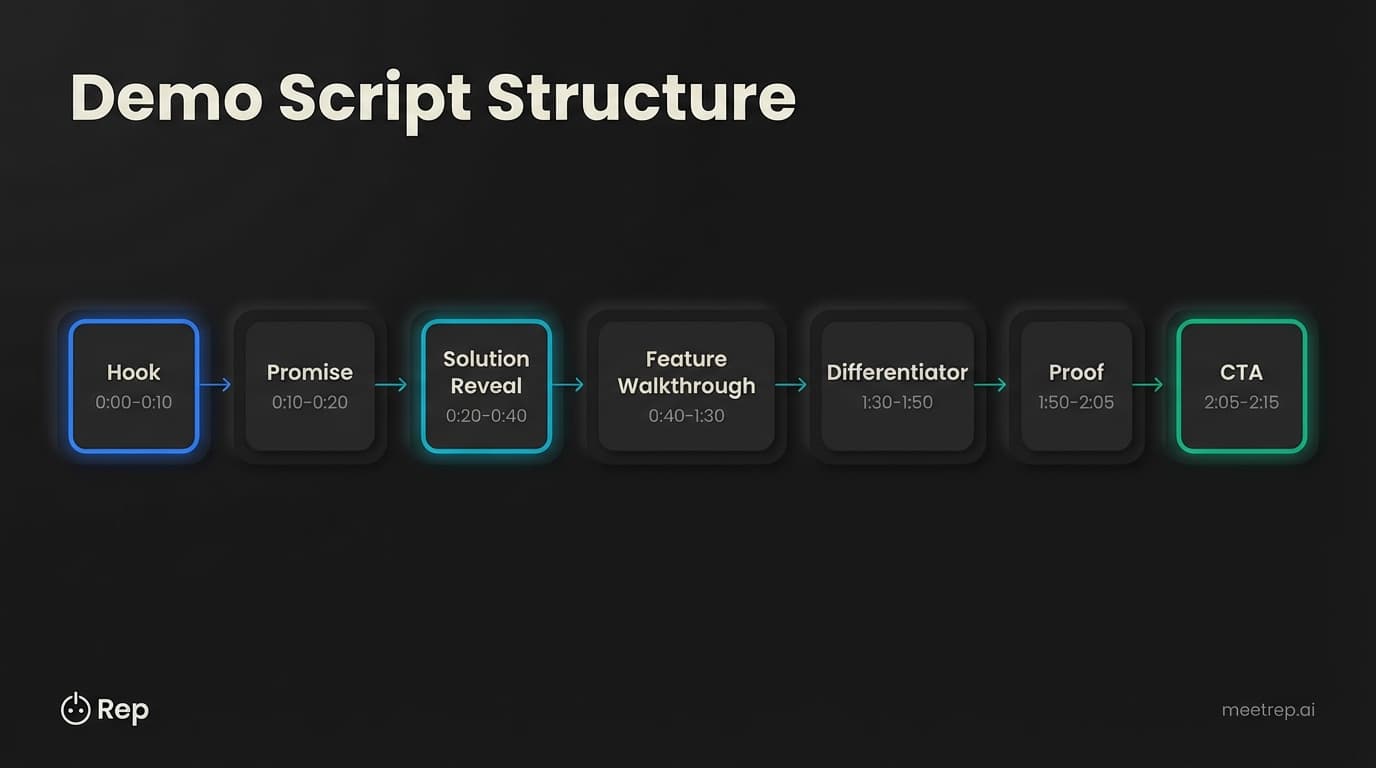
Every high-converting demo script—regardless of format—shares the same underlying structure. I call it Hook-Promise-Proof. It works for 60-second explainers and 10-minute walkthroughs alike.
The Structure:
- Hook (0:00-0:10): Start with a pain point your prospect actually feels. Not your feature. Their problem.
- Promise (0:10-0:20): Tell them exactly what they'll see and what outcome it leads to.
- Solution Reveal (0:20-0:40): Show the "aha" moment. The single thing that makes them say "I need this."
- Feature Walkthrough (0:40-1:30): Demonstrate how it works, step by step.
- Differentiator (1:30-1:50): Why this instead of alternatives.
- Proof (1:50-2:05): Customer results, metrics, logos.
- CTA (2:05-2:15): One clear next step.
That's a 2-minute script. Scale it up or down, but keep the sequence.
The Data:Wistia's 2025 research found that how-to videos under one minute have an 82% average watch rate. Longer than that, and you're fighting attention decay.
What to Include in Every Script:
- Time codes for syncing with visuals
- Screen directions like [SCREEN: Click Dashboard button]
- Pronunciation guides for technical terms ("write 'two thousand ten' not '2010'")
- Emotional direction like (enthusiastic) or (concerned tone)
- Pauses marked as (beat)
One mistake I see constantly: writers forget to verbalize what's happening on screen. If you click something, say you're clicking it. Viewers can't always see small cursor movements.
Voice over script templates by demo type
Here are templates you can use today. I've included word counts and timing so you can adapt them to your needs.
Template 1: The 2-Minute Micro-Demo (Best for MOFU)
This is your workhorse. Use it for homepage videos, email campaigns, and nurture sequences.
[0:00-0:10 HOOK] ~40 words
If you've ever lost a qualified lead because they waited six days
for a demo call, you know how frustrating that is. (beat) By day
six, they've talked to three competitors.

[0:10-0:20 PROMISE] ~40 words
In the next two minutes, I'll show you how [Product] eliminates
that wait completely. Your prospects explore your product the
instant they're interested. No scheduling. No lag.

[0:20-1:30 CORE WALKTHROUGH] ~180 words
Here's how it works.
[SCREEN: Homepage with demo button]
A prospect lands on your site and clicks "Try Demo."
[SCREEN: Demo interface loads]
They're instantly connected to a live walkthrough.

Notice what's happening here. (beat) They're not watching a generic
video. They're navigating based on what THEY want to see.
[SCREEN: User selects feature]
They choose pipeline management—and the demo takes them straight
there. No waiting through features they don't care about.

[SCREEN: Analytics view]
And here's what you see on your end: who engaged, what they
explored, which features got attention. All before your sales
team spends a single minute.

[1:30-1:50 DIFFERENTIATOR] ~60 words
Unlike calendar links that make prospects wait, or generic videos
that bore them, this is a real experience. (beat) Personalized
to their interests. Available at 2am if that's when they're
researching. In any timezone.

[1:50-2:05 PROOF] ~45 words
[SCREEN: Customer logos]
Companies like [Customer A] and [Customer B] already use this.
[Customer A] cut their sales cycle by half. [Customer B] doubled
demo-to-trial conversions.

[2:05-2:15 CTA] ~30 words
Try it yourself right now. Click below to see what your prospects
will experience. (beat) No signup needed. Just click and explore.
Total: ~395 words at 150 WPM = 2:38
Template 2: The 60-Second Explainer (Social/Ads)
Tighter. Punchier. Designed for sound-off viewing with captions.
[0:00-0:05 PATTERN INTERRUPT] ~15 words
Still waiting a week for demo calls? (beat) Watch what happens
instead.

[0:05-0:15 PROBLEM + SOLUTION] ~30 words
[SCREEN: Fast demo montage]
[Product] gives prospects instant access to your product. No
scheduling. No waiting. They explore when they're ready to buy.

[0:15-0:45 QUICK WALKTHROUGH] ~75 words
[SCREEN: Three key features, rapid cuts]
Show up on your website. Answer questions in real-time. Guide
them through exactly what they need to see.

Every interaction captured. Every interested prospect identified.
Your team focuses on the ones ready to talk.

[0:45-0:55 PROOF + CTA] ~30 words
[Customer] doubled conversions in 30 days. See it yourself.
Link below.
Total: ~150 words = 60 seconds
Common mistake: Writing social scripts like mini versions of long-form content. They're not. Social scripts need a visual hook in the first 3 seconds—before the thumb scrolls past.
Template 3: The Feature Deep-Dive (3-5 Minutes)
For prospects who've already shown interest and want specifics.
Structure:
- Problem Statement (0:00-0:30): Why this feature exists
- Feature Introduction (0:30-1:00): What it does in plain language
- Step-by-Step Demo (1:00-3:00): Detailed walkthrough with screen actions
- Advanced Use Cases (3:00-4:00): Power user scenarios
- Integration Points (4:00-4:30): How it connects to their workflow
- CTA (4:30-5:00): Next step
The principle holds for longer content: Hook-Promise-Proof, just expanded. At 120-150 words per minute, you're looking at 600-750 words for a 5-minute script.
Writing for AI voice agents (The 2026 standard)
Here's where things get different. And here's where my experience building Rep becomes relevant.
Traditional scripts assume one-way communication. You write, they read, prospects watch. Done.
AI voice agents don't work that way. They have conversations. Prospects can interrupt. They ask questions. They go off-script. And your "script" needs to handle all of it.
What we learned building Rep: You can't write paragraphs for an AI agent. You have to design for turn-taking and what we call "barge-in"—when a user interrupts mid-sentence and the agent needs to stop, listen, and respond.
The Technical Benchmark
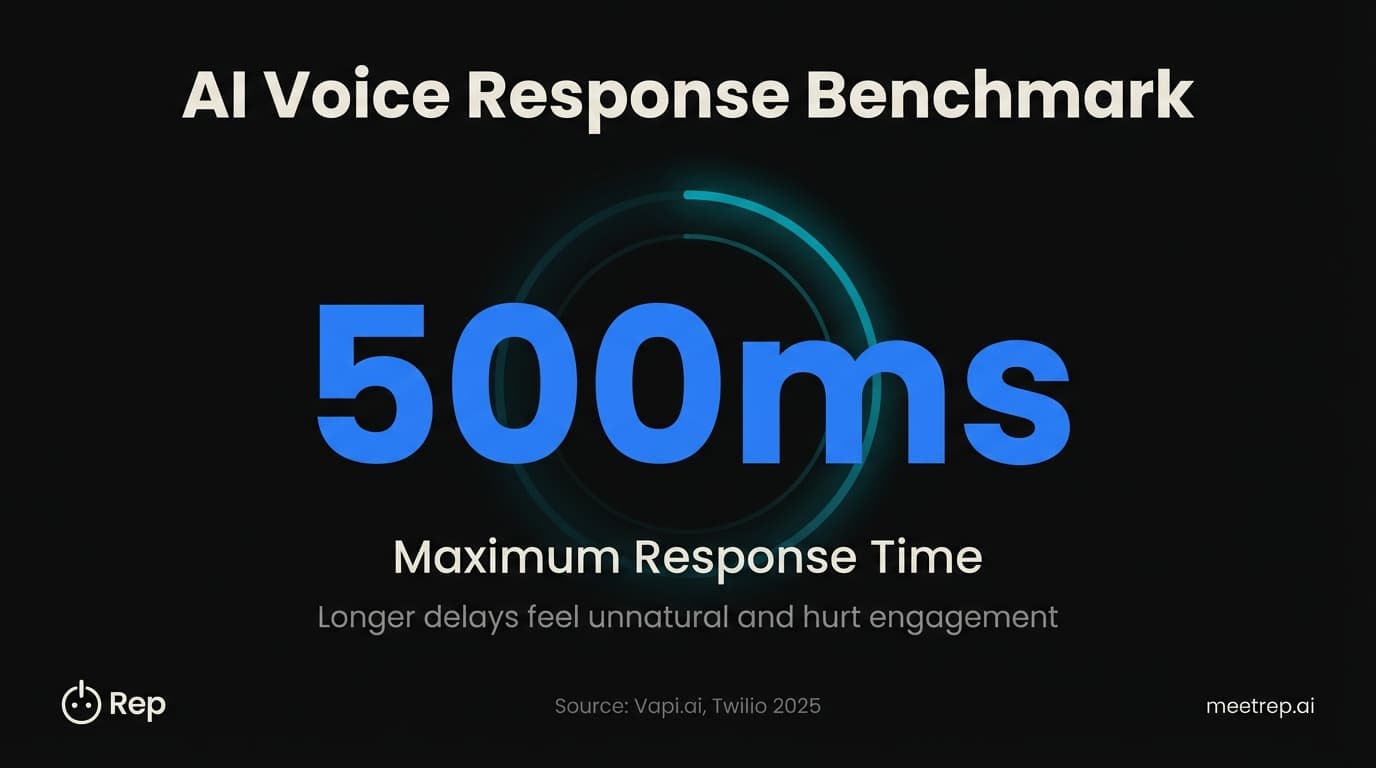
According to Vapi.ai and Twilio's 2025 benchmarks, the magic number is 500 milliseconds. If your AI voice agent takes longer than 500ms to respond after a user stops talking, the conversation feels unnatural. Users notice. Engagement drops.
What does this mean for scripts? Short chunks. No monologues.
Conversational Script Structure:
Agent: "Would you like to see how we handle [Feature A] or
[Feature B]?"
[BARGE-IN POINT - User can interrupt here]

User: "[Feature A]"

Agent: "Good choice. [Feature A] solves [specific pain].
Let me show you."
[500ms pause for processing]
[SCREEN: Navigate to Feature A]
"You'll see three things here..."
[BARGE-IN POINT]
Notice the differences:
- Agent responses under 15 seconds (users get impatient)
- Explicit barge-in points where interruption is expected
- Questions that guide rather than monologues that lecture
- Fallback responses for "I don't understand" scenarios
This isn't a script in the traditional sense. It's conversational design. And it's why companies using interactive and AI-driven demos are seeing those 24%+ conversion rates.
Voice over vs. silent videos: What the data shows
Should you even use voice over? Or just text overlays?
The data says: use voice over, but prepare for sound-off.
Wistia's research (via Motion Array) found that videos with voiceovers have a 73% engagement rate compared to 62% for videos without. That's an 11-point lift.
But here's the catch: according to Facebook Business data from 2024, 85% of mobile videos are watched without sound.
So you need both. Voice over for the 15% with sound on, captions for everyone.
Key Insight:Wistia's 2025 report found caption usage has increased 572% since 2021. This isn't optional anymore—it's expected.
| Use Case | Recommendation | Why |
|---|---|---|
| Website homepage | Voice over + captions | Trust building (visitors have sound options) |
| Social media | Captions primary, VO optional | 85% watch muted |
| In-app tutorials | Text overlays | User-controlled pacing |
| Sales presentations | Live narration or quality AI | Personal connection needed |
| Interactive demos | Conversational AI | Real-time response required |
AI voice tools vs. human talent: Making the call
The question everyone asks: can I use AI voice instead of hiring talent?
My honest answer: it depends on what you're making.
According to Wyzowl's December 2025 data, 63% of video marketers now use AI tools—up from 18% in 2024. The adoption is real.
But quality matters. Retention Rabbit's 2025 YouTube research found 35% higher viewer drop-off in the first 45 seconds when AI narration sounds monotonous.
Decision Matrix:
| Scenario | Recommendation | Reasoning |
|---|---|---|
| Homepage hero video | Human professional | Trust matters—89% say quality impacts brand trust |
| 10+ feature tutorials | High-quality AI (ElevenLabs, Resemble) | Scale + iteration speed |
| Personalized outreach | Hybrid (AI with human review) | Speed + personalization |
| Investor pitch | Human professional | High stakes, emotional nuance |
| Multi-language | AI primary | Cost-prohibitive for human in 20+ languages |
| Interactive AI demos | Conversational AI | Real-time response required |
Cost Reality:
Human professional voice over runs $200-500 per script for 30-60 seconds. Full production? $1,500-7,000 per minute according to Advids' 2025 survey.
AI subscriptions? $99-330/month for unlimited generations with tools like ElevenLabs.
That's 90%+ cost savings. But only if the quality threshold is met.
How to format scripts for natural delivery
The biggest script killer? Writing for the eye instead of the ear.
What sounds robotic:
- Bullet point lists read aloud (they're choppy)
- Sentences over 20 words (speakers run out of breath)
- Passive voice ("The feature can be accessed..." sounds dead)
- Technical jargon without explanation
What sounds natural:
- Contractions ("you'll" not "you will")
- Short sentences mixed with longer ones
- Active voice ("You can access the feature...")
- Conversational markers ("So," "Now," "Here's the thing")
Timing Guide:
| Video Length | Word Count | Best For |
|---|---|---|
| 15 seconds | 30-40 words | Social ads |
| 30 seconds | 60-75 words | TV commercial format |
| 60 seconds | 120-150 words | Product teaser |
| 2-3 minutes | 240-450 words | Micro-demo (sweet spot) |
| 5 minutes | 600-750 words | Feature deep-dive |
| 10 minutes | 1,200-1,500 words | Full tutorial |
Pace: 120-150 words per minute for natural delivery. Faster than 150 and it feels rushed. Slower than 120 and it drags.
Pronunciation Formatting:
Always write out how numbers and technical terms should be read:
- "2025" → "twenty twenty-five"
- "21%" → "twenty-one percent"
- "API" → "A-P-I" or "Application Programming Interface" (first mention)
- "Rep" → "Rep" (not "R-E-P")
This matters even more for AI voice tools, which can mispronounce anything ambiguous.
Real results: Companies getting this right
Theory is nice. Results are better.
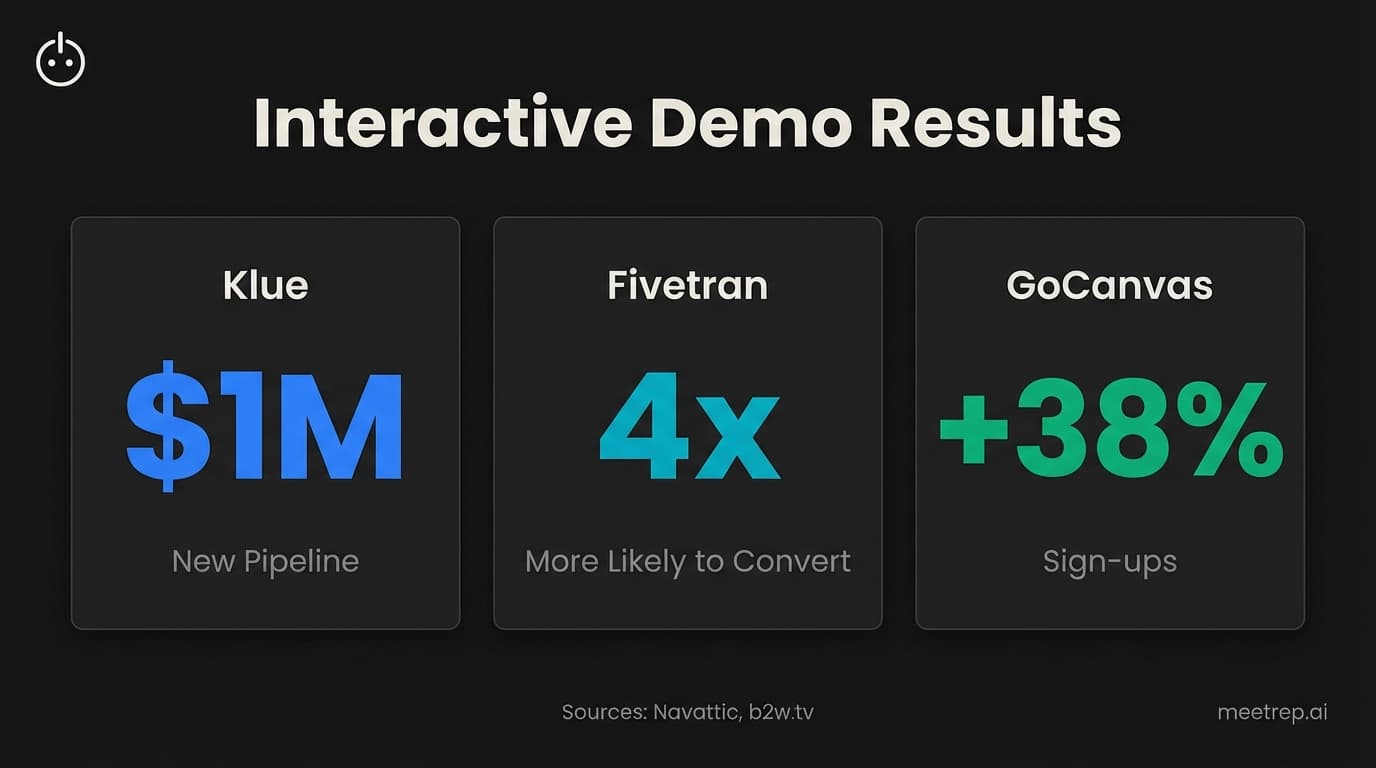
Klue (Competitive Intelligence)
- Built a "Demo Arena" with 14 specific product tours
- Result: $1M in new pipeline, $100k closed-won directly attributed to interactive demos
- Why it worked: Multiple targeted demos instead of one generic walkthrough
Fivetran (Data Integration)
- Created an interactive demo center as primary discovery
- Result: Visitors 4x more likely to convert
- Why it worked: Self-service demos qualified leads before sales involvement
Lattice (HR Tech)
- Built "Choose Your Own Adventure" demos for different personas (Manager vs. HR Admin)
- Result: Higher engagement through role-based experiences
- Why it worked: Personalization—prospects saw content relevant to THEIR job
GoCanvas (Construction Tech)
- Created product demo video with storytelling and animation
- Result: 38% rise in sign-ups, 44% increase in demo requests
- Why it worked: Industry-specific narrative that resonated with construction buyers
The pattern? Specificity beats generic. Interactive beats passive. Personalization beats one-size-fits-all.
The script isn't the hard part anymore. The format is.
If you're still writing linear scripts for passive video playback, you're missing the 8x conversion lift that interactive and conversational formats deliver. The companies seeing 24%+ conversion rates aren't using better words—they're using better formats.
At Rep, we built an AI agent that gives live product demos because we saw this shift coming. Prospects don't want to watch. They want to explore, ask questions, and get answers in real-time.
Whatever format you choose, start with the templates above. Test. Measure. And don't be afraid to throw out the script when conversation works better.

Nadeem Azam
Founder
Software engineer & architect with 10+ years experience. Previously founded GoCustomer.ai.
Nadeem Azam is the Founder of Rep (meetrep.ai), building AI agents that give live product demos 24/7 for B2B sales teams. He writes about AI, sales automation, and the future of product demos.
Frequently Asked Questions
Table of Contents
- What is a voice over script (and why it's changed)
- The anatomy of demo voice over scripts that convert
- Voice over script templates by demo type
- Writing for AI voice agents (The 2026 standard)
- Voice over vs. silent videos: What the data shows
- AI voice tools vs. human talent: Making the call
- How to format scripts for natural delivery
- Real results: Companies getting this right
Ready to automate your demos?
Join the Rep Council and be among the first to experience AI-powered demos.
Get Early AccessRelated Articles
Hexus Acquired by Harvey AI: Congrats & What It Means for Demo Automation Teams
Hexus is shutting down following its acquisition by Harvey AI. Learn how to manage your migration and discover the best demo automation alternatives before April 2026.
Why the "Software Demo" is Broken—and Why AI Agents Are the Future
The traditional software demo is dead. Discover why 94% of B2B buyers rank vendors before calling sales and how AI agents are replacing manual demos to scale revenue.
Why Autonomous Sales Software is the Future of B2B Sales (And Why the Old Playbook is Dead)
B2B sales is at a breaking point with quota attainment at 46%. Discover why autonomous 'Agentic AI' is the new standard for driving revenue and meeting the demand for rep-free buying.