The Ultimate Voice Acting Scripts (Copy-Paste): For Humans and AI

Executive Summary
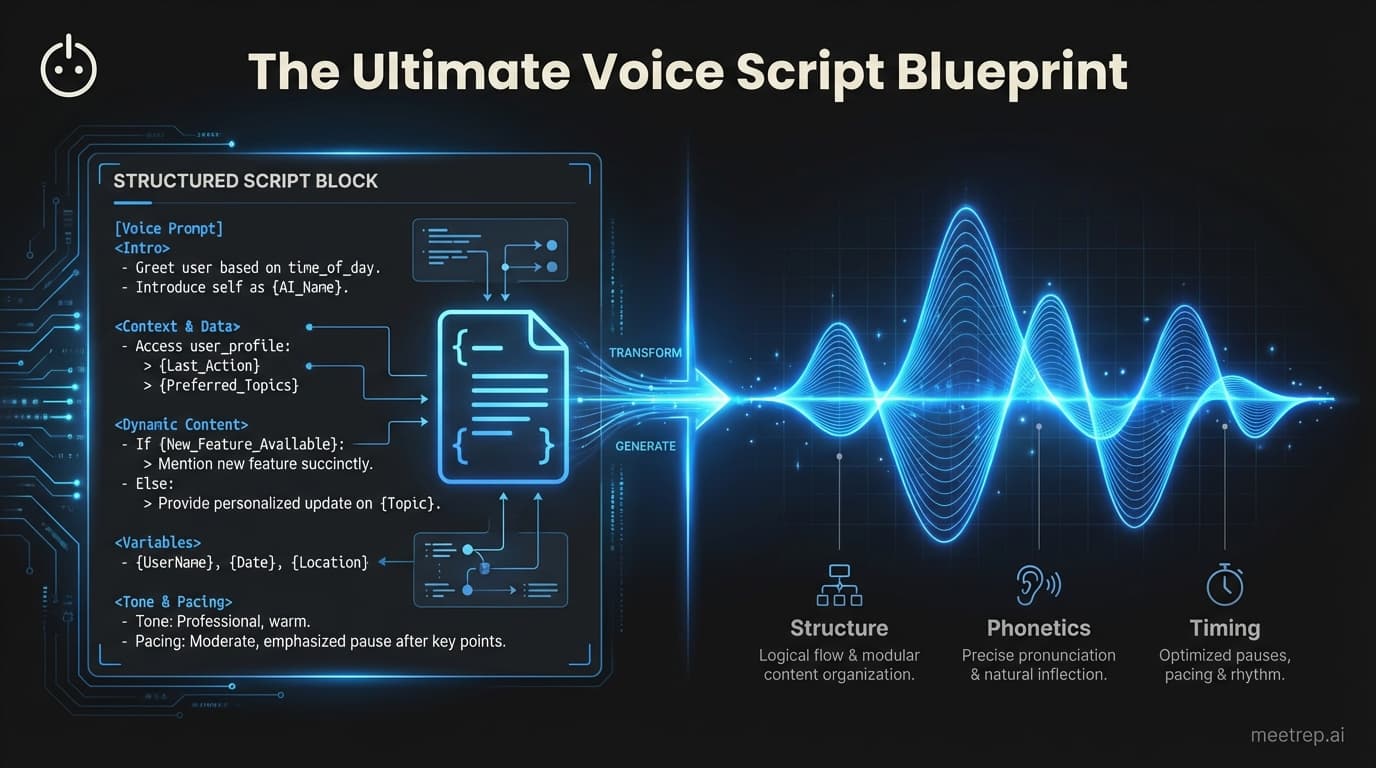
- Format matters: Scripts for AI need specific formatting (SSML) to sound human.
- Short is better: Keep sentences under 15 words to improve TTS flow.
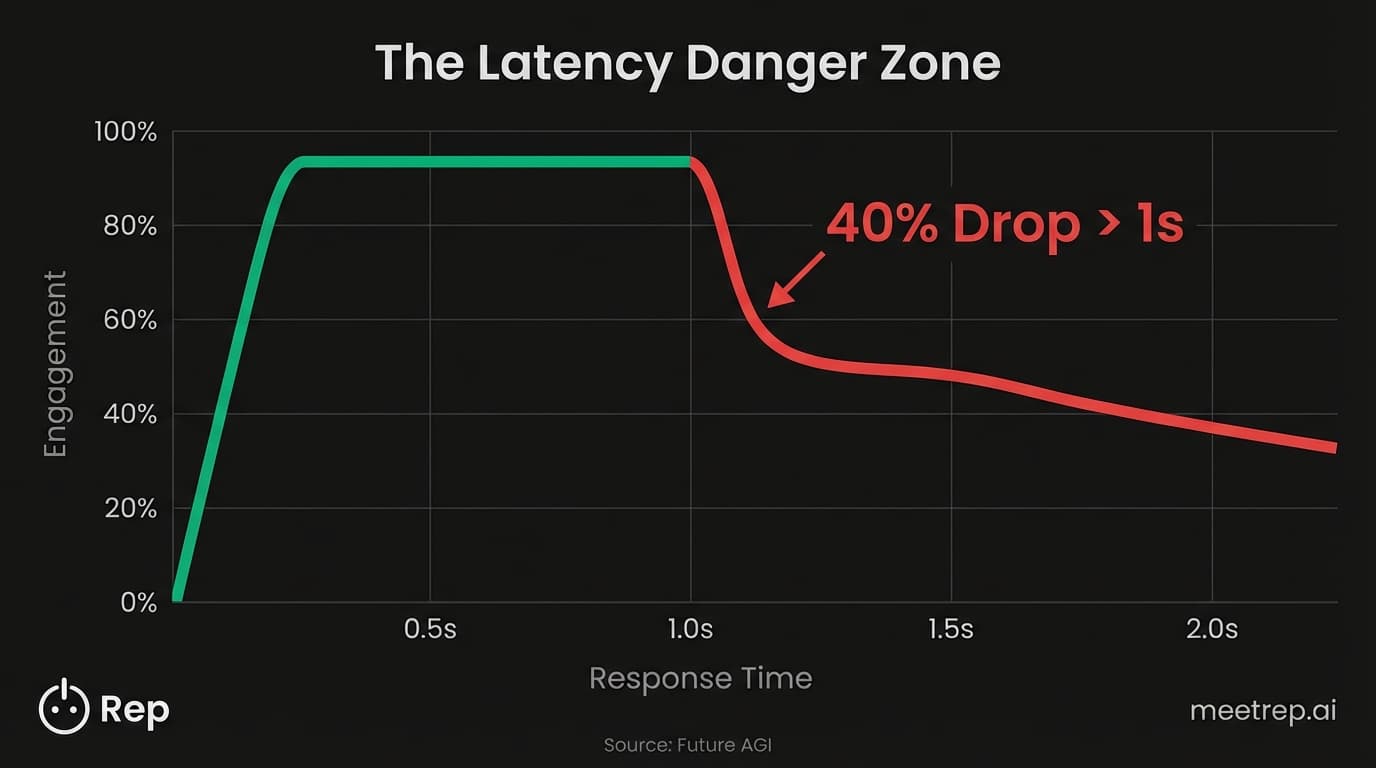
- Latency kills: Delays >1s cause a 40% drop in engagement.
- The outcome: Proper scripts + AI agents can drive 4x higher conversion rates.
Your script is only as good as the delivery. But in 2026? That delivery might not be human.
We know that 89% of businesses use video as a marketing tool, according to Wyzowl's 2025 State of Video Marketing. That is table stakes. The problem isn't deciding to do video or voice marketing; it's the execution bottleneck.
Hiring talent, booking studios, and re-recording for every minor script change is slow. And expensive.
At Rep, we see marketing teams trying to solve this with AI, but they make a fundamental mistake: they feed "read-only" copy to a voice engine and wonder why it sounds robotic.
I've spent the last few years architecting autonomous voice agents. I can tell you that the difference between a conversion and a bounce often isn't the AI's voice quality—it's the script structure.
Whether you're hiring a human actor or deploying an AI agent like Rep, you need scripts designed for the ear. Here are the copy-paste templates we use to drive engagement, along with the technical tweaks needed to make them sound real.
Why "Copy-Paste" Scripts Are Your Secret Weapon
A voice acting script is the blueprint for spoken content, guiding tone, pacing, and emotion to ensure the message lands with the listener. Unlike written copy, it prioritizes rhythm, breath patterns, and time constraints over grammatical perfection.
Why use templates? Consistency and scale.
When we built Rep, we realized that the best AI agent isn't just "smart"—it's disciplined. It follows a proven framework. If you're building a library of explainer videos or setting up an autonomous demo, you cannot reinvent the wheel every time. You need a modular structure that allows you to swap out value propositions without breaking the narrative flow.
Using a standardized script structure allows you to:
- Test variables: If you change the hook but keep the offer, you know exactly what impacted conversion.
- Scale production: Feed these structures into your AI agent to generate thousands of personalized variations instantly.
- Eliminate "Uhms": Tight scripts prevent the wandering monologues that kill sales deals.
The Commercial Script (30-Second Spot)
For a 30-second commercial, you have exactly enough time for about 60-75 words. Any more, and it sounds rushed. Any less, and it drags.
The structure here is rigid: Hook → Problem → Solution → CTA.
Here is a template tuned for high-energy delivery. Note the word counts—I've kept them tight so the speaker doesn't have to race against the clock.
| Time | Section | Script Template (Copy-Paste) |
|---|---|---|
| 0-5s | The Hook | "Still wasting time on [Specific Pain Point]? It doesn't have to be this hard." |
| 6-10s | The Problem | "Teams waste [Number] hours a week on [Task]. It's time you'll never get back." |
| 11-20s | The Solution | "Enter [Product Name]. We help you [Benefit 1] and [Benefit 2] automatically. No setup. No stress." |
| 21-30s | The CTA | "Stop the manual work. Start your free trial today at [Website]. That's [Website]." |
Key Insight: Notice the repetition of the website at the end? In audio, you can't click. You have to hear it twice to remember it.
If using an AI agent: Use short, punchy sentences. AI breath control has improved massively, but long, winding clauses can still cause intonation issues.
The Explainer Video Script (Educational)
Explainer videos are where trust is built. According to Wyzowl, 96% of people watch explainer videos to learn about a product.
The goal here isn't hard sales. It's clarity. The "Meet Bob" framework is a classic for a reason—it builds empathy by showing a character the audience relates to.
Target Length: 60-90 seconds (130-150 words).
| Section | Purpose | Script Template (Copy-Paste) |
|---|---|---|
| The Character | Relatability | "This is [Name]. [Name] is a [Job Title] who loves [Positive Aspect] but hates [Negative Aspect]." |
| The Conflict | Agitation | "Every day, [Name] struggles with [Specific Problem]. It's messy, expensive, and frankly, exhausting." |
| The Pivot | Introduction | "Then, [Name] found [Product Name]. It's the only tool designed to fix [Problem] by [Unique Mechanism]." |
| The Demo | Evidence | "With just one click, [Name] can now [Action]. See how [Feature A] connects to [Feature B]? Simple." |
| The Result | Resolution | "Now, [Name] saves [Number] hours a week. And [He/She] is finally back to doing what matters." |
| CTA | Next Step | "Be like [Name]. See how it works at [Website]." |
What we learned at GoCustomer: Don't overcomplicate the "Mechanism" section. Focus on the outcome (saving time), not the specs (API architecture). The viewer doesn't care how the sausage is made; they care that it tastes good.
The Interactive Sales Demo Script (Rep Special)
This is where things get interesting. A commercial is a monologue. A demo is a conversation.
If you are using Rep to handle your inbound demo requests, the script changes. It needs to account for the prospect's input. Rep isn't just reading text; it's navigating your product live, clicking buttons, and reacting to questions.
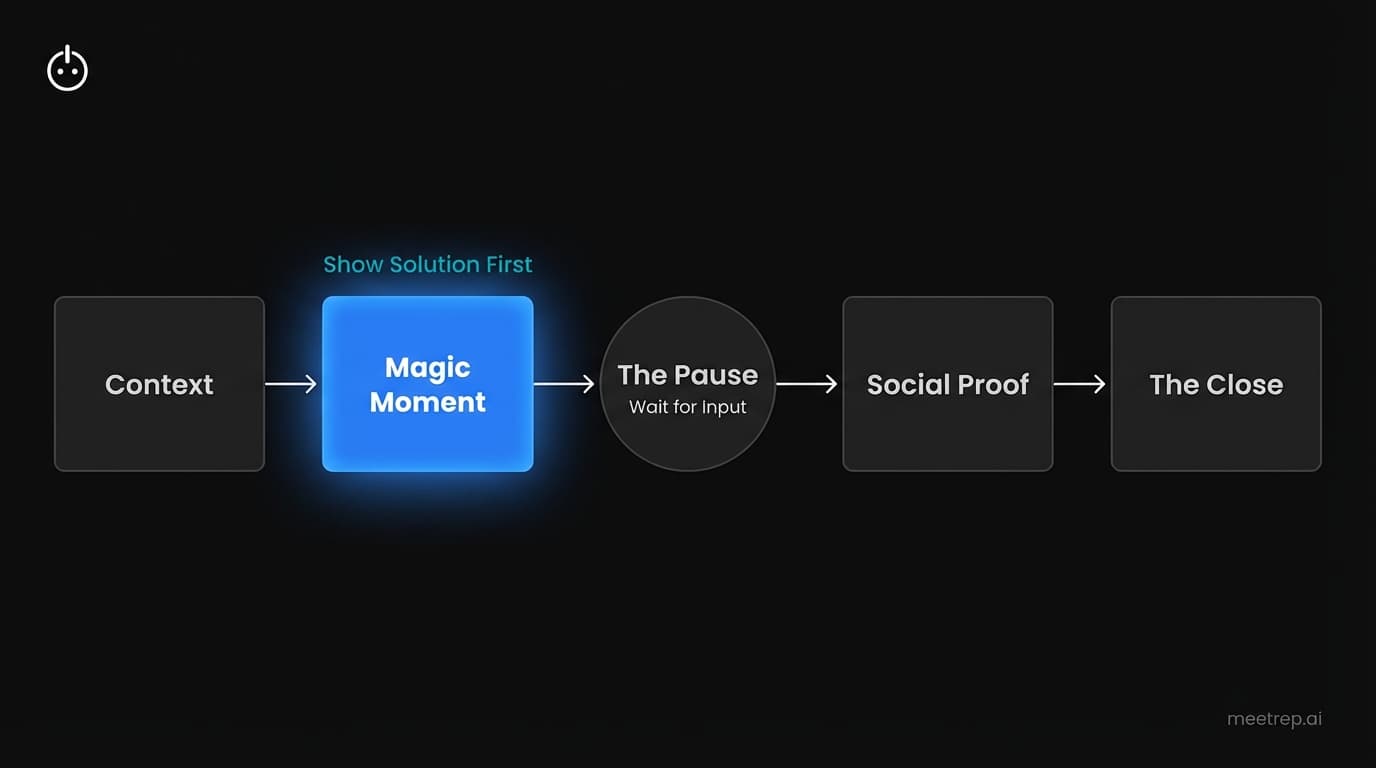
Here is the "Upside-Down" demo script we use. It flips the traditional model—instead of saving the best feature for last, we show the solution immediately to hook attention.
The "Upside-Down" Framework:
1. The Context (15 seconds) "Thanks for joining. Based on what you told us, you're looking to solve [Pain Point]. Is that right? Great. I'm going to show you exactly how we fix that first."
2. The 'Magic Moment' (Screen Share Active) "I've shared my screen. Can you see the dashboard? Perfect. Look at this chart here. This shows [Result]. To get this, all you have to do is click here..." (Action: Rep navigates browser to feature)
3. The Pause (Critical for AI) "Pretty cool, right? Before I show you the reporting features, do you have any questions about this workflow?" (Logic: Wait for input. If silence > 3 seconds, proceed).
4. The Social Proof "We actually helped [Competitor/Peer Company] set this up last month, and they saw a [Stat]% increase in efficiency."
5. The Close "I can set you up with a sandbox account right now to try this yourself. Should I go ahead and email you the credentials?"
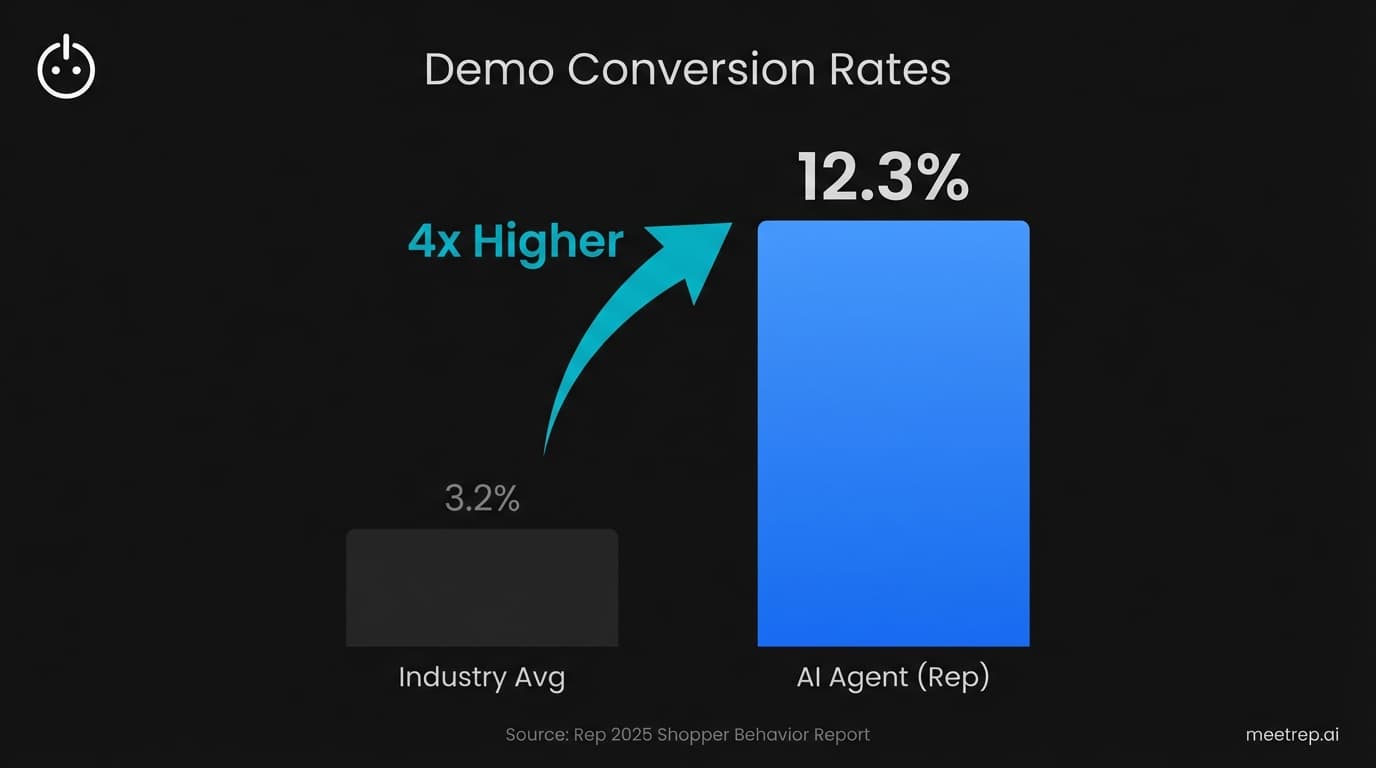
The Data: Interactive, AI-guided conversations convert better. According to our 2025 Shopper Behavior Report, AI chat agents achieve a 12.3% conversion rate, which is nearly 4x the industry average.
Writing for AI: How to Avoid the "Robotic" Voice
You have your script. Now, how do you make it sound human?
This is the part I actually get excited about. When we architected Rep, we spent months obsessing over latency and prosody.
Here is the brutal truth: Latency kills deals. According to data from Future AGI, contact centers report that customers hang up 40% more often when voice agents take longer than 1 second to respond.
To make your script work for an AI agent, you need to "mark it up" for the ear. We use SSML (Speech Synthesis Markup Language) principles to guide the AI.
3 Technical Rules for AI Scripts:
1. Use Phonetics for Acronyms Don't write "SaaS." The AI might say "sass."
- Write: "S-A-A-S" or "Sass."
- Write: "Re-sum-ay" (for Resume).
2. Control the Pace with Breaks AI doesn't need to breathe, but listeners do. If you don't add pauses, the information becomes a wall of noise.
- Code:
This is crucial. <break time="0.5s"/> Here is why. - Result: A dramatic pause that lets the point sink in.
3. Use Contractions Formal writing kills conversational flow.
- Bad: "We do not believe that is true."
- Good: "We don't believe that's true."
Why we built Rep this way: We engineered Rep to handle these nuances automatically, but we also allow for "system instructions" where you can define the persona (e.g., "Friendly Expert"). This tells the model how to speak, not just what to say.
Automating the Delivery with Rep
You have the script. You know the structure. Now you have a choice.
You can hire human actors, book studio time, and wait three days for the audio file. Or, you can hire 50 SDRs to memorize this script and hope they stick to it on every call.
Or you can use Rep.
Rep isn't a chatbot. It's an autonomous sales agent that joins video calls, speaks with a human voice, and actually uses your product. It takes the "Sales Demo Script" above and executes it 24/7.
Why this matters for your funnel:
- Consistency: Rep never has a bad day. The pitch is perfect every time.
- Scale: You can run 100 concurrent demos at 2:00 AM.
- Results: Look at Satya Jewelry. By using Rep to guide high-intent visitors, they increased their Average Order Value (AOV) by 37% Source: Rep Case Study.
And for those worried that AI won't build trust? Retail Rewired reports that 27% of consumers now trust AI recommendations—surpassing trust in influencers (24%). The tide has turned.
Conclusion
A script is software. The voice—whether human or AI—is the hardware. You need both to be compatible to get the result.
My take? The era of manually recording every single explainer video or commercial variation is ending. It's too slow. The winners in 2026 will be the teams that write great "source code" (scripts) and use autonomous agents to execute it at scale.
Don't let your best scripts gather dust because you can't book studio time. Put them to work.
See your script in action. Book a demo with Rep and watch an AI agent deliver a perfect pitch in real-time.

Nadeem Azam
Founder
Software engineer & architect with 10+ years experience. Previously founded GoCustomer.ai.
Nadeem Azam is the Founder of Rep (meetrep.ai), building AI agents that give live product demos 24/7 for B2B sales teams. He writes about AI, sales automation, and the future of product demos.
Frequently Asked Questions
Table of Contents
- Why "Copy-Paste" Scripts Are Your Secret Weapon
- The Commercial Script (30-Second Spot)
- The Explainer Video Script (Educational)
- The Interactive Sales Demo Script (Rep Special)
- Writing for AI: How to Avoid the "Robotic" Voice
- Automating the Delivery with Rep
- Conclusion
Ready to automate your demos?
Join the Rep Council and be among the first to experience AI-powered demos.
Get Early AccessRelated Articles
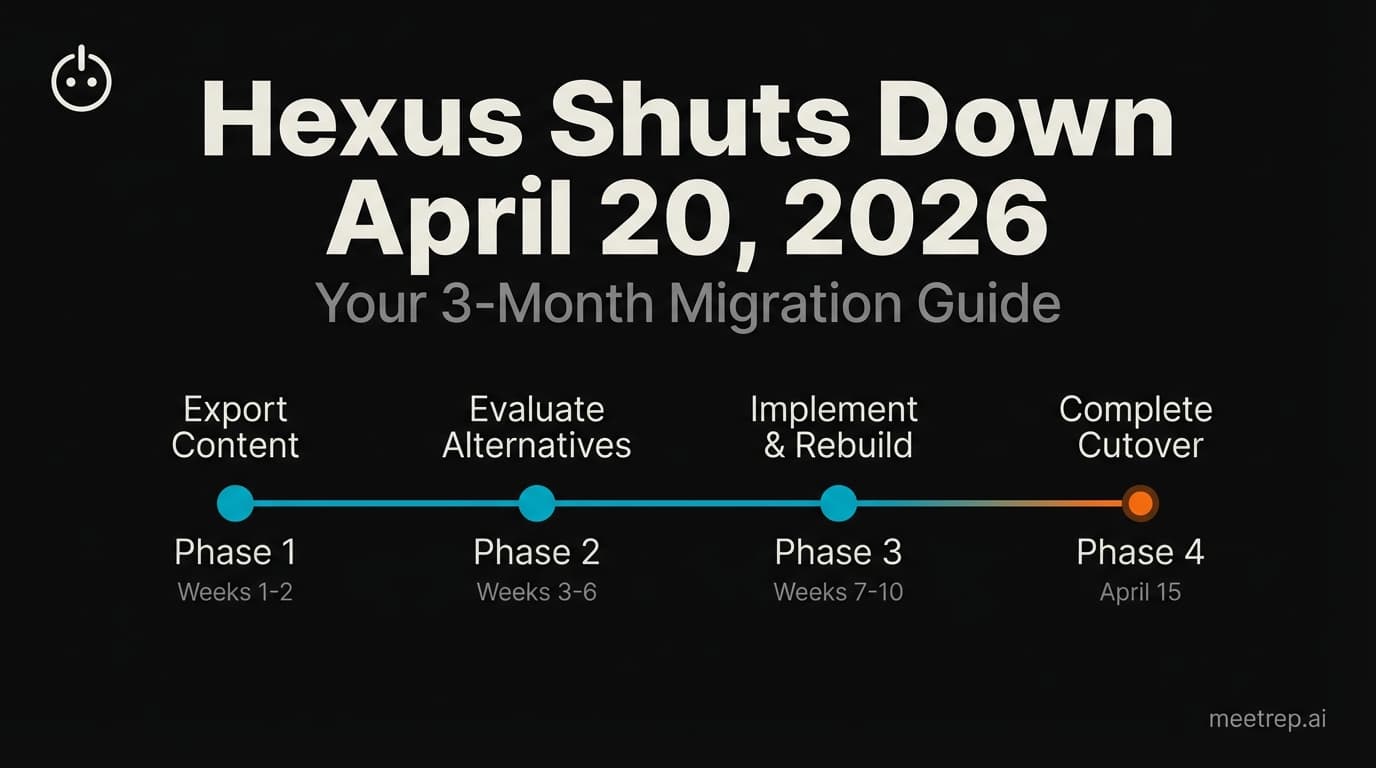
Hexus Acquired by Harvey AI: Congrats & What It Means for Demo Automation Teams
Hexus is shutting down following its acquisition by Harvey AI. Learn how to manage your migration and discover the best demo automation alternatives before April 2026.
Why the "Software Demo" is Broken—and Why AI Agents Are the Future
The traditional software demo is dead. Discover why 94% of B2B buyers rank vendors before calling sales and how AI agents are replacing manual demos to scale revenue.
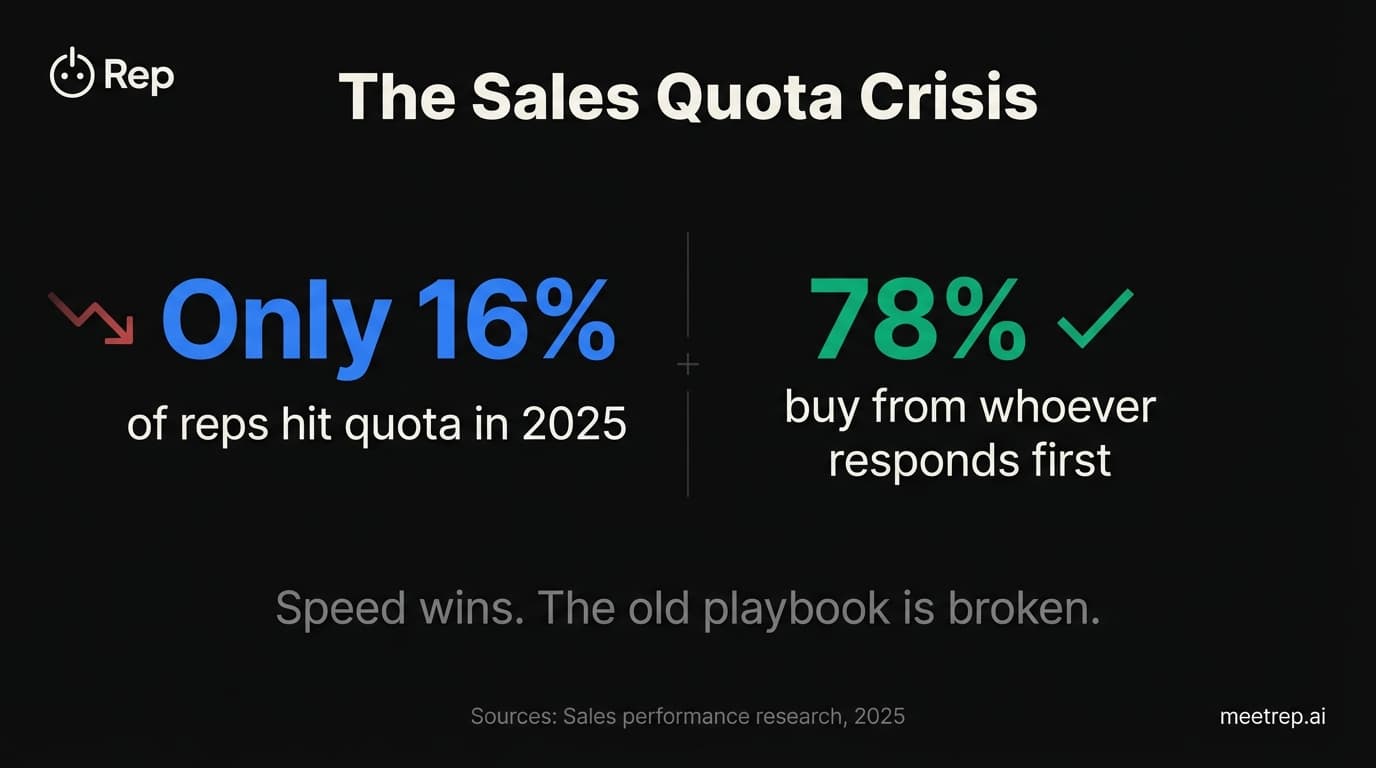
Why Autonomous Sales Software is the Future of B2B Sales (And Why the Old Playbook is Dead)
B2B sales is at a breaking point with quota attainment at 46%. Discover why autonomous 'Agentic AI' is the new standard for driving revenue and meeting the demand for rep-free buying.