The Ultimate Demonstration Script: A Copy-Paste Framework for 2025

Executive Summary
- The Problem: "Harbor Tour" demos kill deals because they focus on features, not pain.
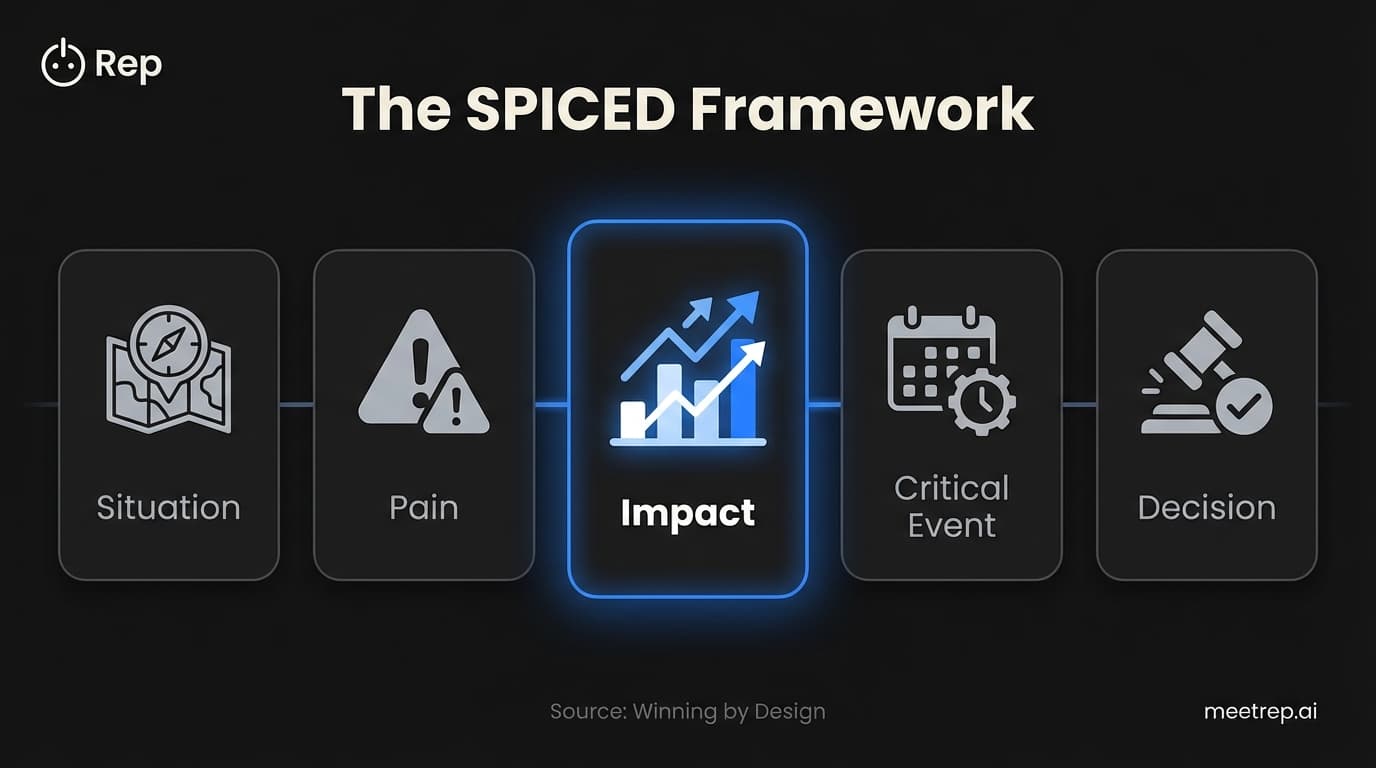
- The Fix: Use the SPICED framework (Situation, Pain, Impact, Critical Event, Decision).
- The Template: Use our copy-paste modular script below to structure every call.
- The Scale: Automate the initial demo with AI agents (like Rep) to ensure 100% script adherence.
The "Harbor Tour."
If you lead a team of Solutions Engineers (SEs), those two words probably raise your blood pressure. You know the drill: the rep opens the software, starts at the top-left tab, and clicks through every single feature for 45 minutes. They show everything. They solve nothing.
I once watched a rep lose a $50k deal because he spent 10 minutes explaining the "Settings" tab. The buyer just wanted to know if the API worked. It was painful to watch.
The result? Lost deals.
In fact, 73% of B2B buyers actively avoid suppliers who send irrelevant outreach or generic presentations.
When I was building GoCustomer.ai, and now at Rep, I learned that the problem usually isn't the product. It's the narrative. Your team doesn't need to memorize a Shakespearean monologue. They need a framework.
This article gives you exactly that: a modular demonstration script based on the industry-standard SPICED methodology. It's the same logic we use to train our AI agents.
Why Most Demo Scripts Fail (The "Harbor Tour" Trap)
A demonstration script fails when it becomes a feature checklist rather than a solution map.
Most teams think a script is a list of buttons to click. "First click here, then say this." That's robotic. And frankly, it's dangerous. When a rep is locked into a rigid sequence, they stop listening. They bulldoze through objections just to get to the next line in their script.
This leads to what Peter Cohan calls the "Harbor Tour"—a long, tortured slog through every corner of the product.
The data shows why this is fatal.
According to Gartner's 2025 Sales Survey, 61% of B2B buyers now prefer an overall rep-free buying experience.
Why? Because they are tired of bad scripts. They don't want to be talked at. They want to find answers. If your script doesn't address their specific pain within the first few minutes, they tune out. Or worse, they ghost you.
Key Insight: A great script isn't about what you say. It's about what you don't show. The goal is to disqualify features that don't matter to this specific buyer.
The Core Framework: SPICED
Before you write a single word of dialogue, you need a structure.
At Rep, we don't just "ingest" manuals. We organize knowledge. The best structure we've found—and the one widely accepted by top revenue teams—is SPICED (popularized by Winning by Design).
Here is how it breaks down:
- Situation: Facts about the customer's world (tools, team size).
- Pain: The problem they are trying to solve.
- Impact: The result of solving that pain (revenue, time, risk).
- Critical Event: The deadline driving the purchase.
- Decision: The process and people involved.
Why use this for a demonstration script? Because it forces the demo to anchor on Impact.
Instead of saying, "Here is our reporting dashboard," a SPICED-based script says, "Since you mentioned you spend 4 hours on manual exports (Pain), here is how this dashboard automates that (Solution), saving you $20k a year (Impact)."
See the difference?
The Ultimate Demonstration Script (Template)
Here is the modular framework. Do not force your reps to memorize this word-for-word. Ask them to memorize the flow.
Part 1: The Re-Confirmation (0-5 Minutes)
Never start the demo without confirming the discovery.
"Thanks for jumping on. Based on our last conversation (or your notes), I understand you're currently using [Current Tool] but struggling with [Specific Pain Point].
That’s causing [Negative Impact/Cost]. Is that still accurate? And is there anything else you want to make sure we cover today?"
Why this works: It proves you listened. It also gives the prospect a chance to pivot the agenda. If they say, "Actually, we just fired our VP of Sales," you better change your script.
Part 2: The "Tell-Show-Tell" Loop (The Meat)
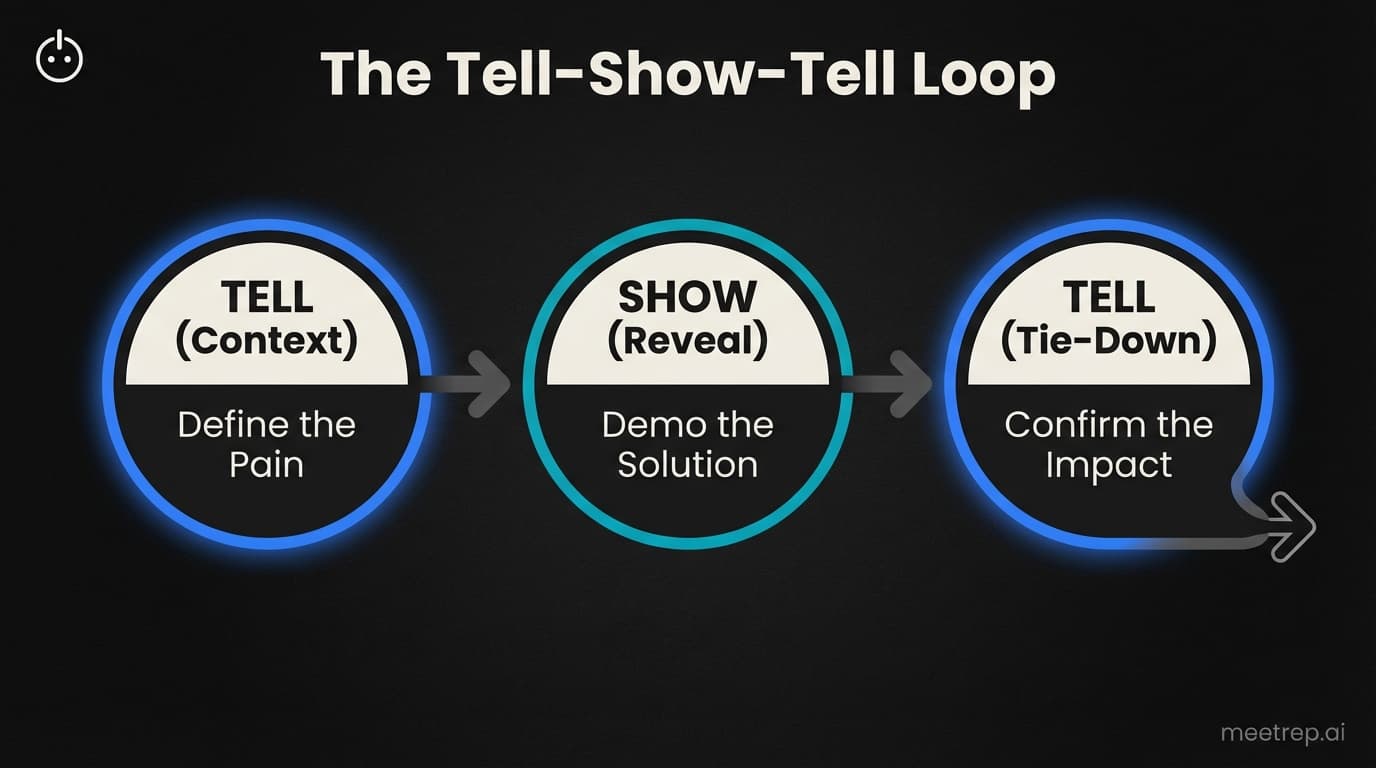
Repeat this loop for each major pain point. Do not show more than 3 flows.
Step A: Context (Tell)
"You mentioned that [Problem X] is costing your team [Y Hours/Dollars]. I want to show you exactly how we fix that."
Step B: The Reveal (Show)Navigate to the screen.
"Watch this. Instead of clicking X, Y, and Z, you just click here. Notice how the data populates automatically?"
Step C: The Tie-Down (Tell/Ask)
"This typically saves teams about 10 hours a week. How does that compare to how you’re doing it today?"
Part 3: The Check-In (Engagement)
Use this every 3-5 minutes. Silence is your enemy.
"I want to pause there for a second. Does this align with what you were picturing?"
OR
"On a scale of 1 to 10, how well does this solve [Pain Point X]?"
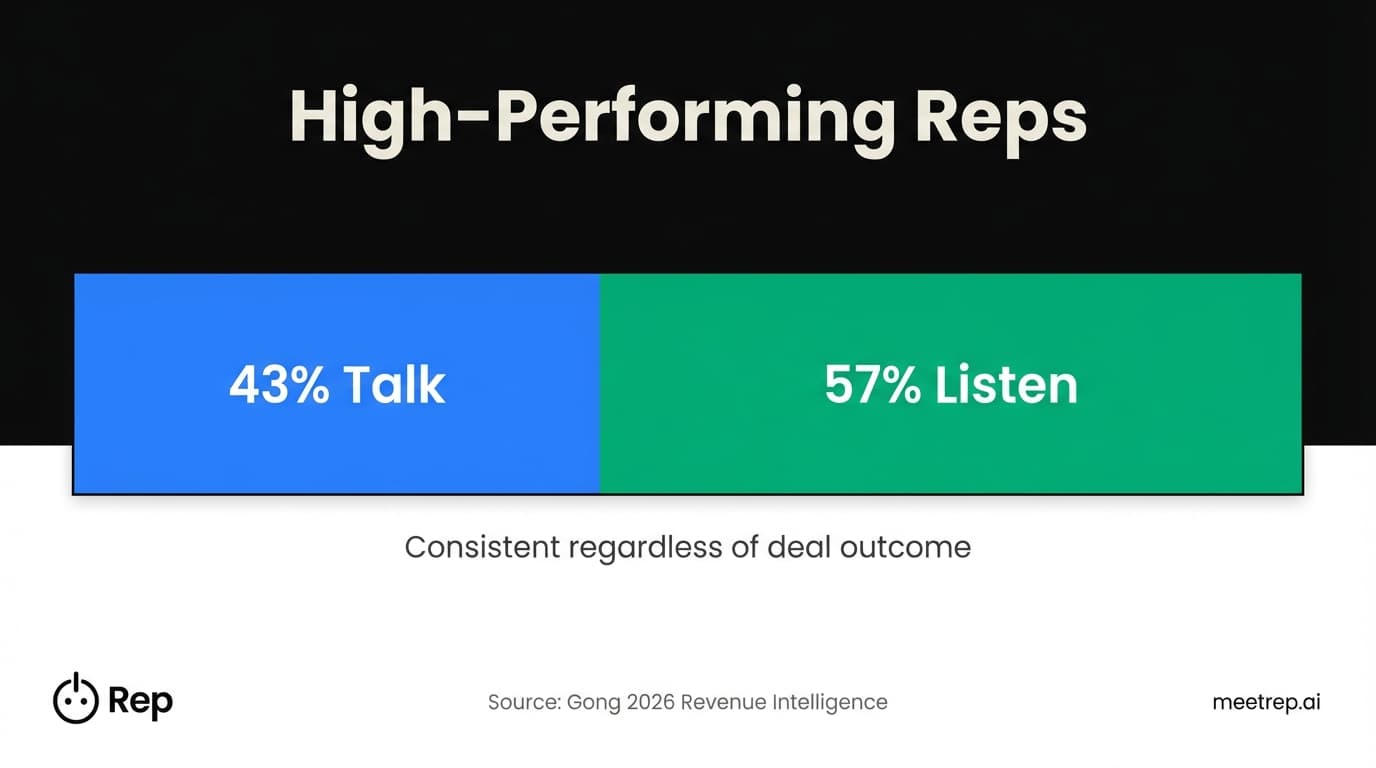
The Data: Consistency is key. According to Gong’s 2026 analysis, high-performing sellers maintain a consistent talk-to-listen ratio of 43:57, regardless of the deal outcome. Low performers swing wildly by 10% or more. A script helps you hit that golden ratio.
Part 4: The Close (Next Steps)
Do not end with "Any questions?" End with a decision.
"Based on what we've seen, it looks like this solves [Pain A] and [Pain B].
You mentioned you need this live by [Critical Event Date]. To hit that, we would need to start the trial by next Tuesday. Does that timeline still work for you?"
Scripted vs. Unscripted: The Trade-offs
Is a script always the right answer? Not always. But for scaling teams, the math is simple.
| Feature | Scripted (Framework-Based) | Unscripted (Improvised) |
|---|---|---|
| Consistency | High. Outcomes are predictable. | Low. Depends on the rep's mood/caffeine. |
| Ramp Time | Fast. Juniors have a map. | Slow. Juniors must "figure it out." |
| Adaptability | Medium. Requires a modular script. | High. Great for expert founders. |
| Win Rate | Stable across the team. | High variance (Stars vs. Laggards). |
| AI Readiness | High. Can be taught to AI agents. | Zero. Cannot be automated. |
Adapting the Script for AI Agents (The Rep Advantage)
Here is the reality of 2025: Your SEs are burning out.
Gong's State of Revenue AI 2026 reports that sales rep quota attainment dropped to 46% in 2025. Your team is working harder, doing more demos, and closing less.
Why? Because they are wasting time on unqualified "intro demos."
This is where AI comes in. We built Rep to handle the "Standard Demo" using the exact script framework above. But unlike a human, an AI agent doesn't get tired. It doesn't forget to ask the "Impact" question. It doesn't skip the "Tie-Down."
Why we built Rep this way: At Rep, we didn't just build a chatbot. We built an autonomous agent that navigates your browser. You don't write a text script for Rep; you build a Playbook. You show Rep: "When the user asks about [Pain X], go to [URL Y] and say [Script Z]."
This allows you to offload the repetitive, top-of-funnel demos to AI. The AI executes the script with 100% fidelity. If the prospect qualifies, they get passed to your senior SEs for the complex, bespoke workshop.
The results are real. Klarna recently reported that their AI assistant handled 2.3 million conversations—doing the work of 700 full-time agents—while reducing resolution time from 11 minutes to under 2 minutes.
Imagine applying that efficiency to your sales demos.
3 Rules for Script Adherence in 2026
If you implement this template today, follow these three rules to keep it human.
1. Internalize, Don't Memorize
If a rep sounds like they are reading, the deal is dead. The script is a map, not a teleprompter. Train your team on the concepts (SPICED), then let them use their own vocabulary.
2. Validate Constantly
The biggest mistake I see? Reps who talk for 15 minutes straight. My rule: You cannot go more than 3 minutes without asking a question. Use the "Check-In" script block above. If the prospect is silent, you aren't selling; you're lecturing.
3. Automate the Intro
Don't burn your expensive SEs on the first call. Use an interactive demo platform or an AI agent to handle the script for the first touch. Sellers that frequently use AI generate 77% more revenue per rep than those who don't. The data is irrefutable.
A Script is a Floor, Not a Ceiling
A demonstration script won't turn a bad product into a unicorn. But it will stop the bleeding.
It sets a floor for performance. It ensures that every prospect, whether they talk to your senior VP or your newest SDR (or your AI agent), sees the value, not just the features.
In a world where quota attainment is sitting at 46%, you can't afford to "wing it" anymore.
Build the framework. Train the team. And for the repetitive stuff? Let AI handle the script so your people can handle the relationship.
Clone your best demo. Train Rep on your ultimate script today.

Nadeem Azam
Founder
Software engineer & architect with 10+ years experience. Previously founded GoCustomer.ai.
Nadeem Azam is the Founder of Rep (meetrep.ai), building AI agents that give live product demos 24/7 for B2B sales teams. He writes about AI, sales automation, and the future of product demos.
Frequently Asked Questions
Table of Contents
- Why Most Demo Scripts Fail (The "Harbor Tour" Trap)
- The Core Framework: SPICED
- The Ultimate Demonstration Script (Template)
- Scripted vs. Unscripted: The Trade-offs
- Adapting the Script for AI Agents (The Rep Advantage)
- 3 Rules for Script Adherence in 2026
- A Script is a Floor, Not a Ceiling
Ready to automate your demos?
Join the Rep Council and be among the first to experience AI-powered demos.
Get Early AccessRelated Articles
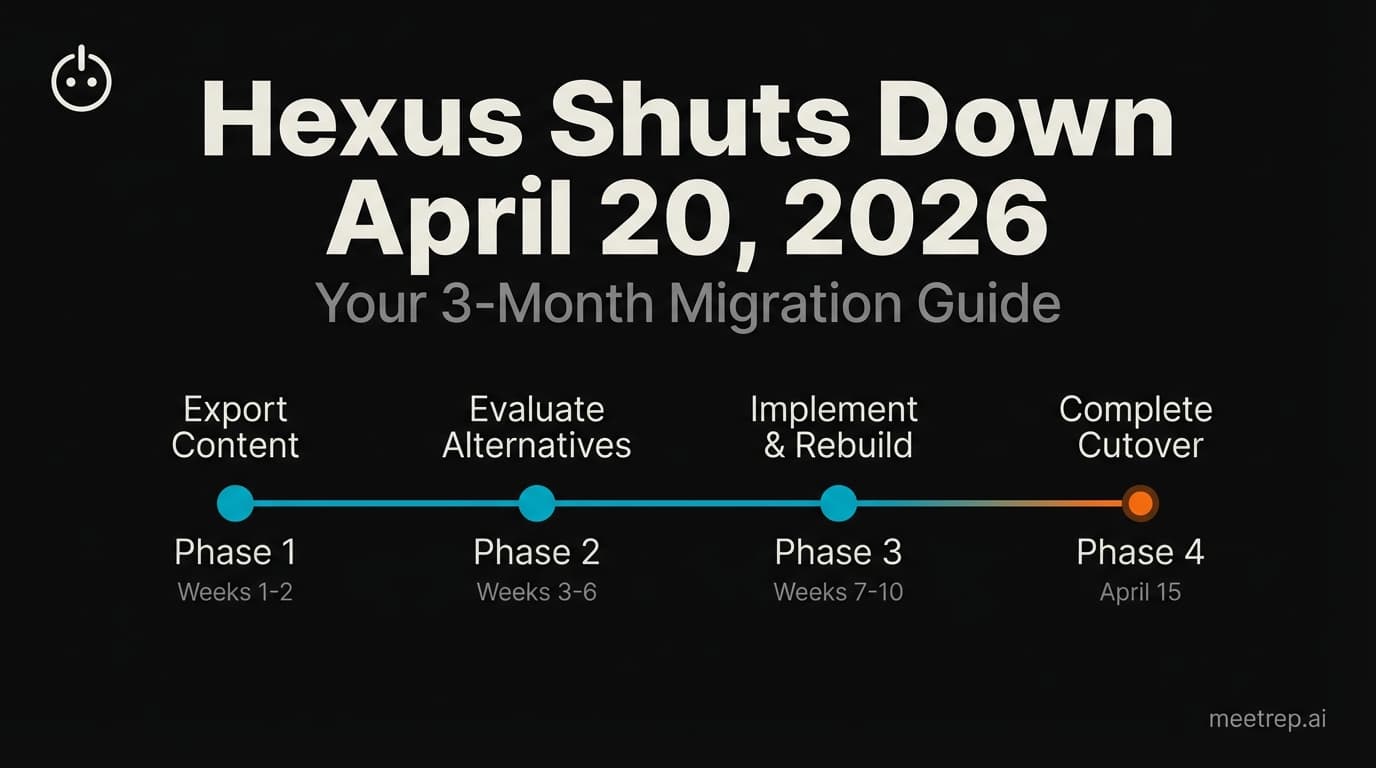
Hexus Acquired by Harvey AI: Congrats & What It Means for Demo Automation Teams
Hexus is shutting down following its acquisition by Harvey AI. Learn how to manage your migration and discover the best demo automation alternatives before April 2026.
Why the "Software Demo" is Broken—and Why AI Agents Are the Future
The traditional software demo is dead. Discover why 94% of B2B buyers rank vendors before calling sales and how AI agents are replacing manual demos to scale revenue.
Why Autonomous Sales Software is the Future of B2B Sales (And Why the Old Playbook is Dead)
B2B sales is at a breaking point with quota attainment at 46%. Discover why autonomous 'Agentic AI' is the new standard for driving revenue and meeting the demand for rep-free buying.