The Ultimate Script Voice Over Example (And Why You Need More Than Just a Script)

Executive Summary
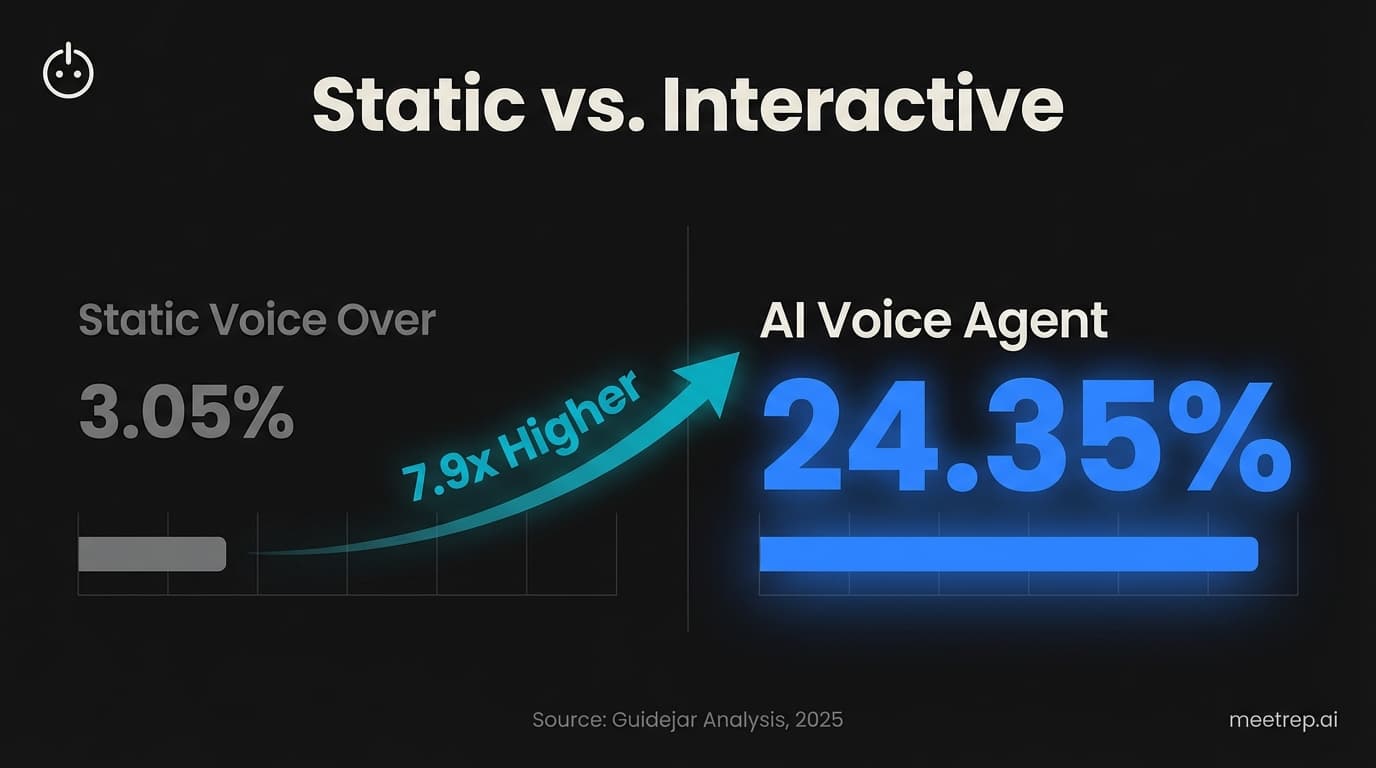
- Static is dead: Passive video scripts convert at 3.05%. Interactive demos convert at 24.35%.
- Copy-Paste: I’ve included 3 templates (PAS, Feature-Benefit, Narrative) below.
- The Shift: The market is moving from "Voice Over" (recording) to "Voice Agents" (live, autonomous navigation).
- Urgency: Gartner predicts AI agents will outnumber human sellers 10x by 2028.
You likely have a tab open right now because you have a product to launch, a feature to explain, or a sales team screaming for assets. You need a script voice over example that you can copy, paste, and record.
I get it.
But before you spend $5,000 on a voice actor or hours fighting with timeline edits, you need to know the ground has shifted under our feet.
In 2025, 89% of businesses are using video marketing (Source: SundaySky). The market is flooded with MP4 files that nobody watches until the end.
The winners in 2026 aren't writing better static scripts. They are building interactive playbooks for AI agents.
As the founder of Rep, I’ve seen companies obsess over a single word in a script for weeks, only to put the video on a landing page where it converts at 3%. Meanwhile, teams using autonomous, interactive demos are seeing conversion rates of 24.35% (Source: Guidejar).
Below, I’m giving you the exact script templates you searched for. But after that, I’m going to show you how to turn those flat words into a 24/7 autonomous sales machine.
The "Old School" Voice Over Script Templates (Copy-Paste)
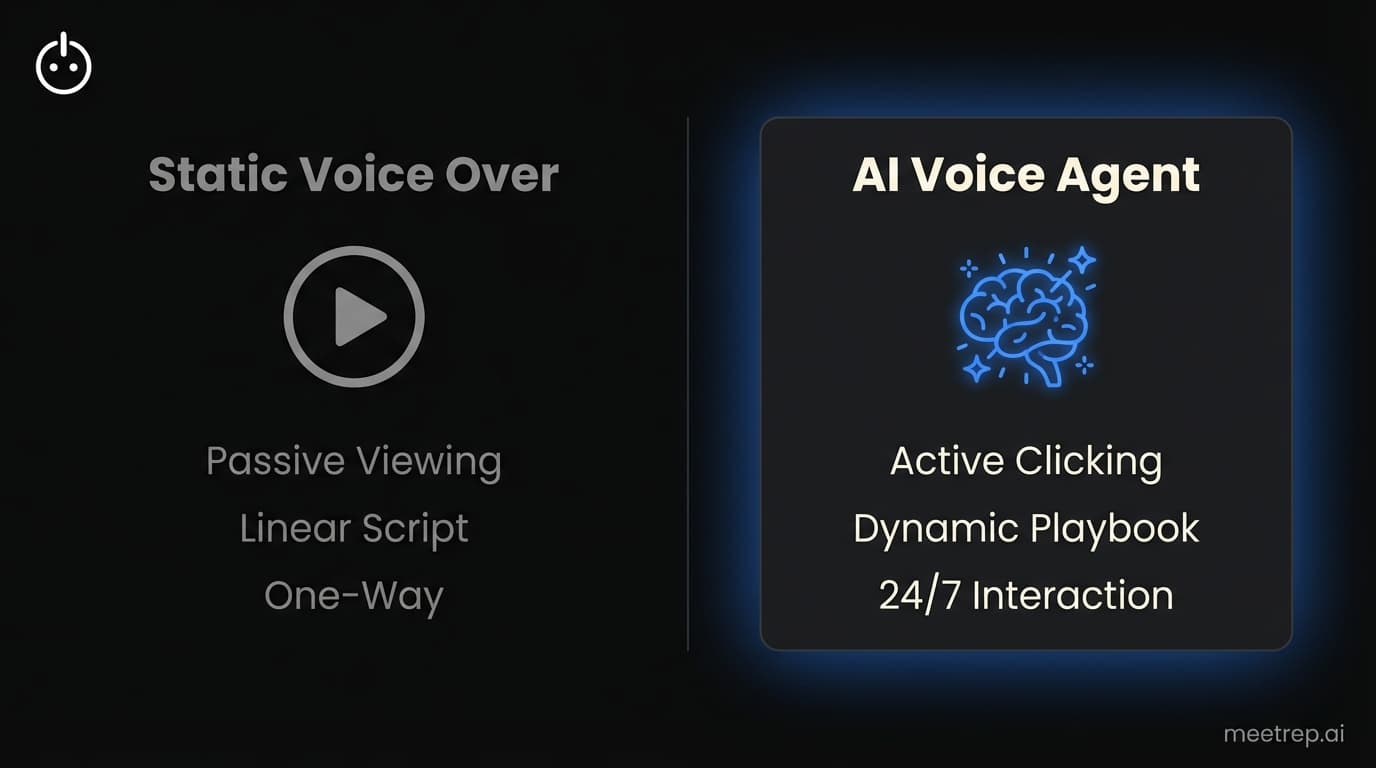
A script voice over example serves as the blueprint for your video's audio track, defining the tone, pacing, and core message. While I believe interactive agents are the future, sometimes you just need a solid script for a quick explainer video.
Here are three templates we used frequently at my previous company, GoCustomer.ai, and that we see clients adapt for Rep today.
1. The PAS Framework (Best for Explainers)
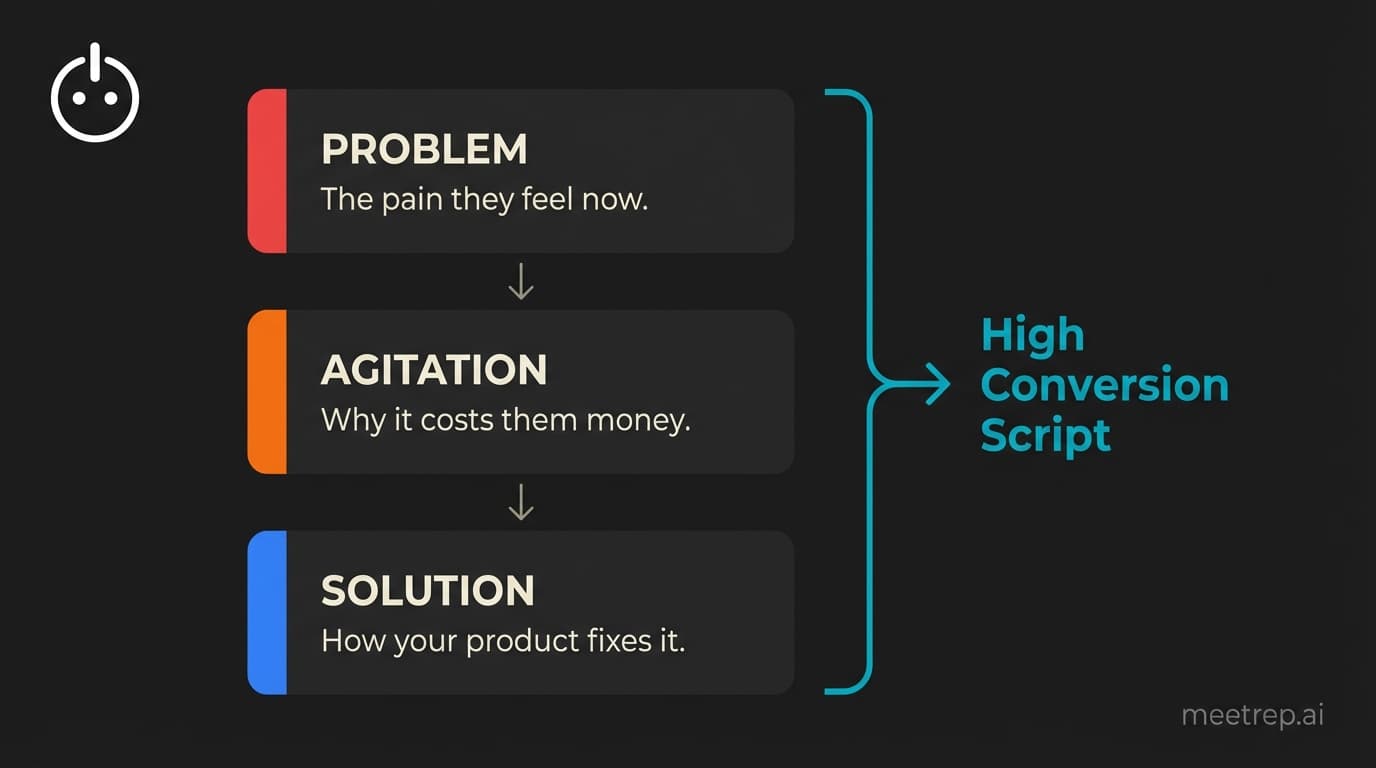
Tone: Empathetic, Authoritative, Urgent Length: ~150 words (60 seconds) Why it works: It forces the listener to nod along with the problem before pitching the solution.
[0:00-0:10] The Problem "Stop me if this sounds familiar. You spend hours manually qualifying leads, only to find out 80% of them aren't ready to buy. Your calendar is full, but your pipeline is empty."
[0:10-0:30] The Agitation "It's not just annoying; it's expensive. Every minute you spend on a bad fit is a minute you aren't closing a deal. And while you're sleeping? Your international leads are cooling off because nobody is there to answer them."
[0:30-0:50] The Solution "Enter [Product Name]. We automate the qualification process 24/7. Imagine an SDR that never sleeps, never takes a sick day, and knows your product inside out."
[0:50-1:00] The CTA "Stop losing deals to timezone math. Visit [Website] and start your free trial today."
2. The "Crispy Duck" Feature Walkthrough (Best for Demos)
Tone: Helpful, precise, clear. Length: ~200 words (90 seconds) Why it works: It ignores the boring setup and focuses entirely on the "Aha!" moment.
Note: In the SaaS world, we talk about the "Crispy Duck"—the one delicious feature that hooks the buyer. Don't bore them with the salad.
[0:00-0:15] The Hook "Today, I'm going to show you how to solve [Specific Pain Point] in under 3 minutes using [Product Name]."
[0:15-0:45] The Walkthrough (The "Crispy Duck") "Let's dive straight in. Most tools make you click through five different tabs to find this data. Watch this. I click 'Analyze,' and boom. It's right there. No exporting to CSV. No pivot tables."
[0:45-1:15] The Benefit "What you're looking at isn't just a dashboard; it's your Monday morning saved. Our users report cutting their reporting time by 40% in the first week."
[1:15-1:30] The Proof & CTA "See why companies like [Customer A] and [Customer B] switched. Click the link below to try it yourself."
3. The Narrative Case Study (Best for Social Proof)
Tone: Story-driven, human, relatable. Length: ~120 words (45 seconds) Why it works: Humans are wired for stories, not features.
[0:00-0:20] The Before "Last year, [Customer Name] hit a wall. Their team was growing, but their revenue wasn't. They were drowning in administrative work."
[0:20-0:35] The Turning Point "Then they found [Product Name]. Within 30 days, they didn't just stabilize—they accelerated."
[0:35-0:45] The Result "34% more revenue. Zero additional headcount. That's the power of automation."
Why Even the Best Scripts Fail in 2026 (The Data)
You can hire the best voice actor in Hollywood. You can polish that script until it shines. But you are fighting a losing battle against user behavior.
Here is the hard truth: Static video is passive. Buyers want agency.
According to research from Guidejar analyzing 110,000 web sessions, the difference is stark. Prospects who engage with interactive demos convert at a rate of 24.35%, compared to just 3.05% for traditional static methods. (Source: Guidejar).
That is a 7.9x difference.
Think about that. For every 100 leads you send to a video based on the scripts above, 97 of them bounce. You are lighting 97% of your media spend on fire because you are forcing a 2026 buyer into a 2015 format.
Key Insight: If your "voice over" cannot answer a question, handle an objection, or click a button for the user, it’s not a sales asset. It’s a brochure.
Why is this happening? Because more than 50% of large B2B transactions will be processed through digital self-serve channels by 2025 (Source: Forrester). Buyers don't want to watch; they want to do.
The Evolution: From "Voice Over" to "Voice Agent"
The term "script voice over example" implies a one-way transmission. You speak; they listen. But the technology has moved to Agentic AI.
Agentic AI systems can autonomously pursue goals, break down tasks, and execute actions—like navigating a web browser—rather than just generating text or audio (Source: MarkTechPost).
When we built Rep, we didn't want another text-to-speech tool. We wanted an autonomous employee. Here is the difference:
| Feature | Static Voice Over Script | AI Voice Agent (Rep) |
|---|---|---|
| Interaction | Passive (Watch only) | Active (Ask, Click, Scroll) |
| Personalization | One size fits all | Adapts to user input |
| Availability | 24/7 (but passive) | 24/7 (Interactive & Live) |
| Goal | Convey information | Close the deal |
| Tech | MP4 / Audio File | Multimodal AI + Browser Automation |
Gartner predicts that by 2028, AI agents will outnumber human sellers by 10x (Source: Gartner).
If you are just writing scripts for MP4s, you are building infrastructure for the past.
My recommendation: Use the scripts I gave you above. But don't record them. Train an agent with them.
How to Turn Your Script into an Autonomous Playbook
At Rep, we don't use the word "script." We use Playbooks.
A script is linear. A playbook is dynamic. It allows the AI to handle interruptions, answer unexpected questions ("Does this integrate with Salesforce?"), and then guide the prospect back to the happy path.
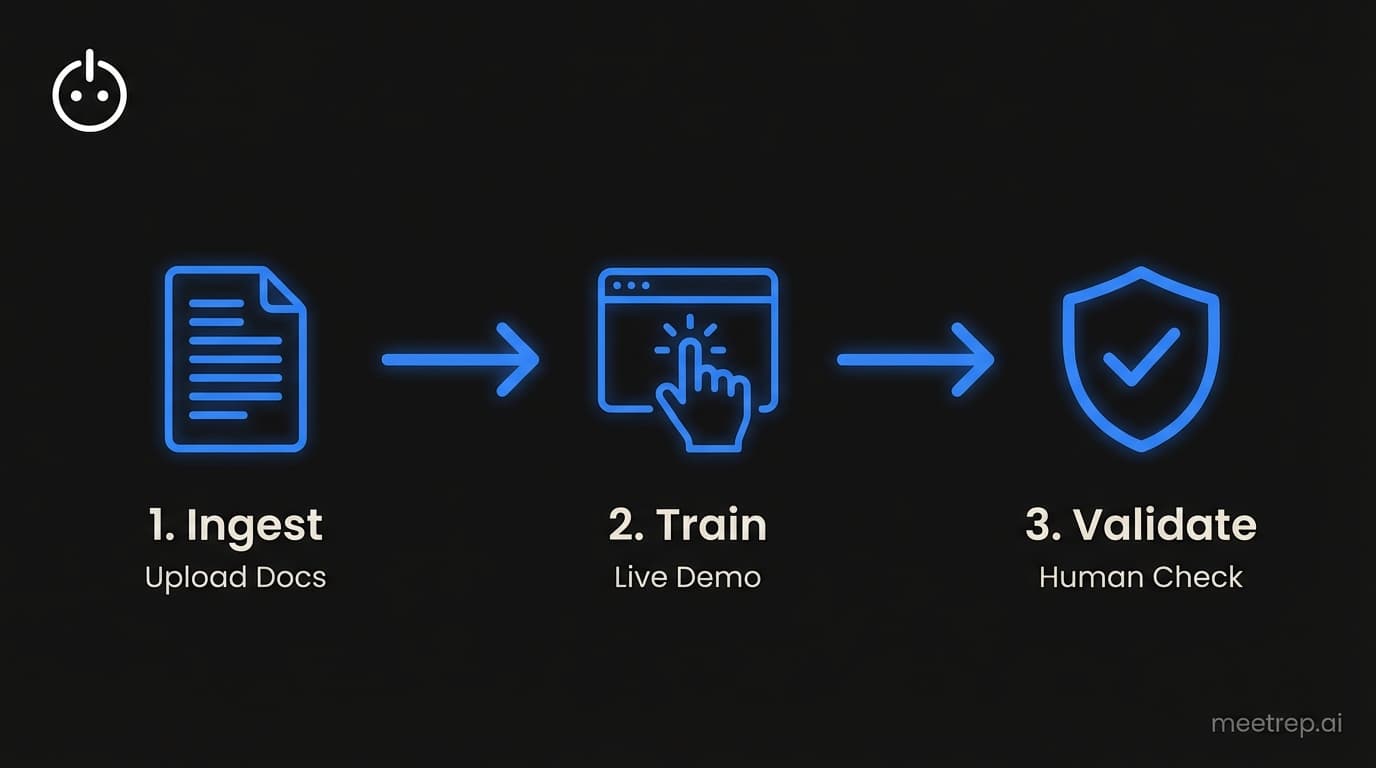
Here is how you can take the script examples from above and turn them into a live Rep agent.
Step 1: Ingest (The Knowledge Base)
Instead of hiring a voice actor, you upload your documents directly to Rep. This includes your product documentation, your FAQs, and yes, your marketing scripts.
This forms the "brain" of the agent. But a brain without a body is just a chatbot.
Step 2: Train (Live Demo Learning)
This is the part I actually get excited about. You don't need to code. You just log into a video room with Rep and give the demo yourself.
You speak the script while clicking through your app. Rep watches. It records:
- "When he says 'click analyze', he clicks this specific CSS selector."
- "When he explains the dashboard, he hovers over these three widgets."
Rep maps your voice to your browser actions. It learns the context, not just the words.
Step 3: Validate (Inline Validation Flow)
The biggest fear marketers have with AI is hallucination. "What if it says something wrong?"
We solved this with Inline Validation. Before Rep ever talks to a customer, it runs the playbook by you. If it finds a gap—say, your script didn't explain what happens if a user lacks admin permissions—it asks you:
"I noticed a gap in the pricing explanation. How should I handle enterprise inquiries?"
You answer once, and that answer becomes part of the permanent playbook.
Why we built Rep this way: At GoCustomer, we learned that trust is binary. If an AI lies once, you kill it. By forcing an inline validation step, we ensure the agent only says what you've approved.
Real-World Examples: Companies Winning with Interactive Demos
You might be thinking, "This sounds great, but does it work?"
The data says yes. But let's look at who is actually doing it.
Hitachi moved beyond static scripts by implementing "Customized Journeys." Instead of forcing every prospect to watch the same video, they offered four distinct paths: video, short demo, long demo, or sandbox. They respected the buyer's context.
Spryker used "Disco Demos" (Discovery Demos) to present a menu of pain points to buyers. The demo adapted in real-time based on what the user clicked (Source: Demoboost).
And then there's the aesthetic factor. 80% of buyers say 'human-like quality' is their top consideration when choosing an AI voice (Source: Voices.com).
This is why we tuned Rep's voice engine to handle natural turn-taking. It pauses when you interrupt. It uses filler words naturally. It sounds like a colleague, not a GPS.
A script is a starting point. It’s the map. But a map doesn't drive the car.
For years, we’ve relied on static scripts and hoping prospects watch until the end. That era is over. The data shows that buyers demand interaction, autonomy, and immediate answers.
My advice? Take the templates I gave you. Write your script. But don't just record it and walk away. Give your script to Rep, and let an autonomous agent turn those words into closed deals.

Nadeem Azam
Founder
Software engineer & architect with 10+ years experience. Previously founded GoCustomer.ai.
Nadeem Azam is the Founder of Rep (meetrep.ai), building AI agents that give live product demos 24/7 for B2B sales teams. He writes about AI, sales automation, and the future of product demos.
Frequently Asked Questions
Table of Contents
- The "Old School" Voice Over Script Templates (Copy-Paste)
- Why Even the Best Scripts Fail in 2026 (The Data)
- The Evolution: From "Voice Over" to "Voice Agent"
- How to Turn Your Script into an Autonomous Playbook
- Real-World Examples: Companies Winning with Interactive Demos
Ready to automate your demos?
Join the Rep Council and be among the first to experience AI-powered demos.
Get Early AccessRelated Articles
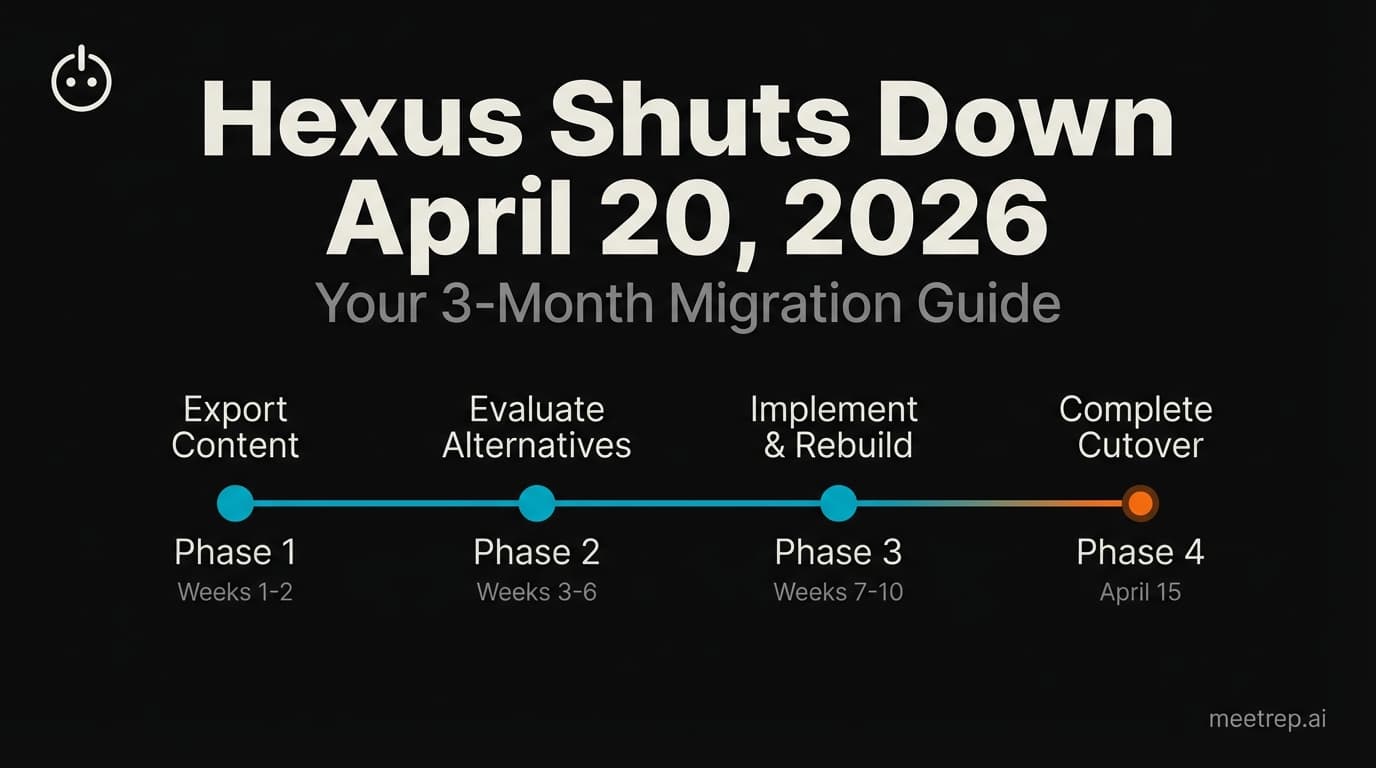
Hexus Acquired by Harvey AI: Congrats & What It Means for Demo Automation Teams
Hexus is shutting down following its acquisition by Harvey AI. Learn how to manage your migration and discover the best demo automation alternatives before April 2026.
Why the "Software Demo" is Broken—and Why AI Agents Are the Future
The traditional software demo is dead. Discover why 94% of B2B buyers rank vendors before calling sales and how AI agents are replacing manual demos to scale revenue.
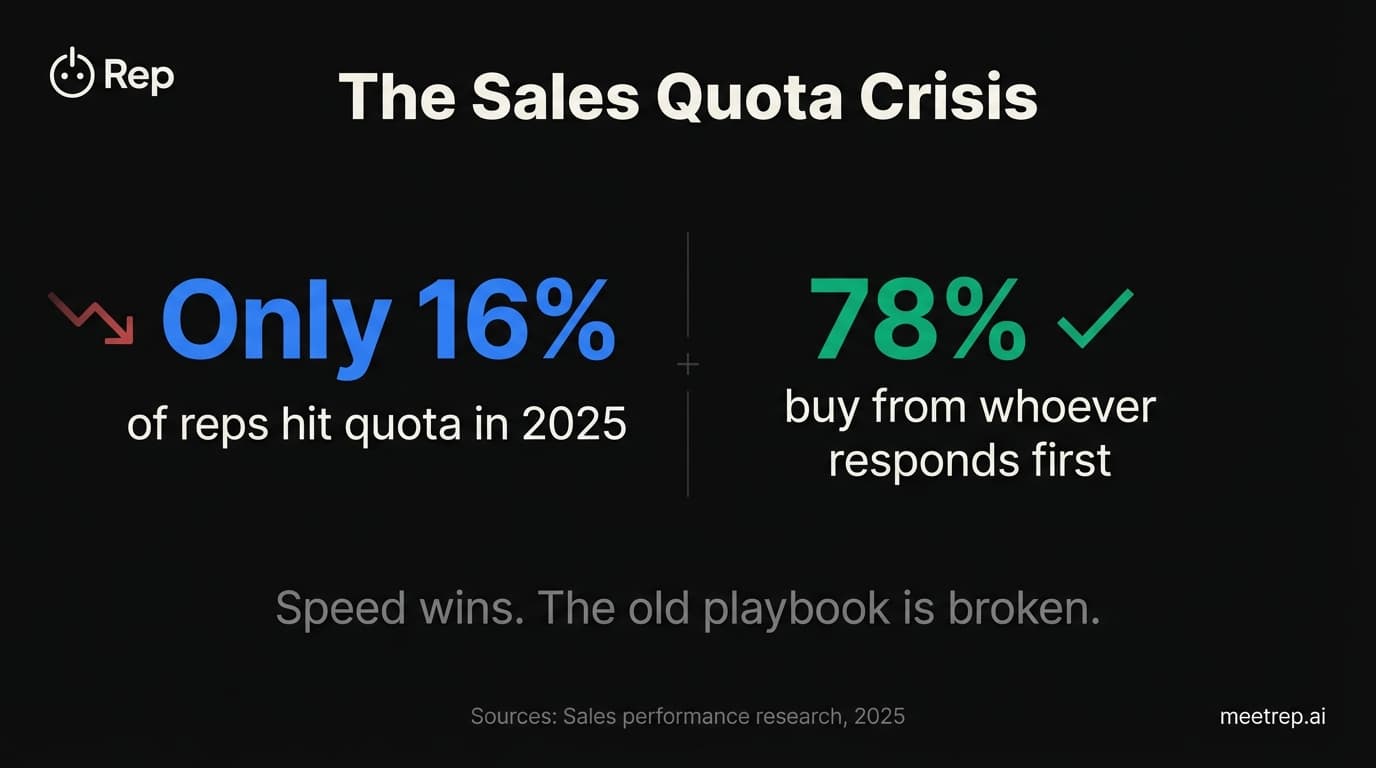
Why Autonomous Sales Software is the Future of B2B Sales (And Why the Old Playbook is Dead)
B2B sales is at a breaking point with quota attainment at 46%. Discover why autonomous 'Agentic AI' is the new standard for driving revenue and meeting the demand for rep-free buying.