The Ultimate Demo Script: A Copy-Paste Template for SaaS

Executive Summary
- The "Harbor Tour" kills deals. Never show features without context.
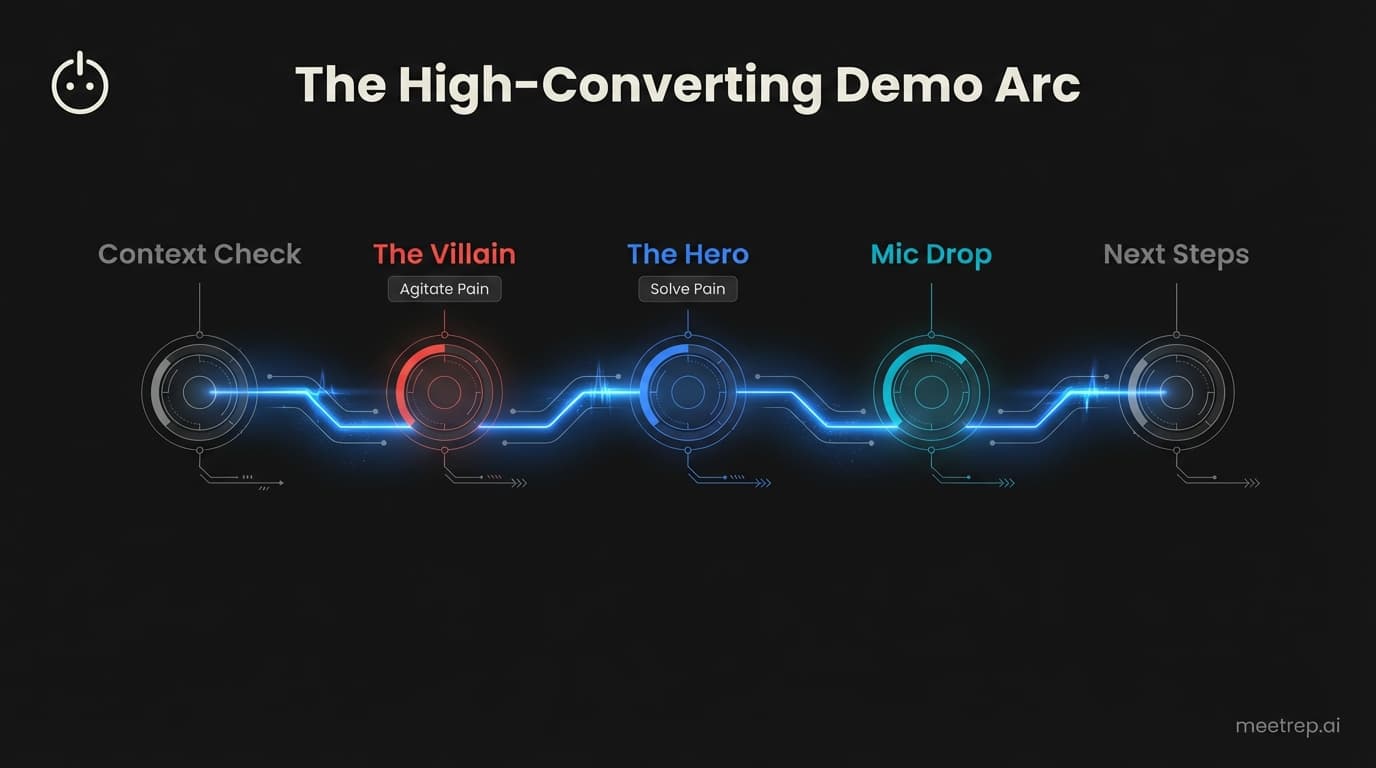
- The 30/30 Rule: First 30% is discovery/context, next 30% is the "Villain" (problem), last 40% is the "Hero" (solution).
- Don't save the best for last. Show the killer feature early.
- Context before clicks. Explain why you're clicking before you click.
- Stop showing the dashboard unless it solves a specific pain point immediately.
Most product demos fail in the first five minutes.
I see it constantly. A brilliant Sales Engineer (SE) gets on the call, shares their screen, and says, "So, let me show you how to log in." Then they proceed to give what we call the "Harbor Tour"—a feature-by-feature walk through every button, menu, and setting in the platform.
The result? Total boredom. And lost deals.
When we founded GoCustomer.ai, and now as we build Rep, I learned a hard truth: Structure beats improvisation.
You might think a script makes you sound robotic. Actually, it's the opposite. A solid demo script frees you from thinking about "what do I show next?" so you can focus on "how is the prospect reacting?"
We literally had to code this structure into our AI agent at Rep. Since an AI can't "wing it," we had to deconstruct the perfect demo into a logical, repeatable flow.
Here is that exact framework. You can copy-paste this today.
What Is a High-Converting Demo Script?
A demo script is a structured narrative framework that guides a prospect from their specific pain point to your solution's value, using your product as the proof points. It is not a monologue of features, nor is it a word-for-word screenplay that must be read verbatim.
Think of it as a jazz standard. You have the chord progression (the script), but the solos (the specific talk tracks) change based on who is in the room.
In my experience building sales automation tools, I've seen that the best scripts follow a specific "arc" that mirrors good storytelling.
| Feature-Dump Demo (Bad) | Narrative Demo Script (Good) |
|---|---|
| "Here is the dashboard." | "You mentioned you can't see pipeline health. Here is how we solve that." |
| "This button does X." | "When your team hits this roadblock, they use this feature to bypass it." |
| "We have 50 integrations." | "We connect to Salesforce so you don't have to copy-paste data." |
| "Any questions so far?" | "Does this look like it would save your SDRs time?" |
| Result: Confusion. | Result: Clarity. |
Phase 1: The Context Check (Minutes 0-5)
Goal: Re-confirm the pain and set the stage.
Most reps skip this. They get nervous and dive right into the software. Don't do that. If you start clicking before you agree on the problem, you are just clicking in a vacuum.
At Rep, we programmed our AI agent to refuse to start the demo until it has confirmed what the user wants to see. Humans should do the same.
The Script Template:
"Thanks for jumping on. I know we only have 30 minutes.
Based on our last conversation, it sounds like your team is struggling primarily with [Pain Point A] and [Pain Point B], which is causing [Negative Business Impact].
Today, I want to focus specifically on those two areas to show you how we fix them. I'm going to skip the generic stuff.
Does that still sound like the right use of our time?"
Why this works:
- It respects their time.
- It proves you listened.
- It gives you permission to skip the boring parts (login, settings, etc.).
Common mistake: Asking "Is there anything else you want to see?" This opens Pandora's box. You invite them to drag you into the weeds. Stick to the agreed-upon pain.
Phase 2: The "Villain" Workflow (Minutes 5-10)
Goal: Agitate the problem before solving it.
This is where the "Harbor Tour" usually starts. The rep logs in and says, "So here is the home screen."
Stop showing the dashboard first.
Unless your dashboard is the primary reason they are buying (rare), it's just noise. Instead, start where the pain lives. If you sell expense software like Concur, start in the messy email inbox where the receipts are buried. If you sell a CRM tool, start in the spreadsheet they are currently using.
The Script Template:
"So, typically, when you're trying to do [Task X], you're probably stuck doing [Old, Painful Process].
You're switching tabs, you're copy-pasting, and that's where the data gets lost.
Is that roughly how it looks for your team today?"
Get them to nod. You need that physical confirmation. Once they admit the "Villain" exists, you can introduce the "Hero."
Phase 3: The "Hero" Flow (Minutes 10-25)
Goal: Show the specific workflow that kills the Villain.
This is the meat of the demo. But here is the trick: Narrate the value, not the click.
When we built the navigation engine for Rep, we realized that an AI silently clicking through screens is terrifying. It needs to explain why it's moving.
The Script Template:
"Instead of that manual process, here is how you handle it in [Your Product].
I'm going to move to the [Feature Name].
Now, watch this. Instead of manually entering that data, I just click [Action].
See how it auto-populated? That just saved the three minutes you usually spend on this step. Multiply that by 50 reps, and that's the time savings we discussed."
Key Insight: Notice I didn't say "This is the auto-populate button." I said "That just saved three minutes." Tie every feature to a metric.
The "Tell-Show-Tell" Framework
For every feature you show, use this micro-script:
- Tell: "I'm going to show you how to automate that report."
- Show: (Click the button).
- Tell: "By doing that, your manager gets the data instantly without chasing you."
Phase 4: The "Mic Drop" Moment (Minutes 25-30)
Goal: Show the one feature that justifies the price tag.
In every software, there is one "Whoa" feature. In Rep, it's usually when the AI voice agent answers a complex objection in real-time. In your product, it might be the analytics, or the one-click export.
Do not save this for the end.
I see so many scripts that build up to a "grand finale." The problem? Executives leave the call early. They have hard stops. If you save the best for last, the decision-maker might be gone.
The Script Template:
"I want to show you the one thing our customers tell us changed their workflow the most.
[Show the Killer Feature]
The reason this matters is [Strategic Value]. Most tools make you do this manually, which is why adoption fails. We automated it so your team actually uses the system."
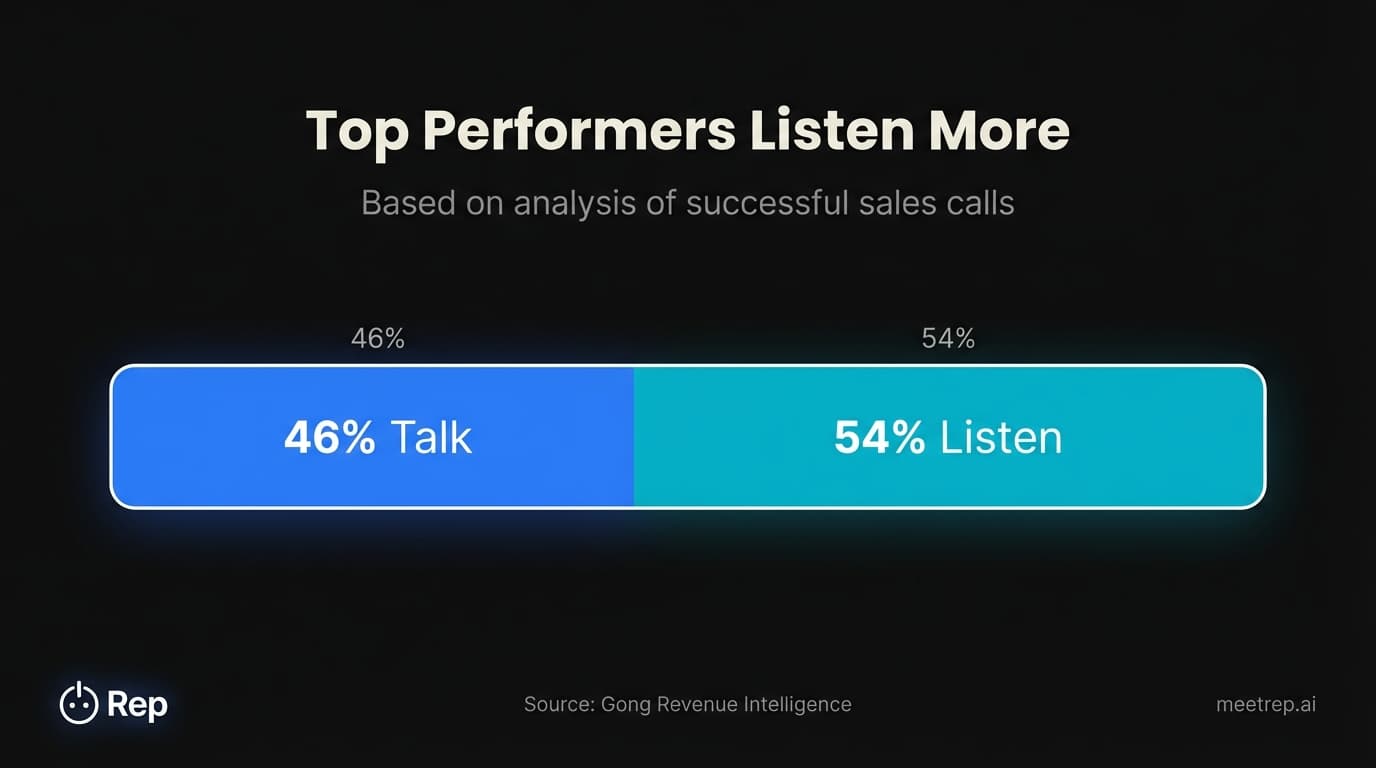
The Data: According to Gong's analysis of sales calls, successful demos switch between "talking" and "listening" frequently, with top performers achieving a 46:54 talk-to-listen ratio. If you monologue for 10 minutes straight to get to a finale, you've lost them.
Phase 5: The Closing & Next Steps
Goal: Secure a clear next step, not just "thoughts?"
Never end a demo with "Do you have any questions?" It's lazy. It invites them to ask about pricing or features you don't have.
Instead, ask a "validation question."
The Script Template:
"Based on what we walked through—specifically solving [Pain Point A]—does this look like something your team would actually use?"
(Wait for the yes).
"Great. Typically, the next step is to get [Stakeholder Name] involved for a technical validation. Does it make sense to set that up for next Tuesday?"
Why We Built Rep This Way
I'm sharing this structure because it's exactly how we built Rep.
When we were designing our autonomous AI demo agent, we had a massive technical challenge. An AI can click anything. It can read the entire documentation. But how do you teach it to sell?
We realized that "selling" isn't about the product. It's about the pathway through the product.
We built Rep to follow this exact script logic:
- Listen to the prospect's question.
- Identify the pain point.
- Go to the specific screen that solves it.
- Narrate the solution while clicking.
The reason most human demos fail is that they lack this discipline. They get distracted. They go down rabbit holes. Rep doesn't. It sticks to the value.
What we learned at GoCustomer: Consistency is the hardest part of scaling a sales team. You can have one "rockstar" SE, but if your other 10 SEs are winging it, you can't forecast revenue. A script isn't about removing creativity; it's about raising the floor so your worst demo is still good.
Conclusion
The "art" of the demo isn't in showing the product. It's in the narrative you wrap around it.
If your SEs are resisting a script, tell them this: Structure creates freedom. When you know exactly where you're going, you can relax and actually listen to the prospect. When you're frantically trying to remember where a setting is, you stop listening.
My take? The days of the "Harbor Tour" are over. Buyers are too educated and too impatient. They want to see how you solve their problem, and they want to see it in the first 10 minutes.
Give them this script. Watch your win rates stabilize.
And if you want to see what a perfectly structured, autonomous demo looks like in action—without burning your SEs' time on early-stage leads—check out how Rep handles it.

Nadeem Azam
Founder
Software engineer & architect with 10+ years experience. Previously founded GoCustomer.ai.
Nadeem Azam is the Founder of Rep (meetrep.ai), building AI agents that give live product demos 24/7 for B2B sales teams. He writes about AI, sales automation, and the future of product demos.
Frequently Asked Questions
Table of Contents
- What Is a High-Converting Demo Script?
- Phase 1: The Context Check (Minutes 0-5)
- Phase 2: The "Villain" Workflow (Minutes 5-10)
- Phase 3: The "Hero" Flow (Minutes 10-25)
- Phase 4: The "Mic Drop" Moment (Minutes 25-30)
- Phase 5: The Closing & Next Steps
- Why We Built Rep This Way
- Conclusion
Ready to automate your demos?
Join the Rep Council and be among the first to experience AI-powered demos.
Get Early AccessRelated Articles
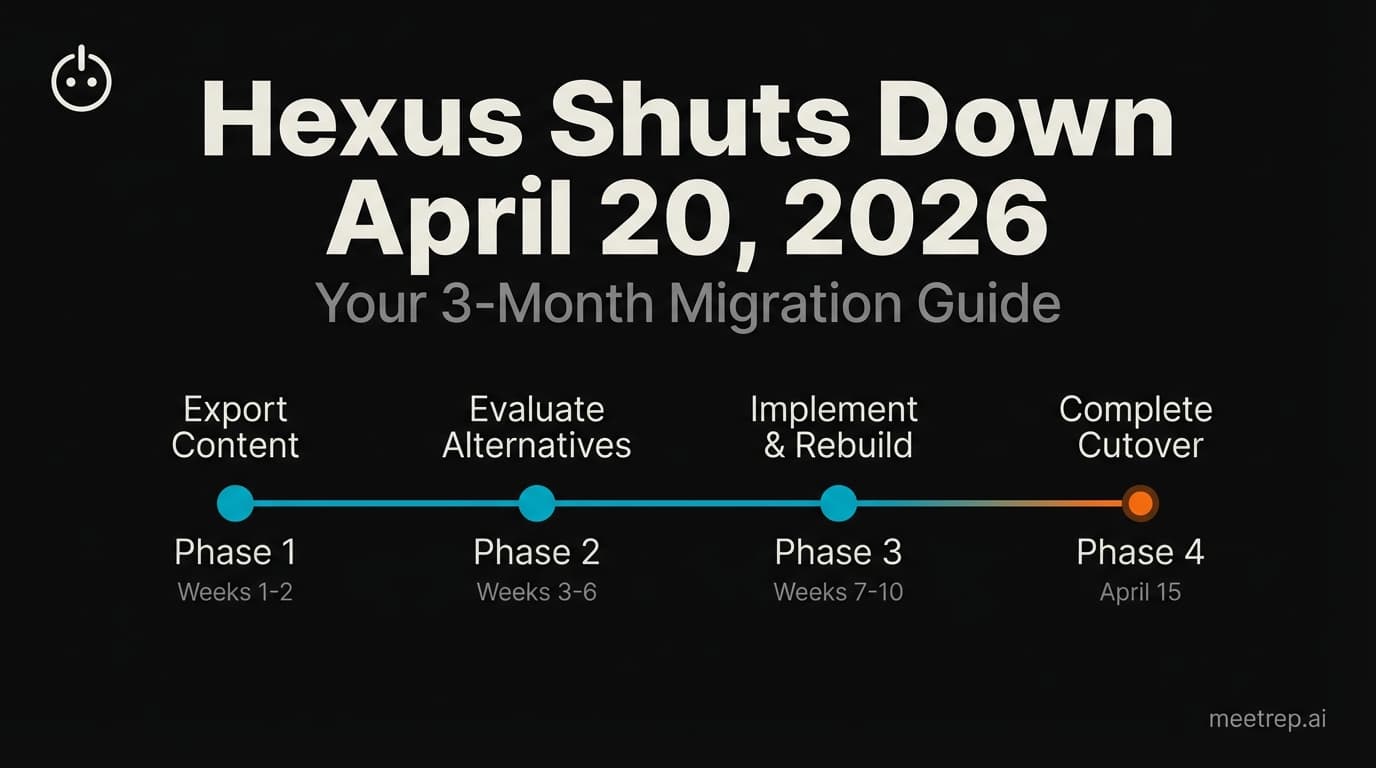
Hexus Acquired by Harvey AI: Congrats & What It Means for Demo Automation Teams
Hexus is shutting down following its acquisition by Harvey AI. Learn how to manage your migration and discover the best demo automation alternatives before April 2026.
Why the "Software Demo" is Broken—and Why AI Agents Are the Future
The traditional software demo is dead. Discover why 94% of B2B buyers rank vendors before calling sales and how AI agents are replacing manual demos to scale revenue.
Why Autonomous Sales Software is the Future of B2B Sales (And Why the Old Playbook is Dead)
B2B sales is at a breaking point with quota attainment at 46%. Discover why autonomous 'Agentic AI' is the new standard for driving revenue and meeting the demand for rep-free buying.