The SE Capacity Crisis: 2026 Presales Benchmark Report

Executive Summary
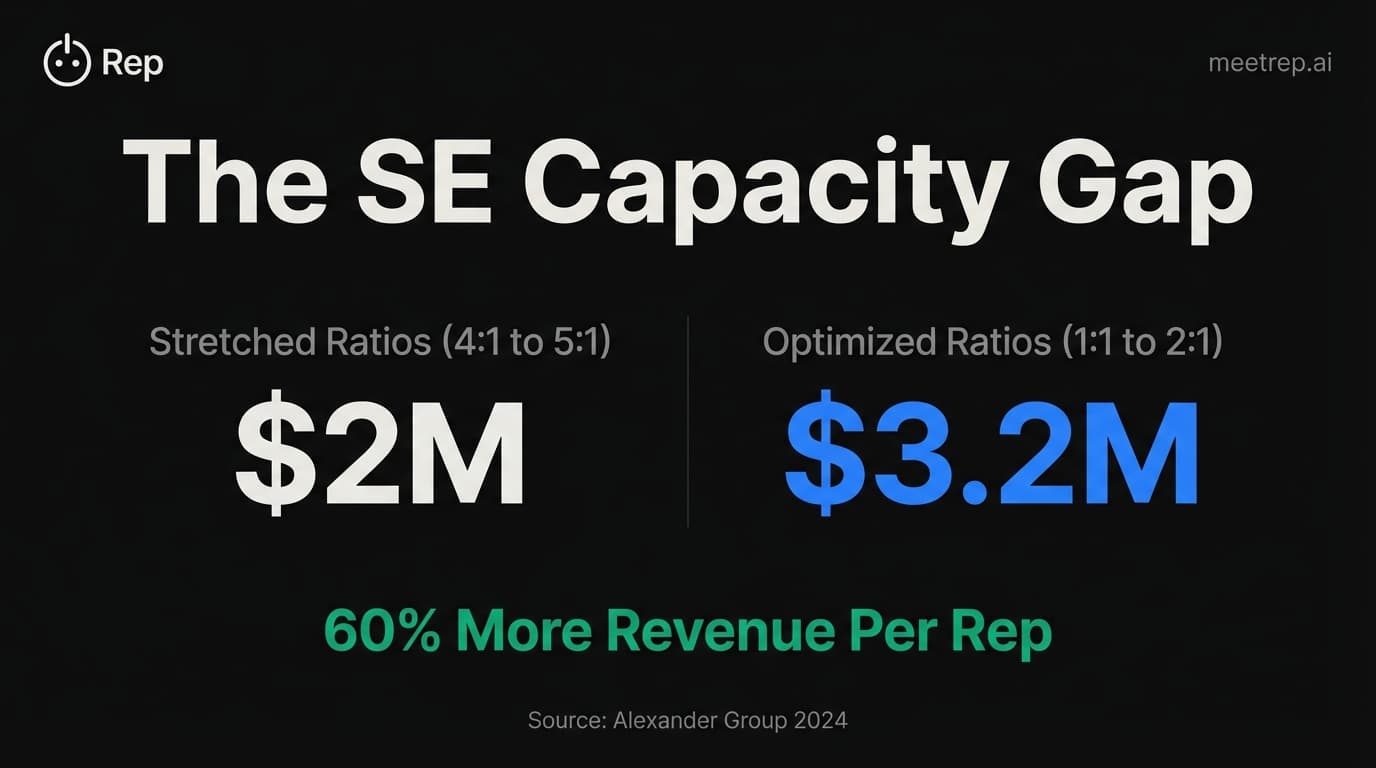
- The median AE:SE ratio is 4:1—but high performers run at 2:1 and generate 60% more revenue per rep
- 67% of prospects wait a week or more for their first demo while 30-50% of demos go to unqualified buyers
- 60% of SEs report feeling overwhelmed, and intro demos rank as the #2 time drain but #10 in actual impact
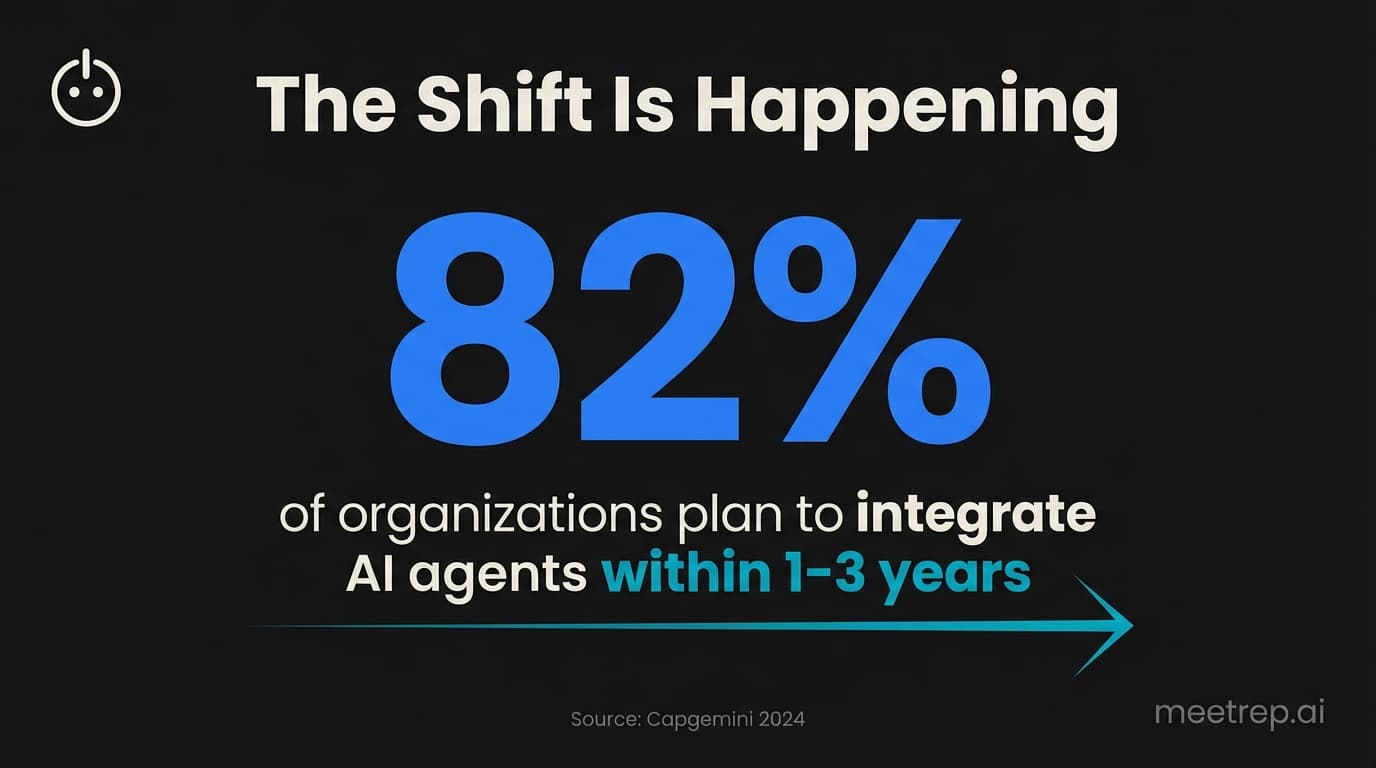
- 82% of organizations plan to integrate AI agents within 1-3 years—the shift is happening now
Your Sales Engineers are the bottleneck. Not your AEs. Not your pipeline. Your SEs.
Here's the problem nobody talks about: the median AE:SE ratio has hit 4:1, yet 70% of deals now require presales support. That math doesn't work. And companies with stretched SE capacity aren't just slower—they generate 60% less revenue per rep than organizations with optimized ratios.
I've spent years building sales automation tools. At GoCustomer.ai, then at Rep. The SE capacity problem is exactly why we built an AI demo agent. This report breaks down the 2026 benchmarks every presales leader needs—the ratios, the costs, and where automation actually makes sense.
What is SE capacity (and why it's a revenue problem)
SE capacity is your presales team's ability to support sales deals with technical expertise, demos, and solution design—without burning out or creating bottlenecks. It's the bandwidth available for qualified opportunities. And right now, most organizations are running at a deficit.
The numbers tell the story. According to Vivun's State of Sales Engineering 2025, the industry median sits at a 4:1 AE:SE ratio. But Alexander Group's analysis of 100 sales organizations found that companies running 1:1 ratios generate $3.2M in revenue per rep. Those stretched to 5:1? They average $2M.
That's a 60% gap.
The Data: Organizations with optimized SE ratios (1:1 to 2:1) generate $3.2M per rep compared to $2M per rep at stretched ratios of 4:1 to 5:1—a 60% revenue difference. (Alexander Group 2024)
So why do sales leaders keep under-investing in presales? Most have never been SEs. They've been SDRs, AEs, and Sales Managers. When budget allows one hire, they choose quota-carrying AEs because that's the world they know. SEs remain invisible until the bottleneck becomes undeniable.
The 2026 AE:SE ratio benchmarks
The "right" AE:SE ratio depends on your deal complexity, but the benchmarks are clearer than most leaders realize:
| Segment | Recommended Ratio | Revenue Impact | Source |
|---|---|---|---|
| Enterprise/Complex | 1:1 to 2:1 | $3.2M/rep | Alexander Group 2024 |
| Mid-Market | 2:1 to 3:1 | Intermediate | Alexander Group 2024 |
| SMB/Transactional | 4:1 to 5:1 | $2M/rep | Alexander Group 2024 |
| Current Industry Median | 4:1 | Baseline | Vivun 2025 |
| Modern High-Performers | 2:1 | Target state | SaaStr/Sapphire Ventures 2024 |
Notice the gap? The median is 4:1, but high performers have moved to 2:1. That's not a small optimization—it's a fundamental structural difference in how they approach presales.
Key Insight: The 4:1 median represents organizations that haven't adapted to increasing product complexity and expanding buying committees. If you're at 4:1 or higher, you're likely leaving revenue on the table.
Honestly, this frustrates me. The data is clear, but budget conversations still default to "hire more AEs." An SE hire at a stretched organization might unlock more revenue than two additional AEs competing for limited presales support.
Where SE time actually goes (the hidden waste)
The SE capacity problem isn't just about headcount. It's about how existing capacity gets burned on low-value work.
Reprise's 2024 Presales Landscape Report found that SEs spend 21 days per year just maintaining demo environments. That's nearly a month of productivity—gone. Not on customer conversations. On infrastructure work.
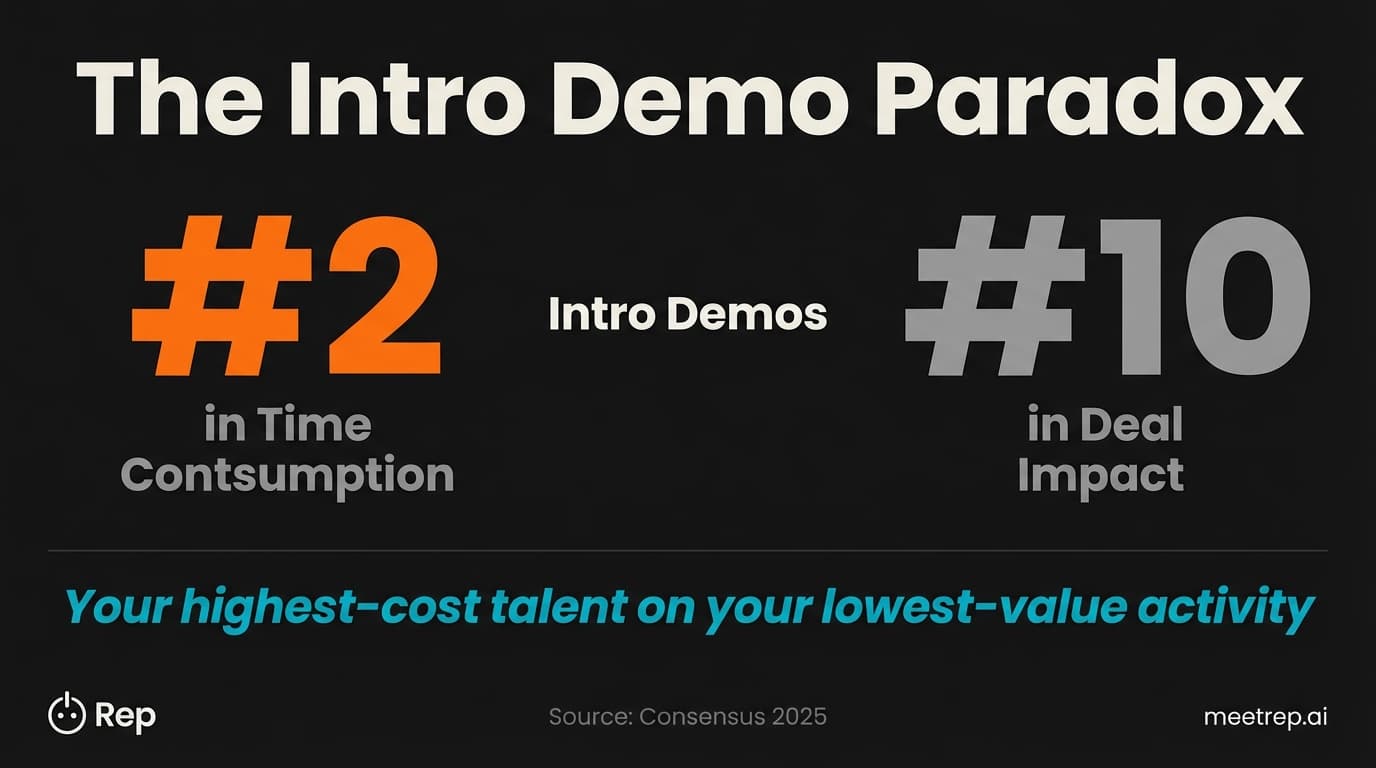
But it gets worse. Consensus's Future of Presales research identified the "worst offender" for SE time waste: intro demos. They rank as the second most time-consuming activity but only tenth in perceived impact on deal success.
Let that sink in. Your highest-paid technical talent spends a disproportionate chunk of their time on work that ranks near the bottom for value.
| Activity | Time Impact | Value Ranking | Source |
|---|---|---|---|
| Intro demos | 2nd highest time consumption | 10th in impact | Consensus 2025 |
| Demo environment maintenance | 21 days/year | Infrastructure (no direct value) | Reprise 2024 |
| Demo builds (traditional) | 100+ hours per new demo | High effort, periodic value | Demostack/Synack case |
Here's the quick math. A 10-person SE team spending 21 days per year on maintenance loses 210 work days annually. At a fully-loaded cost of $200K per SE, that's roughly $168K in pure waste. Add the 30-50% of demos going to unqualified prospects, and you're looking at another $100K+ in wasted labor.
Common mistake: Trying to solve capacity problems with hiring alone. If 30-50% of your demos go to unqualified prospects (Presales Collective via Demoboost), adding headcount just scales the waste.
The five root causes of SE burnout
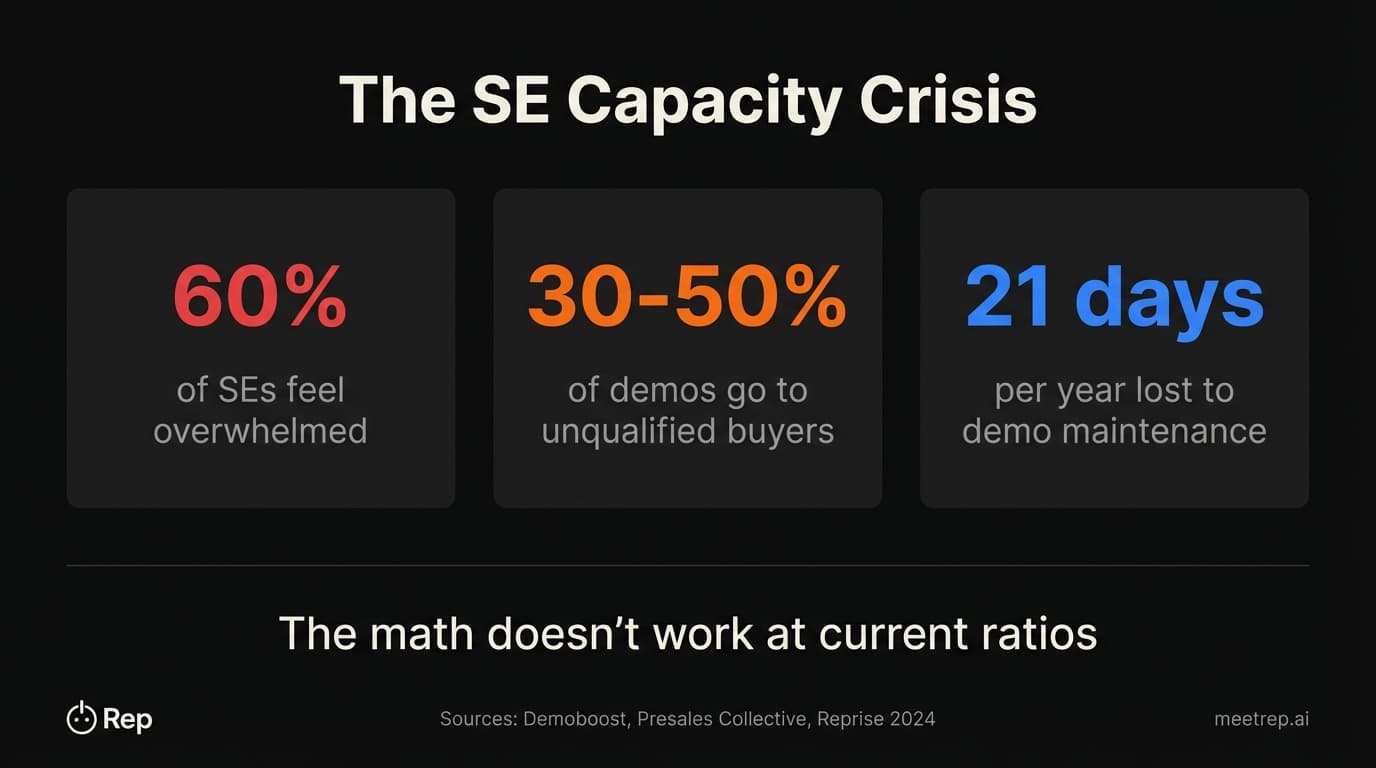
60% of Sales Engineers report feeling overwhelmed by demo fatigue, context switching, and complexity. That's not a morale problem. That's a structural failure.
1. The demo monkey loop. SEs find themselves trapped—jumping from call to call, giving the same demo repeatedly. They're delivering 40% more demos year-over-year without proportional capacity increases.
2. Unqualified deal exposure. When 30-50% of demos go to buyers who won't convert, the psychological toll compounds. Consensus research quantified this: a 10% increase in unqualified demos produces burnout equivalent to two additional crunch weeks.
3. Context switching. SEs bounce between discovery calls, POCs, post-sales training, support escalations, and internal meetings. Each context switch carries a hidden cost of 15-30 minutes for mental reorientation.
4. Unrealistic ramp expectations. According to John Care of Mastering Technical Sales, industry standard runs 3-6 months to demo independently and 6-12 months to full productivity. You can't hire your way out of crisis if new hires take a year to become productive.
5. The empathy gap. Most sales leaders have never been SEs. They intuitively understand AE capacity because they lived that role. SE capacity remains abstract.
The Data: A 10% increase in unqualified demos produces burnout equivalent to two additional crunch weeks for SE teams. (Consensus 2024)
The demo wait time problem
Your prospects are waiting. A lot.
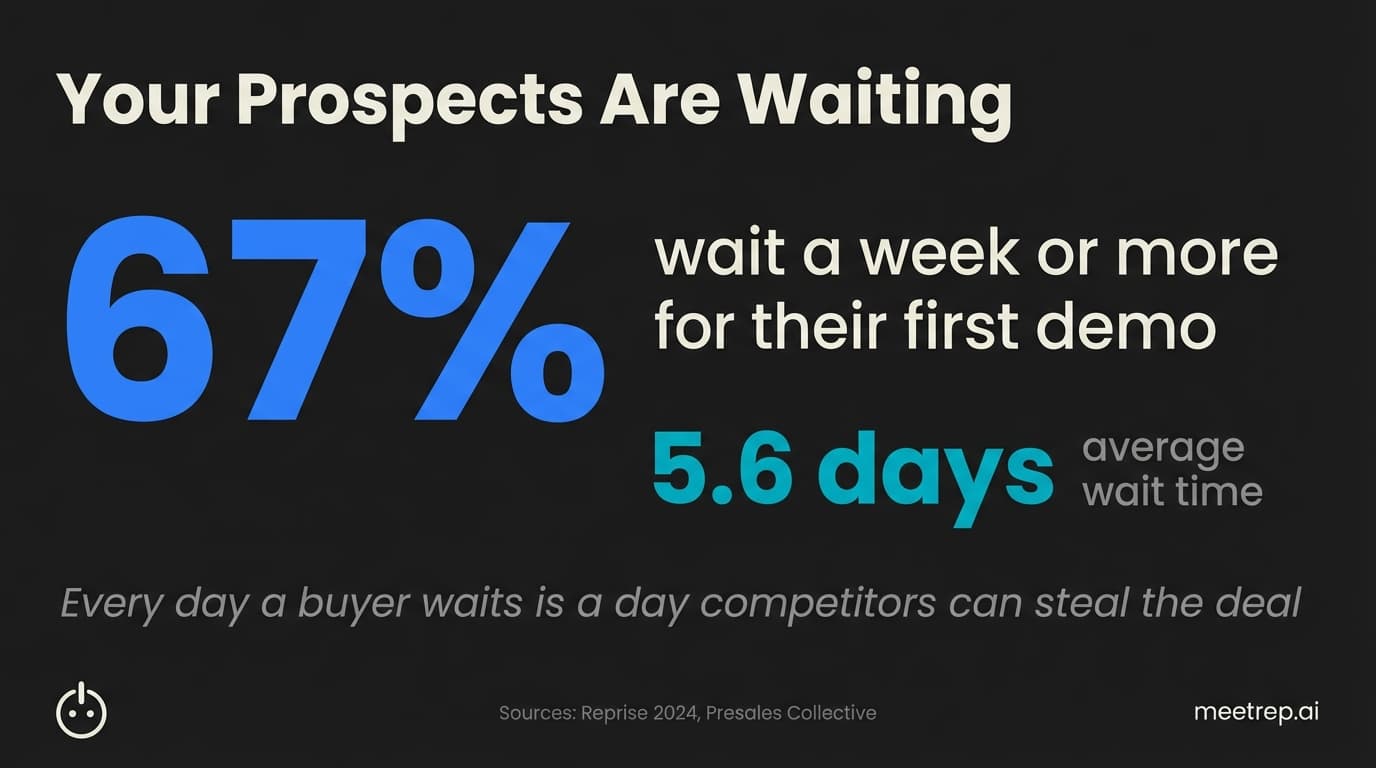
Presales Collective research found the average wait time for a first demo is 5.6 days. Reprise's data is even more concerning: 67% of prospects wait a week or more, and 17% wait more than two weeks.
Think about it from the buyer's perspective. They're actively researching, probably evaluating your competitors. They request a demo. Then... silence. For a week. What happens? They talk to your competitor who responded faster.
Key Insight: Every day a buyer waits is a day competitors can steal the deal. The 5.6-day average wait time isn't just an operational metric—it's a revenue leak.
Organizations using demo automation report 30% reduction in sales cycles. If your average cycle is 90 days, that's 27 days faster to revenue.
The shift to AI and automation
Demo automation isn't a future trend. It's already happening.
Consensus's research found that 57% of organizations are currently automating some demo processes. And Capgemini research shows 82% of organizations plan to integrate AI agents into business operations within 1-3 years.
| Automation Tier | What It Does | Example |
|---|---|---|
| Static assets | Recorded demos, screenshot libraries | Basic video walkthroughs |
| Interactive tools | Click-through tours, guided HTML capture | Walnut, Navattic, Storylane |
| Autonomous agents | Conversational AI handling live interactions | Saleo AI Demo Agent, Rep |
McKinsey's November 2025 research positioned this shift clearly: "60%+ of the increased value AI generates in marketing and sales will come from Agentic AI"—AI that does things autonomously, not just generates text.
Why we built Rep this way: The distinction between click-through demos and live conversational demos isn't incremental—it's fundamental. Click-throughs show your product. Autonomous agents demonstrate it, answer questions in real-time, and handle the natural flow of a buyer conversation. That's why Rep handles live demo interactions conversationally. It's the difference between a brochure and a sales rep.
But let me be clear about my view here: automation isn't magic. It works for specific use cases. Intro demos. After-hours requests. First-touch qualification. It doesn't replace the complex solution design, architecture deep-dives, or relationship building that top SEs provide.
What companies are actually seeing
Sovos (27,000 employees, 9 SEs at 8:1 ratio): After implementing Consensus demo automation: 67% reduction in live SE-attended calls, 50% increase in product specialization, 60% faster SMB sales cycle.
Paycor (20% annual growth): From their Consensus implementation: 30% increase in presales capacity (equivalent to 9 FTEs without hiring), 18% shorter average sales cycle.
Gainsight: From Demostack: 25% increase in win rate when using customized vs. standard demos, demo response time reduced from 48 hours to 1 hour.
The Data: Companies implementing demo automation report 15-67% reductions in SE-attended calls and 30% shorter sales cycles. (Consensus, Demostack)
I should note: these case studies come from vendor marketing materials. Named executives and specific metrics make them credible, but they're not independently audited. Use them as directional evidence, not guaranteed outcomes.
How to calculate your SE capacity gap
Step 1: Know your current ratio. Count AEs. Count SEs. Divide. If you're at 4:1 or higher, you're at industry median—which means you're likely leaving revenue on the table.
Step 2: Estimate waste percentage. What percentage of demos go to unqualified prospects? If you don't track this, estimate at 30%.
Step 3: Calculate wait time cost. How long do prospects wait? Every day beyond immediate availability is a day competitors can steal the deal.
Step 4: Audit time allocation. If intro demos consume more than 20% of SE time, you have a prioritization problem.
My recommendation: Before asking for SE headcount, fix the waste. If 30-50% of demos go to unqualified prospects, automation or better lead qualification will have faster ROI than hiring.
The SE capacity crisis isn't a mystery. The benchmarks are clear: 4:1 is the median, 2:1 is where high performers operate, and the revenue gap is 60%. Your prospects wait 5.6 days while 30-50% of demos go to unqualified buyers. Your SEs are overwhelmed.
At Rep, we built an AI demo agent because we believe intro demos—the repetitive ones, the after-hours requests, the first-touch conversations—shouldn't require your best technical talent. Not when 82% of organizations are moving toward AI agents and the technology exists to handle live conversations.
The question isn't whether automation belongs in your presales stack. It's whether you'll move before your competitors do.

Nadeem Azam
Founder
Software engineer & architect with 10+ years experience. Previously founded GoCustomer.ai.
Nadeem Azam is the Founder of Rep (meetrep.ai), building AI agents that give live product demos 24/7 for B2B sales teams. He writes about AI, sales automation, and the future of product demos.
Frequently Asked Questions
Table of Contents
- What is SE capacity (and why it's a revenue problem)
- The 2026 AE:SE ratio benchmarks
- Where SE time actually goes (the hidden waste)
- The five root causes of SE burnout
- The demo wait time problem
- The shift to AI and automation
- What companies are actually seeing
- How to calculate your SE capacity gap
Ready to automate your demos?
Join the Rep Council and be among the first to experience AI-powered demos.
Get Early AccessRelated Articles
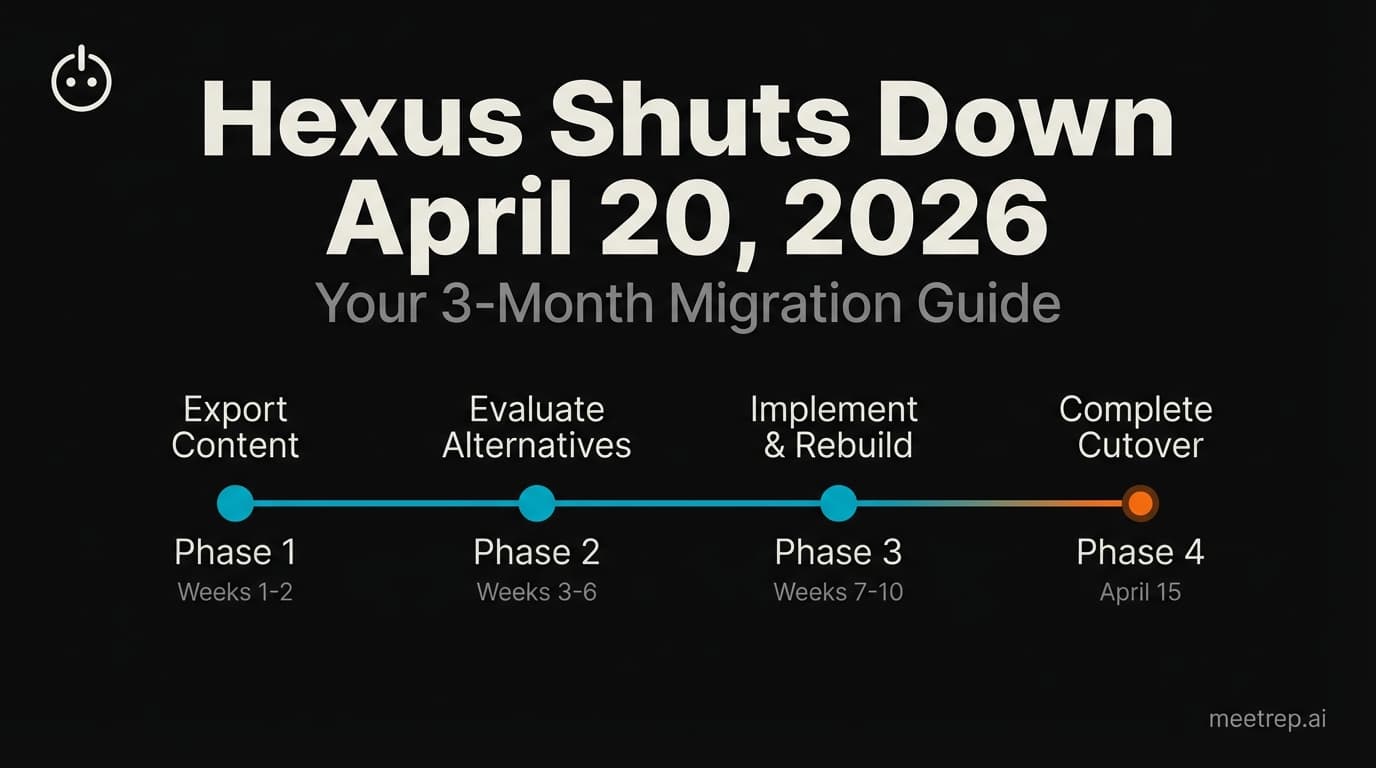
Hexus Acquired by Harvey AI: Congrats & What It Means for Demo Automation Teams
Hexus is shutting down following its acquisition by Harvey AI. Learn how to manage your migration and discover the best demo automation alternatives before April 2026.
Why the "Software Demo" is Broken—and Why AI Agents Are the Future
The traditional software demo is dead. Discover why 94% of B2B buyers rank vendors before calling sales and how AI agents are replacing manual demos to scale revenue.
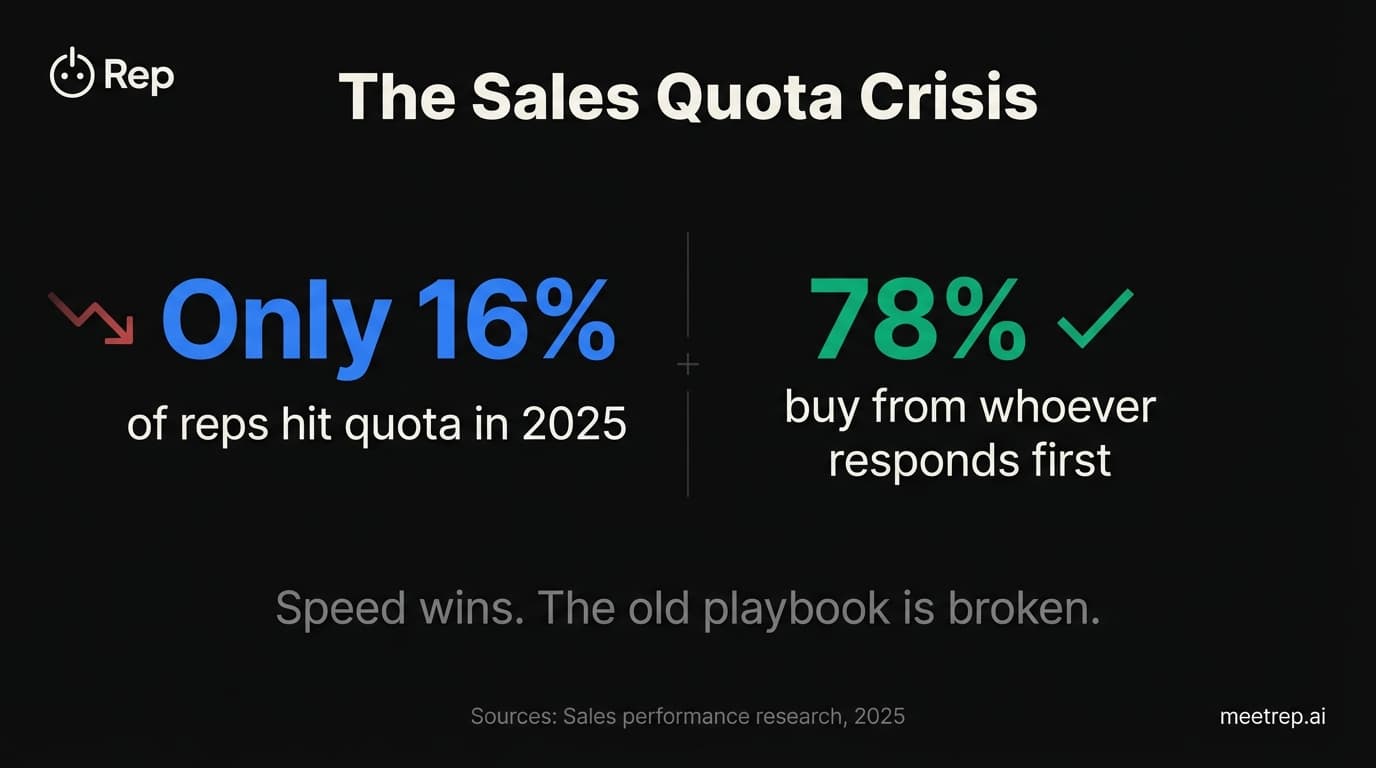
Why Autonomous Sales Software is the Future of B2B Sales (And Why the Old Playbook is Dead)
B2B sales is at a breaking point with quota attainment at 46%. Discover why autonomous 'Agentic AI' is the new standard for driving revenue and meeting the demand for rep-free buying.