The Rise of the AI Sales Agent: What It Means for Your Team

Executive Summary
- AI sales agents are autonomous software that execute sales tasks—prospecting, demos, follow-ups—without constant human direction
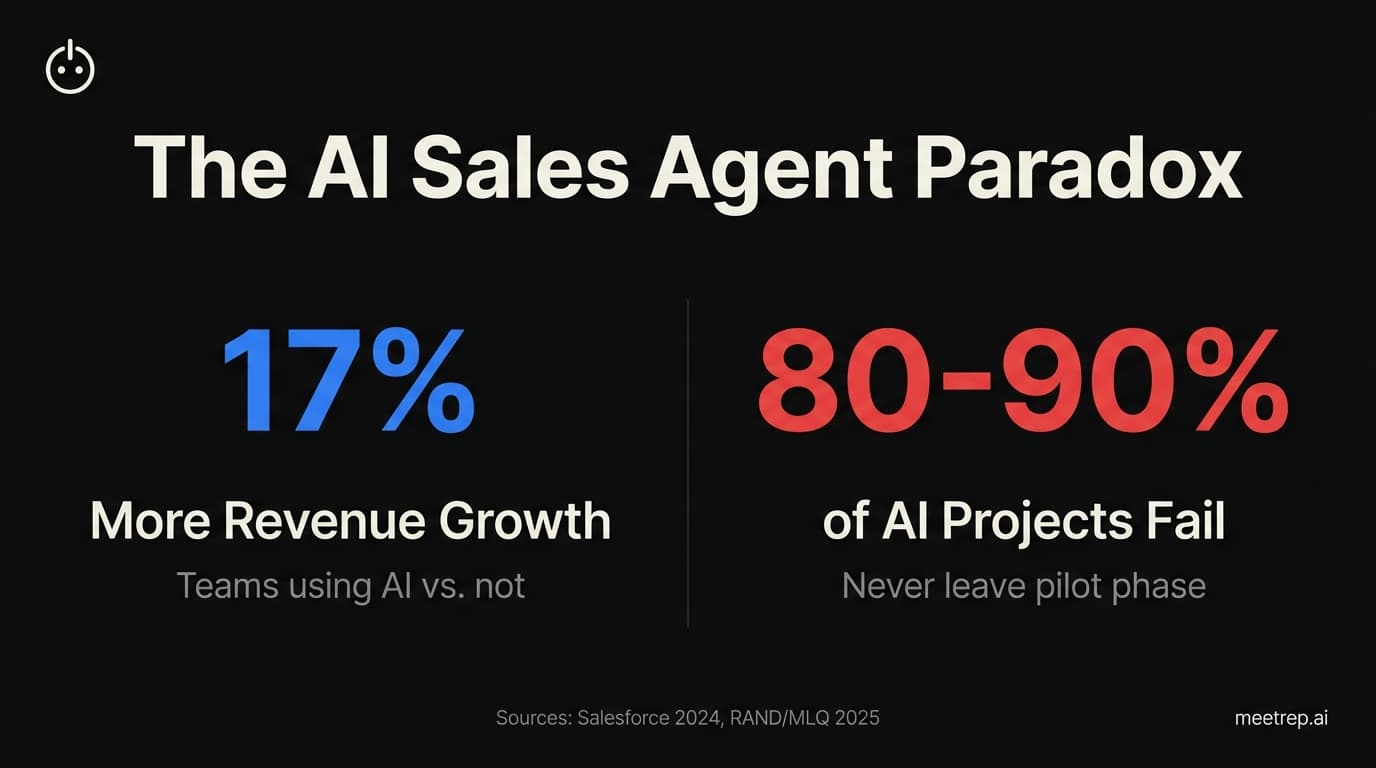
- Teams using AI see 17 percentage points more revenue growth, but 80-90% of AI projects fail to scale
- Three main types exist: AI SDRs (email/outbound), RevOps agents (admin), and Demo agents (live presentations)
- Success depends on narrow use case fit, clean data, and realistic expectations—not "AI everywhere"
Your competitors are running AI sales agent experiments right now. Some are failing spectacularly. A few are seeing results that should worry you.
The data is stark: sales teams using AI saw 83% revenue growth compared to 66% without—a 17-point gap, according to Salesforce's 2024 research. And Gartner predicts that by 2028, AI agents will outnumber human sellers by 10 to 1.
But here's what the hype machine won't tell you: 80-90% of AI projects never leave pilot phase. Most fail. Having built sales automation tools at GoCustomer.ai and now at Rep, I've watched this play out firsthand. The technology works—when deployed correctly for the right use case. Most teams get that part wrong.
This piece cuts through the noise. No vendor spin. Just what's real, what's not, and how to think about AI sales agents for your team.
What Is an AI Sales Agent?
An AI sales agent is autonomous software that performs sales tasks—lead qualification, personalized outreach, meeting scheduling, even live product demos—without constant human direction. Unlike scripted chatbots that follow decision trees, AI sales agents can reason through context, adapt to prospect responses, and take independent action across the sales cycle.
The key word is autonomous. A chatbot waits for input and matches it to pre-written responses. An AI sales agent plans, executes, and learns. Some call them AI sales reps, though the technology goes well beyond mimicking human reps.
The Data:81% of sales teams are now experimenting with or have fully implemented AI, according to Salesforce. Adoption nearly doubled year-over-year—from 24% in 2023 to 43% in 2024 (HubSpot).
The shift matters because your reps aren't actually selling. Salesforce found that 70% of reps' time goes to non-selling tasks: updating CRMs, researching prospects, scheduling meetings, writing follow-up emails. That's not a productivity problem. That's a structural problem. And AI agents are designed to solve it.
But I want to be direct about something. The term "AI sales agent" gets slapped on everything from basic email sequences to sophisticated multi-step automation. Vendors love "agent washing"—dressing up simple automation as revolutionary AI. When evaluating tools, ask: Can it reason through new situations? Can it use multiple tools? Can it operate without constant prompting? If not, it's automation with better marketing.
How AI Sales Agents Actually Work
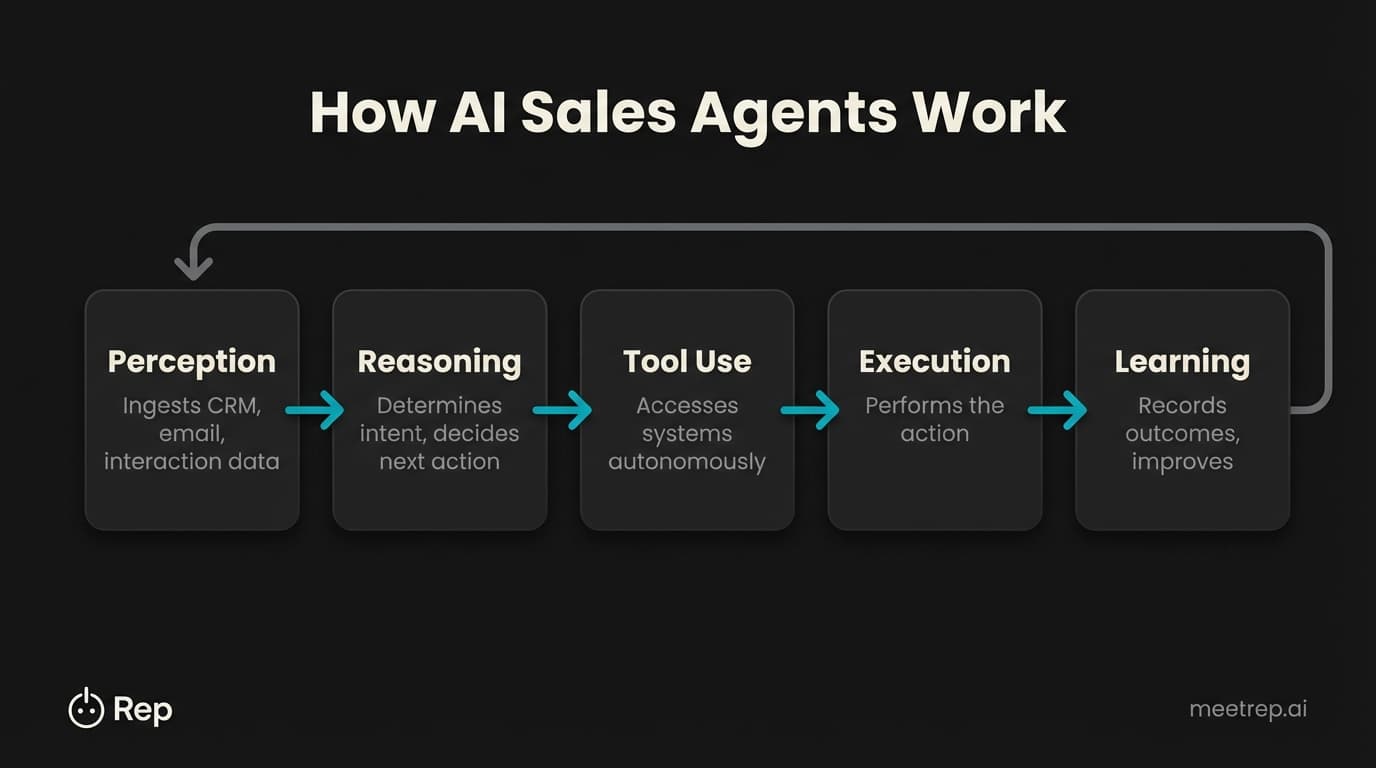
AI sales agents operate through a five-stage cycle that separates them from traditional automation:
- Perception — The agent ingests data from your CRM, emails, and real-time interactions. It sees what's happening.
- Reasoning — Using large language models trained on sales scenarios, it determines prospect intent and decides the best next action based on your playbooks.
- Tool use — It autonomously accesses systems—sending emails via Outreach, updating records in Salesforce, scheduling through Calendly, or navigating a browser to demo your product.
- Execution — It performs the action. This might be sending a personalized email, joining a video call, or walking a prospect through your interface live.
- Learning — It records outcomes and updates its approach. Good agents improve from every interaction.
The "tool use" part is what makes agents different from chatbots. A chatbot talks. An agent does. It can log into systems, click through interfaces, and complete workflows that used to require human hands on keyboard.
Key Insight:McKinsey's 2025 research found that 62% of organizations are experimenting with AI agents. But only 23% have successfully scaled them. The gap between "trying" and "succeeding" is massive—and it's almost always about implementation, not technology.
The Three Types of AI Sales Agents (And Where Each Fits)
Not all AI sales agents do the same thing. The market has split into distinct categories, and understanding them matters for picking the right tool.
| Type | What It Does | Best For | Human Role | Examples |
|---|---|---|---|---|
| AI SDR | Outbound email, LinkedIn, lead qualification | High-volume prospecting | Minimal oversight | 11x.ai, Artisan |
| RevOps Agent | CRM updates, data enrichment, lead scoring | Administrative automation | Low | Salesforce Agentforce |
| Demo Agent | Live product demos, screen sharing, Q&A | Scalable live interactions | Low-medium | Rep |
| AI Coach | Call analysis, rep feedback | Sales enablement | High | Gong, Chorus |
Here's my take on where the market is heading. The AI SDR space is crowded and getting commoditized. Everyone's automating email. And buyers are noticing—one Reddit user put it bluntly: "If I get an email from obvious AI, I'm not going to touch that company with a 10-foot pole."
The Demo Agent category is different. It's not about sending more emails. It's about handling live interactions—joining calls, sharing screens, walking prospects through your product in real-time. That's the gap we're building Rep to fill. Most AI sales agents get you the meeting. A demo agent runs the meeting.
The Productivity Gap AI Sales Agents Can Close
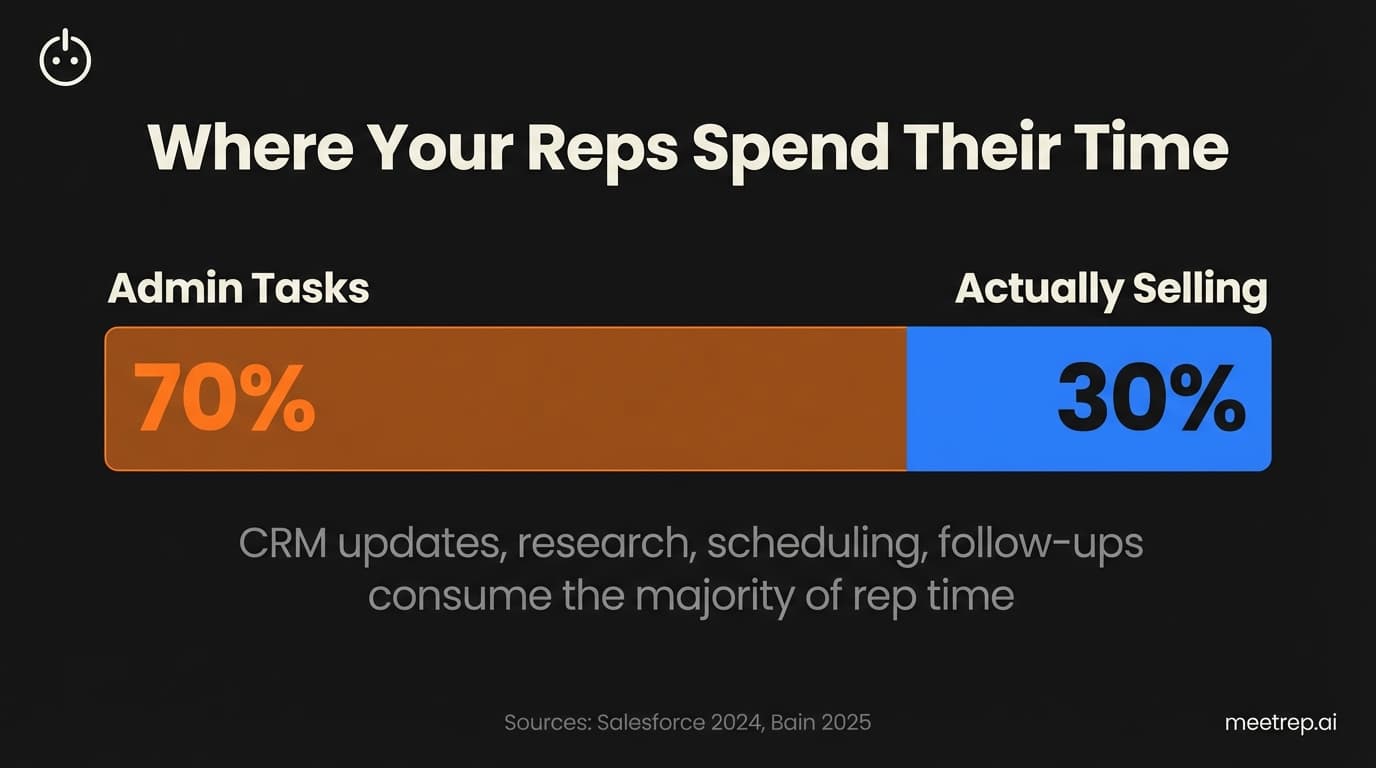
Let's talk numbers. Your reps currently spend only 25-30% of their time actually selling, according to Bain. The rest goes to research, data entry, scheduling, and follow-ups.
Meanwhile, 67% of sales reps don't expect to meet quota, and 84% missed it last year. There's a direct line between these two facts.
The Data:ZoomInfo's 2025 research found that sales professionals using AI frequently report saving 12 hours per week on average. That's 47% productivity gains and 81% shorter deal cycles.
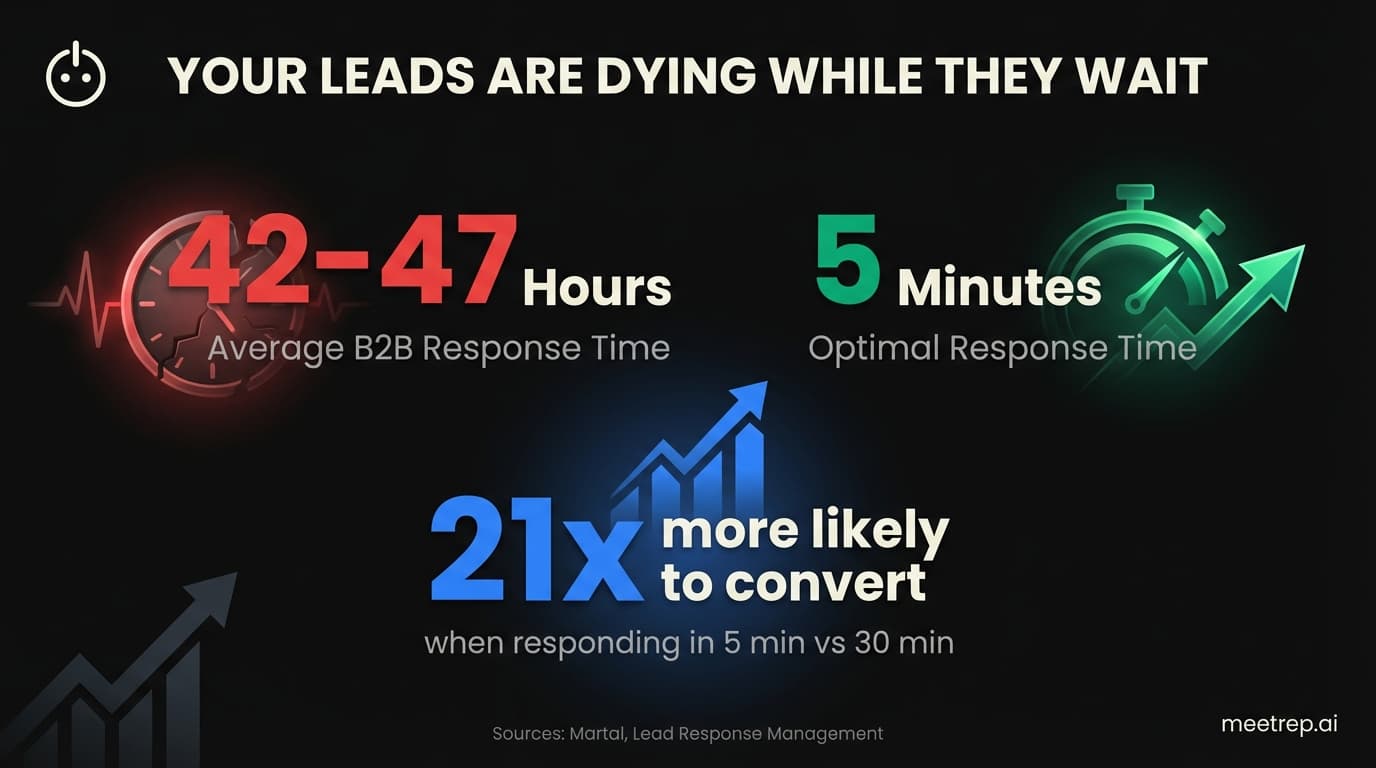
But here's the loss frame that should concern you. Your leads are dying while they wait. The average B2B response time is 42-47 hours—and research shows that responding within 5 minutes makes you 21x more likely to convert compared to waiting 30 minutes. Every hour of delay costs conversions.
AI agents don't sleep. They don't take lunch. They respond in seconds. So for teams drowning in inbound leads, that speed advantage alone can justify the investment.
Real Results: What Companies Actually Achieved
I'm skeptical of vendor case studies. Selection bias is real—you only hear about the wins. But some results are worth examining.
Paycor deployed Gong's AI platform and saw a 141% increase in deal wins. Their VP of Client Sales called it "truly game changing." That's a named company, a specific metric, and a verifiable source.
SpotOn reported 16% win rate improvement and 30% revenue boost per rep using the same platform.
1-800Accountant faced a different problem: handling 40% client growth during tax season without hiring 200 temporary staff. They deployed Salesforce Agentforce and saw agents autonomously resolve 70% of chat engagements during peak week.
And then there's the case that made everyone pay attention. SaaStr replaced their 10-person sales team with 20 AI agents managed by roughly one human. They maintained 8-figure revenue while increasing outreach volume from 7,000 to 70,000 emails. Jason Lemkin's assessment: "It's not better; it's not worse. But it's so much more efficient, and it scales like software scales."
That last example is polarizing. Some see efficiency. Others see job replacement dressed up as innovation. Both reactions are valid.
Key Insight: Gartner's analysis of sales teams found that those successfully partnering with AI are 3.7x more likely to meet quota. But "successfully" is doing heavy lifting in that sentence.
Why Most AI Sales Agent Projects Fail
Here's what the hype machine skips: RAND research shows 80-90% of AI projects never leave pilot phase. Gartner expects 40% of AI agent projects to be scrapped by 2027.
Why? I've watched it happen. The failure modes are predictable:
Data quality problems. AI agents are only as good as your CRM data. Garbage in, garbage out. If your Salesforce is a mess, agents amplify the mess.
Integration headaches. Connecting agents to your existing stack takes longer and costs more than vendors admit. Budget overruns of 180-300% are common.
Wrong use case fit. AI agents work for transactional, high-volume tasks. They struggle with complex enterprise deals requiring relationship skills and political navigation. Teams deploy them everywhere instead of somewhere specific.
Hallucination risk. Early AI SDRs had serious accuracy problems. Artisan's CEO admitted publicly: "I just cringe in pain when looking at the email pitches [our] YC-era product wrote. We had extremely bad hallucinations when we first launched."
Team resistance. Your reps see AI as a threat, not a tool. They worry about training their replacement. Vercel literally shadowed their top performers for six weeks before replacing them with AI. That story spreads.
My recommendation: Start narrow. Pick one specific, repetitive task where failure won't damage customer relationships. Prove value there before expanding. The teams that fail try to boil the ocean. The teams that succeed start with a teaspoon.
Will AI Replace Salespeople?
Let's address this directly. The anxiety is real. 61% of white-collar workers believe AI will replace them within three years. SDRs see themselves as first in line.
The data tells a more complicated story.
Gartner predicts that by 2030, 75% of B2B buyers will prefer human interaction over AI—especially for complex, high-stakes purchases. Salesforce is hiring 2,000 new sales reps to sell their AI products. The irony isn't lost on anyone.
But entry-level and repetitive roles face real displacement. Some teams have already fully replaced human SDRs. That's not a prediction. It's happening.
My read: AI will handle the transactional stuff—first-touch outreach, intro demos, qualification calls, follow-up sequences. Humans will handle what AI can't: building trust, navigating politics, closing complex deals. The job shifts from "doing everything" to "doing the hard things well."
Gartner analyst Melissa Hilbert captured it: "The future of sales will belong to organizations that combine human empathy with AI-powered insights—delivering superior buyer experiences and unlocking real productivity gains."
How to Evaluate If AI Sales Agents Fit Your Team
Not every team should deploy AI sales agents. Here's a framework for thinking through fit:
| Factor | AI Agents Work Well | AI Agents Struggle |
|---|---|---|
| Deal complexity | Transactional, standardized | Enterprise, custom negotiations |
| Lead volume | High (500+ leads/month) | Low (under 100/month) |
| CRM data quality | Clean, complete, structured | Messy, outdated, incomplete |
| Sales cycle | Short (under 30 days) | Long (6+ months) |
| Product | Clear use cases, demo-able | Requires deep customization |
If you're considering AI sales agents, ask yourself:
- Do we have a specific, repetitive task consuming disproportionate rep time?
- Is our CRM data clean enough to trust automated decisions?
- Can we absorb 2x our initial cost estimate? (Budget overruns are the norm, not the exception.)
- Do we have a clear success metric for a pilot—not just "see what happens"?
If you can't answer yes to all four, you're probably not ready.
The AI sales agent wave is real. The productivity gap is real. The competitive pressure is real. But so is the 80-90% failure rate.
My bet is that the winners won't be teams that deploy AI everywhere. They'll be teams that deploy it precisely—in narrow use cases where it multiplies human capability rather than replacing human judgment. Whether that's AI SDRs handling first-touch outreach, demo agents running intro calls, or RevOps agents cleaning your pipeline, the pattern is the same: specific problems, measured results, continuous refinement.
At Rep, we're building for that focused future. Not AI that replaces your sales team—AI that removes the grind so your team can do what only humans can do: build relationships that close deals.

Nadeem Azam
Founder
Software engineer & architect with 10+ years experience. Previously founded GoCustomer.ai.
Nadeem Azam is the Founder of Rep (meetrep.ai), building AI agents that give live product demos 24/7 for B2B sales teams. He writes about AI, sales automation, and the future of product demos.
Frequently Asked Questions
Table of Contents
- What Is an AI Sales Agent?
- How AI Sales Agents Actually Work
- The Three Types of AI Sales Agents (And Where Each Fits)
- The Productivity Gap AI Sales Agents Can Close
- Real Results: What Companies Actually Achieved
- Why Most AI Sales Agent Projects Fail
- Will AI Replace Salespeople?
- How to Evaluate If AI Sales Agents Fit Your Team
Ready to automate your demos?
Join the Rep Council and be among the first to experience AI-powered demos.
Get Early AccessRelated Articles
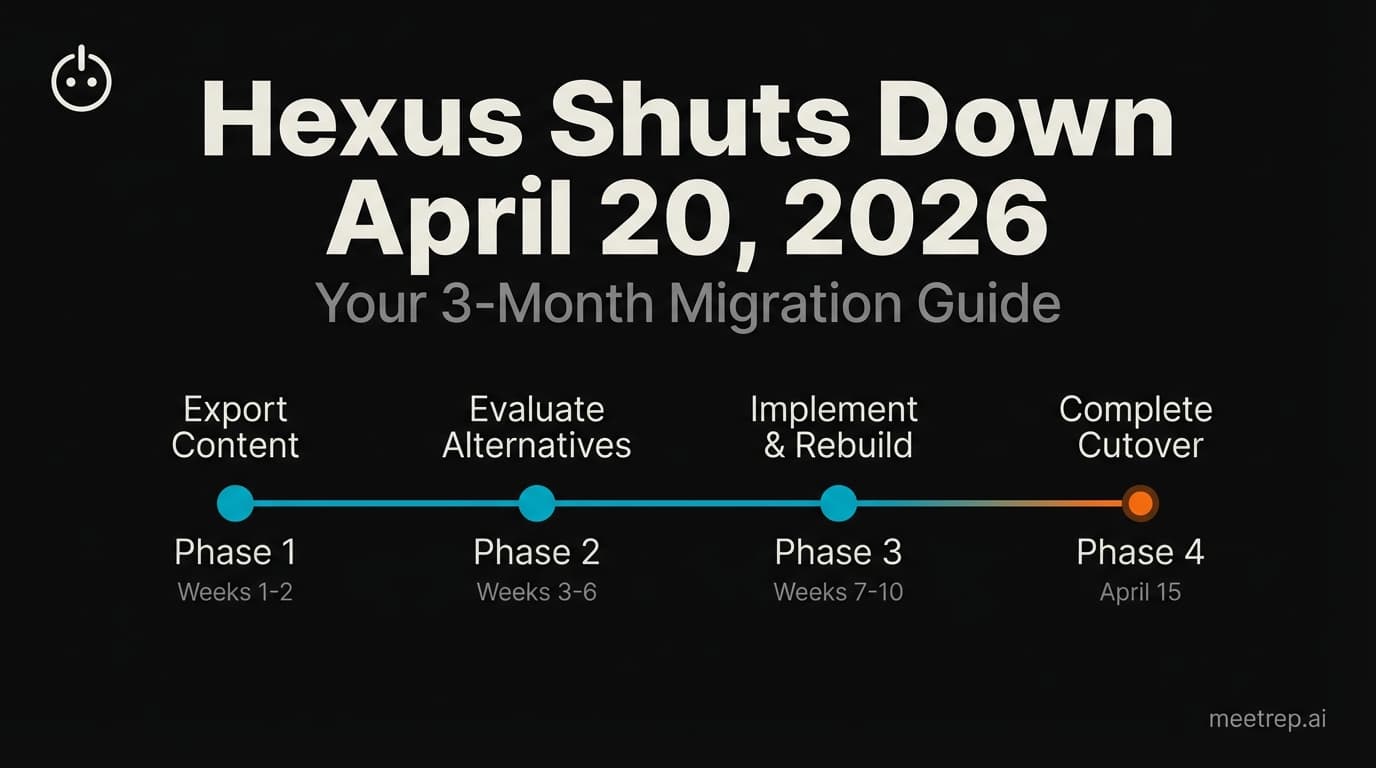
Hexus Acquired by Harvey AI: Congrats & What It Means for Demo Automation Teams
Hexus is shutting down following its acquisition by Harvey AI. Learn how to manage your migration and discover the best demo automation alternatives before April 2026.
Why the "Software Demo" is Broken—and Why AI Agents Are the Future
The traditional software demo is dead. Discover why 94% of B2B buyers rank vendors before calling sales and how AI agents are replacing manual demos to scale revenue.
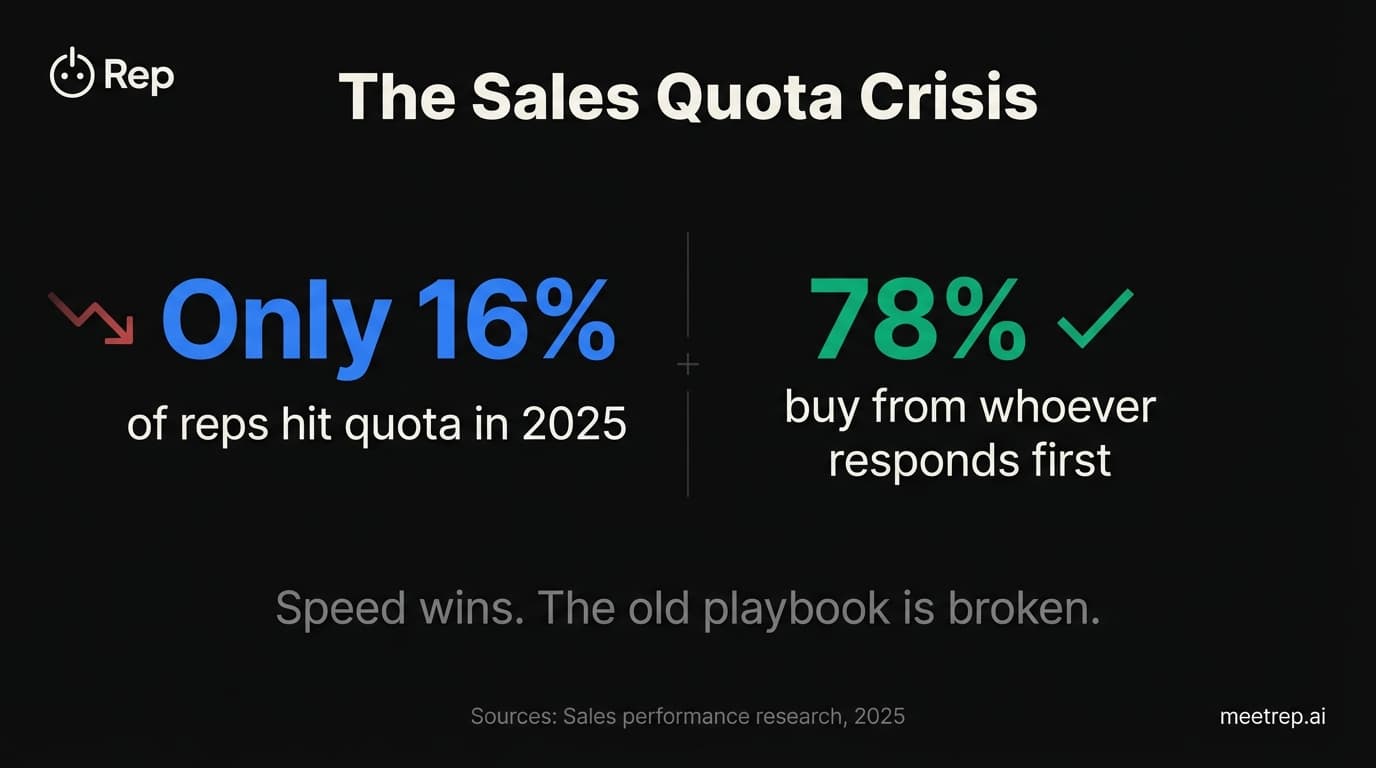
Why Autonomous Sales Software is the Future of B2B Sales (And Why the Old Playbook is Dead)
B2B sales is at a breaking point with quota attainment at 46%. Discover why autonomous 'Agentic AI' is the new standard for driving revenue and meeting the demand for rep-free buying.