The Human Handoff: AI-to-Human Escalation Design That Actually Works

Executive Summary
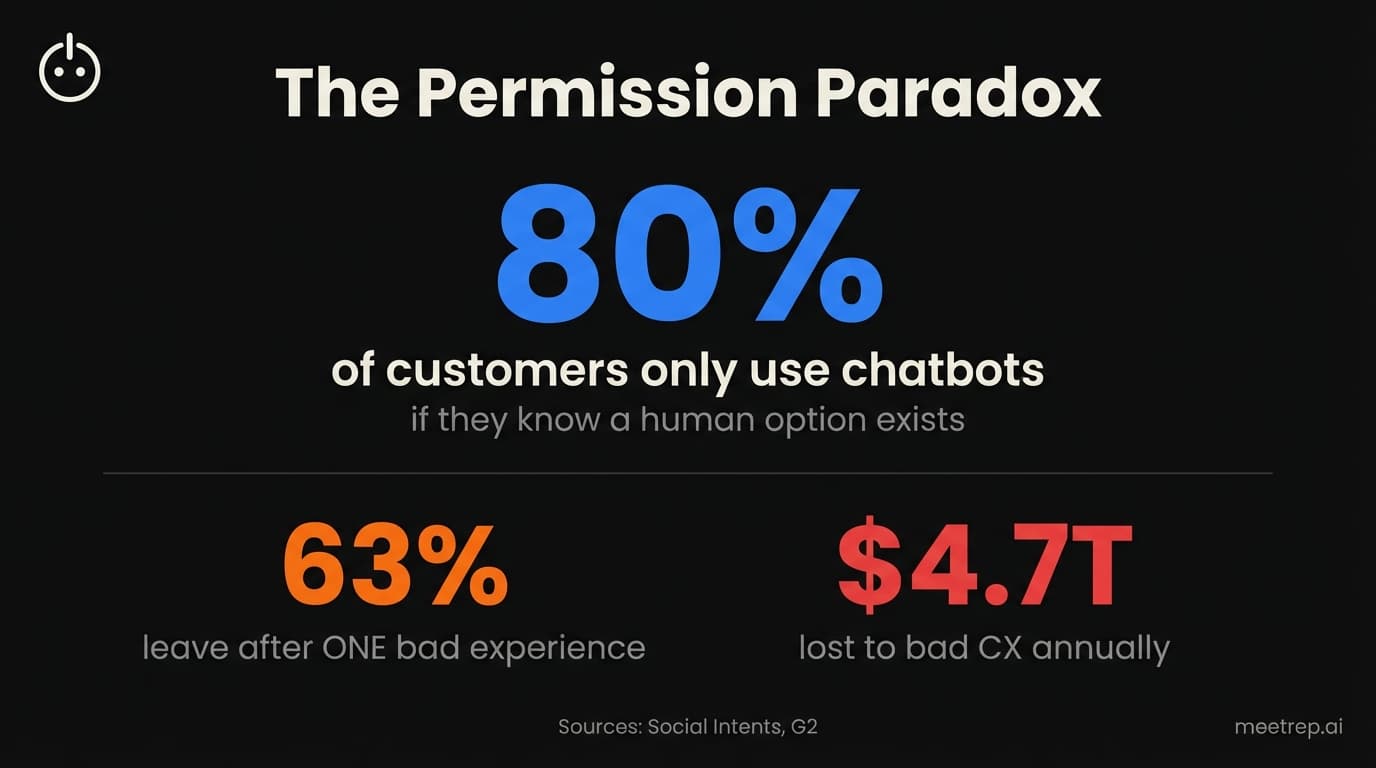
- 80% of customers only use chatbots if they know a human option exists
- Seven specific triggers should immediately escalate to human agents
- Warm transfers (with context) reduce handling time by 36.5% vs. cold transfers
- The metric that matters isn't "deflection rate"—it's resolution quality
Klarna saved $40 million by replacing 700 customer service agents with AI. Then they hired humans back.
The story became a cautionary tale across every sales floor in 2025. And it reveals something most vendors won't tell you: the ai human handoff—that moment when AI stops and a human starts—determines whether your automation becomes a competitive advantage or a PR disaster. Companies that get this right see 30%+ higher win rates, according to Bain & Company. Those that don't? They risk joining the $4.7 trillion lost annually to bad customer experiences.
I've built two sales automation products—GoCustomer.ai and now Rep. The hardest problem isn't the AI. It's knowing precisely when to get out of the AI's way.
Why Most AI Sales Implementations Fail at the Handoff
What exactly is an AI-human handoff? It's the transfer of a customer conversation from an automated AI system to a live human agent while preserving complete context—chat history, sentiment, and what the AI already tried. The goal: customers never repeat themselves, and agents pick up at "line ten, not line one."
Most AI sales support implementations fail not because the AI is bad, but because nobody designed the exit ramp. The AI gets stuck in a loop. The prospect gets frustrated. And by the time a human finally appears, the relationship is already damaged.
Here's the number that should terrify you: 63% of customers will leave after just one poor experience. One. Not three strikes. Not a pattern. One bad interaction with a bot that won't let them escape, and they're gone.
The Data:80% of customers will only use chatbots if they know a human option exists. Your AI isn't competing against human support—it's earning the right to try.
The problem compounds in sales. A support ticket resolved badly is annoying. A sales demo handled badly is revenue lost forever. And unlike support, you often don't get a second chance.
When we built GoCustomer.ai, I watched customers deploy automation without any escalation design. They'd optimize for "deflection rate"—how many conversations avoided humans. Six months later, they'd wonder why pipeline quality tanked.
Deflection isn't a success metric. It's a vanity metric that measures how good you are at avoiding customers.
The Klarna Effect: What Happens When You Get It Wrong
Klarna's story deserves a deeper look because it's not a failure story. It's a correction story. And the correction is more instructive than the mistake.
In 2024, Klarna's AI handled two-thirds of customer service. Resolution time dropped from 11 minutes to 2 minutes. They projected $40 million in annual savings. The work equivalent of 700 people—automated.
Then quality collapsed.
Key Insight: "We focused too much on efficiency and cost... The result was lower quality, and that's not sustainable. Really investing in the quality of the human support is the way of the future for us." — Sebastian Siemiatkowski, CEO, Klarna (Forbes, May 2025)
The problem wasn't the AI. The problem was the absence of escalation design. When conversations got complex, the AI kept trying. When customers got frustrated, the AI kept trying. When what was needed was a human with judgment, the AI kept trying.
Klarna's fix? A hybrid model with clear escalation protocols. Humans for complexity and emotional nuance. AI for speed and routine. The handoff itself designed as carefully as the AI.
This isn't just one company's problem. 44% of organizations experienced negative consequences from generative AI implementation, according to McKinsey. Nearly half. And most of those consequences trace back to the same root cause: no plan for when AI should stop.
The Seven Triggers That Demand Human Intervention
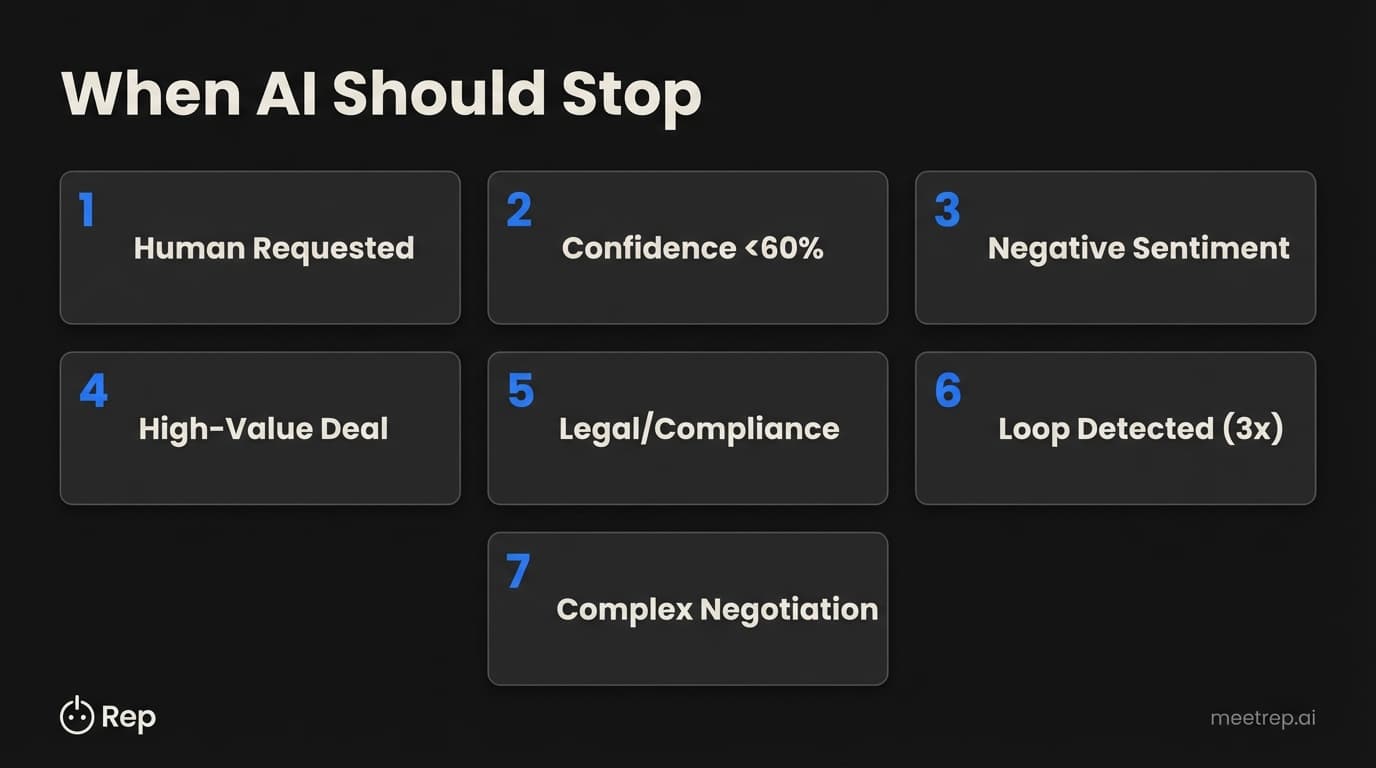
AI-human handoff works when you define exactly when it happens. Not "when needed" or "when appropriate"—those are invitations for disaster. You need specific, measurable triggers.
Based on research and what I've seen building in this space, seven scenarios should immediately escalate to a human:
- Customer explicitly requests a human. "I want to talk to a person." Respect this instantly. Any friction here destroys trust.
- AI confidence score drops below 60%. This is the industry standard threshold. When the AI isn't sure, don't let it guess. Guessing on pricing or product capabilities creates legal liability. (Ask Air Canada—their chatbot's misinformation cost them a court case.)
- Negative sentiment detected. Frustration, anger, repeated questions, ALL CAPS. The AI should recognize when someone's patience has ended and get out of the way.
- High-value purchase exceeds authorization limits. Enterprise deals, custom pricing, multi-year contracts. These justify human involvement because getting them wrong is expensive.
- Legal, compliance, or contract discussions. HIPAA, GDPR, SLAs, MSAs. If it could end up in legal review, a human should be in the loop.
- Conversation loops three or more times. Same objection raised, same question asked. The AI is stuck. Continuing wastes everyone's time.
- Complex negotiations or custom solutions. Non-standard configurations, integrations, multi-stakeholder decisions. These require judgment, not just information retrieval.
The Data: Industry benchmarks show 70-80% of routine inquiries can be AI-resolved, while 20-30% require human escalation. That 20-30% isn't failure—it's where the value is.
The goal isn't zero escalation. It's right escalation. At the right moment, with the right context.
Warm Transfers vs. Cold Transfers: Context Is Everything
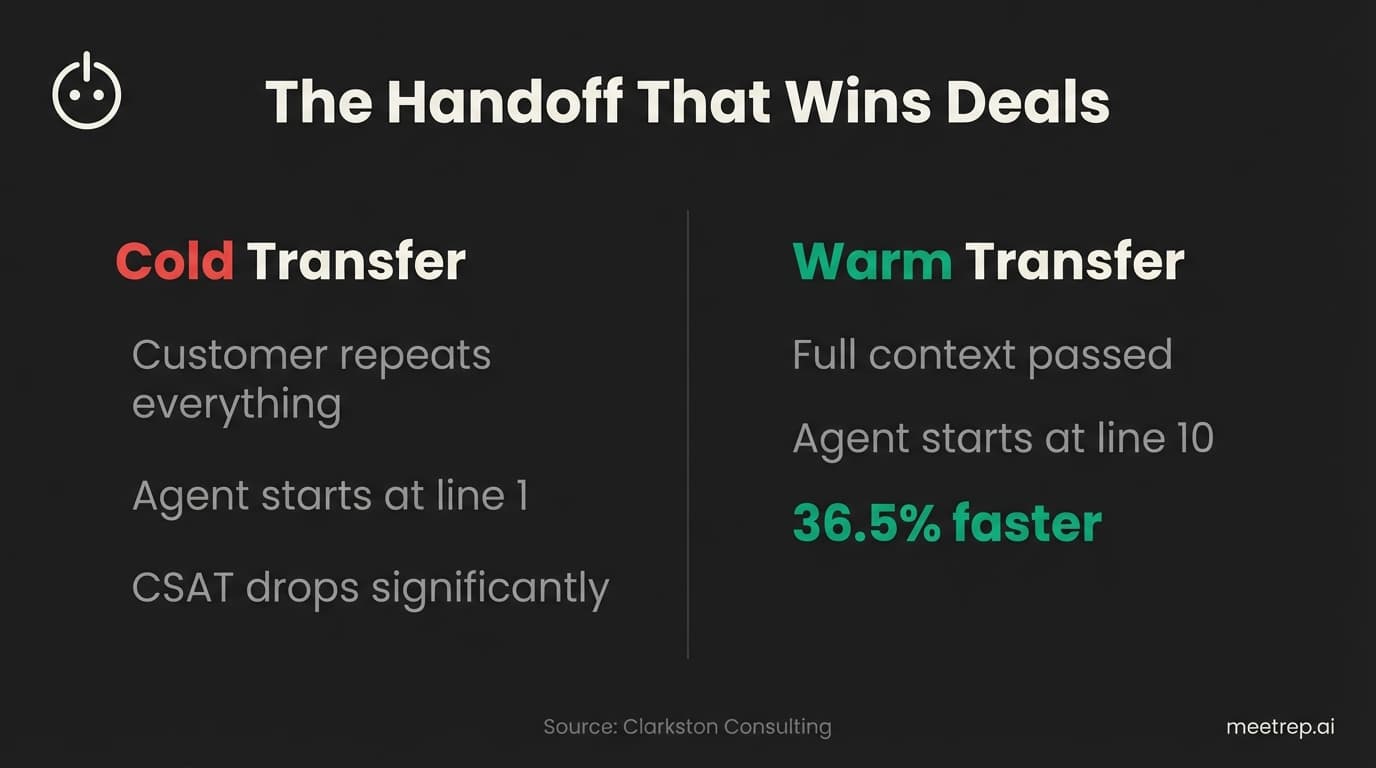
There's a moment in every bad handoff that kills the deal. The human agent joins and says: "Hi, how can I help you?"
And the prospect—who just spent five minutes explaining their situation to a bot—realizes they have to start over. From line one. Again.
This is the difference between warm transfers and cold transfers:
| Factor | Warm Transfer | Cold Transfer |
|---|---|---|
| Context passed | Full transcript, sentiment, attempted solutions | Minimal or none |
| First agent message | "I see you were asking about X. Here's how I can help..." | "Hi, how can I help?" |
| Customer feeling | Understood, valued | Frustrated, ignored |
| Handling time | 36.5% faster | Baseline |
| CSAT impact | Maintained at 85-90% | Drops significantly |
Warm transfers require more engineering. You need bidirectional CRM sync, real-time context packaging, and agent interfaces that surface information before the greeting. It's harder.
But cold transfers are a betrayal. They tell the customer that what they already said doesn't matter. That your convenience trumps their time.
What we learned at GoCustomer: We originally shipped cold transfers because warm was harder to build. Customer complaints tripled in the first month. We rebuilt the entire handoff system in six weeks. Should have done warm from day one.
The handoff package should include:
- Complete conversation transcript
- Customer sentiment classification
- What the AI already tried
- Confidence score and why it escalated
- Suggested next steps for the agent
- Urgency and priority score
When an agent starts at "line ten, not line one," everything moves faster.
What Top Performers Actually Measure
Stop measuring deflection rate. I know everyone does. I know your vendor dashboard puts it front and center. But it's the wrong metric.
Deflection measures how many conversations avoided humans. It doesn't measure whether problems got solved. Klarna had great deflection numbers right up until they had to reverse course publicly.
Here's what actually matters:
| Metric | Target | Why It Matters |
|---|---|---|
| Escalation rate | 5-10% (SaaS), 8-15% (Finance) | Too low = frustrated customers; too high = ineffective AI |
| Context utilization | >85% | Do agents use the handoff context? If not, your packaging is broken |
| Resolution time post-handoff | -36.5% vs. cold transfer | Measures context quality |
| CSAT post-escalation | ≥85% | Should match pure-human baseline |
| Repeat contact rate | <10% | Customer shouldn't need to call back |
Common mistake: Optimizing for escalation rate as a cost metric. When you pressure teams to reduce escalations, they let the AI struggle longer than it should. Prospects notice. Deals die.
The right framing: escalation is a feature, not a failure. Your goal is appropriate escalation at the right moment with complete context.
Sellers effectively partnering with AI are 3.7x more likely to meet quota, according to Gartner. The partnership requires knowing when AI adds value—and when it doesn't.
What This Means for Sales Demos
Demo handoffs work differently than support handoffs. The stakes are higher. The context is richer. And the moment of escalation often determines whether a deal advances or stalls.
Think about what happens in an AI-powered demo:
- AI handles: Initial discovery, standard product walkthrough, feature confirmation, FAQ responses
- Humans handle: Custom use case design, objection handling, pricing negotiation, closing
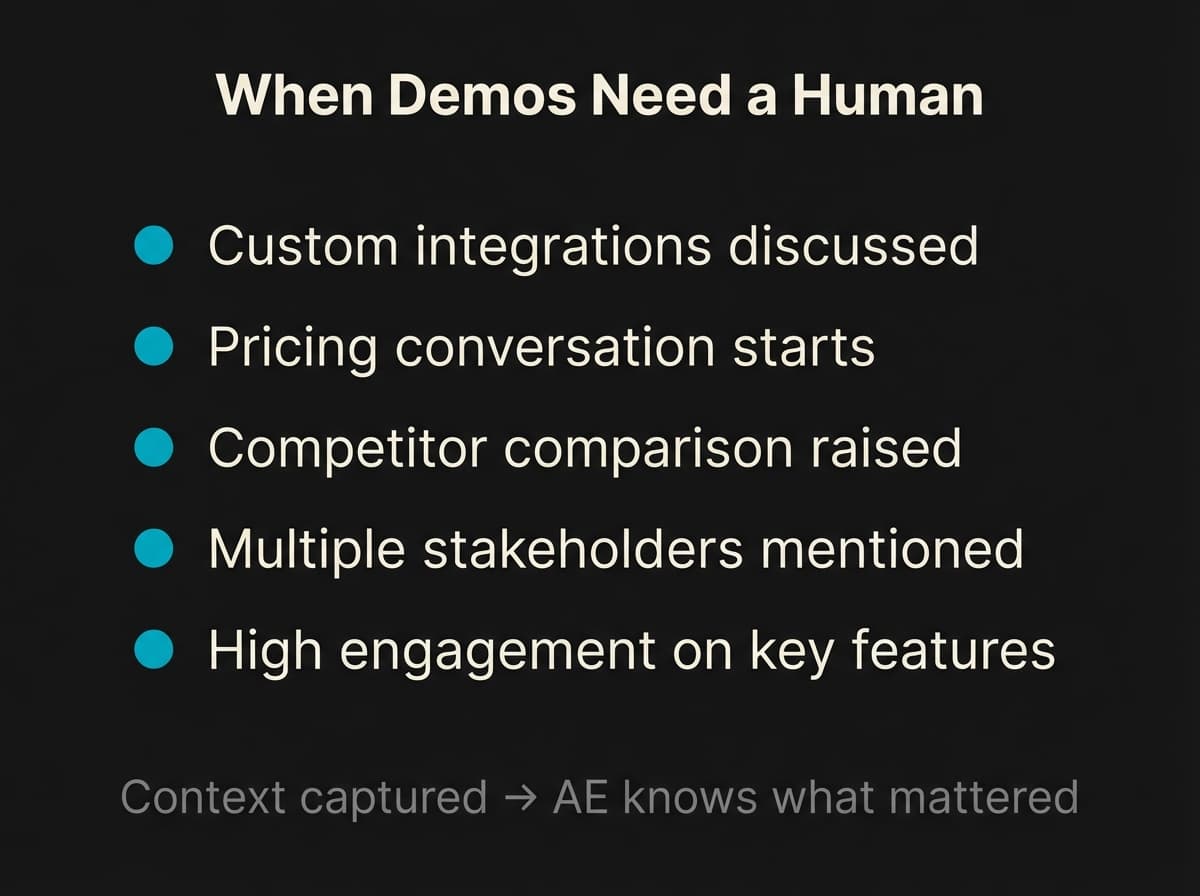
The escalation points are different too. A demo should escalate when:
- Prospect asks about custom integrations (requires technical depth)
- Pricing discussion starts (requires authorization)
- Competitor comparison comes up (requires strategic positioning)
- Multiple stakeholders mentioned (requires account strategy)
- High engagement with specific features (signals buying intent)
The context captured during a demo is gold. What did they click? What did they skip? What questions did they ask? When a human AE picks up, they should know all of this without asking.
This is why we built Rep to capture interaction context automatically. When it's time for human follow-up, the AE sees exactly what the prospect cared about—the features they explored, the questions they asked, the pain points they mentioned. No guessing required.
My recommendation: Don't treat demo handoffs like support handoffs. The intent signals are different. A prospect who spends three minutes on your integrations page is telling you something. Make sure that context reaches the human who closes the deal.
Key Insight:75% of B2B buyers will prefer sales experiences that prioritize human interaction over AI by 2030, according to Gartner. The winning approach isn't less human—it's smarter human deployment.
Here's what I've learned building automation products: the companies that win don't have the most sophisticated AI. They have the most thoughtful escalation design.
Guild Mortgage doubled lead response speed with AI while keeping humans for relationship-critical conversations. Reddit hit 46% case deflection and 84% faster resolution—but they designed the handoff first. The AI came second.
My prediction: by 2027, "escalation design" will be a standard job function in RevOps. Why? Because the cost of getting it wrong—the $4.7 trillion in bad experiences, the Klarna-style reversals, the deals that died in chatbot purgatory—is too high to leave to chance.
The question isn't whether to use AI in sales. It's whether you've designed the moment it should stop. If you're ready to see what thoughtful human-AI collaboration looks like in practice, see how Rep handles demo handoffs—context preserved, escalation designed, humans deployed where they matter.

Nadeem Azam
Founder
Software engineer & architect with 10+ years experience. Previously founded GoCustomer.ai.
Nadeem Azam is the Founder of Rep (meetrep.ai), building AI agents that give live product demos 24/7 for B2B sales teams. He writes about AI, sales automation, and the future of product demos.
Frequently Asked Questions
Table of Contents
- Why Most AI Sales Implementations Fail at the Handoff
- The Klarna Effect: What Happens When You Get It Wrong
- The Seven Triggers That Demand Human Intervention
- Warm Transfers vs. Cold Transfers: Context Is Everything
- What Top Performers Actually Measure
- What This Means for Sales Demos
Ready to automate your demos?
Join the Rep Council and be among the first to experience AI-powered demos.
Get Early AccessRelated Articles
Hexus Acquired by Harvey AI: Congrats & What It Means for Demo Automation Teams
Hexus is shutting down following its acquisition by Harvey AI. Learn how to manage your migration and discover the best demo automation alternatives before April 2026.
Why the "Software Demo" is Broken—and Why AI Agents Are the Future
The traditional software demo is dead. Discover why 94% of B2B buyers rank vendors before calling sales and how AI agents are replacing manual demos to scale revenue.
Why Autonomous Sales Software is the Future of B2B Sales (And Why the Old Playbook is Dead)
B2B sales is at a breaking point with quota attainment at 46%. Discover why autonomous 'Agentic AI' is the new standard for driving revenue and meeting the demand for rep-free buying.