The Death of the Generic Demo: Why Buyers Are Ghosting Your Sales Team

Executive Summary
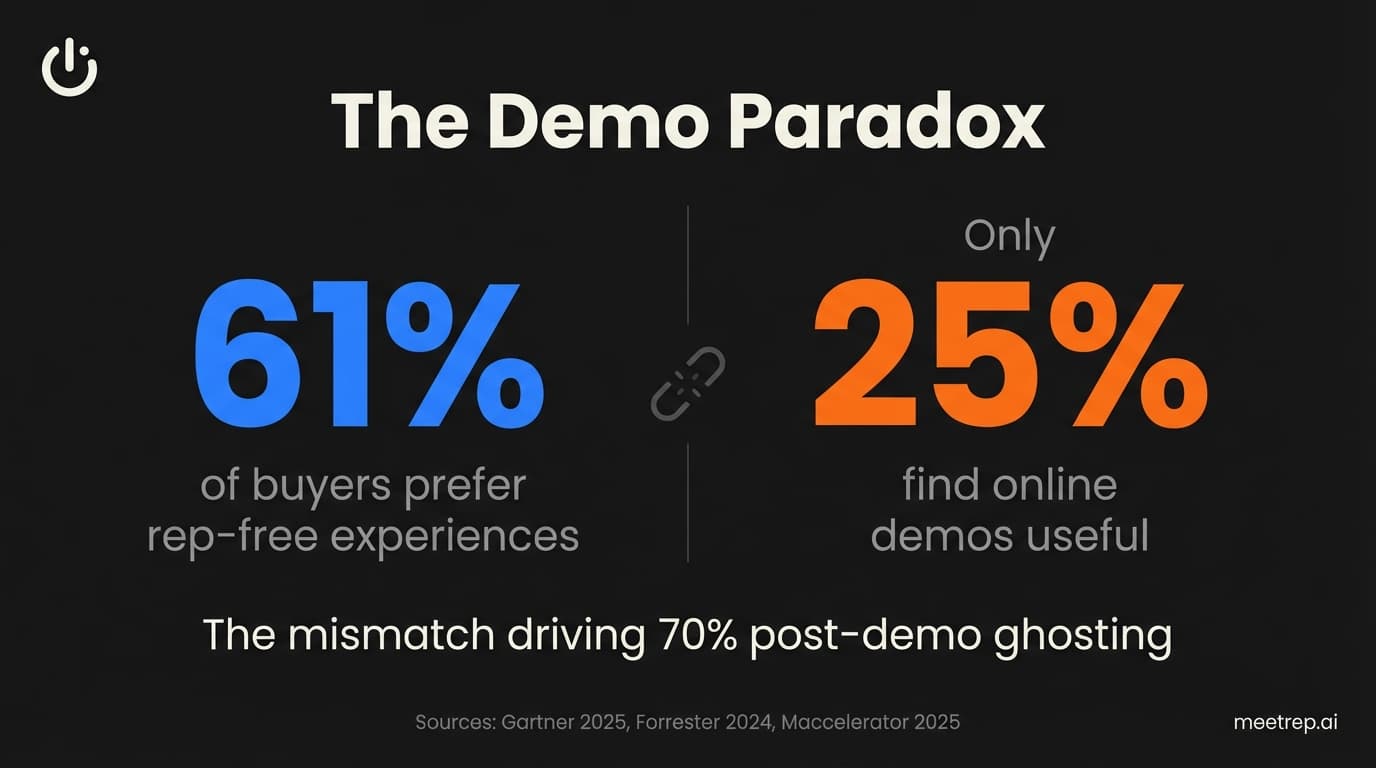
- 61% of B2B buyers now prefer a rep-free experience, yet only 25% find online demos useful—a massive mismatch
- 70% of prospects ghost after demos because generic walkthroughs fail to show workflow fit
- Interactive and autonomous demos convert 52% better (38% vs 25% average)
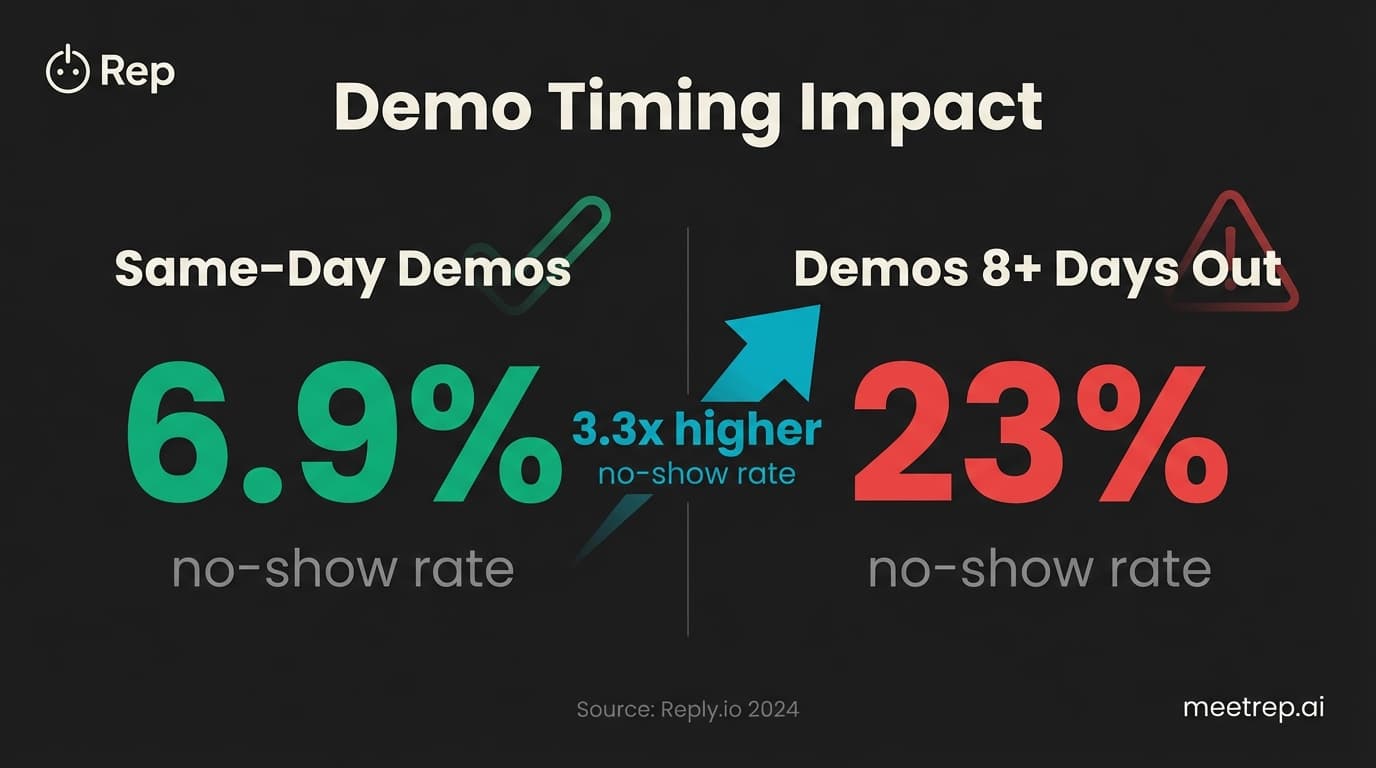
- Speed kills (in a good way): Same-day demos show 6.9% no-shows vs 23% for demos booked 8+ days out
Here's a stat that should make every sales leader uncomfortable: 70% of prospects who seem interested after a demo end up ghosting. Not declining. Not saying "not right now." Just... gone. Radio silence.
And it's not because your reps are bad at their jobs. The problem is structural. Your demo conversion rates are suffering because the entire model—schedule a call for next Tuesday, walk through a generic feature deck, hope they stay engaged—doesn't match how B2B buyers actually want to buy in 2025.
I've spent years building sales automation tools at GoCustomer.ai and now at Rep. The pattern I keep seeing: teams doing more demos but closing fewer deals. Something's broken.
This piece breaks down the data on why generic demos fail, what buyers actually want, and how to fix your conversion rates before your competitors figure it out first.
What's a Good Demo Conversion Rate? (The Benchmarks You Need)
Demo conversion rate measures the percentage of completed product demos that result in closed deals. The average B2B demo-to-close rate is 25%, but this varies dramatically by segment and demo type—interactive demos hit 38%, while screen-share presentations lag behind at 25% or lower.
Here's where most teams actually land, according to Optifai's 2025 benchmark of 939 companies:
| Segment | Demo-to-Close Rate |
|---|---|
| SMB | 32% |
| Mid-Market | 25% |
| Enterprise | 18% |
And by industry:
| Industry | Demo-to-Close Rate |
|---|---|
| SaaS | 30% |
| Professional Services | 22% |
| Manufacturing | 20% |
The number that should grab your attention: interactive demos convert at 38%. That's 52% higher than traditional screen-share demos. We'll get to why that matters shortly.
The Data: If your demo-to-close rate is below 25%, you're underperforming the average. Below 20%? You're leaving serious money on the table. Source: Optifai, Sales Ops Benchmark Q1-Q3 2025
But here's the thing—raw conversion percentages hide a bigger problem. What about all the demos that never happen? What about the 70% who go silent afterward?
Why Your Demos Are Failing: The Structural Problem
Generic demos fail because they assume the buyer is there to learn. They're not. According to Forrester's 2024 research, 92% of buyers start their evaluation with at least one vendor already in mind. And 41% have a single preferred vendor before they ever talk to sales.
Read that again. By the time someone books a demo with you, they've probably already made a mental shortlist. Your demo isn't for discovery. It's for validation.
So what happens when you walk them through a standard feature deck? You're telling them things they already know. Worse, you're wasting their time—and 73% of B2B buyers actively avoid suppliers who send irrelevant outreach, according to Gartner. A generic demo is irrelevant outreach with better production value.
Key Insight: Your demo isn't educating prospects—it's either validating their existing preference or disqualifying you. Generic feature dumps do neither well.
The result? Only 25% of surveyed buyers found online demos useful or helpful. Three out of four buyers sit through your demo and walk away thinking, "That didn't help me."
And when something doesn't help, people stop showing up.
The Ghosting Problem Is Worse Than You Think
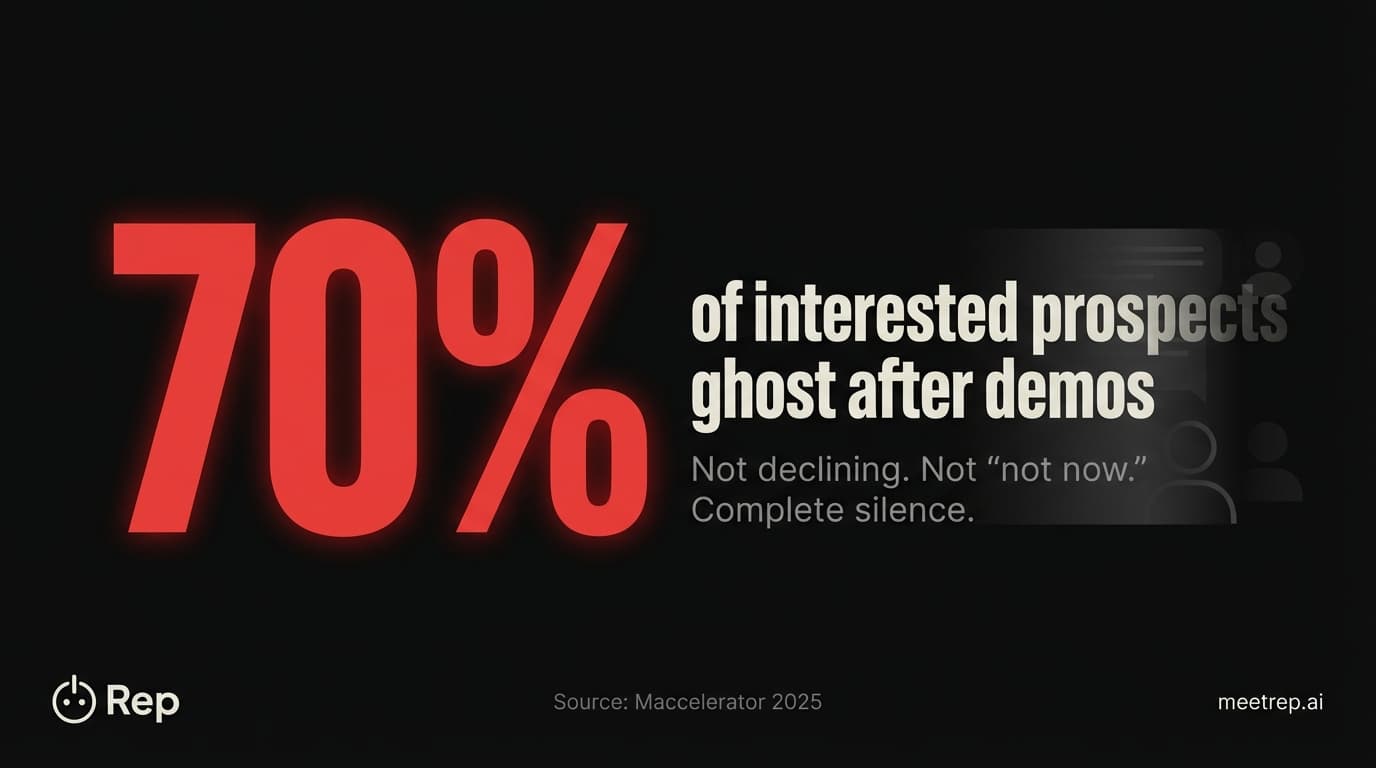
Let's talk about the elephant in the room. Ghosting.
It's not just anecdotal frustration. The data is brutal: 70% of prospects who seem interested after a demo end up ghosting, according to Maccelerator's 2025 analysis. That's not "not now"—that's complete silence.
Why? Five reasons keep coming up in the research:
1. Timing mismatch.Reply.io found that demos booked same-day have a 6.9% no-show rate. Demos booked 8+ days out? That jumps to 23%. The longer the gap, the more likely something else takes priority.
2. The demo didn't address their specific problem. That generic walkthrough? It showed features. It didn't show how their workflow would improve. Buyers don't care about your product's capabilities in the abstract. They care about their Tuesday afternoon.
3. You weren't first.6sense's 2025 Buyer Experience Report found that approximately 80% of deals are won by the vendor contacted first. If you're demo number three, you're fighting for the scraps.
4. Internal chaos. Gartner reports that 74% of B2B buyer teams demonstrate unhealthy conflict during buying decisions. Your champion might be sold—but their VP has different priorities. The deal stalls. You never hear why.
5. They found what they needed elsewhere.61% of B2B buyers now prefer a rep-free buying experience. If they can answer their questions without scheduling another call, they will.
What we learned at GoCustomer: Early on, we tracked what happened to leads who booked demos but never closed. The pattern wasn't "bad demos"—it was timing. By the time we could get them on a call, the urgency had faded. The pain that drove the initial request had been patched over or deprioritized. The demo happened too late to matter.
The Rise of the Rep-Free Buyer
Here's the shift that changes everything: 61% of B2B buyers now prefer a completely rep-free buying experience, according to Gartner's June 2025 survey.
That doesn't mean buyers hate salespeople. It means they hate friction.
They want answers at 2 AM when they're actually researching. They want to see the product in action without scheduling a Zoom for next Tuesday. They want to move at their pace, not yours.
And the data shows they're acting on this preference. 6sense found that buyers now contact sellers at 61% through their buying journey—down from 69% just a year earlier. They're doing more work themselves before ever raising their hand.
So what happens when their first human interaction is a generic demo that doesn't respect the research they've already done?
They ghost.
Key Insight: "Rep-free" doesn't mean "no sales." It means autonomous—buyers want to engage on their timeline, not yours. The companies winning are the ones who make that possible.
The teams still treating demos as "education sessions" are fighting the wrong battle. Buyers don't want to be educated. They want validation, speed, and the ability to self-serve the basic stuff so human time can go toward the complex stuff.
What Actually Works: The 7 Fixes That Move Numbers
Enough diagnosis. Here's what improves demo conversion rates based on 2025 data:
1. Reduce Time-to-Demo
The problem: Every day between "request" and "demo" increases no-show risk.
The data:Same-day demos show 6.9% no-show rates vs 23% for demos booked 8+ days out.
The fix: Stop routing demo requests to SDRs who schedule for next week. Offer same-day options. Better yet, offer instant options.
2. Deploy Instant Scheduling
The problem: Manual scheduling creates back-and-forth that kills momentum.
The data:Instant scheduling increases form-to-meeting conversion from 30% to 66.7%—more than doubling your booking rate.
The fix: Tools like Chili Piper and Calendly eliminate friction. If you're still doing "someone will reach out to schedule," you're losing more than half your potential meetings.
3. Use Interactive Demos
The problem: Static screen shares don't let prospects explore what matters to them.
The data:Interactive demos drive 20-30% higher win rates and show a 68.7% increase in click-through rates compared to static content.
The fix: Tools like Navattic let prospects click through your product. But there's a limitation—they're pre-recorded paths, not live conversations. For complex products, you need something that can actually respond to questions in real-time.
4. Respond First
The problem: If you're not the first vendor to respond, you're already disadvantaged.
The data:Approximately 80% of deals are won by the vendor contacted first. And responding within 5 minutes makes you 10x more likely to successfully contact the lead.
The fix: After-hours lead response can't wait until morning. This is where autonomous systems—AI agents that can engage immediately—become competitive advantages, not nice-to-haves.
5. Personalize to Their Context
The problem: Generic decks ignore the research buyers have already done.
The data:73% of buyers actively avoid suppliers sending irrelevant outreach. A generic demo feels like irrelevant outreach.
The fix: Research their company and role before the demo. Better yet, use tools that adapt in real-time based on what the prospect asks and clicks.
6. Ungate Your Demos
The problem: Forcing people to fill out forms before seeing anything creates unnecessary friction.
The data:Ungated demos have 10% higher engagement rates than gated demos.
The fix: Let people see the product. Capture intent through engagement signals (what they click, how long they stay) rather than demanding email addresses upfront.
7. Don't Make Them Wait for a Human
The problem: Buyers want instant access. Your team can't be available 24/7.
The data:Sales teams using AI saw 83% revenue growth vs 66% for teams without AI. The gap is widening.
The fix: This is why we built Rep. An AI agent that joins video calls, shares its screen, moves through your product live, and answers questions in real-time—24/7. It's not a chatbot. It's not a pre-recorded tour. It's live product demonstration without requiring your team to be on the call.
| Fix | Impact | Source |
|---|---|---|
| Same-day demos | 70% reduction in no-shows (6.9% vs 23%) | Reply.io 2024 |
| Instant scheduling | 122% increase in form-to-meeting (30% → 66.7%) | Chili Piper 2025 |
| Interactive demos | 52% higher conversion rates (25% → 38%) | Optifai 2025 |
| First response | 80% of deals won by first vendor | 6sense 2025 |
| AI-assisted selling | 26% more likely to hit growth targets | Salesforce 2024 |
Generic vs. Modern Demos: A Direct Comparison
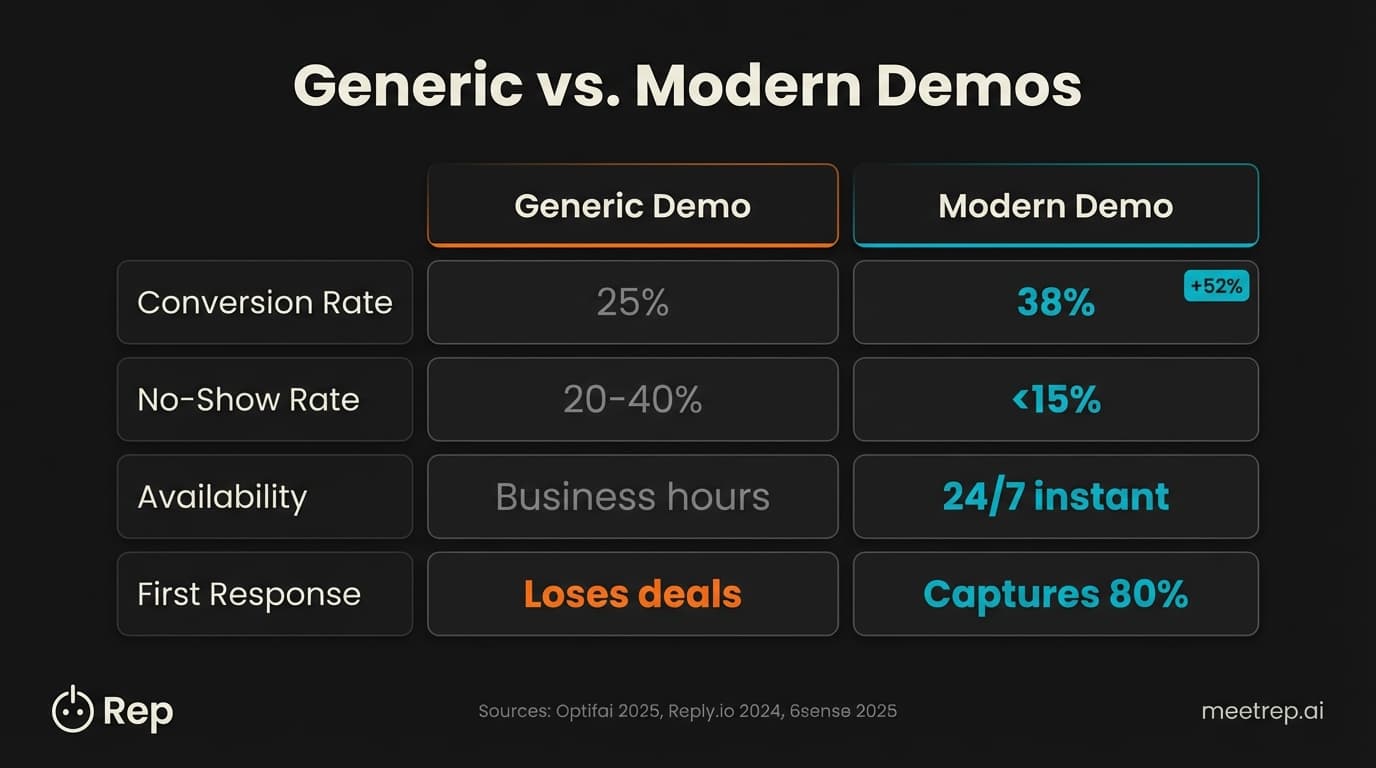
Let's put this side by side:
| Factor | Generic Demo | Interactive/Autonomous Demo |
|---|---|---|
| Conversion rate | 25% average | 38%+ with interactive (+52%) |
| No-show rate | 20-40% industry average | Under 15% (top performers) |
| Buyer perception | Only 25% find useful | 68.7% higher engagement |
| Availability | Business hours, scheduled | 24/7, instant access |
| Personalization | Presenter-dependent | Adapts to prospect questions |
| First-mover advantage | Loses to faster competitors | Captures 80% first-response wins |
The gap isn't subtle. And it's getting wider as buyer expectations shift.
The Data:86% of B2B purchases stall during the buying process. Even if prospects don't ghost, the deal often dies from internal friction. Speed and instant access reduce the window where things can stall.
The Future Is Hybrid—But Not How You Think
Look, here's my honest take: AI isn't replacing human salespeople for complex deals. The complexity of enterprise negotiations, the relationship building required for seven-figure contracts—that still needs humans.
But here's what doesn't need humans: the first demo.
The intro call. The "let me show you around the product." The after-hours inquiry from someone in a different time zone. The tire-kicker who might become a real buyer if they could just see the thing.
Gartner's 2030 predictions suggest human interaction remains critical for complex deals—but the initial engagement is moving autonomous. The companies adapting fastest will capture market share from those still asking buyers to "schedule a call for next Tuesday."
My prediction: within two years, having instant, autonomous demo capability will be table stakes for any SaaS company selling to technical buyers. The teams that figure this out now get a window where they're responding faster, converting higher, and letting their human reps focus on the deals that actually need human judgment.
The teams that wait will wonder why their pipeline keeps shrinking.
The generic demo isn't just underperforming. It's actively working against how buyers want to buy. They've done their research. They want validation, not education. They want speed, not "how's next Tuesday?"
The sales teams winning right now aren't the ones doing more demos—they're the ones making demos instant, interactive, and available when buyers are ready. Not next week. Now.
That's why we built Rep to deliver live product demos 24/7—with real conversations, real screen sharing, real-time answers. No scheduling friction. No "someone will reach out."
The question isn't whether your demo process needs to change. It's whether you'll change it before your competitors do.

Nadeem Azam
Founder
Software engineer & architect with 10+ years experience. Previously founded GoCustomer.ai.
Nadeem Azam is the Founder of Rep (meetrep.ai), building AI agents that give live product demos 24/7 for B2B sales teams. He writes about AI, sales automation, and the future of product demos.
Frequently Asked Questions
Table of Contents
- What's a Good Demo Conversion Rate? (The Benchmarks You Need)
- Why Your Demos Are Failing: The Structural Problem
- The Ghosting Problem Is Worse Than You Think
- The Rise of the Rep-Free Buyer
- What Actually Works: The 7 Fixes That Move Numbers
- Generic vs. Modern Demos: A Direct Comparison
- The Future Is Hybrid—But Not How You Think
Ready to automate your demos?
Join the Rep Council and be among the first to experience AI-powered demos.
Get Early AccessRelated Articles
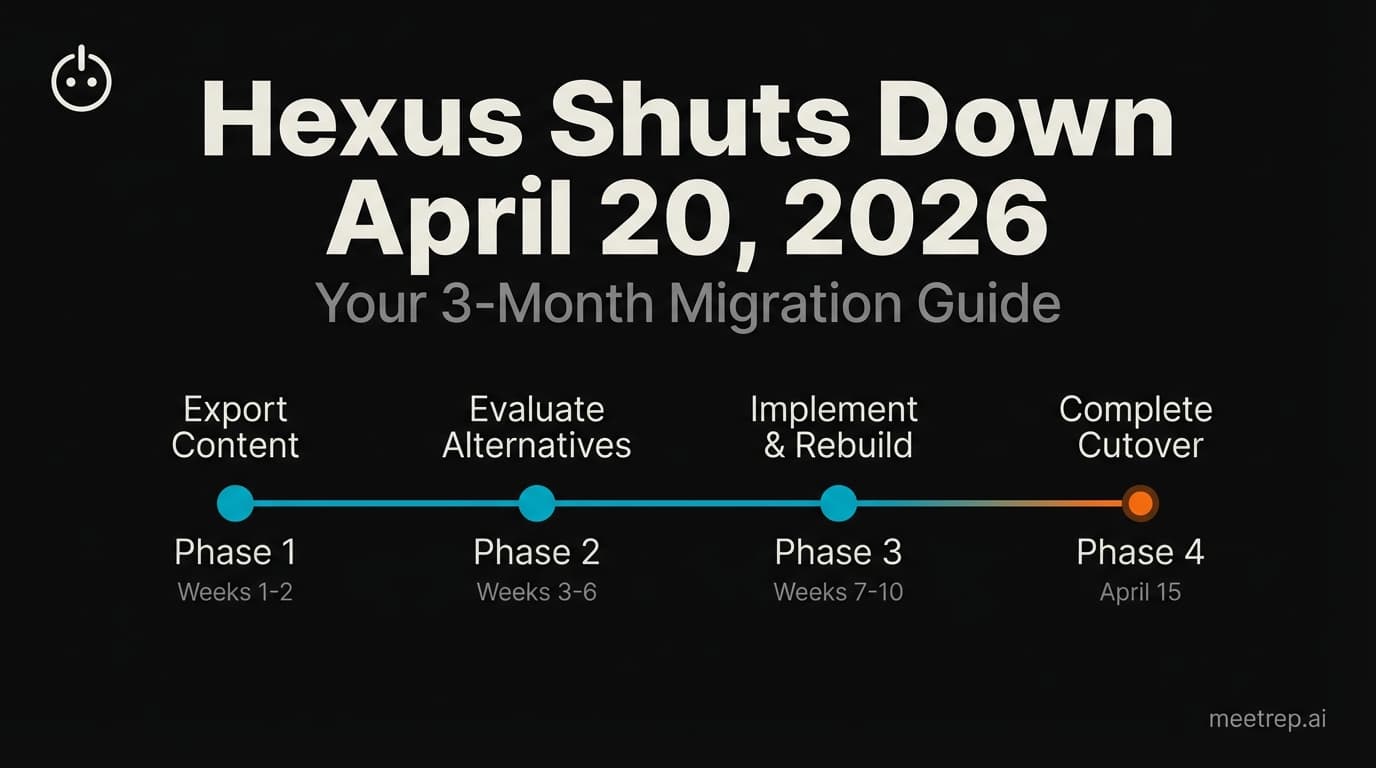
Hexus Acquired by Harvey AI: Congrats & What It Means for Demo Automation Teams
Hexus is shutting down following its acquisition by Harvey AI. Learn how to manage your migration and discover the best demo automation alternatives before April 2026.
Why the "Software Demo" is Broken—and Why AI Agents Are the Future
The traditional software demo is dead. Discover why 94% of B2B buyers rank vendors before calling sales and how AI agents are replacing manual demos to scale revenue.
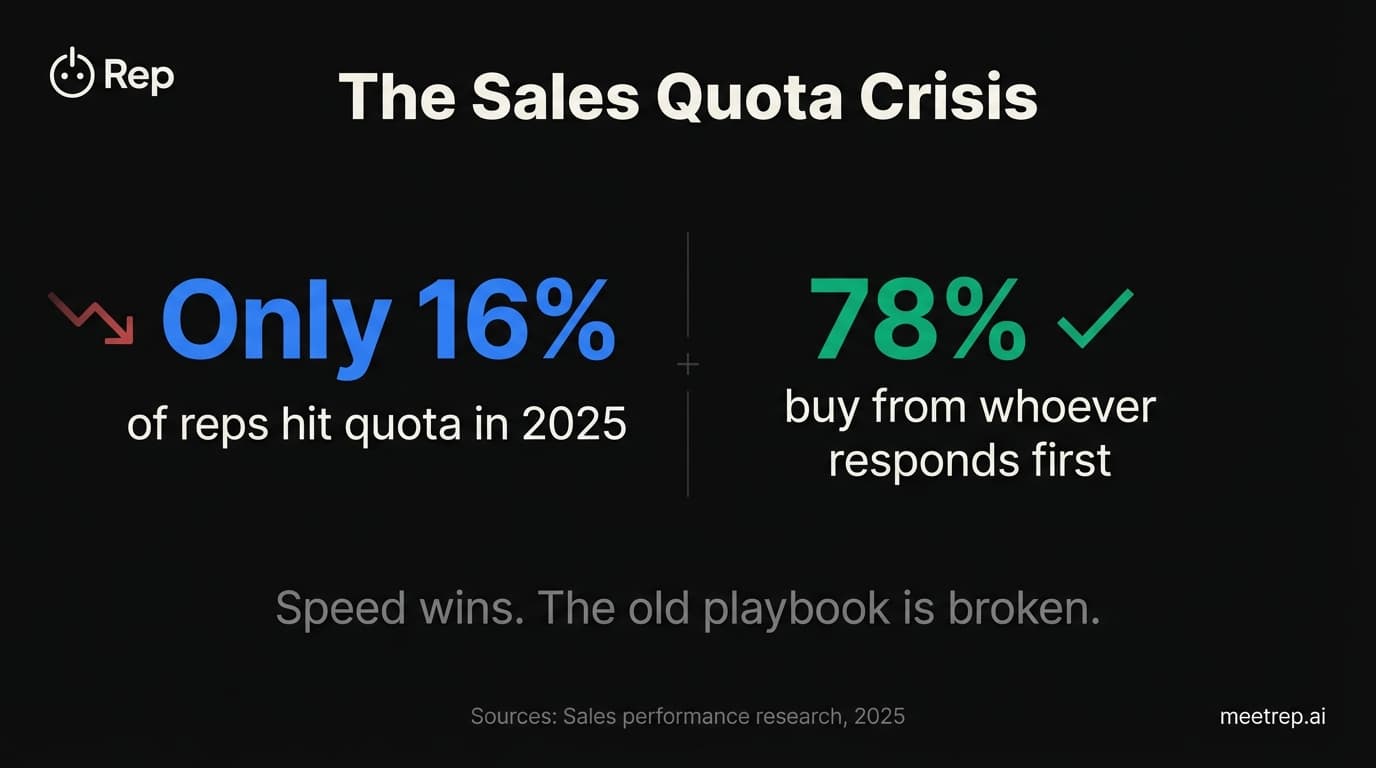
Why Autonomous Sales Software is the Future of B2B Sales (And Why the Old Playbook is Dead)
B2B sales is at a breaking point with quota attainment at 46%. Discover why autonomous 'Agentic AI' is the new standard for driving revenue and meeting the demand for rep-free buying.