The Cost of Slow Demo Response: Why Speed to Lead Is Killing Your Pipeline

Executive Summary
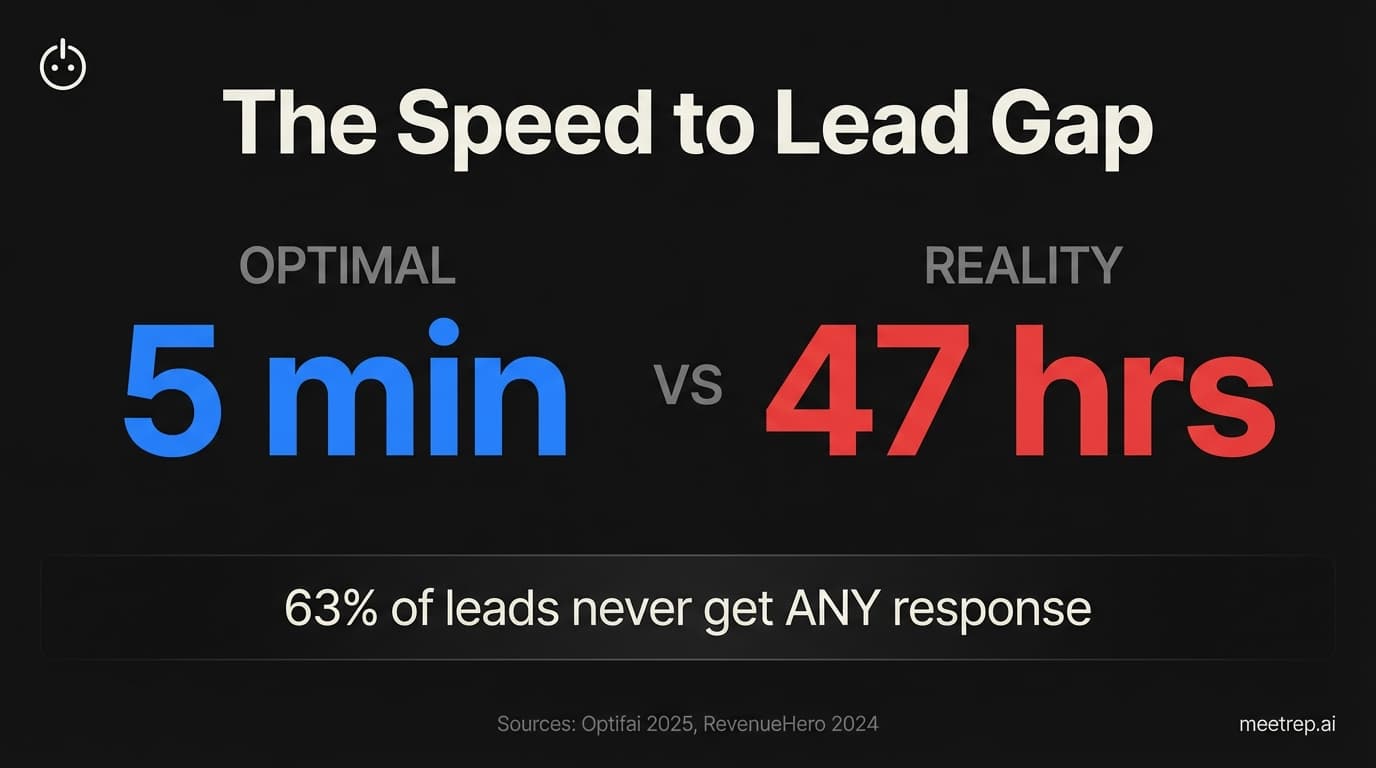
- The average B2B lead response time is 47 hours. 63% of leads never get any response at all.
- Responding in under 5 minutes yields a 2.6x higher close rate than waiting 24+ hours.
- Only 23% of companies hit the 5-minute benchmark. In one study, zero out of 114 companies called within 5 minutes.
- The problem isn't lazy reps—it's system architecture. Processing time often exceeds human response time.
In 2024, only 16% of sales reps hit quota. The lowest number on record. Meanwhile, the average B2B company takes 47 hours to respond to an inbound lead. These two numbers aren't unrelated.
I've spent years building sales automation tools—first at GoCustomer.ai, now at Rep. And I keep seeing the same pattern: teams spend thousands generating leads, then let them die waiting for a callback. Speed to lead isn't just a metric. It's the difference between a conversation and a missed opportunity.
This post breaks down the 2025 data on lead response times—what's actually happening, why it costs you deals, and what to do about it.
What Is Speed to Lead?
Speed to lead measures the time between when a prospect takes action—filling out a form, requesting a demo, clicking "contact us"—and when your team makes first contact. It's also called lead response time. Same thing.
LeanData breaks it into two components: processing time (system delays before a rep even sees the lead) plus rep response time (how fast the human acts). Most teams obsess over the second part while ignoring the first.
Here's what I've learned: processing time is often the bigger problem. Lead sits in a routing queue. CRM sync takes 15 minutes. Round-robin assignment happens at the top of the hour. By the time a rep gets notified, that "hot" lead is already checking their inbox for your competitor's response.
Why Speed to Lead Matters: The Decay Curve
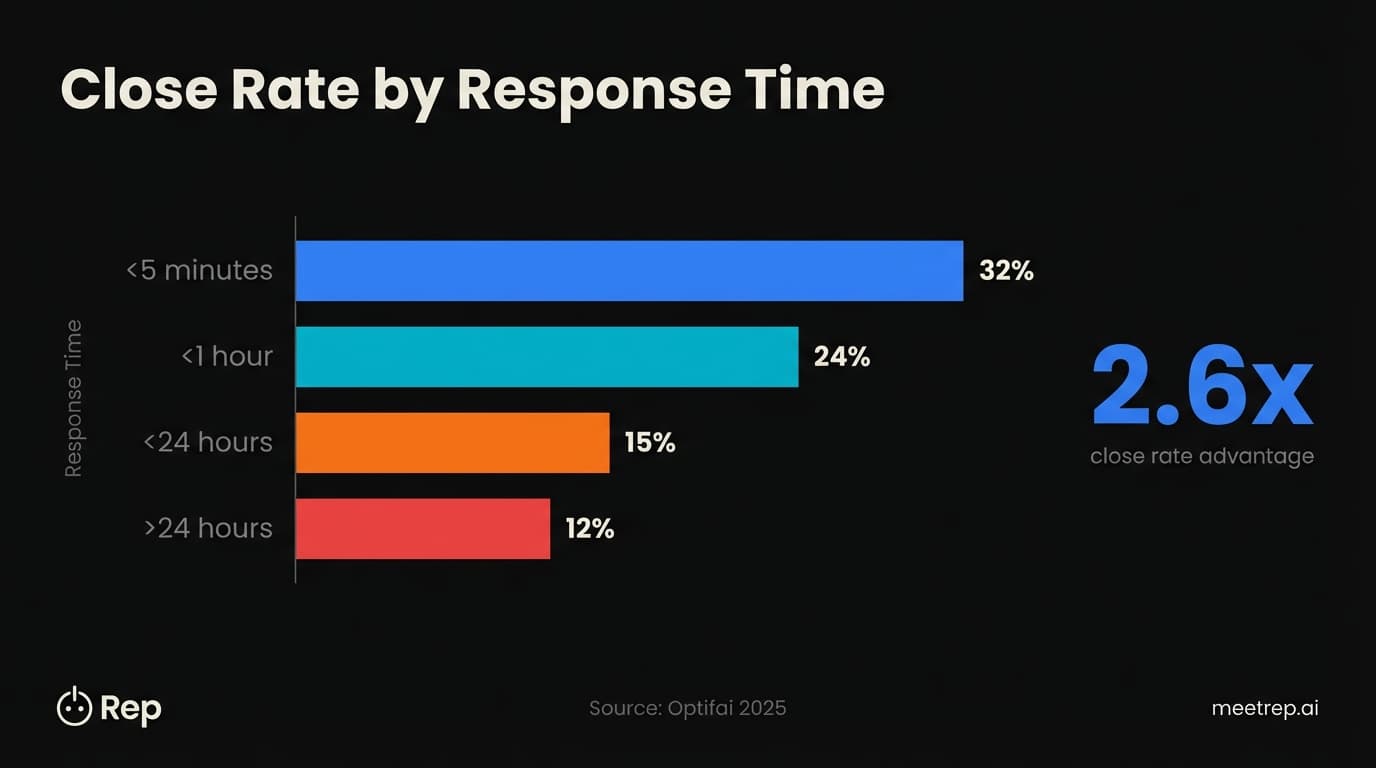
The relationship between response time and conversion isn't linear. It's exponential decay.
According to Optifai's 2025 study of 939 B2B companies, here's what happens to your close rate as time passes:
| Response Time | Close Rate | Performance vs. Best |
|---|---|---|
| Under 5 minutes | 32% | Baseline |
| Under 1 hour | 24% | -25% |
| Under 24 hours | 15% | -53% |
| Over 24 hours | 12% | -63% |
Read that last row again. Waiting more than 24 hours cuts your close rate by 63%. That's not a rounding error. That's leaving two-thirds of your potential revenue on the table.
Key Insight: The 5-minute window isn't arbitrary. It's when prospects are still in "research mode"—browser open, comparing options, ready to engage. Wait an hour, and they've moved on to the next task. Wait a day, and they've forgotten why they reached out.
The famous MIT study from 2007 found you're 21x more likely to qualify a lead within 5 minutes versus 30 minutes. Some people dismiss that as old data. But the 2025 numbers from Optifai tell the same story: speed wins. The mechanism hasn't changed, even if the competitive bar has risen.
The Reality: How Slow Most Companies Actually Are
I wish I could tell you most teams have figured this out. They haven't.
The 2025 benchmarks paint a brutal picture:
- 47 hours: Average B2B lead response time (Optifai 2025)
- 63%: Businesses that never respond at all (RevenueHero 2024)
- 23%: Companies responding in under 5 minutes (Optifai 2025)
- 55%: Companies taking longer than 5 days to respond (Gitnux 2025)
And then there's the Workato study. They ran a mystery shopper test across 114 B2B companies. Submitted real lead forms. Waited to see what would happen.
The Data: Out of 114 companies tested, exactly zero called within 5 minutes. Not one. The average personalized email took 11 hours and 54 minutes to arrive. (Workato 2024)
Zero. Let that sink in.
I've seen this firsthand. At GoCustomer, we'd watch leads come in and sit untouched in Salesforce for hours. Not because reps were slacking—they were in meetings, on other calls, eating lunch. Human stuff. But the lead didn't care about lunch schedules. By afternoon, they'd already booked a demo with someone who responded faster.
What's Actually Causing the Delay
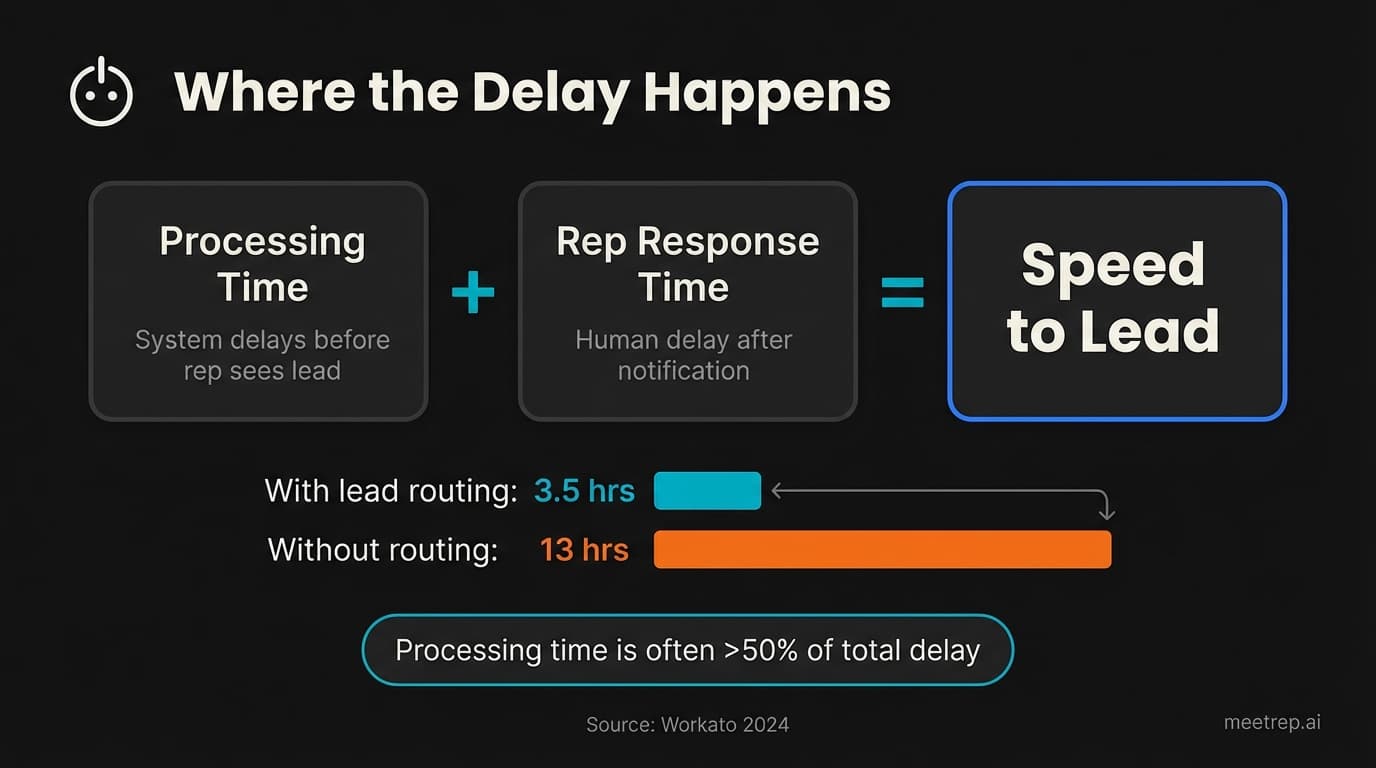
So why is everyone so slow? It's not because sales teams are lazy. The delays compound at multiple points:
Processing time delays:
- Lead routing rules take time to execute
- CRM sync isn't instantaneous (especially across tools)
- Lead-to-account matching runs in batches
- Assignment logic waits for availability rules
Rep response time delays:
- Rep is in a meeting
- Lead arrives after hours or on weekends
- Rep prioritizes other tasks first
- No mobile alerts configured
Demo scheduling delay: Even when a rep responds fast, booking the actual demo creates friction. Back-and-forth emails. Time zone confusion. Calendar ping-pong.
What we learned at GoCustomer: When we broke down our average response time, processing delays accounted for more than half. The CRM wasn't syncing in real-time. Routing rules ran on a schedule. We thought we had a "rep speed" problem, but we had an architecture problem.
Workato's data confirms this: companies using lead routing tools averaged 3 hours 32 minutes. Those without? About 13 hours. The tools help—but even "fast" is still miles from the 5-minute target.
The 24/7 Coverage Problem
Here's a challenge nobody wants to talk about: your prospects don't work your hours.
A lead comes in at 11 PM on a Saturday. They're doing research, comparing options, ready to engage. Your team? Gone until Monday. By then, that lead has talked to three competitors.
Jason Lemkin, founder of SaaStr, put it bluntly:
"AI agents respond instantly at 11 PM on Saturday nights. They never get tired. They never cherry-pick the best leads." — Jason Lemkin, SaaStr 2025
And it's not just after-hours. B2B buying committees now average 10-11 stakeholders. Each one researches on their own schedule. Each one might request information at different times. Manual coverage can't keep up with that kind of fragmentation.
This is a big part of why we built Rep. My view is that the future belongs to tools that can engage prospects instantly, any time of day—giving them the product walkthrough they want when they want it, not when your calendar opens up. That's not about replacing reps. It's about ensuring 100% of leads get worked—not 37%.
Industry Benchmarks: Where You Stand
Response times vary by industry, but none are fast enough:
| Industry | Average Response Time | % Responding <5 min |
|---|---|---|
| B2B SaaS | 38 hours | 28% |
| Professional Services | Not specified | 22% |
| Consulting | Not specified | 18% |
| Manufacturing | 62 hours | 15% |
Source: Optifai 2025
B2B SaaS leads the pack—and still, 72% of companies miss the 5-minute window. Manufacturing is even worse. 62 hours average. That's nearly three days.
Interesting outlier: Hennessey Digital's 2025 study of the legal industry found 25% of law firms now respond in under 5 minutes, up from 13% in 2021. The competitive bar is rising. Some industries are figuring it out. Is yours?
What Actually Works: Fixing Speed to Lead
Telling your reps to "respond faster" is lazy advice. It's like telling someone to drive faster when their car has a flat tire.
Here's what actually moves the needle:
1. Fix processing time first. Audit your lead flow from form submission to rep notification. Where are the delays? Real-time CRM sync. Instant routing. Push notifications to mobile. Kill the batch processes.
2. Implement instant booking. Let prospects schedule demos directly from the form. No back-and-forth. Chili Piper's data shows 66.7% form-to-meeting conversion with instant booking. That's not incremental—that's a step change.
3. Build 24/7 coverage. You have three options: global teams across time zones (expensive), on-call rotations (burnout), or automation. This is where AI-powered demo tools fit in—solutions that can engage prospects with interactive product experiences the moment they want one, not when your calendar opens up.
My recommendation: Start with measurement. Most teams don't actually know their speed to lead. They guess. Pull the data. Calculate time from form submission to first meaningful contact. Break it down by processing time vs. rep response time. You can't fix what you don't measure.
4. Separate lead types. A demo request and a whitepaper download aren't the same thing. Demo requests need instant response. Content downloads can go into nurture sequences. Treat them identically and you'll waste resources while still dropping the ball on high-intent leads.
The Math Nobody Does
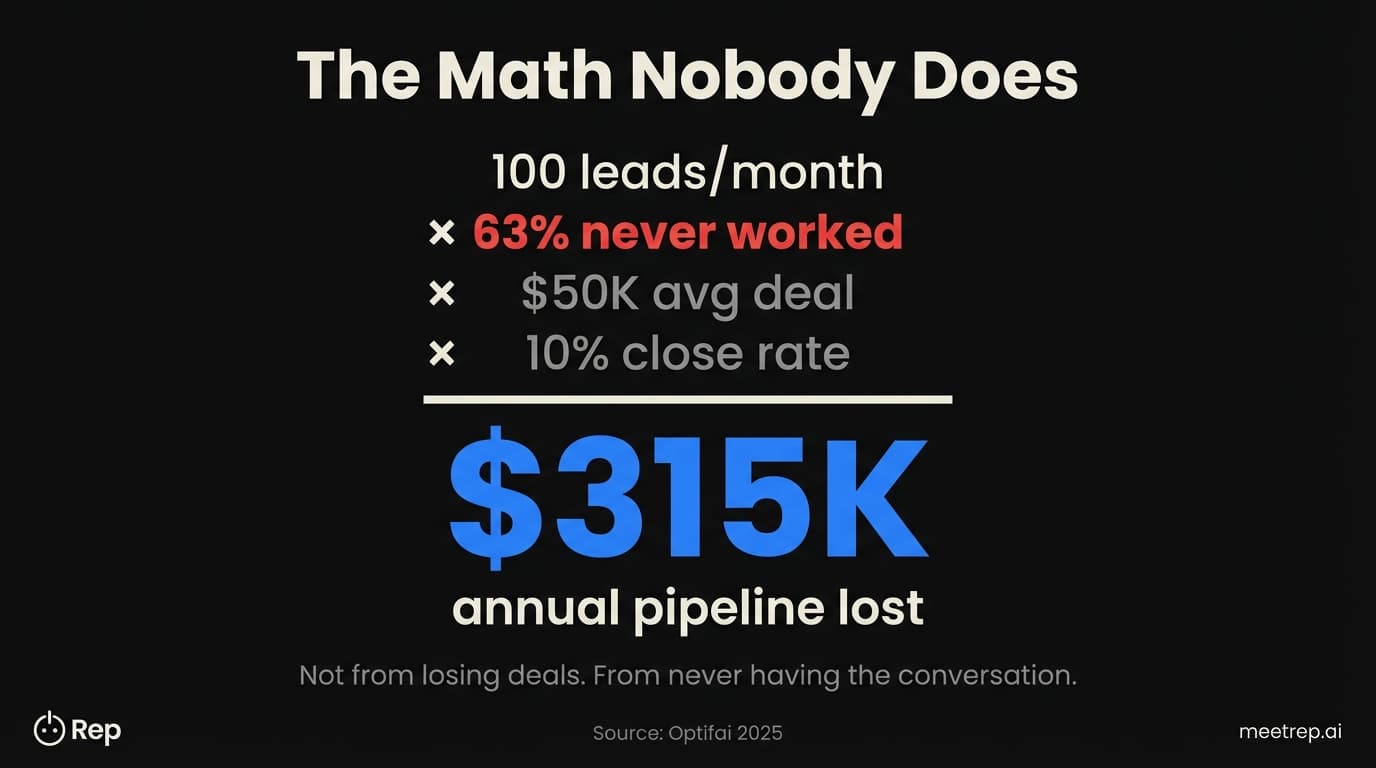
Here's a quick calculation most teams skip:
Say you get 100 inbound leads per month. Average deal size is $50,000. If 63% never get a response (industry average), that's 63 leads gone before anyone talks to them.
Even at a conservative 10% close rate on worked leads, you're leaving $315,000 in annual pipeline on the table. Not from losing competitive deals. From never having the conversation.
That's the cost of slow. And it compounds every month.
The speed-to-lead problem isn't going away. If anything, it's getting worse. Buying committees are larger. Prospects research across more channels. Attention spans are shorter.
I think the companies that win over the next few years won't be the ones with the best reps—they'll be the ones who ensure every lead gets immediate attention. Whether that's through better systems, smarter routing, or AI that can engage prospects at 3 AM.
At Rep, we're betting on the last option. But whatever approach you take, start with the data. Measure your actual speed to lead. Look at the decay curve. Do the math on what slow is costing you.
Because 47 hours isn't a response time. It's a missed opportunity.

Nadeem Azam
Founder
Software engineer & architect with 10+ years experience. Previously founded GoCustomer.ai.
Nadeem Azam is the Founder of Rep (meetrep.ai), building AI agents that give live product demos 24/7 for B2B sales teams. He writes about AI, sales automation, and the future of product demos.
Frequently Asked Questions
Table of Contents
- What Is Speed to Lead?
- Why Speed to Lead Matters: The Decay Curve
- The Reality: How Slow Most Companies Actually Are
- What's Actually Causing the Delay
- The 24/7 Coverage Problem
- Industry Benchmarks: Where You Stand
- What Actually Works: Fixing Speed to Lead
- The Math Nobody Does
Ready to automate your demos?
Join the Rep Council and be among the first to experience AI-powered demos.
Get Early AccessRelated Articles
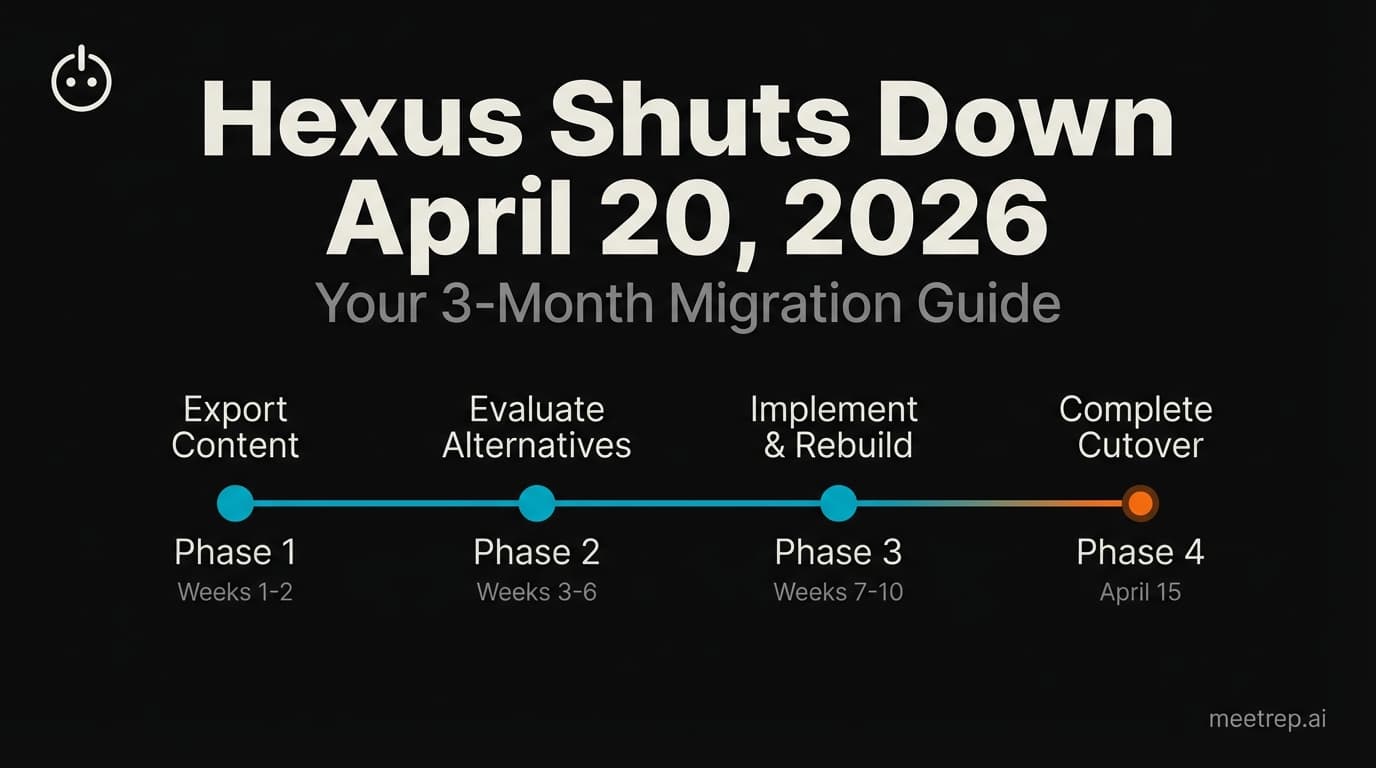
Hexus Acquired by Harvey AI: Congrats & What It Means for Demo Automation Teams
Hexus is shutting down following its acquisition by Harvey AI. Learn how to manage your migration and discover the best demo automation alternatives before April 2026.
Why the "Software Demo" is Broken—and Why AI Agents Are the Future
The traditional software demo is dead. Discover why 94% of B2B buyers rank vendors before calling sales and how AI agents are replacing manual demos to scale revenue.
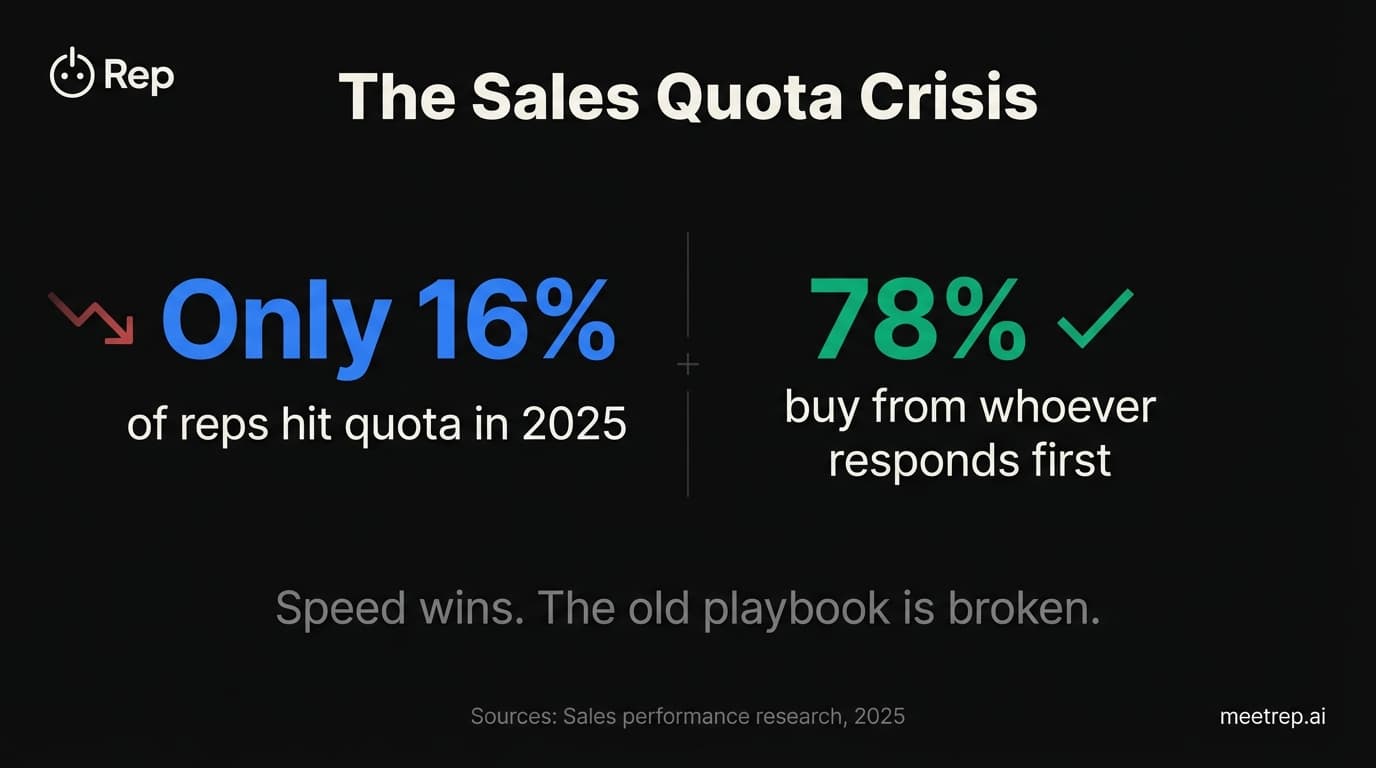
Why Autonomous Sales Software is the Future of B2B Sales (And Why the Old Playbook is Dead)
B2B sales is at a breaking point with quota attainment at 46%. Discover why autonomous 'Agentic AI' is the new standard for driving revenue and meeting the demand for rep-free buying.