The CISO's Guide to AI Security for Sales Agents: From "Block" to "Secure Yes"

Executive Summary
- 97% of AI breaches occurred at organizations lacking proper access controls—security fundamentals still matter most
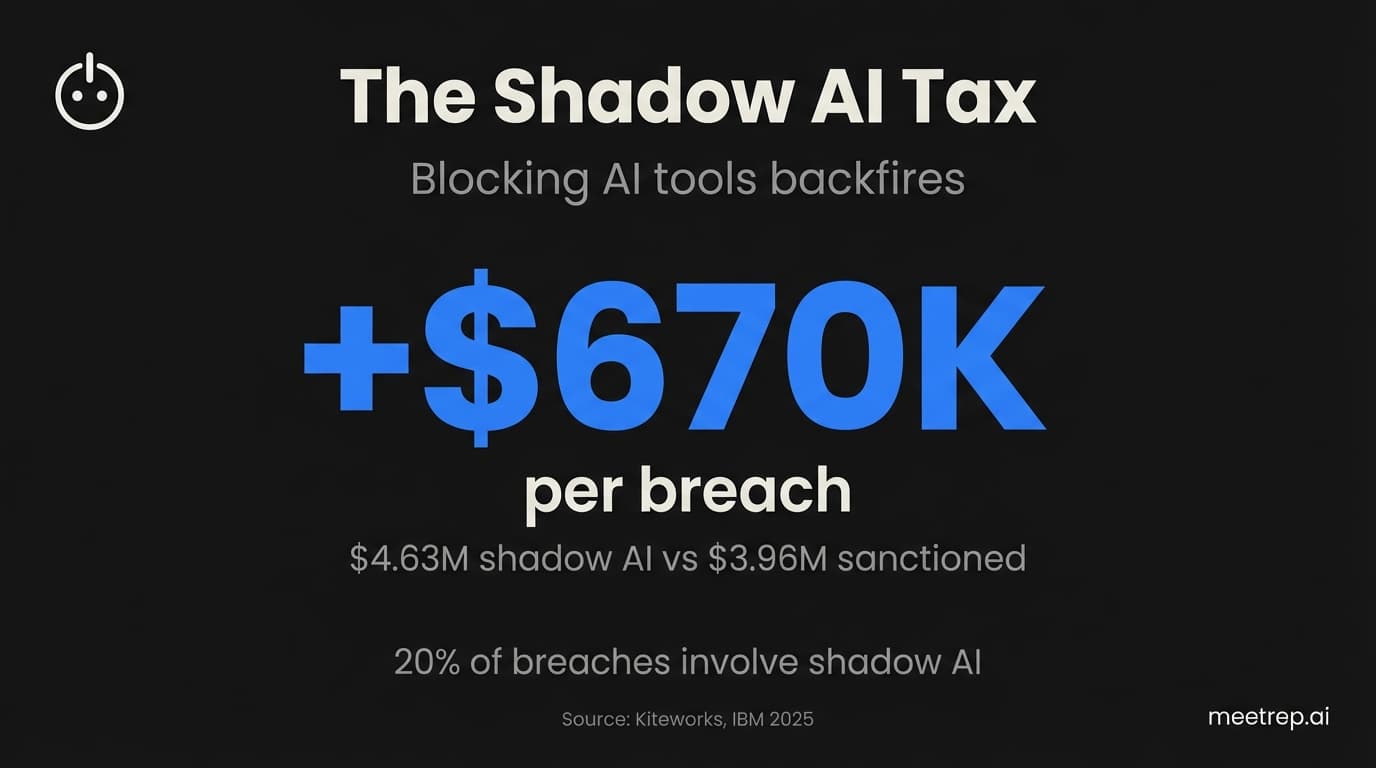
- Shadow AI costs $670,000 more per breach than sanctioned tools—blocking everything backfires
- SOC 2 Type II (not Type I) is non-negotiable for 78% of enterprise buyers
- The EU AI Act goes fully live August 2, 2026—most AI sales tools fall under Limited Risk tier
- Use the 15-question security questionnaire and 7 red flags to evaluate any AI sales vendor
December 2025, Gartner issued a directive that made CISOs everywhere exhale: "Block all AI browsers for the foreseeable future." Finally, air cover to say no.
But here's the problem. Your CEO just read about AI agents handling product demos while she was at Dreamforce. Your board wants "agentic AI" on the 2026 roadmap. And somewhere in your organization, sales reps are already pasting prospect data into ChatGPT.
The question isn't whether your company will use AI sales tools. It's whether you'll sanction secure ones—or lose the shadow AI battle. This guide gives you the framework to move from "no" to "secure yes" without putting your career on the line.
What Is AI Security for Sales Tools?
AI security for sales tools protects customer data, credentials, and CRM integrations in AI-powered platforms. It covers three domains: defending AI systems from attacks like prompt injection, preventing data leakage through AI interactions, and ensuring compliance with emerging regulations. For sales-specific tools, this means securing voice conversation data, demo environment credentials, OAuth tokens connecting to your CRM, and the browser automation that navigates your product.
That last part matters more than most CISOs realize.
When we started building Rep, I assumed the main security concerns would be the obvious ones—data encryption, access controls, credential storage. And those matter. But the real attack surface in AI sales tools is often the browser automation itself. An AI agent that can navigate a web interface and take actions? That's not a chatbot. That's a privileged user.
Key Insight: The Salesloft-Drift breach in August 2025 affected 700+ organizations—including Palo Alto Networks, Cloudflare, and Zscaler—through OAuth token theft from an AI chatbot integration. The attack surface wasn't the AI. It was the connection to everything else.
Here's what keeps me up at night: only 21% of organizations maintain a fully up-to-date inventory of AI agents in their environment. You can't secure what you can't see.
Why "Block Everything" Fails: The Shadow AI Tax
The math on shadow AI is brutal. According to IBM's 2025 Cost of Data Breach Report, 20% of breaches involved shadow AI. And those breaches cost an average of $670,000 more than standard incidents—$4.63M versus $3.96M.
Why the premium? No centralized audit logs. No DLP controls. Unknown data processing locations. Customer data potentially used for model training. And when something goes wrong, you're flying blind.
I get why Gartner said to block AI browsers. The risks are real. But blocking only works if people actually stop. They won't. Your sales team will find workarounds. Your SDRs will paste prospect lists into Claude. Your AEs will use random demo recording tools to send async videos.
The Data:65% of shadow AI breaches compromised PII, versus 53% in the global average. Unsanctioned tools expose more sensitive data because they lack the guardrails.
The alternative? Provide sanctioned tools that are actually secure. Give people a path that doesn't require them to go around you.
| Factor | Sanctioned AI Tool | Shadow AI Tool |
|---|---|---|
| Data Privacy | SOC 2 Type II certified; contractual zero-training clause | Unknown; likely trains on data; no protections |
| Access Control | SSO/SCIM integration; RBAC; least-privilege OAuth | Individual logins; no central oversight |
| Breach Cost | $3.96M average | $4.63M average (+$670K) |
| Visibility | Centralized logs; SIEM integration | None; only 21% track agents |
| PII Exposure | 53% of breaches expose PII | 65% of breaches expose PII |
| Incident Response | Defined SLA; vendor support | No SLA; you're on your own |
The 7 Non-Negotiable AI Security Requirements
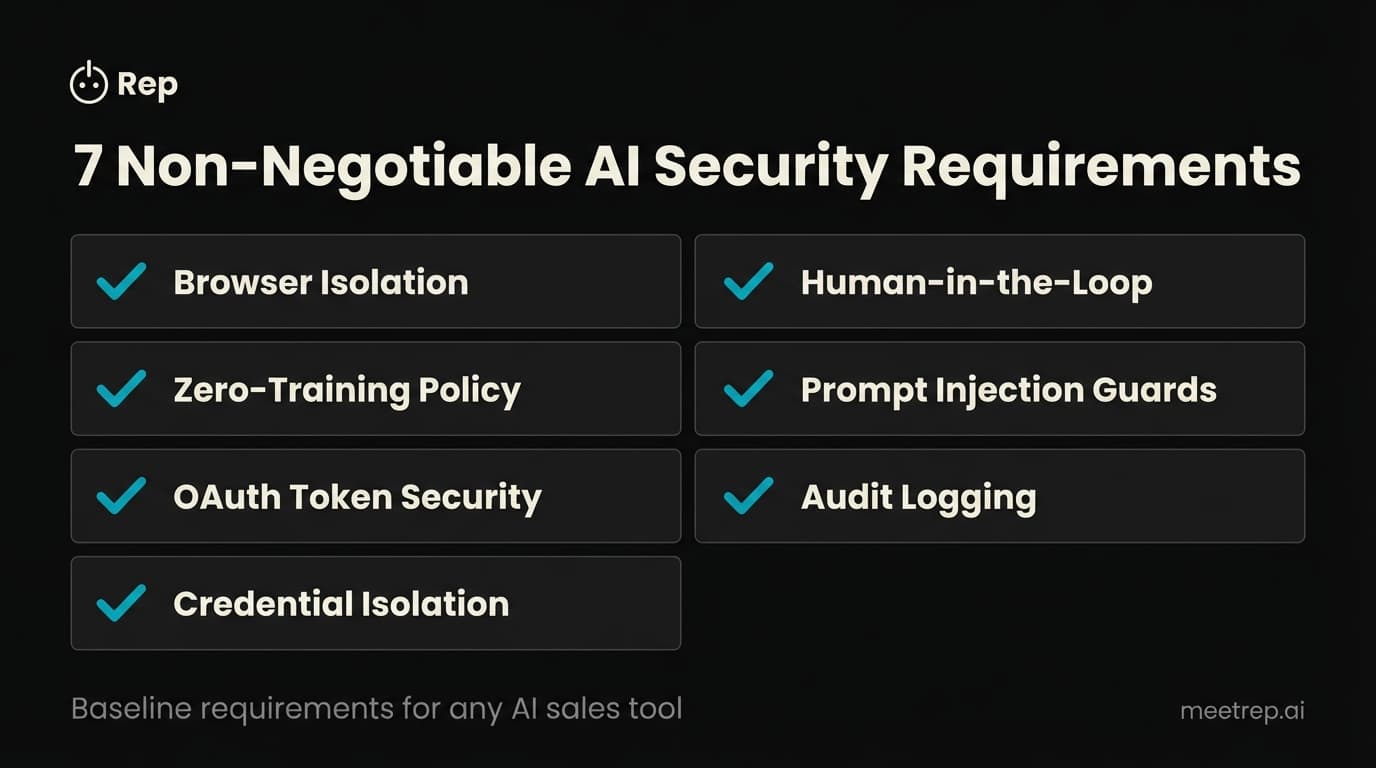
When we built Rep's security architecture, I worked backward from what we'd want to see if we were evaluating ourselves. Not marketing claims—actual controls that address the threat vectors showing up in breach reports.
1. Browser Isolation Architecture
This is why Gartner flagged AI browsers specifically. An AI agent controlling a browser can click links, fill forms, and authenticate to services. If that execution happens on a corporate endpoint, a compromised agent can access local resources, cached credentials, and browser extensions—99% of which have high or critical permissions.
Cloud-based browser isolation moves execution off the endpoint. The browser runs in a containerized environment on vendor infrastructure. No local extensions. Ephemeral sessions that destroy state after each task. Network segmentation that prevents lateral movement.
When I evaluate AI sales vendors, this is the first architecture question I ask. Where does the browser run? Local or cloud? Persistent or ephemeral?
2. Zero-Training Data Policy
81% of CISOs are concerned about sensitive data leaking into AI training sets. They should be. Once your customer data trains a foundational model, you've lost control of it forever.
The standard you need: organization-scoped isolation. Your data improves your agent only—never shared with other customers, never used to train the base model. Get this in writing. A contractual zero-training clause in the DPA, not just a checkbox on the security page.
Common mistake: Accepting vague "we don't train on your data" claims without asking: Does that mean you don't train at all? Or that my data stays in my tenant? There's a difference.
3. OAuth Token Security
The Salesloft-Drift breach was an OAuth attack. Attackers compromised Drift's AWS environment, stole OAuth tokens, and used those tokens to access Salesforce data across hundreds of customers. 700+ organizations affected because of how the integration was scoped.
What to require:
- Least-privilege OAuth scopes (read vs. write, specific objects only)
- Short-lived tokens with rotation
- Quarterly audits of all active grants
- Immediate revocation capabilities
At Rep, we made OAuth scope transparency a core requirement. You should be able to see exactly what permissions any AI tool has to your CRM. If a vendor can't show you their OAuth scopes, that's a red flag.
4. Credential Management Isolation
Here's a risk most people miss. AI agents that perform browser automation need credentials to log into demo environments. Where do those credentials live?
Research published in December 2025 showed that browser agents can expose login credentials, email addresses, and ZIP codes during automated browsing sessions. If credentials are stored in prompts, logs, or persistent memory—they're vulnerable.
The architecture should separate credential storage from prompt context entirely. Encrypted at rest, in-memory only during session, never written to logs. BYOK (Bring Your Own Key) support for organizations that require customer-managed encryption.
5. Human-in-the-Loop Controls
Gartner predicts AI agents will cause 25% of enterprise security breaches by 2028. Not because the AI is malicious—because autonomous agents executing actions at scale will inevitably make mistakes.
The solution is configurable approval workflows. Let the AI handle routine tasks autonomously, but require human authorization for sensitive actions: contract modifications, data deletion, high-value transactions. Define escalation rules. Create audit trails of what got approved and what didn't.
6. Prompt Injection Guardrails
1 in 80 GenAI prompts exposes sensitive data to potential attackers. Prompt injection—where malicious instructions are embedded in content the agent processes—is the fastest-growing attack vector.
In 2025, researchers found a CVSS 9.4 vulnerability in Salesforce's Agentforce platform demonstrating exactly this risk. An attacker could inject instructions into web pages that the AI agent would follow, bypassing user intent entirely.
Mitigations include:
- Immutable system prompts that can't be overridden by user input
- Input sanitization and output filtering
- Content filtering for known injection patterns
- URL whitelisting for browser agents
7. Audit Logging and Behavioral Monitoring
If 97% of AI breaches happened at organizations lacking access controls, logging is your safety net. You need fine-grained logs of every AI agent action, immutable records, configurable retention, and real-time export to your SIEM.
But logging alone isn't enough. Behavioral monitoring detects anomalies: unusual API calls, abnormal data access patterns, high-volume actions outside business hours. Early detection of a compromised agent limits the blast radius.
My recommendation: Ask vendors for sample audit logs. Can you reconstruct exactly what the AI agent did during any session? If not, you're accepting black-box risk.
SOC 2 Type II vs. Type I: Why the Distinction Matters
I've been on both sides of SOC 2 audits—as a buyer evaluating vendors and as a founder going through the process. The Type I versus Type II distinction trips people up.
78% of enterprise clients require SOC 2 Type II from their vendors. Type I isn't enough. Here's why.
| Aspect | Type I | Type II |
|---|---|---|
| Assessment Period | Single point in time | 3-12 months operational |
| What It Proves | Controls are designed properly | Controls work consistently over time |
| Enterprise Acceptance | Generally insufficient | Required by 78% of buyers |
| Audit Cost | $15,000-$40,000 | $30,000-$100,000 |
| Trust Level | "Should work" | "Does work" |
Type I says: "On the day the auditor visited, our controls were designed correctly."
Type II says: "Over the past 6-12 months, our controls actually worked in production."
That's a different statement. A vendor can paper over problems for a Type I audit. They can't fake operational effectiveness over a year.
Common mistake: Accepting a Type I report as a "stepping stone" to Type II. Ask when Type II will be complete. If they can't give you a date, they may not be serious about it.
The EU AI Act and CCPA ADMT: What Sales Teams Need to Know
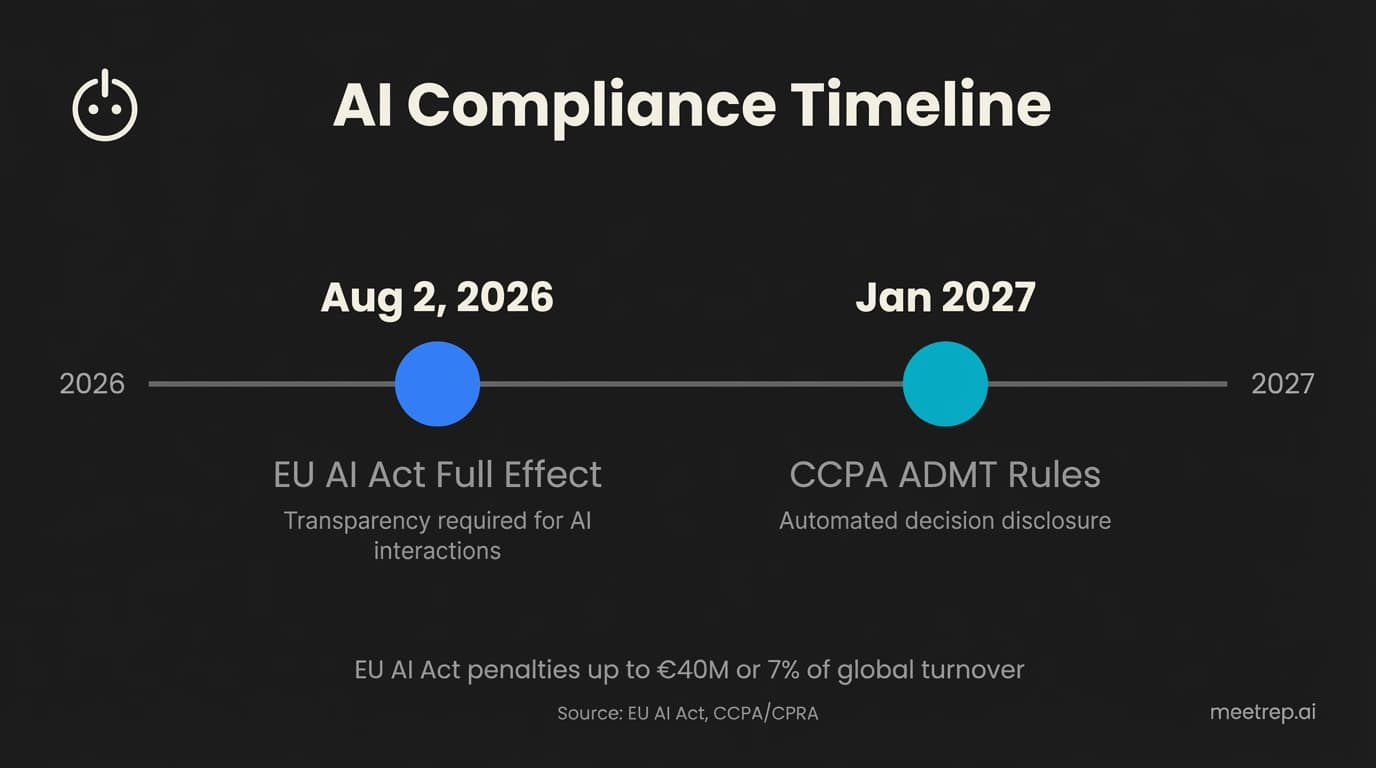
Two regulatory deadlines should be on every CISO's calendar:
August 2, 2026: Full applicability of the EU AI Act
January 2027: CCPA/CPRA Automated Decision-Making Technology (ADMT) requirements take effect
The EU AI Act classifies AI systems by risk tier. Most AI sales agents fall under "Limited Risk," which requires:
- Disclosure when users interact with AI
- Transparency about AI decision-making
- Clear labeling of AI-generated content
The penalties are real. Up to €40 million or 7% of global annual turnover for the highest-tier violations.
| Risk Tier | Examples | Requirements | Max Penalty |
|---|---|---|---|
| Prohibited | Social scoring, subliminal manipulation | Cannot be deployed | €40M or 7% turnover |
| High-Risk | CV screening, credit scoring | Conformity assessment, human oversight | €20M or 4% turnover |
| Limited Risk | Chatbots, AI sales agents | Transparency, disclosure | €10M or 2% turnover |
| Minimal Risk | Spam filters | None specific | N/A |
Voice conversation data gets extra scrutiny under GDPR Article 22. If your AI sales tool records calls, you need explicit consent, right to human review of automated decisions, and explanation of the AI logic involved.
The 15-Question Vendor Security Questionnaire
When I evaluate AI sales vendors—or when buyers evaluate Rep—these are the questions that actually matter. Not "do you take security seriously?" but specific, verifiable controls.
Certifications & Testing:
- What is your SOC 2 certification status (Type I or Type II) and last audit date?
- Provide executive summary of most recent penetration test (must be within 12 months)
- What other certifications do you hold (ISO 27001, ISO 42001, HIPAA)?
Data Handling: 4. Where is customer data stored (specific regions/countries)? 5. Do you use customer data to train foundational models shared with other clients? 6. What are data retention policies and automated deletion procedures? 7. Do you support customer-managed encryption keys (BYOK)?
Access & Authentication: 8. What OAuth scopes do you request, and why? 9. Do you support SSO (SAML 2.0, OAuth 2.0), SCIM, and RBAC?
AI-Specific Controls: 10. How are credentials stored during browser automation? 11. What human-in-the-loop controls exist for sensitive actions? 12. How do you prevent prompt injection attacks?
Monitoring & Response: 13. Can audit logs be exported to customer SIEM in real-time? 14. What is your incident response plan and breach notification SLA? 15. What behavioral monitoring detects compromised agents?
7 Red Flags That Should Kill the Deal
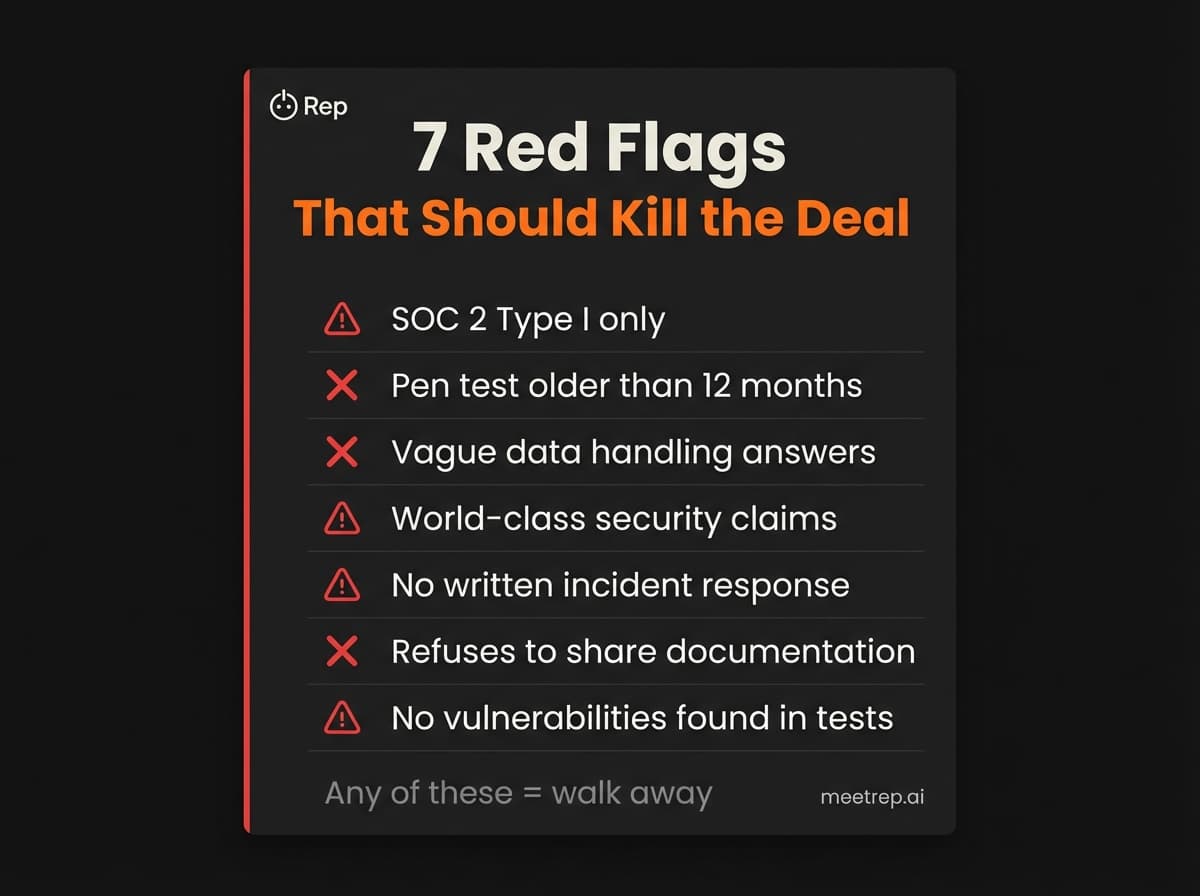
After years of evaluating vendors—and being evaluated—I've learned to spot the tells that signal immature security.
- SOC 2 Type I only. Type II is the standard. Type I is a stepping stone.
- Penetration test older than 12 months. Security posture changes. Testing should be annual.
- Vague data handling answers. "Industry-standard encryption" without specifying AES-256, TLS 1.3, or specific algorithms.
- "World-class security" claims. Attorney-flagged puffery. Creates legal liability without proving anything.
- No written incident response plan. "Best efforts" SLAs without defined timelines indicate unpreparedness.
- Refusal to share documentation. If they won't share pen test summaries or security architecture docs, why not?
- "No vulnerabilities found" in pen tests. Unrealistic. Even mature security programs find issues. This suggests inadequate testing.
Making the Case for Sanctioned AI Tools
So how do you move from "block everything" to "secure yes"?
The business case writes itself when you show the alternative. Shadow AI is already in your organization. Only 21% of companies have full visibility into what AI agents are running. The question isn't whether to allow AI—it's whether you control the terms.
When we built Rep, we designed the architecture around exactly this challenge. Cloud-based browser execution so the agent never runs on corporate endpoints. Organization-scoped data isolation so customer data stays in their tenant. OAuth 2.0 with configurable scopes so you control what connects. Audit logs for every action so you can reconstruct any session.
Not because these features are differentiators. Because they're baseline requirements for any CISO who's been paying attention.
The goal isn't to block AI adoption—that just drives shadow AI with its $670,000 cost premium. The goal is to channel adoption through sanctioned tools with the controls you'd build yourself if you had the time.
The choice isn't really between AI and no AI. It's between secure, sanctioned AI and shadow tools proliferating without oversight.
When your CEO asks about AI agents for sales demos—and they will—you have two options. You can say no and watch shadow AI multiply. Or you can hand them this framework and say: "Here's what we need before we approve any vendor."
My bet? You'll find tools that meet the bar. And your organization will be better off with visible, auditable, controlled AI than with whatever your sales team is already using behind your back.
If you're evaluating AI demo platforms, Rep was built with these requirements in mind. But whatever tool you choose, use the 15 questions. Watch for the red flags. And remember: the goal isn't to block AI. It's to secure it.

Nadeem Azam
Founder
Software engineer & architect with 10+ years experience. Previously founded GoCustomer.ai.
Nadeem Azam is the Founder of Rep (meetrep.ai), building AI agents that give live product demos 24/7 for B2B sales teams. He writes about AI, sales automation, and the future of product demos.
Frequently Asked Questions
Table of Contents
- What Is AI Security for Sales Tools?
- Why "Block Everything" Fails: The Shadow AI Tax
- The 7 Non-Negotiable AI Security Requirements
- SOC 2 Type II vs. Type I: Why the Distinction Matters
- The EU AI Act and CCPA ADMT: What Sales Teams Need to Know
- The 15-Question Vendor Security Questionnaire
- 7 Red Flags That Should Kill the Deal
- Making the Case for Sanctioned AI Tools
Ready to automate your demos?
Join the Rep Council and be among the first to experience AI-powered demos.
Get Early AccessRelated Articles
Hexus Acquired by Harvey AI: Congrats & What It Means for Demo Automation Teams
Hexus is shutting down following its acquisition by Harvey AI. Learn how to manage your migration and discover the best demo automation alternatives before April 2026.
Why the "Software Demo" is Broken—and Why AI Agents Are the Future
The traditional software demo is dead. Discover why 94% of B2B buyers rank vendors before calling sales and how AI agents are replacing manual demos to scale revenue.
Why Autonomous Sales Software is the Future of B2B Sales (And Why the Old Playbook is Dead)
B2B sales is at a breaking point with quota attainment at 46%. Discover why autonomous 'Agentic AI' is the new standard for driving revenue and meeting the demand for rep-free buying.