The AI Sales Stack: How Modern Teams Structure Their Tech

Executive Summary
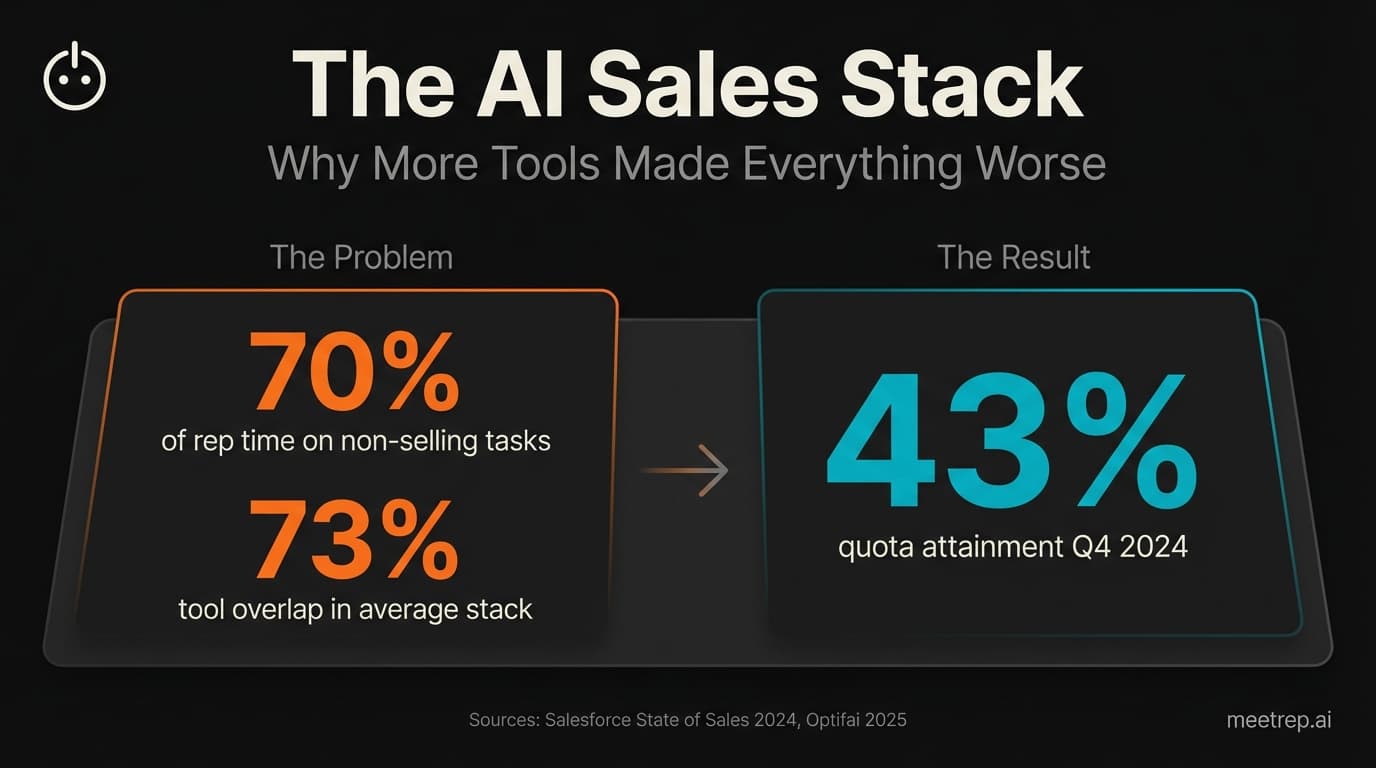
- The average sales stack has 8.3 tools with 73% overlap—most teams are over-tooled
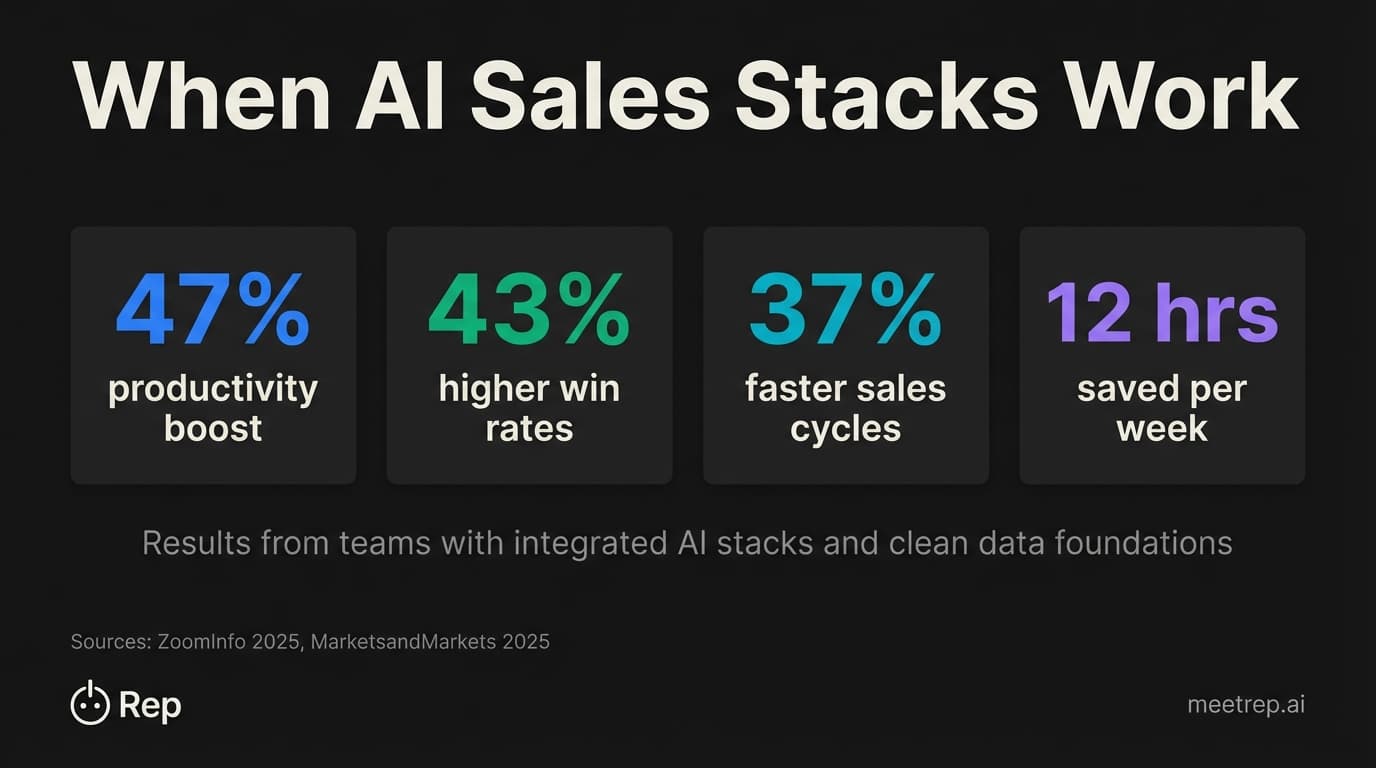
- AI-powered stacks deliver 43% higher win rates and 37% faster sales cycles, but only when built on clean data
- The shift to "agentic AI" is real: 45% of teams now use hybrid AI-SDR models
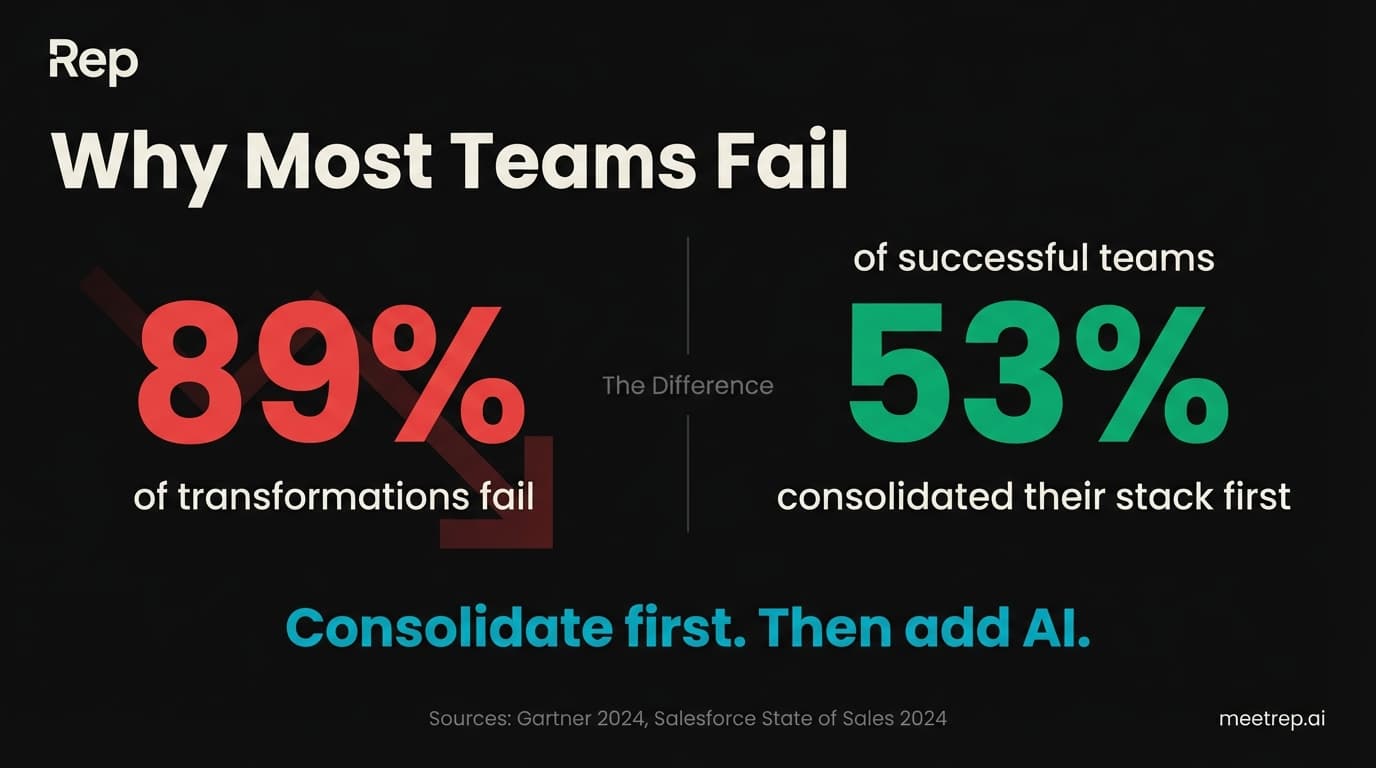
- Consolidate first, then layer AI on top. Don't add more tools to a broken foundation.
Quota attainment crashed to 43% in Q4 2024. Let that sink in.
Most reps are missing their numbers. And here's the painful part: it's not because they're working less. According to Salesforce's State of Sales report, reps spend 70% of their time on non-selling tasks. They're drowning in admin work, toggling between tools, and manually updating CRMs instead of actually selling.
Meanwhile, 81% of sales teams have either implemented or started experimenting with AI. That's not a trend anymore. That's the new baseline.
I've spent years building sales automation products—first at GoCustomer.ai, now at Rep. And the pattern I keep seeing is this: teams don't have a tools problem. They have an integration problem. An architecture problem. A "too many tools doing overlapping things" problem.
This guide breaks down what actually belongs in a modern AI sales stack, what's hype, and how to structure your tech without creating another Frankenstack.
What Is an AI Sales Stack?
An AI sales stack is the integrated collection of artificial intelligence-powered tools that sales teams use to automate repetitive tasks, generate predictive insights, and speed up every stage of the sales process—from prospecting to closing. Unlike traditional stacks built around manual workflows, modern AI-native stacks share data across platforms and make recommendations in real time.
But here's what that definition misses: the "AI" part matters less than the "integrated" part.
I've watched teams buy six different AI tools that don't talk to each other. Each one promising automation. Each one creating its own data silo. The result? More complexity, not less. Reps end up doing more manual work reconciling systems than they did before.
Key Insight: The Gartner Seller Skills Survey (December 2024) found that 70% of sellers are overwhelmed by the number of technologies required to do their work. More tools isn't the answer. Better-connected tools is.
So when I talk about an AI sales stack, I mean something specific: a deliberately structured set of tools where AI capabilities are layered on top of a unified data foundation. Not a pile of point solutions. A system.
The Productivity Crisis Driving AI Adoption
The numbers are stark. According to the Salesforce State of Sales (July 2024), 67% of sales reps don't expect to meet their quota this year. And 84% missed it last year.
That's not a blip. That's a structural problem.
Where does the time go? Reps spend 70% of their week on non-selling activities: updating CRMs, writing emails, scheduling meetings, researching accounts, logging notes. The actual conversations with prospects—the part that generates revenue—gets squeezed into whatever time is left.
And the tech stack that was supposed to help? It's making things worse.
The Data: The average sales tech stack includes 8.3 tools costing $187 per rep per month, with 73% of companies reporting tool overlap. Optifai Sales Tech Stack Benchmark 2025
That overlap isn't just wasted budget. It's cognitive overhead. Every extra tool means another login, another dashboard to check, another set of data that might or might not match what's in Salesforce.
When we built GoCustomer.ai, we learned this the hard way. We added features our competitors had. Made sense at the time—match feature-for-feature, right? Wrong. Customers didn't need more features. They needed the features they had to actually work together.
This is why AI adoption has accelerated so fast. Teams are desperate for relief. The ZoomInfo State of AI in Sales & Marketing 2025 found that AI users report a 47% productivity boost and save 12 hours per week. That's not marginal improvement. That's getting a day and a half back.
What Belongs in a Modern AI Sales Stack
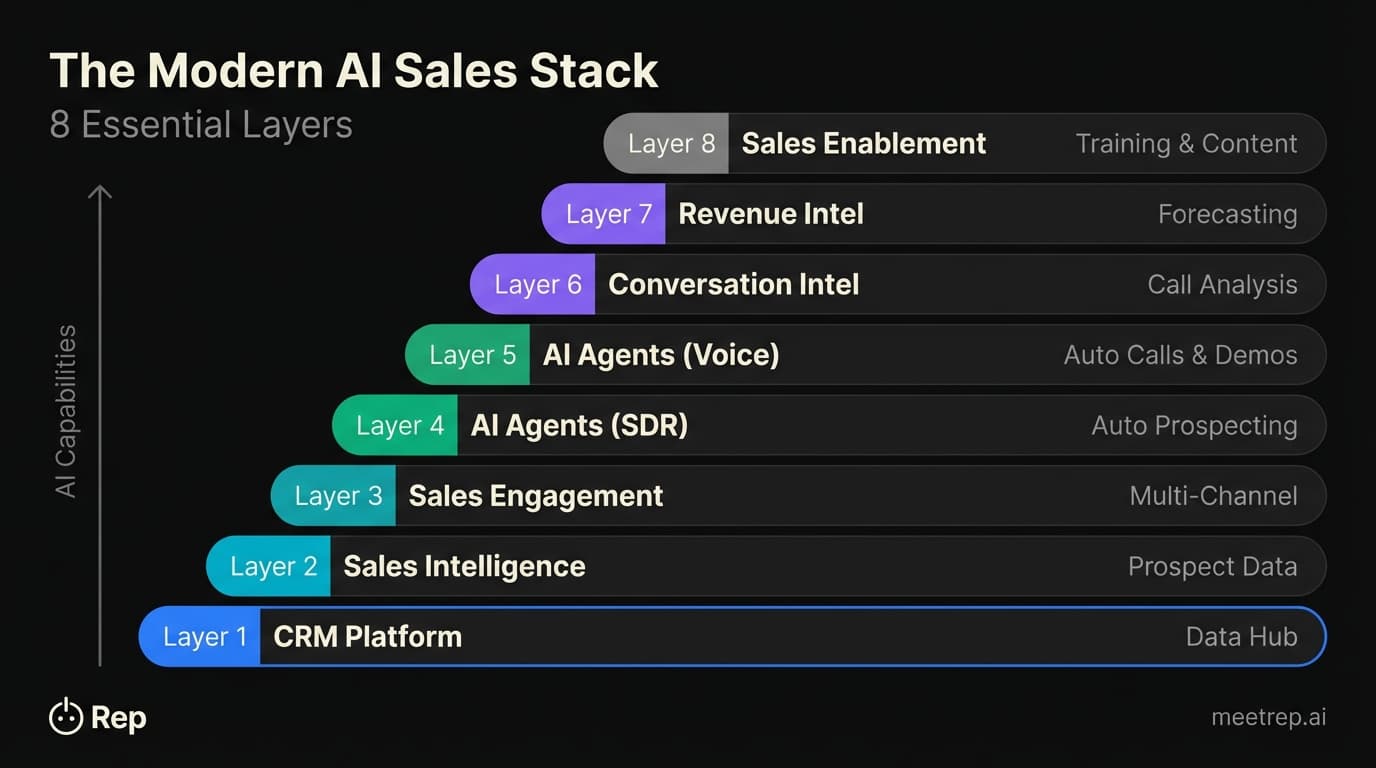
A well-structured AI sales stack has eight core layers. Each serves a distinct function. The goal isn't to have all eight immediately—it's to understand what each does so you can prioritize based on where you're losing the most time.
The 8 Core Components:
- CRM Platform – Your data hub. Everything else connects here.
- Sales Intelligence & Enrichment – Prospect discovery, contact data, intent signals.
- Sales Engagement – Multi-channel outreach, sequence automation.
- AI Sales Agents (SDR) – Autonomous prospecting and outreach.
- AI Sales Agents (Voice/Demo) – Autonomous phone calls and product demonstrations.
- Conversation Intelligence – Call recording, transcription, deal analysis.
- Revenue Intelligence – Forecasting, pipeline visibility, predictive analytics.
- Sales Enablement – Training, content management, coaching.
Here's how they break down:
| Layer | Function | Example Tools | Typical Cost |
|---|---|---|---|
| CRM | Data hub, pipeline management | Salesforce, HubSpot | $25-300/user/mo |
| Sales Intelligence | Prospect data, enrichment, intent | ZoomInfo, Apollo, Cognism | $75-200/user/mo |
| Sales Engagement | Multi-channel outreach, sequences | Outreach, Salesloft | $100-200/user/mo |
| AI Agents (SDR) | Autonomous prospecting | 11x, Artisan, Regie.ai | Custom |
| AI Agents (Voice/Demo) | Autonomous calls and demos | Retell AI, Rep | Custom |
| Conversation Intelligence | Call analysis, coaching | Gong, Chorus | $50-150/user/mo |
| Revenue Intelligence | Forecasting, deal health | Clari, 6sense | Custom |
| Enablement | Training, content | Seismic, Highspot | Custom |
The teams seeing the best results—43% higher win rates and 37% faster sales cycles according to MarketsandMarkets (November 2025)—aren't the ones with the most tools. They're the ones with the best integration between tools.
Layer 1: The Data Foundation Problem
Here's my hot take: most AI sales tools fail not because of the AI, but because of the data.
The MarketingOps.com 2025 State of RevOps Report found that 75% of RevOps professionals cite data inconsistencies as the most frustrating part of their tech stack. That's three out of four RevOps leaders dealing with dirty data every single day.
And dirty data breaks AI. It doesn't matter how sophisticated your lead scoring model is if the information feeding it is incomplete, outdated, or duplicated.
Common Mistake: Teams buy AI tools before fixing their CRM hygiene. The AI makes predictions based on garbage data. The predictions are wrong. The team loses trust in the tool. The tool becomes shelfware. I've seen this happen dozens of times.
What works instead: start with your CRM. Audit it. Clean it. Set up processes to keep it clean. Then layer AI on top.
The ROI difference is dramatic. AI-native CRMs show 287% ROI compared to traditional tools according to Optifai's 2025 benchmark. But that ROI assumes the data is actually usable.
Salesforce Einstein, HubSpot's AI features, Microsoft Dynamics 365—these all offer impressive capabilities. But none of them can fix fundamentally broken data. That's on you.
The Shift to Agentic AI: What's Real and What's Marketing
You've probably heard "agentic AI" a lot lately. Let me cut through the buzzwords.
Traditional sales automation follows rules: "If prospect opens email, wait 2 days, then send follow-up." It's linear. Predictable. Useful, but limited.
Agentic AI is different. It reasons. It makes decisions. It adapts based on context without requiring explicit rules for every scenario.
Here's a concrete example: a traditional sequence sends the same follow-up to everyone who opened your email. An agentic system might research each prospect's company, identify relevant news, determine the best angle, write a personalized message, and decide on optimal timing—all autonomously.
| Traditional Automation | Agentic AI |
|---|---|
| Follows pre-set rules | Reasons through multi-step tasks |
| Same action for similar triggers | Adapts approach per situation |
| Requires explicit programming | Learns and improves |
| Assists the rep | Acts on behalf of the rep |
Is this hype? Partly. But there's real substance underneath.
The Data: According to the Outreach Sales 2025 Data Report, 45% of teams are already using a hybrid AI-SDR model. And 100% of AI-SDR users reported time savings.
The tools in this space—11x, Artisan, Regie.ai for outbound; Retell AI and Rep for voice and demos—are handling tasks that required humans just two years ago.
At Rep, we built an AI voice agent that joins video calls, shares its screen, and walks prospects through product demos live. Not a recording. Not a chatbot. An AI that actually navigates your product and answers questions in real time. A year ago, that sounded like science fiction. Now it's in production.
But here's my honest assessment: not every team needs agentic AI yet. If your CRM is a mess and your sequences aren't optimized, autonomous agents will just do the wrong things faster. Fix the foundation first.
Where Teams Go Wrong
After watching dozens of teams attempt AI sales stack transformations, the failure patterns are consistent.
Mistake 1: Adding tools without consolidating first.
The Salesforce State of Sales (July 2024) found that 53% of teams who fully implemented AI first consolidated their tech stack. Read that again. They didn't add AI on top of their existing mess. They cleaned house first.
Mistake 2: Ignoring integration requirements.
A tool that doesn't integrate with your CRM isn't a sales tool. It's a data silo waiting to cause problems. Before buying anything, ask: "Does this add data to our CRM or create a parallel system?"
What we learned at GoCustomer: We built features customers asked for without checking how those features would integrate with their existing tools. Result: lower adoption than simpler competitors with better integrations. Integration isn't a feature. It's the feature.
Mistake 3: Skipping change management.
Look, only 11% of sales organizations succeed during transformation, according to Gartner (December 2024). The other 89% fail. Not because the tech doesn't work—because the people don't adopt it.
Mistake 4: Chasing features instead of outcomes.
"This tool has AI-powered everything!" Great. Does it help reps close more deals? If you can't connect a tool directly to pipeline or revenue impact, question whether you need it.
Building Your Stack: A Decision Framework
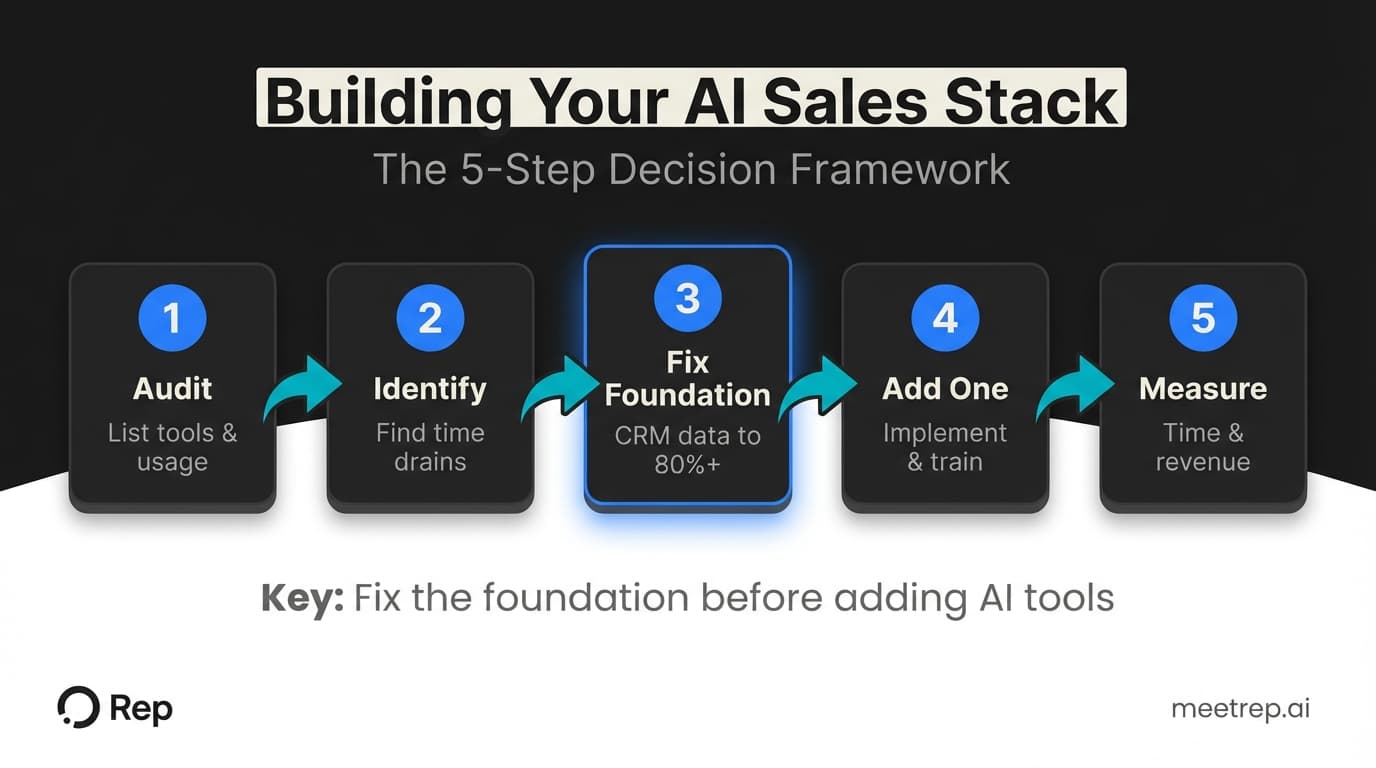
Here's the framework I use when advising teams on their AI sales stack:
Step 1: Audit what you have.
List every tool. Document who uses it. Check actual usage data, not license counts. You'll probably find 30-40% of licenses going unused.
Step 2: Identify your biggest time drain.
Where do reps lose the most time? Prospecting? Demo scheduling? CRM updates? Follow-ups? Start there.
Step 3: Fix the foundation.
If CRM data quality is below 80%, stop. Don't buy anything new. Clean the data first. This isn't exciting. It works.
Step 4: Add one capability at a time.
Implement. Train. Measure. Then consider the next addition. Parallel implementations almost always fail.
Step 5: Measure ruthlessly.
Track time saved, not just features used. Track revenue impact, not just activity metrics. If a tool doesn't move one of those needles within 90 days, cut it.
Budget reality check by company size:
| Stage | Recommended Focus | Monthly Budget/Rep |
|---|---|---|
| Startup (< 20 reps) | CRM + 2-3 core tools | $100-150 |
| Mid-market (20-100 reps) | Full stack, prioritize integration | $150-250 |
| Enterprise (100+ reps) | Composable architecture, data governance | $200-350 |
Remember: the average is $187/rep/month with 73% overlap. You can probably spend less and get better results by consolidating.
What the Best Teams Do Differently
The teams winning with AI sales stacks share a few patterns.
They consolidate aggressively. Fewer tools, better integration. When Upwork implemented Gong Forecast, they reduced their tech stack while improving forecast accuracy to 95%.
They start with data quality. Carnegie Learning deployed Salesforce Agentforce for account research and saw a 92% reduction in research time—but only because their account data was clean enough for the AI to use.
They invest in change management. SpotOn deployed Gong across their sales org and saw 16% improved win rates. But they also invested heavily in training, not just licenses.
They measure outcomes, not activity. BlueGrace Logistics focused on response rates, not emails sent. Their response rates jumped from 16% to 30% after implementing AI-powered outreach.
The pattern is clear: the best teams treat their AI sales stack as a system, not a collection of tools. They think architecturally.
The shift to AI-native sales stacks isn't coming. It's here. 81% of teams are already on board. The question isn't whether to adopt AI—it's whether to do it well or poorly.
My recommendation: don't chase the newest agentic AI tool. Start with your foundation. Clean your CRM. Consolidate overlapping tools. Then layer AI where it can actually work.
That's what we're building at Rep—AI that works because it integrates properly, not despite your existing stack. If you want to see how autonomous demo automation fits into a modern sales stack, check out what we're doing.
The teams that get this right will close more deals with less effort. The teams that don't will keep adding tools to their Frankenstack, wondering why nothing works.
Your move.

Nadeem Azam
Founder
Software engineer & architect with 10+ years experience. Previously founded GoCustomer.ai.
Nadeem Azam is the Founder of Rep (meetrep.ai), building AI agents that give live product demos 24/7 for B2B sales teams. He writes about AI, sales automation, and the future of product demos.
Frequently Asked Questions
Table of Contents
- What Is an AI Sales Stack?
- The Productivity Crisis Driving AI Adoption
- What Belongs in a Modern AI Sales Stack
- Layer 1: The Data Foundation Problem
- The Shift to Agentic AI: What's Real and What's Marketing
- Where Teams Go Wrong
- Building Your Stack: A Decision Framework
- What the Best Teams Do Differently
Ready to automate your demos?
Join the Rep Council and be among the first to experience AI-powered demos.
Get Early AccessRelated Articles
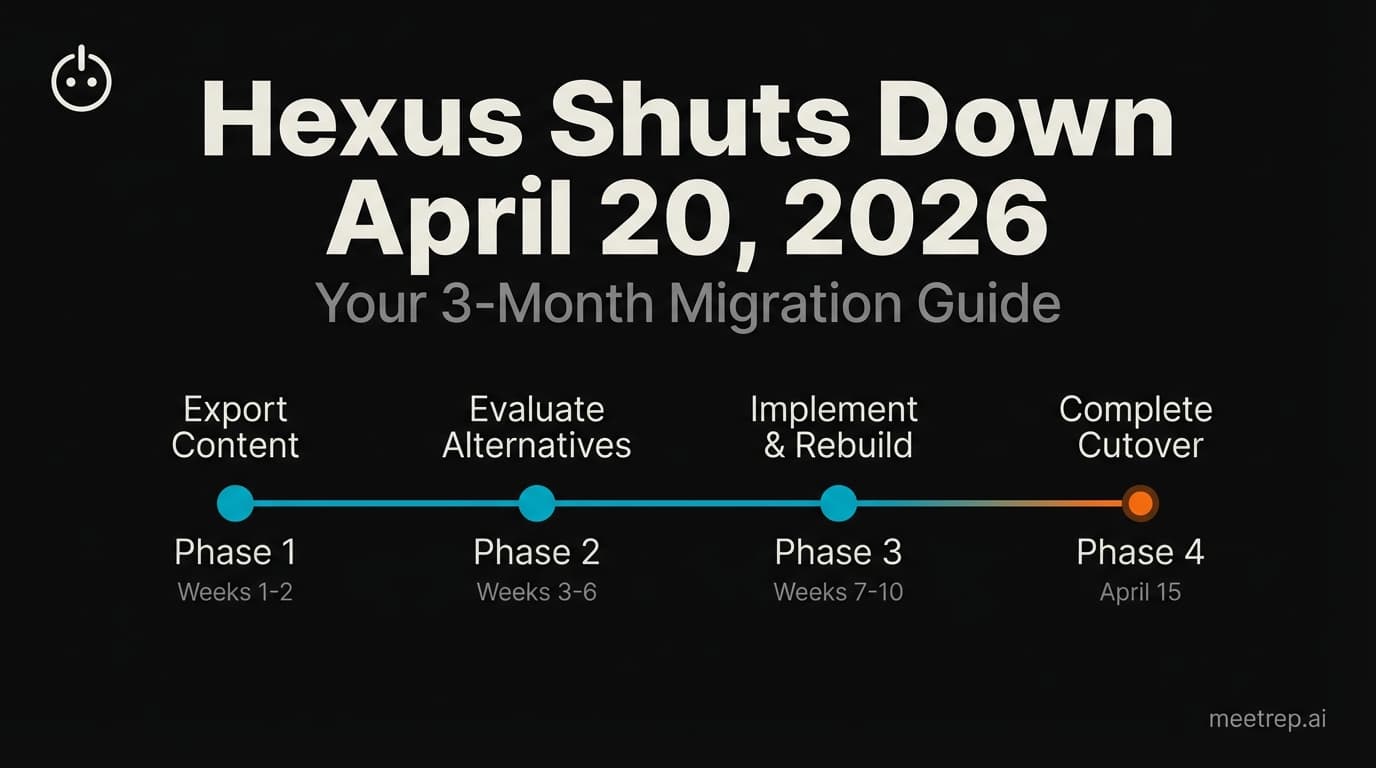
Hexus Acquired by Harvey AI: Congrats & What It Means for Demo Automation Teams
Hexus is shutting down following its acquisition by Harvey AI. Learn how to manage your migration and discover the best demo automation alternatives before April 2026.
Why the "Software Demo" is Broken—and Why AI Agents Are the Future
The traditional software demo is dead. Discover why 94% of B2B buyers rank vendors before calling sales and how AI agents are replacing manual demos to scale revenue.
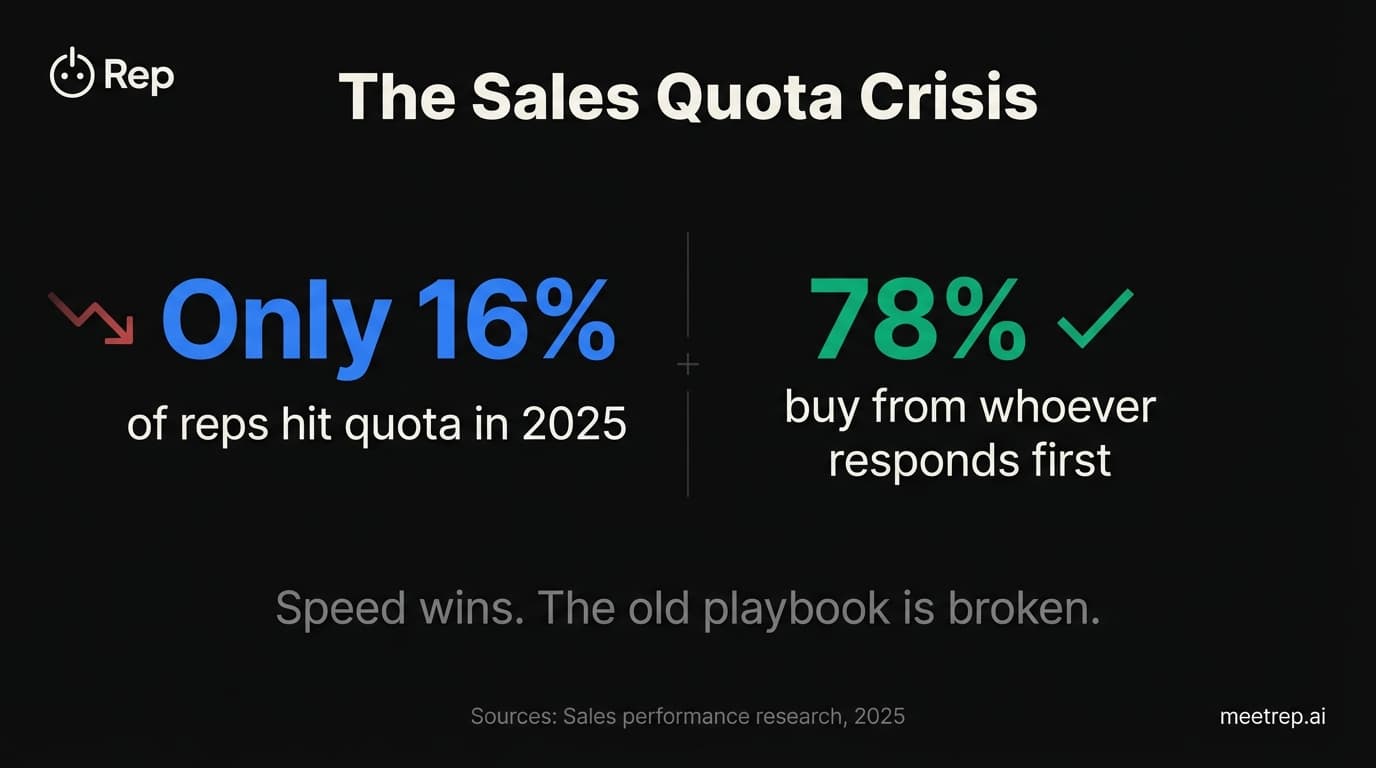
Why Autonomous Sales Software is the Future of B2B Sales (And Why the Old Playbook is Dead)
B2B sales is at a breaking point with quota attainment at 46%. Discover why autonomous 'Agentic AI' is the new standard for driving revenue and meeting the demand for rep-free buying.