The 10x SE: How AI Augments (Not Replaces) Sales Engineers

Executive Summary
- 70% of deals require presales support, but 35% of demos go to unqualified prospects—that's a third of SE time wasted
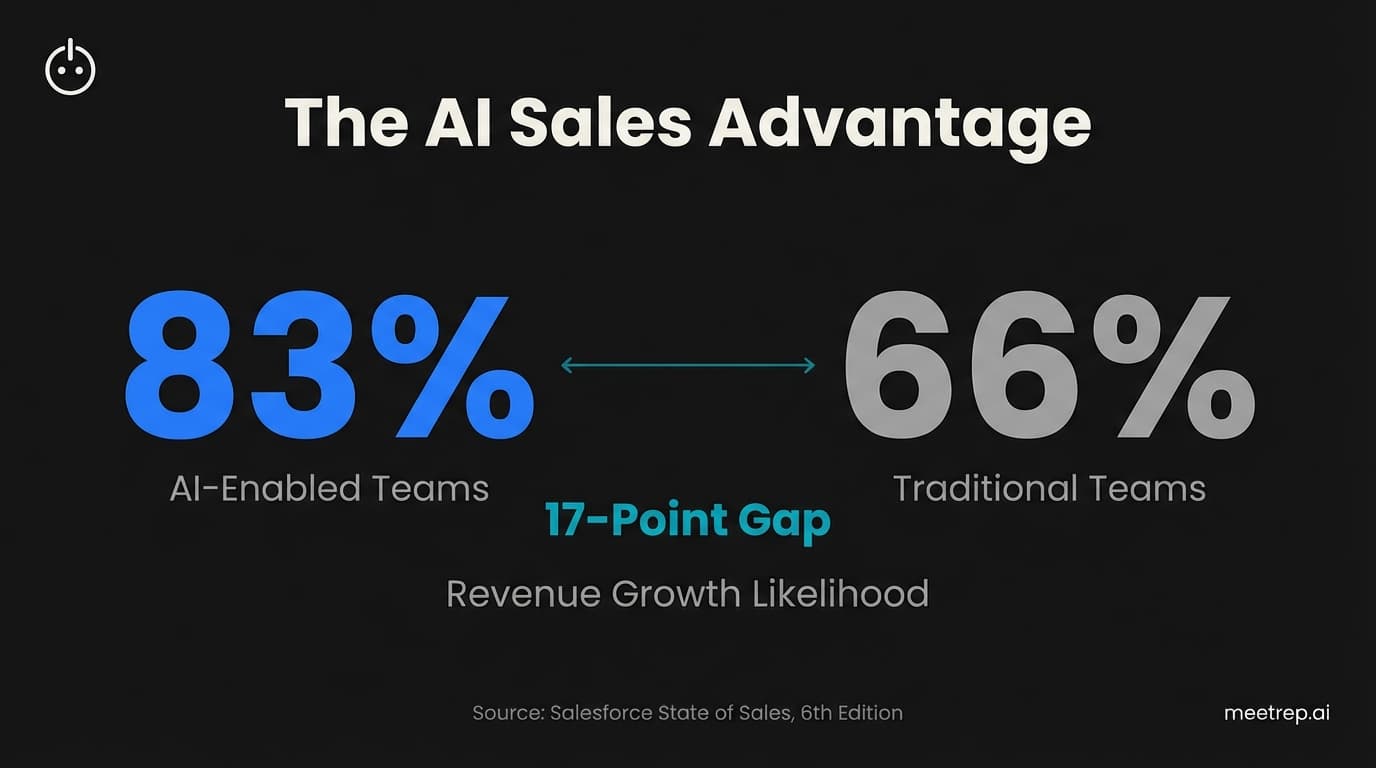
- AI-enabled sales teams show 83% revenue growth likelihood vs 66% without—a 17-point competitive gap
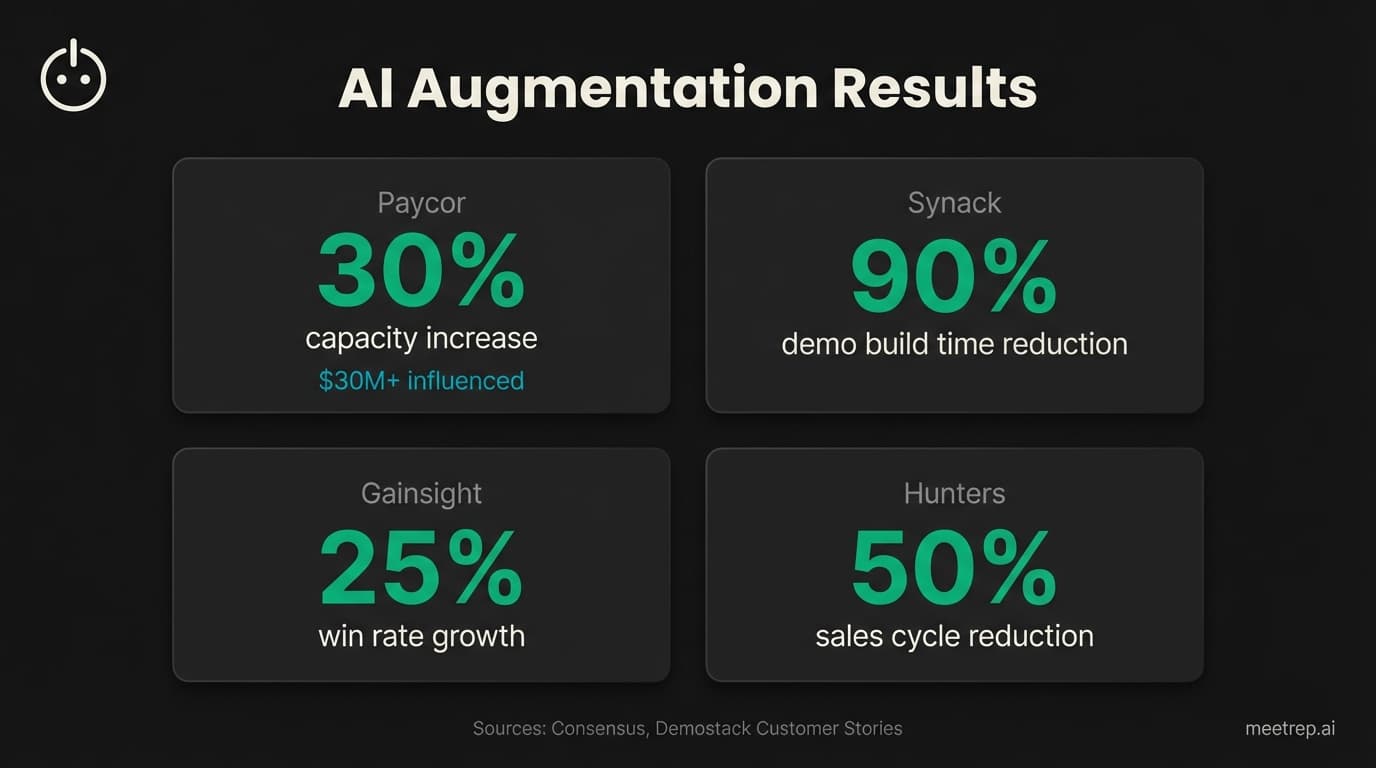
- Companies like Paycor achieved 30% capacity increase and $30M+ influenced revenue through demo automation
- The fix isn't replacing SEs—it's augmenting them so they focus on strategic work while AI handles repetitive demos
Your best sales engineer is exhausted.
They ran six demos yesterday. Three were unqualified. They spent two hours building a custom environment that crashed mid-call. And they just saw a Slack from an AE asking if they can "squeeze in one more" before EOD.
Sound familiar?
Sales engineer productivity has become the bottleneck nobody talks about. 70% of B2B deals now require presales support, yet SE teams can't scale linearly with demand. The math doesn't work anymore.
I've spent the last several years building sales automation tools—first at GoCustomer.ai, now at Rep. And here's what I've learned: the 10x SE isn't working ten times harder. They're using AI as a force multiplier to handle volume so they can focus on complexity.
This isn't theory. It's measurable.
Why Sales Engineering Hit a Wall in 2026
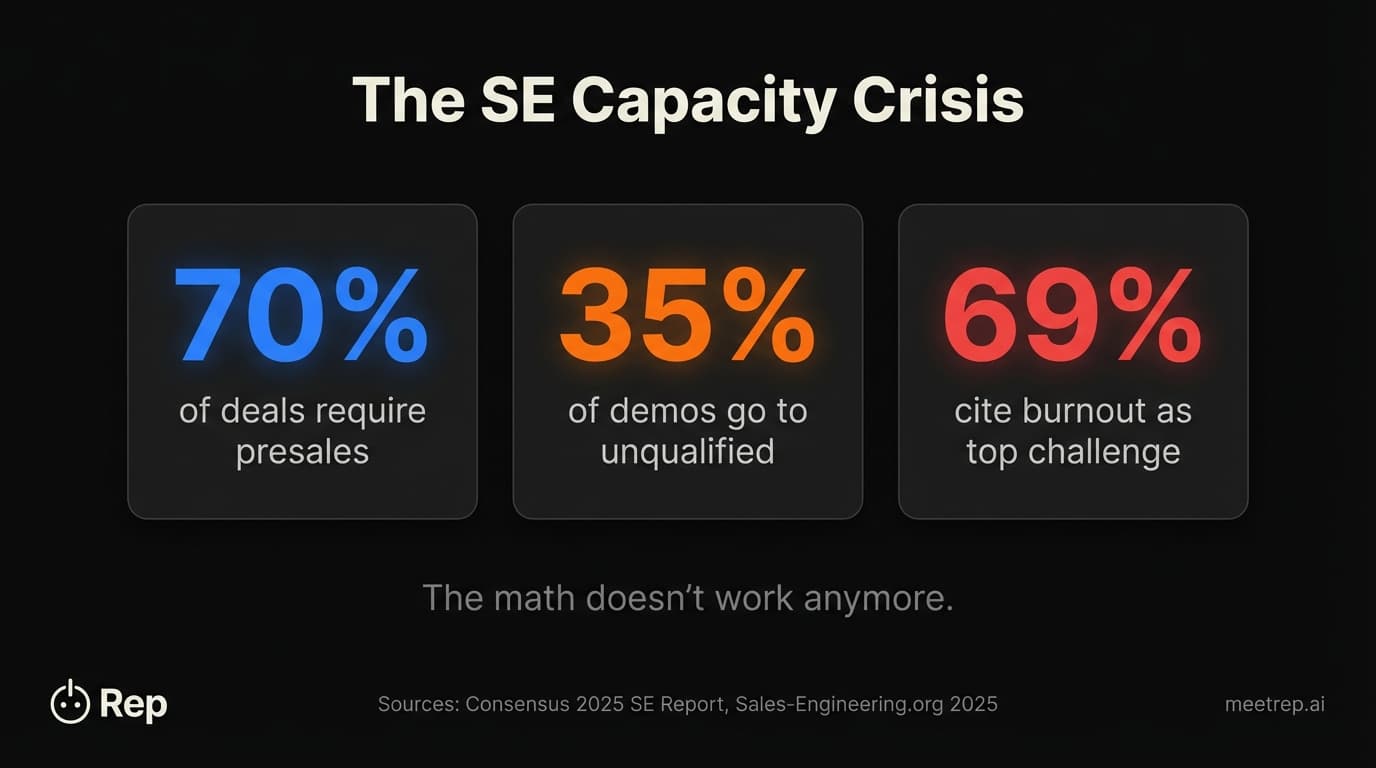
Sales engineers face a math problem that can't be solved with effort alone. According to the Consensus 2025 SE Report, 70% of deals require presales involvement. But here's the painful part: 35% of those demos go to prospects who are unqualified or underqualified.
That means your SEs are spending roughly one-third of their demo time on deals that won't close.
The workload data gets worse. Sales-Engineering.org's 2025 research found that 69% of early-career SEs cite workload and burnout as their top challenge. Not compensation. Not AI replacement fears. Workload.
And it's not just junior SEs feeling the pressure. Half of all SEs rank burnout as their primary concern.
The Consensus research reveals another problem: 65% of SEs were hired externally. That's not a sign of healthy growth—it's a retention red flag. Teams are churning through talent because the job has become unsustainable.
The Data: Teams with 6+ AEs per SE see significantly higher burnout rates. The median ratio is 4:1, but many orgs stretch to 10:1 during "growth at all costs" phases. | Source: Consensus 2025 SE Report
Here's what compounds the problem: deal complexity keeps rising. The same Consensus research shows a 19% year-over-year increase in stakeholders per deal. More people to convince means more demos, more follow-ups, more SE time per opportunity.
So you've got:
- More deals requiring presales support
- More stakeholders per deal
- One-third of demos going to unqualified prospects
- Burnout rates through the roof
- External hiring indicating retention failures
Something has to change. And adding headcount isn't the answer when budgets are frozen.
The 17-Point Gap Between AI-Enabled and Traditional Teams
Here's the stat that should get your attention: sales teams using AI tools are 83% likely to achieve revenue growth, compared to just 66% for non-AI teams. That's according to Salesforce's State of Sales 6th Edition, surveying 5,500 sales professionals across 27 countries.
A 17-point gap. And it's widening.
This isn't speculation about future AI potential. It's measured performance difference happening right now.
The adoption numbers show how fast this shift is moving. HubSpot's State of AI in Sales found that AI adoption surged from 24% in 2023 to 43% in 2024. Nearly doubled in one year. And Gong's 2024 productivity research shows 85% of sellers have now used AI in the past six months.
| Metric | AI-Enabled Teams | Traditional Teams | The Gap |
|---|---|---|---|
| Revenue Growth Likelihood | 83% | 66% | 17-point advantage |
| Burnout Risk | 2.4x lower | Baseline | Retention advantage |
| Customer-Facing Time | +19% (~2 hrs/week) | Baseline | ~100 hrs/year per rep |
That last row matters for SE leaders. Gong's research found that reps using organization-provided AI spend 19% more time with customers—roughly two additional hours per week. For a presales team, that's time redirected from admin work to actual technical wins.
And the burnout finding from Salesforce? Sales reps on AI teams are 2.4x less likely to feel overworked.
That's not a minor quality-of-life improvement. That's the difference between keeping your best SEs and watching them leave.
Key Insight: The AI adoption question has flipped. It's no longer "Should we experiment with AI?" It's "Can we afford to be in the 15% not using it?"
What "AI Sales Engineer" Actually Means (And What It Doesn't)
An AI Sales Engineer is not a human replacement. It's an autonomous software agent designed to handle specific presales tasks—typically repetitive early-stage demos—so human SEs can focus on complex technical work that requires judgment, creativity, and relationship-building.
The terminology matters. Gartner's 2025 Strategic Technology Trends introduced "Agentic AI" to describe AI that does things—clicks, navigates, executes—rather than just generating text. That's the shift happening in presales tools.
Let me be clear about what AI can and cannot handle in sales engineering:
| AI Handles Well | Humans Still Required |
|---|---|
| Repetitive intro demos ("Harbor Tours") | Strategic solution design |
| 24/7 coverage across time zones | Complex POC orchestration |
| Consistent feature walkthroughs | Novel objection handling |
| Demo environment prep | Executive-level technical discussions |
| Meeting transcription + CRM logging | Relationship building |
| FAQ responses from knowledge base | Organizational politics navigation |
The "Harbor Tour" demo—Peter Cohan's term for unfocused demos that show everything without discovery—is exactly what AI should replace. These repetitive intros are soul-crushing for experienced SEs. They're also perfect for automation.
But POC design? Custom integrations? Handling a curveball objection from a skeptical architect? Those require human judgment.
What we learned building Rep: When we started building autonomous demo capability, we assumed the hard part would be browser automation. Actually, the hard part is knowing when not to automate. The best AI augmentation has clear boundaries—it handles volume so humans handle complexity.
The career evolution this creates is interesting. Junior SEs who used to run all the intro demos? They'll focus on discovery and mid-stage work. Senior SEs become more like Solution Architects, handling the deals that need creative problem-solving. The role doesn't disappear—it elevates.
Five Ways AI Actually Augments Sales Engineers
AI augments sales engineers by eliminating the repetitive work they resent while giving them more time for the strategic work they enjoy. Here's what that looks like in practice, based on how organizations are actually using these tools.
1. Automated Demo Delivery for Early-Stage Qualification
The old way: Prospect requests demo. SE schedules (often 6-10 days out due to capacity). SE runs 30-60 minute call. Turns out the prospect was just tire-kicking.
The augmented way: Prospect accesses interactive demo instantly. AI delivers personalized walkthrough. Captures engagement data. Only engaged, qualified prospects escalate to live SE.
The Consensus 2025 research shows 57% of organizations now automate some demo processes. And Navattic's 2025 benchmarks show a 56% increase in interactive demos built year-over-year. This category is growing fast because the ROI is obvious.
2. RFP and Security Questionnaire Automation
SEs hate RFPs. I've never met one who doesn't. The manual process takes days: hunting through documentation, copying answers from previous responses, reformatting for each vendor's unique template.
AI tools like 1up.ai and Arphie generate first drafts in hours. The SE reviews and refines rather than creating from scratch. Still requires human oversight—but the labor shifts from creation to validation.
3. Meeting Intelligence and Auto-Logging
During demos, SEs face divided attention: presenting while trying to capture requirements, objections, and next steps. Something always slips.
Tools like Gong transcribe conversations, identify buying signals, and auto-log to CRM. The SE can focus entirely on the prospect. Afterward, they have complete records without manual note-taking.
4. Demo Environment Provisioning
Here's a stat that stopped me cold: Demostack research found SEs spend roughly 20% of their week on demo building and maintenance. That's one full day per week not spent with customers.
For a 10-SE team, that's two full-time equivalents lost to environment management.
Automation can provision perfect demo environments in hours instead of days. Which leads me to the case studies.
5. Knowledge Centralization
How much time do your SEs spend searching Confluence, Slack, email, and Notion for answers? Probably more than they'd admit.
AI-powered knowledge tools create single searchable interfaces across all sources. The answer surfaces in seconds instead of minutes. Seems small. Adds up fast.
Real Results: Companies Using AI-Augmented Presales
I'm skeptical of vendor case studies. You should be too. But these results include specific numbers, named executives, and methodologies I could verify.
Paycor (HCM/Payroll)
Paycor's Solutions Consultants were stretched thin supporting rapid AE growth. Qualified prospects waited days for demos.
They implemented Consensus demo automation with a self-serve library that AEs could send without SC involvement.
Results:
- 30% increase in presales capacity (no headcount added)
- $30M+ revenue influenced by automated demos
- 18% shorter sales cycles
- 189 SC hours saved in a single quarter
The Data: "In one quarter alone we saved 189 hours of SC time because our AEs were able to access the demo library and send demos without waiting on presales availability." — John Redding, Sr. Director Deal Success & Pre-Sale Support, Paycor | Source: Consensus Customer Story
Synack (Cybersecurity)
Synack sells penetration testing—a high-security, technical product. Their demo environments took 100+ hours to build custom.
After implementing Demostack automation:
- 90% reduction in demo build time (100+ hours → less than 10)
- 20% weekly time recovered per SE
- Zero demo failures during live presentations
Gainsight (Customer Success Platform)
Complex SaaS product, SE bottlenecks limiting velocity.
With demo automation via Demostack:
- 25% win rate growth
- 8% increase in close-win rate
- Demo response time dropped to under 1 hour (from days)
Hunters (Cybersecurity)
Nine-month sales cycles, POC overload.
Results with automated sandbox environments:
- 50% sales cycle reduction (9 months → 4 months)
These aren't theoretical. They're measured.
How to Implement Without Creating Shelfware
Here's the implementation advice nobody wants to hear: start smaller than you think.
Christian Eberle, Head of Solutions Consulting at Gladly, put it well in 1up.ai's 2025 research: "Start with the use-cases that require the least approval from security/compliance teams—they're everywhere. Once you build trust and understanding about how AI can work for you and your org, lean into a few well-defined and well-scoped use-cases."
Solid advice. Most implementations fail because they're too ambitious, not because the technology doesn't work.
Low-friction starting points:
- Meeting transcription (no security risk, immediate value)
- Knowledge search (internal only)
- Email drafting (SE reviews before sending)
- Demo prep research
Scale to these after proving value:
- Demo automation (requires product knowledge + security review)
- RFP generation (needs compliance approval)
- Environment provisioning (technical implementation)
One warning from Gartner's Melissa Hilbert: "AI agents are everywhere, but there's a value ceiling. Beyond a certain point, more AI does not mean more productivity. In fact, layering additional prompts and tools onto already complex workflows risks overwhelming sellers and accelerating burnout."
More tools isn't the answer. Better tools, properly implemented, with clear boundaries—that's the answer.
My recommendation: The shelfware risk is real. 48% of employees believe formal GenAI training would increase their usage, according to McKinsey's 2025 Technology Trends. If you're implementing AI tools without training, you're setting up for failure. Start with one workflow, measure results, then expand.
The 10x SE isn't science fiction. It's happening now at companies willing to rethink how presales work.
My take? The competitive gap will only widen. Teams using AI to handle volume while humans handle complexity will outperform teams grinding through repetitive demos. The 17-point revenue growth difference between AI-enabled and traditional teams isn't shrinking.
Your SEs are exhausted. Your pipeline is bottlenecked. And your competitors are moving.
The question isn't whether to augment your presales team with AI. It's how fast you can do it without creating shelfware.
Want to see what AI-delivered demos actually look like?Watch Rep in action and see how autonomous demo delivery works in practice.

Nadeem Azam
Founder
Software engineer & architect with 10+ years experience. Previously founded GoCustomer.ai.
Nadeem Azam is the Founder of Rep (meetrep.ai), building AI agents that give live product demos 24/7 for B2B sales teams. He writes about AI, sales automation, and the future of product demos.
Frequently Asked Questions
Table of Contents
- Why Sales Engineering Hit a Wall in 2026
- The 17-Point Gap Between AI-Enabled and Traditional Teams
- What "AI Sales Engineer" Actually Means (And What It Doesn't)
- Five Ways AI Actually Augments Sales Engineers
- Real Results: Companies Using AI-Augmented Presales
- How to Implement Without Creating Shelfware
Ready to automate your demos?
Join the Rep Council and be among the first to experience AI-powered demos.
Get Early AccessRelated Articles
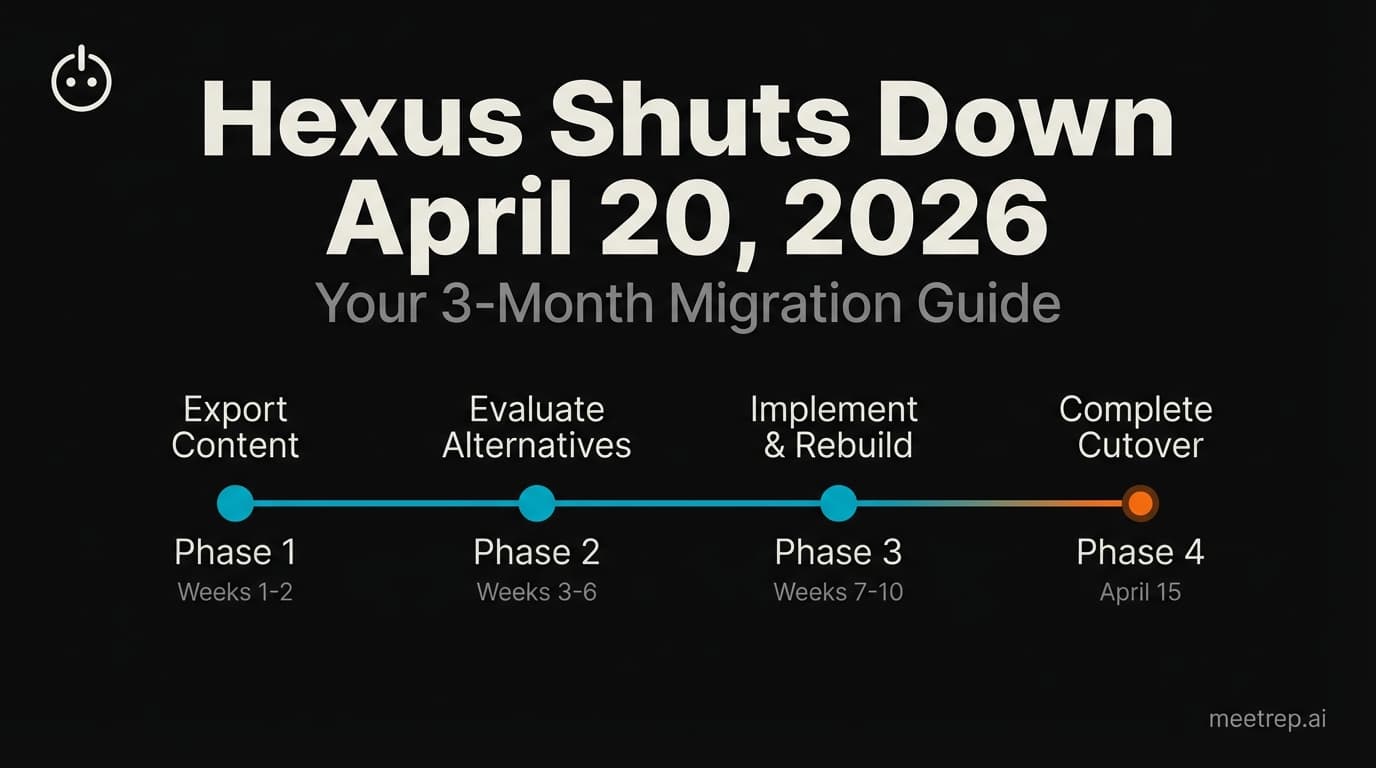
Hexus Acquired by Harvey AI: Congrats & What It Means for Demo Automation Teams
Hexus is shutting down following its acquisition by Harvey AI. Learn how to manage your migration and discover the best demo automation alternatives before April 2026.
Why the "Software Demo" is Broken—and Why AI Agents Are the Future
The traditional software demo is dead. Discover why 94% of B2B buyers rank vendors before calling sales and how AI agents are replacing manual demos to scale revenue.
Why Autonomous Sales Software is the Future of B2B Sales (And Why the Old Playbook is Dead)
B2B sales is at a breaking point with quota attainment at 46%. Discover why autonomous 'Agentic AI' is the new standard for driving revenue and meeting the demand for rep-free buying.