Strategies to Reduce No-Shows Sales Demo Appointments: The ROI Guide

Executive Summary
- The Benchmark: No-show rates average 6.5% but spike to 18.1% in industries like Education.
- The Killer: Waiting. Demos booked >1 week out have a 24.5% no-show rate.
- The Fix: Move from "calendar booking" to "instant execution" using AI agents.
- The ROI: AI-equipped teams generate 77% more revenue per rep.
In 2026, a "booked meeting" is a vanity metric. A "held meeting" is revenue.
I've spent the last decade building sales automation tools, first at GoCustomer.ai and now at Rep. If there is one thing I have learned, it's that the gap between "I want a demo" and "I am on the Zoom call" is where companies die. You pay for the lead. You pay the SDR to book it. But if the prospect ghosts?
Gone. Poof. Just like that.
You paid for nothing.
This isn't just annoying; it's expensive. According to BluLogix, this type of "revenue leakage"—inefficiencies like no-shows and dropped handoffs—costs companies 5–10% of their total revenue annually. For a $50M ARR company, that is $2.5M to $5M evaporating because of bad process.
Most teams try to fix this with better email reminders. That is a mistake. The data shows the problem isn't memory; it's latency.
What Is the Average Sales Demo No-Show Rate?
The average B2B sales demo no-show rate is roughly 6.5% across all industries.
But averages lie.
This number hides massive variance depending on who you are selling to. While technical buyers often keep appointments, industries with less tech-savvy stakeholders see ghosting rates nearly three times higher. To understand your own performance, you need to compare yourself against your specific sector, not a generic global average.
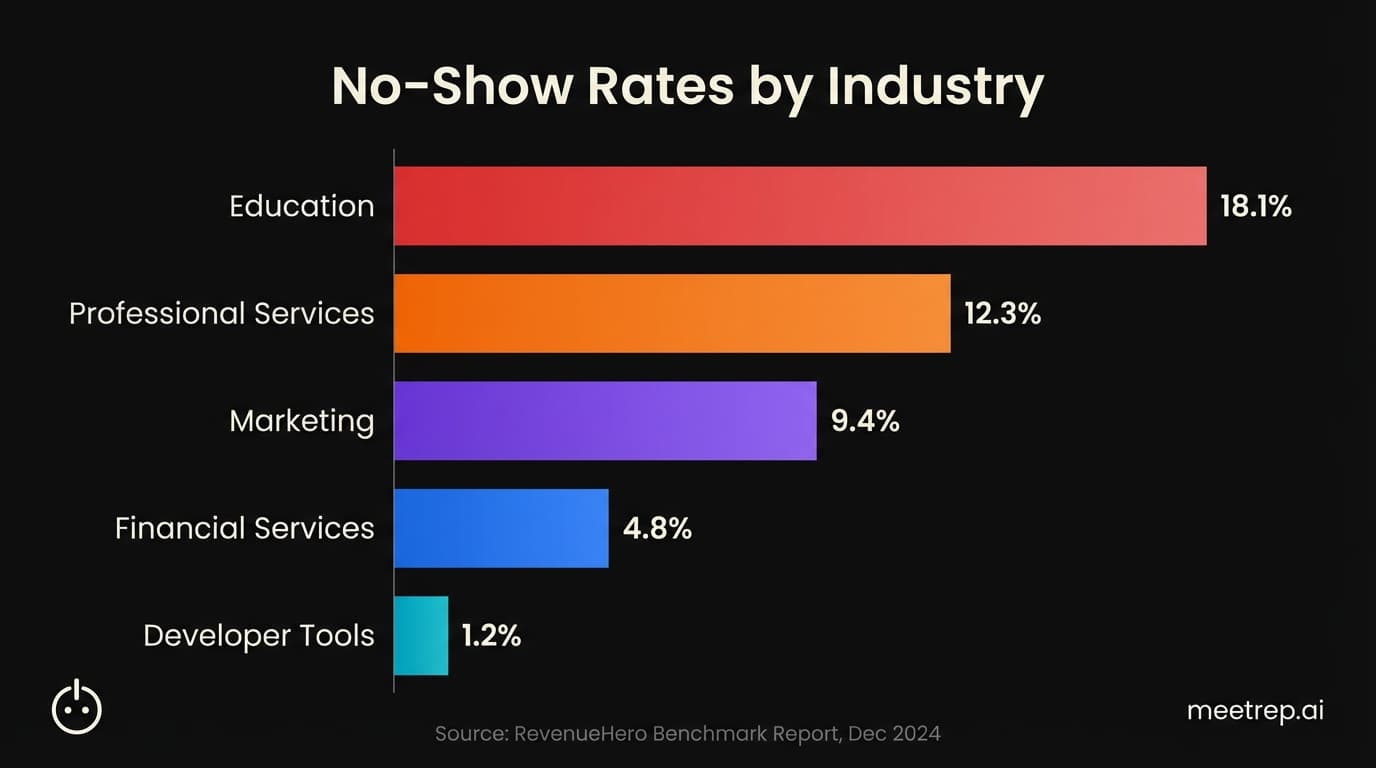
The Data: According to RevenueHero's December 2024 Benchmark Report, here is how no-show rates break down by industry:
| Industry | No-Show Rate |
|---|---|
| Education Software | 18.1% |
| Professional Services | 12.3% |
| Marketing / Advertising | 9.4% |
| Financial Services | 4.8% |
| Developer Tools | 1.2% |
What we learned at GoCustomer: When we looked at this data internally, we found a direct correlation between "pain urgency" and attendance. Developer tools have a 1.2% no-show rate because when a dev needs a tool, they usually need it to fix something broken right now. Education buyers (18.1%) are often browsing for next semester.
If your no-show rate is above 15%, you don't have a scheduling problem. You have an intent problem.
Why Do Prospects No-Show Sales Demos?
Prospects no-show because the time between "interest" and "action" is too long.
Internal conflicts account for some cancellations, sure. But the primary driver is the cooling of intent during the waiting period. The longer the gap between the form fill and the call, the higher the probability the buyer moves on. They forget. They lose interest. Or worse, they solve the problem with a competitor who picked up the phone faster.
This isn't just my opinion. The numbers are brutal.
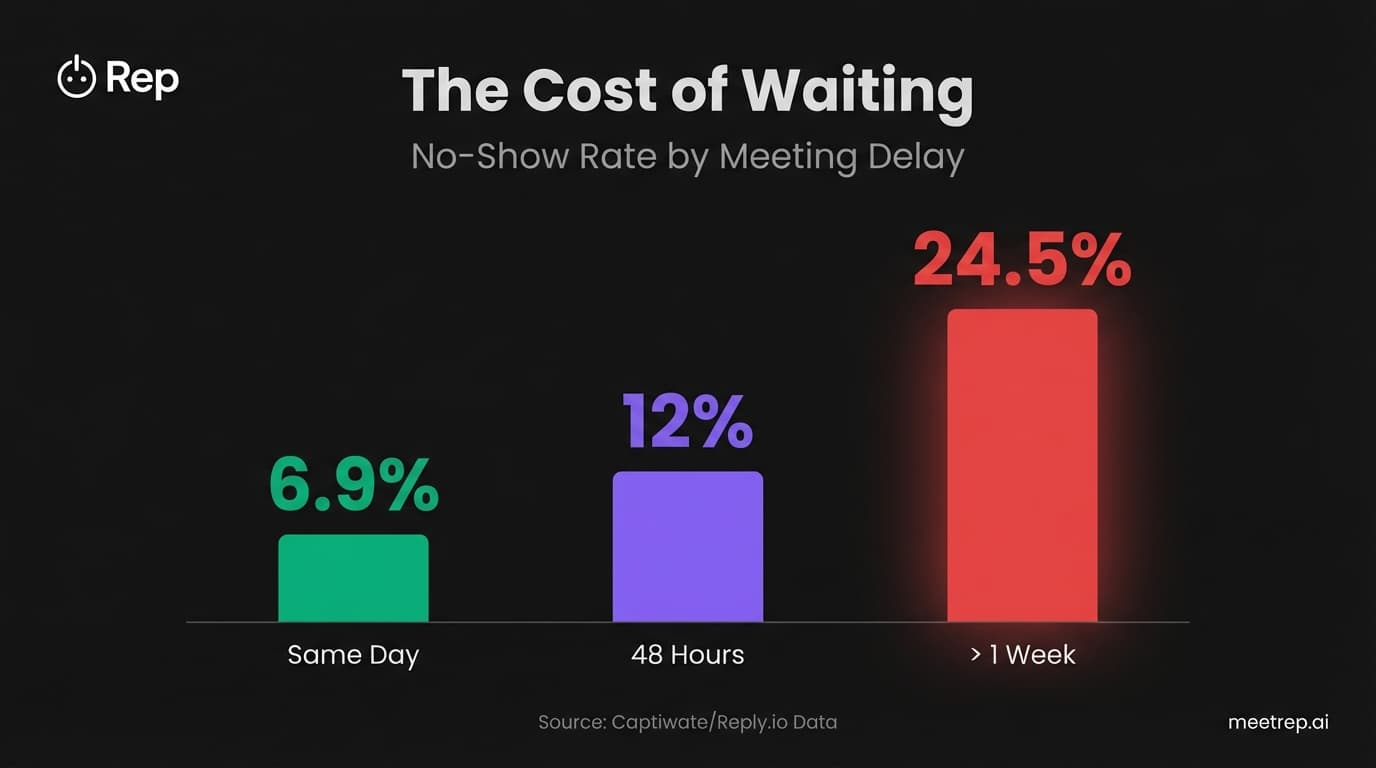
According to data cited by Captiwate, the timing of the meeting dictates the show rate:
- Same-Day Meetings: 6.90% no-show rate
- Booked 48 Hours Out: ~12% no-show rate
- Booked >1 Week Out: 24.50% no-show rate
Think about that.
If your SDR books a demo for next Tuesday because your Account Executive's calendar is full, you have effectively quadrupled the chance of that deal dying before it starts. You haven't filled the pipeline; you've clogged it with ghosts.
Common Mistake: Assuming that "fully booked calendars" means you are winning. If those calendars are booked 2 weeks out, you are actually losing. You are trading high-intent revenue today for low-probability meetings next week.
Strategy 1: Replace Scheduling with Instant Execution
When considering strategies to reduce no-shows sales demo appointments, the most effective approach is to eliminate the appointment entirely.
Instead of asking a prospect to pick a time next week, use AI agents to conduct the initial discovery and demonstration instantly, the moment intent is highest.
We built Rep specifically to solve this "time-to-demo" friction.
Here is the reality of the modern buyer: They are researching at 10 PM. They are researching between meetings. They want answers now. But 63% of companies fail to respond to inbound leads instantly, according to Martal Group.
When you force that buyer to wait for a human to wake up, log in, and check their email, you lose.
The shift to Agentic AI This isn't about chatbots. A chatbot gives you a link to a knowledge base article. An autonomous agent (like Rep) joins a video call, shares its screen, logs into your actual product, and gives a full demo.
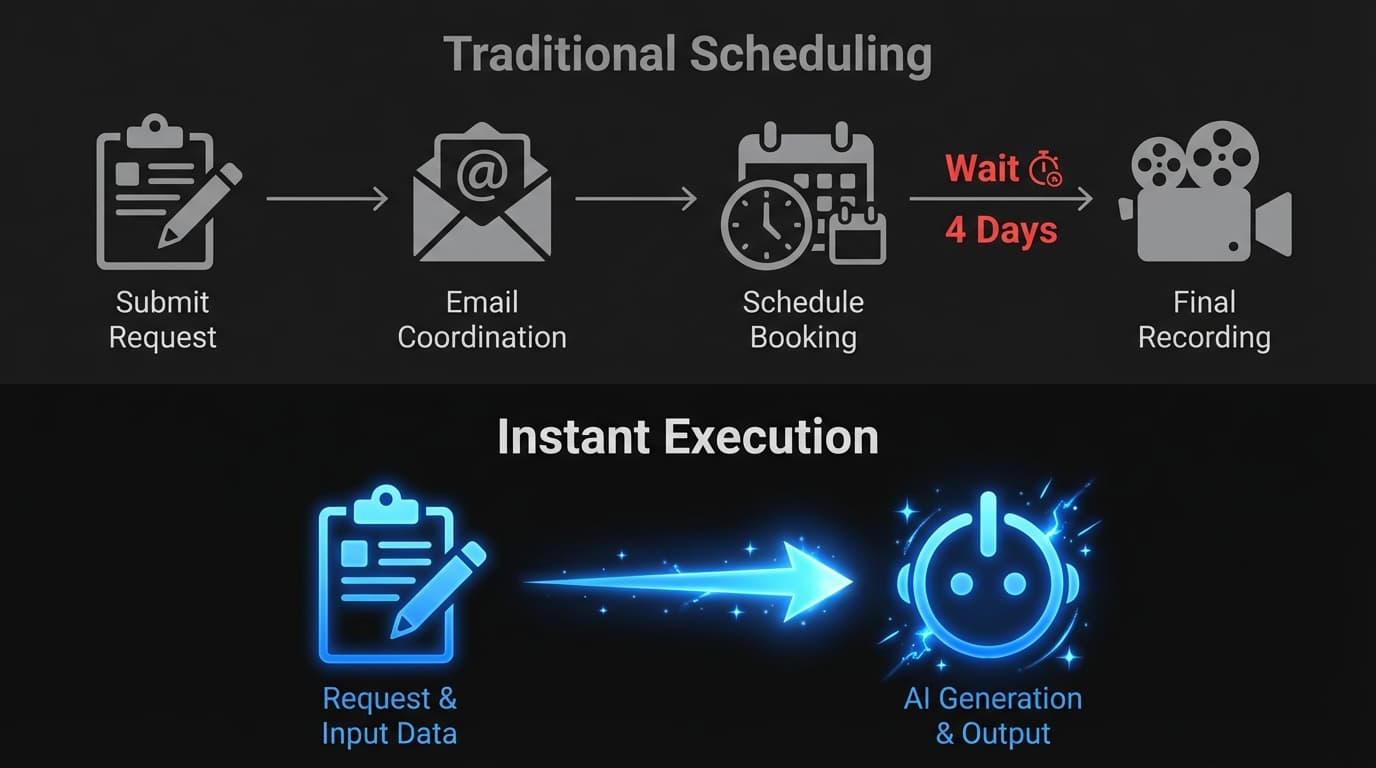
- Old Way: Form Fill → Email Tag → Calendar Invite → Wait 4 Days → Zoom Call.
- New Way: Form Fill → "Start Demo Now" → Agent Joins → Deal Qualified.
You can't no-show a meeting that happens immediately.
Key Insight: Companies using automation to cut speed-to-lead see results. OpenPhone reduced their speed-to-lead by 67% and saw a 17% lift in inbound conversion rates.
Strategy 2: Pre-Qualify with Interactive Demos
If you cannot demo instantly, you must engage the prospect's desire to "touch" the product immediately.
Interactive product demos allow prospects to click through a guided version of your software before they ever speak to a human. This locks in their interest. It filters out unqualified leads who would otherwise clutter your calendar.
Why does this work? Because B2B buyers are tired of "discovery calls" that are just interrogations. They want to see the goods.
According to Reprise, companies using interactive demos see:
- 50% reduction in sales cycles.
- 50% increase in lead-to-pipeline conversion.
Why we built Rep this way: At GoCustomer, we realized that "interactive click-throughs" (like Navattic or Storylane) are great, but they are lonely. The prospect clicks around in silence. We designed Rep to combine that interactivity with voice. The AI talks to you while it drives the browser. It creates a relationship, not just a click-path.
By the time a prospect books a meeting with a human AE after a Rep demo, they are educated, qualified, and serious. They don't no-show.
Strategy 3: Multi-Threading via AI Nurture
Single-threaded deals are the primary cause of late-stage no-shows. If your only contact at the company gets sick, fired, or busy, the meeting disappears.
Reducing no-shows requires "multi-threading"—engaging multiple stakeholders in the account so the deal has momentum beyond one person.
But asking SDRs to manually research and email five other people at every target account is a massive time sink.
This is where AI scales. AI agents can autonomously verify agendas and loop in colleagues. "Hey, I see we have a demo on Tuesday regarding [Problem X]. Should we invite [VP of Ops] to this call since it impacts her budget?"
The Data: According to HubSpot, multi-threading can boost win rates by 130%.
The connection to no-shows is simple: It is easy to blow off a sales rep. It is much harder to blow off your own boss who is also on the calendar invite.
The Financial Argument for "Held Rate"
CFOs and RevOps leaders need to stop obsessing over "Booked Meetings." A booked meeting is a cost. A held meeting is an asset.
When you look at the ROI of AI in sales, the data is overwhelming. It's not just about saving time; it's about making money.
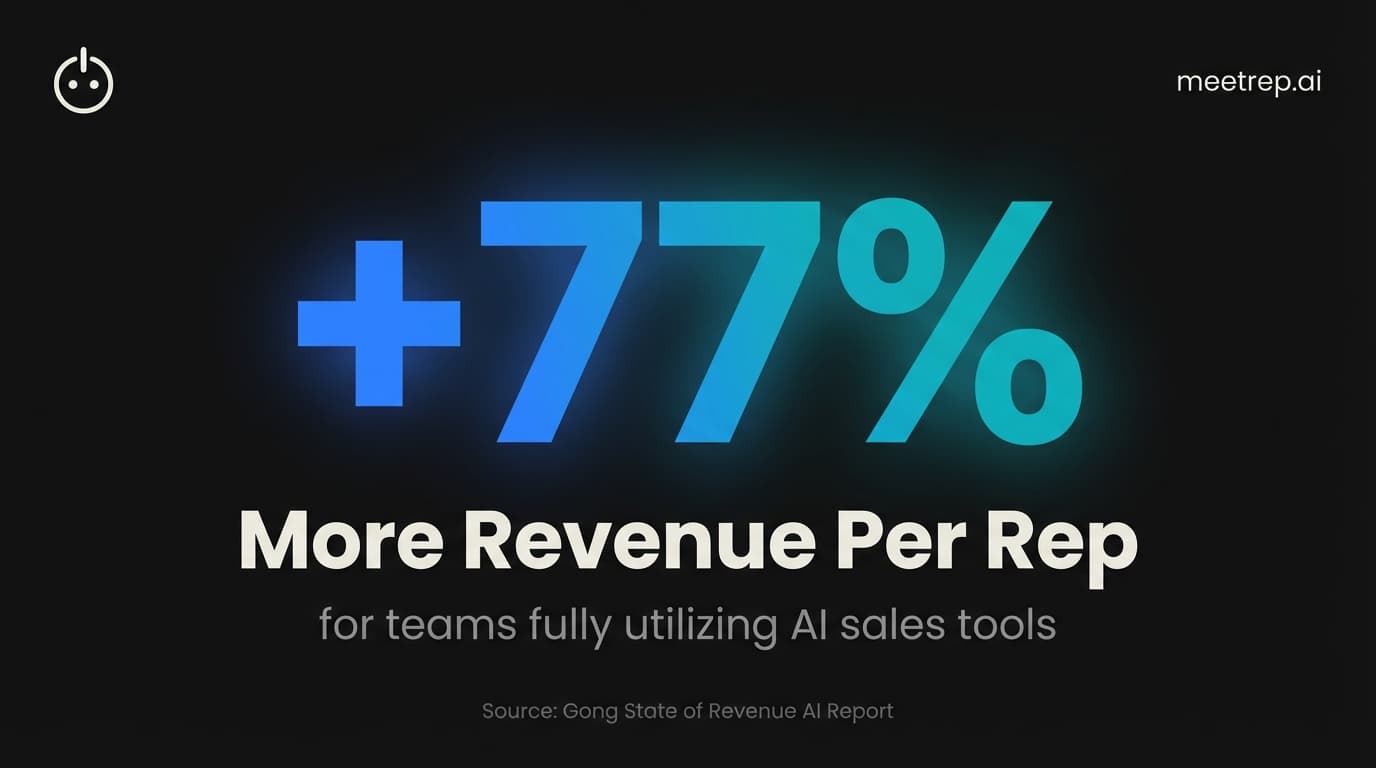
According to Gong's State of Revenue AI Report, sales teams that fully utilize AI generate 77% more revenue per representative than those who don't.
Why? Because the AI handles the low-value friction—the scheduling, the chasing, the initial demos—allowing the human reps to focus entirely on closing the high-value, high-intent opportunities that actually show up.
The battle against no-shows isn't won by sending more confirmation emails. It's won by speed.
My take is simple: If you are relying on a calendar to manage your pipeline, you are already too slow. The technology exists today to let your prospects demo, qualify, and convert at 2 AM on a Saturday without a human lifting a finger.
Stop managing calendars. Start managing revenue.
Ready to eliminate the scheduling gap? See how Rep can handle your initial demos instantly, 24/7.

Nadeem Azam
Founder
Software engineer & architect with 10+ years experience. Previously founded GoCustomer.ai.
Nadeem Azam is the Founder of Rep (meetrep.ai), building AI agents that give live product demos 24/7 for B2B sales teams. He writes about AI, sales automation, and the future of product demos.
Frequently Asked Questions
Table of Contents
- What Is the Average Sales Demo No-Show Rate?
- Why Do Prospects No-Show Sales Demos?
- Strategy 1: Replace Scheduling with Instant Execution
- Strategy 2: Pre-Qualify with Interactive Demos
- Strategy 3: Multi-Threading via AI Nurture
- The Financial Argument for "Held Rate"
Ready to automate your demos?
Join the Rep Council and be among the first to experience AI-powered demos.
Get Early AccessRelated Articles
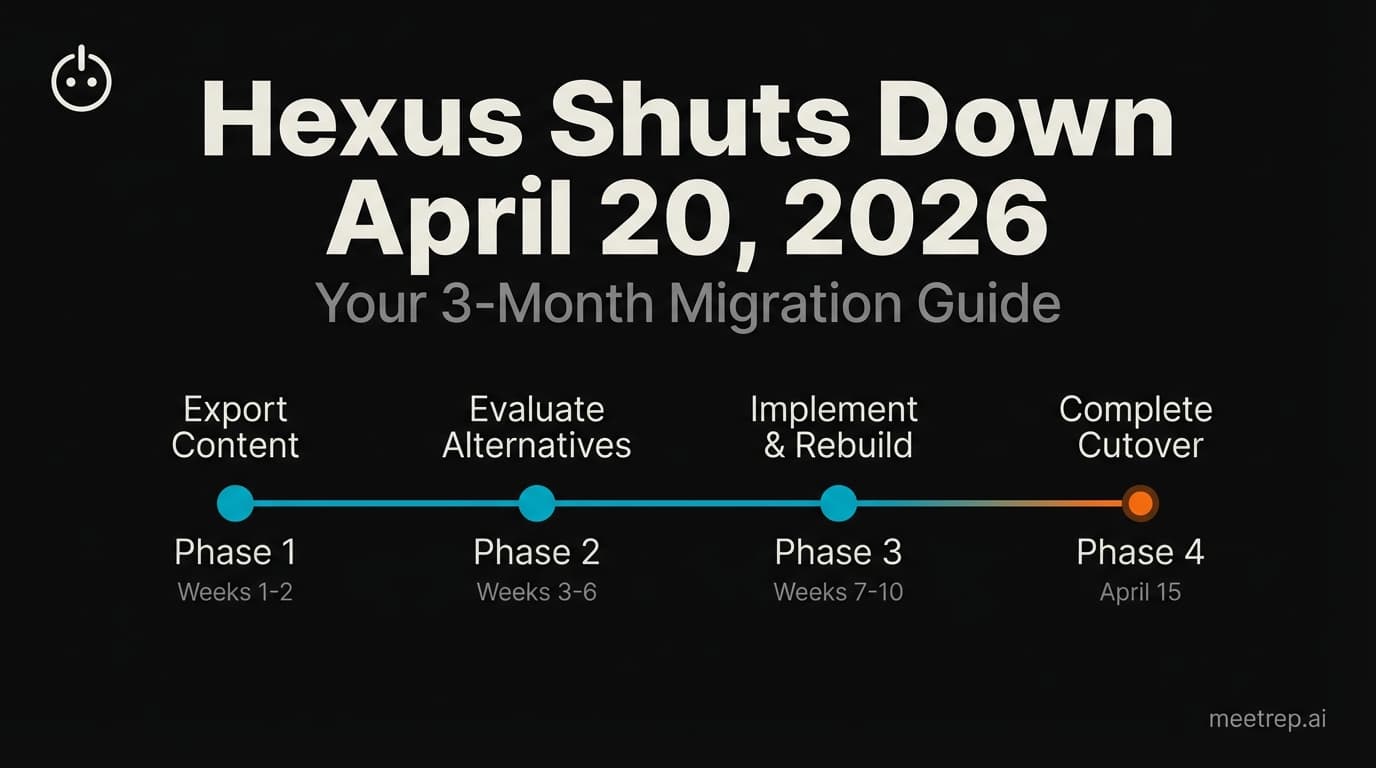
Hexus Acquired by Harvey AI: Congrats & What It Means for Demo Automation Teams
Hexus is shutting down following its acquisition by Harvey AI. Learn how to manage your migration and discover the best demo automation alternatives before April 2026.
Why the "Software Demo" is Broken—and Why AI Agents Are the Future
The traditional software demo is dead. Discover why 94% of B2B buyers rank vendors before calling sales and how AI agents are replacing manual demos to scale revenue.
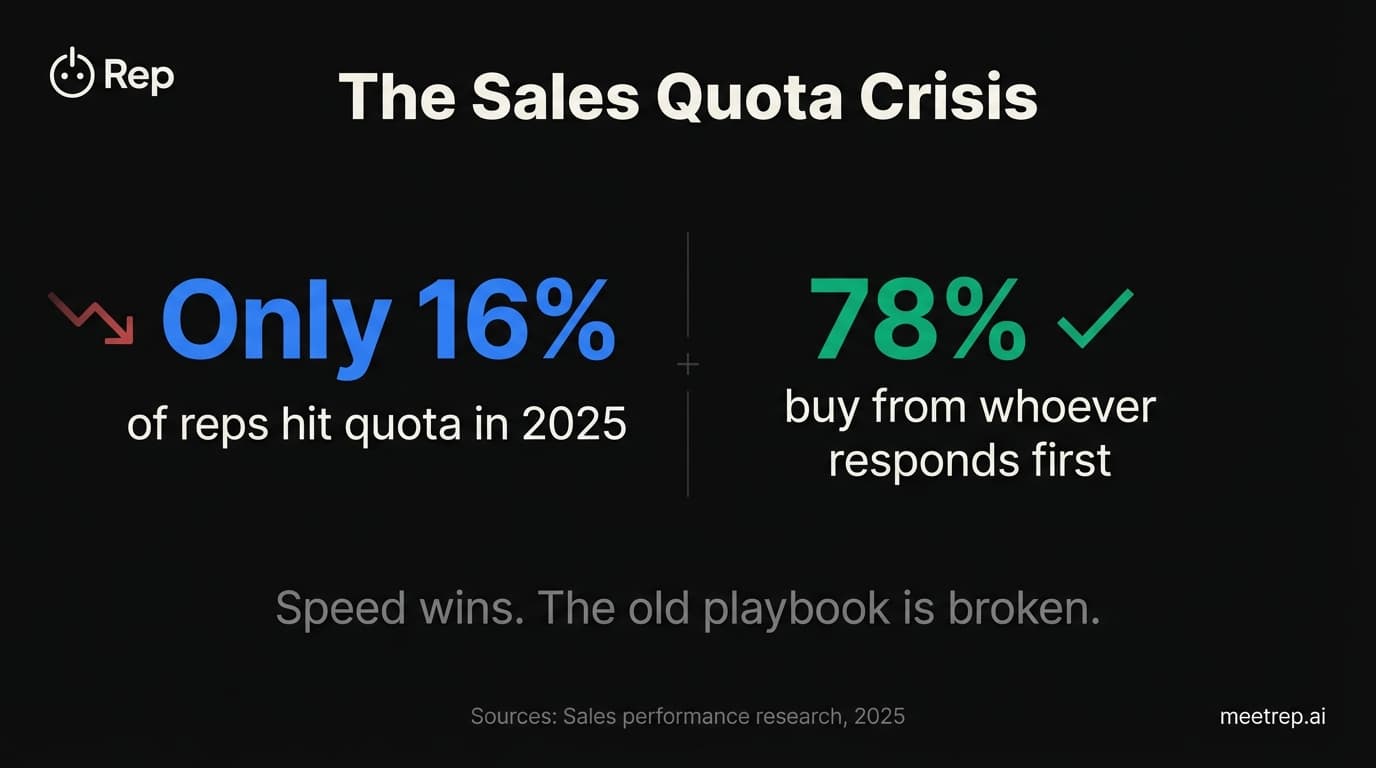
Why Autonomous Sales Software is the Future of B2B Sales (And Why the Old Playbook is Dead)
B2B sales is at a breaking point with quota attainment at 46%. Discover why autonomous 'Agentic AI' is the new standard for driving revenue and meeting the demand for rep-free buying.