SDR Agency vs In-House: Which Actually Works for Your Business?

Executive Summary
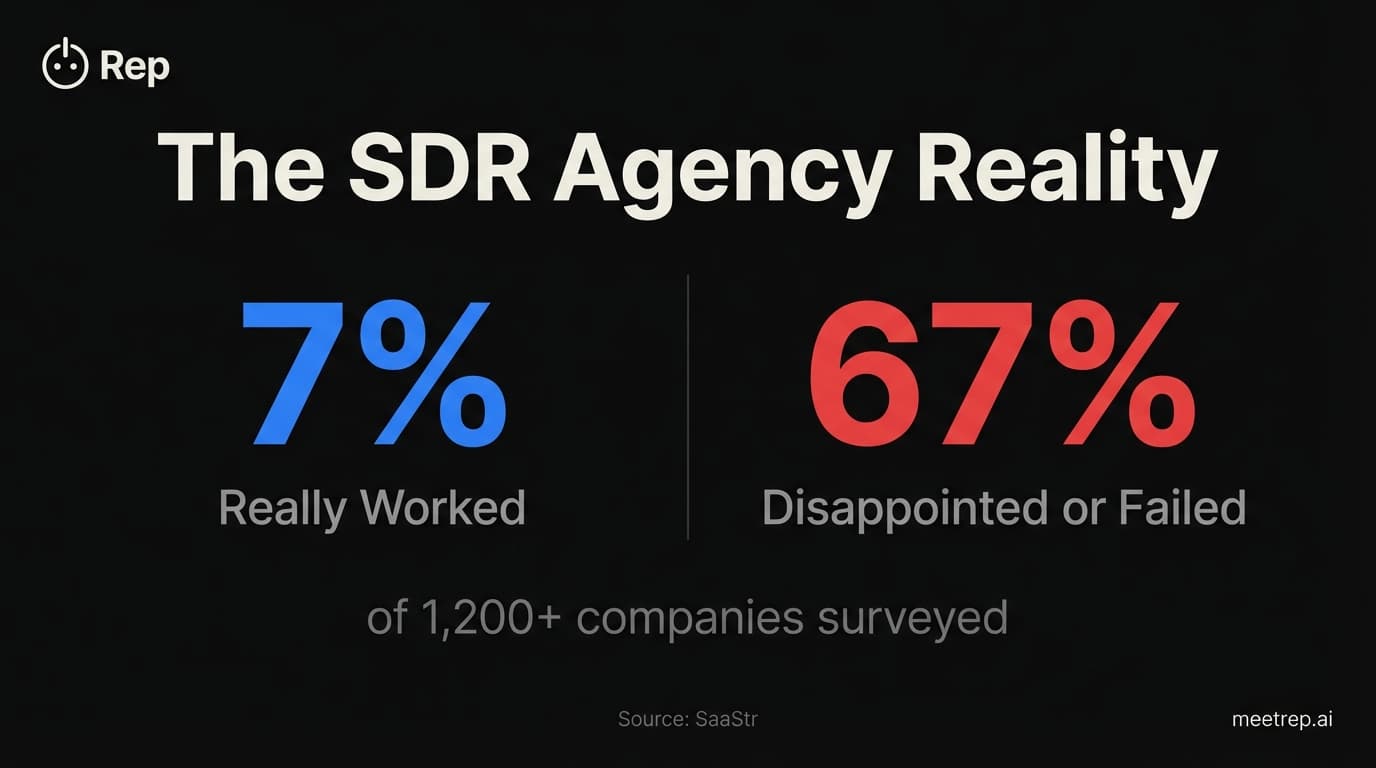
- SDR agencies cost $3K-$12K/month but only "really work" for 7% of companies
- In-house SDRs cost $9,800-$14,200/month fully loaded, with 3+ month ramp times
- The highest performers use hybrid approaches: AI for volume, humans for complex deals
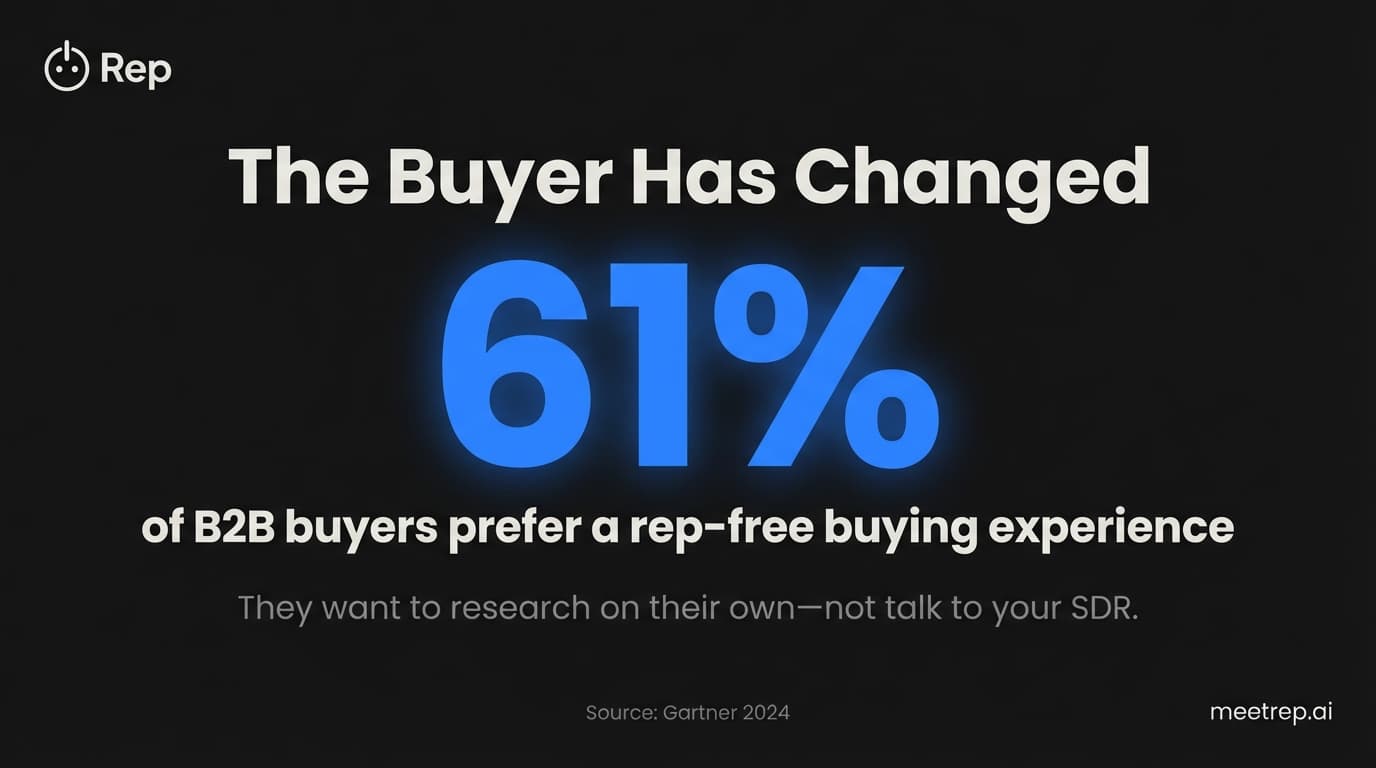
- 61% of B2B buyers now prefer "rep-free" experiences—this changes the math entirely
Here's a number most SDR agency content won't show you: only 7% of companies say outsourced SDRs "really worked" for them. That's from a SaaStr survey of over 1,200 respondents. Sixty-seven percent reported disappointment or outright failure.
So why do companies keep trying it? Because the alternative—building in-house—costs $110,000 to $175,000 per productive rep annually. And that's before you factor in the 3-month ramp time where you're paying full salary for zero output.
I've spent years building sales automation tools, first at GoCustomer.ai and now at Rep. I've watched this decision paralyze founders and frustrate VPs of Sales. The truth? The binary "agency vs in-house" framing is outdated. There's a third path most guides ignore.
This guide gives you the real numbers, the actual success patterns, and a framework to decide what works for your situation.
What Is an SDR Agency (And What Do They Actually Do)?
An SDR agency is a B2B service provider offering outsourced Sales Development Representatives who handle prospecting, lead qualification, and appointment setting for your company. Instead of hiring, training, and managing your own team, you pay a monthly retainer or per-meeting fee, and the agency handles outbound on your behalf.
Here's what that looks like in practice. The agency assigns reps to your account. They learn your product (supposedly). They run email sequences, make calls, and book meetings on your calendar. You show up and close.
Sounds great on paper.
But here's where it gets messy. Those reps typically work multiple accounts. They didn't build your product. They don't feel the pain your customers feel. And their incentive? Book meetings. Not good meetings. Just meetings.
The Data: According to a SaaStr survey of 1,200+ respondents, only 7% of companies reported that outsourced SDRs "really worked." Another 26% said it "sort of" worked. The remaining 67% were disappointed or saw outright failure.
That's a brutal success rate. And yet the outsourced SDR services market hit $3.84 billion in 2024 and is projected to reach $6.98 billion by 2032. Companies keep trying because the alternative feels worse.
The True Cost of In-House SDRs (It's Not Just Salary)
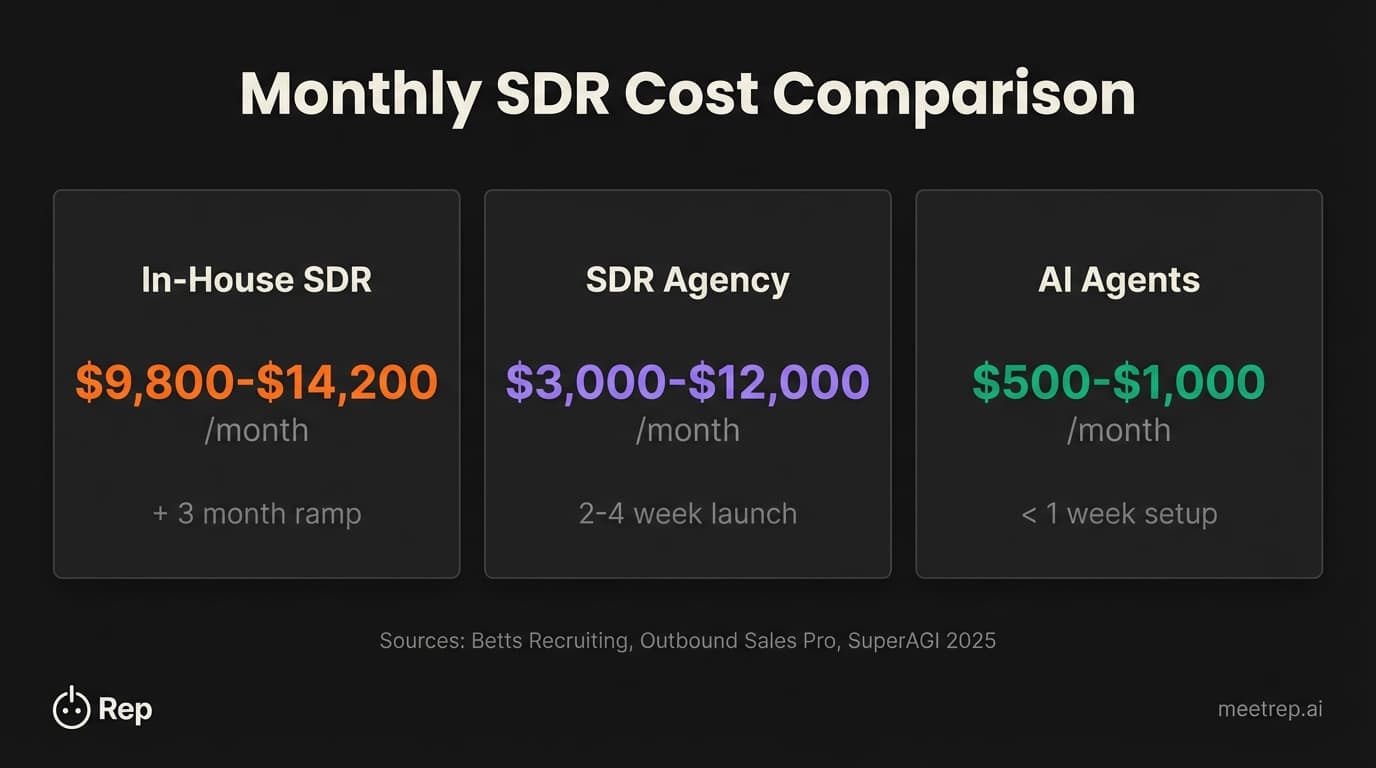
A fully loaded in-house SDR costs between $9,800 and $14,200 per month—that's $110,000 to $175,000 annually. Most hiring managers only see base salary. They miss everything else.
Let me break down what "fully loaded" actually means:
| Cost Component | Monthly | Annual | Source |
|---|---|---|---|
| Base Salary | $4,200-$5,400 | $50K-$65K | Betts Recruiting 2025 |
| Benefits & Taxes (25-30%) | $1,300-$2,000 | $15K-$24K | Outbound Sales Pro 2025 |
| Tech Stack | $500-$667 | $6K-$8K | Orum 2025 |
| Management Overhead | $800-$1,800 | $15K-$18K | Martal Group 2025 |
| Total (Productive Rep) | $9,800-$14,200 | $110K-$175K | Multiple sources |
But wait. That $110K-$175K assumes a productive rep. Here's the kicker: the average SDR takes 3.1-3.2 months to ramp to full productivity. During that time, you're paying full salary for partial output.
So your first-year cost for a new SDR? Add $30K-$40K in ramp time losses on top of the fully loaded number.
And here's what really hurts: median SDR tenure is just 1.9 years. You'll barely get 18 months of productive work before you're recruiting again.
What we learned building sales tools: At GoCustomer.ai, I saw this math break companies. They'd hire two SDRs, spend $100K over 6-9 months, and have nothing to show for it. Not because the SDRs were bad—but because the economics are brutal if you don't nail hiring, onboarding, and management from day one.
What SDR Agencies Actually Charge
SDR agency pricing falls into two models: monthly retainers and pay-per-meeting. The range is wider than most people expect.
Monthly Retainer Model:
- Offshore agencies: $2,500-$4,500/month
- US-based agencies: $7,000-$10,000/month
- Premium/specialized agencies: $10,000-$12,000/month
Pay-Per-Meeting Model:
- SMB/Mid-Market targets: $150-$600 per appointment
- Enterprise targets: $900+ per appointment
Source: Outbound Sales Pro 2025
Here's what the math looks like. If you need 15 qualified meetings per month and you're targeting mid-market, a pay-per-meeting model at $400/meeting runs you $6,000/month. A retainer model might cost $7,000-$8,000/month and include those same 15 meetings.
Sounds cheaper than in-house, right? It is—on paper.
But the comparison isn't apples-to-apples. Agencies often report "booked" meetings, not "held" meetings. The no-show rate matters enormously. And the quality of meetings varies wildly.
Key Insight:SalesHive data shows the cost per held meeting averages $357-$500 for outsourced SDRs versus $821-$1,150 for in-house. That's a real savings—if the meetings actually convert to opportunities at the same rate. Big if.
When Agencies Actually Work (The 7% Pattern)
So what separates the 7% who succeed from the 67% who fail? I've studied this. The pattern is clear.
Agencies work when:
- You already have a proven ICP. Agencies can't figure out your market for you. If you're still discovering who buys your product, an agency will burn cash running experiments you should be running yourself.
- Your product is simple enough to explain in 30 minutes. Complex enterprise software with 15 stakeholders and 9-month sales cycles? Agencies struggle. Products with clear value props and fast decisions? Agencies can execute.
- You're willing to stay involved. The "set it and forget it" mentality kills agency engagements. The best results come when clients review messaging weekly, provide list feedback, and iterate on targeting.
- You can afford to pay for quality. The $3K/month offshore options have terrible track records. US-based programs at $7K-$10K/month perform better. You get what you pay for.
- You need speed over depth. Agencies can generate meetings in 2-4 weeks. In-house takes 3-6 months. If you have a fundraising deadline or board meeting in 60 days, agencies make sense.
Common mistake: Companies hire agencies when they don't have product-market fit yet. They expect the agency to validate their ICP through outbound. This never works. Agencies execute playbooks—they don't create them. If you're still figuring out who buys your product, do founder-led sales first.
Real example of agency success:Belkins generated 135 in-person meetings for GE HealthCare over 7 months, achieving 112% of their KPI target. Notice what's true here: GE HealthCare has a clear ICP, a known product, and presumably dedicated resources to manage the relationship. They're not a startup figuring out their market.
When to Build In-House (Despite the Cost)
In-house makes sense when the economics flip. That happens in specific situations.
Build in-house when:
- Your average deal size exceeds $50K. High-value deals require relationship depth that outsourced reps can't build. The cost per meeting matters less when each deal is worth six figures.
- Your product requires extensive training. If it takes 60+ minutes to give a proper demo, agencies will butcher it. Some products are just too complex to outsource.
- You're building a talent pipeline. Great SDRs become great AEs. That's the career path. When you hire in-house, you're building your future closing team. Agencies don't give you that.
- You need tight integration with product and marketing. In-house SDRs sit in your Slack. They hear feedback from prospects and relay it in real-time. That feedback loop matters for fast-moving products.
- You can absorb 3-6 months of ramp time. If you don't have immediate pipeline pressure, the long-term payoff of in-house usually beats agency economics.
Here's the uncomfortable truth: in-house teams fail too. A lot. Tito Bohrt put it bluntly on LinkedIn: "3-9 months down the road when you realize you've spent $100K on 2 SDRs and they have produced nothing." That happens when companies hire without process, skip sales management, or expect SDRs to figure out targeting alone.
The Third Path: AI and Hybrid Models
Here's where the conversation changes. The binary "agency vs in-house" choice assumes you need humans to do all the prospecting work. In 2025, that assumption is wrong.
Three data points matter:
- 61% of B2B buyers now prefer a "rep-free" buying experience. They don't want to talk to your SDR. They want to research on their own.
- 36% of B2B companies reduced their SDR headcount in 2025. The market is already adjusting.
- AI SDR agents operate at $500-$1,000/month—that's 83-95% cheaper than human SDRs.
The math is shifting. Fast.
| Model | Monthly Cost | Ramp Time | Availability | Best For |
|---|---|---|---|---|
| In-House SDR | $9,800-$14,200 | 3.1 months | 40 hrs/week | Complex products, talent pipeline |
| SDR Agency | $3,000-$12,000 | 2-4 weeks | 40 hrs/week | Speed, market testing |
| AI Agents | $500-$1,000 | <1 week | 24/7 | Volume, self-service buyers |
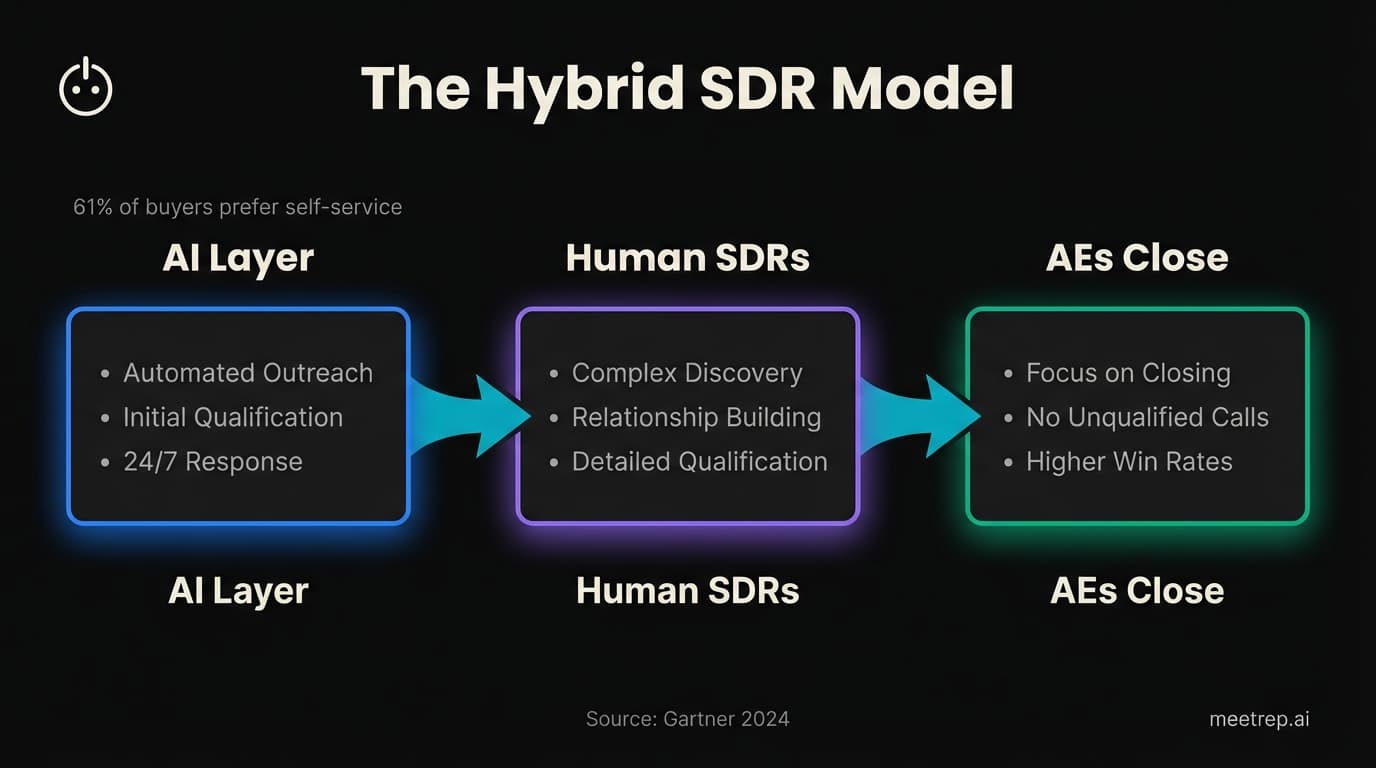
The smartest teams I see are running hybrid approaches:
- AI handles top-of-funnel. Automated outreach, initial qualification, instant responses to inbound. The 61% who want self-service get self-service.
- Lean human team handles mid-funnel. Complex discovery, relationship building, detailed qualification.
- AEs focus purely on closing. No more wasting closer time on unqualified intro calls.
One specific bottleneck persists across all models: demos. Whether you use agencies, in-house, or AI for prospecting, someone still needs to show the product. That's why we built Rep—to handle live demos 24/7 with AI, so your team (or agency) focuses on relationships, not repetitive walkthroughs.
How to Choose an SDR Agency (If You Go That Route)
If you've decided an agency fits your situation, here's how to choose wisely. Most guides give you vague "check their reviews" advice. I'll be more specific.
The 7-Point Evaluation Framework:
1. Demand held meeting rates, not booked meetings. This is the metric agencies avoid. Ask directly: "What was your average held-meeting rate last quarter?" Good agencies hit 70%+. If they won't share this number, walk away.
2. Verify industry experience with named case studies. "We work with SaaS companies" isn't enough. Ask for 3+ case studies in your specific vertical with named companies and specific results. Belkins and SalesRoads publish these publicly—that's a good sign.
3. Understand their pricing model completely. Get clarity on setup fees ($2K-$5K is typical), data/list costs (some agencies charge extra), tech stack costs (should be included), and minimum contract length. Avoid 6-12 month lock-ins on first engagements.
4. Define "qualified meeting" before signing. Write down exactly what qualifies: title, company size, expressed interest level, budget authority. Get agreement in writing. This prevents gaming where agencies book unqualified meetings just to hit quotas.
5. Ensure you get CRM integration, not monthly reports. You need real-time visibility into activities, not a slide deck once a month. If you're "locked out of email templates, targeting logic, or CRM reporting, assume the worst," as SocialBloom puts it.
6. Negotiate data ownership. Insist that you own all contact lists, email templates, and messaging learnings. Ask: "What happens to data if we terminate?" The answer should be full export, not deletion.
7. Expect realistic ramp time. Agencies claiming meetings "by next week" are cutting corners. Realistic launch is 2-4 weeks with proper ICP definition, list building, and messaging development.
My recommendation: Start with a 3-month pilot at the $7K-$10K/month range with a US-based agency. Establish clear KPIs (held meetings, opportunity conversion rate, cost per opportunity). If you're not seeing positive signals by month 2, it's not going to work.
The Decision Framework: 5 Questions to Answer
I've built this framework from watching dozens of companies make this choice—some successfully, many not.
Question 1: What's your fully loaded monthly budget?
- Under $5K: AI-first approach, skip human SDRs entirely
- $5K-$10K: Agency makes sense if you meet the criteria above
- $10K+: In-house becomes viable, especially if you have sales leadership
Question 2: How complex is your product?
- Simple (demos under 30 minutes, clear value prop): Agency or AI can handle it
- Complex (60+ minute demos, multiple stakeholders): In-house required
Question 3: What's your timeline to pipeline?
- Under 30 days: Agency is your only human option
- 3-6 months: In-house becomes feasible
- Immediate: AI agents provide instant availability
Question 4: Do you have sales management expertise?
- No dedicated sales leader: Agency removes this burden
- Strong sales leadership: In-house can thrive with proper management
Question 5: What do your buyers prefer?
- Self-service research: AI-first, on-demand demos
- High-touch relationship: In-house SDRs + AE partnerships
Most companies answer these questions and realize they need a blend. That's fine. That's actually the right answer for most growth-stage companies.
The SDR model question isn't really "agency vs in-house" anymore. It's "how do I build a motion that matches how buyers actually want to buy?"
Sixty-one percent of your prospects want to research without talking to anyone. Another chunk wants quick, low-friction demos on their schedule—not yours. The ones who want human contact? They want expertise, not scripts.
The companies winning right now combine AI for scale (24/7 availability, instant response), targeted human outreach for complex deals, and on-demand product access for the majority who want to self-educate. At Rep, we're building the demo piece of that puzzle—AI that joins calls, shows your product live, and answers questions without burning SDR or AE time.
Whether you choose agency, in-house, or hybrid, the bottleneck is the same: showing value fast, at scale, when prospects want it. That's the problem worth solving.

Nadeem Azam
Founder
Software engineer & architect with 10+ years experience. Previously founded GoCustomer.ai.
Nadeem Azam is the Founder of Rep (meetrep.ai), building AI agents that give live product demos 24/7 for B2B sales teams. He writes about AI, sales automation, and the future of product demos.
Frequently Asked Questions
Table of Contents
- What Is an SDR Agency (And What Do They Actually Do)?
- The True Cost of In-House SDRs (It's Not Just Salary)
- What SDR Agencies Actually Charge
- When Agencies Actually Work (The 7% Pattern)
- When to Build In-House (Despite the Cost)
- The Third Path: AI and Hybrid Models
- How to Choose an SDR Agency (If You Go That Route)
- The Decision Framework: 5 Questions to Answer
Ready to automate your demos?
Join the Rep Council and be among the first to experience AI-powered demos.
Get Early AccessRelated Articles
Hexus Acquired by Harvey AI: Congrats & What It Means for Demo Automation Teams
Hexus is shutting down following its acquisition by Harvey AI. Learn how to manage your migration and discover the best demo automation alternatives before April 2026.
Why the "Software Demo" is Broken—and Why AI Agents Are the Future
The traditional software demo is dead. Discover why 94% of B2B buyers rank vendors before calling sales and how AI agents are replacing manual demos to scale revenue.
Why Autonomous Sales Software is the Future of B2B Sales (And Why the Old Playbook is Dead)
B2B sales is at a breaking point with quota attainment at 46%. Discover why autonomous 'Agentic AI' is the new standard for driving revenue and meeting the demand for rep-free buying.