The Sales Pre Bottleneck: Why Your Best Technical Assets Are Stuck in "Demo Jail" (And How to Free Them)

Executive Summary
- The Problem: SEs waste 35% of their time on unqualified demos.
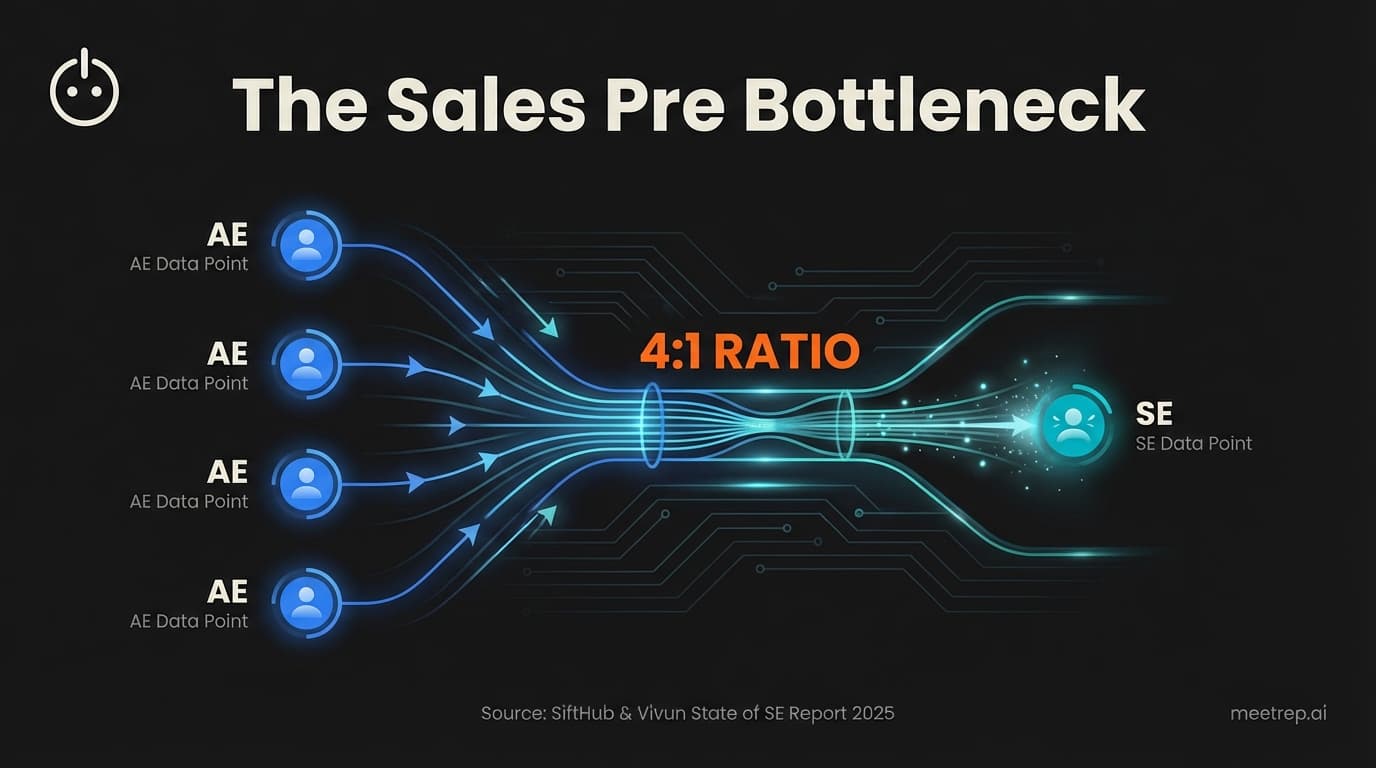
- The Bottleneck: The median AE:SE ratio is 4:1, creating a scarcity of technical support.
- The Shift: 80% of buyer interactions are now digital; they want instant access, not meetings.
- The Fix: Using AI agents for the "Sales Pre" layer reduces CAC by 71% and frees humans for high-value deals.
Your Account Executives likely outnumber your Sales Engineers by 4 to 1.
That is the industry median. In some growth-stage companies I’ve seen, it stretches to 10:1. It’s a simple math problem that is quietly killing your revenue.
When we were building GoCustomer.ai, and now at Rep, I saw this dynamic play out in hundreds of organizations. AEs fight for time on an SE’s calendar. SEs spend their days giving the same generic "harbor tour" demo to prospects who—frankly—aren't even qualified to buy. Deals stall because the "technical win" takes three weeks to schedule.
It’s inefficient. It’s expensive. And it burns out your best technical talent.
If you are a sales leader in 2026, you cannot fix this by hiring more humans. The unit economics don't work. The solution is to change how you define "Sales Pre" entirely.
What is "Sales Pre" in 2026?
Sales Pre (or Pre-Sales) refers to the technical and strategic activities that occur before a deal is closed, primarily focusing on technical validation, solution design, and risk reduction.
Unlike direct sales, which manages commercial terms, pre-sales ensures the product is a viable fit for the customer's environment. Historically, this meant "the person who does the demo."
That definition is outdated.
According to Arphie.ai’s guide to pre-sales, the core function is actually risk reduction for both parties. The SE’s job is to prove to the buyer that the solution will work, and to prove to the seller that the deal is technically sound.
My recommendation: Stop calling your SEs "demo resources." If you are paying someone $180k+ a year to possess deep technical knowledge, they should be architecting solutions for your biggest deals, not explaining where the "Settings" button is for the fiftieth time.
The "Hidden Bottleneck" Killing Deal Velocity
The math I mentioned earlier? It’s getting worse.
According to the 2025 State of Sales Engineering Report by SiftHub and Vivun, the median AE:SE ratio sits stubbornly at 4:1.
Here is what that looks like in practice:
- Four AEs are hunting deals.
- They all uncover opportunities simultaneously (usually end of quarter).
- They all need a "technical deep dive" to move the deal to the next stage.
- There is only one SE.
Calendar tetris ensues. The demo gets pushed out 10 days. By then? The champion has moved on. Or a competitor stepped in.
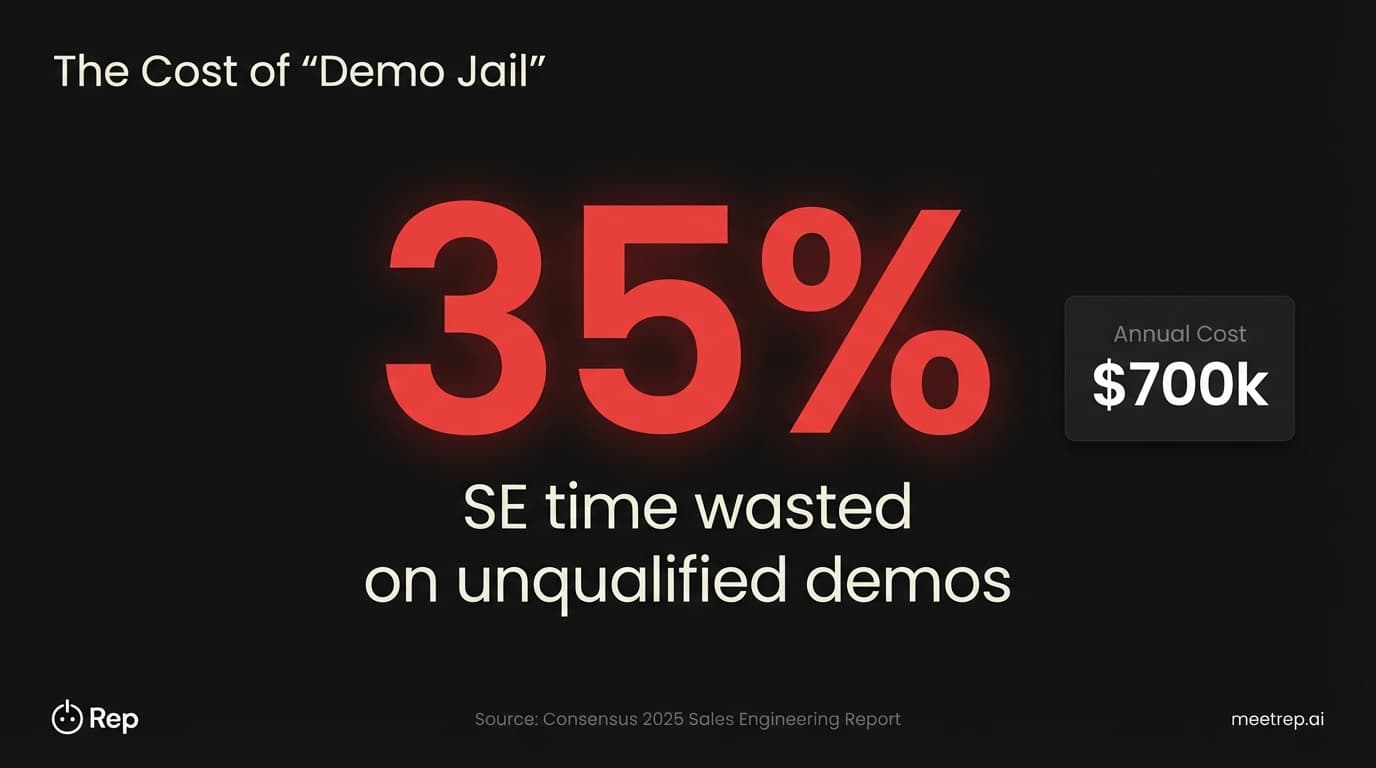
But here is the statistic that genuinely shocked me when I first saw it: 35% of demos delivered by Sales Engineers are for unqualified prospects.
That number comes from Consensus's 2025 report.
Think about the waste. If your SE team costs $2M a year, you are lighting $700,000 on fire annually. You are paying high-end salaries for people to perform a repetitive "intro to the platform" script that essentially acts as a qualification filter.
Common Mistake: Assuming that "more headcount" fixes this. It doesn't. If you hire another SE, the AEs will just fill their calendar with more unqualified demos. You don't need more capacity; you need better filtering.
The Buyer Has Changed (Even If You Haven't)
While we worry about internal ratios, the buyer has already moved on.
Gartner predicts that by 2025, 80% of B2B sales interactions between suppliers and buyers will occur in digital channels.
What does this mean? It means buyers hate "Book a Meeting."
They want Speed-to-Demo. They want to see the product now. Not next Tuesday at 2 PM EST after a 15-minute qualification call with an SDR who doesn't understand the product.
According to TestBox, 43% of B2B buyers (and 54% of millennials) prefer a rep-free buying experience. If you force them into your manual "Sales Pre" process, you are adding friction where competitors are offering instant gratification.
Enter the AI Sales Rep: Scaling Without Headcount
So, how do you fix the 4:1 ratio without doubling your payroll?
You bifurcate the Sales Pre role.
You keep your humans for the complex, creative work (solution architecture, security reviews, executive alignment). You use AI for the repetitive, initial discovery and demonstration work.
When we designed the architecture for Rep, we didn't want to build another "interactive video" tool. Video is passive. Real sales happens in the browser, with real data, answering real questions.
We built an autonomous AI agent that actually joins the Zoom call. It shares its screen. It logs into your actual web application. And it navigates the product live while talking to the prospect.
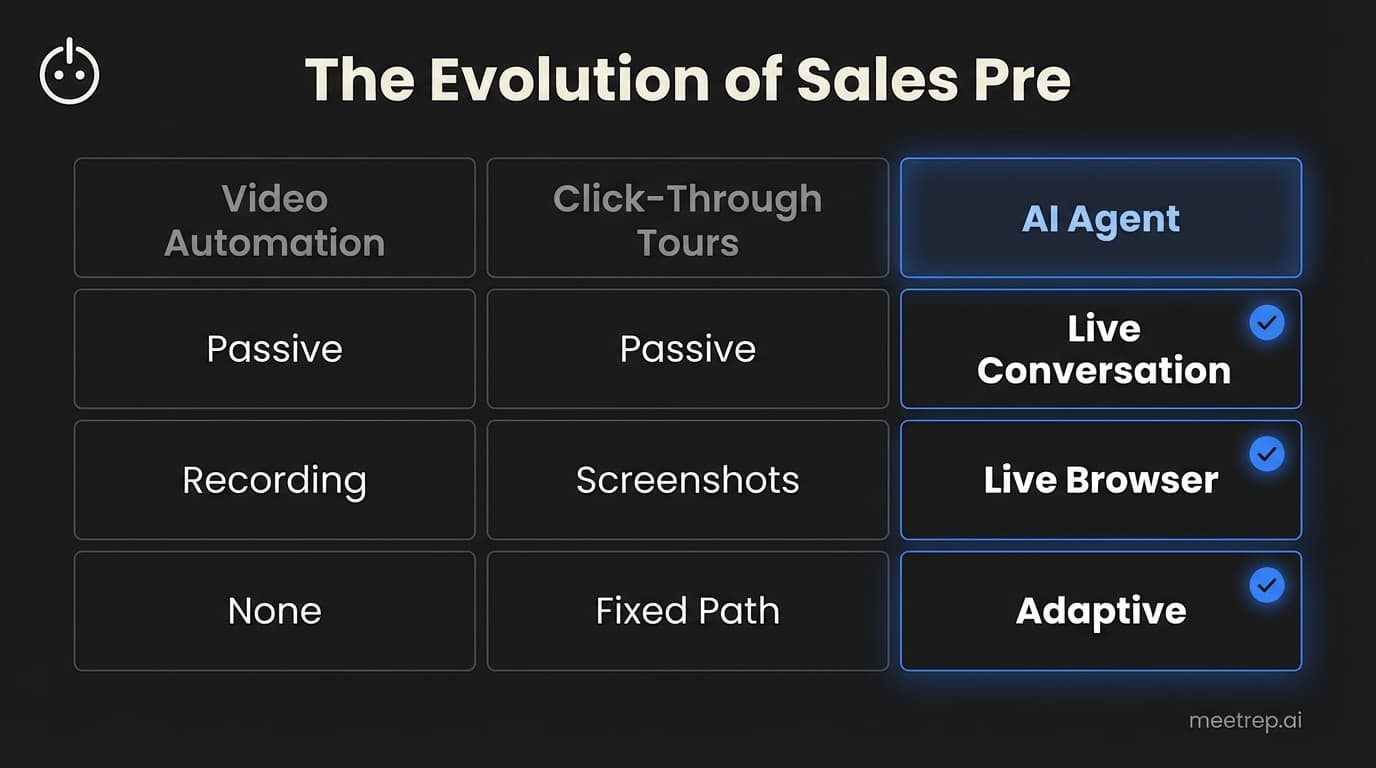
Here is how the modern toolset compares:
| Feature | Video Automation (Consensus) | Click-Through Tours (Walnut/Navattic) | AI Agent (Rep) |
|---|---|---|---|
| Format | Pre-recorded Video | HTML Screenshots | Live Browser Navigation |
| Interaction | Passive Watching | Clicking Hotspots | Voice Conversation |
| Q&A | None (Form fill) | None | Real-time Answers |
| Personalization | Low (Branching video) | Low (Fixed path) | High (Adapts to prospect) |
| Goal | Awareness | Engagement | Qualification & Demo |
Why we built Rep this way: Buyers know when they are watching a video. They tune out. But when an AI says, "Let me show you how that works," and actually clicks the button in the live app to show the result, the engagement level spikes. It feels real because it is real.
Case Study: The ROI of Automated Pre-Sales
This isn't theoretical. The data on automating the "Sales Pre" layer is becoming undeniable.
Take the example of DataPrime Analytics (via Maccelerator). They implemented automation for their technical qualification and demo booking process.
The results were immediate:
- CAC Reduction: 71% drop (from $3,200 to $920).
- Sales Cycle: Shortened from 45 days to 19 days.
Key Insight: DataPrime didn't just save money on SE hours. They shortened their sales cycle by 58% because prospects didn't have to wait for "the next available slot."
Why? Because they stopped treating every lead as a "human-worthy" event. They let automation handle the qualification. By the time a human SE got involved, the prospect was educated, qualified, and ready to talk specifics.
The Data: Organizations with effective pre-sales support achieve a 49% higher win rate on forecasted deals Source: Spekit/G2. But you only get that lift if your SEs have the time to prep. If they are back-to-back on intro calls, they can't do the prep work that drives that 49% lift.
How to Structure Your Hybrid Pre-Sales Team
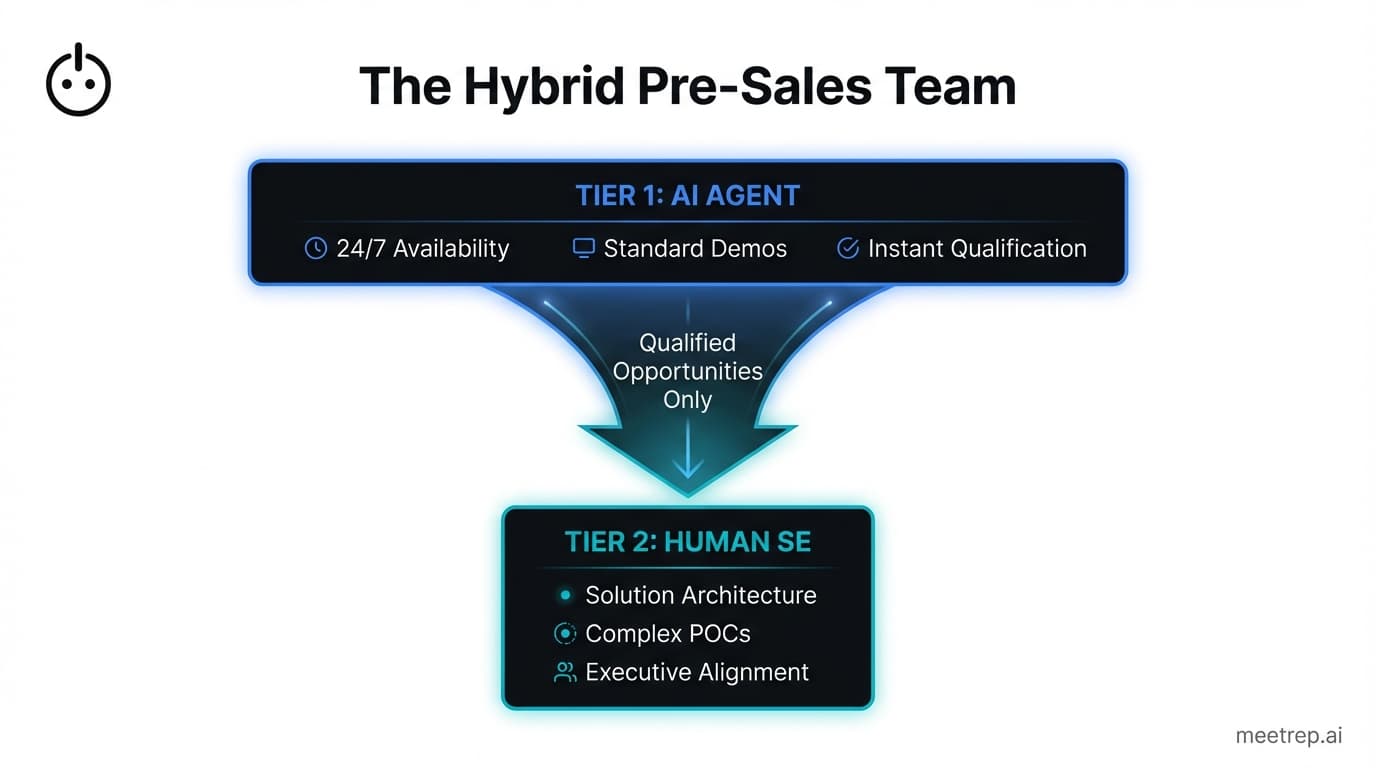
I believe the winning org chart for 2026 looks different. It’s not just AEs and SEs anymore.
It looks like this:
Tier 1: The AI "Sales Pre" Layer (The Scale Engine)
- Role: Handles all inbound demo requests instantly (24/7).
- Task: Runs the "Standard Demo." Answers FAQs ("Does it integrate with Salesforce?").
- Outcome: Disqualifies bad fits immediately. Passes qualified opportunities to humans with a transcript of exactly what the prospect cares about.
Tier 2: The Human Sales Engineer (The Value Architects)
- Role: Engages only after Tier 1 qualification.
- Task: Deep-dive solutioning, custom POCs, stakeholder alignment.
- Outcome: The "Technical Win."
This structure fixes the ratio. Your AI scales infinitely to support 10, 20, or 50 AEs. Your humans focus purely on the high-value interactions that actually close revenue.
Final Thoughts
We are past the point where "hiring more people" is a viable strategy for scaling pre-sales.
The math just doesn't work.
You have a choice. You can keep forcing your expensive, talented engineers to give the same "Intro to the Platform" demo five times a day until they quit. Or you can hand that work to an AI that never sleeps, never complains, and gives your buyers the instant access they are begging for.
My advice? Let the robots handle the harbor tours. Let your humans handle the architecture.
See how an autonomous demo works at Rep.

Nadeem Azam
Founder
Software engineer & architect with 10+ years experience. Previously founded GoCustomer.ai.
Nadeem Azam is the Founder of Rep (meetrep.ai), building AI agents that give live product demos 24/7 for B2B sales teams. He writes about AI, sales automation, and the future of product demos.
Frequently Asked Questions
Table of Contents
- What is "Sales Pre" in 2026?
- The "Hidden Bottleneck" Killing Deal Velocity
- The Buyer Has Changed (Even If You Haven't)
- Enter the AI Sales Rep: Scaling Without Headcount
- Case Study: The ROI of Automated Pre-Sales
- How to Structure Your Hybrid Pre-Sales Team
- Final Thoughts
Ready to automate your demos?
Join the Rep Council and be among the first to experience AI-powered demos.
Get Early AccessRelated Articles
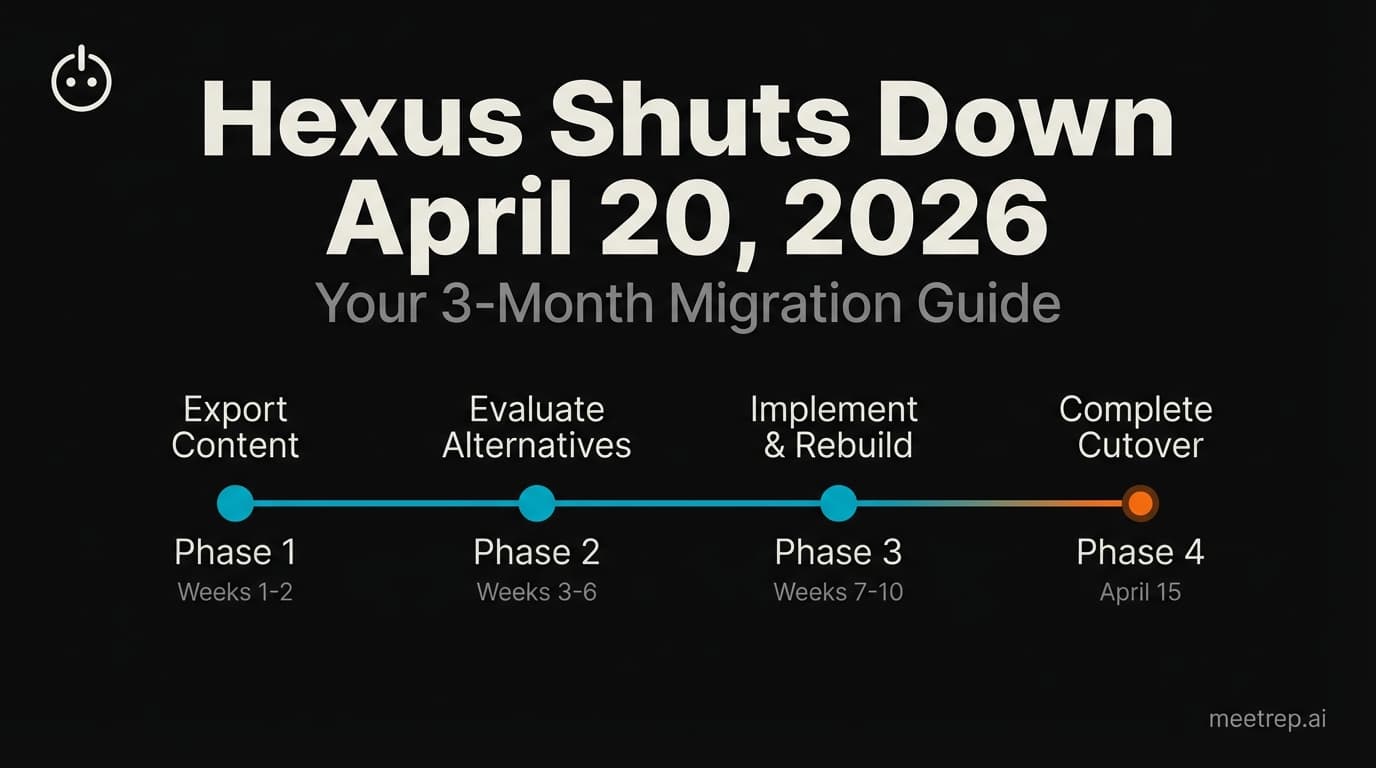
Hexus Acquired by Harvey AI: Congrats & What It Means for Demo Automation Teams
Hexus is shutting down following its acquisition by Harvey AI. Learn how to manage your migration and discover the best demo automation alternatives before April 2026.
Why the "Software Demo" is Broken—and Why AI Agents Are the Future
The traditional software demo is dead. Discover why 94% of B2B buyers rank vendors before calling sales and how AI agents are replacing manual demos to scale revenue.
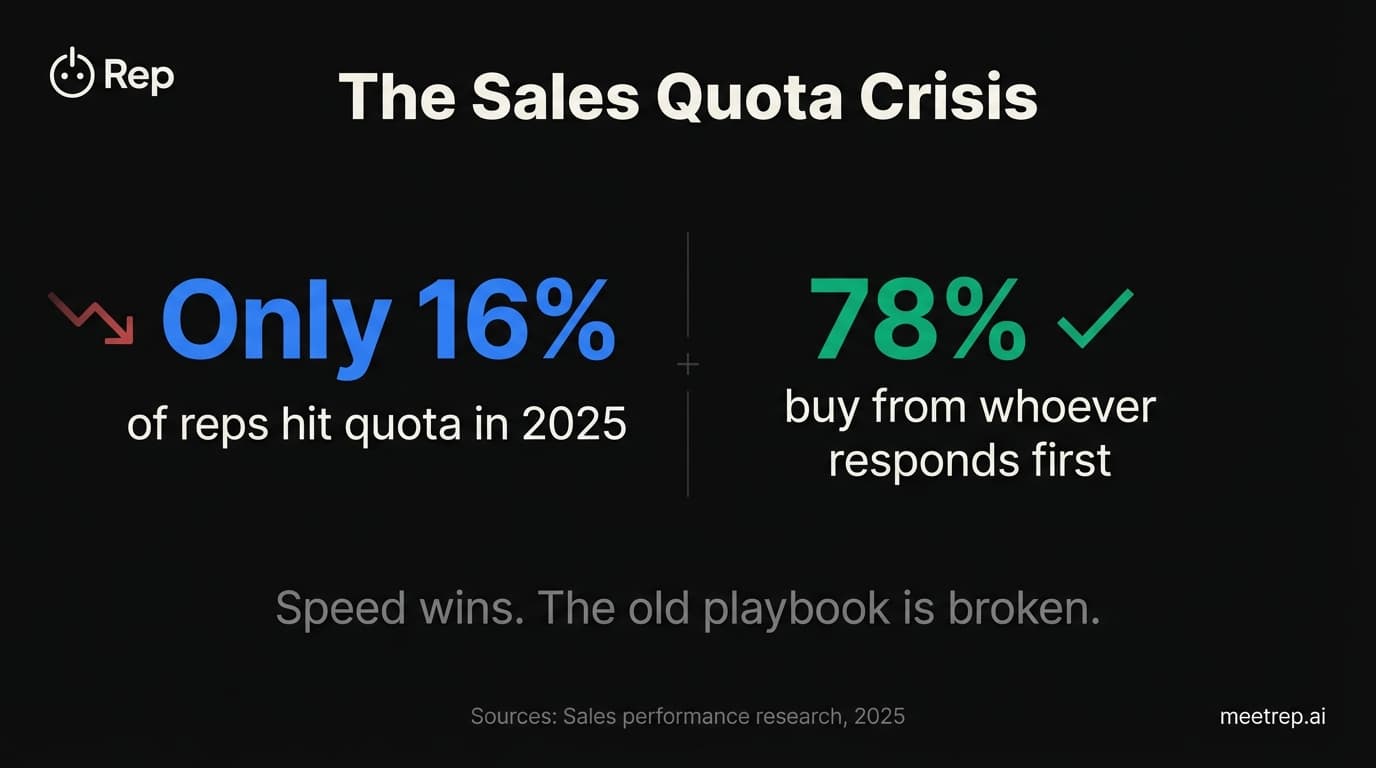
Why Autonomous Sales Software is the Future of B2B Sales (And Why the Old Playbook is Dead)
B2B sales is at a breaking point with quota attainment at 46%. Discover why autonomous 'Agentic AI' is the new standard for driving revenue and meeting the demand for rep-free buying.