Sales Meeting Agenda: Templates and Best Practices That Actually Drive Revenue

Executive Summary
- 35% of meetings are unproductive, costing U.S. businesses $259 billion annually
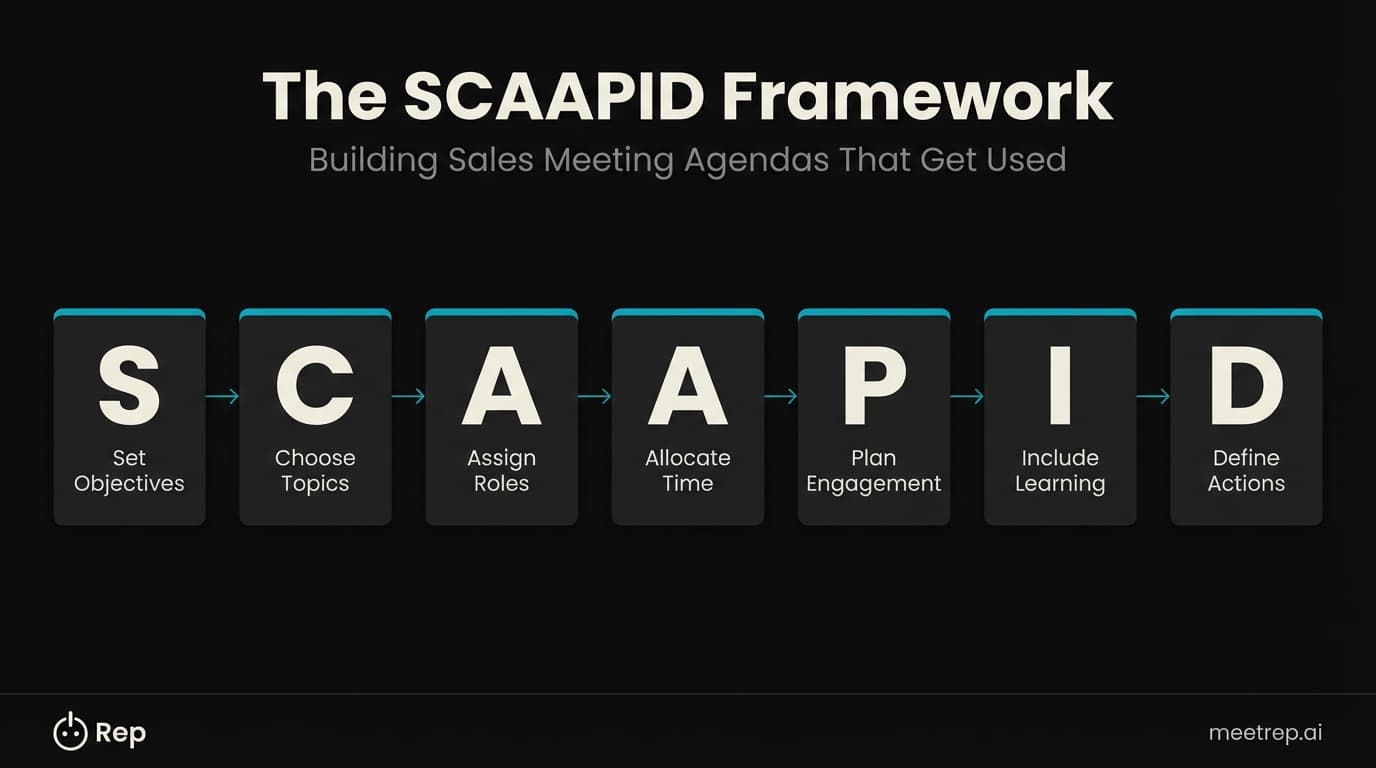
- Use the SCAAPID framework: Set objectives, Choose topics, Assign roles, Allocate time, Plan engagement, Include learning, Define action items
- The 60-minute default is dead—median meeting duration is now 35 minutes
- Top-performing managers are 42% more likely to excel at leading valuable meetings
Here's the uncomfortable truth about your sales meeting agenda: you probably don't have one. And if you do, nobody follows it.
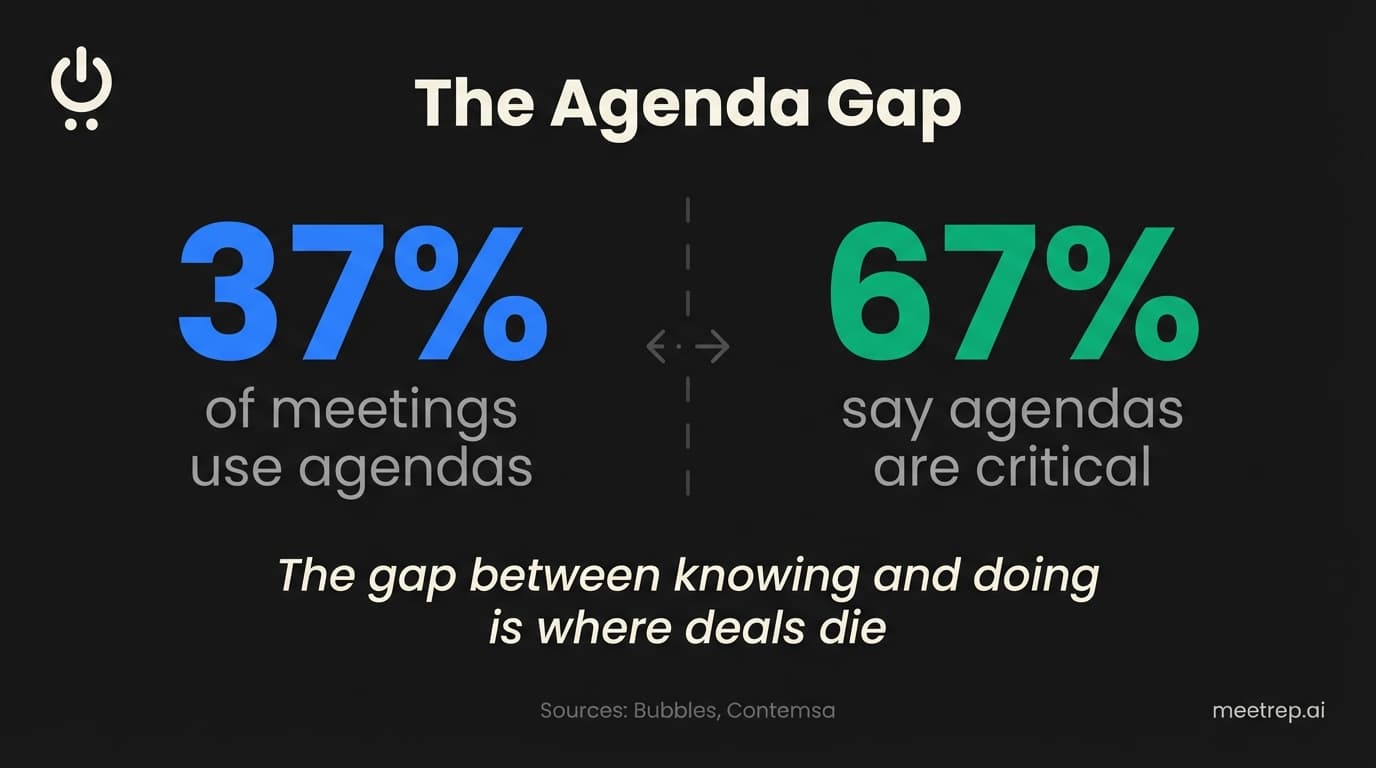
Only 37% of meetings actually use agendas, according to Bubbles' 2024 research. Yet 67% of professionals say having a clear agenda is critical for productive meetings. That gap—between what we know works and what we actually do—is where deals go to die.
I've watched this play out across hundreds of sales teams. When we built GoCustomer.ai, the pattern was everywhere: teams knew they needed structure, had templates somewhere in a Google Drive folder, and still winged every call. This guide gives you templates you can copy in 30 seconds and start using today.
What Is a Sales Meeting Agenda (And Why Most Fail)?
A sales meeting agenda is a structured outline of discussion topics, time allocations, and goals shared before a meeting to keep everyone focused and accountable. It serves as a contract between participants about what will happen, who owns each section, and what outcomes need to be achieved. Done right, it transforms meetings from time sinks into revenue drivers.
But here's why most agendas fail: they're created and then ignored. Reps get into a call, rapport builds naturally, and suddenly they're 20 minutes deep with no structure. The agenda sits unopened in an email somewhere.
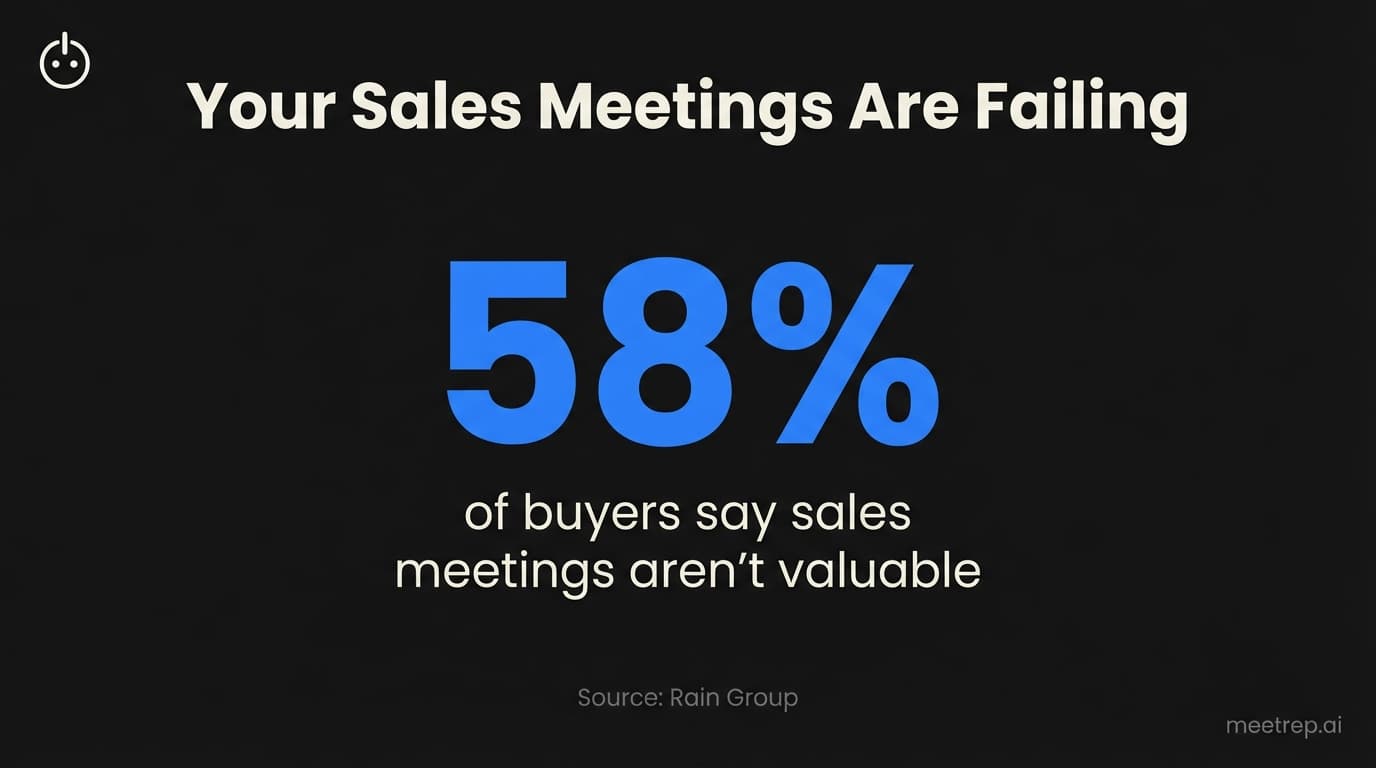
The Data:58% of buyers say sales meetings aren't valuable, according to Rain Group's research. That's not because sellers are bad at their jobs. It's because they're not following a structure that ensures value gets delivered every time.
The difference between teams that actually use agendas and teams that don't? Top-performing sales managers are 42% more likely to excel at leading valuable team meetings. Structure isn't optional for high performers. It's foundational.
The SCAAPID Framework: How to Build Agendas That Get Used
Forget generic advice. You need a framework specific to sales—one that accounts for the reality that every minute you spend in meetings is a minute not spent closing deals.
The SCAAPID framework addresses every failure mode I've seen kill meeting productivity:
- Set objectives — Define 1-2 specific outcomes. Not "discuss pipeline" but "decide which 3 deals need executive escalation this week."
- Choose topics — Select only items that directly support your objectives. Everything else gets cut or moved to async.
- Assign roles — Every agenda item needs an owner. Who presents? Who takes notes? Who keeps time?
- Allocate time — Specific minutes per topic. No "as long as needed." The constraint forces prioritization.
- Plan engagement — How will you keep this from becoming a monologue? What questions will you ask?
- Include learning — Reserve 5-10 minutes for skill development or call reviews. Meetings that only cover status updates become soul-crushing fast.
- Define action items — Before the meeting ends, capture who does what by when.
Key Insight: The median meeting duration in 2025 is 35 minutes, with only 12% exceeding 60 minutes. The hour-long default is dead. If you're still scheduling 60-minute blocks by reflex, you're probably wasting 25 minutes per session.
7 Sales Meeting Agenda Templates (Copy/Paste Ready)
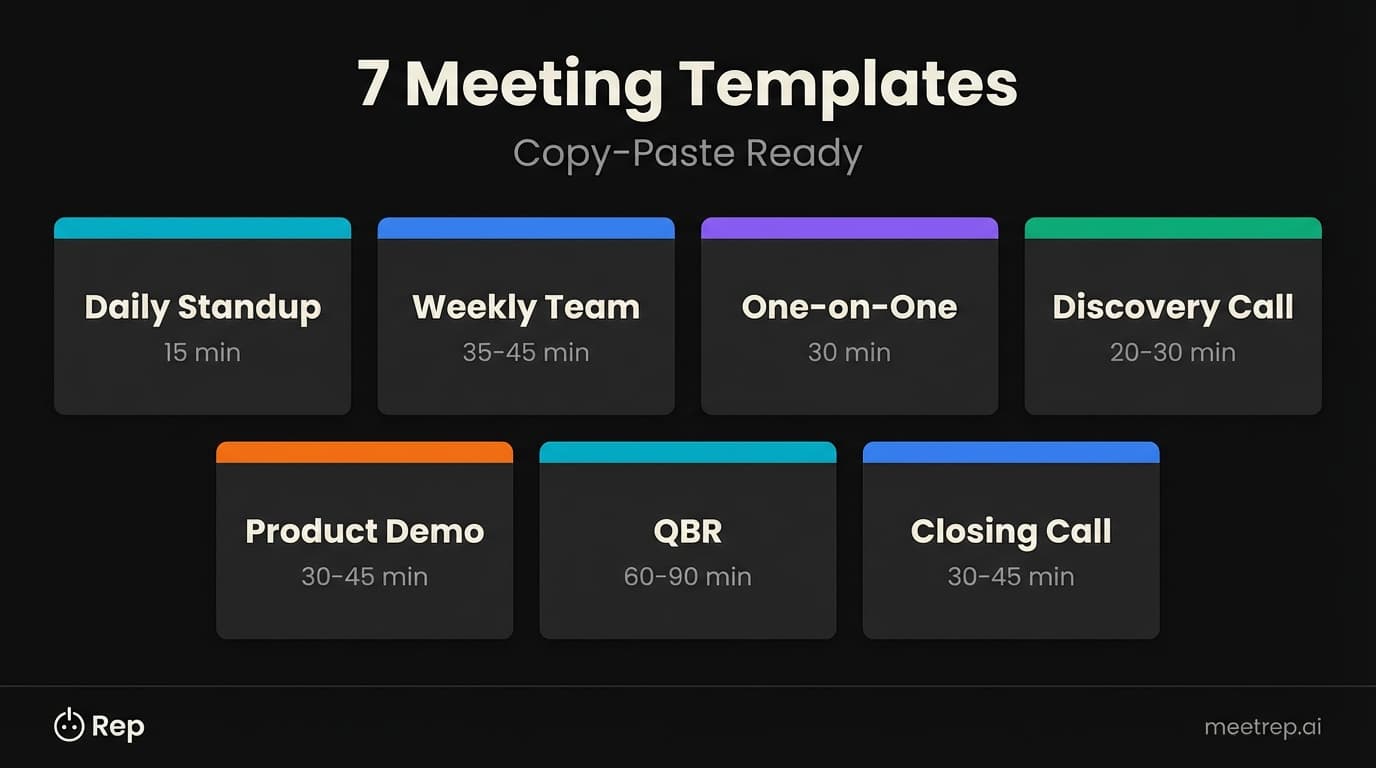
Here they are. Grab what you need.
Template 1: The 15-Minute Daily Standup
Objective: Surface blockers, align on priorities
| Time | Item | Owner |
|---|---|---|
| 0-2 min | Quick wins/updates | Team (round robin) |
| 2-12 min | Blockers that need help | Anyone stuck |
| 12-15 min | One Big Thing for today | Each rep states focus |
Rules: No status updates that could be a Slack message. Only blockers that require live discussion.
The Data: Ineffective standups cost $283 per employee per month, according to Resolution.de. For a 10-person sales team, that's $34,000 annually wasted on morning meetings that accomplish nothing.
Template 2: The Weekly Team Meeting (35-45 Minutes)
Objective: Align on pipeline health, unblock stalled deals, develop skills
| Time | Item | Owner |
|---|---|---|
| 0-5 min | Wins of the week | Manager opens, team shares |
| 5-20 min | Pipeline review (focus on stalled deals) | Each AE presents 1-2 at-risk deals |
| 20-30 min | Roadblocks requiring team input | Open discussion |
| 30-40 min | Learning moment (call review or skill) | Rotating owner |
| 40-45 min | Action items + next week preview | Manager closes |
Why this works: We're not reviewing every deal. That's what your CRM is for. The live meeting focuses on decisions that require human judgment—where to push, what's actually blocking progress, and skill development that benefits from discussion.
Template 3: The One-on-One (30 Minutes)
Objective: Coach, unblock, develop
| Time | Item | Owner |
|---|---|---|
| 0-5 min | Personal check-in | Both |
| 5-15 min | Deal deep-dive (1-2 deals max) | Rep presents |
| 15-25 min | Skill focus (one specific area) | Manager coaches |
| 25-30 min | Roadblocks + action items | Both |
What we learned at GoCustomer: The biggest mistake managers make in one-on-ones is trying to cover too much. Reviewing 10 deals in 30 minutes means you're not actually coaching on any of them. Pick one or two. Go deep. And please—don't skip the personal check-in because you're "busy."
Template 4: The Discovery Call (20-30 Minutes)
Objective: Qualify fit, uncover pain, confirm next steps
| Time | Item | Owner |
|---|---|---|
| 0-3 min | Rapport + confirm agenda | Rep |
| 3-15 min | Pain discovery questions | Rep leads, prospect shares |
| 15-20 min | Cost of inaction discussion | Rep quantifies |
| 20-25 min | Quick capability overview (if earned) | Rep |
| 25-30 min | Next steps with calendar invite | Rep closes |
Critical element: That "cost of inaction" discussion is non-negotiable. You need prospects to articulate what happens if they do nothing. Without urgency, deals stall.
Key Insight:Deals closing within 50 days have a 47% win rate. Beyond that? It drops to 20% or lower. Speed matters. Your discovery agenda should create momentum, not friction.
Template 5: The Product Demo (30-45 Minutes)
Objective: Show solution fit, handle objections, secure next step
| Time | Item | Owner |
|---|---|---|
| 0-5 min | Recap discovery findings | Rep confirms |
| 5-25 min | Customized demo (pain points only) | Rep shows |
| 25-35 min | Q&A + objection handling | Prospect drives |
| 35-45 min | Next steps + pricing preview | Rep closes |
The feature-dump trap: Nothing kills demos faster than showing every feature whether the prospect cares or not. Your agenda should list the 2-3 features that address their specific pain points from discovery. Everything else is noise.
Template 6: The QBR (60-90 Minutes)
Objective: Strategic alignment, identify expansion, plan next quarter
| Time | Item | Owner |
|---|---|---|
| 0-15 min | Value delivered this quarter | Sales + CS present |
| 15-35 min | Performance scorecard review | Sales leads |
| 35-50 min | Risks, escalations, challenges | Open discussion |
| 50-65 min | Expansion opportunities | Sales + CS identify |
| 65-80 min | Next quarter priorities (top 3) | Leadership decides |
| 80-90 min | Action items + owners | All confirm |
QBRs are strategic, not operational. They happen quarterly. This is the one meeting type where longer duration is justified.
Template 7: The Closing Call (30-45 Minutes)
Objective: Address final concerns, confirm terms, get commitment
| Time | Item | Owner |
|---|---|---|
| 0-5 min | Recap value agreed upon | Rep summarizes |
| 5-20 min | Address remaining objections | Both |
| 20-30 min | Pricing and terms walkthrough | Rep presents |
| 30-40 min | Negotiation (if needed) | Both |
| 40-45 min | Commitment ask + implementation next steps | Rep closes |
My recommendation: Send pricing ahead of time. Surprising prospects with numbers in a live call creates awkward pauses at best, deal death at worst. Give them time to process.
Internal vs. External Meetings: What Changes
The templates above cover both categories, but the underlying approach is very different:
| Element | Internal Team Meetings | External Prospect Meetings |
|---|---|---|
| Primary goal | Alignment + coaching | Advance the deal |
| Tone | Candid, problem-solving | Consultative, professional |
| Agenda distribution | 24 hours before via Slack | 48+ hours via email |
| Flexibility | Can pivot based on urgent issues | Stick to agenda (prospect's time) |
| Success metric | Action items completed | Clear next step with commitment |
The biggest mistake I see? Running external calls like internal meetings. Prospects don't care about your team's pipeline hygiene. They care about their problems.
Best Practices That Actually Matter
Most "best practices" articles give you advice like "start on time" and "stay focused." Thanks. Here's what actually moves the needle:
Time-box ruthlessly. Not just the meeting—each agenda item. When we hit 15 minutes on pipeline review, we move on. Period. Parkinson's Law applies: discussion expands to fill the time you give it.
Cancel meetings without guilt. Ask before every scheduled meeting: "Does this require live discussion, or could it be async?" If there's no decision to make, cancel and send a Loom instead.
End early, every time. Block 25 minutes instead of 30. Block 50 instead of 60. Ending early feels like a gift. Running over feels like theft.
The Data:Sales reps spend only 30% of their time actively selling, according to Salesforce's State of Sales 2024. Every minute you save in meetings is a minute that can go toward closing deals.
Track talk-to-listen ratio. In external meetings, if you're talking more than 50% of the time, you're doing it wrong. Tools like Gong measure this automatically.
Always define the next step before hanging up. No meeting should end with "let's touch base next week." What specifically is happening? Who's doing it? By when?
How to Know If Your Meetings Are Actually Working
Running meetings with agendas is step one. Knowing whether those meetings drive results is step two.
| Metric | What It Tells You | Target |
|---|---|---|
| Meeting-to-opportunity conversion | Are discovery calls creating pipeline? | 40-60% |
| Deal velocity | Are meetings accelerating or stalling deals? | <50 days to close |
| Action item completion rate | Are follow-throughs happening? | >80% |
Warning signs meetings are broken:
- "Let's schedule another call to discuss" becomes the default outcome
- Prospects go dark after meetings
- The same topics get discussed week after week
The Role of AI in Meeting Efficiency
Here's where I'll share my bias: I think AI will completely change how sales teams approach meetings over the next two years.
Not because AI will replace human sales reps. But because AI handles consistent execution in ways humans struggle with.
Think about demo calls. Every AE knows they should follow a structure, hit the key value props, remember to quantify cost of inaction, and close with a clear next step. But after the 8th demo of the day, things slip. The agenda exists; it just doesn't get followed.
At Rep, we built an AI agent that delivers product demos around the clock. It joins video calls, shares its screen, navigates your actual product, and converses naturally with prospects. The key advantage isn't that it's cheaper or faster. It's that it follows the playbook perfectly every single time.
For internal meetings, tools like Gong capture transcripts and measure talk ratios automatically. Scheduling tools like Calendly and Chili Piper eliminate back-and-forth.
My prediction: within two years, most initial product demos will be handled by AI agents. The teams that adopt early will have a structural advantage.
The meeting agenda isn't sexy. It won't make your product demo go viral. But it's the unglamorous foundation that separates consistent performers from chaotic ones.
I've seen teams transform their win rates by doing nothing more than actually using the templates they already had. Not better templates. Not fancier frameworks. Just discipline in execution.
Start with one template from this guide. Use it for your next meeting. Then use it again. The compounding effect of consistency beats the one-time impact of any individual tactic.
And if agenda discipline remains a struggle—especially for demo consistency—that's exactly the problem Rep was built to solve. An AI agent that follows your playbook perfectly, every single time, 24/7.

Nadeem Azam
Founder
Software engineer & architect with 10+ years experience. Previously founded GoCustomer.ai.
Nadeem Azam is the Founder of Rep (meetrep.ai), building AI agents that give live product demos 24/7 for B2B sales teams. He writes about AI, sales automation, and the future of product demos.
Frequently Asked Questions
Table of Contents
- What Is a Sales Meeting Agenda (And Why Most Fail)?
- The SCAAPID Framework: How to Build Agendas That Get Used
- 7 Sales Meeting Agenda Templates (Copy/Paste Ready)
- Internal vs. External Meetings: What Changes
- Best Practices That Actually Matter
- How to Know If Your Meetings Are Actually Working
- The Role of AI in Meeting Efficiency
Ready to automate your demos?
Join the Rep Council and be among the first to experience AI-powered demos.
Get Early AccessRelated Articles
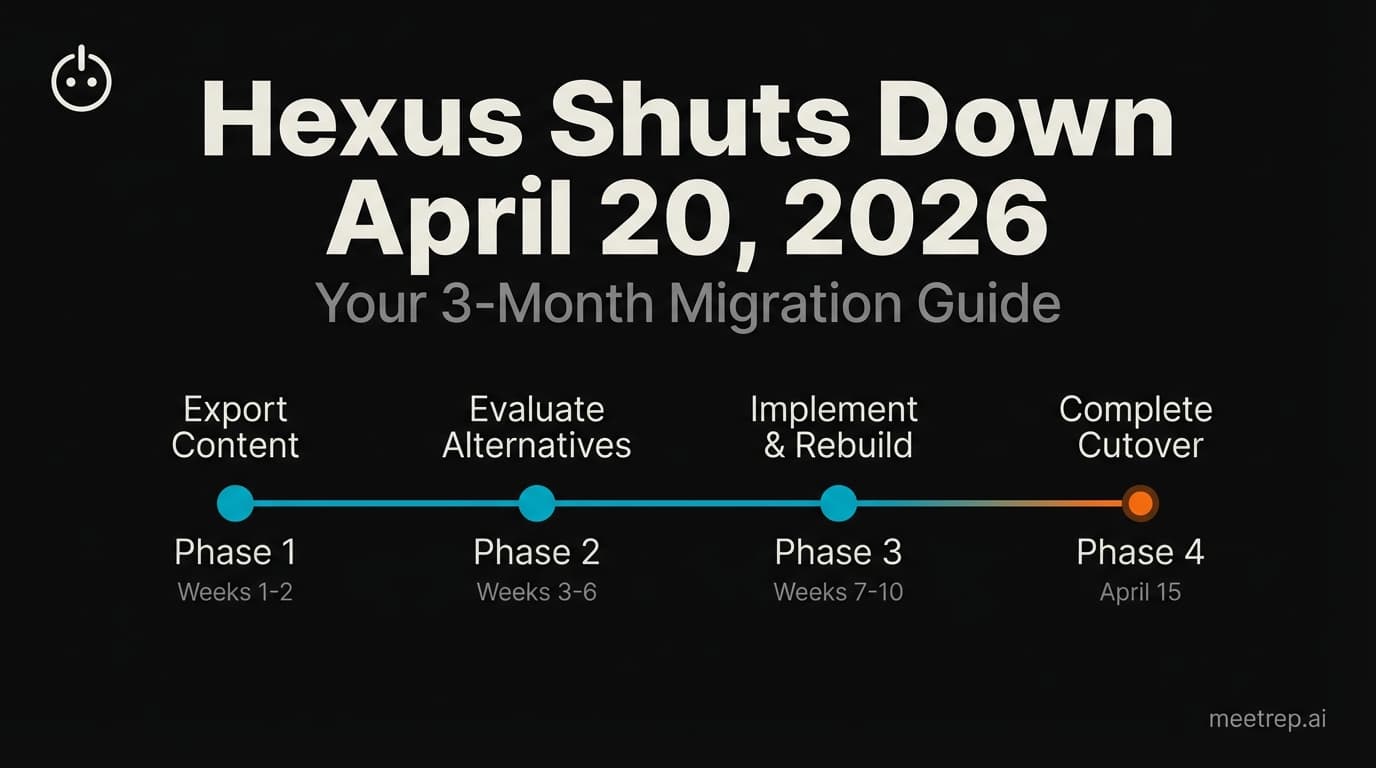
Hexus Acquired by Harvey AI: Congrats & What It Means for Demo Automation Teams
Hexus is shutting down following its acquisition by Harvey AI. Learn how to manage your migration and discover the best demo automation alternatives before April 2026.
Why the "Software Demo" is Broken—and Why AI Agents Are the Future
The traditional software demo is dead. Discover why 94% of B2B buyers rank vendors before calling sales and how AI agents are replacing manual demos to scale revenue.
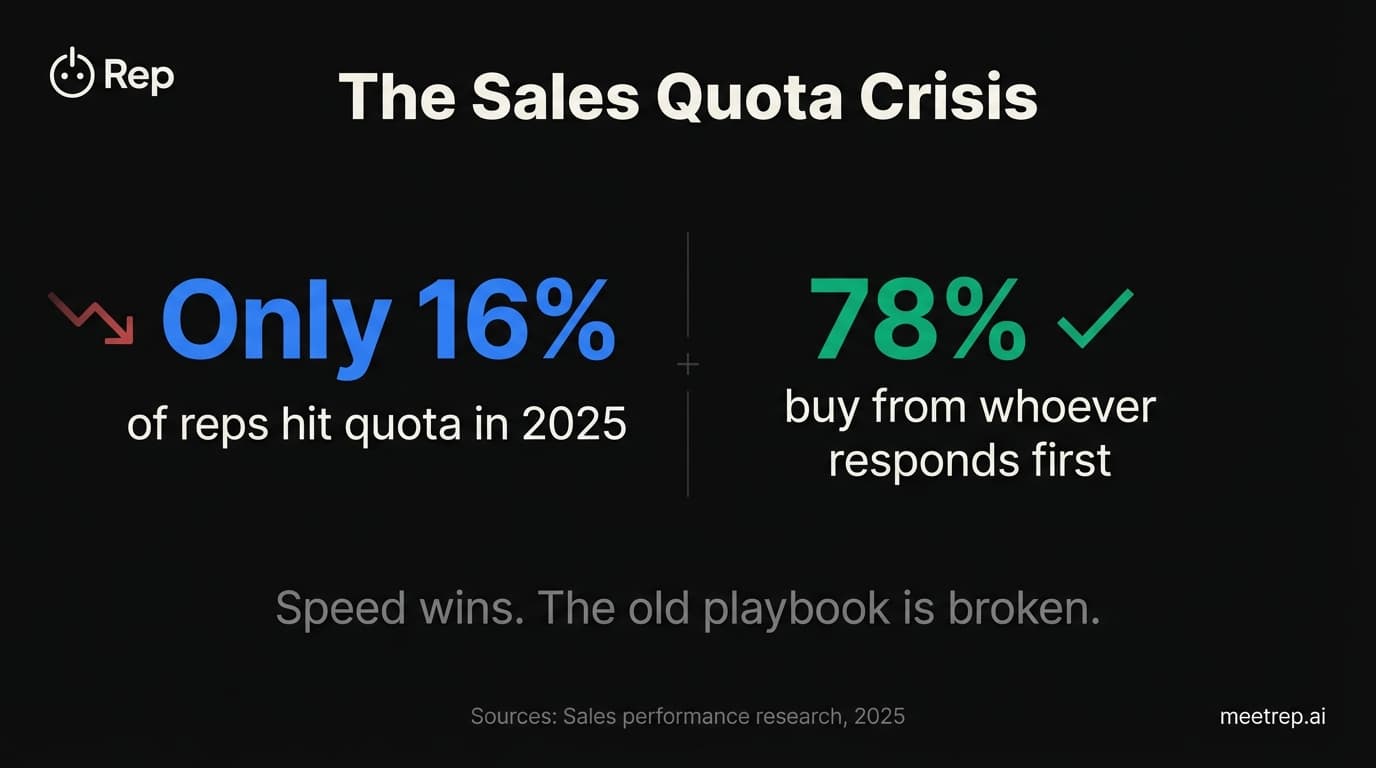
Why Autonomous Sales Software is the Future of B2B Sales (And Why the Old Playbook is Dead)
B2B sales is at a breaking point with quota attainment at 46%. Discover why autonomous 'Agentic AI' is the new standard for driving revenue and meeting the demand for rep-free buying.