Sales Discovery Questions: The Data-Backed Framework That Actually Closes Deals

Executive Summary
- 11-14 questions is the optimal range per discovery call (Gong 2024-2025)
- 43% talking, 57% listening is the ratio winners maintain (Gong March 2025)
- Multi-threading boosts win rates by 130% on deals over $50K (Gong April 2025)
- Stop qualifying. Start diagnosing. Buyers already know what they want—your job is to uncover the root cause they can't see.
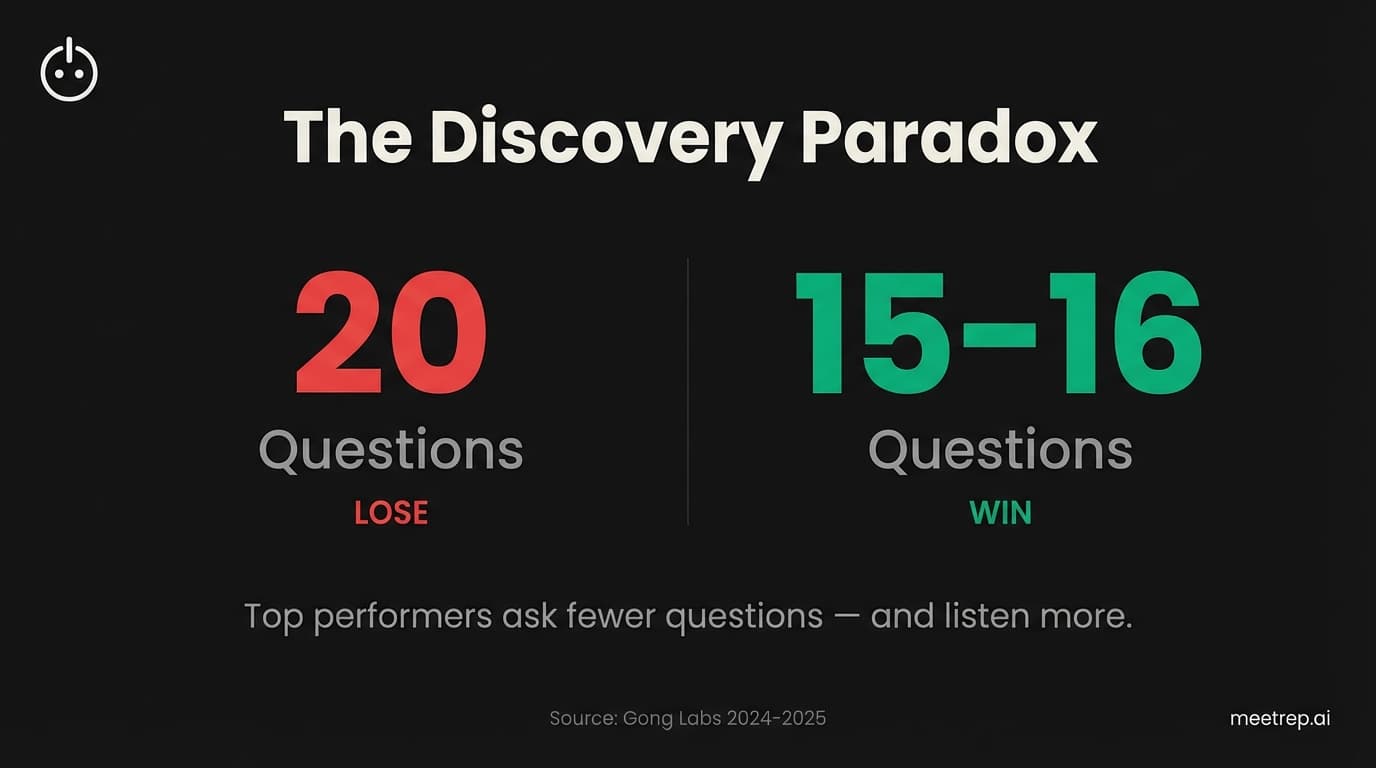
Here's what nobody tells you about sales discovery questions: asking more of them doesn't help. In fact, Gong's analysis of thousands of calls found that reps who lost deals asked around 20 questions—while winners asked just 15-16.
So why does most discovery advice focus on giving you longer lists of questions?
I've thought about this a lot while building Rep, our AI demo platform. The problem isn't that reps lack questions. It's that they're still treating discovery like an interrogation when buyers have already done their homework. According to Corporate Visions' 2025 research, prospects are 69% through their buying journey before they'll even talk to you.
The game has changed. This guide shows you how to adapt.
What makes discovery questions different in 2025?
Sales discovery questions in 2025 require a fundamental shift: from qualification to diagnosis. Your prospects have already researched your product, compared alternatives, and probably watched your demo video. Showing up with "What keeps you up at night?" isn't just outdated—it signals you haven't done your homework either.
The data backs this up. Forrester's December 2024 report found that 86% of B2B purchases stall during the buying process. Not because of budget. Not because of timing. Because sellers fail to handle the complexity buyers face internally.
And here's what surprised me: top performers ask 39% more questions than their peers, according to Sales Insights Lab research cited by Salesgenie. But—and this matters—they spend half the time discussing product features compared to average reps. They're not interrogating. They're diagnosing.
Key Insight: The shift isn't from "bad questions" to "good questions." It's from "gathering information" to "helping buyers understand their own situation better." When RAIN Group's 2024 research shows top performers are 60% more likely to change buyer thinking, that's the skill they're describing.
What does diagnosis look like in practice? Instead of asking "Do you have budget for this?" (they know, and they'll tell you when ready), ask "What would need to be true internally for this to get prioritized this quarter?" One gathers a fact. The other uncovers the real blockers.
How many questions should you ask on a sales discovery call?
The optimal range is 11-14 questions per discovery call, according to Gong's analysis. Go below that and you're not qualifying properly. Go above—especially past 20—and you're running an interrogation that kills deals.
That might sound counterintuitive. More questions means more information, right?
Wrong. Here's what the data actually shows: sellers who won deals asked 15-16 questions. Sellers who lost asked around 20. The difference isn't huge in number, but it's massive in approach. Winners asked strategic questions and went deeper on the answers. Losers ran through a checklist.
| Question Count | Outcome | What It Signals |
|---|---|---|
| Under 11 | Higher risk | Insufficient qualification |
| 11-14 | Optimal | Strategic, focused discovery |
| 15-16 | Winners | Deep on key areas |
| 20+ | Losers | Interrogation mode |
Source: Gong Labs 2024-2025
I see this pattern constantly. Reps get a discovery framework like MEDDIC and treat it as a checklist to complete rather than a guide for thinking. They ask about Metrics, Economic Buyer, Decision Criteria—all the boxes—but they never zoom in on the answer that actually matters.
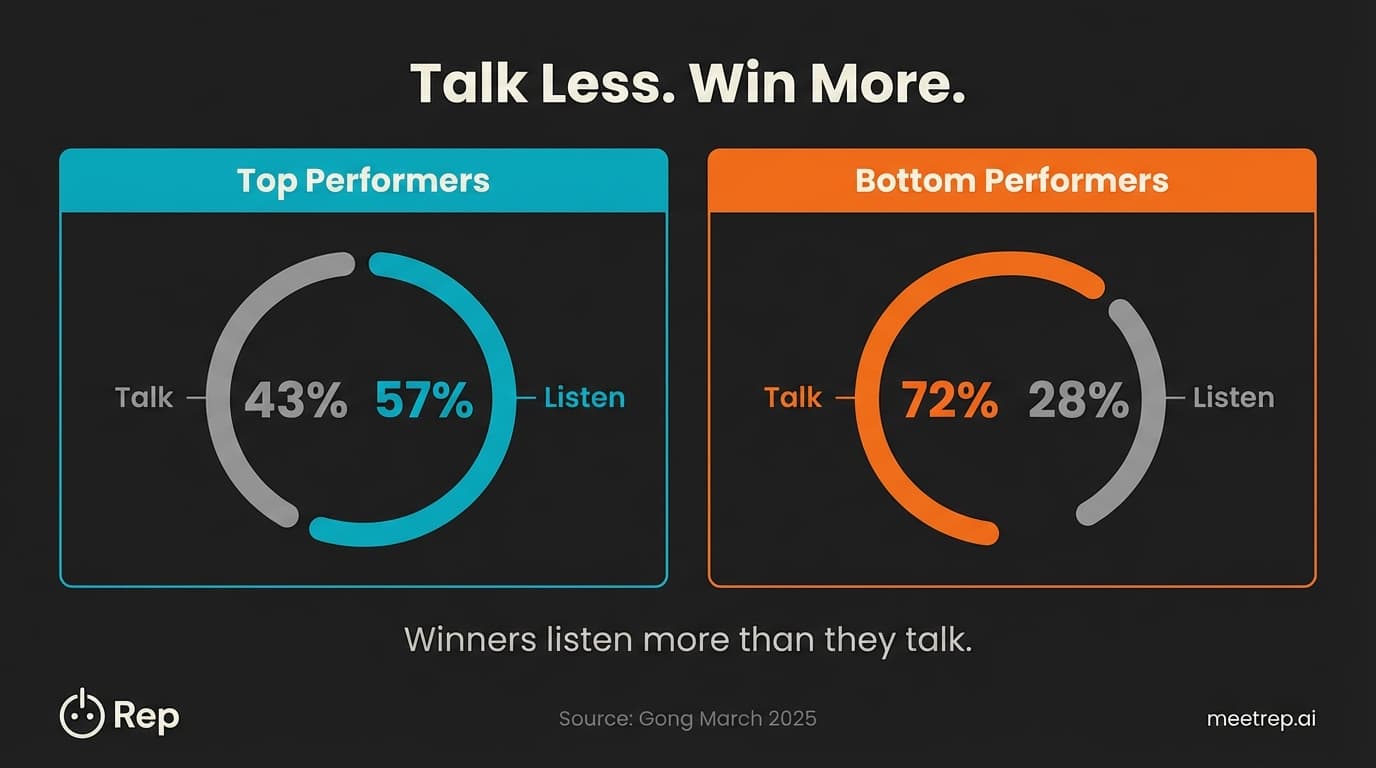
The Data: Top performers maintain a 43:57 talk-to-listen ratio. Bottom performers? They talk 72% of the time and listen only 28%. (Gong March 2025)
That ratio is the real skill. Asking 14 great questions means nothing if you're already formulating your next question while they're still answering the first one.
Discovery questions that actually uncover pain points
The best discovery questions help prospects articulate problems they couldn't quite name before. They don't just gather information—they create clarity. And that clarity is what earns you the right to propose a solution.
Here are the questions that consistently surface real pain, organized by what they're designed to uncover:
Opening questions (establish context and trigger event):
- "What prompted you to take this call today?"
- "What's changed recently that's making this a priority now?"
- "How long has this been on your radar?"
Pain exploration questions (go deeper than surface symptoms): 4. "Walk me through a recent example of when this problem showed up." 5. "What have you tried before, and what didn't work about it?" 6. "When [problem] happens, what's the ripple effect across your team?" 7. "What's this costing you—not just in dollars, but in time, headaches, missed opportunities?"
Future state questions (understand what success looks like): 8. "If you could wave a magic wand, what would be different six months from now?" 9. "What would need to be true for you to consider this initiative a success?"
Urgency questions (quantify the cost of inaction): 10. "What happens if you don't solve this in the next quarter?" 11. "Who else is feeling the pain from this, and how are they dealing with it?"
Notice what's missing? Budget. Timeline. Authority. Those BANT questions have their place, but not at the top of your discovery call. When you lead with "What's your budget?", you're signaling that you're qualifying them as a lead rather than helping them solve a problem.
What we learned building GoCustomer: Reps don't struggle because they lack questions. They struggle because they ask in the wrong order. Pain first. Implications second. Logistics last. When we flipped the sequence in our training, discovery-to-demo conversion jumped noticeably.
Questions to map the buying committee (the multi-threading imperative)
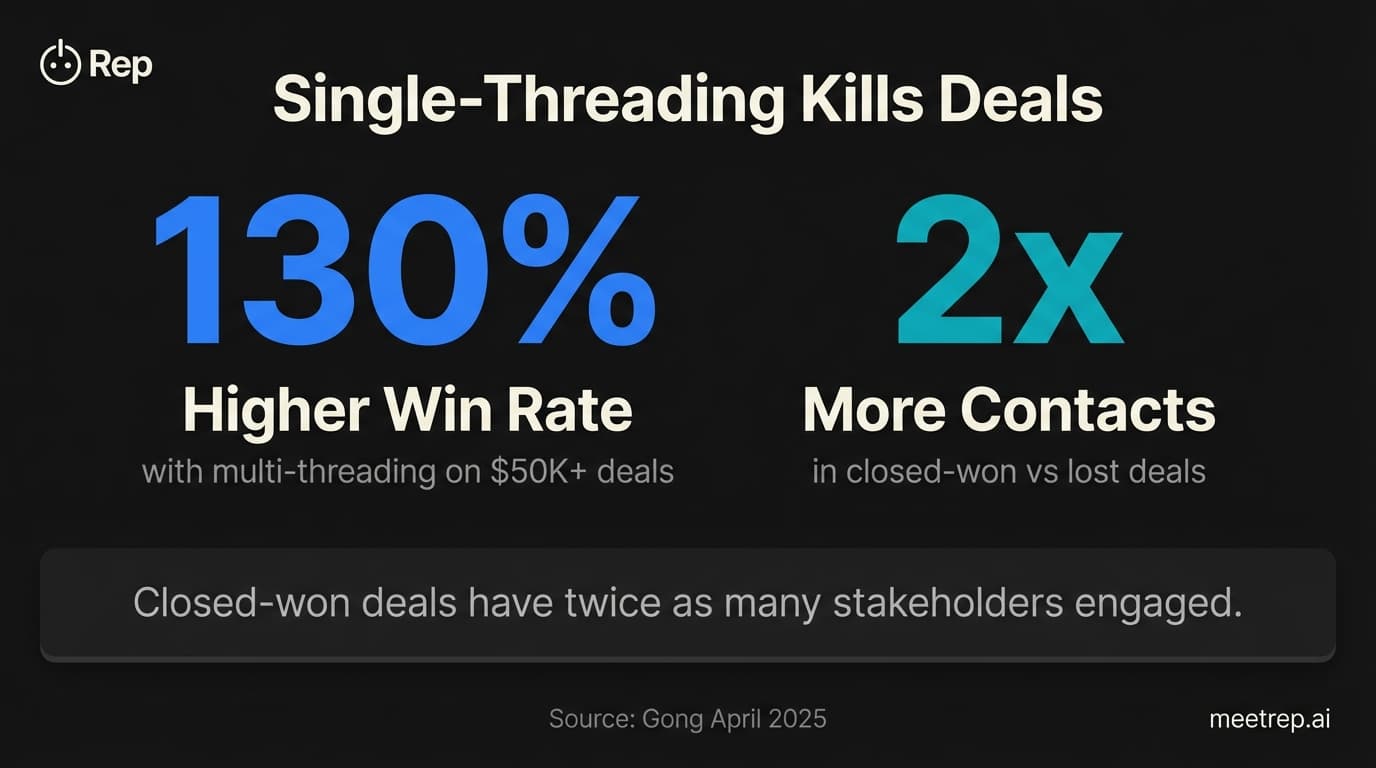
Multi-threading—engaging multiple stakeholders in a deal—boosts win rates by 130% on deals over $50K, according to Gong's April 2025 Deal Orchestration Study. Closed-won deals have twice as many buyer contacts as lost deals.
Read that again. Twice as many contacts. Single-threading is an immediate red flag.
Yet most reps treat stakeholder mapping as an afterthought. They find one champion and hope that person sells internally. Hope isn't a strategy.
Questions to map the buying committee:
- "Who else cares about solving this problem?" (Start broad)
- "If we succeed here, who benefits most? Who might not?" (Find allies and blockers)
- "Walk me through how decisions like this typically get made at [company]." (Understand the process)
- "Who owns the budget for initiatives like this?" (Economic Buyer)
- "Is there anyone who needs to weigh in that we haven't talked about yet?" (Hidden stakeholders)
- "What happens if we get to the end of this process and people aren't aligned?" (Consensus reality check)
That last question is my favorite. It forces the prospect to think about internal alignment before it becomes a problem. And their answer tells you exactly how much selling your champion will need to do.
Key Insight: Josh Morgan, Head of Sales Enablement at Mintel, found through Gong analysis that his team "didn't multi-thread enough." After fixing that pattern, win rates increased 34%. Single-threading was killing deals they should have won.
The best time to multi-thread is early. Don't wait until you've presented pricing to discover that the CFO has concerns about implementation. Ask upfront: "Who else should be involved in evaluating this, even informally?"
Which discovery framework should you actually use?
Honestly, here's my take on frameworks: they're useful scaffolding, not sacred scripture. I've watched reps religiously follow MEDDIC and still lose deals because they forgot to actually listen.
That said, frameworks give you structure when you're ramping or under pressure. The question is which one fits your situation.
| Framework | Best For | Key Focus | When It Falls Short |
|---|---|---|---|
| BANT | Transactional SMB sales, quick qualification | Budget, Authority, Need, Timeline | Outdated for initial discovery—buyers know this stuff already |
| MEDDIC | Enterprise deals >$50K, complex sales | Metrics, Economic Buyer, Decision Criteria/Process, Identify Pain, Champion | Can become checkbox exercise; overkill for small deals |
| SPIN | Consultative selling, problem amplification | Situation, Problem, Implication, Need-Payoff | Slow; doesn't work when buyer is already solution-aware |
| SPICED | Urgent deals, event-driven sales | Situation, Pain, Impact, Critical Event, Decision | Assumes urgency exists—doesn't create it |
| Gap Selling | ROI-focused buyers, value selling | Current State → Future State → Quantified Gap | Requires deep business acumen to execute well |
Sources: Framework methodologies; effectiveness data from RAIN Group 2024 (60% more likely to change thinking with consultative approach)
My recommendation: Don't pick one framework and force every conversation into it. Instead, know all of them. Start with SPICED-style questions to uncover urgency. Use SPIN's implication questions to amplify pain. Apply MEDDIC when you need to map complex buying committees. Mix and match based on what the conversation needs, not what your playbook says.
And if your deal is over $50K? MEDDIC's multi-threading emphasis isn't optional. That 130% win rate boost is real.
Why demos without discovery fail (and how to fix the sequence)
Demos conducted without a discovery process are 73% less successful than those with proper discovery, according to Cognism's 2024 research. Let that sink in. Skipping discovery doesn't save time—it wastes it.
I see this constantly. A rep gets an inbound lead, the prospect says "Can I see a demo?", and the rep obliges immediately. Forty-five minutes later, the prospect says "Thanks, we'll be in touch" and disappears.
What went wrong? The demo wasn't specific to their situation. The rep showed features instead of solutions. The prospect didn't see their specific problem on screen.
Here's the fix. When a prospect asks for a demo immediately, try:
"Absolutely, I'd love to show you the product. But I've found demos are way more useful when I understand your situation first. Mind if I ask a few quick questions so I can show you the parts that actually matter for what you're dealing with?"
Most prospects appreciate this. It signals you're trying to help, not just pitch.
Why we built Rep this way: At Rep, our AI handles those initial product walkthroughs 24/7. Prospects can explore features and get questions answered on their schedule. But here's the key: by the time they talk to a human, the basic "what does it do?" questions are already handled. The human conversation can start at diagnosis—"What specific challenge are you trying to solve?"—not interrogation.
The sequence matters. Discovery creates context. Context makes demos relevant. Relevant demos close deals.
The 7 discovery mistakes killing your deals
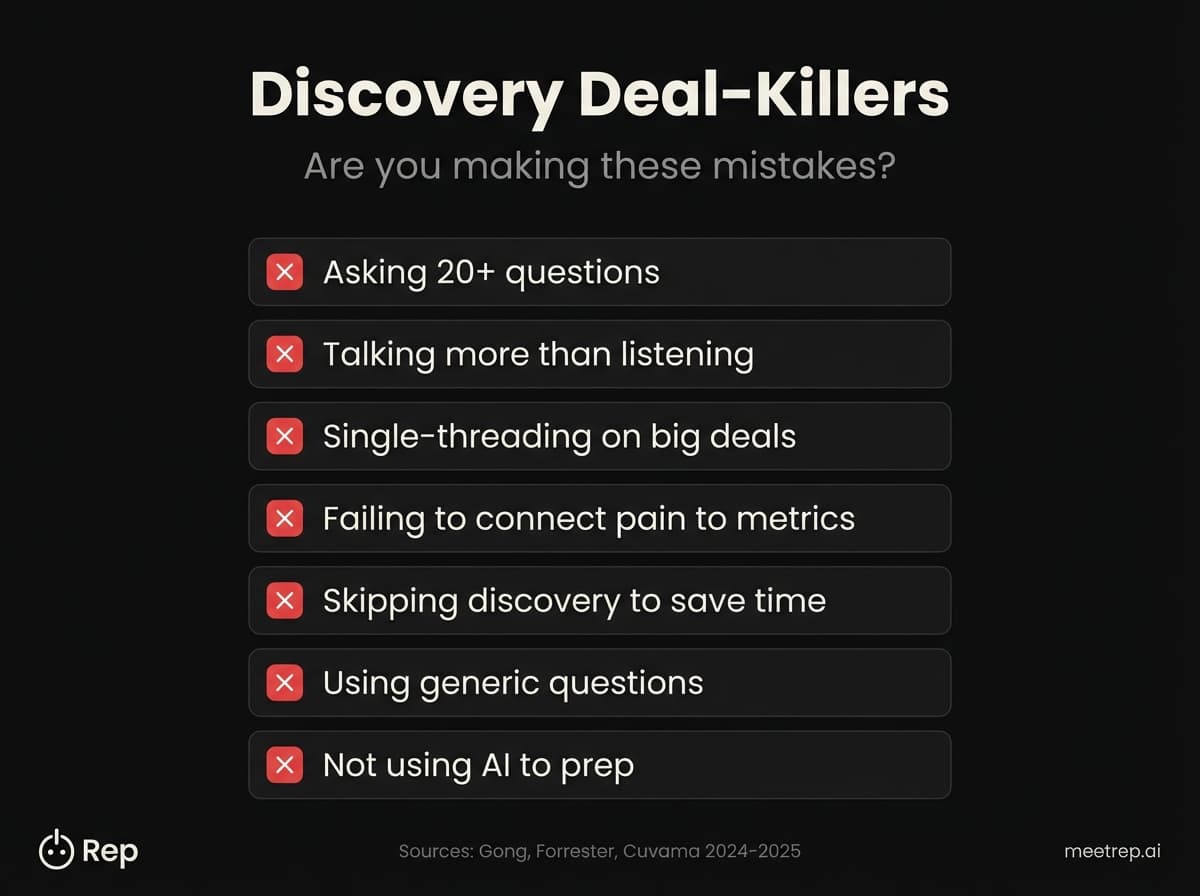
Not all discovery failures look the same. But they all have the same effect: stalled deals and ghosted follow-ups.
Mistake 1: Asking 20+ questions Losers ask around 20 questions; winners ask 15-16. More isn't better. (Gong March 2025)
Mistake 2: Talking more than listening Bottom performers talk 72% of the time. Winners maintain 43:57. If you're dominating the airtime, you're not discovering anything.
Mistake 3: Single-threading on big deals Deals with one contact have half the win rate of multi-threaded deals. (Gong April 2025)
Mistake 4: Failing to connect pain to metricsCuvama's 2024 research found 78% of reps struggle to connect pain to business impact. If you can't quantify the problem, you can't justify the solution.
Mistake 5: Skipping discovery to "save time" Demos without discovery are 73% less successful. You're not saving time. You're wasting it.
Mistake 6: Using generic questions when buyers are 69% through their journey They've done the research. "What keeps you up at night?" makes you sound unprepared.
Mistake 7: Not using AI to prep Sellers who partner effectively with AI are 3.7 times more likely to hit quota, according to Gartner and Salesloft's 2025 research. That's not a typo. 3.7x.
The Data: 86% of B2B purchases stall during the buying process (Forrester December 2024). Most stalls happen because discovery didn't uncover the internal complexity. Good questions prevent this.
How AI is changing discovery in 2025
Here's something that might surprise you: the best AI application for discovery isn't generating more questions. It's handling the information-gathering phase so humans can focus on what humans do best—diagnosing problems and building relationships.
The data on AI partnership is striking. Gartner and Salesloft's April 2025 research found sellers using AI effectively are 3.7 times more likely to hit quota. Not 37% more. 3.7 times.
What does effective AI partnership look like for discovery?
Pre-call research: AI can aggregate company news, earnings reports, LinkedIn activity, tech stack information—all the background that helps you show up prepared. Sixty percent of sales leaders already use AI for this, according to HubSpot and The Sales Collective's 2025 data.
During-call support: Real-time question suggestions, objection handling prompts, note-taking that captures action items automatically.
Post-call analysis: Identifying questions you missed, scoring discovery thoroughness, flagging single-threaded deals.
But here's the angle I think about most, given what we're building at Rep: what if AI handles the initial product exploration entirely?
When a prospect can ask an AI "What does this feature do?" at 2am and get an immediate answer with a live product walkthrough, something interesting happens. The human conversation no longer needs to cover basics. Your discovery call can start with "I saw you spent time exploring [feature]—what problem were you trying to solve?" instead of "Let me show you what our product does."
That's the shift. AI handles interrogation. Humans handle diagnosis.
The shift from interrogation to diagnosis isn't just semantics. It's the difference between running through a checklist and actually helping someone understand their situation.
I think about this constantly while building Rep. The goal isn't to replace human discovery—it's to make it better. When AI handles the basic "what does your product do?" questions through autonomous demos, human conversations can start at a higher level. You skip the feature tour and get straight to "What's really going on here?"
That's where deals are won. Not in the number of questions you ask. In the quality of understanding you create.
If you're ready to see how AI-powered demos can handle the initial product exploration while capturing discovery insights automatically, see Rep in action.

Nadeem Azam
Founder
Software engineer & architect with 10+ years experience. Previously founded GoCustomer.ai.
Nadeem Azam is the Founder of Rep (meetrep.ai), building AI agents that give live product demos 24/7 for B2B sales teams. He writes about AI, sales automation, and the future of product demos.
Frequently Asked Questions
Table of Contents
- What makes discovery questions different in 2025?
- How many questions should you ask on a sales discovery call?
- Discovery questions that actually uncover pain points
- Questions to map the buying committee (the multi-threading imperative)
- Which discovery framework should you actually use?
- Why demos without discovery fail (and how to fix the sequence)
- The 7 discovery mistakes killing your deals
- How AI is changing discovery in 2025
Ready to automate your demos?
Join the Rep Council and be among the first to experience AI-powered demos.
Get Early AccessRelated Articles
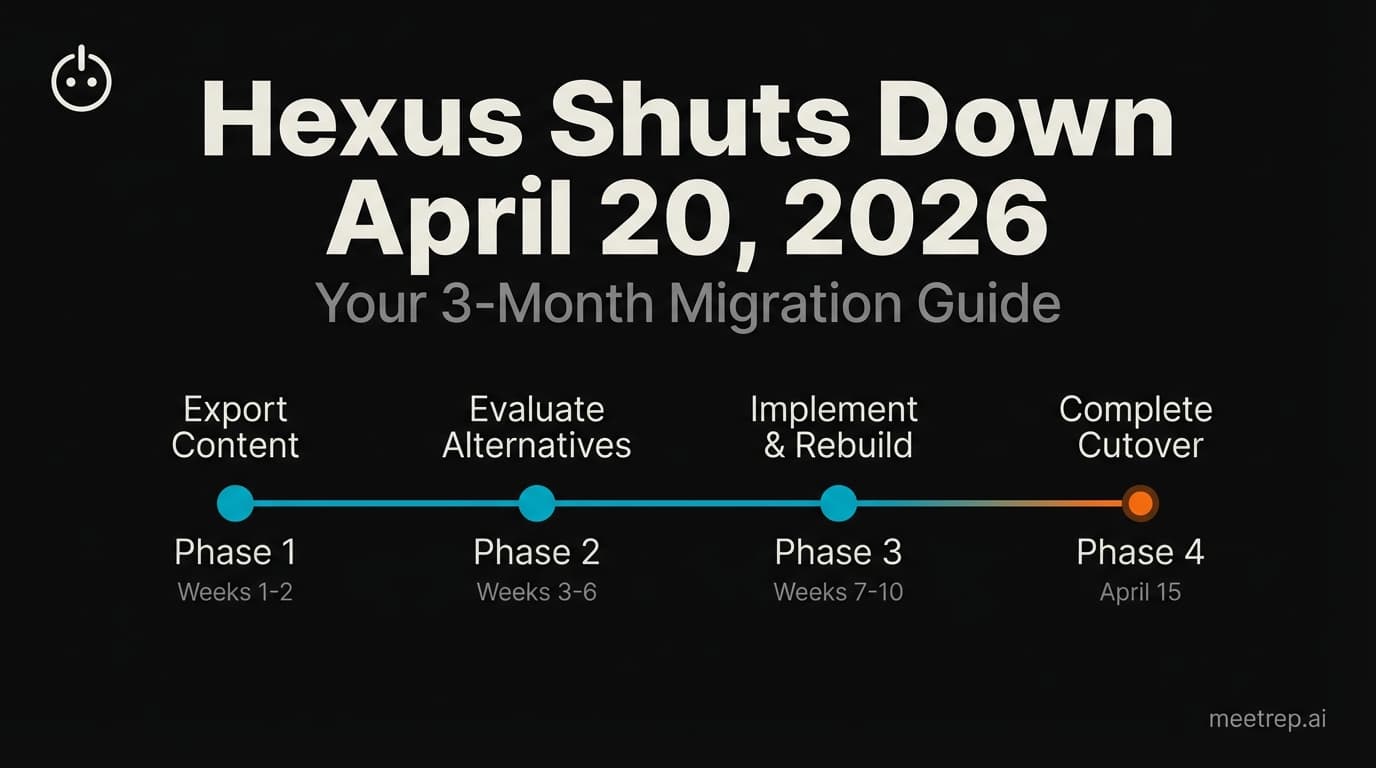
Hexus Acquired by Harvey AI: Congrats & What It Means for Demo Automation Teams
Hexus is shutting down following its acquisition by Harvey AI. Learn how to manage your migration and discover the best demo automation alternatives before April 2026.
Why the "Software Demo" is Broken—and Why AI Agents Are the Future
The traditional software demo is dead. Discover why 94% of B2B buyers rank vendors before calling sales and how AI agents are replacing manual demos to scale revenue.
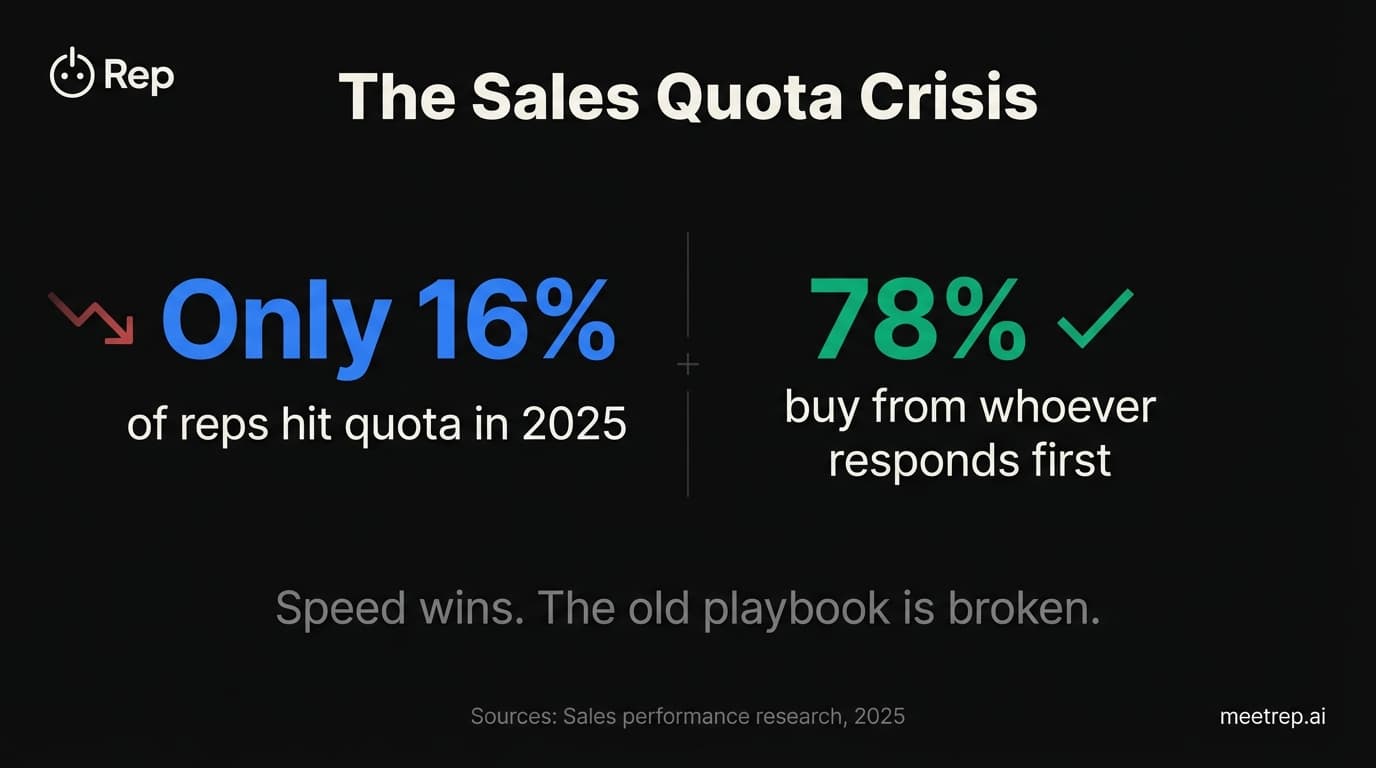
Why Autonomous Sales Software is the Future of B2B Sales (And Why the Old Playbook is Dead)
B2B sales is at a breaking point with quota attainment at 46%. Discover why autonomous 'Agentic AI' is the new standard for driving revenue and meeting the demand for rep-free buying.