Sales Demo Software 2026: The Shift to Autonomous Agents

Executive Summary
- The Problem: Buyers wait an average of 6–10 days to speak with sales, yet 92% have already shortlisted vendors before reaching out.
- The Shift: The market is moving from "click-through" tours (Navattic) to "autonomous agents" (Rep, 11x) that drive browsers live.
- The Risk: By 2028, 90% of B2B buying will be agent-intermediated. Sticking to manual-only scheduling is a career risk.
Your buyers are waiting 10 days to see your product. Your competitors are showing them in 10 seconds.
That’s the brutal reality of B2B sales right now. We used to think getting the lead was the hard part. But today, the real killer isn't lack of interest—it's friction.
I’ve built two sales automation platforms, first with GoCustomer.ai and now with Rep. I've seen the backend data. The "request a demo" form is dying, and it’s taking traditional sales cycles down with it.
If you’re a VP of Sales looking at sales demo software, you aren't just looking for a tool to record videos. You're looking for a way to stop bleeding revenue while your team sleeps.
In this guide, I’ll break down exactly how the market is shifting from static tours to autonomous agents, and how to choose the right tech stack without getting distracted by the hype.
What Is Sales Demo Software?
Sales demo software is a category of tools that enables revenue teams to create, deliver, and analyze product demonstrations without relying solely on live, human-led calls.
It ranges from interactive product tour platforms (like Navattic) that allow self-guided exploration, to live demo automation tools (like Demostack) that clone environments for AEs, and autonomous AI agents (like Rep) that conduct live, voice-based demos 24/7.
But let’s be real. It’s not just "software." It’s a response to a broken buyer journey.
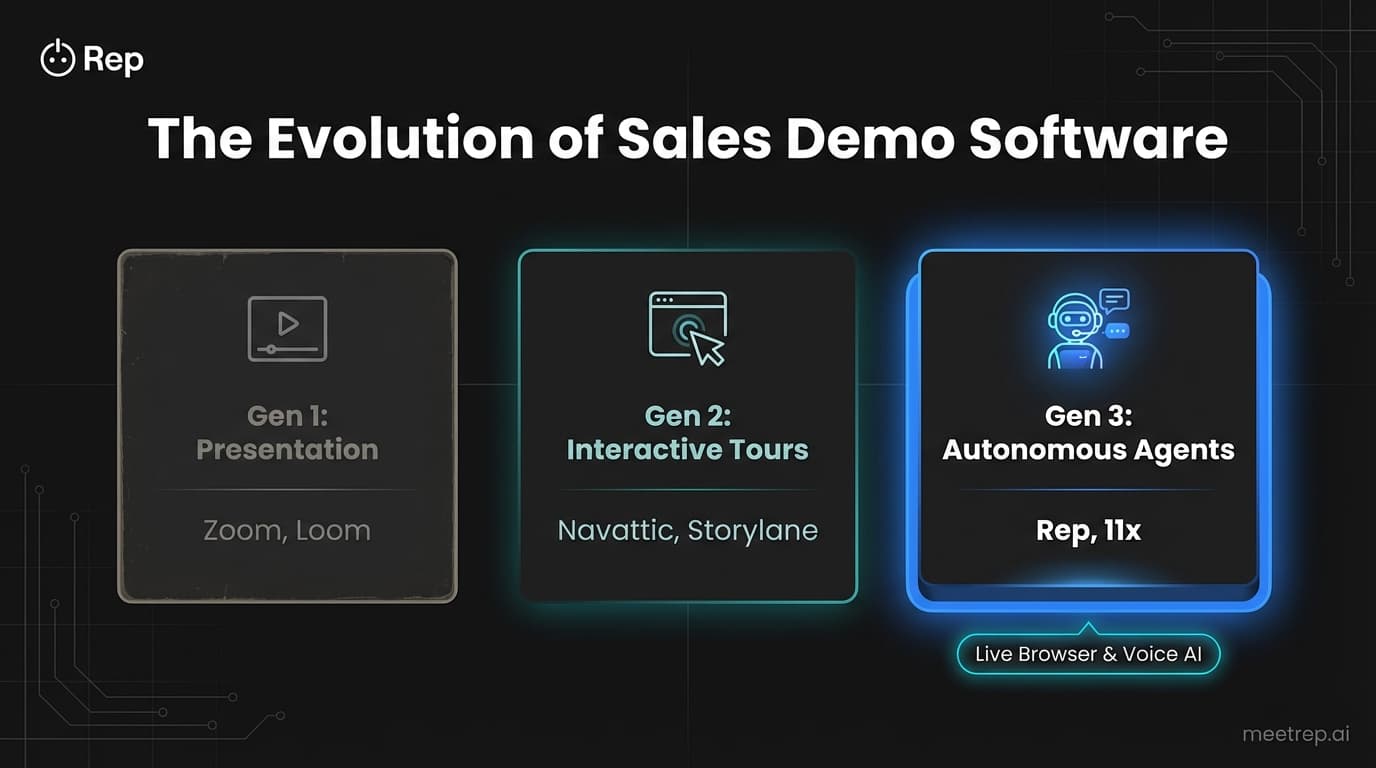
When we started building Rep, we realized that the definition of "demo" had split into three distinct generations. Understanding where you sit on this curve determines whether you win the deal or just get a "thanks, we'll keep you on file."
The Three Generations of Demo Tech
| Generation | Type | Primary Tools | The Experience |
|---|---|---|---|
| Gen 1 | Presentation | Zoom, Loom, Gong | "Can everyone see my screen?" Human-dependent, high friction, hard to scale. |
| Gen 2 | Interactive Tours | Navattic, Storylane | Click-through screenshots on a website. Good for marketing, but lacks voice or objection handling. |
| Gen 3 | Autonomous Agents | Rep, 11x | AI joins the call, speaks naturally, and navigates the live browser. Combines scale with interactivity. |
Most companies are stuck in Gen 1, dabbling in Gen 2. But the alpha is in Gen 3.
Why Speed to Demo is the Only Metric That Matters
You might think your biggest problem is lead quality. It probably isn't.
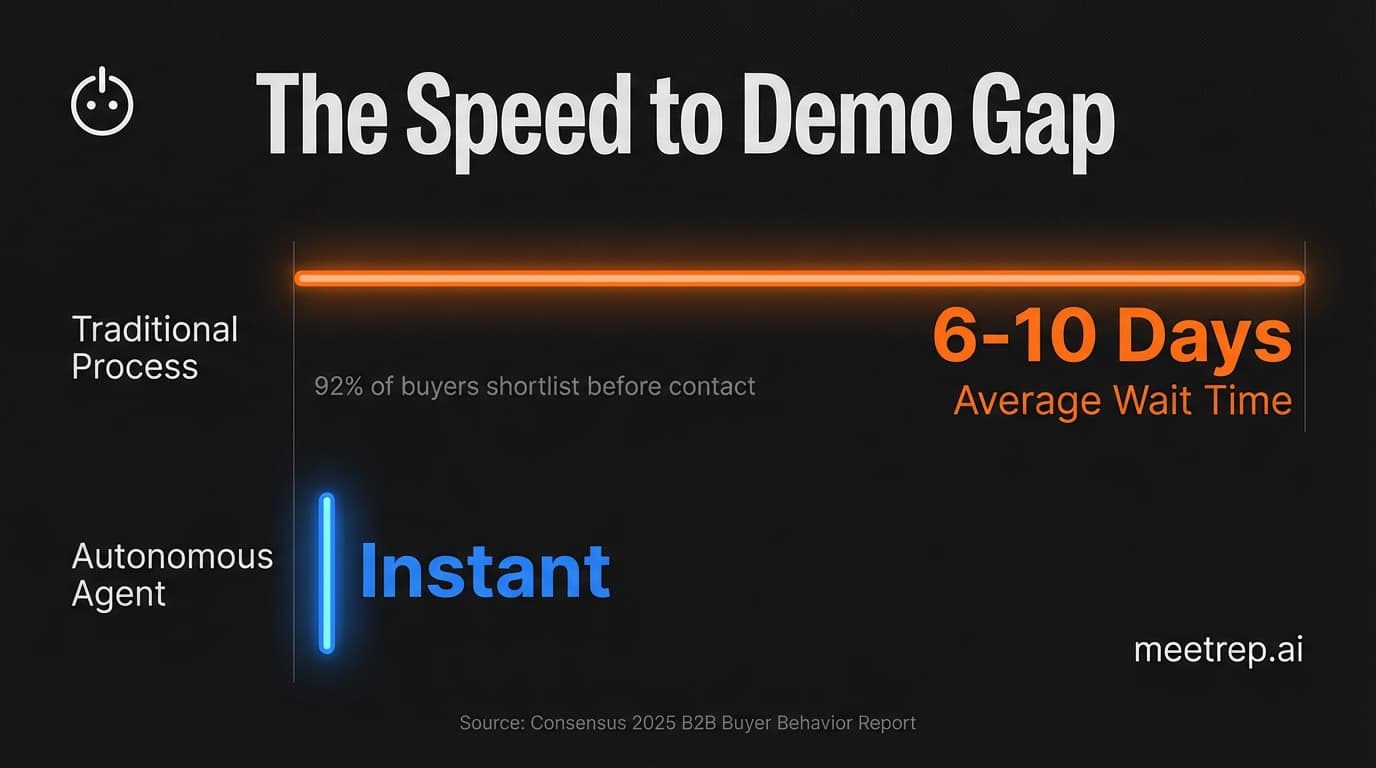
According to Consensus's 2025 B2B Buyer Behavior Report, the average buyer waits 6–10 days to speak with a sales rep after requesting a demo.
Six days.
In internet time, that’s a decade.
Here’s why that delay is fatal. According to Forrester, 92% of B2B buyers start their journey with at least one vendor in mind. Even scarier? 41% have already selected their preferred vendor before they even contact you.
Key Insight: If you aren't in the consideration set before the demo request, you have likely already lost. If you make them wait 6 days to see the product, you confirm their suspicion that you're hard to work with.
When we built the architecture for Rep, we obsessed over this. We didn't want a "faster" calendar booking tool. We wanted to eliminate the calendar entirely.
If a prospect wants to see how your reporting dashboard works at 2 AM on a Saturday, they should see it. Not a video of it. Not a screenshot. The actual dashboard, driven by an agent that can answer, "Hey, can we export this to CSV?"
The 3 Types of Demo Tools (And When to Use Them)
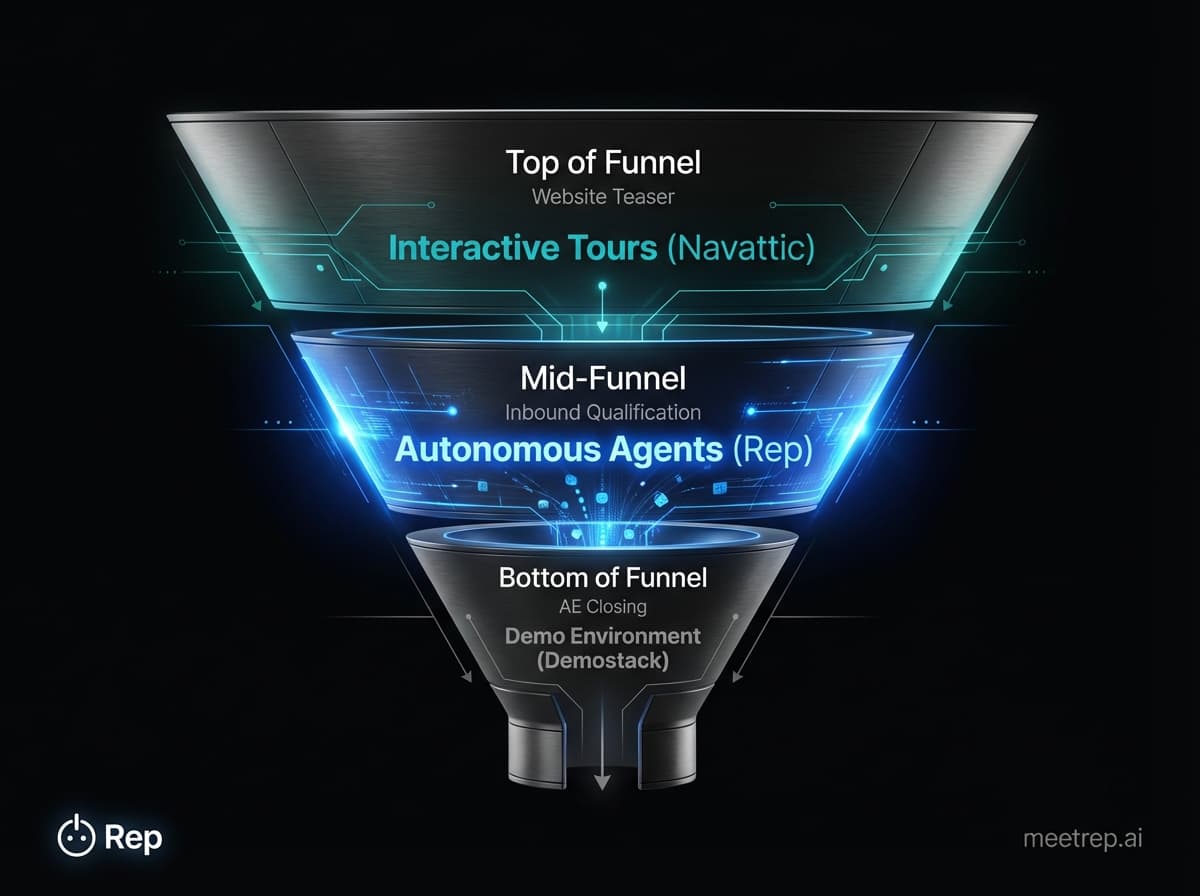
Not all sales demo software solves the same problem. I see leaders buy the wrong tool for the wrong funnel stage constantly.
Here is the framework I use:
1. Top of Funnel: Interactive Product Tours
These are perfect for your marketing site. They replace static screenshots with clickable HTML captures.
- Pros: Easy to set up, zero engineering lift, great for "teaser" content.
- Cons: It’s a lonely experience. If the buyer has a specific question ("Does this integrate with Salesforce?"), the tour can't answer. It's linear.
2. Mid-Funnel: Autonomous AI Agents
This is the new category. These are "digital workers" that handle the inbound qualification and initial discovery demo.
- Pros: Joins live video calls. Handles voice objections. Navigates the real product (not screenshots). Available 24/7.
- Cons: Requires training (like a human SDR). Not meant for closing million-dollar enterprise deals (yet).
3. Bottom of Funnel: Demo Environment Automation
Tools: Demostack, Saleo
These tools help your human AEs avoid the "demo curse" (bugs, bad data, messy environments). They clone your product into a sandbox.
- Pros: No more "sorry, the wifi is slow." Perfect, tailored data for every call.
- Cons: Still requires a human to deliver the demo. Doesn't solve the scaling problem.
My recommendation: Don't view these as competitors. Use Navattic on your homepage to hook them. Use Rep to handle the immediate "Book a Demo" influx. Use Demostack for your AE's closing calls.
Core Capabilities to Look For in 2026
If you are evaluating sales demo software right now, ignore the feature lists from 2023. "Screen recording" is table stakes. "Analytics" are expected.
Here is what actually separates the modern platforms from the legacy tools.
1. Voice Intelligence (Not Just Chat)
Buyers don't want to type into a chat widget during a demo. They want to talk. The best tools now use advanced voice AI (similar to Vapi or Bland AI standards) to handle interruptions, accents, and complex questions naturally.
At Rep, we spent months tuning our latency. If the AI takes 3 seconds to respond, the illusion breaks. It needs to be under 800ms.
2. Live Browser Automation
This is technical, but critical. Most "demo" tools are just playing a video and overlaying a fake cursor. Real autonomous agents act like a user. They log into the browser. They click DOM elements. They type real text.
Why does this matter? Because if you update your product, a video-based tool breaks. A browser-based agent just sees the new UI and adapts.
3. Contextual Memory
Does the software remember that this prospect asked about "SSO" five minutes ago? According to Gartner, 75% of B2B buyers prefer a rep-free experience, but only if that experience is intelligent. If the bot repeats itself, you lose trust.
Common mistake: Buying a "chatbot" and calling it an agent. Chatbots follow a decision tree (If X, then Y). Agents have a goal ("Show the reporting feature") and figure out how to get there based on the conversation.
The ROI of Autonomy (Cost of Inaction)
Let's talk money.
Most VPs I talk to are terrified of the cost of software. But they ignore the cost of the "hidden funnel."
According to consensus data, deals involving 9+ demo views have 8–10x higher close rates.
Think about that.
You cannot hire enough human SEs (Sales Engineers) to give 9 demos to every prospect. The math doesn't work. You’d go bankrupt.
But an autonomous agent costs a fraction of a human headcount and can run 500 concurrent demos.
The Math:
- Human SDR: $60k-$90k/year. Limited to ~40 hours/week. Sleeps. Quits. Needs training.
- Autonomous Agent: ~10% of the cost. Unlimited scale. Never sleeps. Improves with every call.
The Data: Companies like THEY New York saw a 3.2x increase in conversion rate by using Rep to automate the demonstration process. This isn't theoretical; it's operational efficiency.
The risk isn't that the AI will mess up a call. The risk is that by 2028, when 90% of B2B buying will be agent-intermediated (Gartner), you will still be asking prospects to "pick a time next Tuesday."
Conclusion
The era of the "click-through" demo is peaking. It solved a specific problem for marketing, but it didn't solve the core friction of sales.
We are entering the age of the Digital Worker.
My advice? Stop treating your demo as a "meeting" that needs to be scheduled. Treat it as an asset that should be available on demand.
If you want to see what that looks like—without talking to a human—you can literally just talk to Rep. It’s the only way to really understand the shift.

Nadeem Azam
Founder
Software engineer & architect with 10+ years experience. Previously founded GoCustomer.ai.
Nadeem Azam is the Founder of Rep (meetrep.ai), building AI agents that give live product demos 24/7 for B2B sales teams. He writes about AI, sales automation, and the future of product demos.
Frequently Asked Questions
Table of Contents
- What Is Sales Demo Software?
- Why Speed to Demo is the Only Metric That Matters
- The 3 Types of Demo Tools (And When to Use Them)
- Core Capabilities to Look For in 2026
- The ROI of Autonomy (Cost of Inaction)
- Conclusion
Ready to automate your demos?
Join the Rep Council and be among the first to experience AI-powered demos.
Get Early AccessRelated Articles
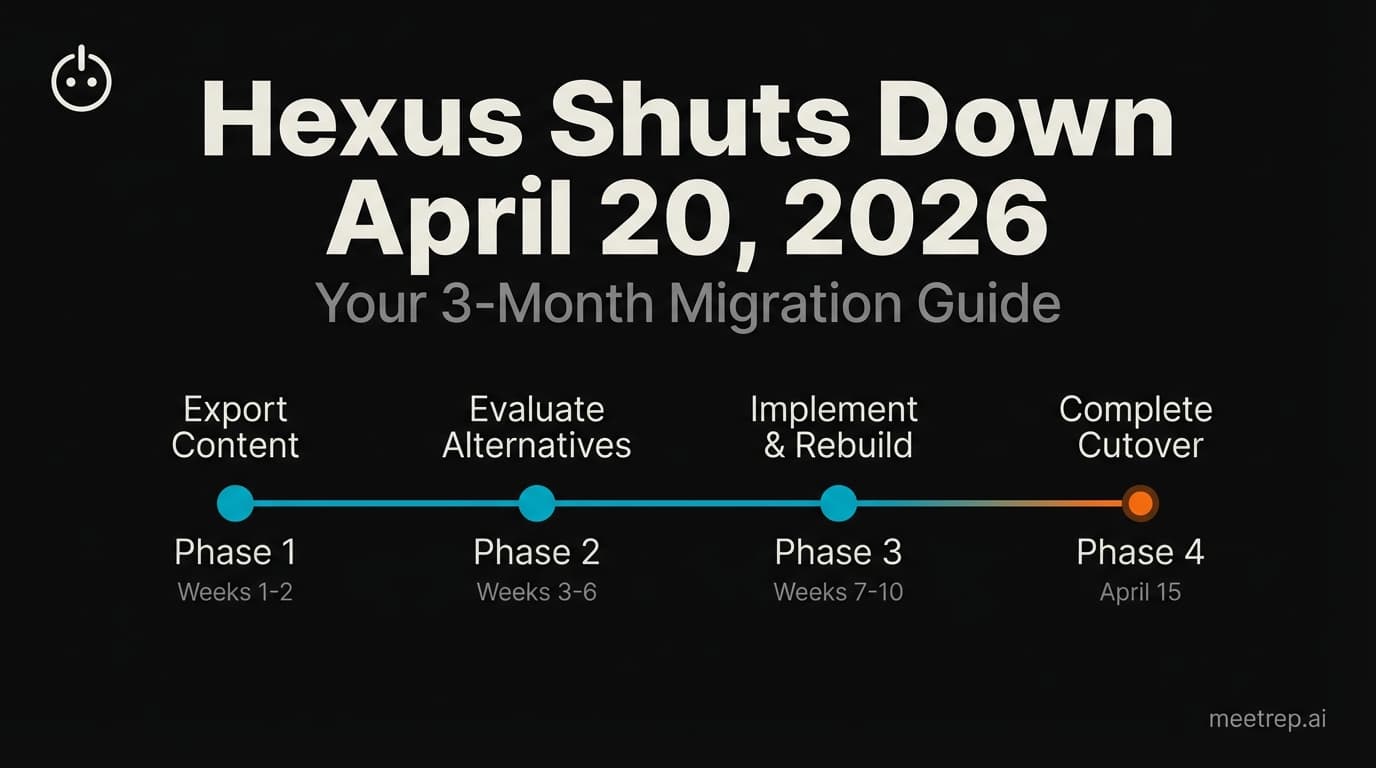
Hexus Acquired by Harvey AI: Congrats & What It Means for Demo Automation Teams
Hexus is shutting down following its acquisition by Harvey AI. Learn how to manage your migration and discover the best demo automation alternatives before April 2026.
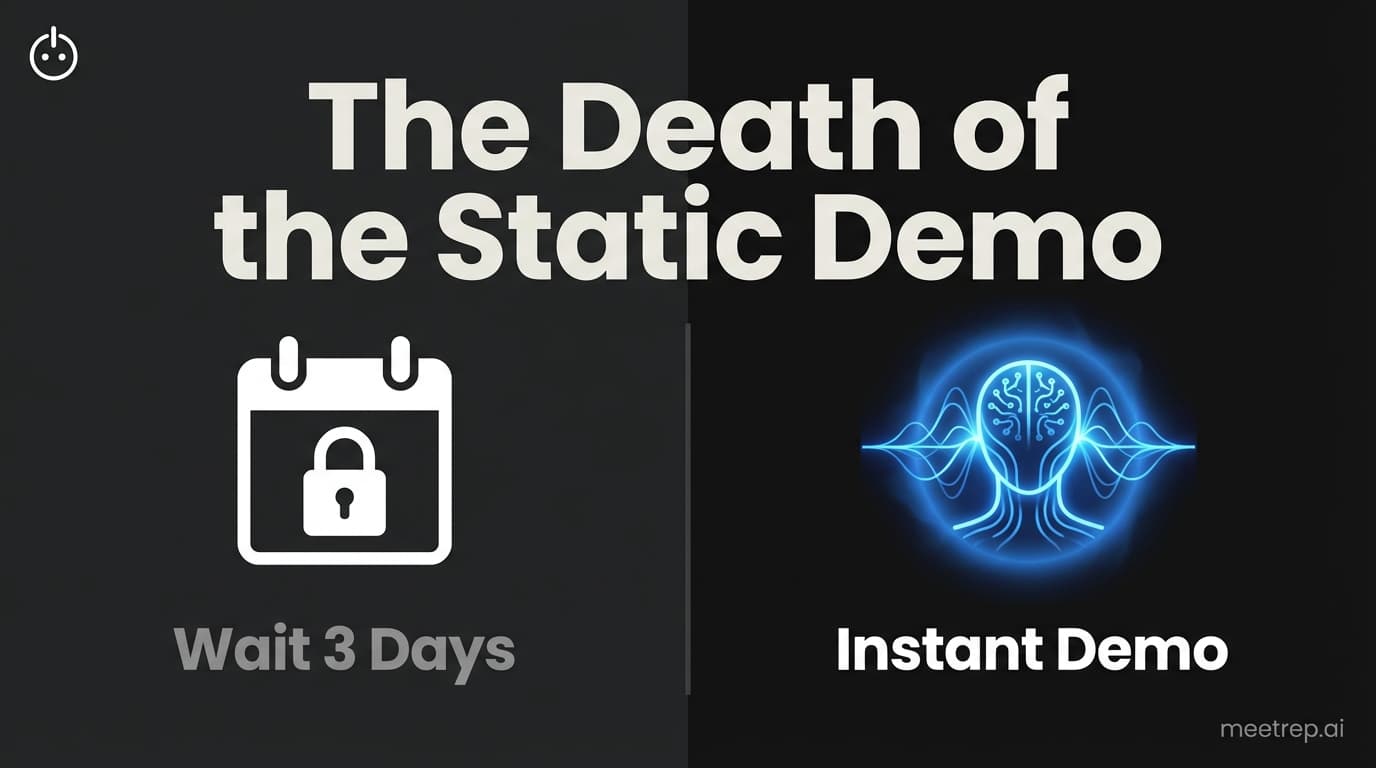
Why the "Software Demo" is Broken—and Why AI Agents Are the Future
The traditional software demo is dead. Discover why 94% of B2B buyers rank vendors before calling sales and how AI agents are replacing manual demos to scale revenue.
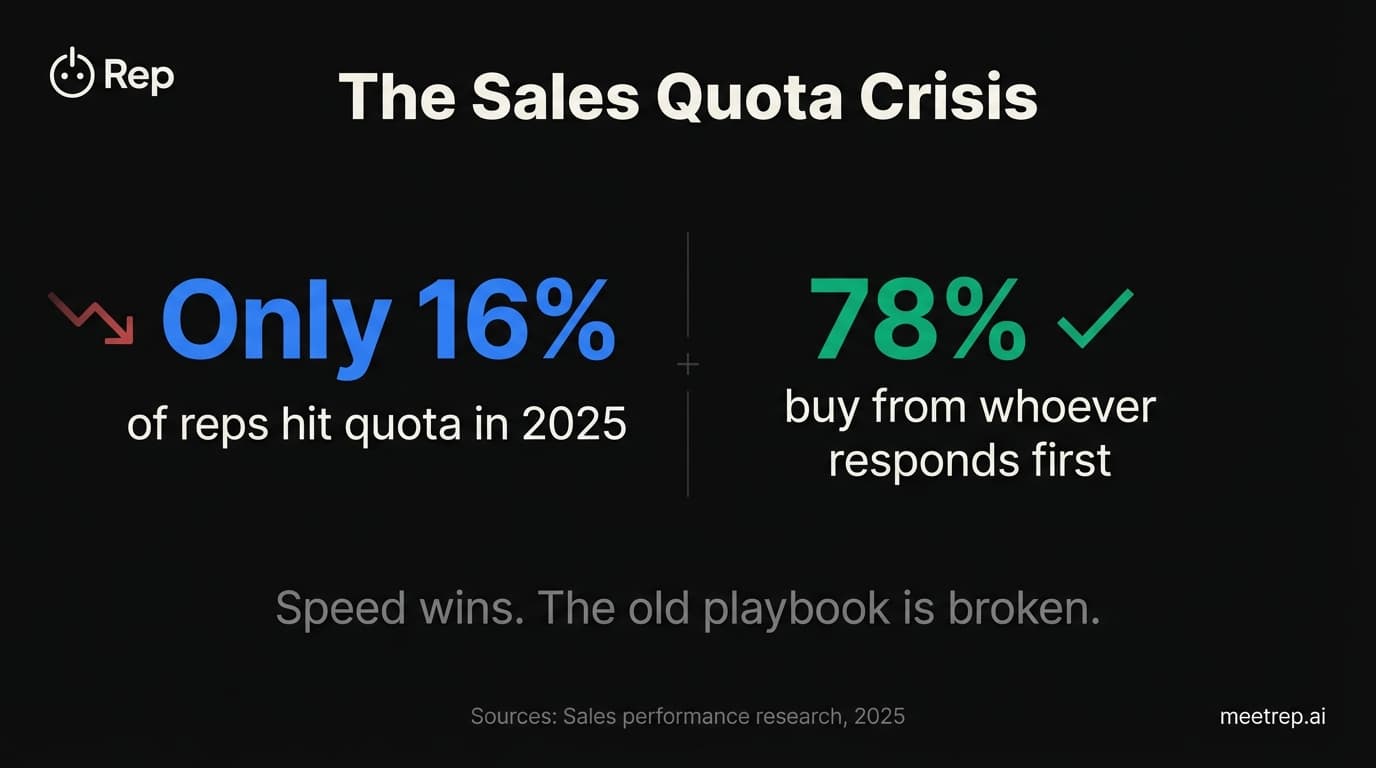
Why Autonomous Sales Software is the Future of B2B Sales (And Why the Old Playbook is Dead)
B2B sales is at a breaking point with quota attainment at 46%. Discover why autonomous 'Agentic AI' is the new standard for driving revenue and meeting the demand for rep-free buying.