Sales Automation Software: ROI, Features, and the Tools That Actually Work

Executive Summary
- Sales automation returns $5.44 for every $1 spent—but most teams never see it
- Reps save 2+ hours daily when automation is implemented correctly
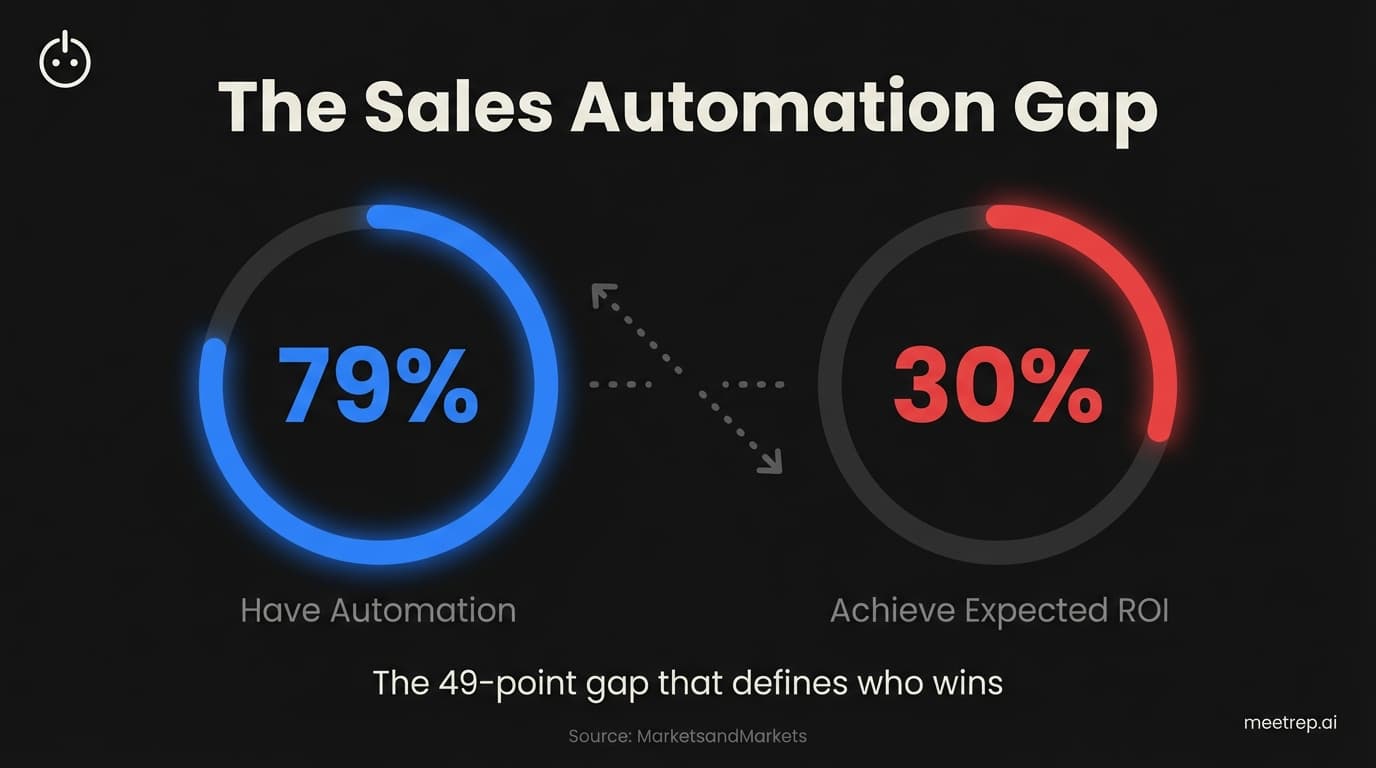
- The gap between adoption (79%) and ROI (30%) comes down to data quality and change management
- Agentic AI—tools that act autonomously—is the 2026 inflection point
Your reps are spending 70% of their time on everything except selling. That's not a guess—it's what Salesforce found when they surveyed 5,500 sales professionals across 27 countries. Sales automation software is supposed to fix this. And for some teams, it does—Graph8's 2025 research shows $5.44 returned for every dollar spent.
But here's what the vendor pitch won't tell you: 79% of teams buy automation tools, yet only 30% hit their expected ROI.
I've been building in this space since GoCustomer.ai. Now at Rep, I'm watching the market shift from basic workflow automation to something genuinely different: AI that doesn't just assist—it acts. This guide covers what actually works in 2026, what doesn't, and where the real opportunities are hiding.
What Is Sales Automation Software?
Sales automation software eliminates repetitive manual tasks from the sales process using rules, triggers, and CRM data. It handles lead capture, follow-up sequences, scheduling, pipeline updates, and reporting—freeing reps to focus on conversations that actually close deals.
That's the textbook answer. Here's the practical one.
Most sales automation falls into "workflow automation"—if a lead fills out a form, send this email. If an opportunity moves to stage 3, create this task. It's not intelligent. It's not adaptive. It just follows rules you set.
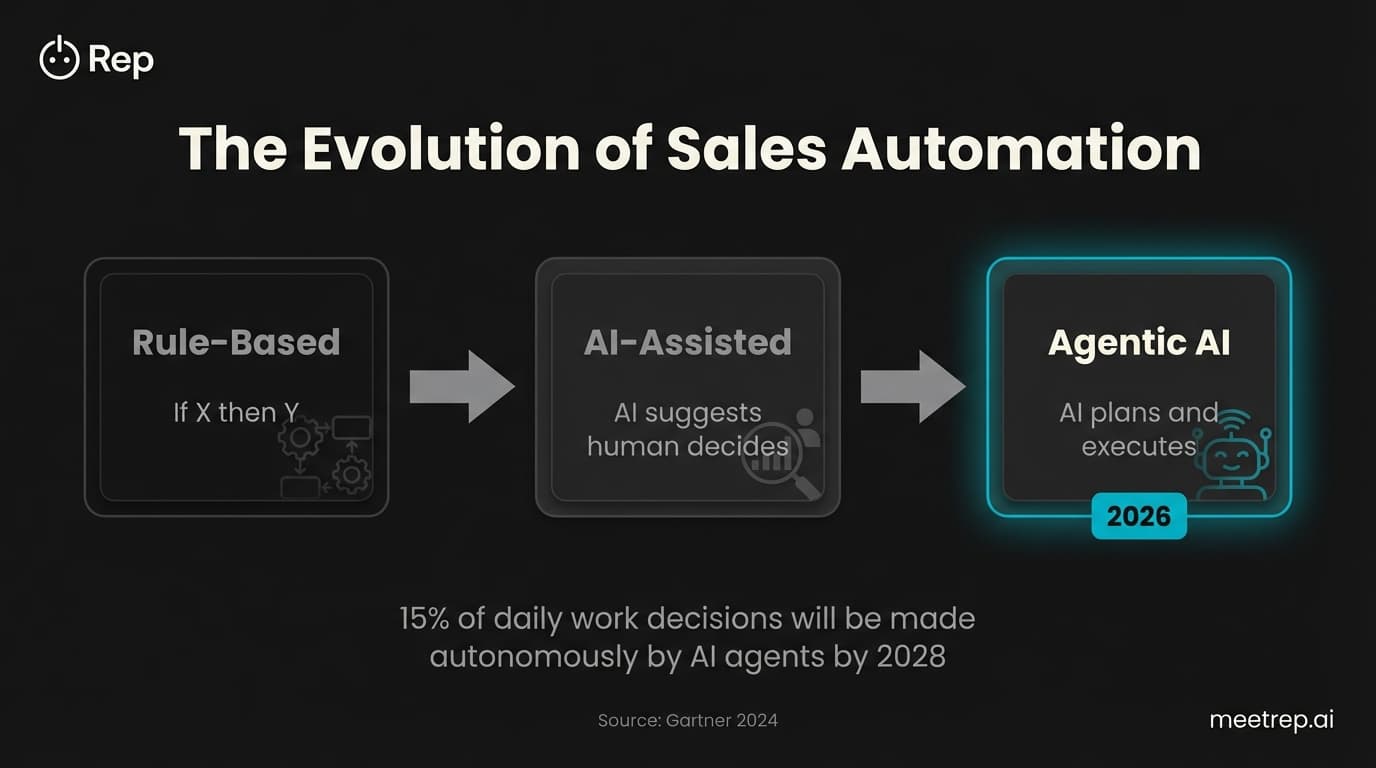
The newer generation—what Gartner calls "agentic AI"—works differently. These tools don't wait for triggers. They plan, act, and adjust based on goals. Gartner predicts that by 2028, 15% of daily work decisions will be made autonomously by AI agents. That's up from 0% in 2024.
The market is shifting fast. If you're evaluating sales automation tools today, you need to understand this distinction:
| Automation Type | How It Works | Example |
|---|---|---|
| Rule-Based | If X happens, do Y | "Send follow-up email 3 days after demo" |
| AI-Assisted (Copilot) | AI suggests, human approves | "Gong suggests talking points for next call" |
| Agentic AI | AI plans and executes autonomously | "Rep joins call and delivers product demo" |
Most tools on the market are still rule-based or copilot-style. True agentic AI is emerging—and it's where the biggest productivity gains will come from.
The ROI of Sales Automation (What the Data Actually Shows)
Sales automation delivers strong ROI when implemented correctly. Graph8's 2025 research found an average return of $5.44 for every dollar invested, with 76% of companies achieving positive ROI within 12 months.
But averages hide a brutal reality.
The Data: According to MarketsandMarkets, 79% of sales teams have implemented automation—but only 30% achieve their expected ROI. That's a 49-point gap between "we bought it" and "it worked."
The difference between the winners and everyone else comes down to three factors:
1. Data quality. Automation is only as good as your CRM data. Everstage reports that 31% of sales admins say poor data quality costs them 20% or more of annual revenue. You can't automate your way out of dirty data.
2. Process first, tools second. Teams that automate broken processes just break faster. The ones that see ROI fix their sales motion before adding automation.
3. Actual adoption. This is the killer. We learned this the hard way at GoCustomer—you can build the best features in the world, but if reps don't use them, you've built expensive shelfware.
What we learned at GoCustomer: Adoption is everything. Our highest-ROI customers weren't the ones with the most sophisticated implementations—they were the ones who got 80%+ of their team using the core features within 30 days. Features reps don't use have zero ROI.
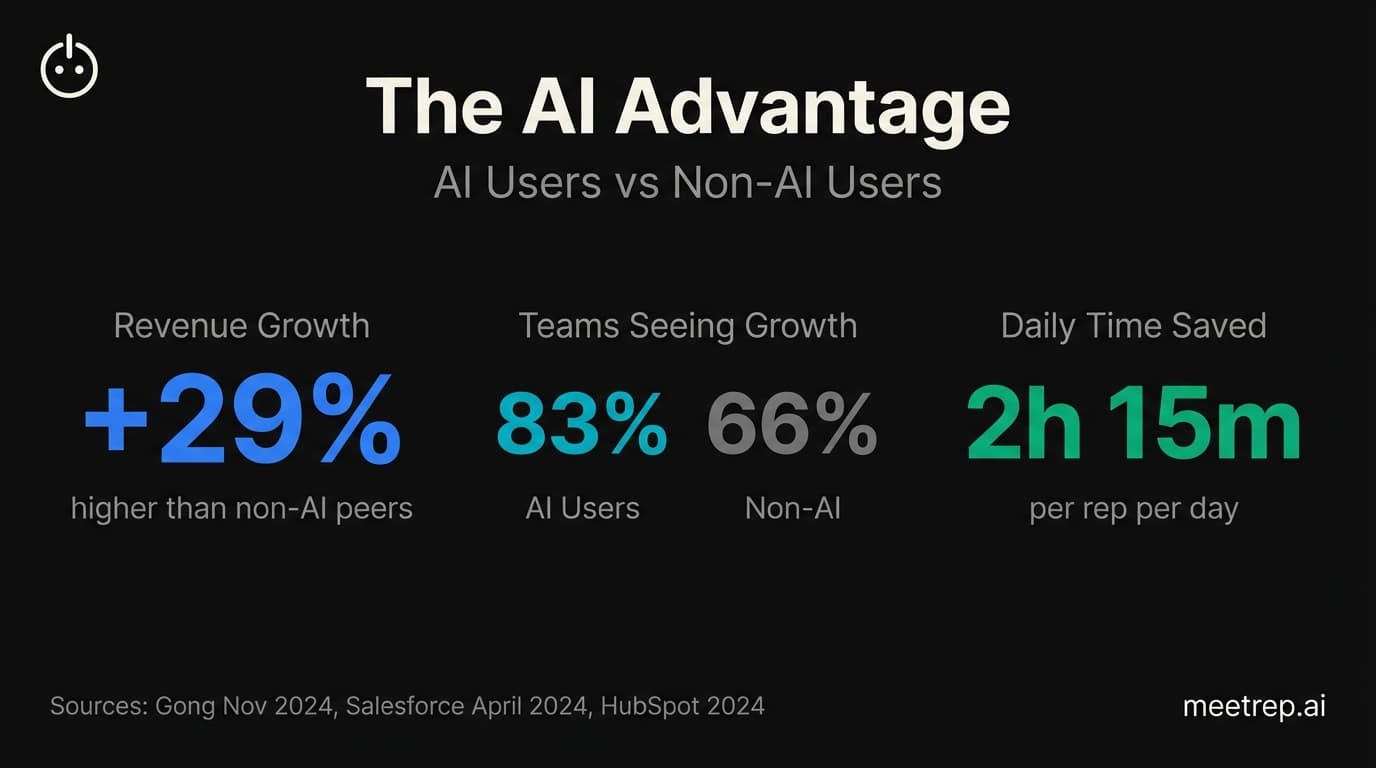
Here's what the ROI looks like when teams get it right:
| Metric | AI Users | Non-AI Users | Source |
|---|---|---|---|
| Revenue growth | 29% higher | Baseline | Gong Nov 2024 |
| Teams seeing growth | 83% | 66% | Salesforce April 2024 |
| Time saved daily | 2h 15m | 0 | HubSpot 2024 |
The signal is clear. Teams using AI-powered automation aren't just marginally better—they're pulling away from the pack.
What's the Hidden Cost of Not Automating?
We talk a lot about ROI. But the cost of inaction is just as real—and it's compounding daily.
Right now, your reps spend only 30% of their workweek actually selling. The other 70% goes to admin work, data entry, scheduling, and "work about work." That's not a productivity problem—it's a business model problem.
And it's getting worse. Salesforce found that 67% of reps don't expect to meet quota this year. Only 16% hit quota last year. You can't train or motivate your way out of that gap if the underlying productivity math doesn't work.
Then there's burnout. Gartner reports that 89% of B2B sellers feel burned out. Not "a little tired." Burned out. When your best reps quit because they're drowning in admin work, that's a direct cost to your business.
Key Insight: The question isn't "can we afford sales automation?" It's "can we afford not to automate while competitors save 2+ hours per rep per day?"
Top Sales Automation Software Categories (2026)
The sales automation market has fragmented into distinct categories. Understanding what each does—and doesn't do—will save you from buying tools that overlap or leave gaps.
1. CRM Platforms (System of Record)
Your CRM is the foundation. Without clean data here, nothing else works.
Top options:
- Salesforce Sales Cloud — Enterprise standard, most extensive ecosystem
- HubSpot Sales Hub — Best for SMB/mid-market, strong free tier
- Pipedrive — Visual pipeline, $14/user/month entry
- Zoho CRM — Value play, $14/user/month
- Microsoft Dynamics 365 — Best for Microsoft-native orgs
2. Sales Engagement (System of Action)
These platforms automate outbound sequences—emails, calls, social touches—across your pipeline.
Top options:
- Outreach — Market leader, enterprise focus
- Salesloft — Strong coaching and analytics
- Apollo.io — Combined data + engagement, popular with growth teams
- Reply.io — Solid mid-market option
3. Revenue Intelligence (System of Insight)
These tools analyze conversations and pipeline data to surface insights—what's working, what's not, where deals are stuck.
Top options:
- Gong — Conversation intelligence leader
- Clari — Revenue forecasting focus
- Chorus.ai (ZoomInfo) — Strong enterprise integrations
4. Demo Automation (The New Frontier)
This is where things get interesting.
Traditional demo automation—tools like Consensus, Walnut, and Navattic—let prospects click through interactive product tours. They're useful for top-of-funnel qualification. But they can't have a conversation. They can't answer questions. They can't adjust based on what the prospect cares about.
That's changing. At Rep, we're building autonomous AI agents that join video calls, share their screen, navigate your live product, and actually talk to prospects in real-time. It's not a click-through tour—it's a real demo, delivered by AI.
Hot take: Most "sales automation" doesn't actually automate sales. It automates the stuff around sales—the admin work, the data entry, the scheduling. Demo automation is one of the first categories where AI is handling actual customer-facing selling tasks. That's why DataIntelo projects this market will hit $6.8 billion by 2032.
Essential Features to Look For
Not every team needs every feature. But when evaluating sales automation platforms, these capabilities separate the tools that deliver ROI from the ones that become shelfware.
Non-negotiables:
- CRM integration (native Salesforce/HubSpot sync, not just Zapier)
- Email sequence automation with personalization
- Meeting scheduling without manual back-and-forth
- Activity logging (automatic, not rep-dependent)
- Mobile access (reps live on their phones)
High-impact for mid-market and up:
- Lead scoring (ideally AI-powered, not just rules)
- Multi-channel sequencing (email + phone + social)
- Pipeline analytics and forecasting
- Conversation intelligence (call recording + analysis)
- Territory and routing automation
The 2026 differentiator: Agentic capabilities—tools that don't just assist but act. 75% of B2B buyers prefer self-service before talking to a rep. Tools that enable autonomous interactions (like demo agents) meet buyers where they want to be.
The feature checklist matters less than the implementation. I've seen teams with basic tools crush teams with enterprise stacks—because they actually use what they buy.
Why Sales Automation Projects Fail (And How to Avoid It)
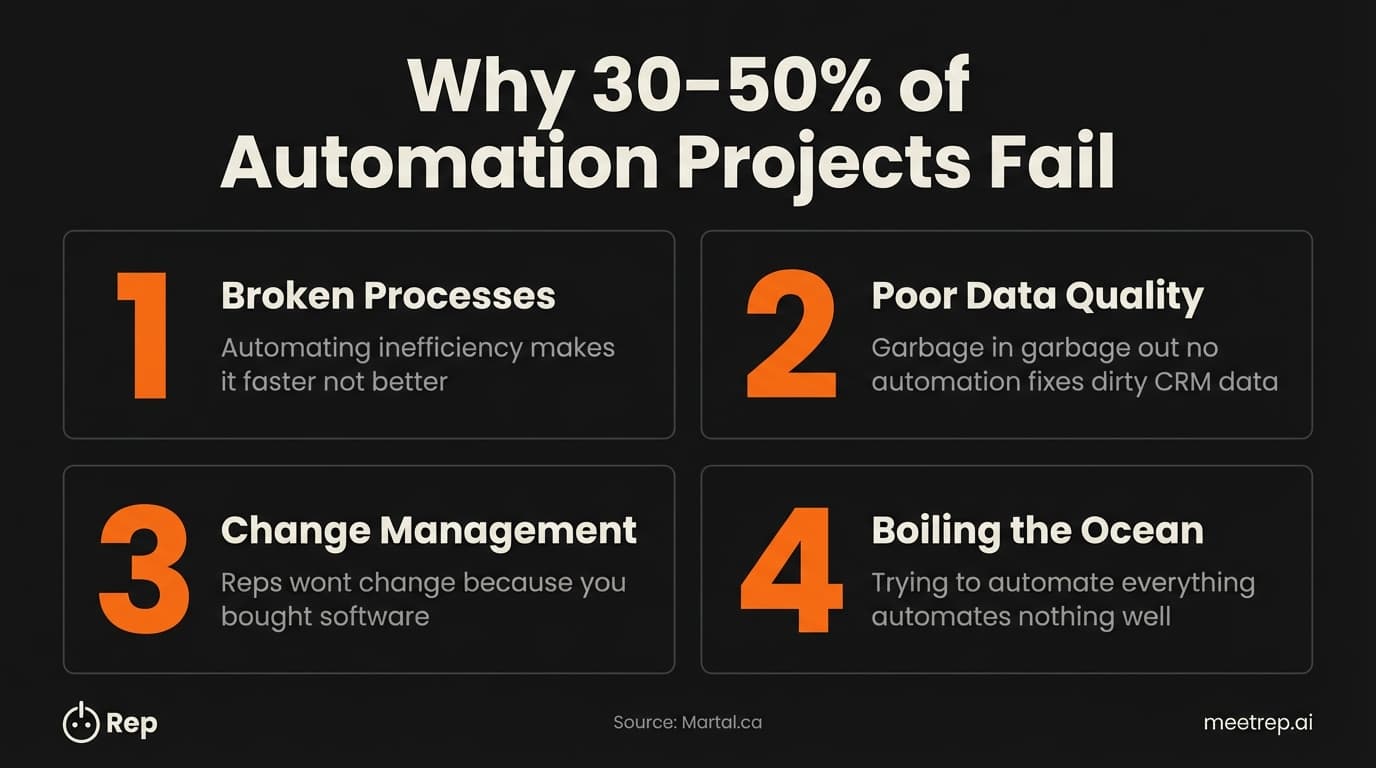
Let's talk about the 30-50% failure rate nobody wants to discuss.
Martal.ca found that up to half of initial sales automation projects fail to meet expectations. And Oliv.ai reports that 60% of RevOps initiatives don't survive 18 months.
So what goes wrong?
Failure mode #1: Automating broken processes. If your current sales motion is inefficient, automation makes it inefficiently faster. Fix the process first. Then automate.
Failure mode #2: Ignoring data quality. Your fancy lead scoring model is useless if half your CRM records have missing or outdated information. 31% of admins say this costs them 20%+ of revenue.
Failure mode #3: Underestimating change management. Reps don't change behavior because you bought new software. They change when they see personal benefit. You need training, enablement, and visible quick wins.
Failure mode #4: Boiling the ocean. Teams that try to automate everything at once usually automate nothing well. Start with one high-impact workflow. Get adoption. Then expand.
My recommendation: Before you buy anything, answer this: "What's the one workflow that, if automated, would save each rep 30+ minutes per day?" Start there. Get to 80% adoption. Then add the next one.
The Rise of Agentic AI in Sales
Here's where things get genuinely exciting.
For twenty years, "sales automation" meant rule-based workflows. If trigger, then action. Useful, but limited. You still needed humans for anything requiring judgment, conversation, or adaptation.
Agentic AI changes that. These are AI systems that can plan, execute, and adjust based on goals—not just triggers.
Gartner named agentic AI the top tech trend for 2025. Forrester predicts that by 2028, 60% of brands will use agentic AI for one-to-one customer interactions.
What does this look like in practice?
Instead of an AI that suggests what to say on a call (copilot), you have AI that takes the call. Instead of automation that sends follow-up emails, you have AI that conducts discovery conversations, qualifies leads, and handles initial demos—without a human in the loop.
That's what we're building at Rep. Our AI agent joins video calls, shares its screen, navigates your live product, and has real conversations with prospects. It's not replacing your senior AEs—it's handling the repetitive intro demos that burn them out.
McKinsey put it well in Harvard Business Review: "Imagine creating a perfect replica of your top-performing sellers—but instead of someone whose capacity for work is limited by time and geography, this replica can work alongside human sales reps continuously."
We're not fully there yet. And I'll be honest—Gartner also predicts that 40% of agentic AI projects will be canceled by 2027 due to cost and complexity. This technology is real, but it's not magic. Implementation still matters.
How to Choose the Right Sales Automation Tools
After evaluating dozens of platforms and building two of them myself, here's how I'd approach the decision:
Step 1: Audit your current state. Where do reps spend non-selling time? What's your CRM data quality (honestly)? What tools do you already have that reps actually use?
Step 2: Identify one high-impact automation target. Not five. One. The workflow that will show clear time savings or conversion improvement.
Step 3: Map requirements to categories. Do you need a CRM upgrade? Engagement platform? Revenue intelligence? Demo automation? Most teams don't need all four on day one.
Step 4: Prioritize integration depth over feature count. A tool that syncs natively with your CRM beats a tool with 50 features that requires Zapier.
Step 5: Plan for adoption, not just implementation. Budget for training. Identify internal champions. Set 30/60/90 day adoption targets.
Step 6: Start small, prove ROI, then expand. Get one workflow working. Document the results. Use that proof to fund the next phase.
The sales automation market has never been more capable—or more confusing. Every vendor claims AI. Every pitch deck promises transformation. And somewhere between the hype and reality, teams are either pulling ahead or falling behind.
My take? The winners in 2026 won't be the teams with the biggest tech stacks. They'll be the ones who pick fewer tools, implement them completely, and actually get their reps to use them. Data quality matters more than features. Adoption matters more than sophistication.
And for the first time, we're seeing automation that doesn't just assist the sale—it conducts it. That's the shift worth watching.
If repetitive demos are burning out your team, see how Rep handles them autonomously.

Nadeem Azam
Founder
Software engineer & architect with 10+ years experience. Previously founded GoCustomer.ai.
Nadeem Azam is the Founder of Rep (meetrep.ai), building AI agents that give live product demos 24/7 for B2B sales teams. He writes about AI, sales automation, and the future of product demos.
Frequently Asked Questions
Table of Contents
- What Is Sales Automation Software?
- The ROI of Sales Automation (What the Data Actually Shows)
- What's the Hidden Cost of Not Automating?
- Top Sales Automation Software Categories (2026)
- Essential Features to Look For
- Why Sales Automation Projects Fail (And How to Avoid It)
- The Rise of Agentic AI in Sales
- How to Choose the Right Sales Automation Tools
Ready to automate your demos?
Join the Rep Council and be among the first to experience AI-powered demos.
Get Early AccessRelated Articles
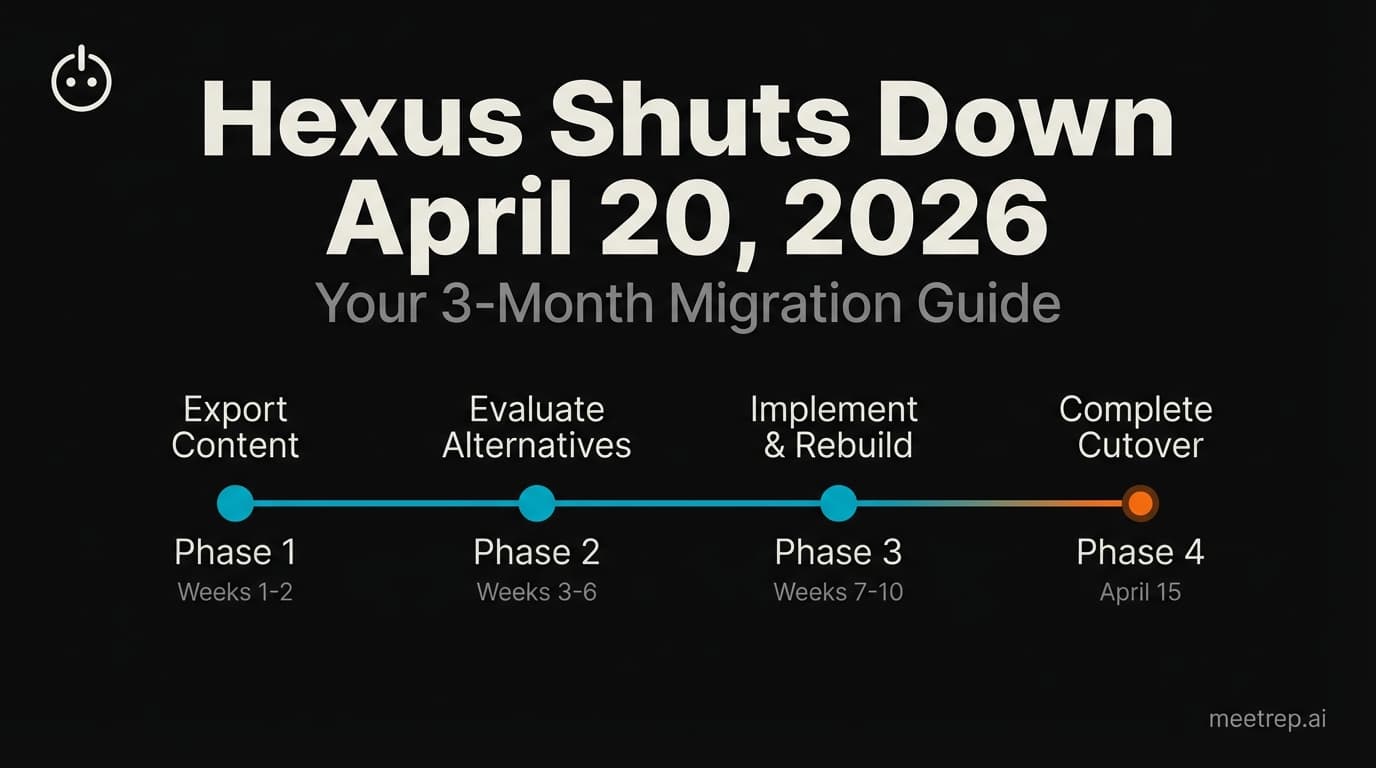
Hexus Acquired by Harvey AI: Congrats & What It Means for Demo Automation Teams
Hexus is shutting down following its acquisition by Harvey AI. Learn how to manage your migration and discover the best demo automation alternatives before April 2026.
Why the "Software Demo" is Broken—and Why AI Agents Are the Future
The traditional software demo is dead. Discover why 94% of B2B buyers rank vendors before calling sales and how AI agents are replacing manual demos to scale revenue.
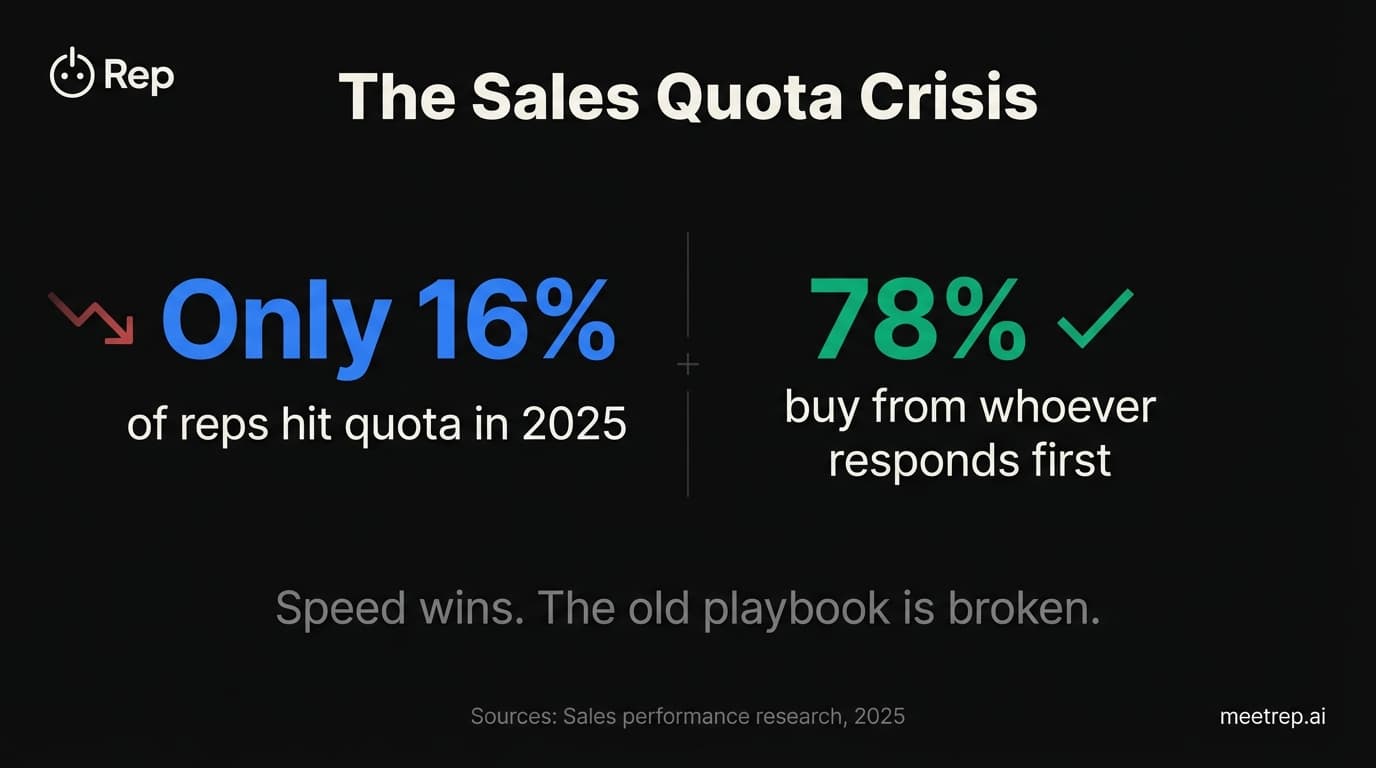
Why Autonomous Sales Software is the Future of B2B Sales (And Why the Old Playbook is Dead)
B2B sales is at a breaking point with quota attainment at 46%. Discover why autonomous 'Agentic AI' is the new standard for driving revenue and meeting the demand for rep-free buying.