Rep vs Supademo: Which Demo Tool Actually Fits Your Sales Process?

Executive Summary
- Supademo creates screenshot-based click-through demos for websites, docs, and marketing—fast to build, great for top-of-funnel
- Rep delivers live AI-powered demos where an agent joins video calls, shares its screen, and has real conversations with prospects
- Use Supademo when you need quick demo creation for product tours and leave-behinds
- Use Rep when you need to qualify leads, handle questions, and scale live demos without hiring more SDRs
- Many teams should use both—Supademo for awareness, Rep for qualification
Here's a stat that should bother you: only 25% of B2B buyers find online demos useful, according to Forrester's 2024 research. Three out of four prospects walk away from demos thinking they wasted their time.
That's not a tools problem. It's a fit problem.
If you're searching for a Supademo alternative—or just trying to figure out which demo tool makes sense for your team—the answer depends entirely on what you're actually trying to accomplish. I've spent years building sales automation products (first GoCustomer.ai, now Rep), and the biggest mistake I see teams make isn't choosing the "wrong" tool. It's using the right tool for the wrong job.
Supademo and Rep aren't really competitors. They solve fundamentally different problems. This post breaks down exactly when each one wins.
What's the Actual Difference Between Supademo and Rep?
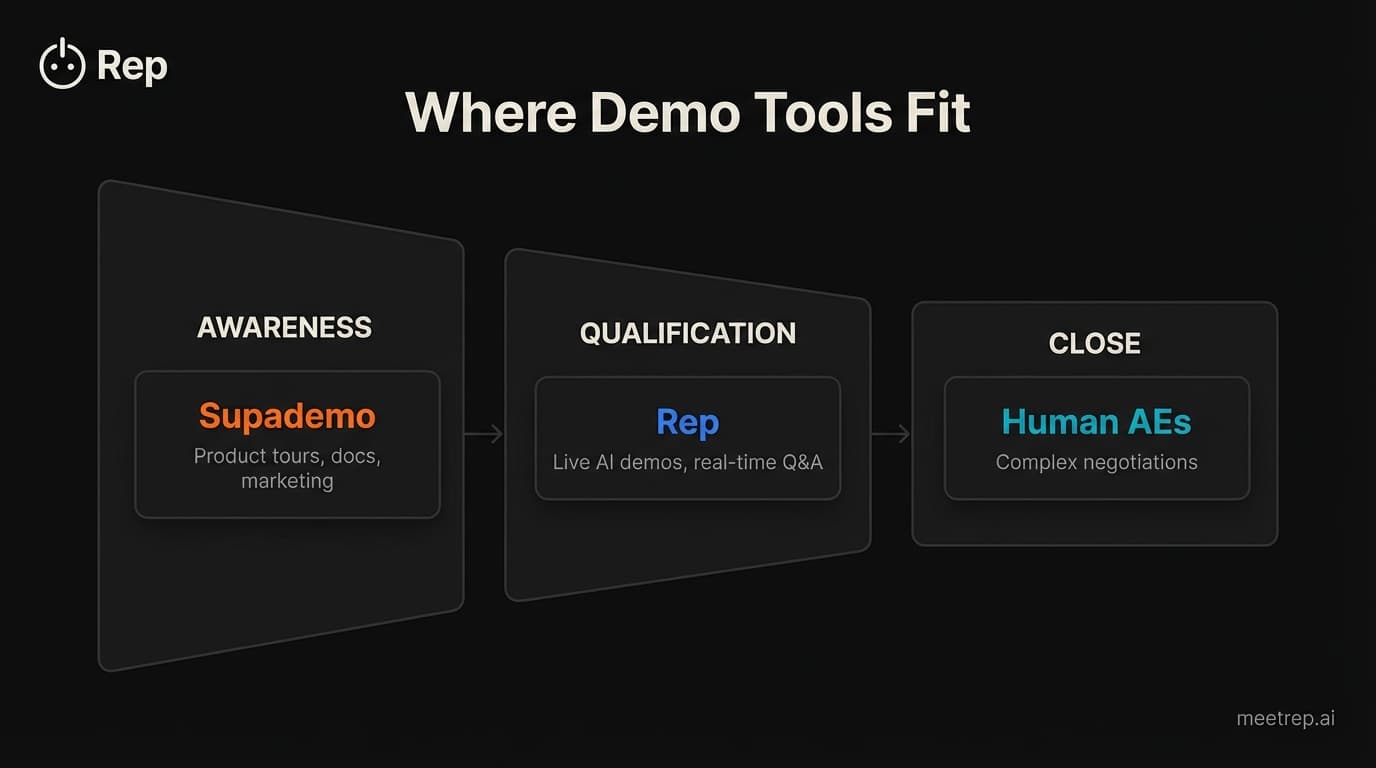
Supademo and Rep represent two distinct approaches to product demonstration. Understanding this distinction is the key to choosing correctly. Supademo captures your product interface as screenshots or HTML, then lets you add annotations, hotspots, and AI voiceovers. Prospects click through at their own pace. Rep joins live video calls as an AI agent, shares its screen, navigates your actual product in real-time, and has back-and-forth conversations with prospects.
The core difference: asynchronous content versus synchronous interaction.
| Dimension | Supademo | Rep |
|---|---|---|
| Interaction Type | Click-through, self-paced | Live conversation, real-time |
| What Prospects See | Pre-recorded screenshots/HTML | Your actual live product |
| Question Handling | Pre-set paths only | Real-time Q&A with AI |
| Best Funnel Stage | Top-of-funnel (awareness) | Mid/Bottom-funnel (qualification) |
| Setup Time | Minutes | Days (but then automated) |
| Maintenance | Re-record when UI changes | Automatic (shows current product) |
| Availability | Always on (it's content) | Always on (it's an agent) |
Think of it this way: Supademo is like a really good product video that prospects control. Rep is like having an SDR available around the clock who never needs sleep, vacation, or a salary increase.
Key Insight: The choice isn't about which tool has better features. It's about whether your prospects need to explore your product or discuss it with someone who can answer their specific questions.
Supademo Pricing: What You're Actually Paying For
Supademo pricing starts with a free tier and scales based on features and team size. Here's the breakdown that matters for budget planning:
| Plan | Cost | What You Get | Key Limitation |
|---|---|---|---|
| Free | $0 | 5 demos, basic editor | Supademo watermark |
| Pro | ~$27/creator/month | Unlimited demos, AI voiceover | Screenshot capture only |
| Scale | $38-50/creator/month | Branching, custom branding, analytics | Screenshot capture only |
| Growth | $350/month (5 creators) | HTML cloning, AI voice cloning | Big price jump |
| Enterprise | Custom | SSO, SLAs, dedicated support | Contact sales |
The number that catches most teams off guard: $350/month for HTML demos.
Screenshot demos work fine for simple products. But if your app has complex dashboards, data tables, or interactive elements, prospects can tell they're looking at static images. HTML capture solves this by cloning your actual front-end code—but it's locked behind that Growth tier.
The Data: Supademo has grown to over 100,000 users with a 4.7/5 rating on G2 from 421 verified reviews. The majority—about 63%—are small businesses, which makes sense given the accessible Pro pricing.
For quick demo creation on a startup budget, Supademo's $27/month Pro plan is genuinely hard to beat. That's the honest assessment.
Where Supademo Wins (And We're Not Just Saying That)
I want to be direct about this: Supademo is the better choice for several common scenarios. We built Rep to solve a different problem, not to be "Supademo but better."
Supademo excels at:
Website product tours. You want visitors to understand your product in 2-3 minutes without scheduling a call. Supademo embeds directly on your landing page. beehiiv saw a 50% increase in free-to-paid conversions and 20% more qualified leads after adding interactive demos to their site.
Documentation and support. Help articles come alive when users can click through the actual steps instead of reading descriptions.
Leave-behind materials. After a live call, you send a Supademo link so prospects can re-explore the features you discussed. They share it with their team. That's distribution you can't replicate with calendar invites.
Speed to first demo.ProcessMaker reported cutting demo creation time from 8-10 hours down to 5 minutes. When you need a product tour live by tomorrow, that matters.
Budget constraints. At $27/month, the Pro plan pays for itself if it converts even one additional prospect per quarter.
My recommendation: If your primary goal is lead generation on your website and you have a relatively simple product, start with Supademo. Seriously. Don't overthink it.
When Supademo Hits Its Limits
Screenshot demos have an inherent constraint: they can't have conversations.
When a prospect viewing your Supademo tour thinks "but how does this handle our specific data format?" they have two options. Schedule a meeting and wait (introducing friction), or leave without an answer (potentially lost deal).
Honestly, the recurring friction points from G2 reviews tell the story:
Update burden. One reviewer put it bluntly: "I hate when I need to update my screenshots. I have to create a new page and build everything for this page again." Every UI change means re-recording. That's the nature of screenshot capture, not a Supademo-specific flaw.
No real-time answers. Pre-recorded content can't pivot based on what a specific prospect cares about. You're guessing at the questions they'll have.
Fidelity gap. Unless you're paying $350/month for HTML capture, sophisticated buyers can tell they're clicking through images, not your actual product.
And here's the number that stuck with me when researching this space: according to Gartner's 2025 research, 61% of B2B buyers now prefer a rep-free buying experience. But—and this is the part people miss—they still want human-like interaction for "contextual intelligence" on complex decisions. They want self-service and the ability to ask questions.
Screenshot demos give you the first. Not the second.
What Rep Does Differently
Rep takes a fundamentally different approach. Instead of creating content about your product, Rep provides live demonstrations through an AI agent.
Here's what that actually means:
When a prospect books a demo, Rep joins the video call as a participant. It shares its screen. It opens a real browser, logs into your actual product with demo credentials, and navigates through features while talking to the prospect in real-time using voice AI. If they ask a question—"can this integrate with Salesforce?"—Rep answers immediately using your knowledge base.
The core capabilities:
- Live browser automation (clicks, types, scrolls through your actual product)
- Natural voice conversation with real-time Q&A
- Multiple voice personas (Puck for energetic, Charon for technical, Aoede for balanced)
- Automatic extraction of pain points, action items, and follow-up needs
- Learning system that improves from every conversation
- 24/7 availability across any time zone
When we were building Rep, we had to decide: compete directly with screenshot tools on their terms, or build something for a different part of the funnel? We chose different. Rep isn't trying to replace your website product tour. It's trying to handle the live demo calls that currently eat up your SDR calendar.
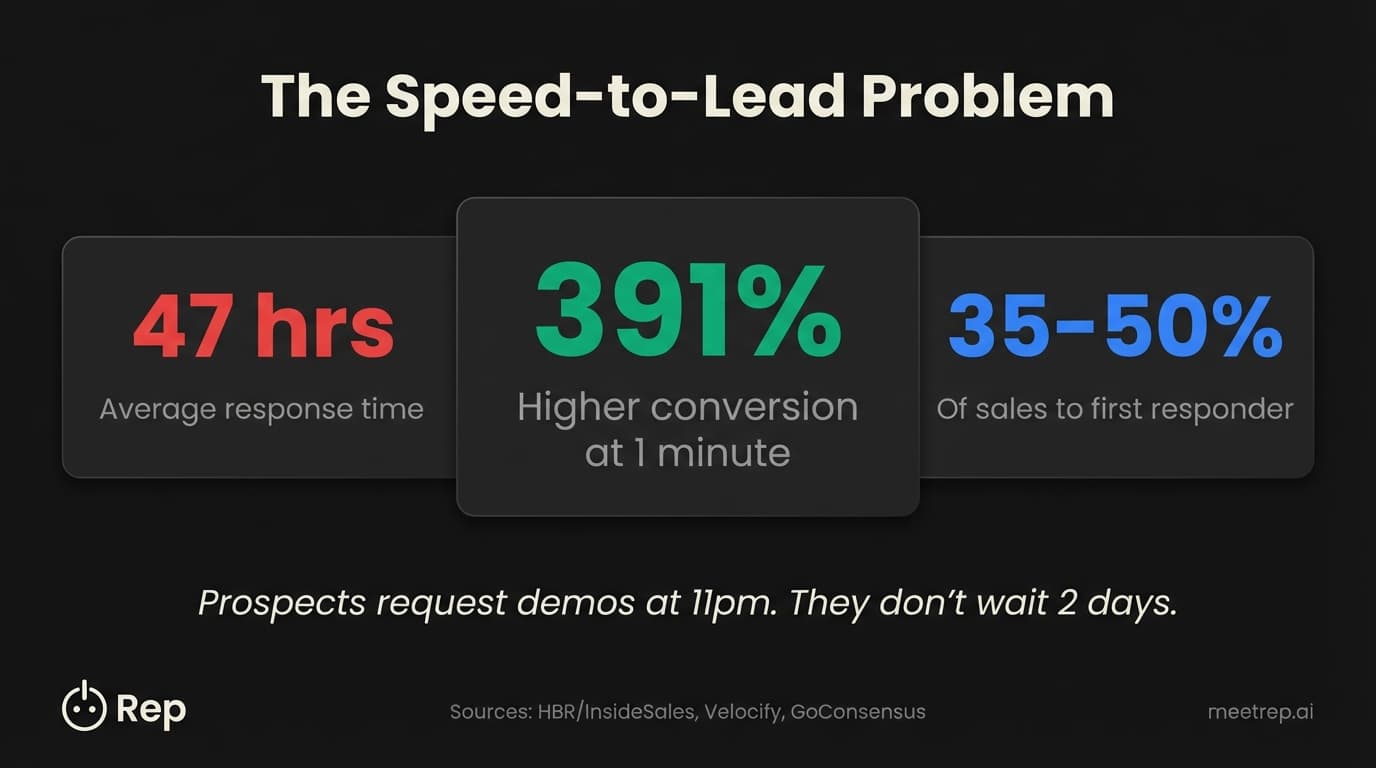
Why we built Rep this way: The 47-hour average lead response time (per HBR research) bothered me. Prospects request a demo at 11pm because that's when they're doing research. They don't want to wait two days for a calendar slot. They want to see the product while they're thinking about it.
The Speed-to-Lead Problem (And Why It Actually Matters)
This is where the ROI math gets interesting.
According to Velocify research, companies responding within one minute see 391% higher conversion rates than those responding later. And multiple studies show the first vendor to respond wins 35-50% of sales.
But most teams respond in... 47 hours. Two days. By then, the prospect has moved on, cooled off, or talked to a competitor.
Look, Supademo helps with the content side—prospects can explore your product tour at 11pm. But they can't get their specific questions answered until someone's back in the office.
Rep handles the conversation side. A prospect clicks your demo link at 11pm, Rep joins immediately, gives a live demo tailored to their interests, and captures their pain points for your AE to follow up in the morning. No waiting. No friction.
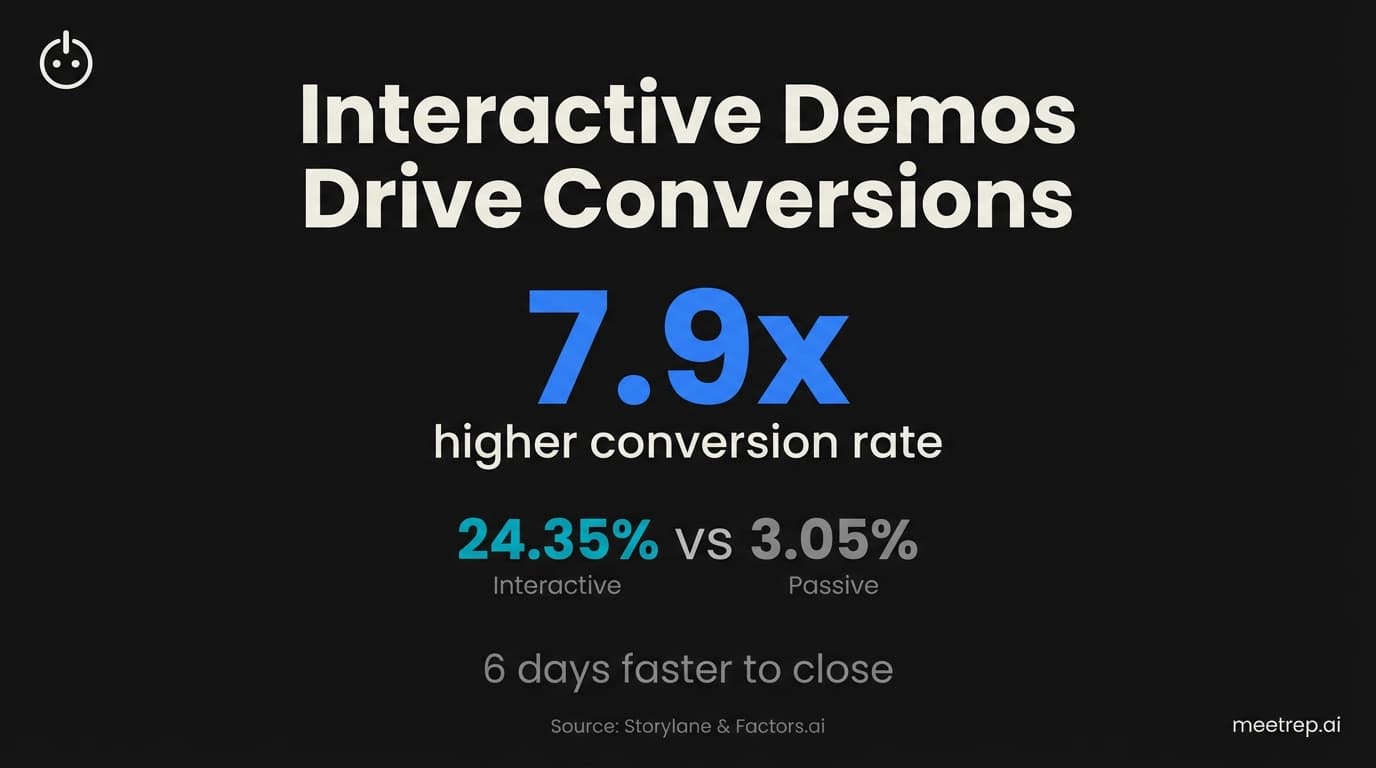
The Data:Storylane and Factors.ai research found that interactive demos convert at 24.35% versus 3.05% for passive content—a 7.9x improvement. And deals involving demos close in 27 days versus 33 days—6 days faster.
So the question becomes: do your prospects need passive exploration (Supademo), interactive conversation (Rep), or both at different stages?
How to Choose: A Practical Decision Framework
Let me give you the framework I'd use if I were evaluating this for my own sales team.
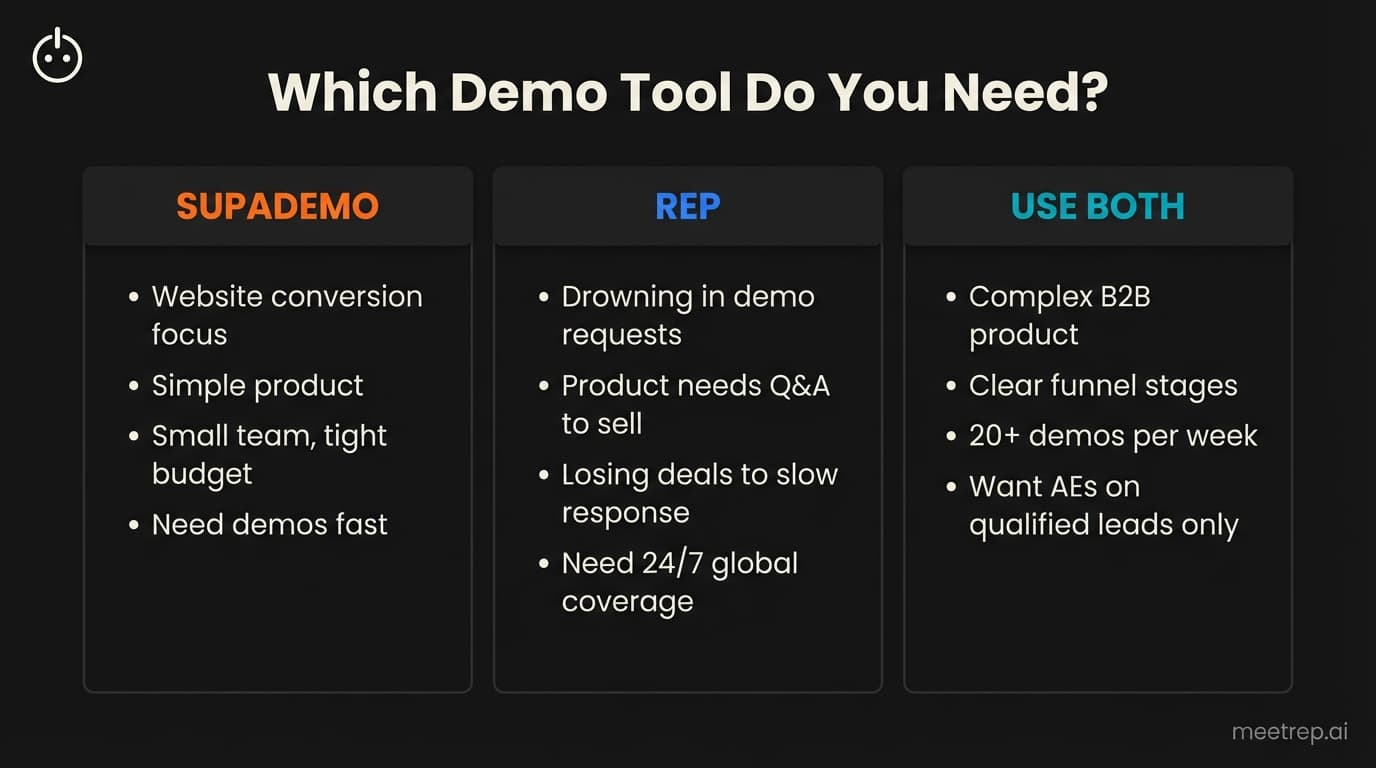
Choose Supademo if:
- Your primary goal is website conversion and product education
- You have a relatively simple product that "shows itself"
- Your team is small (under 10) and budget-conscious
- You need demos live fast—this week, not this month
- Most of your deals close without extensive Q&A
Choose Rep if:
- You're drowning in demo requests and SDRs are stretched thin
- Your product requires explanation and Q&A to sell
- You're losing deals to slow response times
- You want to qualify leads before they reach human AEs
- You need global coverage without hiring across time zones
Use both if:
- You have clear top-of-funnel (awareness) and bottom-of-funnel (qualification) needs
- Supademo handles your website tour and leave-behinds
- Rep handles the actual demo requests and initial calls
- Your human AEs only talk to pre-qualified, educated prospects
My recommendation: Most growing B2B teams with complex products should eventually run both. Supademo costs $27-350/month for marketing-stage content. Rep costs more but replaces SDR hours that run $60-80k/year fully loaded. The math works when you're running 20+ demos per week.
The demo tools category is projected to hit $500 million by 2025. And the underlying reason is simple: buyers have changed. They want to self-serve their research. They expect immediate answers. And they have zero patience for 47-hour response times.
My prediction: within two years, the winning sales teams will run both asynchronous demo content (Supademo or similar) and live AI agents (Rep or similar) as complementary systems. One for awareness. One for qualification. The tools that survive will be the ones that recognize they're not competing with each other—they're replacing different parts of a broken manual process.
If you're still early-stage and need something live this week, start with Supademo. If you're drowning in demo requests and want to see how live AI demos work, take a look at Rep. Either way, stop forcing your team to do work that tools can handle better.

Nadeem Azam
Founder
Software engineer & architect with 10+ years experience. Previously founded GoCustomer.ai.
Nadeem Azam is the Founder of Rep (meetrep.ai), building AI agents that give live product demos 24/7 for B2B sales teams. He writes about AI, sales automation, and the future of product demos.
Frequently Asked Questions
Table of Contents
- What's the Actual Difference Between Supademo and Rep?
- Supademo Pricing: What You're Actually Paying For
- Where Supademo Wins (And We're Not Just Saying That)
- When Supademo Hits Its Limits
- What Rep Does Differently
- The Speed-to-Lead Problem (And Why It Actually Matters)
- How to Choose: A Practical Decision Framework
Ready to automate your demos?
Join the Rep Council and be among the first to experience AI-powered demos.
Get Early AccessRelated Articles
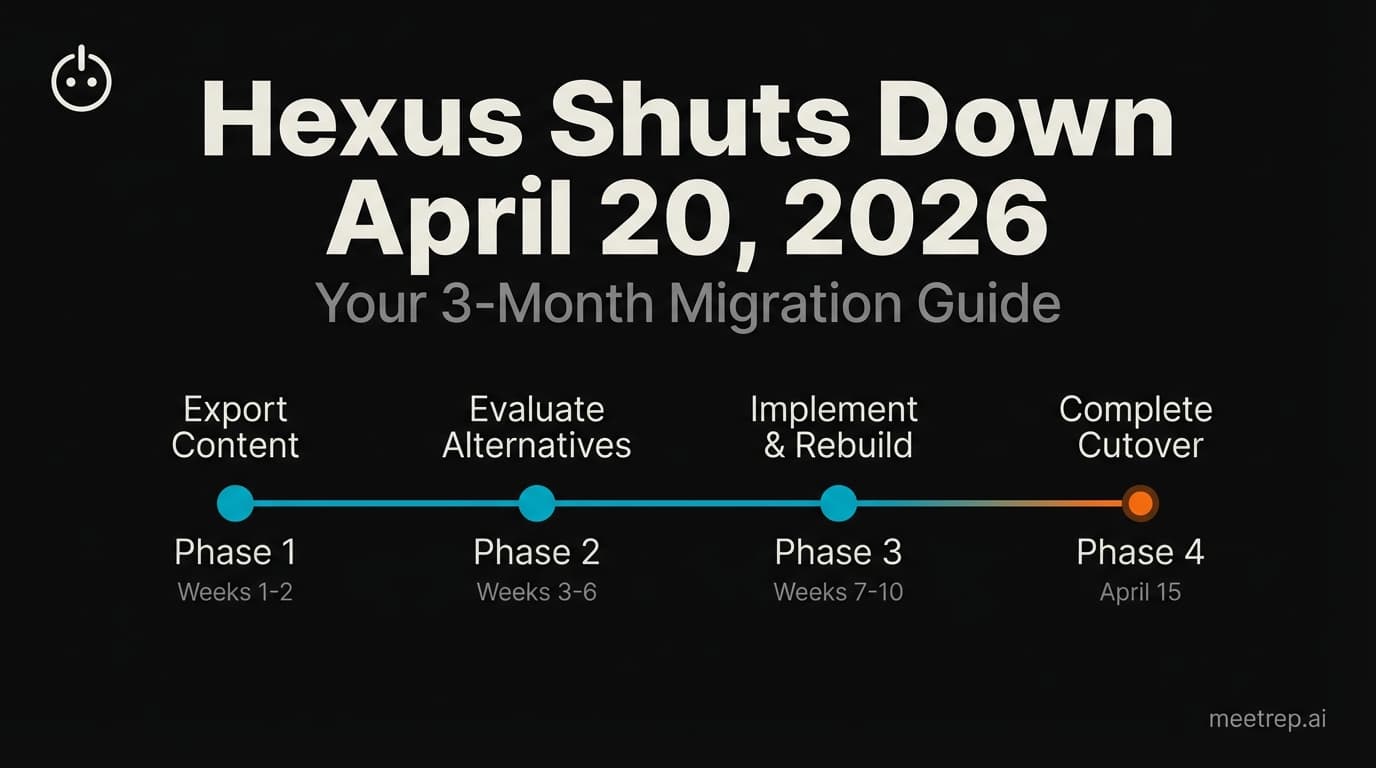
Hexus Acquired by Harvey AI: Congrats & What It Means for Demo Automation Teams
Hexus is shutting down following its acquisition by Harvey AI. Learn how to manage your migration and discover the best demo automation alternatives before April 2026.
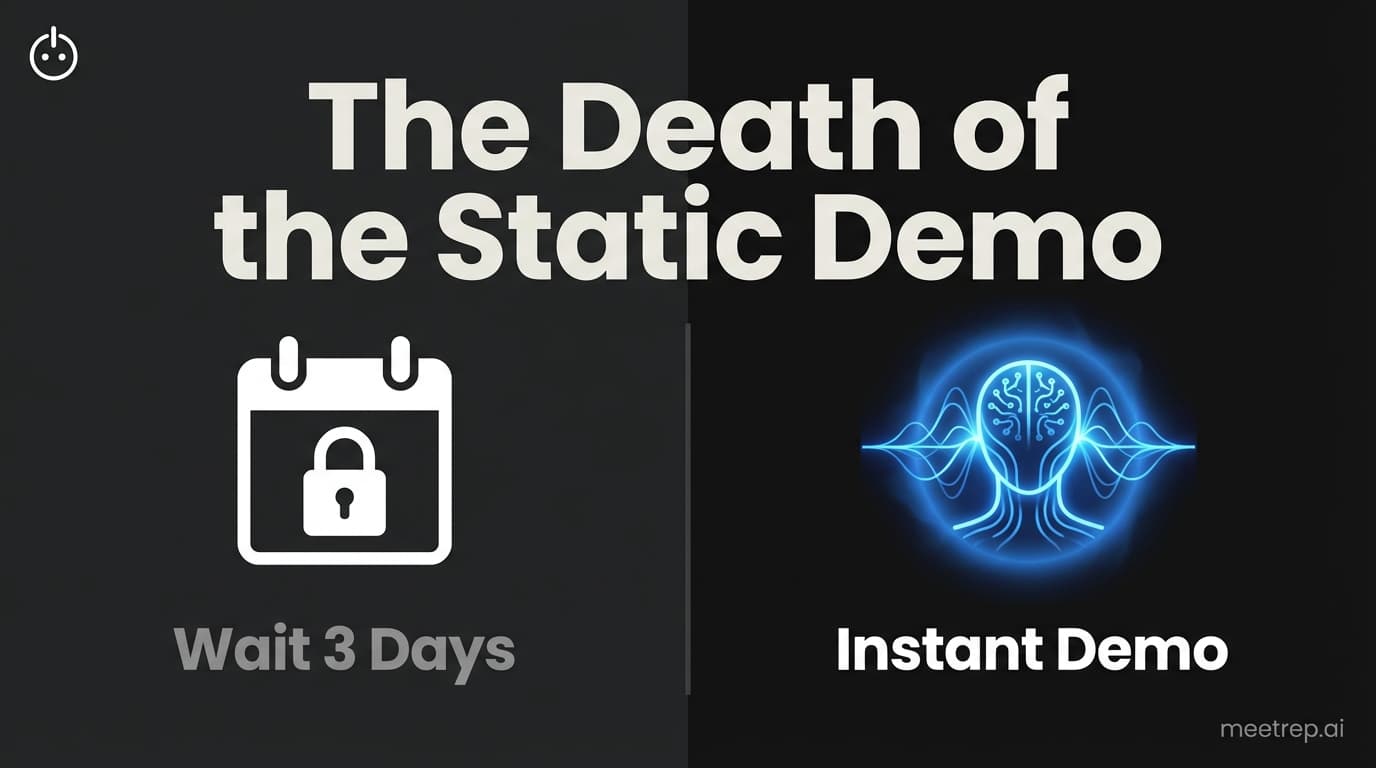
Why the "Software Demo" is Broken—and Why AI Agents Are the Future
The traditional software demo is dead. Discover why 94% of B2B buyers rank vendors before calling sales and how AI agents are replacing manual demos to scale revenue.
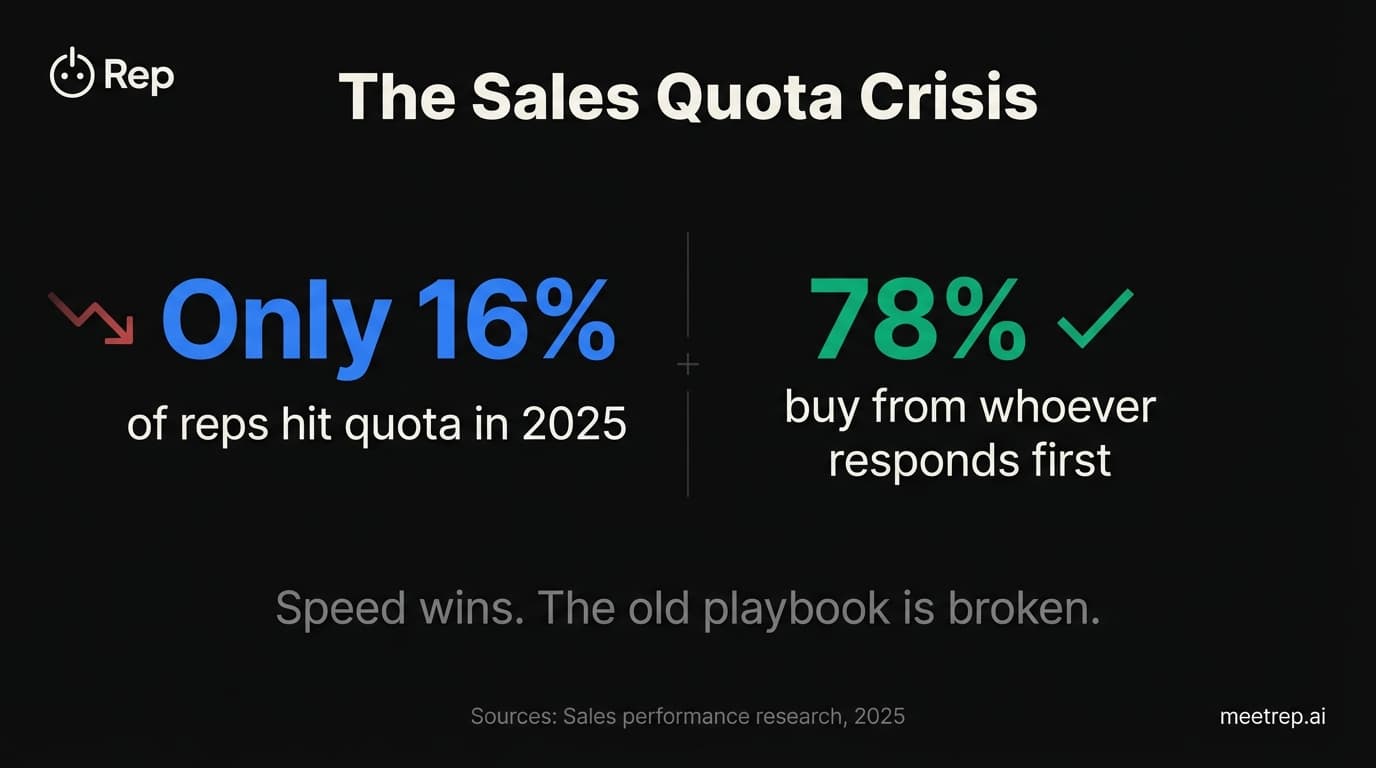
Why Autonomous Sales Software is the Future of B2B Sales (And Why the Old Playbook is Dead)
B2B sales is at a breaking point with quota attainment at 46%. Discover why autonomous 'Agentic AI' is the new standard for driving revenue and meeting the demand for rep-free buying.