Qualified Leads: Definition, Types, and How to Get More

Executive Summary
- A qualified lead meets specific criteria showing genuine purchase potential—not just someone who downloaded an ebook
- The average MQL-to-SQL conversion rate is just 13%. Top performers hit 35%+.
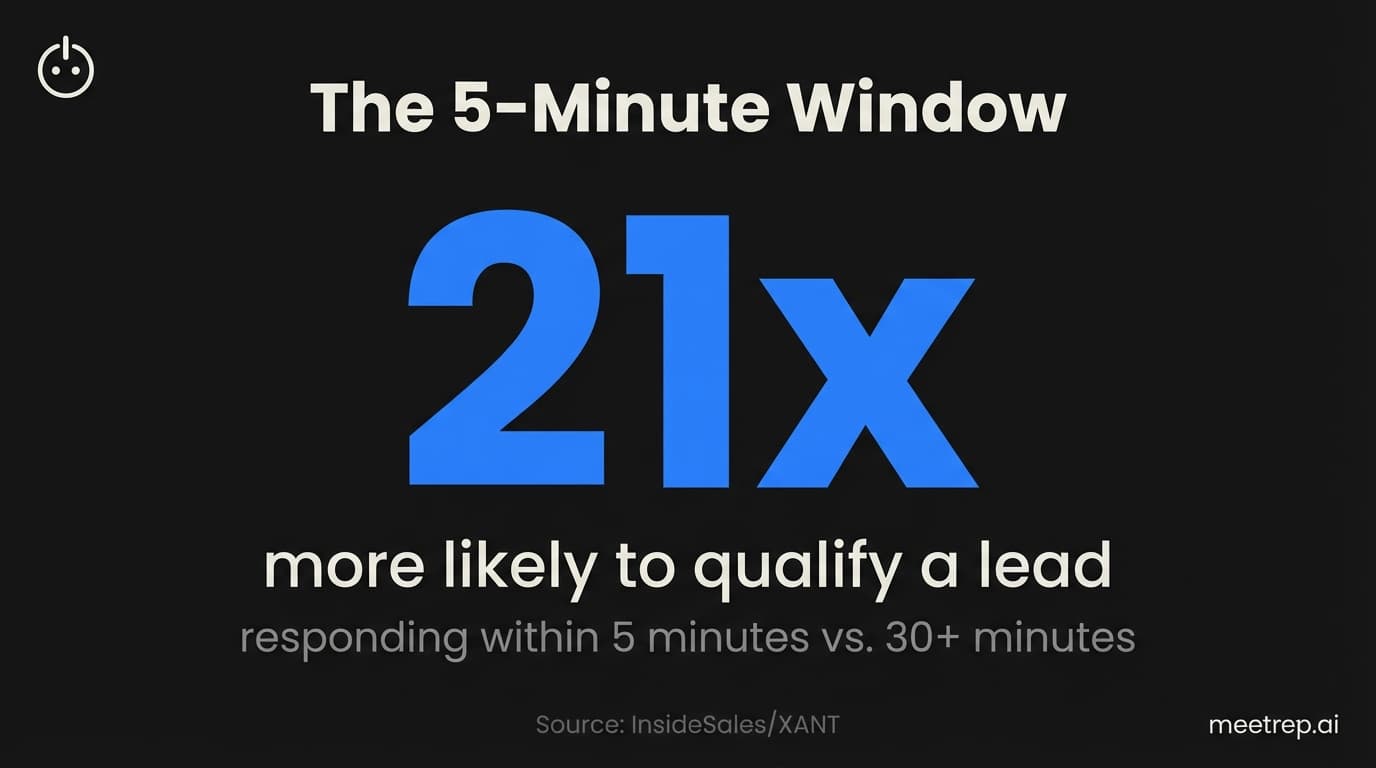
- Speed matters more than most teams realize: responding within 5 minutes makes you 21x more likely to qualify a lead
- BANT works for simple sales, MEDDIC for enterprise deals—pick the framework that matches your sales cycle
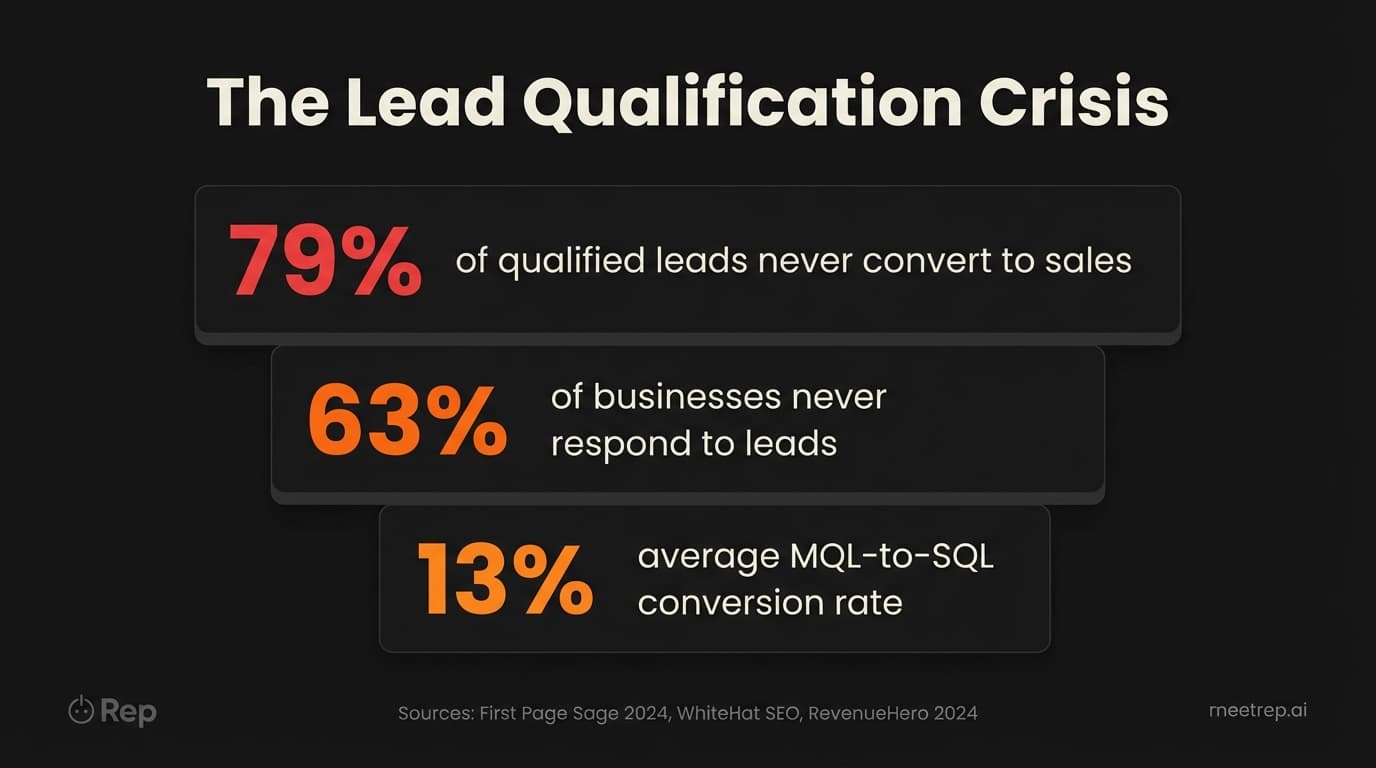
Here's an uncomfortable truth about qualified leads: 79% of them never convert into sales opportunities. That's not a typo. Nearly four out of five leads that marketing calls "qualified" go absolutely nowhere.
I've watched this play out at companies I've built. At GoCustomer.ai, we'd see customers drowning in "MQLs" while their sales teams complained about lead quality. The definition was broken. The handoff was broken. And everyone blamed everyone else.
This guide breaks down what qualified leads actually are, the real difference between MQL and SQL (it's more complex than most articles admit), and the frameworks that separate high-converting teams from everyone else. I'll share what's worked from building sales tools, plus the 2024-2025 data that should inform your strategy.
What Is a Qualified Lead?
A qualified lead is a prospect who has been evaluated against specific criteria and determined to have genuine potential to become a paying customer. This means more than "showed interest." It means they have the budget, authority, need, and timeline—or whatever criteria your business uses to define a real opportunity.
The key word is evaluated. An unqualified lead is anyone who lands in your system. A qualified lead has passed through some filter that says: this person is worth sales time.
And that filter matters enormously. Because without it, you're asking your sales team to sort through noise. According to Salesforce's 2024 State of Sales report, 70% of sales rep time gets consumed by non-selling tasks. Much of that time? Chasing leads that were never going to buy.
Key Insight: Qualification isn't about rejecting leads. It's about routing them correctly. A lead that isn't ready to buy might be perfect for nurturing. But they shouldn't hit an AE's calendar.
The problem is that "qualified" means different things to different teams. Marketing thinks anyone who attended a webinar is qualified. Sales thinks only hand-raisers requesting pricing count. This gap is where deals go to die.
MQL vs. SQL: What's the Real Difference?
Marketing Qualified Leads (MQLs) and Sales Qualified Leads (SQLs) represent different stages of evaluation—and confusing them causes most sales-marketing friction.
An MQL is a lead that marketing has identified as more likely to become a customer based on engagement signals: content downloads, webinar attendance, email clicks, website behavior. The lead hit some threshold that says "this person is interested."
An SQL is a lead that sales has personally vetted and confirmed as ready for direct sales conversation. They've typically had a discovery call. Someone verified that the prospect has budget, authority, timeline, and a real problem to solve.
Here's the critical difference: MQLs are inferred qualification based on behavior. SQLs are confirmed qualification based on conversation.
| Attribute | MQL (Marketing Qualified Lead) | SQL (Sales Qualified Lead) |
|---|---|---|
| Definition | Lead deemed more likely to buy based on engagement | Lead vetted by sales as ready for direct conversation |
| Funnel Stage | Middle of funnel | Bottom of funnel |
| Primary Owner | Marketing team | Sales team |
| Qualification Basis | Content downloads, webinar attendance, lead score | BANT criteria met, demo request, sales conversation |
| Intent Level | Interest demonstrated | Purchase intent demonstrated |
| Typical Actions | Downloads ebook, attends webinar, visits pricing page | Requests demo, asks pricing questions, takes discovery call |
| Industry Average | — | 13% of MQLs convert to SQL |
The Data: According to First Page Sage's 2024 analysis, the average MQL-to-SQL conversion rate across B2B industries is just 13%. That means 87% of the leads marketing calls "qualified" don't make it through sales evaluation.
That 13% number should stop you cold. If you're sending 100 MQLs to sales monthly and only 13 become real opportunities, something's wrong with either your definition, your targeting, or your handoff process. Probably all three.
The Lead Nobody Talks About: PQLs
Product Qualified Leads (PQLs) are reshaping how SaaS companies think about qualification. A PQL is someone who has used your product—through a free trial, freemium tier, or sandbox—and demonstrated buying signals through their actual behavior.
This is completely different from MQLs. Instead of inferring intent from content consumption, you're observing intent from product usage.
A user who signs up for a free trial, invites teammates, and uses your product daily for two weeks? That's a PQL. They've self-qualified through action.
For product-led growth companies, PQLs often convert at higher rates than traditional MQLs because the prospect has already experienced the product's value. But they require different infrastructure: in-app tracking, usage analytics, and triggers based on feature adoption rather than content engagement.
My recommendation: If you have a free trial or freemium model, track PQLs separately. Don't lump them in with your MQLs. They're a different animal—usually a much better one.
The Lead Qualification Process: Step by Step
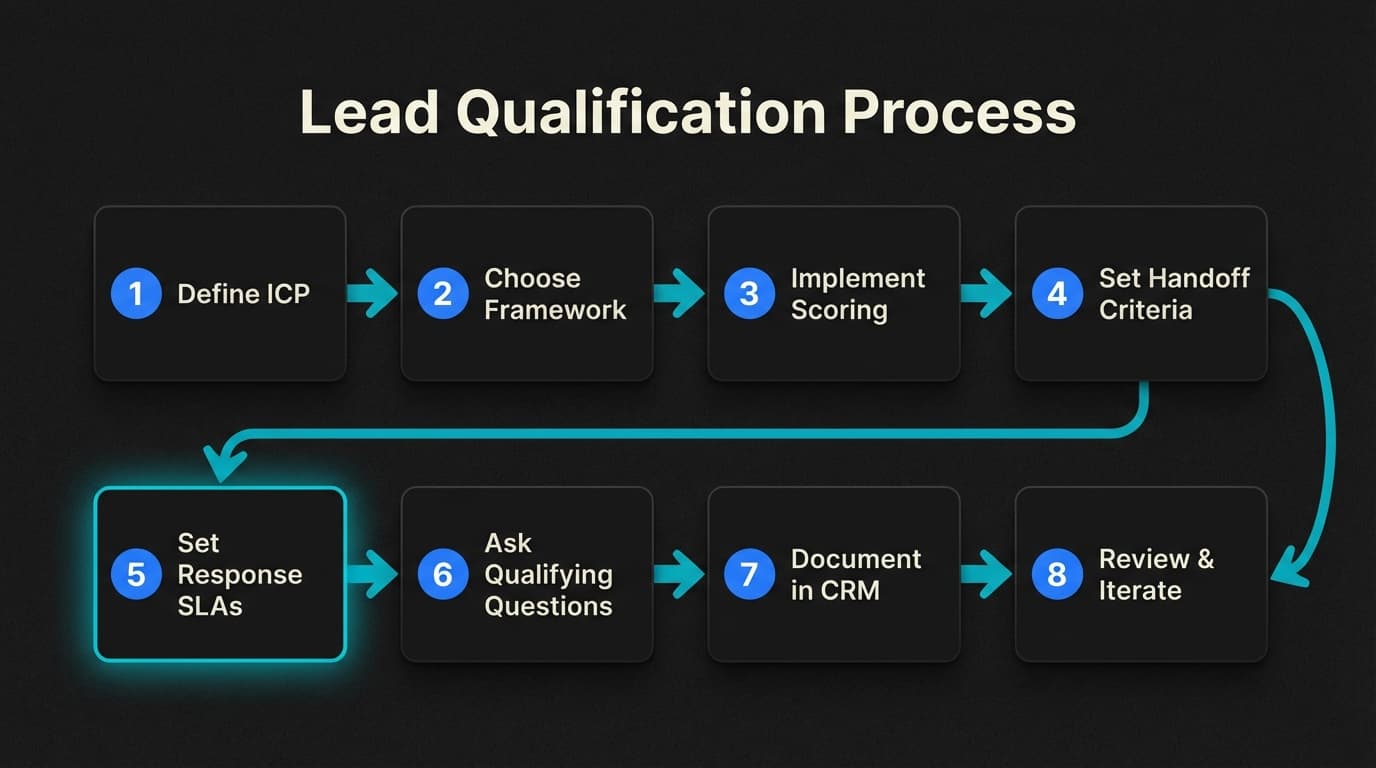
Here's a practical framework for qualifying leads, from first touch to sales handoff. This process works whether you're using BANT, MEDDIC, or any other framework—it's the operational layer underneath.
- Define your Ideal Customer Profile (ICP) Start with who you're actually trying to reach. Firmographics (company size, industry, revenue), demographics (role, seniority), and behavioral patterns (tech stack, buying signals). Be specific. "Mid-market companies" isn't an ICP.
- Choose a qualification framework Pick BANT for simple sales cycles, MEDDIC for enterprise deals with multiple stakeholders, CHAMP for consultative selling. More on these frameworks in the next section.
- Implement lead scoring Assign points to engagement behaviors (email opens, content downloads, page visits) and fit criteria (matches ICP, company size, role). Set thresholds for MQL status.
- Establish MQL-to-SQL handoff criteria Document exactly what makes a lead ready for sales. Get marketing and sales to sign off. This is where most teams fail—vague definitions create constant friction.
- Set response time SLAs This is critical. According to research from InsideSales/XANT cited by Chili Piper, responding within 5 minutes makes you 21x more likely to qualify a lead than waiting 30+ minutes. Twenty-one times.
- Ask qualifying questions Budget, Authority, Need, Timeline at minimum. For complex deals, add Pain, Champion, Decision Process. I'll cover specific frameworks below.
- Document everything in your CRM Track qualification status, disqualification reasons, and conversion data. This creates the feedback loop you need to improve.
- Review and iterate Analyze conversion rates monthly. If your MQL-to-SQL rate is below 20%, tighten your criteria. If it's above 40%, you might be leaving leads on the table.
Common mistake: Teams build elaborate scoring models but ignore speed-to-lead. According to RevenueHero's 2024 study, 63% of businesses don't respond to inbound leads at all. Let that sink in. No response. If you fix nothing else, fix your response time.
Lead Qualification Frameworks: BANT vs. MEDDIC vs. CHAMP
Not all frameworks work for all sales. Picking the wrong one is like using a sledgehammer for finish carpentry—technically it hits things, but you're making a mess.
| Framework | Key Criteria | Best For | Limitations |
|---|---|---|---|
| BANT | Budget, Authority, Need, Timeline | Simple sales cycles, SMB, high-volume qualification | Seller-centric; may disqualify promising leads too early |
| MEDDIC | Metrics, Economic Buyer, Decision Criteria/Process, Identify Pain, Champion | Complex enterprise deals, 6+ month cycles, high ACV | Time-consuming; requires significant training |
| CHAMP | Challenges, Authority, Money, Prioritization | Consultative selling, relationship-driven, custom solutions | Less structured; more time per lead |
| GPCTBA/C&I | Goals, Plans, Challenges, Timeline, Budget, Authority, Consequences & Implications | Inbound sales, value-based selling | Very complex; long discovery calls |
BANT: The Classic
BANT—Budget, Authority, Need, Timeline—has been around since IBM popularized it in the 1960s. It's still useful for straightforward sales.
When to use it: Short sales cycles, clear pricing, single decision-maker. Think: SMB SaaS with self-serve pricing.
The problem: BANT is seller-centric. It asks "can this person buy from us right now?" instead of "does this person have a problem we can solve?" That can disqualify great prospects who are early in their buying process.
MEDDIC: Enterprise-Grade
MEDDIC was built for complex B2B sales. It forces you to understand the entire buying process, not just the person in front of you.
When to use it: Enterprise deals with multiple stakeholders, long sales cycles, high contract values. If your average deal takes 6+ months and involves a procurement team, this is your framework.
The hard part: MEDDIC takes time. You need to identify a Champion (internal advocate), understand the Decision Process (how they actually buy), and quantify Metrics (the business case). This isn't a 15-minute discovery call.
CHAMP: Challenger-Friendly
CHAMP flips BANT on its head. Instead of leading with Budget, you lead with Challenges. The assumption: if the pain is big enough, budget finds a way.
When to use it: Consultative sales, custom solutions, relationship-driven deals. CHAMP works well when you're selling outcomes, not features.
What we learned at GoCustomer: We found that BANT disqualified too many early-stage prospects who eventually became great customers. They didn't have "budget" yet because they hadn't identified the problem clearly. Switching to a challenge-first approach changed our conversion math completely.
How to Build a Lead Scoring System That Sales Actually Trusts
Lead scoring sounds simple. Assign points, set thresholds, route leads. In practice, it's where sales-marketing trust goes to die.
The problem isn't the concept. It's that most scoring models inflate over time. A lead attends three webinars and downloads five ebooks? They're technically "engaged." But are they ready to buy? Often, no.
Here's how to build a scoring system that holds up:
Separate Fit Score from Engagement Score
Fit scoring asks: Is this the right type of lead? Does their company match our ICP? Is their role one that typically buys?
Engagement scoring asks: Is this lead active? Are they consuming content? Are they showing intent signals?
A lead with high fit and low engagement might just need nurturing. A lead with high engagement and low fit is probably never going to close—they might just like your content.
Route based on the combination:
| Fit | Engagement | Action |
|---|---|---|
| High | High | Fast-track to sales |
| High | Low | Marketing nurture |
| Low | High | Monitor or disqualify |
| Low | Low | Deprioritize |
Decay Scores Over Time
Here's a mistake I see constantly: scores only go up. A lead who was active six months ago still carries those points even though they've gone cold.
Build in decay. If a lead doesn't engage for 30 days, subtract points. If they don't engage for 90 days, subtract more. This keeps your MQL pool fresh.
Create Feedback Loops
The single biggest predictor of scoring system success? Whether sales gives feedback on lead quality.
Set up a simple process: sales marks whether each MQL was "good" or "bad" after their first conversation. Roll that data up monthly. If 60% of leads from a specific campaign are marked "bad," adjust scoring for that campaign.
The Data: According to HubSpot's 2025 State of Sales Report, 68% of sales teams report improved lead quality year over year. The teams seeing improvement have one thing in common: closed-loop feedback between sales and marketing.
Speed-to-Lead: The Qualification Factor Nobody Optimizes
I've buried the most important point halfway through this article. That's intentional—most qualification content buries it, too. But speed-to-lead might matter more than your scoring model, your frameworks, or your definitions.
The data is stark. Responding within 5 minutes makes you 21x more likely to qualify a lead than waiting 30+ minutes. And according to research cited by Convoso, calling within one minute delivers a 391% conversion boost. One minute.
Yet most companies are slow. Painfully slow.
The RevenueHero 2024 study found that 63% of businesses don't respond to inbound leads at all. Zero contact. The lead fills out a form, and nobody reaches out.
Think about what that means. You're spending money on ads, content, and campaigns to generate leads, then letting them sit in a queue until they've moved on.
Key Insight: Before you rebuild your scoring model or debate MQL definitions, check your average response time. If it's over 5 minutes for high-intent leads, that's your biggest problem.
This is partly why we built Rep the way we did. The idea of an AI that can engage prospects immediately—handling that first demo conversation while human reps sleep or focus on closing—came directly from watching how much opportunity leaks through slow response times.
Real Results: Companies That Got Qualification Right
Theory is useful. Results are better. Here are three companies that overhauled their lead qualification process and saw measurable impact.
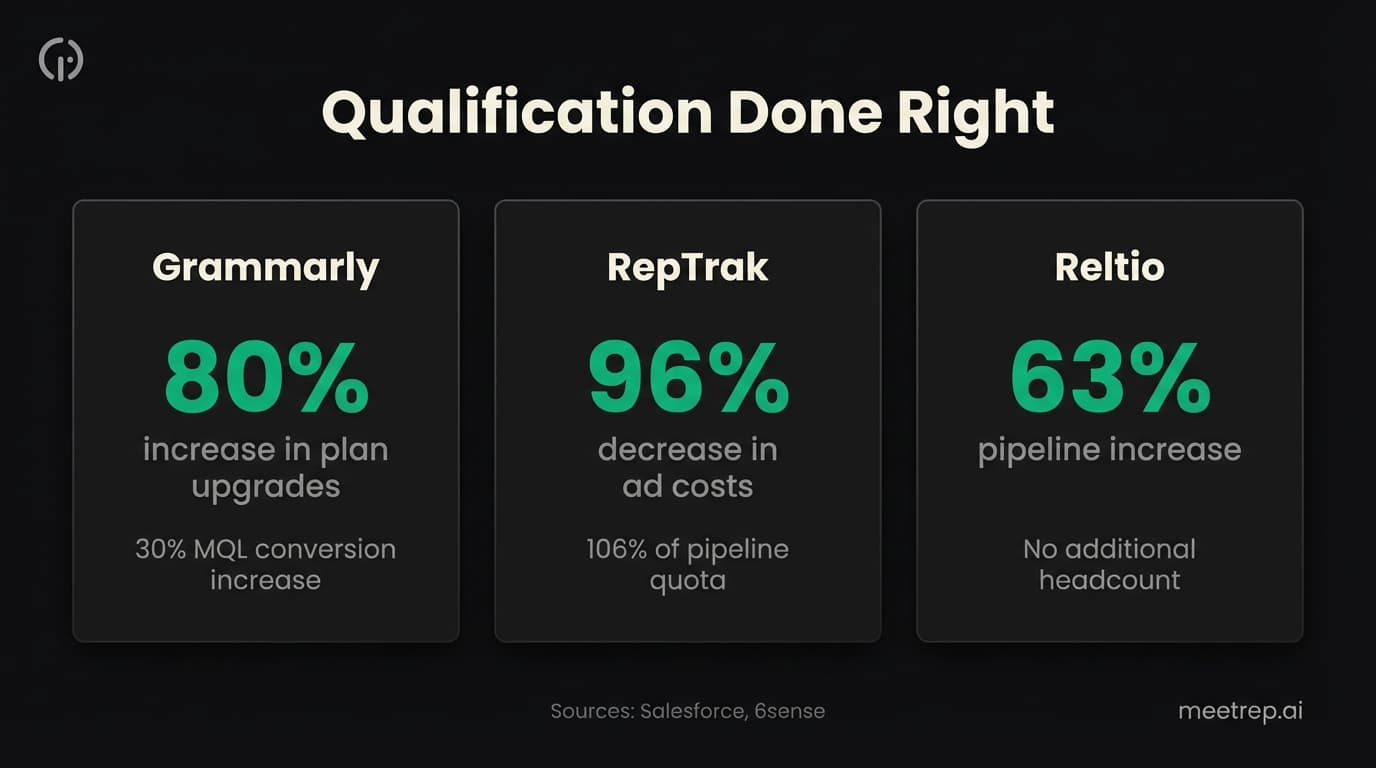
Grammarly: 80% Increase in Plan Upgrades
Grammarly was dealing with a familiar problem: marketing spent hours manually building email lists, sending roughly 400 MQLs monthly—many of which included spam bots and accounts that would never convert.
They implemented AI-powered lead scoring with Salesforce Einstein. The results:
- 80% increase in plan upgrades
- 30% increase in MQL conversion rates
- Sales cycle reduced from 60-90 days to 30 days
- 8% increase in sales-accepted leads
The key wasn't just better technology. It was that marketing and sales finally agreed on what "qualified" meant. As their Senior Marketing Operations Manager put it: "We've increased our conversion rates between marketing and sales leads, and it's really built trust between the two teams."
RepTrak: 96% Decrease in Ad Costs
RepTrak, a reputation data company, had the opposite problem. Their CEO and board described marketing as "dark magic" with unclear ROI. Marketing was treating anyone with engagement as an MQL—no real qualification criteria.
They implemented 6sense for intent data and account-based marketing. The shift was dramatic:
- 96% decrease in ad costs
- 106% of pipeline quota goal
- 64% increase in contract value
- 22-day reduction in sales cycle (from 112 days to 90)
The insight from their VP of Global Marketing: "We tried to move the market to us instead of meeting the market where it is, and that never works." They started qualifying based on where accounts actually were in their buying process, not just who clicked what.
Reltio: 63% Pipeline Increase Without Adding Headcount
Reltio faced a common growth challenge: they needed to increase pipeline targets without hiring more BDRs. They had a backlog of "aged leads"—webinar attendees, event contacts, old inquiries—that nobody had bandwidth to follow up on.
They implemented AI-powered email for automated follow-up on these aged leads:
- 63% increase in overall pipeline production
- 6,000+ AI conversations conducted
- 28% email open rate for AI-generated emails
- BDR team size stayed flat while output grew
The Head of Global Business Development's framing stuck with me: "It's not you versus AI email writer. It's you and the AI. It's a collaborative approach." Qualification doesn't have to be a human-only job.
Common Lead Qualification Mistakes (And How to Avoid Them)
After building tools in this space and watching customers struggle, here are the mistakes I see most often:
1. Treating All MQLs Equally
A lead who requested a demo is not the same as a lead who downloaded a whitepaper. But many teams route both to sales the same way. Build tiers into your qualification: hot (demo request, pricing page), warm (multiple content touches), and cold (single download).
2. Ignoring Response Time
I've beaten this drum enough. But seriously: check your response time. If it's over 5 minutes for high-intent leads, fixing that will improve conversion more than any other change you make.
3. No Feedback Loop Between Sales and Marketing
If sales thinks lead quality is bad but marketing has no mechanism to hear that feedback, nothing improves. Set up a simple weekly review: which leads converted? Which didn't? Why?
4. Over-Engineering Scoring Models
I've seen companies with 47 different scoring criteria. Nobody understands how the model works, leads with random high scores flood sales, and trust collapses. Start simple: 5-10 criteria, clear weights, and iterate from there.
5. Skipping the Disqualification Process
Good qualification includes saying no. If a lead doesn't fit—wrong industry, too small, no budget authority—disqualify them explicitly. Don't let them clog your pipeline.
The Sales-Marketing Handoff: Getting Alignment Right
The MQL-to-SQL handoff is where most qualification systems break down. And the root cause is usually perception gaps.
According to Forrester's Q2 2024 research, 65% of sales and marketing professionals believe there's a lack of alignment between their teams. But 82% of C-suite executives claim alignment exists.
That 17-point gap explains a lot. Leadership thinks everything's fine while practitioners deal with constant friction.
Here's how to fix the handoff:
1. Write down your definitions. What exactly makes an MQL? What criteria must be met for SQL status? Document it. Make both teams sign off.
2. Set SLAs. Sales commits to following up on MQLs within X hours. Marketing commits to certain lead volumes and quality thresholds. Make it measurable.
3. Meet weekly. Not monthly. Weekly. Review what's working, what's not, and adjust in real-time.
4. Share the same dashboard. If marketing looks at one set of metrics and sales looks at another, alignment is impossible. Build a single source of truth.
The Data: Teams with integrated GTM tech stacks are 42% more productive than those without, according to Highspot's 2025 State of Sales Enablement Report. Integration isn't just a nice-to-have—it's a productivity multiplier.
Tools and Technology for Lead Qualification in 2025
The tools available have shifted dramatically. AI isn't just hype anymore—it's producing real results. According to Salesforce's 2024 report, 83% of AI-enabled sales teams grew revenue, compared to just 66% of teams without AI.
Here's what's working:
CRM with native scoring: Salesforce Einstein, HubSpot's AI tools. These integrate scoring directly into your existing workflow—no separate system to manage.
Intent data platforms: 6sense, Demandbase, ZoomInfo. These tell you which accounts are researching solutions like yours, even before they fill out a form. Intent data transforms qualification from reactive to proactive.
Conversation intelligence:Gong, Chorus. These analyze sales calls and identify what actually qualifies leads—which questions work, which objections signal real interest, which calls go nowhere.
Demo automation: Tools like Rep handle the first demo conversation automatically, qualifying prospects based on real engagement rather than just form fills. When a prospect can get an immediate live demo, you see their actual interest—not just their willingness to click buttons.
The through-line across all of these: reducing the gap between lead activity and human judgment. The faster you can assess real intent, the better your qualification.
Here's what I keep coming back to: lead qualification isn't complicated in theory. You define who you're looking for, you filter for those people, and you respond quickly. But the gap between theory and execution is where revenue dies.
The companies winning at qualification in 2025 share a few traits. They've aligned on definitions. They respond fast. They feed data back from sales to marketing constantly. And increasingly, they're using AI to handle the repetitive parts—scoring, routing, even that first demo conversation—so human reps focus on deals that actually close.
If you're struggling with lead quality, start with the basics. Check your response time. Write down your MQL definition and see if sales agrees. Build one feedback loop. The frameworks and technology matter, but they're multipliers on a foundation. Get the foundation right first.
Want to see how AI-powered demos can qualify leads automatically? Check out Rep for live demo automation that engages prospects instantly—no waiting, no scheduling friction.

Nadeem Azam
Founder
Software engineer & architect with 10+ years experience. Previously founded GoCustomer.ai.
Nadeem Azam is the Founder of Rep (meetrep.ai), building AI agents that give live product demos 24/7 for B2B sales teams. He writes about AI, sales automation, and the future of product demos.
Frequently Asked Questions
Table of Contents
- What Is a Qualified Lead?
- MQL vs. SQL: What's the Real Difference?
- The Lead Nobody Talks About: PQLs
- The Lead Qualification Process: Step by Step
- Lead Qualification Frameworks: BANT vs. MEDDIC vs. CHAMP
- How to Build a Lead Scoring System That Sales Actually Trusts
- Speed-to-Lead: The Qualification Factor Nobody Optimizes
- Real Results: Companies That Got Qualification Right
- Common Lead Qualification Mistakes (And How to Avoid Them)
- The Sales-Marketing Handoff: Getting Alignment Right
- Tools and Technology for Lead Qualification in 2025
Ready to automate your demos?
Join the Rep Council and be among the first to experience AI-powered demos.
Get Early AccessRelated Articles
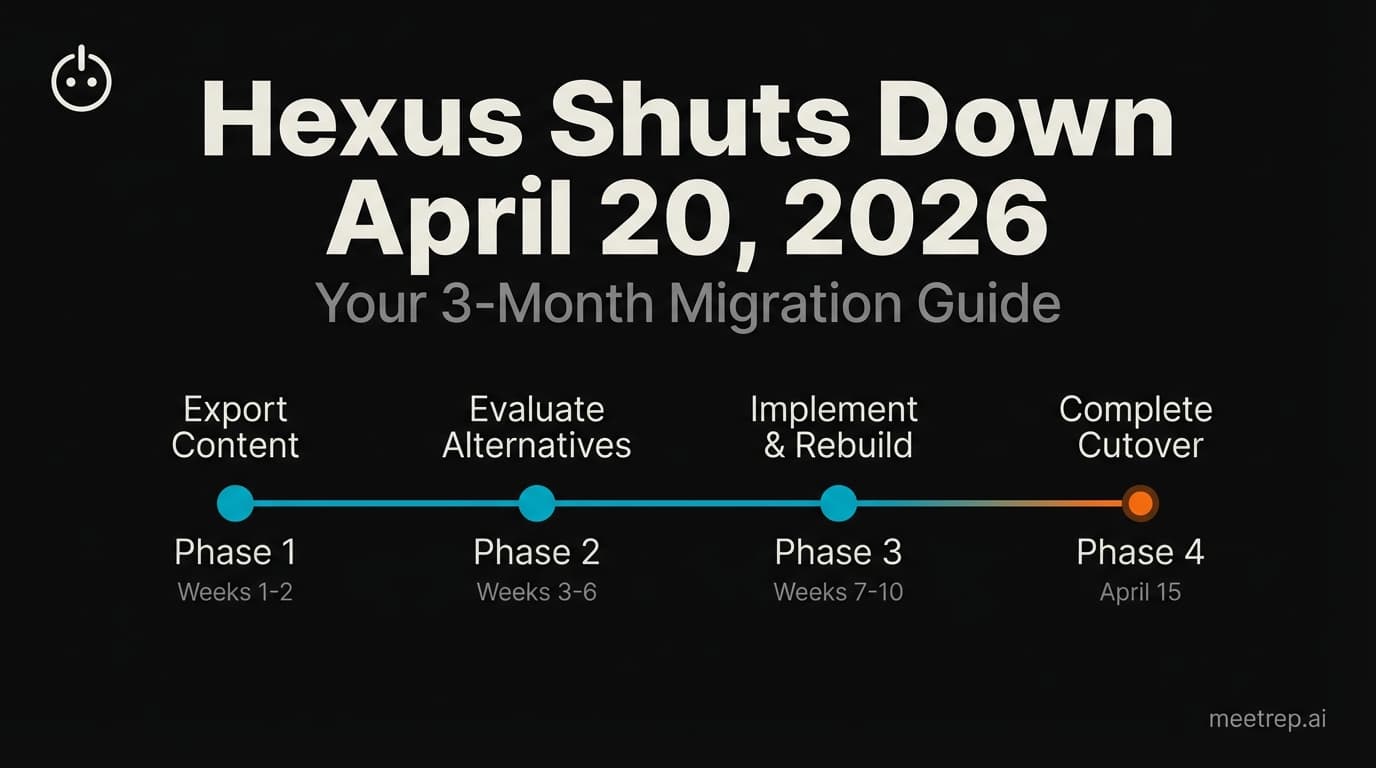
Hexus Acquired by Harvey AI: Congrats & What It Means for Demo Automation Teams
Hexus is shutting down following its acquisition by Harvey AI. Learn how to manage your migration and discover the best demo automation alternatives before April 2026.
Why the "Software Demo" is Broken—and Why AI Agents Are the Future
The traditional software demo is dead. Discover why 94% of B2B buyers rank vendors before calling sales and how AI agents are replacing manual demos to scale revenue.
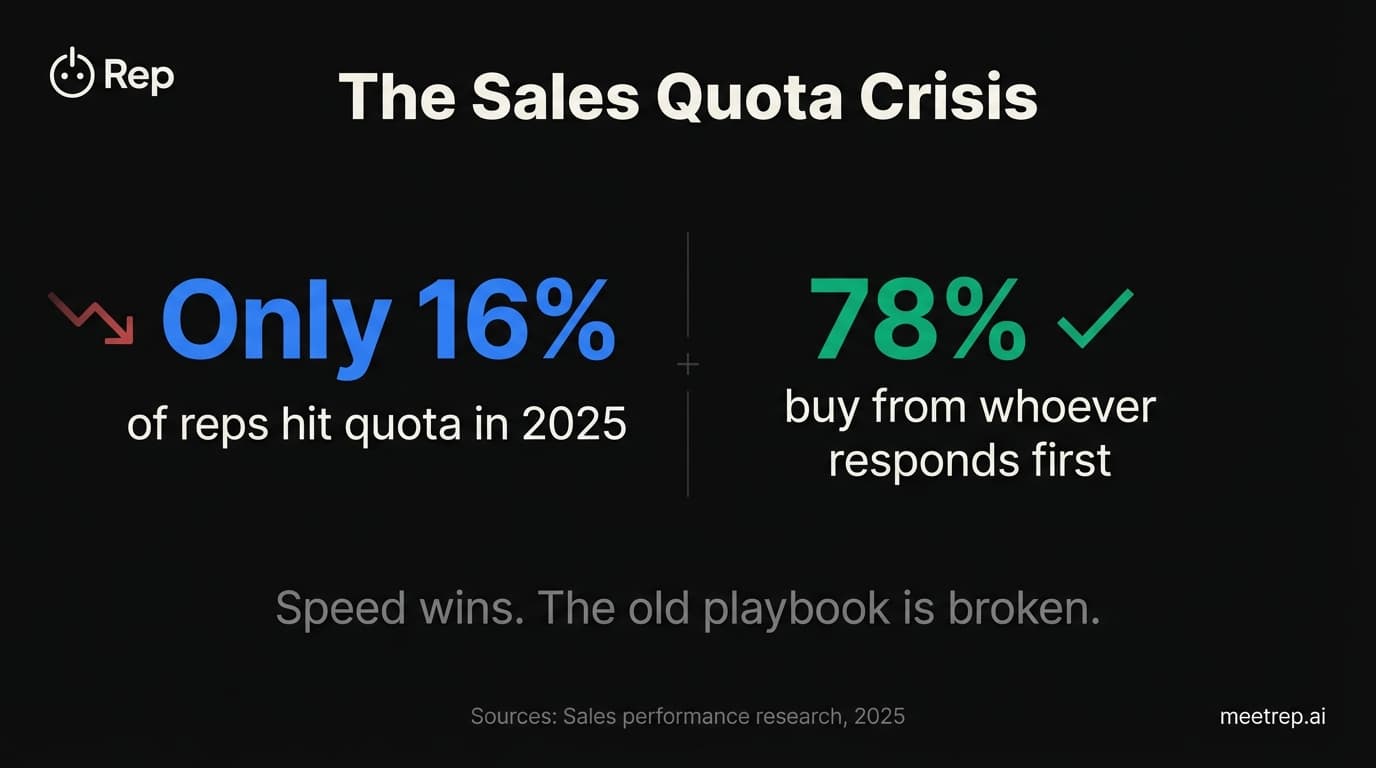
Why Autonomous Sales Software is the Future of B2B Sales (And Why the Old Playbook is Dead)
B2B sales is at a breaking point with quota attainment at 46%. Discover why autonomous 'Agentic AI' is the new standard for driving revenue and meeting the demand for rep-free buying.