Probing Questions: 50+ Examples and Techniques for Sales

Executive Summary
- Probing questions are open-ended inquiries that uncover needs, challenges, and decision criteria
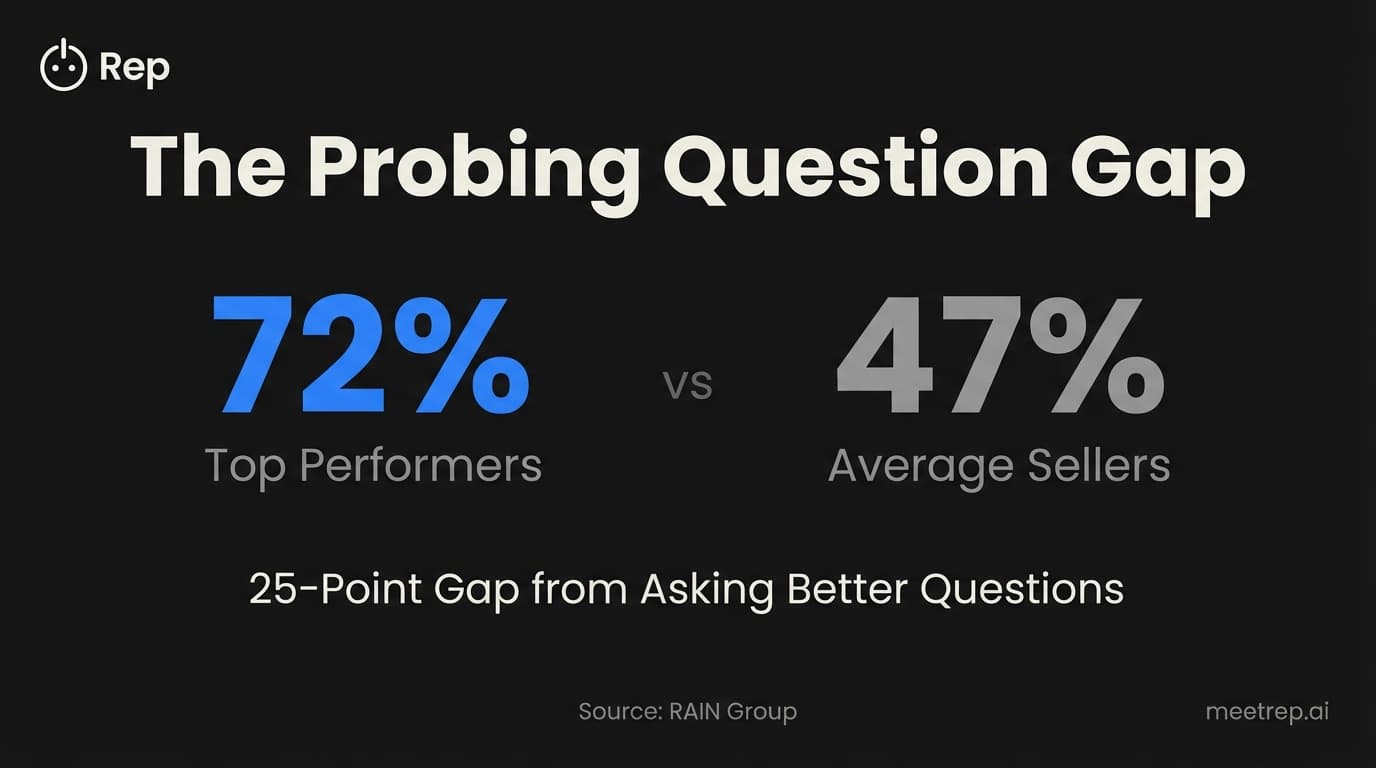
- Top performers ask 39% more questions and achieve 72% win rates vs 47% for average sellers (RAIN Group)
- The sweet spot is 11-14 questions per call, uncovering 3-4 business problems (Gong Labs)
- The skill isn't asking one perfect question—it's layering 2-3 follow-ups to reach root causes
Most advice about probing questions is garbage.
You've read it before: "Ask open-ended questions." "Don't interrogate." "Uncover the pain." Thanks. Super helpful. And yet 84% of sales reps missed quota last year. The problem isn't that reps don't know they should ask questions. It's that they don't know which questions move deals forward—or how to follow up when the prospect gives a surface-level answer.
I've spent years building sales automation products. First GoCustomer.ai, now Rep. Here's what we learned: the magic isn't in any single question. It's in the follow-up layers.
What are probing questions and why do they matter?
Probing questions are open-ended inquiries designed to uncover detailed information about a prospect's needs, challenges, and decision-making process. Unlike closed questions that yield yes/no answers, probing questions encourage deeper thought and reveal root causes behind surface-level responses. Think "What challenges does this create for your team?" instead of "Is this a challenge?"
But here's what everyone misses: asking probing questions isn't the skill. Anyone can read a question off a list. The skill is knowing when to probe deeper versus when to move on.
The Data: Top performers are 47% more likely to ask the right questions and achieve 72% win rates compared to 47% for average sellers. That's a 25-point gap. From questions.
Only 27% of revenue leaders say they're confident their teams understand customer needs. There's a massive disconnect between knowing you should ask questions and knowing how to ask them well.
The data behind effective discovery calls
Gong Labs analyzed millions of sales calls and found clear patterns:
| Metric | What Works | Why It Matters |
|---|---|---|
| Question count | 11-14 per call | Fewer = missed problems; more = interrogation |
| Problems uncovered | 3-4 business problems | Deals stall without multiple pain points |
| Call length | 76% longer for top performers | They let prospects talk |
The "talk less" advice you've heard? It's real. Top performers' discovery calls are 76% longer not because they're rambling—but because they're asking better questions and actually listening.
Six types of probing questions (with examples)
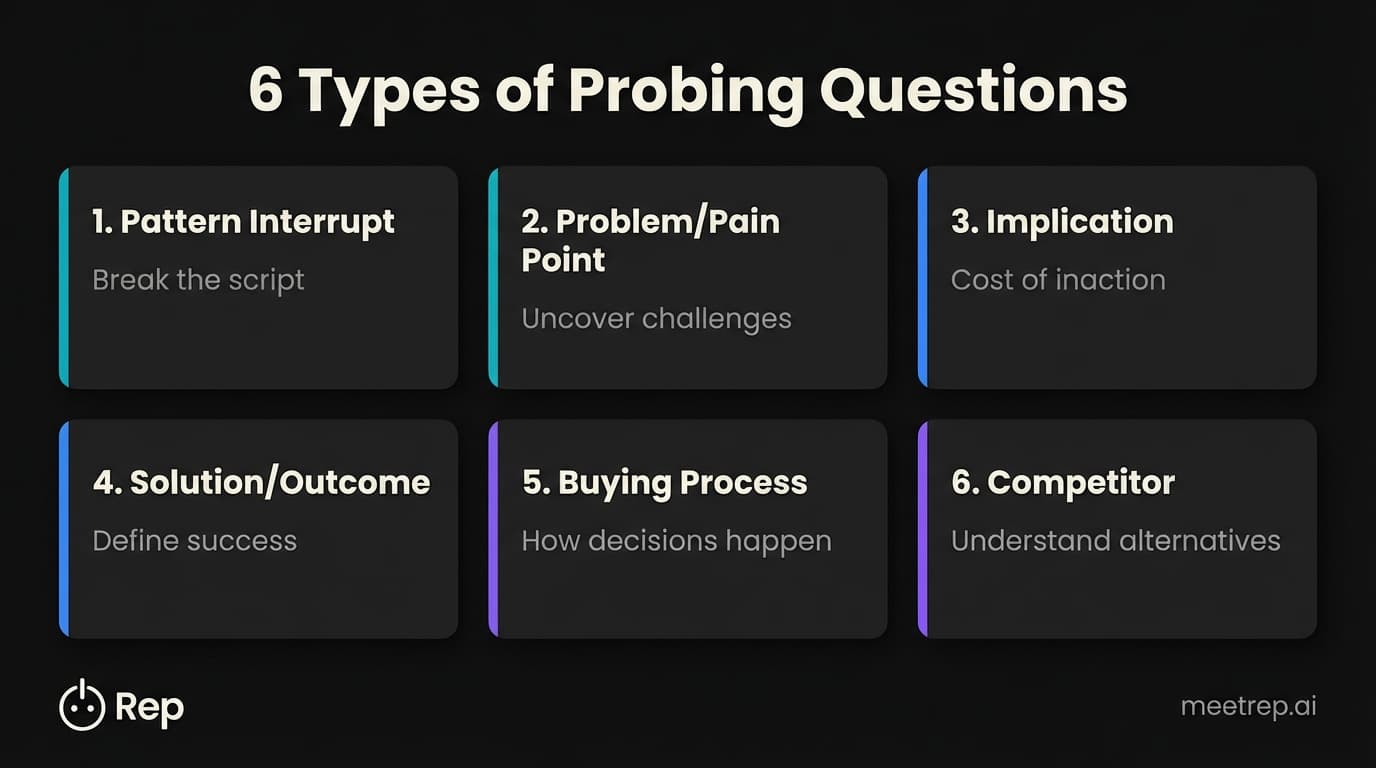
1. Pattern interrupt questions
These break the prospect's automatic "another sales call" script.
The Data: Using "How've you been?" as an opener is 6.6x more successful in booking meetings than standard openings.
Examples:
- "I have to level with you—is this actually a priority right now?"
- "Before I waste your time, can I ask you something?"
- "How've you been?" (Yes, really. The data backs it up.)
2. Problem/pain point questions
The core of discovery. But don't just ask "what's your biggest challenge?" That's lazy.
Better examples:
- "Walk me through your current process for [specific task]."
- "What happens when that process breaks down?"
- "If nothing changes, what does Q3 look like?"
3. Implication questions (SPIN-style)
These create urgency by exploring the cost of inaction.
Examples:
- "If this isn't resolved by [date], how does that affect [metric]?"
- "What's the downstream impact on your customers?"
- "Who else feels the pain when this happens?"
4. Solution/outcome questions
Understand what good looks like. Don't assume.
Examples:
- "If you could wave a magic wand, what would the ideal solution look like?"
- "What does success look like for this initiative—for you personally?"
5. Buying process questions
You can have a champion who loves you. Doesn't matter if you don't understand how decisions get made.
Examples:
- "Who else needs to weigh in before you can move forward?"
- "Walk me through how your company made the last purchase like this."
- "What would kill this deal?"
6. Competitor questions
Here's a contrarian take: most reps avoid competitor conversations. Don't.
The Data:Discussing competitors early in the sales cycle increases win odds by 49%.
Examples:
- "Who else are you looking at, and how do we stack up?"
- "What do you like about [competitor]?"
- "Have you used [competitor] before? What was your experience?"
Probing questions vs clarifying questions
This trips people up constantly. They're not the same—and you need both.
| Aspect | Probing Questions | Clarifying Questions |
|---|---|---|
| Purpose | Encourage deep thought; uncover new information | Verify facts; confirm understanding |
| Format | Open-ended ("What happens if...?") | Often closed ("Did you say 50 users?") |
| When to use | Mid-conversation, after rapport | Anytime you need to verify |
| Example | "What challenges does this create?" | "Did I understand correctly that your team has 50 users?" |
Key distinction: Probing questions are exploratory—you don't know the answer. Clarifying questions are confirmatory—you're checking what you heard.
How to ask probing questions without interrogating
Here's the fear: rapid-fire questions make prospects defensive. You feel like a cop. They clam up.
This is a real problem. And the solution isn't "ask fewer questions." It's asking questions differently.
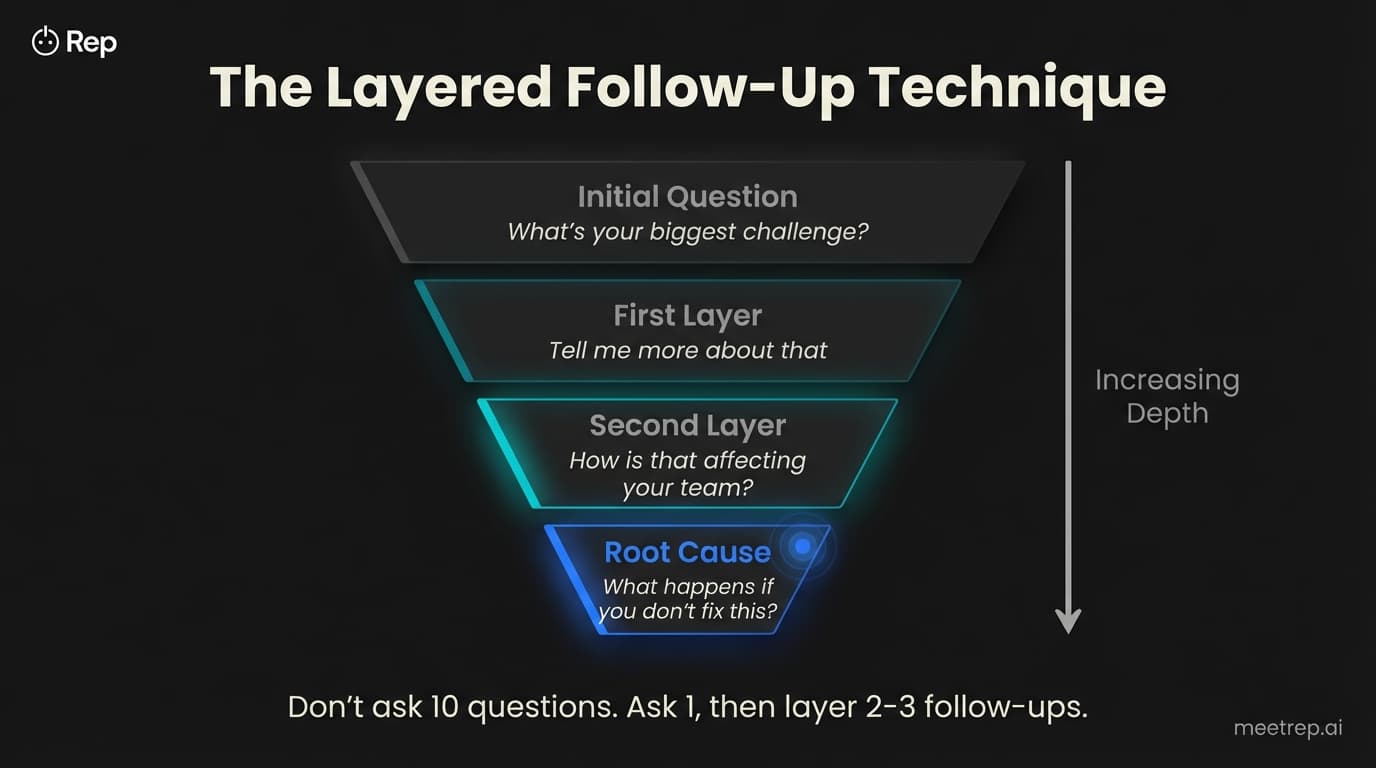
The layered follow-up technique
Don't ask ten unrelated questions. Ask one, then layer 2-3 follow-ups based on the answer.
Example sequence:
Rep: "What's your biggest challenge with customer retention?"
Prospect: "Churn is up 15% this quarter."
Rep: "Can you tell me more about that?" (First layer)
Prospect: "Our onboarding process is too manual. People drop off before they see value."
Rep: "How is that affecting your CS team's bandwidth?" (Second layer)
Prospect: "They're drowning. We've had two people quit in the last month."
Rep: "What happens if you don't fix this by year-end?" (Third layer—implication)
Now you have a quantified pain point (15% churn), a root cause (manual onboarding), human impact (team burnout), and urgency (timeline pressure). One initial question. Three follow-ups. That's the technique.
Allow silence
This is hard. After you ask a question, pause for 3-5 seconds. Don't fill the silence. The prospect is processing. Let them.
Use "labeling" to soften hard questions
Preface tough questions so they don't feel like attacks:
- "I have to level with you..."
- "This might sound like a strange question, but..."
- "I'm curious..."
Five probing question mistakes that kill deals
Common Mistake #1: Asking without listening Reps follow a script robotically. Prospect says something revealing, rep ignores it and asks the next question on their list. Fix: After every answer, ask "Can you tell me more about that?" before moving on.
Common Mistake #2: The interrogation pattern Ten rapid-fire questions, no breathing room. Prospects get defensive. Fix: After 2-3 questions, share a relevant insight or summarize what you've heard. Then return to probing.
Common Mistake #3: Leading questions disguised as probing "Don't you think your team would benefit from automation?" That's not a probe. That's a pitch with a question mark. Fix: If you can answer yes/no, rephrase it.
Common Mistake #4: Stopping at the first answer "We need to scale faster" is not a pain point. It's a symptom. Fix: Layer follow-ups. "Tell me more about that." "Why now?" "What happens if you don't?"
Common Mistake #5: Ignoring stated priorities Prospect says churn is their focus. Rep asks about new logo acquisition. Fix: Bridge everything back to what they said matters.
Real companies, real results
Iron Mountain implemented conversation intelligence to analyze discovery calls. Result: 60% of new reps hit targets in 5 months vs 9% before—a 148% improvement. Their VP of Inside Sales: "When you are talking more than the customer, you probably aren't practicing active listening."
Andela codified top performers' probing question sequences into playbooks. Result: 33% reduction in sales cycle time and 50% reduction in SDR ramp time.
The 2026 reality: AI and the rep-free buyer
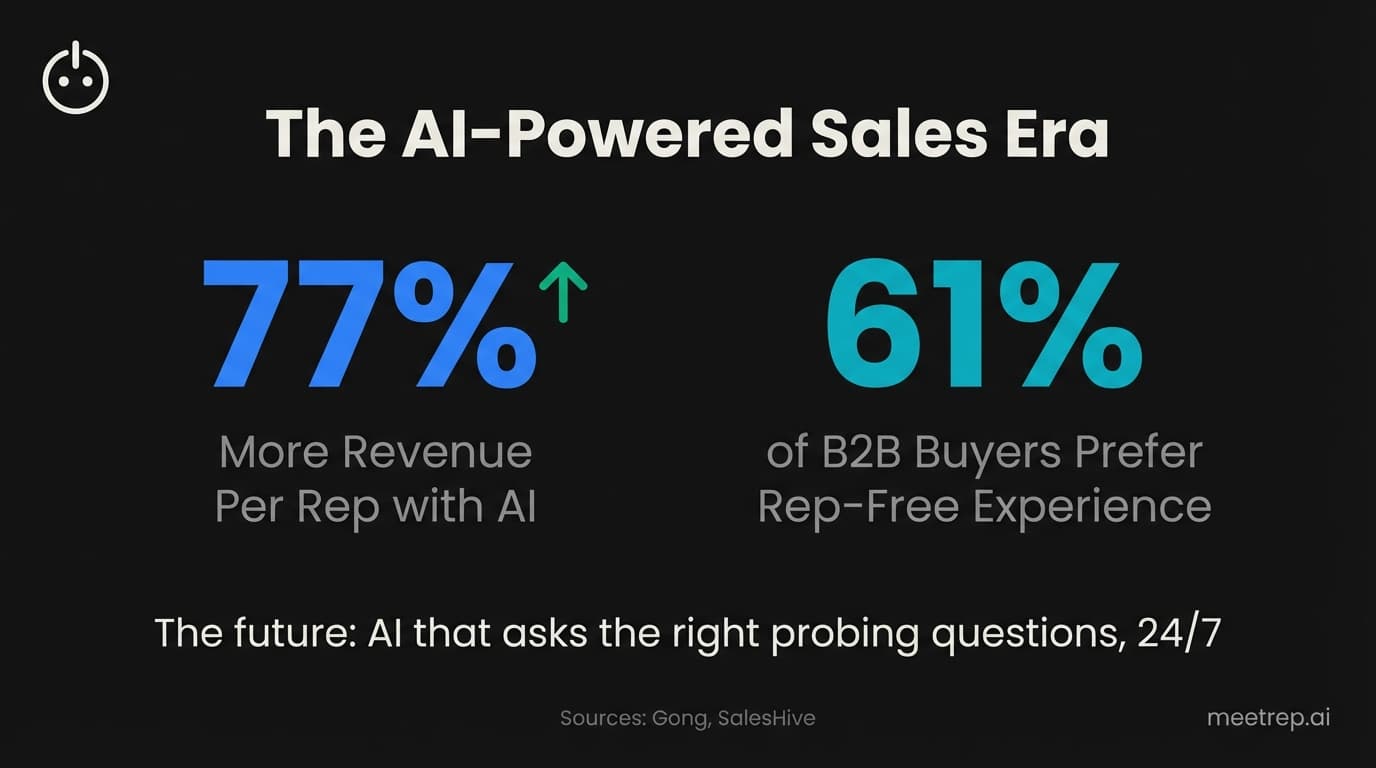
Here's something most probing question guides won't tell you: 61% of B2B buyers now prefer a "rep-free" buying experience.
That doesn't mean probing questions are dead. It means they need to work in both human-led and automated contexts.
The Data: Teams using AI generate 77% more revenue per rep. This isn't about replacing humans—it's about scaling what works.
When 74% of buyers choose the rep who first adds value, speed matters. An AI that can ask the right probing questions at 2am—while giving a live product demo—serves the prospect who wants answers now, not Tuesday at 3pm.
Here's my honest take after building sales automation for years: the gap between top performers and everyone else isn't talent. It's technique.
Top performers ask 39% more questions. They let calls run longer. They don't interrogate—they layer. And increasingly, they're using AI to scale these techniques 24/7.
The questions in this guide aren't magic. But used with the layered follow-up technique—where you dig 2-3 levels deep instead of moving to the next checkbox—they'll surface pain points your competitors miss.
Want to see how AI can ask these same probing questions during live product demos? See how Rep works.

Nadeem Azam
Founder
Software engineer & architect with 10+ years experience. Previously founded GoCustomer.ai.
Nadeem Azam is the Founder of Rep (meetrep.ai), building AI agents that give live product demos 24/7 for B2B sales teams. He writes about AI, sales automation, and the future of product demos.
Frequently Asked Questions
Table of Contents
- What are probing questions and why do they matter?
- The data behind effective discovery calls
- Six types of probing questions (with examples)
- Probing questions vs clarifying questions
- How to ask probing questions without interrogating
- Five probing question mistakes that kill deals
- Real companies, real results
- The 2026 reality: AI and the rep-free buyer
Ready to automate your demos?
Join the Rep Council and be among the first to experience AI-powered demos.
Get Early AccessRelated Articles
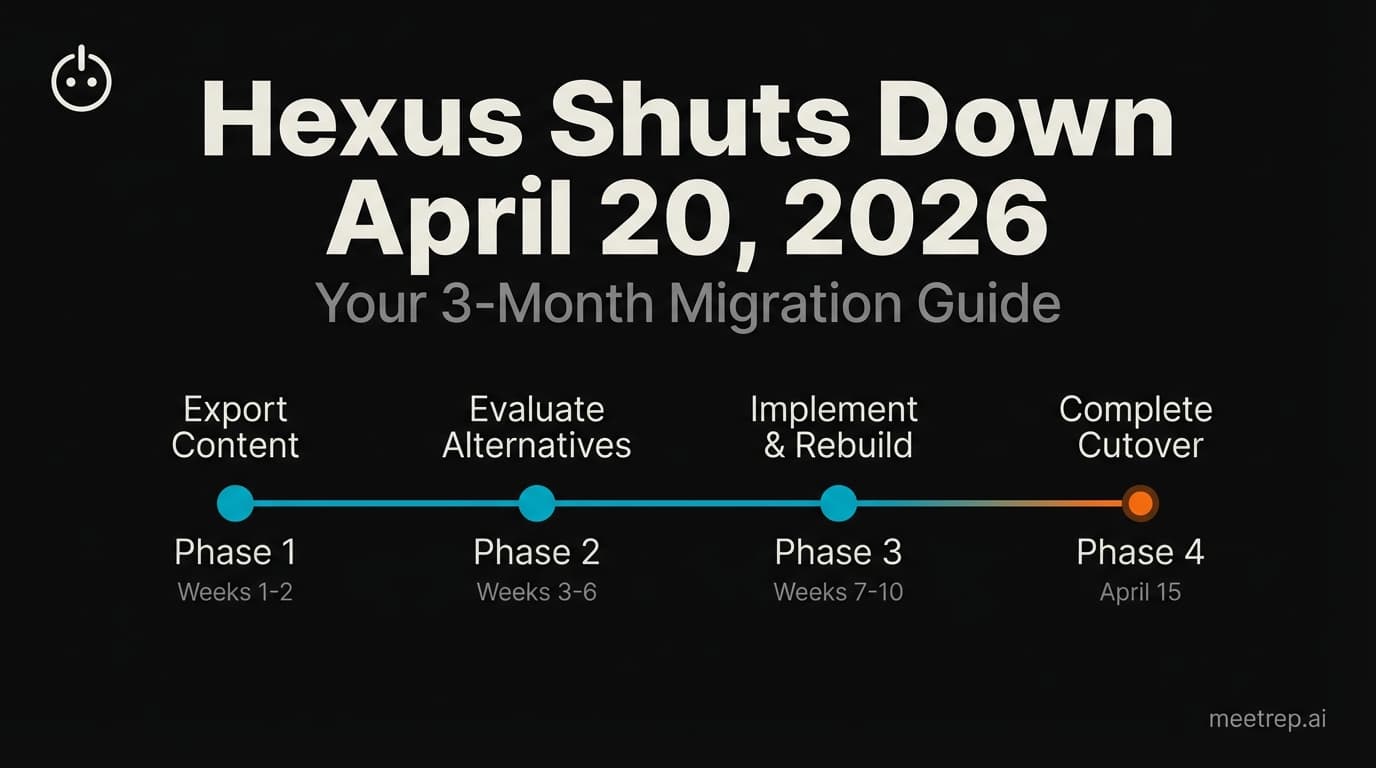
Hexus Acquired by Harvey AI: Congrats & What It Means for Demo Automation Teams
Hexus is shutting down following its acquisition by Harvey AI. Learn how to manage your migration and discover the best demo automation alternatives before April 2026.
Why the "Software Demo" is Broken—and Why AI Agents Are the Future
The traditional software demo is dead. Discover why 94% of B2B buyers rank vendors before calling sales and how AI agents are replacing manual demos to scale revenue.
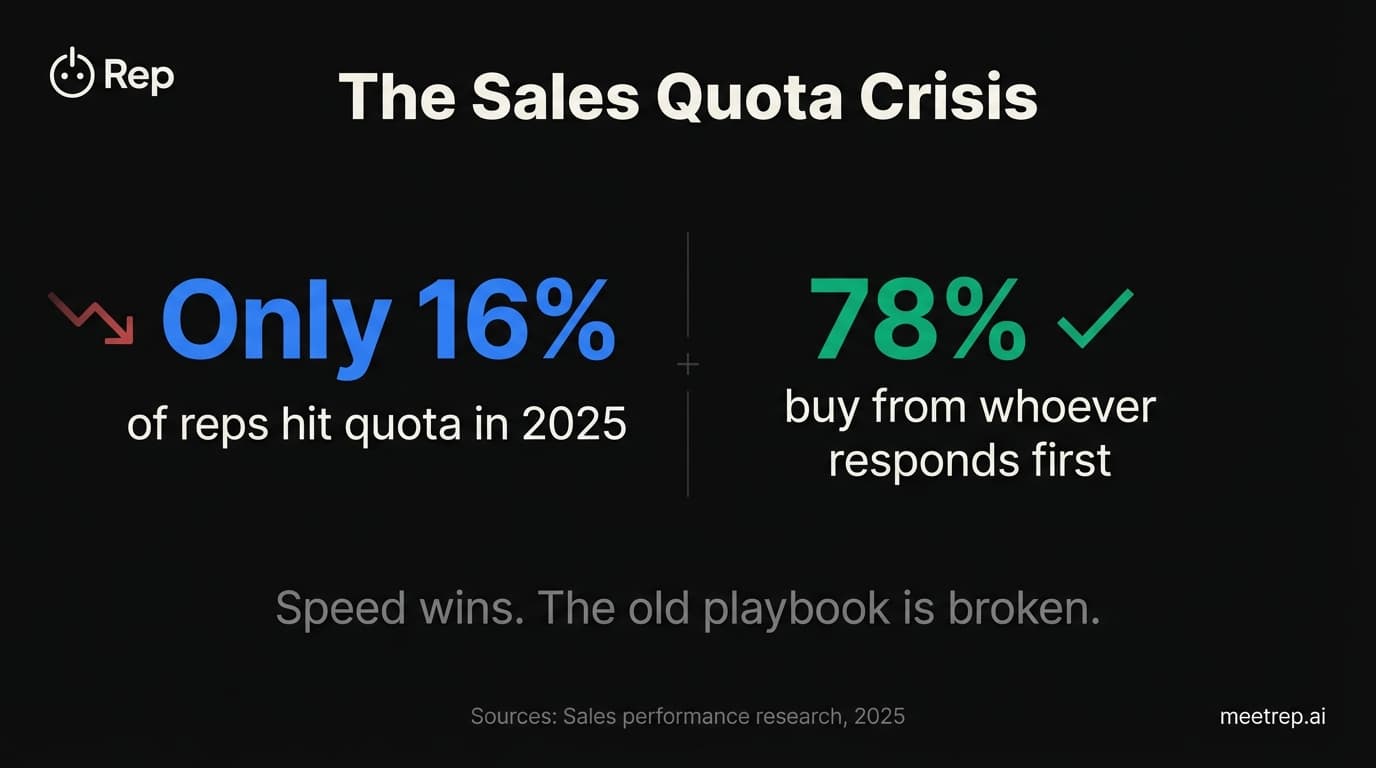
Why Autonomous Sales Software is the Future of B2B Sales (And Why the Old Playbook is Dead)
B2B sales is at a breaking point with quota attainment at 46%. Discover why autonomous 'Agentic AI' is the new standard for driving revenue and meeting the demand for rep-free buying.