Presales Vs Sales: The 2026 Guide to Ratios, Roles, and Reality

Executive Summary
- The Reality: 70% of deals now require presales, yet 84% of sales reps miss quota.
- The Ratio: The industry standard is stabilizing at 4 AEs to 1 SE.
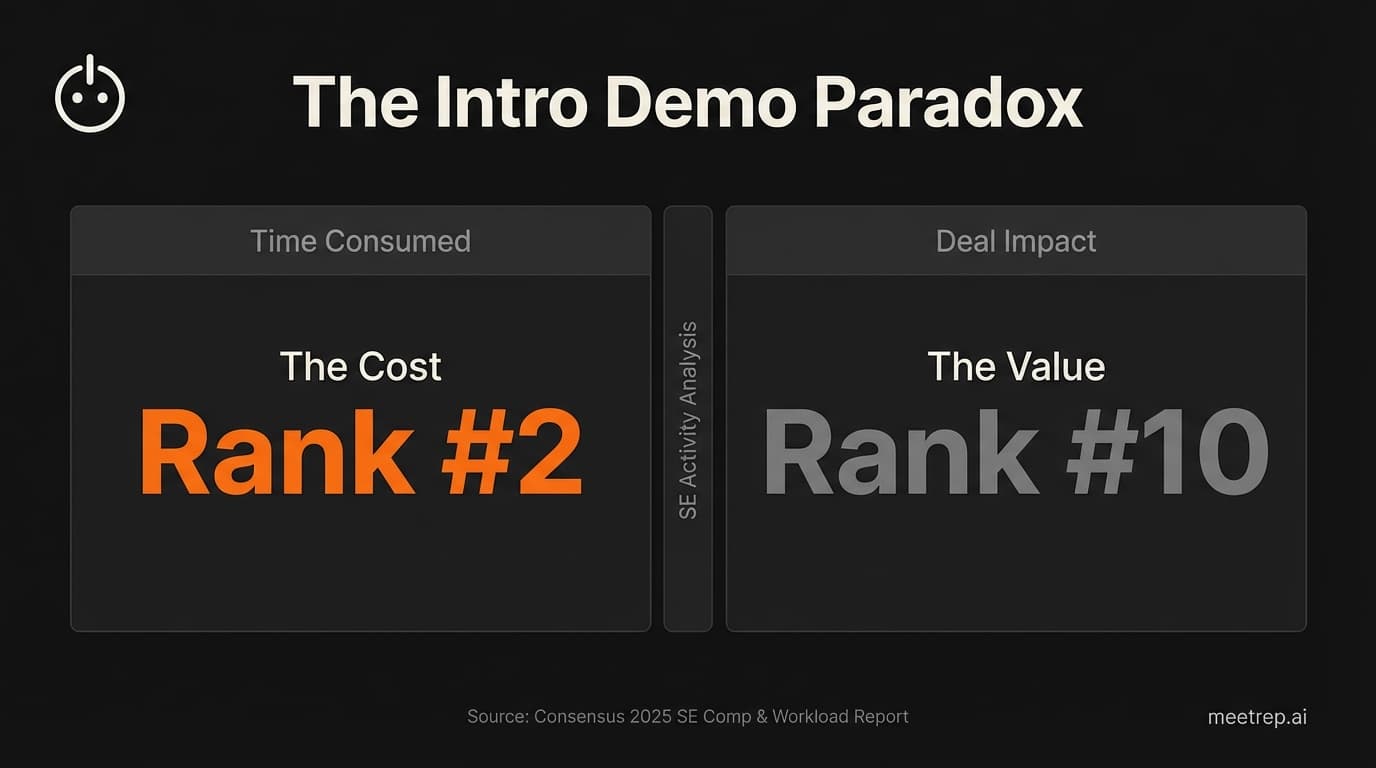
- The Burnout: Intro demos are the #1 cause of SE burnout but rank 10th in deal impact.
- The Fix: Automating the "Sales" parts of Presales to protect your technical talent.
In 2024, 84% of sales representatives failed to meet their quota. Yet, 70% of all deals now require presales support to close.
Read those two sentences again.
The traditional wall between "Sales" (the openers) and "Presales" (the closers) hasn't just cracked. It has collapsed. When I was building GoCustomer.ai, we saw this shift firsthand. Buyers stopped trusting the pitch and started demanding the product. They didn't care about our slide decks. They wanted to see if the code actually worked.
But here's the problem. While the roles are blurring, the economics are drifting apart. You can't solve this by just asking your SEs to "help out more." That's a recipe for burnout, not revenue.
In this guide, I'm going to break down the 2026 math—from salary bands to the 4:1 ratio—and show you why treating your SEs like backup dancers is costing you deals.
Presales vs Sales: What’s the Difference in 2026?
Presales is a technical sales function focused on securing the "technical win" through discovery, demonstrations, and solution design. Unlike Sales (Account Executives), who focus on commercial terms and relationship management, Presales professionals (SEs) validate that the solution actually solves the customer's problem.
That's the textbook definition. But in practice, the lines are messy.
Sales reps are under immense pressure to be "technical enough" to demo. Presales engineers are under pressure to be "commercial enough" to close. And the reason is simple: buyer patience is at an all-time low.
According to Consensus, 70% of sales deals now require presales support. Why? Because trust in the generalist sales rep has eroded. The "technical win"—getting the prospect's engineers or users to say "yes, this works"—is no longer a late-stage milestone. It's the gatekeeper for the entire deal.
Key Insight: Sales owns the Commercial Win (Price, Terms, Timing). Presales owns the Technical Win (Feasibility, Fit, Security). You can get the Commercial Win and still lose the deal if the Technical Win fails. You rarely see the reverse.
The Economics: Why the Gap is Widening
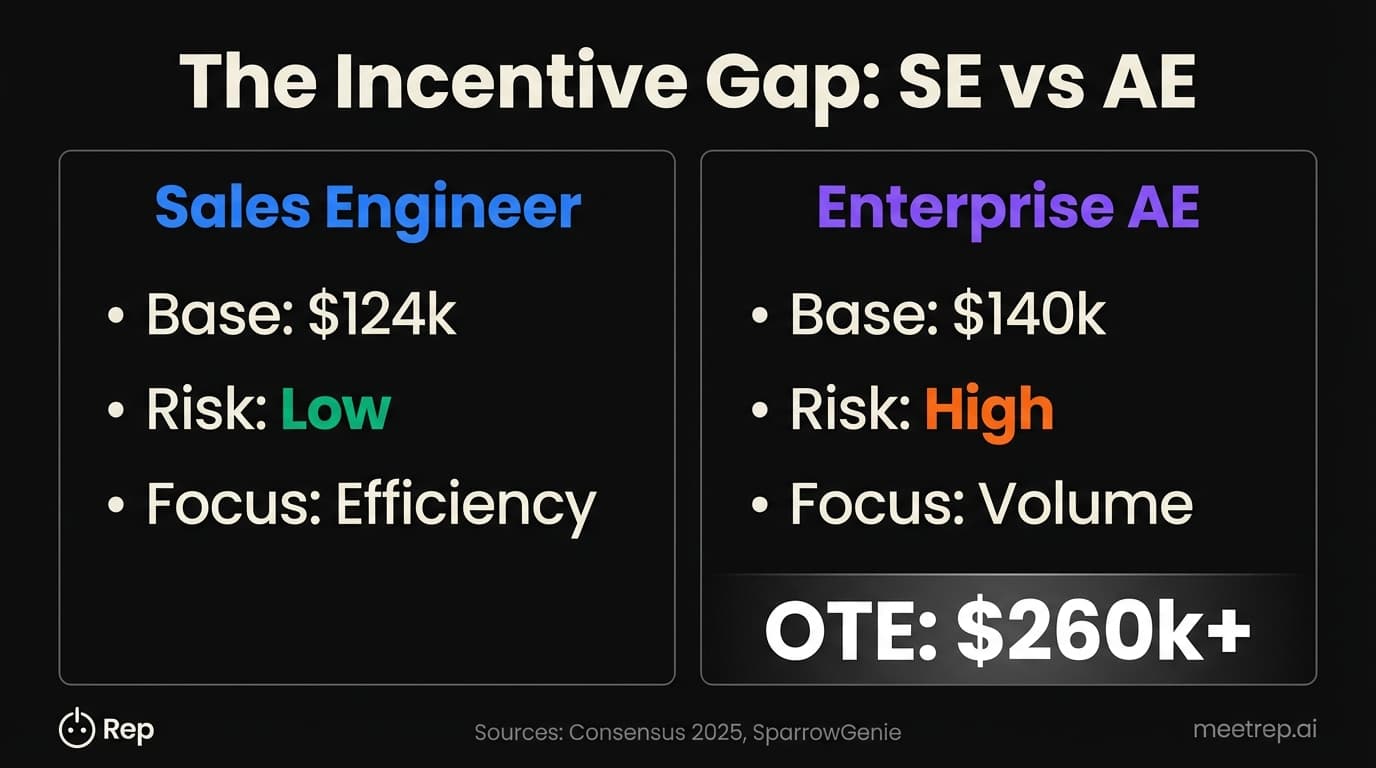
If you want to understand the tension between these teams, look at the bank accounts. The compensation structures for Sales Engineers (ICs) and Enterprise Account Executives tell two very different stories about risk and reward.
Sales Engineers are the "safe" investment for the company. They command high base salaries. Why? Because their technical skill set is rare and hard to hire for. Account Executives are the high-risk, high-reward gamble.
Here is the breakdown based on 2025 data from Consensus and SparrowGenie:
| Feature | Sales Engineer (IC) | Enterprise AE |
|---|---|---|
| Avg Base Salary | ~$124,000 | ~$140,000 - $180,000 |
| Avg Commission | ~$43,000 | ~$120,000 - $300,000+ |
| Total OTE | ~$167,000 | $260,000 - $500,000 |
| Risk Profile | Low (High Base) | High (High Variable) |
| Primary Metric | Technical Win / Activity | Revenue Quota |
| Split | 70/30 or 80/20 | 50/50 |
Why This Matters for Leaders
This creates a friction point. Your AEs are incentivized to throw every possible deal at the wall because they need that massive commission check. Your SEs, however, are incentivized to be efficient. They get paid (mostly) whether that specific long-shot deal closes or not.
When an AE drags an SE into a "hail mary" demo, they aren't just wasting time. They are wasting your most expensive fixed-cost resource on a low-probability bet.
The "Blur" is Real: Where Roles Overlap
The biggest change I've seen in the last two years isn't in the job descriptions. It's in the buyer behavior.
Buyers wait an average of 5.6 days to see their first demo. That is nearly a week of silence where your competitor can sneak in.
Because of this lag time, we are seeing the rise of the "Salesy SE" and the "Technical AE."
- The Technical AE: Reps who learn to run the "Harbor Tour" demo so they don't have to wait for an SE resource.
- The Salesy SE: Engineers who run the whole cycle for technical products because the AE adds no value to a developer buyer.
But there is a danger here.
84% of sales reps missed quota last year. When AEs try to cover the technical gap, they often fail. They promise features that don't exist ("vaporware") or gloss over critical implementation details. Then, the SE has to come in later and clean up the mess—often called the "apology demo."
What we learned at GoCustomer: We tried letting our AEs handle the first technical pass. The result? Our "technical win" rate dropped by half. We realized that AEs sell the dream, but SEs sell the reality. Mixing them up too early killed our credibility.
The Burnout Crisis: 4:1 Ratios and the "Intro Demo" Trap
This is the part that keeps directors of presales awake at night.
The industry is settling on a strict benchmark: the 4:1 AE:SE ratio. That means for every four deal-hungry sales reps, you have one technical expert.
At 4:1, the math works—but only if the SE focuses exclusively on high-value activities. If that single SE is dragged into every qualification call and introductory demo, they drown.
The data backs this up. According to Consensus's 2025 report:
- Intro Demos are ranked as the 2nd most time-consuming activity for SEs.
- But they rank 10th in perceived impact on the deal.
Think about that. Your team is spending their second-biggest chunk of time on their tenth-most important task.
And the cost is human. 69% of early-career SEs cite workload as their number one challenge. When you force a highly technical person to give the same "Introduction to the Dashboard" demo 50 times a month, they don't just get bored. They quit.
The Data: A 10% increase in unqualified demos produces burnout levels equivalent to working two additional "crunch weeks" per year. You are literally burning out your team on leads that shouldn't have passed the filter.
Solving the Efficiency Gap with AI
So, you have a math problem.
- You have a 4:1 ratio (industry standard).
- You have high-cost SEs ($167k OTE).
- You have a flood of leads that need demos now, not in 5.6 days.
You can't hire more SEs (budget says no). You can't let AEs do it (84% miss rate says no).
This is exactly why we built Rep.
We realized that the "Presales vs Sales" debate misses the third option: Automation.
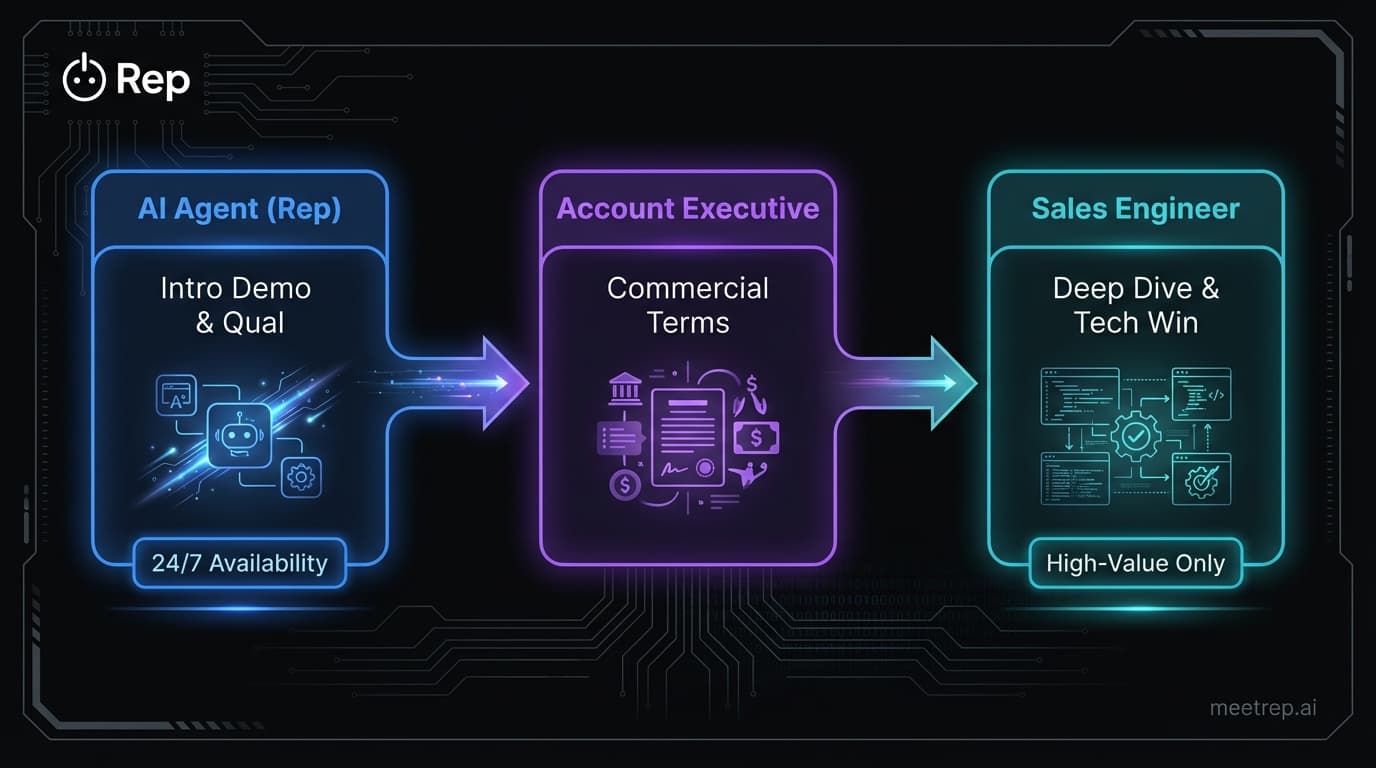
The solution isn't to force AEs to become engineers. It's to let an AI Agent handle the "Sales" demo—the repetitive, introductory, qualification-heavy walkthrough—so your SEs can handle the "Presales" demo.
Here is the new split we are seeing at forward-thinking companies:
- Stage 1 (The AI): Rep joins the call instantly (24/7). It demos the core product, answers the 50 most common questions, and qualifies the technical fit.
- Stage 2 (The AE): Receives the extraction data (budget, timeline, stakeholders) from Rep.
- Stage 3 (The SE): Steps in only for the qualified Deep Dive. They focus on custom workflows, security reviews, and proof-of-concepts.
Why we built Rep this way: We didn't build Rep to replace the SE. We built it to replace the Intro Demo. If an AI can handle the "harbor tour," your SEs get 30% of their week back to focus on the deals that actually need their brainpower.
The Bottom Line
The era of throwing bodies at the problem is over. You cannot hire your way out of the 4:1 pressure cooker.
If you continue to use your $167k Sales Engineers as "intro demo" machines, you will lose them. And if you rely on your struggling AEs to fill the technical gap, you will lose the deal.
The winning organizations in 2026 aren't the ones with the most SEs. They're the ones who treat their SEs like surgeons—brought in only for the critical operation, not the initial check-up.
My recommendation? Stop debating "Presales vs Sales." Start automating the gap between them. Let Rep handle the first touch, so your team can handle the close.

Nadeem Azam
Founder
Software engineer & architect with 10+ years experience. Previously founded GoCustomer.ai.
Nadeem Azam is the Founder of Rep (meetrep.ai), building AI agents that give live product demos 24/7 for B2B sales teams. He writes about AI, sales automation, and the future of product demos.
Frequently Asked Questions
Table of Contents
- Presales vs Sales: What’s the Difference in 2026?
- The Economics: Why the Gap is Widening
- The "Blur" is Real: Where Roles Overlap
- The Burnout Crisis: 4:1 Ratios and the "Intro Demo" Trap
- Solving the Efficiency Gap with AI
- The Bottom Line
Ready to automate your demos?
Join the Rep Council and be among the first to experience AI-powered demos.
Get Early AccessRelated Articles
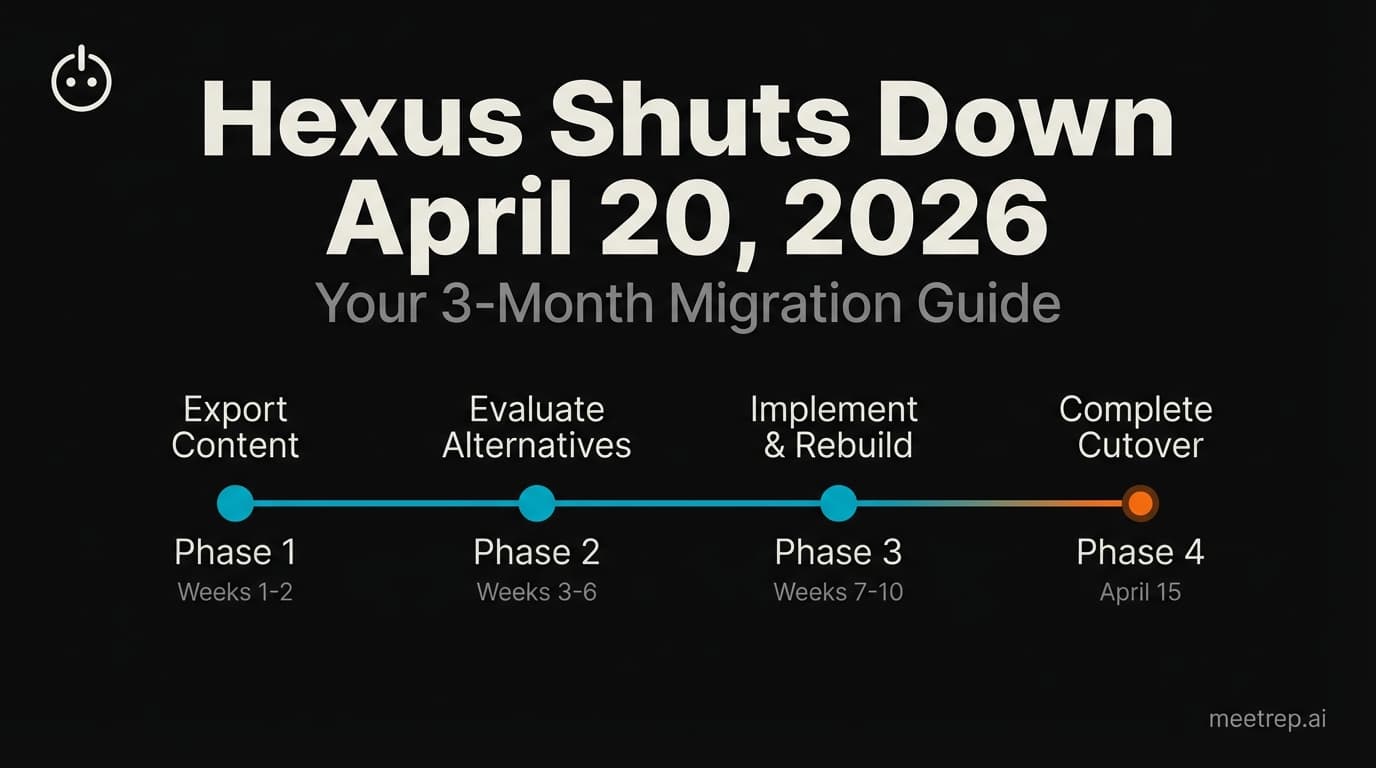
Hexus Acquired by Harvey AI: Congrats & What It Means for Demo Automation Teams
Hexus is shutting down following its acquisition by Harvey AI. Learn how to manage your migration and discover the best demo automation alternatives before April 2026.
Why the "Software Demo" is Broken—and Why AI Agents Are the Future
The traditional software demo is dead. Discover why 94% of B2B buyers rank vendors before calling sales and how AI agents are replacing manual demos to scale revenue.
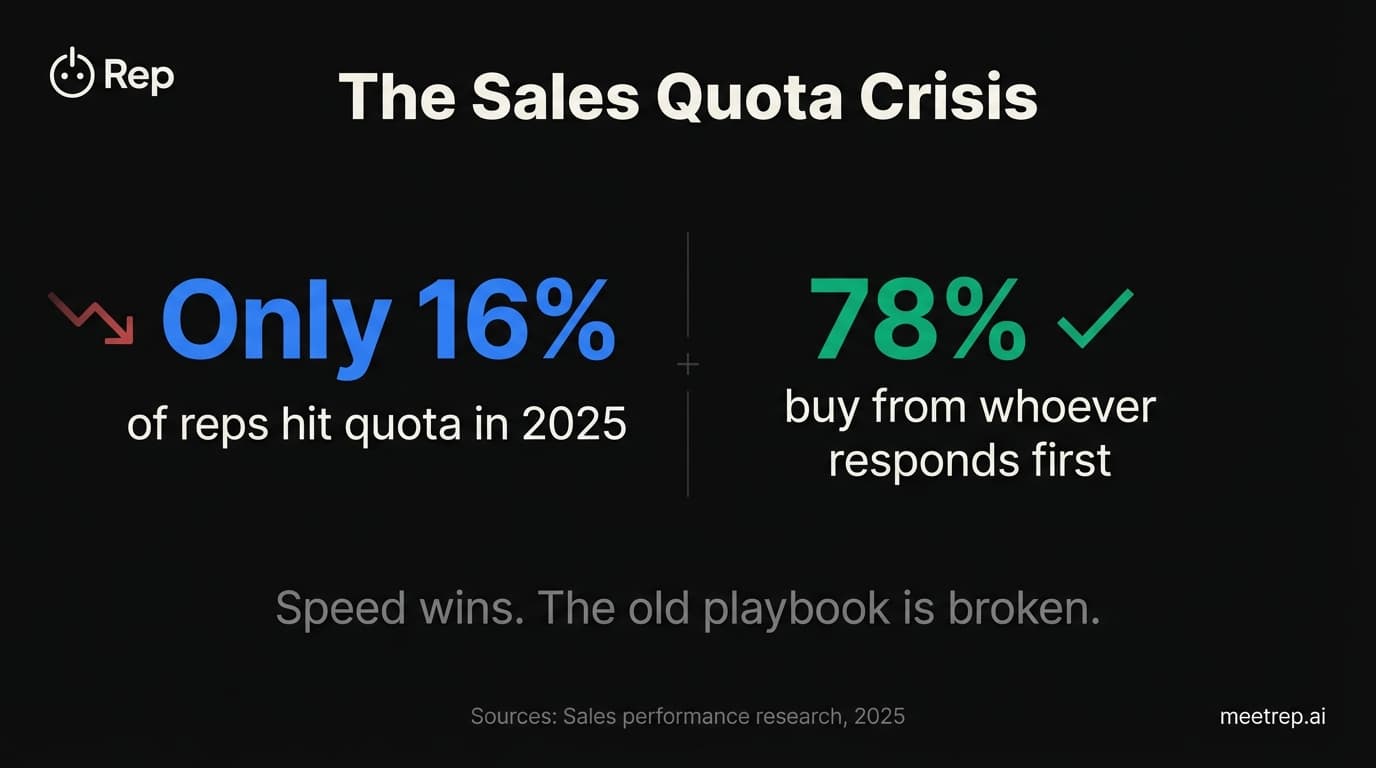
Why Autonomous Sales Software is the Future of B2B Sales (And Why the Old Playbook is Dead)
B2B sales is at a breaking point with quota attainment at 46%. Discover why autonomous 'Agentic AI' is the new standard for driving revenue and meeting the demand for rep-free buying.