Navattic Alternative: Why Click-Through Demos Fall Short for Sales Teams

Executive Summary
- Navattic excels at marketing demos—website embeds, top-of-funnel tours, product awareness
- Click-through demos can't answer prospect questions, handle objections, or qualify leads in real-time
- Conversational AI demos (like Rep) handle BOFU qualification through actual two-way dialogue
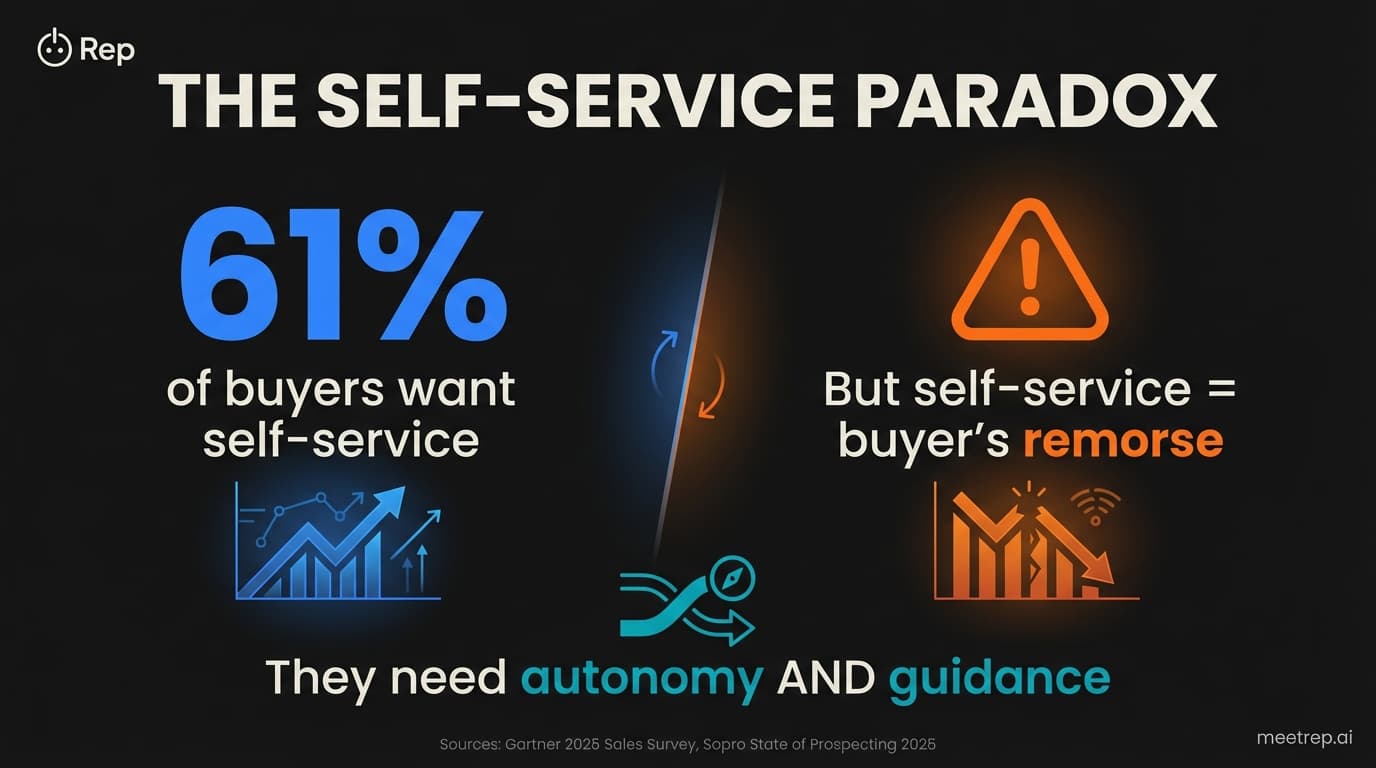
- 61% of buyers want self-service—but self-service purchases lead to buyer's remorse. You need both autonomy AND guidance.
- Choose based on funnel stage: Navattic for awareness, Rep for qualification
You're searching for a Navattic alternative. I get it.
Maybe it's the $500/month minimum with no monthly billing option. Maybe it's the mobile experience that G2 reviewers keep calling "clunky." Or maybe you've realized something more fundamental: click-through demos can't answer questions.
I'm Nadeem, founder of Rep. I've built sales automation products for years—first GoCustomer.ai, now Rep. And I'll be honest: this article has a bias. Rep is a Navattic alternative. But I'm going to tell you when not to use Rep, when Navattic is actually the right choice, and what the real differences are between click-through and conversational demos.
Because the best alternative depends entirely on what you're trying to do.
What's Actually Wrong With Navattic?
Nothing, honestly. Navattic built a solid product for its intended use case: marketing teams who need website demo embeds.
The problems arise when sales teams try to use it for qualification. Here's what users report on G2:
The learning curve is real. "Creating the first few flows can take a little bit of time... we didn't quite anticipate how long it would take," one reviewer noted. Another described the UI as "very challenging" with folder organization "hosted in a weird spot."
Mobile is still rough. Multiple reviews mention this: "Mobile view still seems to be very clunky." In a world where prospects browse on phones at 11pm, that matters.
Design flexibility is limited. As Supademo's analysis put it: "Navattic has rigid limitations when it comes to design, hotspot designs, slide animations, fonts/logos."
The maintenance burden is hidden. Every product update means recapturing screens, re-stitching flows, re-testing navigation. Teams spend hours after every release.
But here's the real issue. And it's not Navattic's fault—it's a limitation of the entire click-through category.
Key Insight: Click-through demos follow predetermined paths. They can't answer questions. They can't handle objections. They can't pivot based on what a prospect actually cares about. The experience is passive. And for BOFU prospects who need specific answers, passive doesn't convert.
The Self-Service Paradox (And Why It Matters)
Here's something most demo tool vendors won't tell you.
According to Gartner's 2025 Sales Survey, 61% of B2B buyers prefer rep-free experiences. They want to research on their own. They want control.
But here's the catch: Sopro's 2025 State of Prospecting report found that self-service purchases are more likely to result in buyer's remorse.
Think about that. Buyers want autonomy. But when they get it without guidance, they regret their decisions.
This is the paradox click-through demos can't solve. They give autonomy (click through at your own pace) but no guidance (can't answer your specific questions). Prospects get independence without intelligence.
What they actually need is both. The ability to explore on their own schedule, plus the ability to get real answers when they have questions.
Sound familiar? It should. It's why your best AEs close deals—they let prospects drive while providing expert guidance. The question is whether you can scale that.
What Are Conversational Demos? (And What Is "Agentic Sales"?)
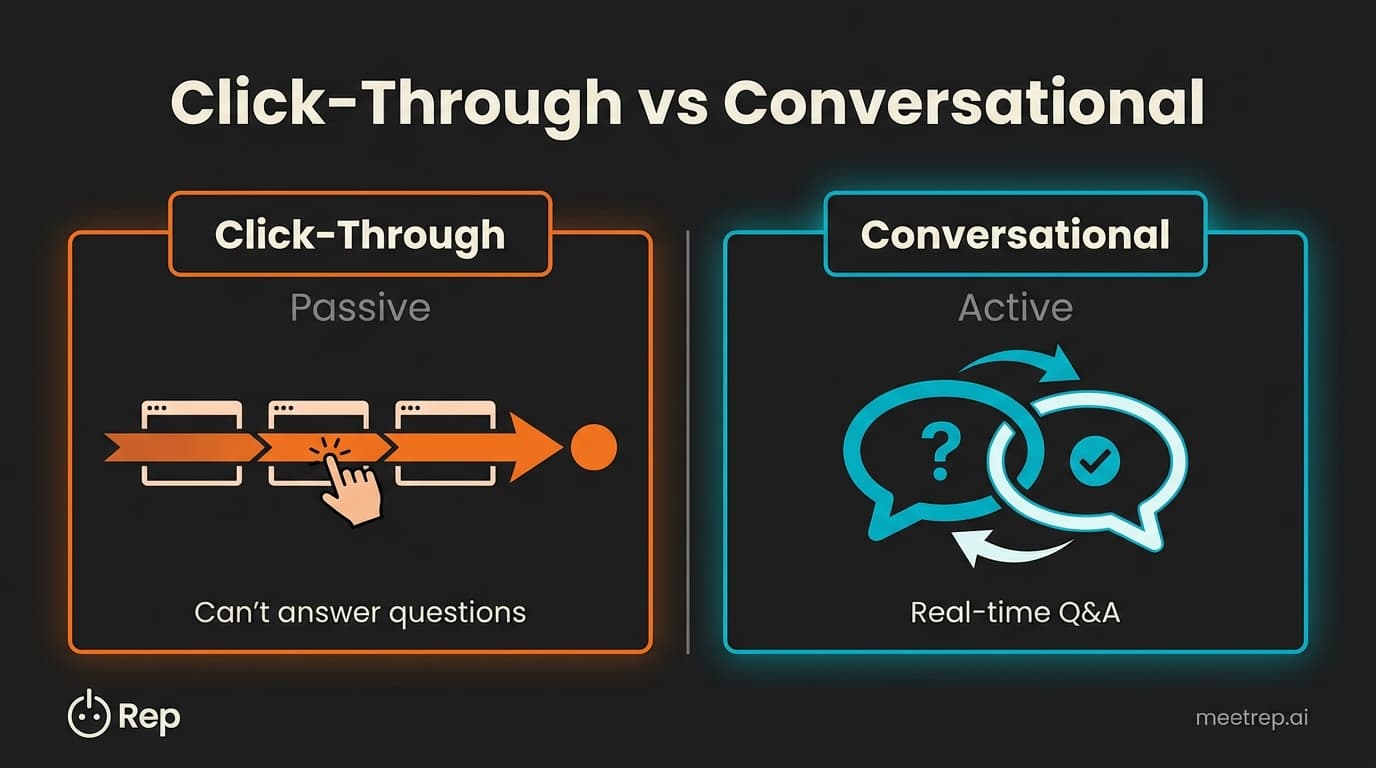
Conversational demos are AI-powered product demonstrations that engage in actual two-way dialogue. Instead of clicking through predetermined paths, prospects have a conversation. They ask questions. They get answers. They see the product respond to their specific needs.
This is part of a bigger shift that Gartner calls "Agentic AI": AI systems that don't just chat, but actually execute tasks. Navigate software. Book meetings. Update CRMs. Make decisions.
The Data: Gartner predicts that by 2028, 15% of day-to-day work decisions will be made autonomously through agentic AI—up from 0% in 2024. And by 2027, 95% of sellers' research workflows will begin with AI.
We're at an inflection point. Click-through demos were the 2020-2024 standard for self-serve product exploration. But the 2025-2026 market is shifting toward AI that can actually respond, adapt, and qualify.
The difference matters:
| Aspect | Click-Through (Navattic) | Conversational (Rep) |
|---|---|---|
| User experience | Click hotspots, read tooltips | Voice conversation, watch AI navigate |
| Q&A capability | None—predetermined paths only | Real-time answers from knowledge base |
| Personalization | Pre-set variables | Adaptive, based on conversation |
| Qualification | Form fills + analytics | Natural Q&A captures intent |
| Best for | Marketing (TOFU) | Sales (BOFU) |
Rep vs Navattic: The Real Differences
Let me be specific about what Rep does differently. And where Navattic wins.
How Rep works: Rep joins video calls as an AI participant. It shares its screen and navigates your actual product—not a captured HTML replica. It speaks with prospects in real-time. It answers questions using your knowledge base. It extracts insights like pain points and action items automatically.
The core technical difference: Navattic captures your product as HTML/CSS screenshots. Rep runs your actual application in a cloud browser. This means Rep shows real data, real functionality, real product behavior. No maintenance when your UI changes.
Why we built Rep this way: When I was building sales automation tools at GoCustomer, we saw the same pattern repeatedly: static demos generated interest, but they didn't close deals. Prospects had questions that predetermined paths couldn't answer. They'd ghost after demos because nothing addressed their specific situation. We built Rep to actually have the conversation—not simulate one.
Here's the detailed comparison:
| Feature | Navattic | Rep |
|---|---|---|
| Core technology | HTML/CSS capture | Live browser automation + voice AI |
| Demo experience | Click-through screens | AI navigates live product |
| Real-time Q&A | ❌ No | ✅ Yes—answers from knowledge base |
| Voice conversation | ❌ No | ✅ Yes |
| Mobile experience | Documented issues | Video stream works on any device |
| Maintenance | Manual recapture after UI changes | AI learns from docs/recordings |
| Video call integration | ❌ No | ✅ Joins Zoom/Google Meet |
| Lead qualification | Forms + engagement analytics | Conversational discovery |
| Pricing | $500-$1,000/mo (annual only) | Contact for pricing |
| Best for | Website embeds, marketing tours | Sales demos, BOFU qualification |
Where Navattic wins: Website embeds. Marketing pages. Top-of-funnel "see it in action" tours. If you need a quick, polished product tour on your homepage, Navattic does that well. Their Trainual case study shows a 450% lift in free trial signups. That's real.
Where Rep wins: Actual sales conversations. Complex products that need explanation. BOFU prospects who have specific questions. If you need to qualify leads, handle objections, and move deals forward—that's what Rep is built for.
When Navattic Is the Right Choice
I said I'd tell you when not to use Rep. Here it is.
Use Navattic if:
- Your primary goal is website lead generation, not sales qualification
- You need a quick "take a tour" button on your homepage
- Your product is simple enough that predetermined paths cover most questions
- Your team is marketing-led, not sales-led
- You want embedded demos in blog posts, landing pages, and emails
Use Navattic for: Top-of-funnel awareness. Product marketing. PLG activation flows where users need to see the product before signing up.
Navattic's customers include Coupa ($10M+ ARR influenced by demos) and Ramp (15% of website leads attributed to Navattic tours). These are real results for the right use case.
My recommendation: Don't throw out your click-through demos. Use them for what they're good at—awareness. But add conversational demos for what click-throughs can't do—qualification.
Best Navattic Alternatives by Use Case
If you've decided Navattic isn't right for your situation, here's how to choose:
| Your Priority | Best Alternative | Why |
|---|---|---|
| Budget-friendly | Arcade ($0-42/mo), Supademo ($27/mo) | Free tiers, fast setup |
| Enterprise sales | Consensus ($12K+/yr), Walnut ($9K+/yr) | Stakeholder tracking, deep CRM integration |
| Multi-format demos | Storylane ($40/mo starter) | HTML + screenshot + video in one platform |
| Video-first | Consensus | Video demos with stakeholder tracking |
| AI/Conversational | Rep | Live demos with two-way voice conversation |
| Sandbox POCs | TestBox, Demostack ($55K+/yr) | Full environment replication |
Navattic Pricing: What You'll Actually Pay
Let's talk numbers:
| Plan | Price | Seats | Key Features |
|---|---|---|---|
| Starter | Free | 1 | 1 HTML demo, basic analytics |
| Starter Plus | $40/mo | 1 | Custom themes, Slack integration |
| Base | $500/mo | 5 | Unlimited demos, 25+ integrations |
| Growth | $1,000/mo | 10 | A/B testing, account identification |
| Enterprise | Custom | Custom | SSO, offline demos |
Important details most comparison articles skip:
- No monthly billing. Minimum quarterly commitment on paid plans.
- Quarterly billing is more expensive. $600/mo for Base, $1,200/mo for Growth.
- Startup pricing exists. $300/mo for companies under 20 employees.
- Average annual cost is ~$7,000 according to Vendr data.
For budget-conscious teams, that $500/mo minimum with no monthly option is a real barrier. Arcade and Supademo start at $0-42/mo with actual monthly billing.
Addressing the AI Concern: "Won't It Hallucinate?"
Fair question. It's the first thing enterprise buyers ask us about Rep.
Here's how we handle it: Rep uses RAG (Retrieval-Augmented Generation) to ground every answer in your specific knowledge base. It doesn't generate answers from broad training data like ChatGPT. It retrieves information from documents you've uploaded—product docs, FAQs, sales playbooks—then generates responses from that defined source.
The system also uses what we call "Product Intelligence": a structured knowledge base that captures features, capabilities, limitations, pricing, and competitive positioning. Rep can only say what you've trained it to say.
Does this eliminate all risk? No. Deloitte's December 2025 analysis confirms that hallucination risks in agentic AI are real. But guardrails, knowledge bases, and inline validation dramatically reduce that risk.
We built Rep with organization-scoped isolation—your data stays yours—and encrypted credential storage for demo accounts. Is it perfect? Nothing is. But we take this seriously because our customers' credibility is on the line.
The Conversion Case for Conversational Demos
Let's talk results.
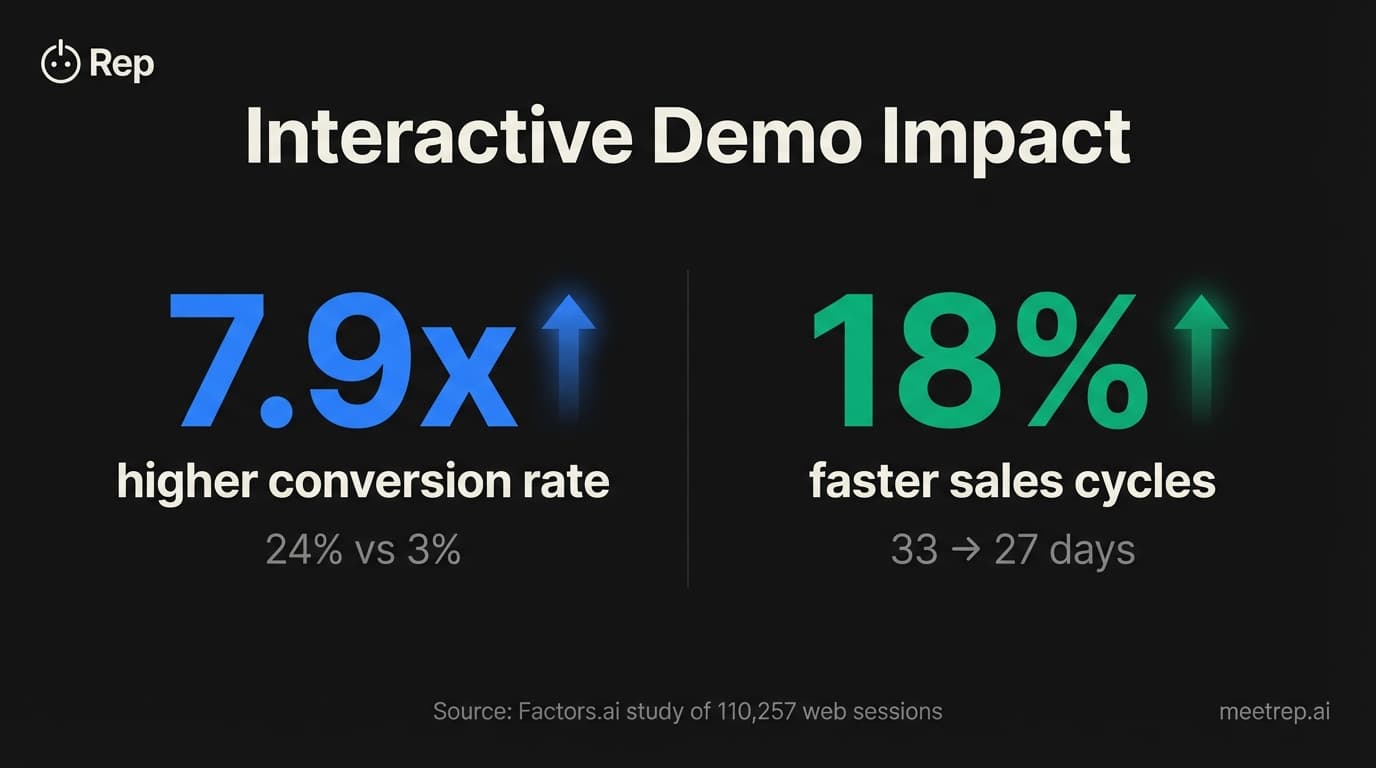
According to a Factors.ai study of 110,257 web sessions, interactive demo users achieved 7.9x higher conversion rates: 24.35% versus 3.05% for non-demo users. The same study found sales cycles reduced from 33 to 27 days—an 18% reduction.
That's for click-through demos. Conversational demos add another layer: qualification.
6sense's 2025 Buyer Experience Report found that 81% of buyers pick a winner before talking to sales. By the time they request a demo, they're comparing finalists. They have specific questions. They need specific answers.
Click-through demos show them the product. Conversational demos answer their questions, surface their concerns, and capture buying signals—all before your AE joins the call.
The Data:Gartner found that 73% of B2B buyers actively avoid suppliers sending irrelevant outreach. Generic demos aren't just ineffective—they actively damage your market.
How to Choose: A Simple Framework
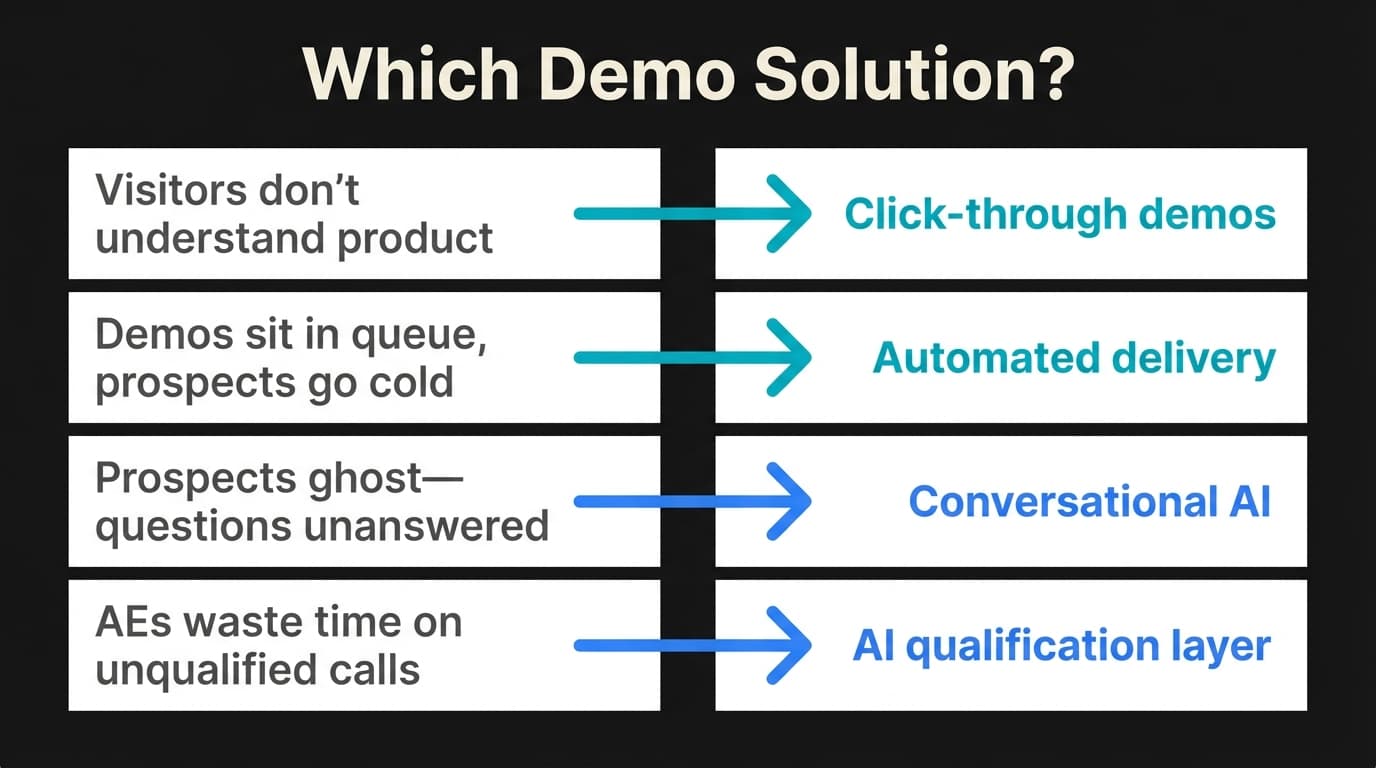
Stop thinking "which demo tool is best." Start thinking "what problem am I solving."
Problem: Website visitors leave without understanding my product. → Solution: Click-through demos (Navattic, Storylane, Arcade)
Problem: Demo requests sit in a queue while prospects go cold. → Solution: Automated demo delivery (Consensus video, Rep conversational)
Problem: Prospects ghost after demos because their questions weren't answered. → Solution: Conversational demos (Rep)
Problem: Sales team spends too much time on unqualified prospects. → Solution: AI qualification layer (Rep) before human handoff
Problem: Enterprise deals need stakeholder buy-in from people who weren't on the demo. → Solution: Shareable demos with tracking (Consensus, Navattic)
The right Navattic alternative isn't universal. It depends on where your pipeline is leaking.
The demo tool market is shifting. Click-through demos established the category and drove real results for marketing teams. But as AI capabilities advance and buyer expectations rise, the question isn't just "how do I show my product" but "how do I actually help buyers buy."
That's the question we're building Rep to answer. Not to replace every click-through demo—they still have their place—but to handle the conversations that static demos can't.
If your pipeline is leaking at the qualification stage, if prospects are ghosting after demos that didn't address their questions, if your AEs are spending too much time on early-stage calls—that's when conversational demos make sense.

Nadeem Azam
Founder
Software engineer & architect with 10+ years experience. Previously founded GoCustomer.ai.
Nadeem Azam is the Founder of Rep (meetrep.ai), building AI agents that give live product demos 24/7 for B2B sales teams. He writes about AI, sales automation, and the future of product demos.
Frequently Asked Questions
Table of Contents
- What's Actually Wrong With Navattic?
- The Self-Service Paradox (And Why It Matters)
- What Are Conversational Demos? (And What Is "Agentic Sales"?)
- Rep vs Navattic: The Real Differences
- When Navattic Is the Right Choice
- Best Navattic Alternatives by Use Case
- Navattic Pricing: What You'll Actually Pay
- Addressing the AI Concern: "Won't It Hallucinate?"
- The Conversion Case for Conversational Demos
- How to Choose: A Simple Framework
Ready to automate your demos?
Join the Rep Council and be among the first to experience AI-powered demos.
Get Early AccessRelated Articles
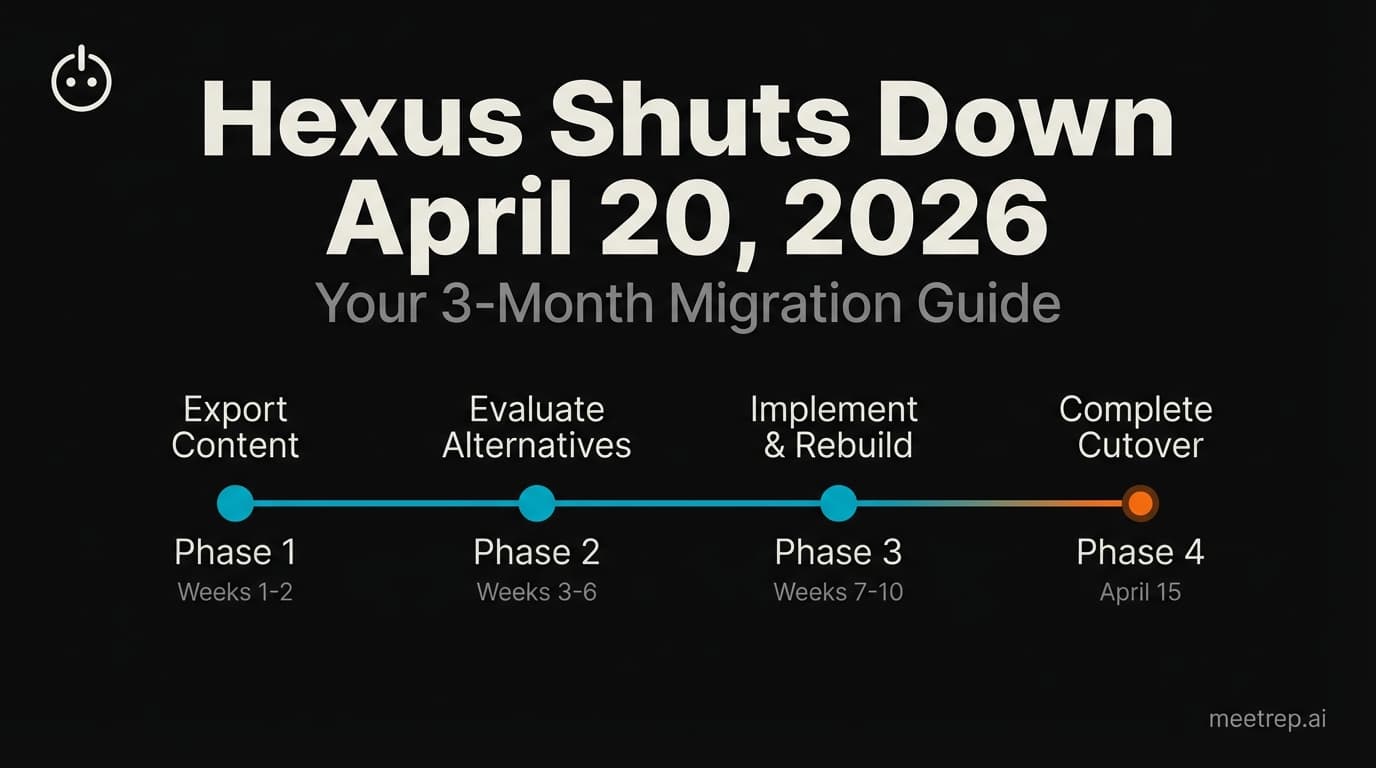
Hexus Acquired by Harvey AI: Congrats & What It Means for Demo Automation Teams
Hexus is shutting down following its acquisition by Harvey AI. Learn how to manage your migration and discover the best demo automation alternatives before April 2026.
Why the "Software Demo" is Broken—and Why AI Agents Are the Future
The traditional software demo is dead. Discover why 94% of B2B buyers rank vendors before calling sales and how AI agents are replacing manual demos to scale revenue.
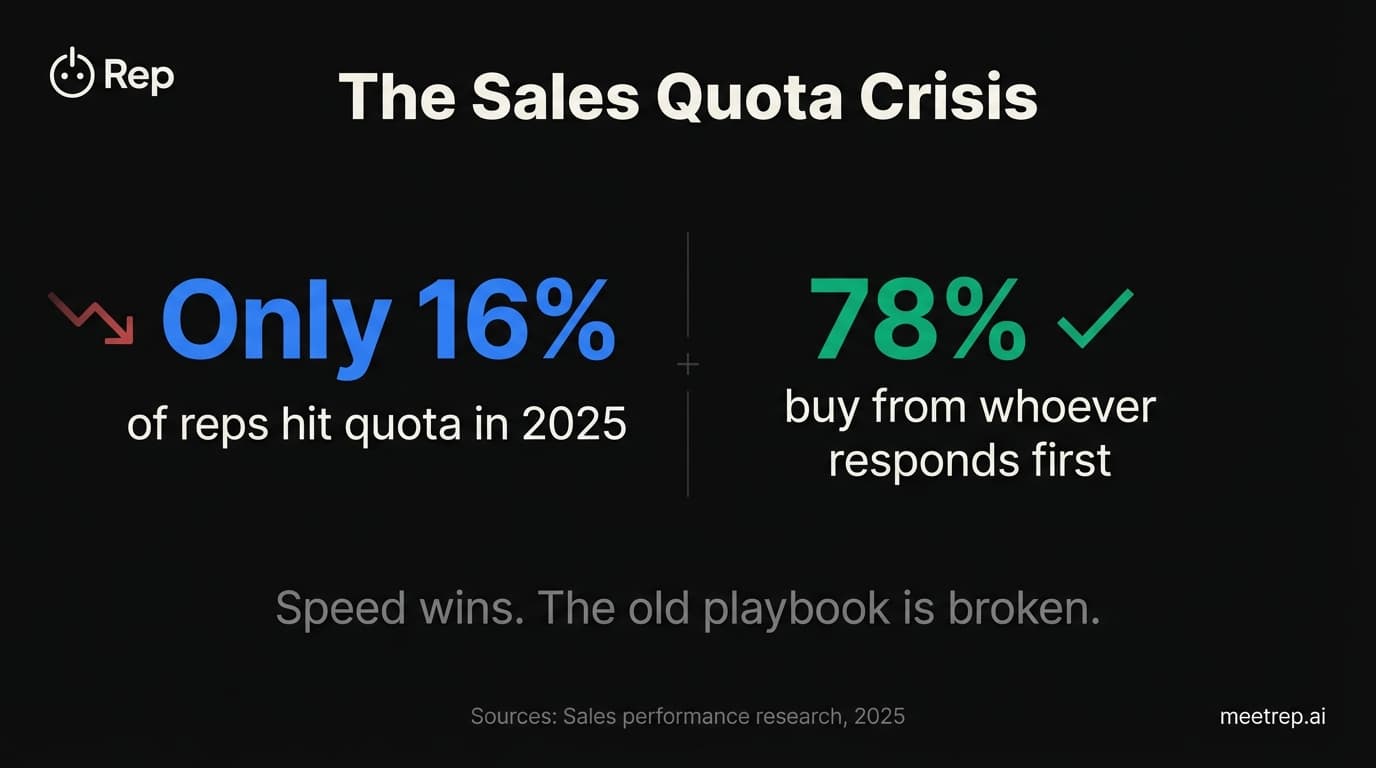
Why Autonomous Sales Software is the Future of B2B Sales (And Why the Old Playbook is Dead)
B2B sales is at a breaking point with quota attainment at 46%. Discover why autonomous 'Agentic AI' is the new standard for driving revenue and meeting the demand for rep-free buying.