Mastering the Discovery Call in 2026: The AI-Augmented Playbook

Executive Summary
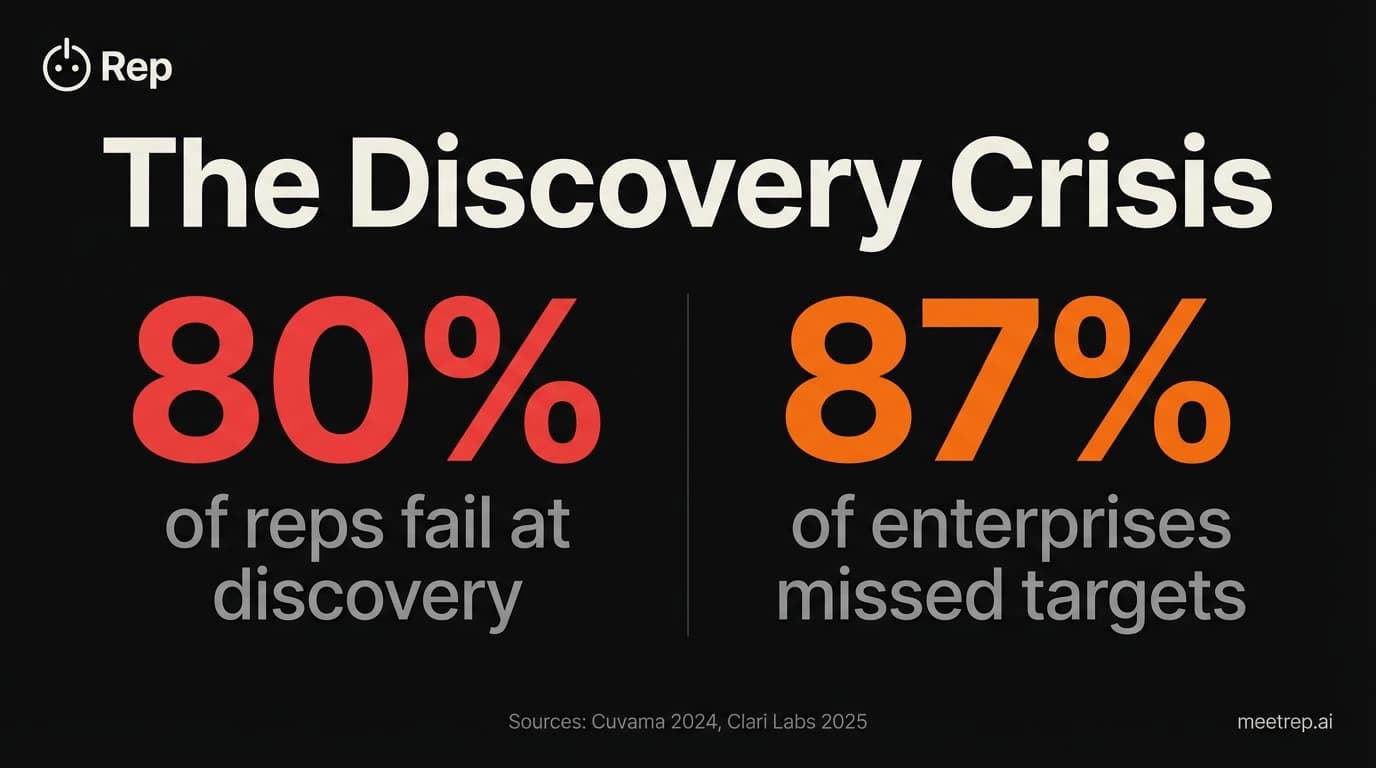
- The Problem: Cold call success has crashed to 2.3%; buyers ignore "interrogation" calls.
- The Shift: 61% of B2B buyers now prefer a rep-free experience for initial research.
- The Playbook: Move from "Ask then Demo" to "Demo while Asking."
- The Tool: Use AI agents to handle the initial discovery 24/7, reducing sales cycles by 2 weeks.
If you’re still running discovery calls like it’s 2023—asking 20 questions before showing the product—you’re losing deals.
The numbers are brutal. In 2025, cold call success rates plummeted to 2.3% (down from ~4.8% the previous year). That means 97.7% of your team's outbound effort is evaporating.
Why? Because buyers are exhausted.
They don’t want to be interrogated by a junior SDR who can’t answer technical questions. They want to see the product. And they want to see it now.
At Rep, we see this shift every day. The old playbook was about "gatekeeping" the demo until the prospect proved they were worthy. The new playbook is about visual discovery—using AI to answer questions and show value instantly, 24/7.
Here is how to master the discovery call in 2026.
The State of Discovery in 2026 (Why the Old Way Failed)
The traditional discovery call is failing because buyer behavior has fundamentally changed. Today, 61% of B2B buyers prefer a rep-free buying experience for their initial information gathering, according to Gartner's June 2025 report.
Think about your own behavior. When you look for software, do you want to schedule a 30-minute "qualification call" just to see the pricing page?
Of course not. You want answers immediately.
At GoCustomer.ai, we learned this the hard way. We tried to force prospects through a rigid qualification process. The result? Drop-offs. High-intent leads vanished because we made them wait.
In 2026, the "Gatekeeper Model" is dead.
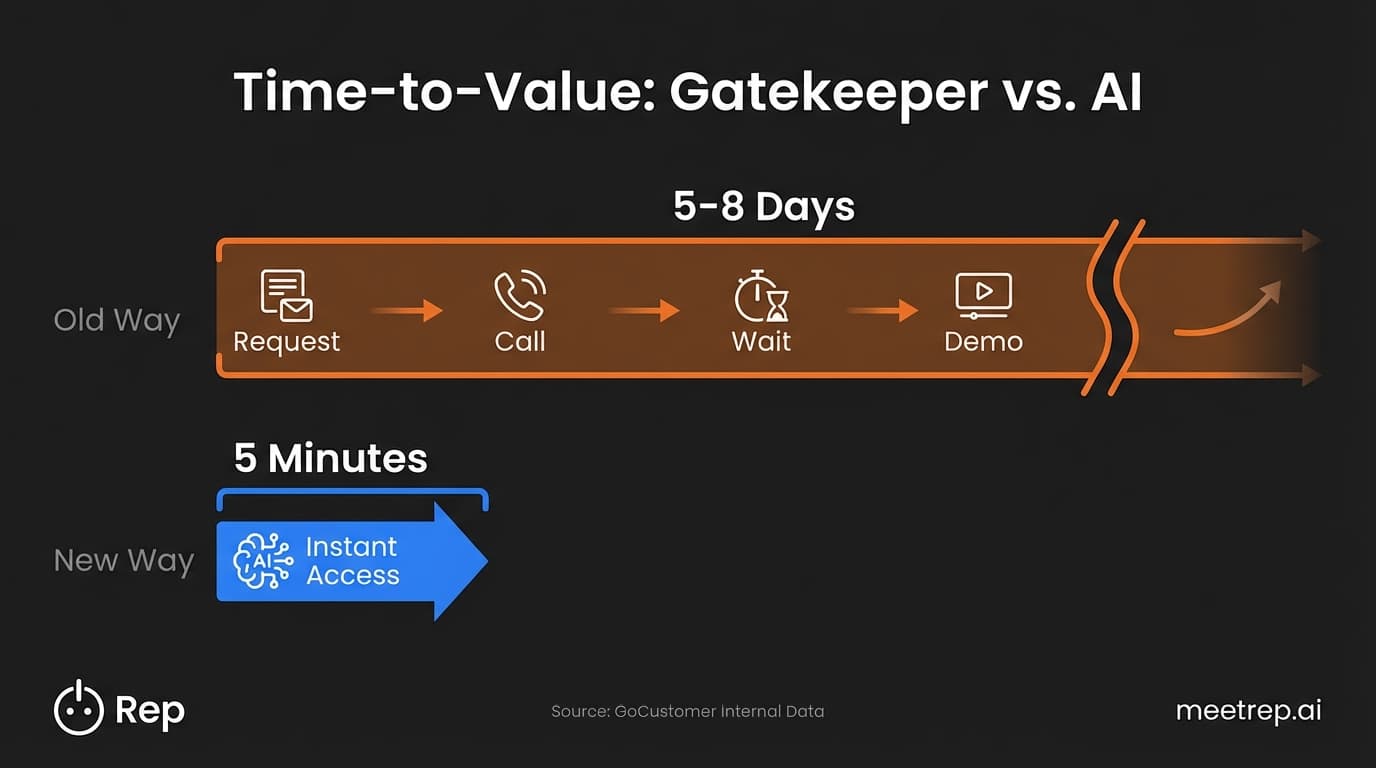
The Old Model (Gatekeeper):
- Prospect requests info.
- SDR schedules call (2-3 day delay).
- SDR asks BANT questions (Budget, Authority, Need, Timing).
- If qualified, SDR books demo with AE (another 3-5 day delay).
- Total Time: 5-8 days before prospect sees value.
The New Model (AI-Augmented):
- Prospect clicks "Demo Now" at 2:00 AM.
- AI Agent joins video room instantly.
- Agent asks qualification questions while navigating the product live.
- Agent books follow-up with human AE for complex negotiation.
- Total Time: 5 minutes to see value.
The Data: Sticking to traditional cold outreach is yielding half the results it did just one year ago. Saleshive and Cognism's 2025 data shows success rates dropped to 2.3%, creating a massive efficiency gap for teams that refuse to adapt.
The 2026 Discovery Framework: Visual, Instant, Autonomous
A modern discovery call is a bi-directional exchange where value is demonstrated while needs are assessed, often facilitated by AI to ensure zero wait time.
This isn't just about speed. It's about context.
The biggest mistake I see SDR managers make is separating "discovery" from "demo." They train reps to ask, ask, ask. But questions without value feel like an interrogation.
The "Visual Verification" Technique
Instead of asking, "Do you struggle with X?", the new playbook uses Visual Verification.
- Old Way: "Tell me about your reporting challenges."
- New Way (Visual): "Most clients struggle to get data out of Salesforce. Let me show you our one-click export feature—is this the kind of report you’re trying to build?"
This works because it proves competence immediately. It turns a quiz into a consultation.
We built Rep specifically for this. Unlike chatbots that just generate text, Rep uses Browser Automation. It actually logs into your web app, shares its screen, and clicks through the product.
If a prospect says, "I'm worried about security," Rep doesn't just read a script. It navigates to the admin settings and shows the SSO configuration page.
Key Insight: If you aren't showing the product during the first 5 minutes of a discovery call, you’re risking the deal. Buyers assume "no demo" means "vaporware."
The "Goldilocks Zone": 11-14 Questions & The Art of Listening
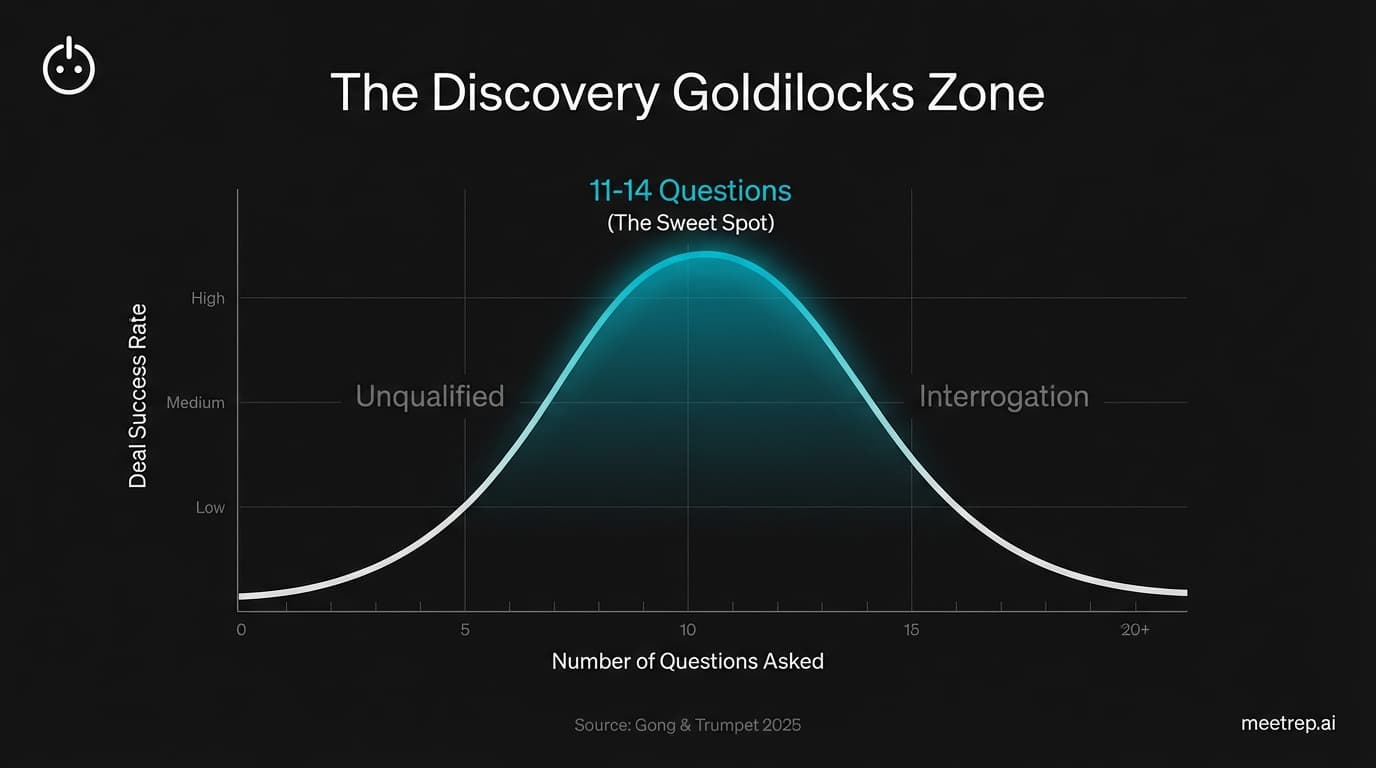
Top-performing salespeople ask between 11-14 questions during a discovery call. Any fewer, and you haven't qualified the deal. Any more, and the prospect feels interrogated.
This benchmark, originally identified by Gong and re-verified in 2025 sales literature, remains the gold standard.
But here is the problem: Humans are inconsistent.
On a Friday afternoon, an exhausted SDR might only ask 4 questions before rushing to book the meeting. Or they might get nervous and ask 25 questions, annoying the buyer.
Where AI Wins on Consistency
This is where AI agents shine. They never get tired. They never forget to ask about the budget. They never skip the "impact" question because they feel awkward.
When we designed Rep's conversation engine, we didn't just give it a script. We gave it a memory. It tracks which questions have been answered and which are still pending. If the prospect answers a question naturally during the intro ("We're looking to replace HubSpot next month"), Rep marks the "Timing" and "Competitor" questions as complete without asking them again.
The AI Discovery Checklist:
- Situation: "How are you handling [process] today?"
- Pain: "What happens when that breaks?"
- Implication: "How much time is your team losing on that?"
- Visual Proof: "If I could show you how to fix that in 2 minutes, would that be worth exploring?" (AI immediately shares screen).
Common Mistake: Asking questions that could be answered by LinkedIn or the company website. In 2026, AI tools (like Previsible's report shows) are scraping your site before the buyer even arrives. Your discovery call should focus on unspoken pain, not public facts.
Handling the "Rep-Free" Buyer (The AI Agent's Role)
By 2028, Gartner predicts that AI agents will outnumber human sellers by 10x.
This sounds terrifying to some sales leaders. It shouldn't be.
The goal isn't to replace your best Account Executives. The goal is to free them from the low-value work of qualifying inbound leads and explaining basic features.
Think about the "MOFU Squeeze"—that middle-of-funnel dead zone where leads go to die because they aren't quite ready for a sales call, but they need more than a whitepaper.
Case Study: High-Volume Discovery
Look at Heavys, a headphones brand for metalheads. They implemented AI agents to handle inbound inquiries.
The result? 95% of inquiries were handled entirely by the AI, leading to a 12% lift in conversion rates, according to a 2025 Shopify case study.
Or consider Sila, a fintech infrastructure company. They used Rep to engage website visitors. One rep increased their monthly SQLs by 50% simply by letting the AI handle the initial "cold call" discovery on the site.
The AI didn't close the million-dollar deal. But it did the discovery work to find the deal in the first place.
AI Agent vs. Human SDR: A Honest Comparison
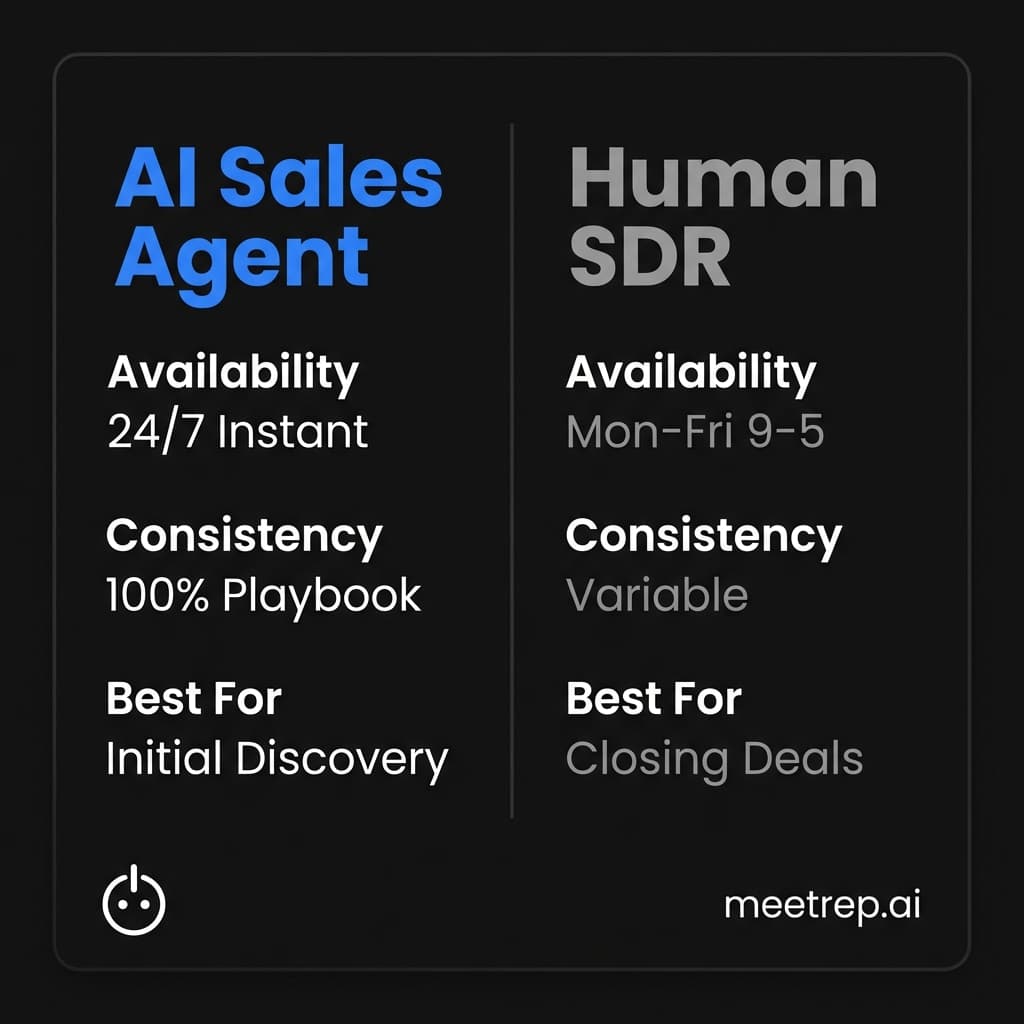
| Feature | AI Sales Agent (Rep) | Human SDR |
|---|---|---|
| Availability | 24/7/365 (Critical for global buyers) | 8 hours/day (Mon-Fri) |
| Response Time | Instant (<2 seconds) | Variable (hours to days) |
| Consistency | 100% Playbook Adherence | Varies by mood/energy |
| Memory | Infinite (Perfect Recall) | Limited (Needs CRM notes) |
| Best For | Initial Discovery, Demos, FAQ | Complex Negotiation, Relationship |
Avoiding the "Vaporware" Trap (Compliance & Trust)
We have to address the elephant in the room. The AI sales space has seen some ugly moments.
In August 2025, the FTC sued Air AI for deceptive claims about their capabilities and earnings potential, as reported by the FTC.
This lawsuit was a wake-up call for the industry.
It created a "Trust Gap." Buyers are wary of "AI SDRs" that promise to make millions while you sleep but actually just spam people with hallucinations.
My Recommendation: Don't buy "black box" AI tools that promise magic. Look for Agentic AI with Browser Automation.
Why this matters:
- Generative AI (Chatbots): Just predicts text. Can hallucinate facts. Dangerous for sales.
- Agentic AI (Rep): Navigates your actual product. It shows what exists. It's grounded in your real application.
When we built Rep, we focused on SOC2 compliance and Human-in-the-Loop training. You can upload your exact sales playbook, and the agent sticks to it. If it doesn't know an answer, it doesn't make one up—it checks your uploaded knowledge base or offers to loop in a human.
Measuring Success: Metrics That Matter in 2026
If you implement an AI-augmented discovery playbook, how do you know it's working?
Forget "Call Volume." That is a vanity metric from 2020. Here are the three metrics that actually predict revenue in 2026:
1. Speed to Lead (Target: <2 minutes) The old "5-minute rule" is now the "2-minute rule." If a prospect requests a demo, an AI agent should be speaking to them instantly.
2. Interactive Demo Completion Rate Are prospects staying for the show? According to Navattic's 2025 State of the Interactive Product Demo, prospects who view interactive demos get to sales calls two weeks faster than those who don't. You should aim for a >60% completion rate on your AI-led demos.
3. Discovery-to-Opportunity Conversion This is the ultimate test. Are the meetings booked by your AI agent actually qualified? At GoCustomer, we tracked this obsessively. High volume means nothing if the AEs reject the meetings.
Loss Framing: Every day a deal drags on past 50 days, your win probability drops by over half. Outreach's 2025 data shows that opportunities closed within 50 days have a 47% win rate, compared to <20% after that threshold. Speed is your only defense against deal rot.
The Future is Hybrid
The debate between "Human vs. AI" is the wrong conversation. The future is obviously hybrid.
Humans are unbeatable at empathy, complex negotiation, and reading the room during a crisis. AI is unbeatable at speed, data recall, and being awake at 3:00 AM.
The winning discovery playbook for 2026 uses AI to handle the "science" of sales—the qualification, the basic demo, the data entry—so your humans can focus on the "art."
Don't let your team burn out making 2.3% success-rate calls. Give them the tools to win.
Train your first AI Rep today and start showing your product 24/7.

Nadeem Azam
Founder
Software engineer & architect with 10+ years experience. Previously founded GoCustomer.ai.
Nadeem Azam is the Founder of Rep (meetrep.ai), building AI agents that give live product demos 24/7 for B2B sales teams. He writes about AI, sales automation, and the future of product demos.
Frequently Asked Questions
Table of Contents
- The State of Discovery in 2026 (Why the Old Way Failed)
- The 2026 Discovery Framework: Visual, Instant, Autonomous
- The "Goldilocks Zone": 11-14 Questions & The Art of Listening
- Handling the "Rep-Free" Buyer (The AI Agent's Role)
- Avoiding the "Vaporware" Trap (Compliance & Trust)
- Measuring Success: Metrics That Matter in 2026
- The Future is Hybrid
Ready to automate your demos?
Join the Rep Council and be among the first to experience AI-powered demos.
Get Early AccessRelated Articles
Hexus Acquired by Harvey AI: Congrats & What It Means for Demo Automation Teams
Hexus is shutting down following its acquisition by Harvey AI. Learn how to manage your migration and discover the best demo automation alternatives before April 2026.
Why the "Software Demo" is Broken—and Why AI Agents Are the Future
The traditional software demo is dead. Discover why 94% of B2B buyers rank vendors before calling sales and how AI agents are replacing manual demos to scale revenue.
Why Autonomous Sales Software is the Future of B2B Sales (And Why the Old Playbook is Dead)
B2B sales is at a breaking point with quota attainment at 46%. Discover why autonomous 'Agentic AI' is the new standard for driving revenue and meeting the demand for rep-free buying.