Mastering Sales Discovery Questions: The 2026 Playbook (Backed by Data)

Executive Summary
- The Magic Number: The optimal number of questions per call is 11–14.
- The Shift: Buyers are 70% through their process before talking to you. Don't ask what you can Google.
- The Risk: Without deep discovery, you miss the 6.7 stakeholders needed to close.
- The AI Edge: Teams using AI for discovery see 77% higher revenue per rep.
The average B2B sales cycle has lengthened by 22% since 2022. Deals are stalling. Buyers are ghosting. And if your team is still running discovery calls like they did three years ago, you're in trouble.
I’ve seen this firsthand. At GoCustomer, and now building Rep, I've watched millions of interactions. The data is clear: buyers don't want a brochure. They’ve already done their research. They want a diagnosis.
If your reps are asking, "So, tell me about your budget," they aren't doing discovery. They're doing data entry. And that's why you're losing deals.
Here is the data-backed playbook for asking sales discovery questions that actually convert.
The State of Discovery in 2026 (Why Old Scripts Fail)
Sales discovery questions are the diagnostic tools used to uncover a prospect's core challenges, Cost of Inaction (COI), and urgency. In 2026, effective discovery isn't about gathering data—it's about creating a gap between the customer's current state and their potential future.
Why the shift? Because the "Growth Squeeze" is real. Win rates have dropped to roughly 21%.
Buyers are skeptical. They prefer a "rep-free" experience. According to Gartner, 75% of B2B buyers now prefer to avoid sales reps entirely.
That hurts to read, right?
But here's the catch. They don't hate sales. They hate bad sales. They hate being interrogated about things they could have just filled out on a form.
If your discovery call feels like an interrogation, you lose. If it feels like a consultation, you win.
Key Insight: Discovery is no longer about you qualifying them. It's about you helping them qualify their own problem.
The Magic Number: How Many Questions Should You Ask?
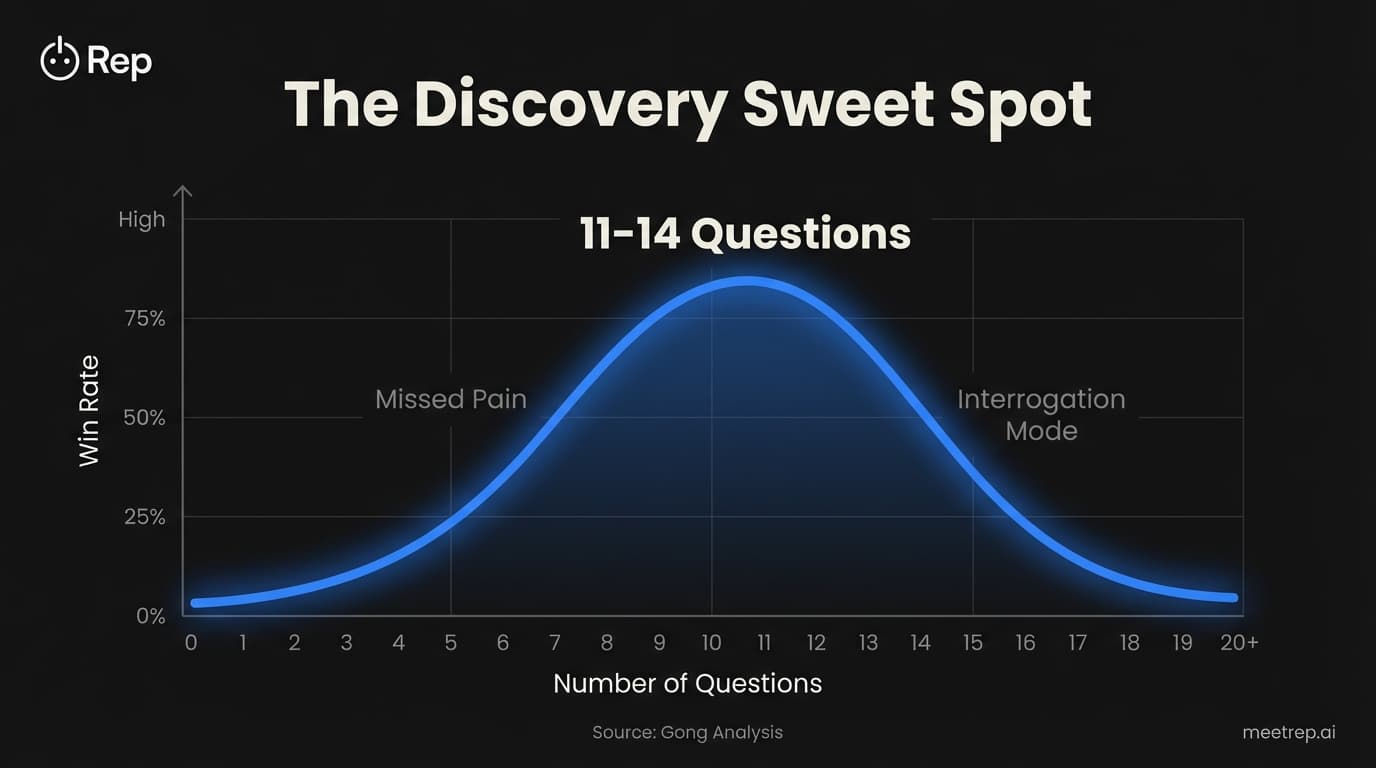
11 to 14 questions.
That’s the sweet spot. Data from GrowthList and Gong analysis shows that win rates peak when reps ask between 11 and 14 targeted questions.
Ask fewer than 11? You haven't uncovered enough pain to justify the purchase. Ask more than 14? You're interrogating the witness.
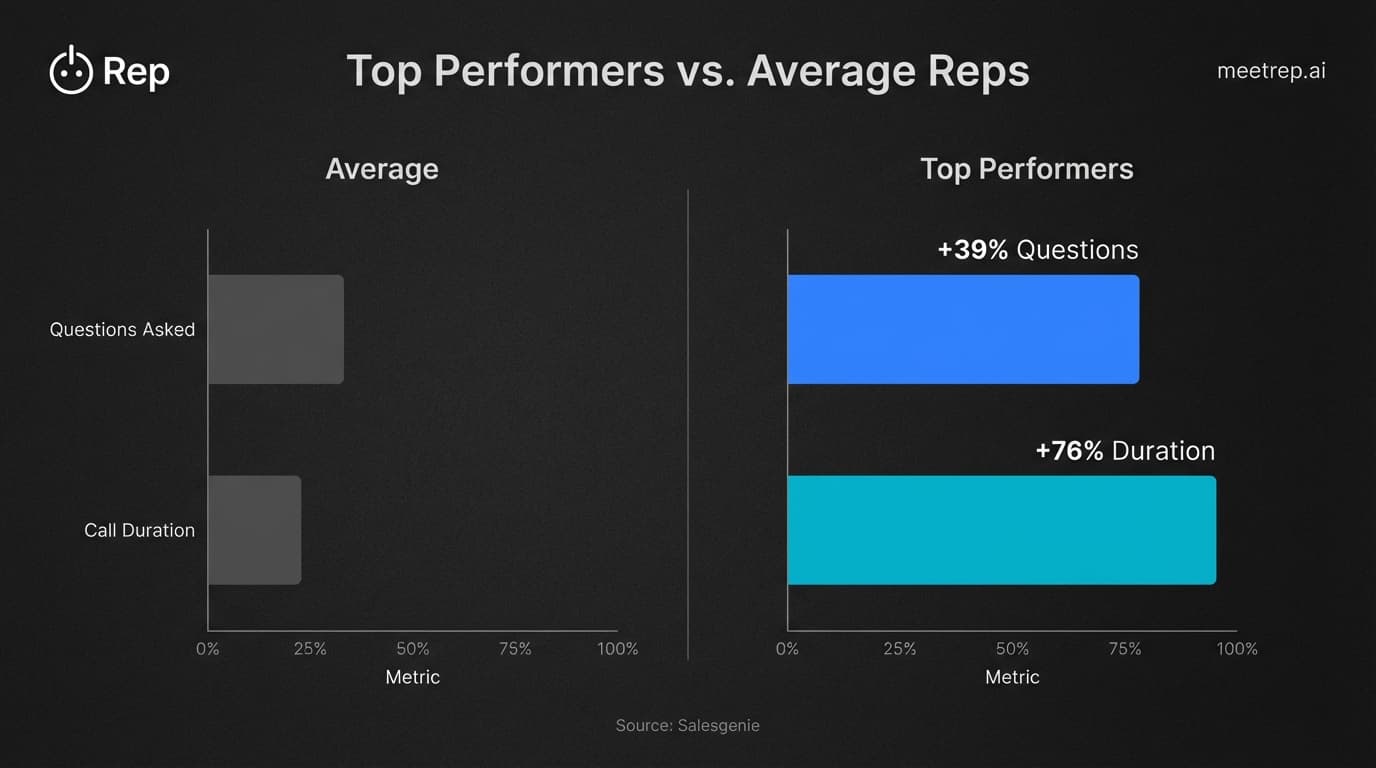
Quantity vs. Quality: It’s not just about hitting a number. Salesgenie data reveals that top-performing reps ask 39% more questions than their peers. But critically, their calls are also 76% longer.
They aren't firing off questions rapid-fire. They are asking a question, listening to the answer, and then digging deeper.
Common Mistake: Don't confuse "discovery" with "qualification." Qualification is for you (budget, timeline). Discovery is for them (pain, solution, future state).
The 4-Part Discovery Framework
Scripts make you sound like a robot. Frameworks make you sound like an expert.
At Rep, we train our autonomous AI agents on this exact flow. Why? Because it works. It moves the conversation from surface-level chatter to deep business impact.
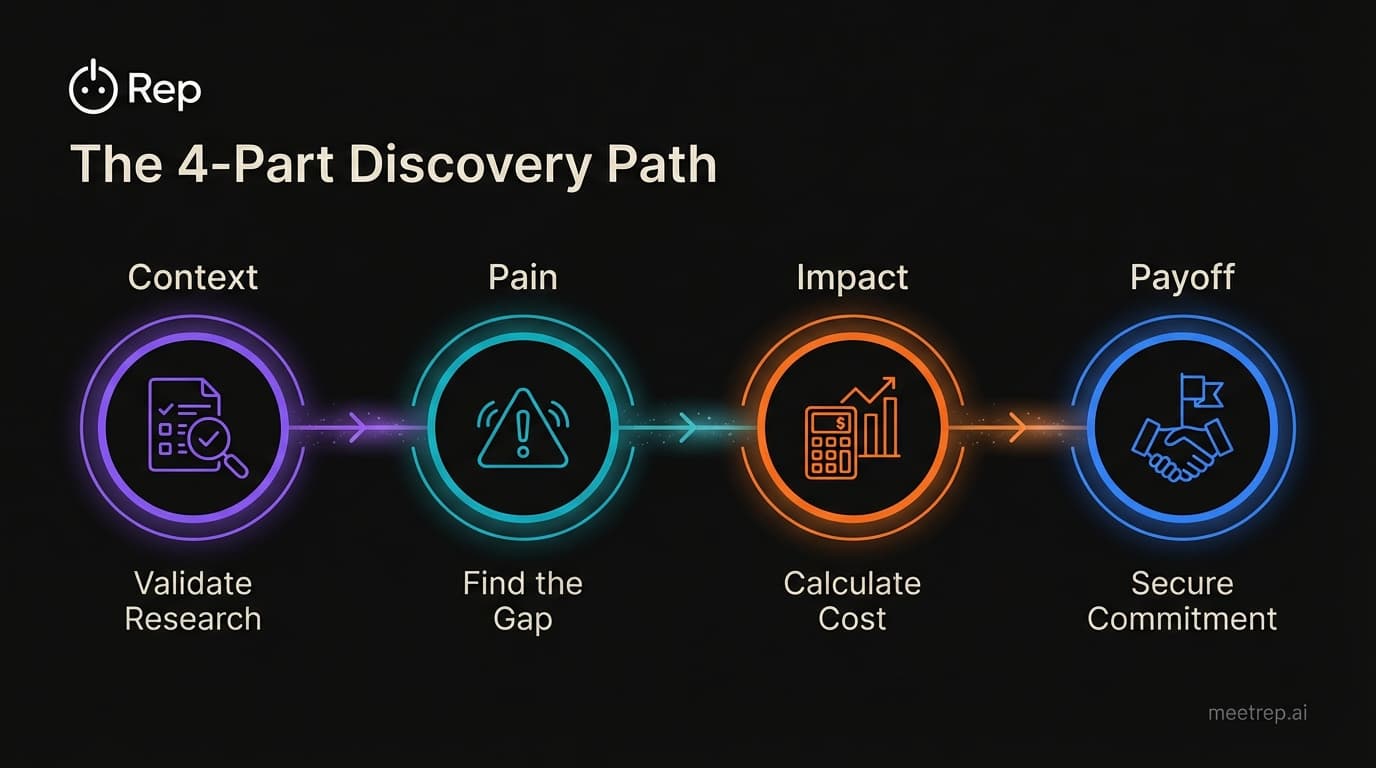
| Phase | Goal | The "Why" |
|---|---|---|
| 1. Context & Situation | Validate research. Establish baseline. | Show you did your homework. Don't ask "What do you do?" |
| 2. Problem & Pain | Uncover the gap between current and desired state. | No pain = no sale. You must find the friction. |
| 3. Impact & Implication | Calculate the Cost of Inaction (COI). | Quantify the pain. "What does this cost you annually?" |
| 4. Payoff & Next Steps | Secure the commitment. | Move to solution. Get the demo booked. |
Phase 1: Context (Don't Be Lazy)
Use tools to research beforehand. If you ask a VP "How big is your team?" when LinkedIn lists it clearly, you've lost credibility in seconds.
Instead try: "I saw on LinkedIn your team grew by 20% last quarter. Has your onboarding process kept up with that pace?"
Phase 2: Pain (The Gap)
This is where deals are won. You need to find the gap between where they are and where they want to be. Most reps stop at "we have a manual process." Top reps ask, "And why is that manual process unsustainable now?"
Phase 3: Impact (The Hurt)
Pain isn't enough. A scraped knee is pain; a broken leg is impact. You need to find the broken leg. This is where you bring in the other stakeholders—remember, the average deal now involves 6.7 people. If you don't ask about them, you're selling in a vacuum.
Phase 4: Payoff
Paint the picture of the future. "If we could fix X, what would that mean for your Q3 goals?" This isn't about your features. It's about their promotion, their bonus, or their sanity.
20 Power Questions for 2026 (Categorized)
Stop asking "What keeps you up at night?" Everyone hates that question. It's lazy. Try these instead.
The Opener Questions
- "I saw [Company] just released [News/Feature]. How is that impacting your team's workload?" (Shows you did research).
- "Most [Role] I talk to are struggling with [Industry Challenge]. Is that hitting you too, or do you have it handled?" (Uses social proof to lower their guard).
- *"What triggered you to look into this now versus six months ago?"* (Identifies the compelling event).
The Problem-Mining Questions
- "Walk me through your current process for X. Where does it usually break down?"
- "On a scale of 1 to 10, how confident are you in your current data accuracy?"
- "How much time is your team spending on [manual task] each week?"
- "What’s the biggest barrier stopping you from hitting your Q3 targets?"
- "If you had a magic wand, what one part of your workflow would you erase?" (Great for finding the emotional pain point).
The Impact & Cost of Inaction Questions (Critical)
These are the most important questions on the list.
- "What happens if you don't solve this problem by next quarter?" (My personal favorite).
- "Have you tried to fix this before? Why didn't it work?"
- "Who else is this problem impacting? Does the CFO know this is costing $X?"
- "If this issue persists, how does it affect your personal goals for the year?"
- "What are you sacrificing to keep the current process running?"
The "Buying Vision" Questions
- "Who else needs to see this to make it a priority?"
- "How does your organization typically buy software like this?"
- "What would a 'home run' look like for this project?"
- "If we prove we can solve X, is there any reason we couldn't move forward?"
Hot Take: If you aren't asking "What happens if you do nothing?", you aren't selling. You're just presenting. Status quo is your biggest competitor, not your rival vendor.
Deploying AI for "Always-On" Discovery
Here's the hard truth: your team needs to sleep. Your buyers don't.
We know from Cognism's data that the average cold call lasts just 93 seconds. That is not enough time for deep discovery.
Real discovery often happens when the prospect is researching on their own—at 8 PM, on their phone. This is where "Agentic AI" changes the game.
At Rep, we've seen this shift firsthand. Companies like NutraBio deployed an AI agent to handle inbound inquiries. The agent didn't just answer FAQs; it asked discovery questions.
The result? An 11.46% conversion rate and a 10% higher Average Order Value.
Why? Because the AI asked the right questions at the exact moment the buyer was interested.
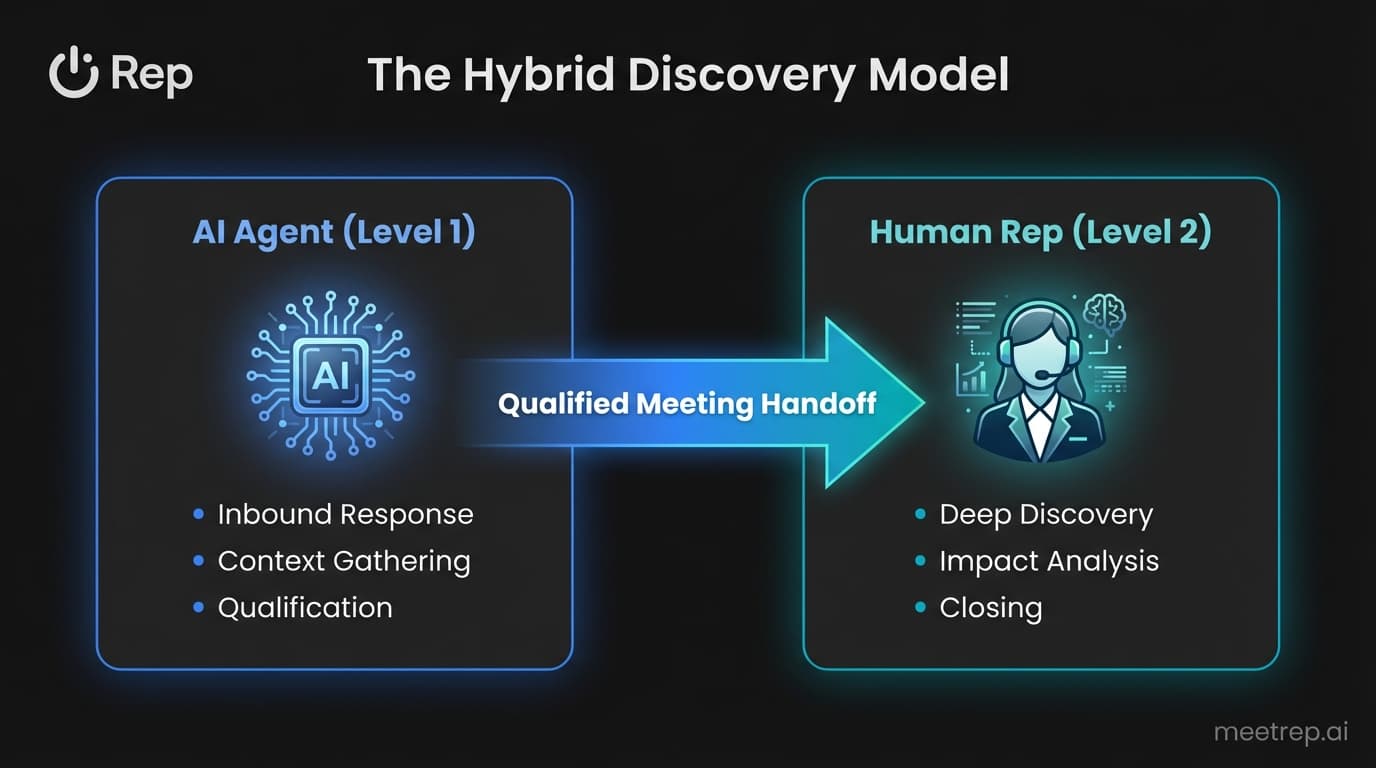
The Hybrid Model:
- AI Agents handle the initial inbound discovery (24/7), asking the "Level 1" context questions.
- Human Reps receive the qualified meeting with all the context, allowing them to jump straight to "Level 2" Impact and Payoff questions.
This isn't theory. Gong reports that sales teams frequently using AI generate 77% more revenue per rep.

Nadeem Azam
Founder
Software engineer & architect with 10+ years experience. Previously founded GoCustomer.ai.
Nadeem Azam is the Founder of Rep (meetrep.ai), building AI agents that give live product demos 24/7 for B2B sales teams. He writes about AI, sales automation, and the future of product demos.
Frequently Asked Questions
Table of Contents
- The State of Discovery in 2026 (Why Old Scripts Fail)
- The Magic Number: How Many Questions Should You Ask?
- The 4-Part Discovery Framework
- 20 Power Questions for 2026 (Categorized)
- Deploying AI for "Always-On" Discovery
Ready to automate your demos?
Join the Rep Council and be among the first to experience AI-powered demos.
Get Early AccessRelated Articles
Hexus Acquired by Harvey AI: Congrats & What It Means for Demo Automation Teams
Hexus is shutting down following its acquisition by Harvey AI. Learn how to manage your migration and discover the best demo automation alternatives before April 2026.
Why the "Software Demo" is Broken—and Why AI Agents Are the Future
The traditional software demo is dead. Discover why 94% of B2B buyers rank vendors before calling sales and how AI agents are replacing manual demos to scale revenue.
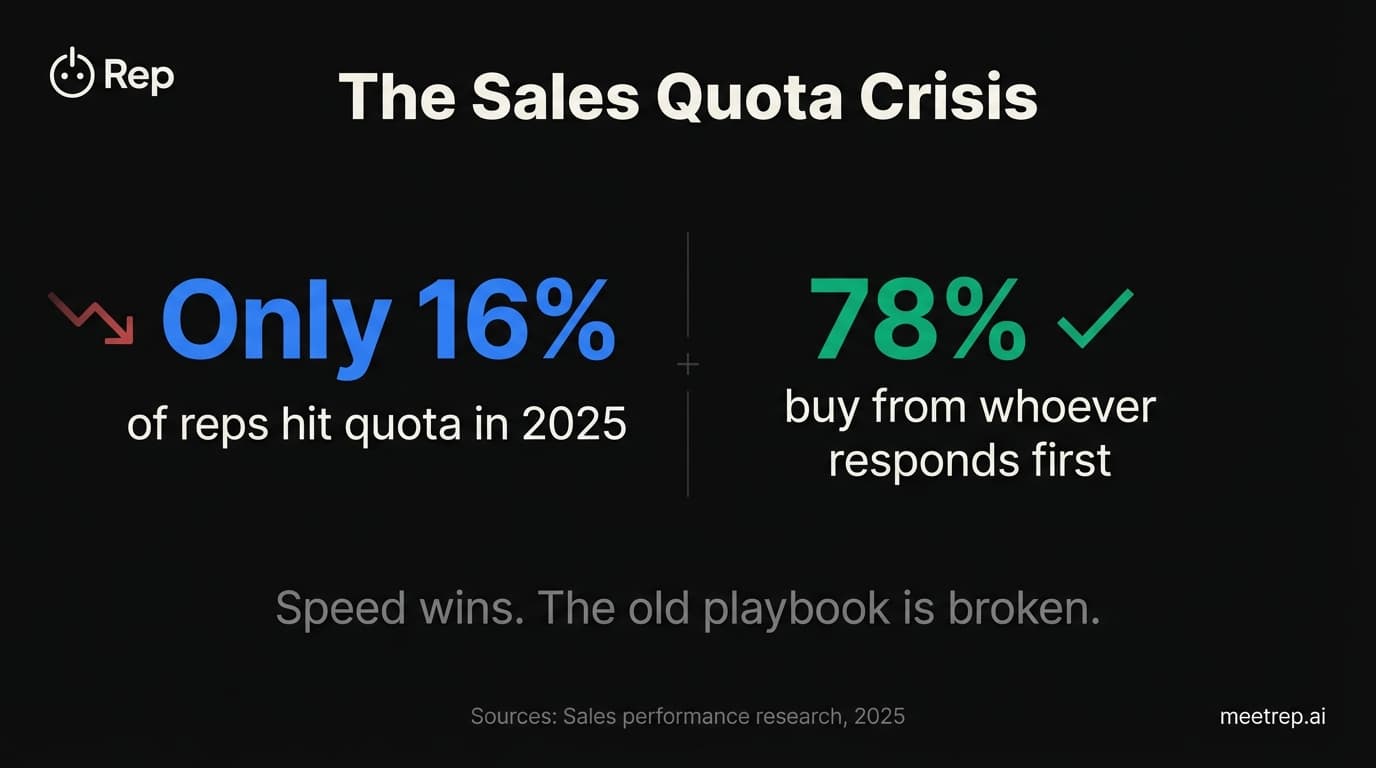
Why Autonomous Sales Software is the Future of B2B Sales (And Why the Old Playbook is Dead)
B2B sales is at a breaking point with quota attainment at 46%. Discover why autonomous 'Agentic AI' is the new standard for driving revenue and meeting the demand for rep-free buying.