Live vs Interactive vs Video Demos: Which Format Converts Best?

Executive Summary
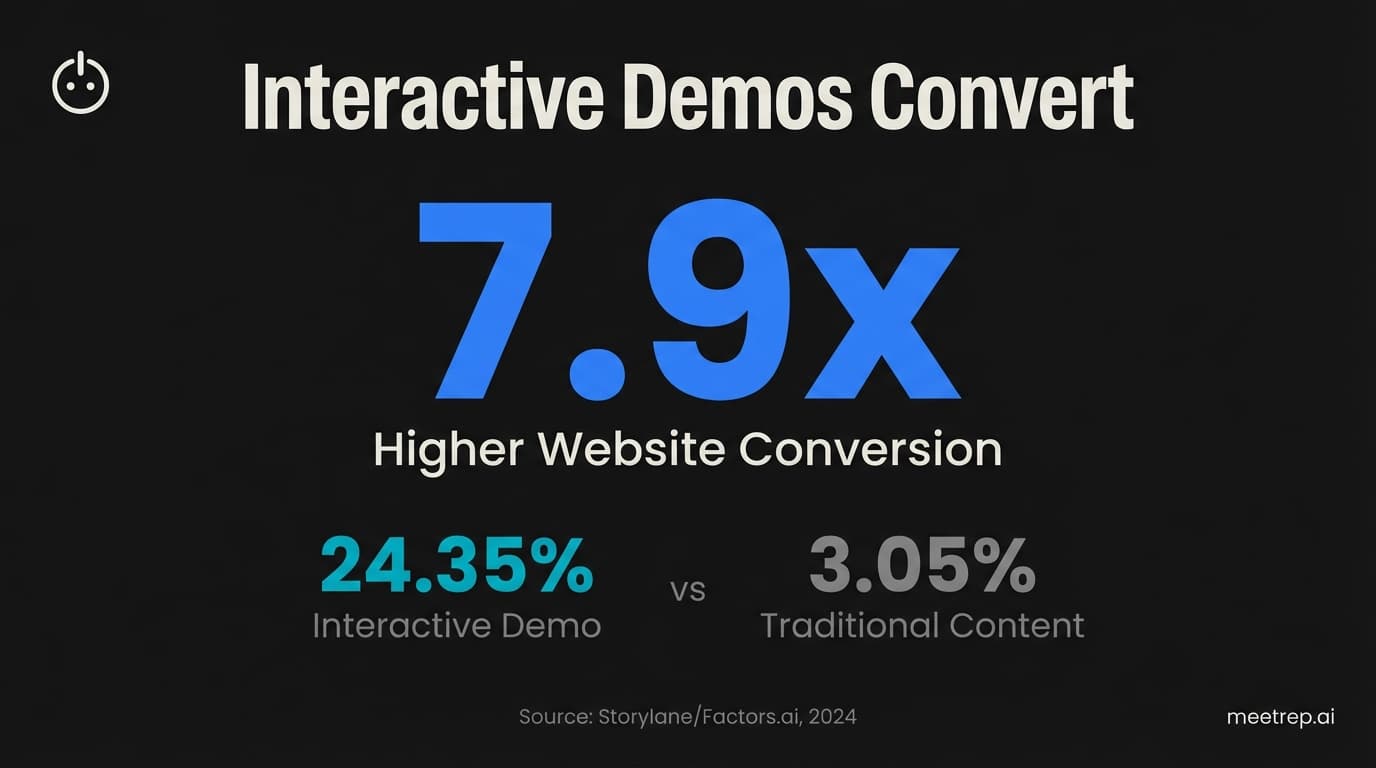
- Interactive demos achieve 7.9x higher website conversion than static content (24.35% vs 3.05%)
- Live demos still win for high-value enterprise deals—but 30-50% of live demos to unqualified prospects
- Video excels at top-of-funnel awareness (70% of buyers watch video during purchase)
- The smartest teams use all three formats mapped to buyer journey stages
Your prospects don't want to wait 10 days for a demo. And honestly? Your SEs don't want to give the same intro presentation for the 47th time this quarter.
Here's what's actually happening: 61% of B2B buyers now prefer rep-free experiences. But the same Gartner research shows deal quality jumps 1.8x when buyers use digital tools alongside human reps. So which demo format wins?
I've spent the last few years building sales automation tools—first at GoCustomer.ai, now at Rep. And the answer isn't what most comparison articles tell you. It's not live vs. interactive. It's knowing when to use each.
This guide breaks down the real conversion data, the honest trade-offs, and a framework for choosing the right format at each stage of your buyer's journey.
What Is an Interactive Demo?
An interactive demo is a self-guided, clickable product experience that lets prospects explore your software without a sales rep. Unlike passive video or scheduled live calls, interactive demos use captured HTML/CSS or screenshots to simulate your actual product environment—users click through, navigate features, and learn at their own pace.
The category has exploded. According to Navattic's 2025 State of the Demo report, "Take a Tour" CTAs grew 29.2% year-over-year across B2B websites. That's not a trend. That's a fundamental shift in how buyers want to evaluate software.
Tools like Navattic, Storylane, Arcade, and Walnut dominate this space, each with different approaches—some capture HTML, others use screenshots, some create sandbox environments.
Key Insight: Gartner's 2025 Hype Cycle rates interactive demo applications as "High benefit" with "Adolescent maturity"—meaning proven value, growing adoption, and room to mature.
But here's my take: interactive demos aren't a silver bullet. They're exceptional for certain use cases and mediocre for others. Let's look at the actual numbers.
Interactive Demos Convert 7.9x Higher—Here's the Data
The most rigorous conversion study I've found comes from Storylane and Factors.ai, analyzing 110,257 web sessions and 150 closed deals. That sample size matters.
The headline numbers:
| Metric | Interactive Demo | Without Interactive Demo | Improvement |
|---|---|---|---|
| Website Conversion | 24.35% | 3.05% | 7.9x higher |
| Deal Conversion | 10.1% | 3.1% | 3.2x higher |
| Sales Cycle Length | 27 days | 33 days | 18% shorter |
And the Optifai benchmark study (939 B2B companies) found that organizations using interactive demos hit 38% demo-to-close rates versus the 25% industry average.
The Data: Companies with interactive demos on their websites convert at 24.35%—nearly 8x the 3.05% conversion rate for traditional content. Source: Storylane/Factors.ai, October 2024.
Why such a massive lift?
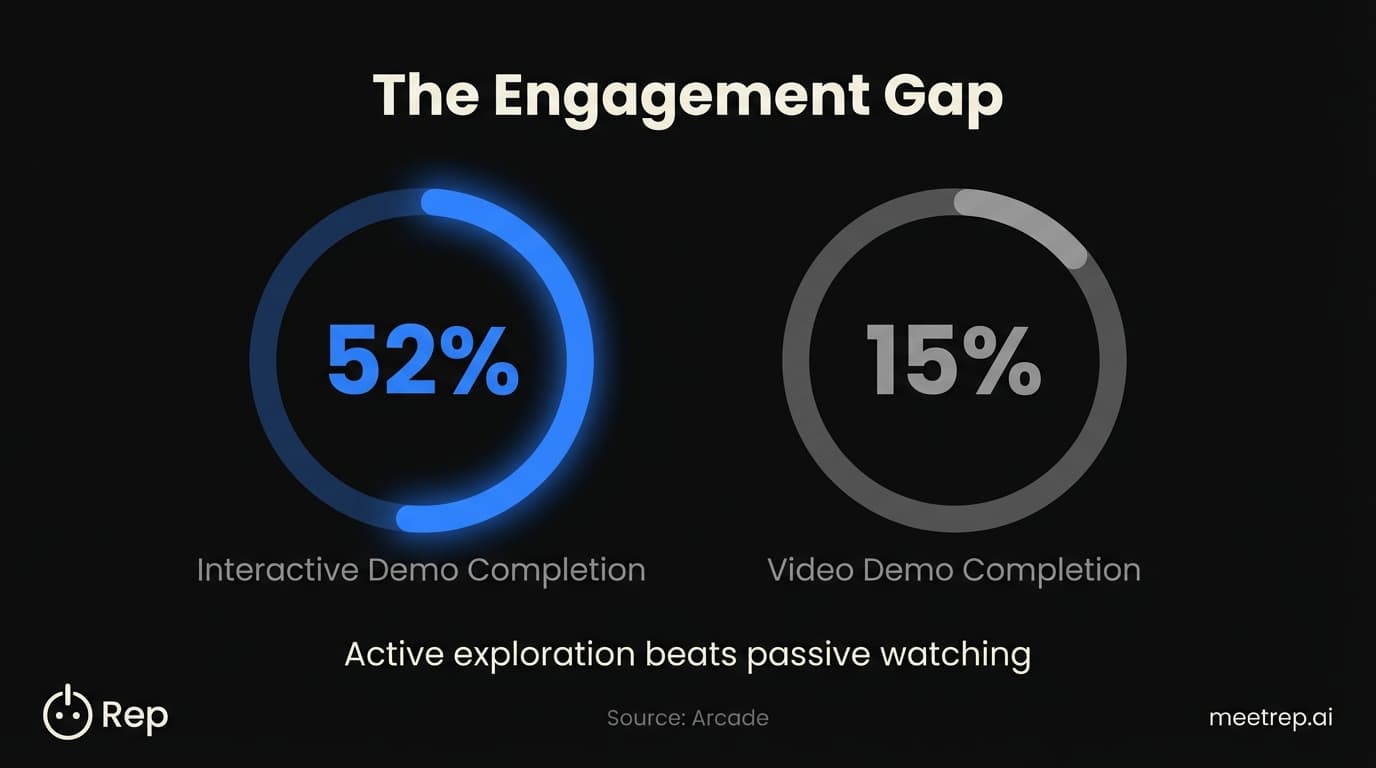
The engagement difference is dramatic. Arcade's research shows interactive demos achieve 52% completion rates versus roughly 15% for video. Users don't just watch. They click, explore, and engage.
That active exploration creates something video can't: behavioral data. You can see which features prospects clicked, where they spent time, and where they dropped off. That intelligence shapes your live conversations when they happen.
Real results from real companies:
Klue (competitive intelligence platform) generated $550,000+ in pipeline within 60 days of launching their interactive demo center—with a 3x increase in demo requests.
Labelbox saw 30% more MQLs and a 9x increase in homepage CTA clicks after implementing interactive demos.
Zapier increased booked meetings by 70% on their Workflows page using interactive demos.
These aren't small improvements. But before you rip out your live demo program, let's talk about when human-led demos still matter.
When Live Demos Still Win (And When They Don't)
Live demos aren't dead. But they're badly misallocated.
Here's the uncomfortable stat: 30-50% of live demos go to unqualified prospects. That means your SEs—your most expensive pre-sales resource—spend half their time on people who will never buy.
And it gets worse. The Presales Collective reports that SEs spend up to 21 days per year just maintaining demo environments. Not running demos. Maintaining them.
Common mistake: Treating every inbound demo request the same. When 23% of your SEs report that more than half their weekly demos are to unqualified prospects, something's broken.
When live demos still outperform:
| Scenario | Why Live Wins |
|---|---|
| Enterprise deals ($100K+) | Complex requirements need real-time customization |
| Multi-stakeholder evaluation | Live Q&A builds consensus |
| Technical deep-dives | SEs can adapt to unexpected questions |
| Relationship-driven sales | Trust building requires human connection |
Gartner's research backs this up: buyers are 1.8x more likely to complete high-quality deals when they use digital tools alongside sales reps. The key word is "alongside." Not instead of.
When live demos hurt you:
Buyers wait an average of 6-10 days to get a live demo. In that window, your competitor with an instant interactive demo is engaging the prospect while you're playing calendar Tetris.
Look, I get it—live demos feel more controlled. But the math doesn't lie. My recommendation: Use interactive demos to qualify and educate. Reserve live demos for the 50-70% of prospects who are actually worth SE time.
Video Demos: Best for Awareness, Worst for Conversion
Video demos serve a different purpose entirely. They're passive, linear, and one-to-many. That's not a flaw—it's a feature for certain use cases.
According to Google research (via Vidico), 70% of B2B buyers watch video during their purchase journey. And Broadcast2World's 2024 survey found 57% of businesses create product demo videos, with 45% reporting good ROI.
But here's the engagement gap: Arcade's data shows video achieves just 3.21% average CTR versus 67% for top-performing interactive demos. That's a 20x difference in click engagement.
Completion tells a similar story. Interactive demos hit 52% completion. Video? About 15%.
Hot take: Most "demo videos" should be called "awareness videos." They introduce your product. They don't demonstrate it—not in any meaningful hands-on way.
Where video actually excels:
Video wins when you need scale without interaction. Social media distribution. Product launches. Evergreen YouTube content. Quick overviews under two minutes.
Quantum Metric found interactive demos were 10x faster to create than professional video while doubling their demo page conversions. That production cost difference matters for resource-strapped teams.
The practical trade-off:
| Factor | Interactive Demo | Video Demo |
|---|---|---|
| Engagement | 52% completion | ~15% completion |
| Production Time | Hours | Days to weeks |
| Personalization | Can create variants | Same content for everyone |
| Distribution | Website, email | Social, YouTube, ads |
| Analytics | Feature-level engagement | Watch time, drop-off |
Use video for top-of-funnel awareness. Use interactive demos for mid-funnel education and qualification. This isn't controversial—it's just matching format to purpose.
The Fourth Category: AI-Powered Live Demos
Most comparison articles ignore this entirely. But there's an emerging category that combines the scalability of interactive demos with the conversational depth of live demos: autonomous AI demo agents.
Gartner predicts AI agents will outnumber human sellers 10x by 2028. And 82% of organizations plan to integrate AI agents within 1-3 years.
Why we built Rep this way: At Rep, we're building AI agents that join video calls, share their screen, navigate your actual product, and have real conversations with prospects. Not chatbots. Autonomous agents that run live demos 24/7.
This category matters because it addresses the core limitation of interactive demos: they can't answer questions in real-time. And it addresses the core limitation of live demos: they don't scale.
Early results from the market:
TBI Bank deployed an AI voice sales agent that handled 10,000 leads daily, generating over $1M in incremental revenue—with only 1% of users detecting it was AI.
Solda.ai reports these systems run at roughly 50% the cost of traditional teams for routine qualification and demo tasks.
I'm obviously biased here—this is exactly what we're building. But the data suggests this isn't a niche category. It's the future of how demos get delivered at scale.
How to Choose: A Decision Framework
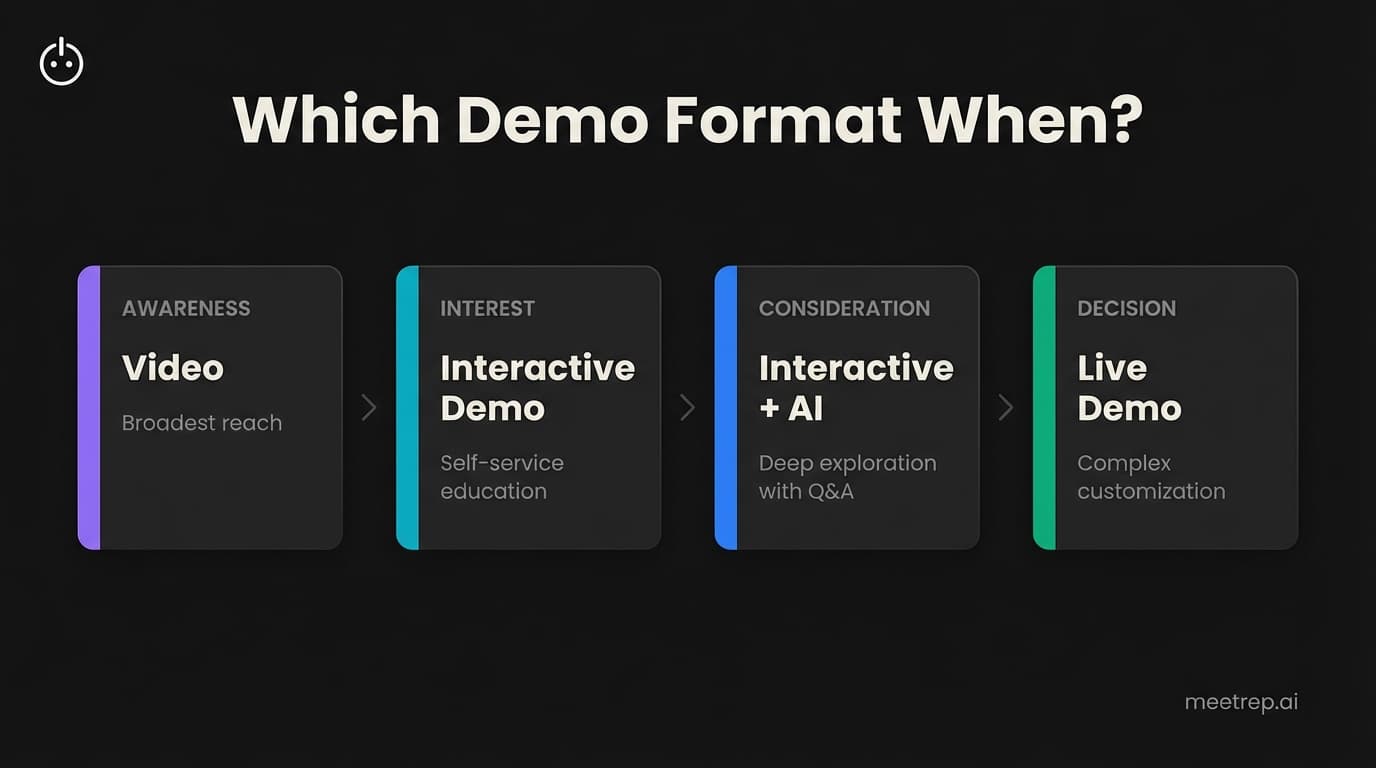
Stop asking "which demo format is best?" Start asking "which format for which situation?"
| Buyer Stage | Best Format | Why |
|---|---|---|
| Awareness (don't know you exist) | Video | Broadest reach, lowest friction |
| Interest (researching solutions) | Interactive Demo | Self-service education, instant access |
| Consideration (comparing options) | Interactive Demo + AI Agent | Deeper exploration, Q&A capability |
| Decision (ready to buy) | Live Demo | Complex customization, consensus building |
The qualification filter:
Interactive demos work as a filter, not a replacement. When prospects engage with an interactive demo, you learn:
- Which features they explored (buyer intent signal)
- Where they dropped off (objection indicator)
- How long they spent (interest level)
This intelligence makes your live demos more effective. You're not starting from zero—you know what matters to them.
What we learned building Rep: The biggest mistake teams make is treating "demo request" as a binary. Some requests need a 45-minute deep-dive with your senior SE. Others need a 5-minute feature overview. Format should match the ask.
My recommendation for most B2B SaaS teams:
- Put interactive demos on your website (address the 61% who prefer rep-free research)
- Use video for social and top-of-funnel campaigns
- Reserve live demos for qualified, high-value opportunities
- Explore AI agents for after-hours coverage and high-volume qualification
This isn't about replacing one format with another. It's about portfolio allocation.
The demo format wars miss the point. This isn't about picking a winner—it's about deploying the right format at the right moment.
Your buyers spend only 17% of their journey talking to your team. The other 83% happens without you. Interactive demos, video, and AI agents let you show up in that invisible window.
And here's my prediction: within two years, teams that still rely exclusively on scheduled live demos will lose deals to competitors who offer instant access. The data already shows it happening.
If you want to see what AI-powered live demos look like, Rep is building exactly that—autonomous agents that join calls and demo your product 24/7. Worth exploring if you're hitting the scaling wall with SE capacity.

Nadeem Azam
Founder
Software engineer & architect with 10+ years experience. Previously founded GoCustomer.ai.
Nadeem Azam is the Founder of Rep (meetrep.ai), building AI agents that give live product demos 24/7 for B2B sales teams. He writes about AI, sales automation, and the future of product demos.
Frequently Asked Questions
Table of Contents
- What Is an Interactive Demo?
- Interactive Demos Convert 7.9x Higher—Here's the Data
- When Live Demos Still Win (And When They Don't)
- Video Demos: Best for Awareness, Worst for Conversion
- The Fourth Category: AI-Powered Live Demos
- How to Choose: A Decision Framework
Ready to automate your demos?
Join the Rep Council and be among the first to experience AI-powered demos.
Get Early AccessRelated Articles
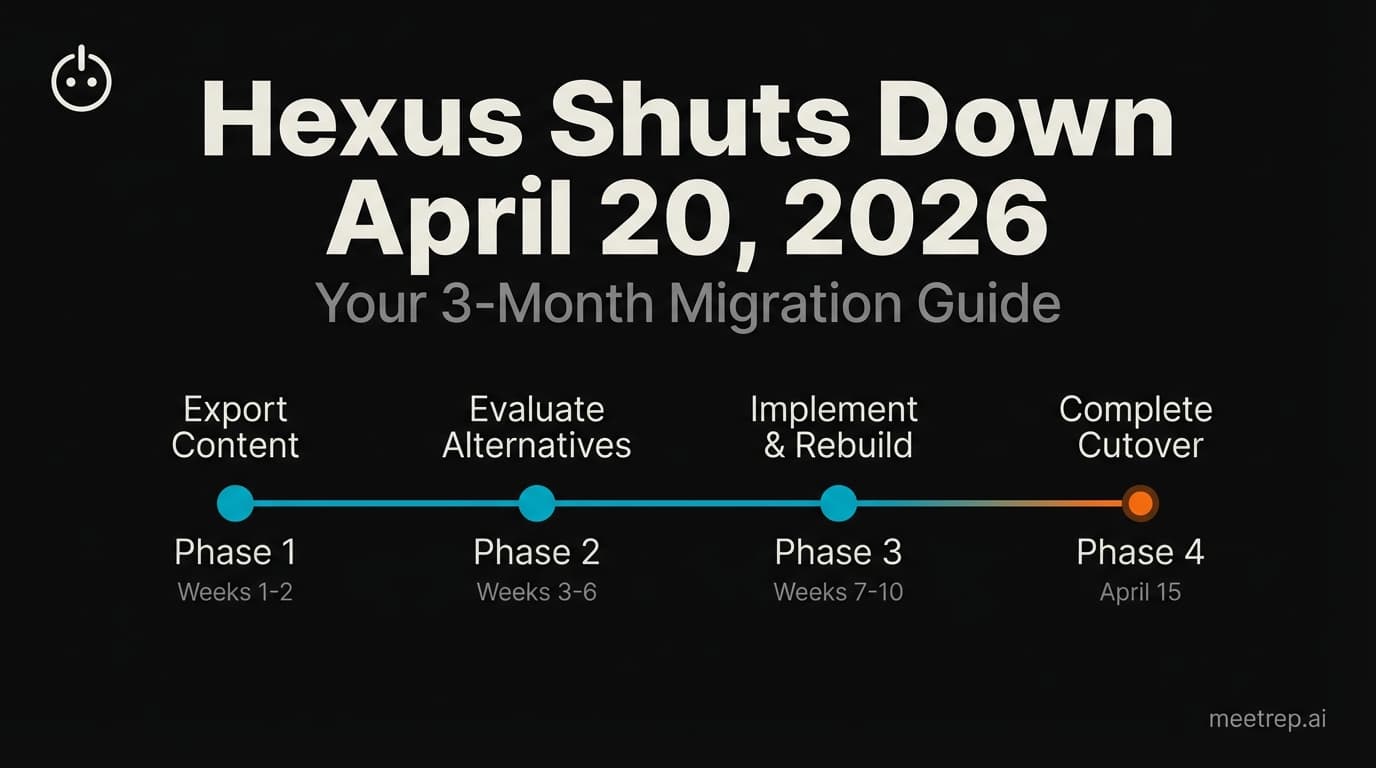
Hexus Acquired by Harvey AI: Congrats & What It Means for Demo Automation Teams
Hexus is shutting down following its acquisition by Harvey AI. Learn how to manage your migration and discover the best demo automation alternatives before April 2026.
Why the "Software Demo" is Broken—and Why AI Agents Are the Future
The traditional software demo is dead. Discover why 94% of B2B buyers rank vendors before calling sales and how AI agents are replacing manual demos to scale revenue.
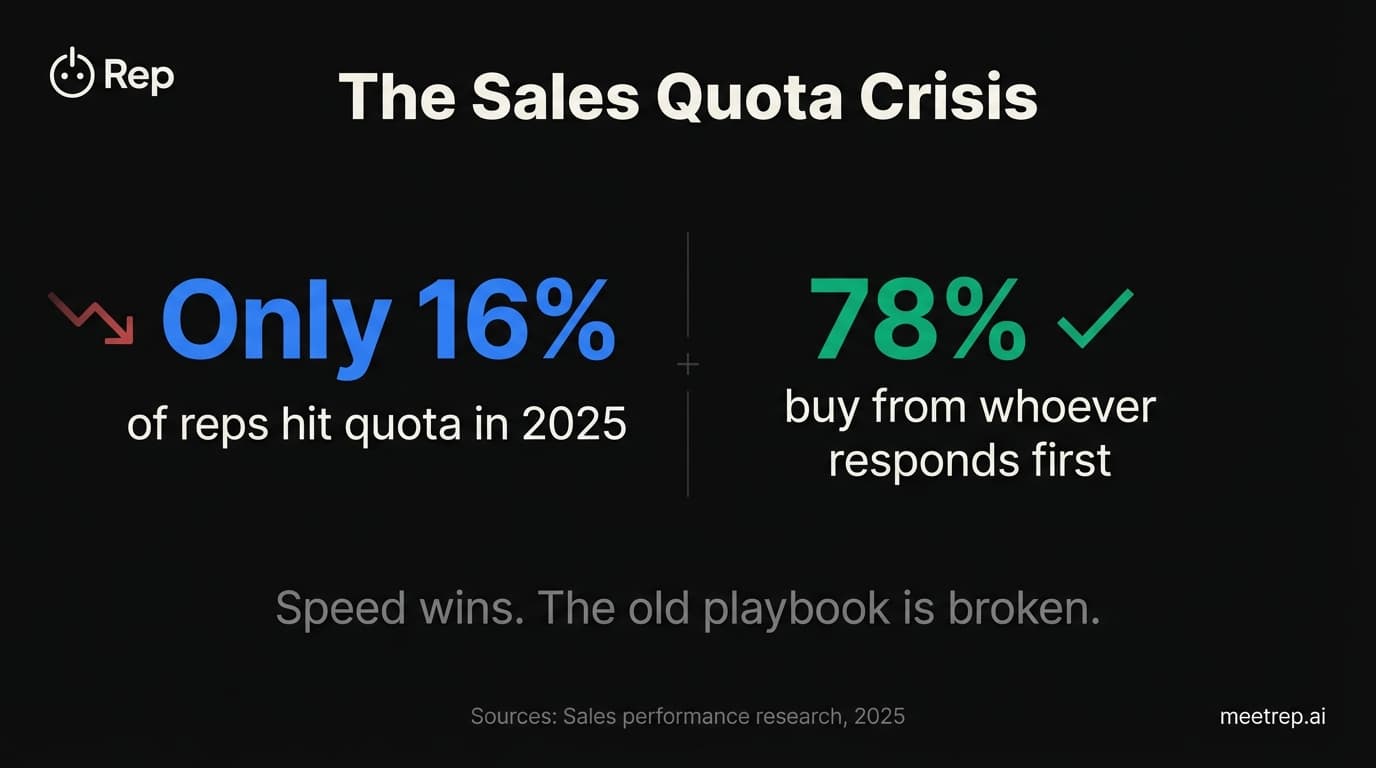
Why Autonomous Sales Software is the Future of B2B Sales (And Why the Old Playbook is Dead)
B2B sales is at a breaking point with quota attainment at 46%. Discover why autonomous 'Agentic AI' is the new standard for driving revenue and meeting the demand for rep-free buying.