Lead Qualification Checklist: Never Miss a Qualified Prospect

Executive Summary
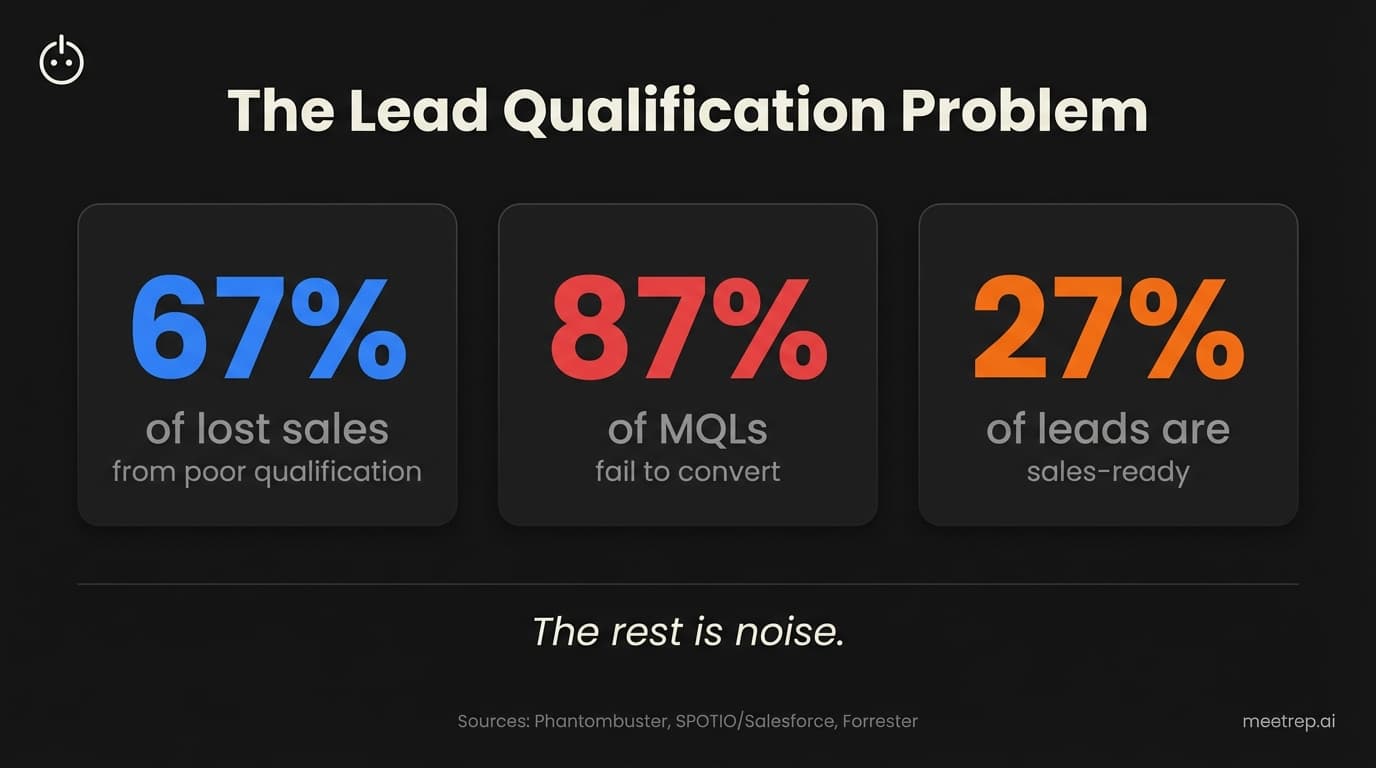
- 67% of lost sales come from poor qualification—not product or pricing issues
- Only 27% of leads entering your CRM are actually sales-ready
- Use the 7-step checklist: Interest → ICP Fit → Need → Budget → Authority → Timeline → Score
- BANT works for most deals; save MEDDIC for complex enterprise sales
- The framework matters less than consistent application
Here's a stat that should bother you: 67% of lost sales stem from poor lead qualification. Not bad pricing. Not weak product. Bad qualification. If you don't have a lead qualification checklist your team actually uses, you're already behind.
And yet, only 39% of companies consistently apply qualification criteria to their leads. That's a wild gap. Most teams know qualification matters. Most teams have heard of BANT. But most teams still wing it—and then wonder why only 57% of salespeople hit quota in 2024.
I've watched this pattern repeat across dozens of sales teams, first while building GoCustomer.ai and now at Rep. My take? The problem isn't that people don't know what qualification is. The problem is they don't have a repeatable checklist they actually use.
This post fixes that. You'll get a practical lead qualification checklist you can apply today, clear guidance on when to use BANT versus MEDDIC versus CHAMP, and the specific questions that separate qualified prospects from time-wasters.
What Is Lead Qualification (And Why 87% of MQLs Fail)?
Lead qualification is the process of evaluating whether a prospect has the fit, need, budget, authority, and timeline to become a customer. It separates leads worth pursuing from those that will waste your time. Without it, you're just cold-calling your own pipeline.
Here's the brutal math. According to SPOTIO and Salesforce data, the average MQL-to-SQL conversion rate is just 13%. That means 87% of the leads marketing sends you won't make it through qualification. And Forrester research shows only 27% of leads are "sales-ready" when they hit your CRM.
So 73% of your leads are noise. Not signal.
The Data:Salesforce's 2024 State of Sales Report found that sales reps spend only 30% of their time actually selling. The other 70% goes to admin, meetings, and—critically—chasing leads that were never going to close.
This is why a lead qualification checklist matters. It's not bureaucracy. It's a filter that protects your selling time.
Qualification vs. Scoring: What's the Difference?
Lead scoring assigns points based on demographics and behavior—company size gets 10 points, pricing page visit gets 15 points, and so on. It's automated and creates a ranked list.
Lead qualification is the human (or AI-assisted) conversation that validates whether someone is actually ready to buy. Scoring tells you who to call first. Qualification tells you whether to keep calling at all.
Best practice? Use scoring to prioritize which leads to qualify. Then use a framework like BANT or MEDDIC to actually qualify them.
The 7-Step Lead Qualification Checklist for 2026
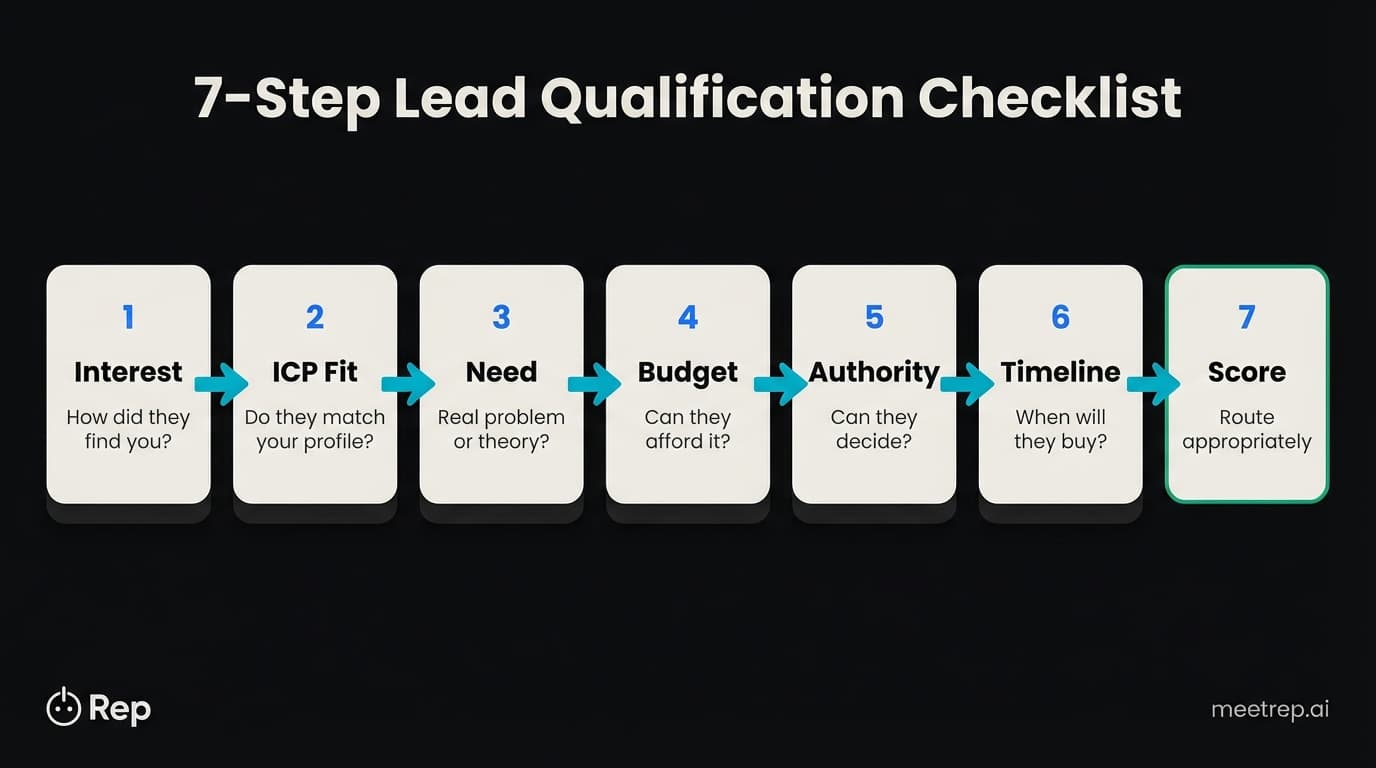
This checklist works whether you're an SDR handling 50 leads a week or a sales manager building a qualification process for your team. Each step includes the specific questions to ask.
Step 1: Assess Interest Level
Before anything else, gauge how they found you and what actions they've taken. Direct signals (demo requests, pricing page visits) beat indirect signals (blog views, newsletter opens) every time.
Questions to ask yourself:
- Did they request contact, or did we reach out cold?
- What pages have they visited? (Pricing and case studies = high intent)
- Have they engaged with multiple touchpoints?
Red flag: They downloaded one ebook six months ago and haven't engaged since. That's not a lead—that's a contact.
Step 2: Verify ICP Fit
Does this company match your Ideal Customer Profile? Check firmographics before investing conversation time.
Criteria to verify:
- Industry (are they in your target verticals?)
- Company size (employee count, revenue range)
- Geography (can you actually serve them?)
- Tech stack (do they use tools you integrate with?)
Questions to ask:
- "What does your company do, and how large is your team?"
- "What tools are you currently using for [your category]?"
Common mistake: Skipping ICP verification because the lead "seems interested." Interest without fit is a dead end. A 5-person startup genuinely excited about your enterprise software still can't buy it.
Step 3: Identify the Specific Need
This is where most qualification falls apart. You need a real problem—not theoretical interest. Honestly, this step alone disqualifies more leads than any other in my experience.
What you're looking for:
- A specific, urgent pain point your solution addresses
- Clear impact of the problem (time lost, money wasted, opportunities missed)
- A compelling event driving urgency
Questions to ask:
- "What prompted you to look for a solution right now?"
- "How is this problem affecting your team today?"
- "What happens if you do nothing about this?"
The last question is gold. If they can't articulate consequences of inaction, urgency is low.
Step 4: Confirm Budget Availability
Budget conversations feel awkward. But discovering budget issues in month three of a deal is worse. Why waste three months when you could know in three minutes?
What you need to know:
- Is there budget allocated for this category?
- What's the expected investment range?
- Who controls the budget?
Questions to ask:
- "Have you set aside budget for solving this problem?"
- "What have you invested in similar solutions before?"
- "Is this a funded initiative, or are you exploring options?"
Don't ask "What's your budget?" on call one. Frame it around value and past investments first.
Step 5: Map the Decision-Making Authority
You need to know if you're talking to someone who can say yes—or someone who can only say "I'll pass this along."
Questions to ask:
- "Walk me through how decisions like this typically get made at your company."
- "Who else would need to be involved in evaluating this?"
- "Who signs off on purchases in this range?"
Key Insight:6sense's 2025 BDR Benchmark found that 90% of top BDRs practice multi-threading—reaching out to 9 contacts per opportunity on average. One contact isn't enough in complex B2B sales.
If you're only talking to one person, you're exposed. Champions get reassigned. Influencers lose internal battles. Map the buying committee early.
Step 6: Establish Timeline
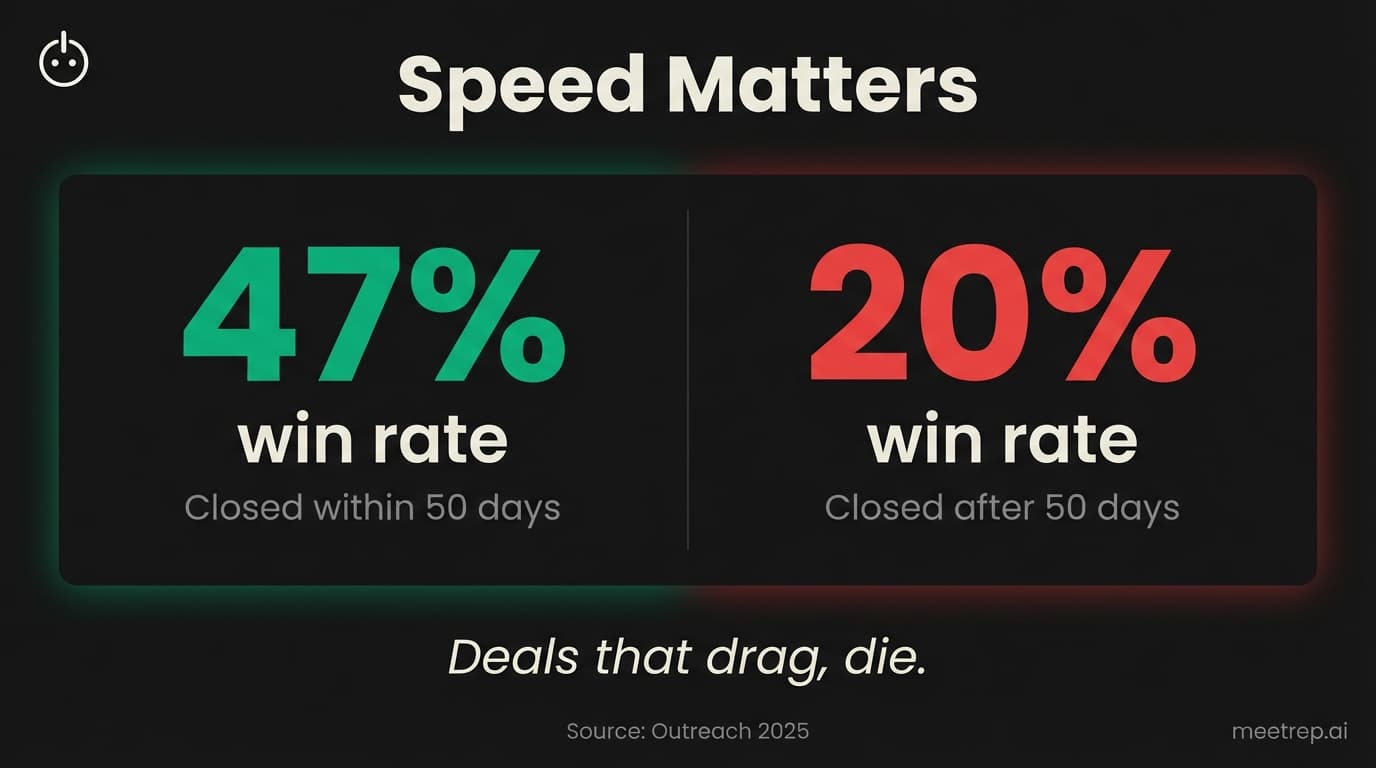
No timeline, no urgency. And Outreach's 2025 data shows that opportunities closed within 50 days have a 47% win rate—compared to 20% or lower after that threshold.
Speed matters.
Questions to ask:
- "When are you looking to have a solution in place?"
- "Is there a specific date or event driving this timeline?"
- "What happens if you don't solve this by [their stated date]?"
Compelling events to listen for:
- Contract renewals with current vendors
- New leadership starting
- Funding rounds closing
- Compliance deadlines
- End of fiscal year/budget cycles
Step 7: Score and Route
Once you've gathered the information, score the lead and route them appropriately.
| Lead Score | Next Step |
|---|---|
| Meets all criteria (ICP, Need, Budget, Authority, Timeline) | SQL → Pass to AE for demo |
| Missing 1-2 criteria but strong signals | SAL → Nurture with targeted content, re-qualify in 30 days |
| Missing 3+ criteria | Disqualify → Document reason, add to long-term nurture |
| Clear mismatch (wrong ICP, no budget, no authority) | Disqualify → Remove from active pipeline |
Document everything in your CRM. Future you will thank present you.
Choosing the Right Qualification Framework
You've probably heard of BANT. Maybe MEDDIC. Possibly CHAMP. Here's when to use each.
| Framework | What It Stands For | Best For | Complexity |
|---|---|---|---|
| BANT | Budget, Authority, Need, Timeline | High-volume SMB sales, deals under $50K | Low |
| MEDDIC | Metrics, Economic Buyer, Decision Criteria, Decision Process, Identify Pain, Champion | Enterprise deals over $100K, long sales cycles | High |
| CHAMP | Challenges, Authority, Money, Prioritization | Modern SaaS, consultative sales, $25K-$150K deals | Medium |
| ANUM | Authority, Need, Urgency, Money | Mid-market, when you need C-level access early | Low |
BANT: The Workhorse Framework
BANT gets criticized as "outdated." I disagree. For high-volume, transactional sales with clear buying processes, BANT is perfectly fine.
The four questions:
- Budget: Do they have money allocated or the ability to secure it?
- Authority: Can this person make or influence the decision?
- Need: Is there a specific problem your solution solves?
- Timeline: When do they plan to make a decision?
What we learned at GoCustomer: Most teams don't need a fancier framework. They need to actually ask these four questions consistently. We saw qualification rates improve just by enforcing BANT on every discovery call—no new methodology required.
MEDDIC: For Complex Enterprise Deals
When you're selling $100K+ deals with 6-month sales cycles and 8-person buying committees, BANT isn't enough. MEDDIC gives you the depth.
The six elements:
- Metrics: What quantifiable outcomes do they expect? (ROI, time saved, revenue impact)
- Economic Buyer: Who has final budget authority? (Not your champion—the person who signs)
- Decision Criteria: What technical and business requirements will they evaluate against?
- Decision Process: What steps, stakeholders, and timeline drive their purchase?
- Identify Pain: What specific problem is causing urgency?
- Champion: Who inside the organization is advocating for your solution?
MEDDIC is more work. But on big deals, that work pays off.
CHAMP: Pain-First for Modern SaaS
CHAMP flips the traditional order. Instead of leading with budget (which feels aggressive), it leads with challenges.
The logic: If the pain is severe enough, budgets can be created. CHAMP prioritizes understanding the problem before discussing money.
The four elements:
- Challenges: What's the biggest problem they're facing?
- Authority: Who needs to be involved?
- Money: Is there budget, or can it be allocated?
- Prioritization: How important is this relative to other initiatives?
I like CHAMP for inbound leads who already requested contact. They've shown interest—now figure out if the problem is real enough to fund.
MQL vs SQL vs SAL vs PQL: Know Your Lead Types
These acronyms get thrown around constantly. Here's what they actually mean:
| Lead Type | Definition | Who Owns It | Conversion Signal |
|---|---|---|---|
| MQL (Marketing Qualified Lead) | Showed interest through marketing activities (downloads, webinars, form fills) | Marketing | Behavioral engagement |
| SAL (Sales Accepted Lead) | MQL that sales has accepted but not fully qualified | Sales | Accepted from marketing |
| SQL (Sales Qualified Lead) | Passed qualification criteria (BANT/MEDDIC); ready for active pursuit | Sales | Met qualification criteria |
| PQL (Product Qualified Lead) | Experienced product value through trial, freemium, or interactive demo | Product/Sales | Product usage behavior |
The key distinction: MQLs show interest. SQLs demonstrate readiness to buy.
The Data: With a 13% MQL-to-SQL conversion rate, 87% of marketing-qualified leads fail to advance to sales. This isn't marketing's failure—it's how qualification is supposed to work. The filter protects your time.
Why PQLs Matter
PQLs convert at higher rates because their interest is based on actual product experience, not content consumption. They've already seen value.
This is part of why we built Rep the way we did. When a prospect goes through an interactive demo—experiencing your product firsthand—they self-qualify. The ones who complete the demo and ask follow-up questions? Those are PQLs. Way more valuable than someone who downloaded a whitepaper.
The Disqualification Playbook: When to Say No
Most qualification content focuses on finding "yes." But knowing when to say "no" is just as important. Frankly, my hardest lesson as a founder was learning to disqualify faster.
Immediate disqualifiers:
- Wrong ICP fit — Too small, wrong industry, geography you can't serve
- No budget and no path to budget — "We have zero funding for this"
- No authority and no access — Talking to someone blocked from decision-makers
- No urgency — "Maybe we'll look at this next year"
- Active deal with competitor — Already signed or in final negotiations
How to disqualify professionally:
Don't ghost. Be direct but respectful.
"Based on what you've shared, it sounds like [specific reason] means we might not be the right fit right now. I don't want to waste your time. Would it make sense to reconnect in [timeframe] when [condition changes]?"
Document the reason in your CRM. Some disqualified leads become qualified later. Funding closes. Priorities shift. New leadership arrives.
Automating Qualification Without Losing the Human Touch
Pipedrive's 2024/2025 report found that 74% of AI adopters report increased productivity, with 67% saving 2-5 hours weekly.
The question isn't whether to use AI in qualification. It's how.
Where AI works well:
- Initial lead scoring and routing
- Extracting qualification data from conversations
- Following up with slow-responding leads
- Handling first-touch interactions at scale
Where humans still win:
- Complex objection handling
- Reading between the lines on budget discussions
- Building champion relationships
- Negotiating with economic buyers
Key Insight:6sense found that supported BDRs achieve 95% quota attainment versus 80% for unsupported BDRs. The tool matters. But it's a 15% gap, not a 50% gap. Tools amplify good process—they don't replace it.
Signal-Based Qualification
Modern qualification goes beyond self-reported data. Intent signals—hiring patterns, tech stack changes, funding announcements—indicate buying readiness before a lead ever fills out a form.
Tools like ZoomInfo, Clearbit, and Cognism surface these signals. When a company posts 3 SDR job openings, they're scaling sales. When they add Salesforce to their tech stack, they might need tools that integrate.
My prediction for 2026: teams that combine AI qualification with signal-based prioritization will outperform purely human-driven processes by 30% or more. The data already points in this direction.
At Rep, we're building toward this. Our AI agent captures pain points and action items automatically during demo conversations—so qualification data gets captured without manual note-taking. The goal is giving reps better signal, not replacing their judgment.
Measuring Qualification Success: Benchmarks That Matter
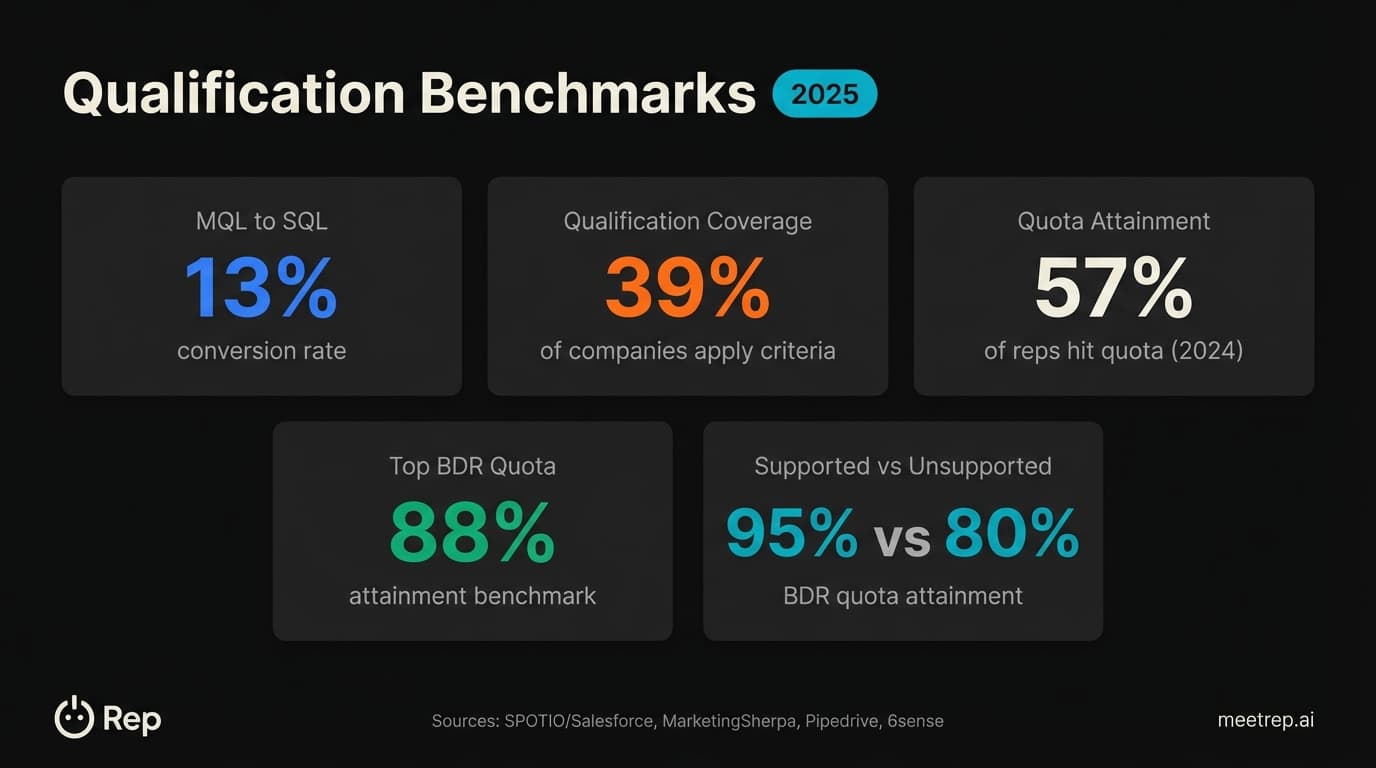
You can't improve what you don't measure. Here are the numbers to track:
| Metric | What It Measures | 2025 Benchmark | Source |
|---|---|---|---|
| MQL-to-SQL Conversion | % of marketing leads that pass qualification | 13% | SPOTIO/Salesforce |
| SQL-to-Opportunity | % of qualified leads that become pipeline | Varies by industry | Internal |
| Qualification Coverage | % of leads that receive consistent qualification | 39% (industry average—beat this) | MarketingSherpa |
| Average Quota Attainment | Team performance against targets | 57% (2024) | Pipedrive |
| BDR Quota Attainment | Individual contributor benchmark | 88% | 6sense |
If your MQL-to-SQL conversion is well above 13%, your qualification criteria might be too loose. If it's well below, marketing and sales need to align on ICP.
Case Study: What Happens When Qualification Works
LogiNext, an enterprise logistics SaaS company, struggled with manual lead processes and low qualification rates. After implementing HubSpot Marketing Hub with automated workflows, they achieved:
- 4x increase in lead qualification rates
- 5x traffic growth
- 70% reduction in manual effort
- 2-month shorter sales cycle
The key wasn't magic technology. It was applying qualification consistently across all leads instead of ad-hoc.
Similarly, EdgePetrol used Gong to standardize qualification coaching. Result? 300% pipeline increase and 66% faster ramp time for new reps.
What surprised me about both cases: the biggest gains came from consistency, not sophistication. Both companies used straightforward frameworks. They just used them every time.
The pattern is clear. Consistent qualification + tool support = better outcomes.
Look, I've seen teams implement elaborate qualification frameworks and still miss quota. And I've seen teams use basic BANT consistently and crush their numbers.
The difference isn't the framework. It's whether people actually use it.
Pick a checklist—the 7-step process above, BANT, MEDDIC, whatever fits your deal complexity. Then use it on every single lead. Document what you learn. Disqualify ruthlessly. Protect your selling time.
The 57% of reps who hit quota aren't smarter than everyone else. They're just better at filtering out the noise.
If you want to see how Rep handles first-pass qualification through interactive demos—letting prospects self-qualify while capturing key insights automatically—check out how it works.

Nadeem Azam
Founder
Software engineer & architect with 10+ years experience. Previously founded GoCustomer.ai.
Nadeem Azam is the Founder of Rep (meetrep.ai), building AI agents that give live product demos 24/7 for B2B sales teams. He writes about AI, sales automation, and the future of product demos.
Frequently Asked Questions
Table of Contents
- What Is Lead Qualification (And Why 87% of MQLs Fail)?
- The 7-Step Lead Qualification Checklist for 2026
- Choosing the Right Qualification Framework
- MQL vs SQL vs SAL vs PQL: Know Your Lead Types
- The Disqualification Playbook: When to Say No
- Automating Qualification Without Losing the Human Touch
- Measuring Qualification Success: Benchmarks That Matter
- Case Study: What Happens When Qualification Works
Ready to automate your demos?
Join the Rep Council and be among the first to experience AI-powered demos.
Get Early AccessRelated Articles
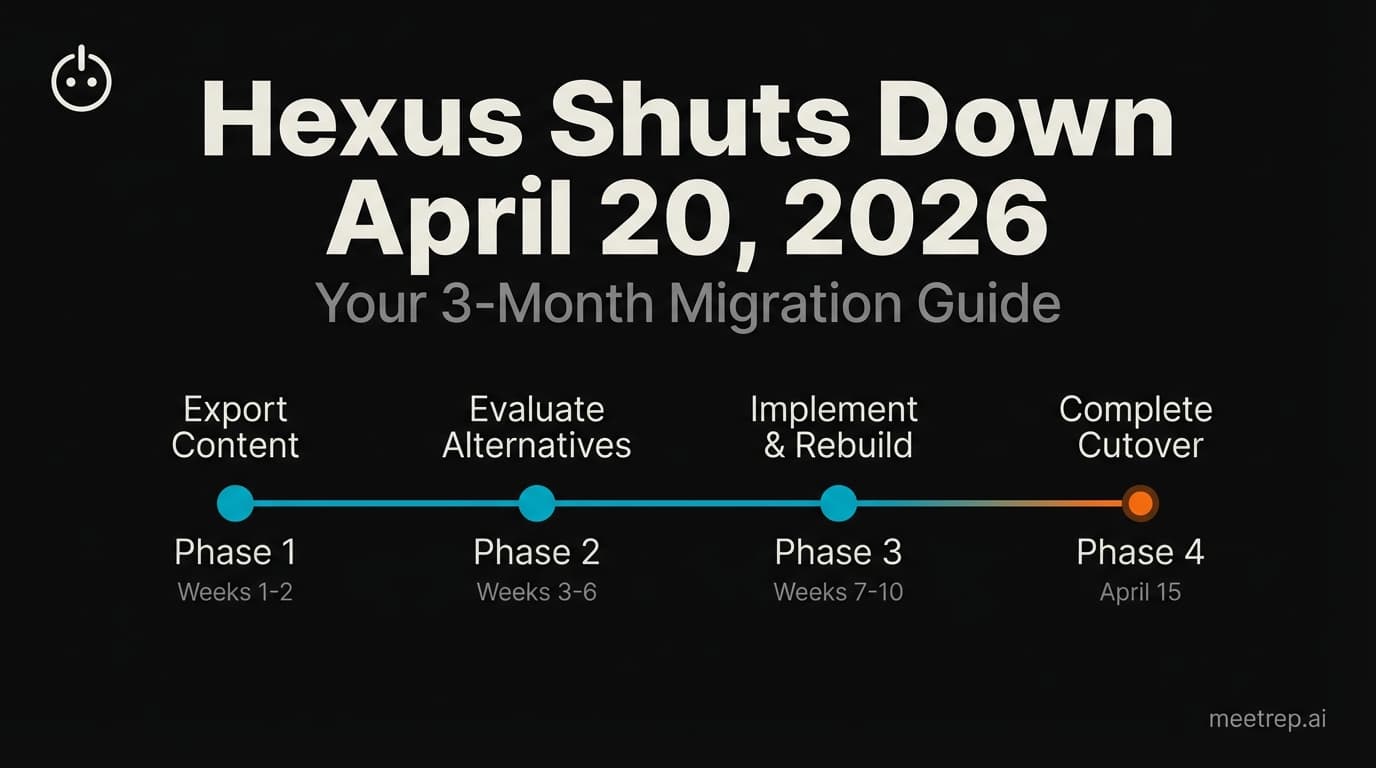
Hexus Acquired by Harvey AI: Congrats & What It Means for Demo Automation Teams
Hexus is shutting down following its acquisition by Harvey AI. Learn how to manage your migration and discover the best demo automation alternatives before April 2026.
Why the "Software Demo" is Broken—and Why AI Agents Are the Future
The traditional software demo is dead. Discover why 94% of B2B buyers rank vendors before calling sales and how AI agents are replacing manual demos to scale revenue.
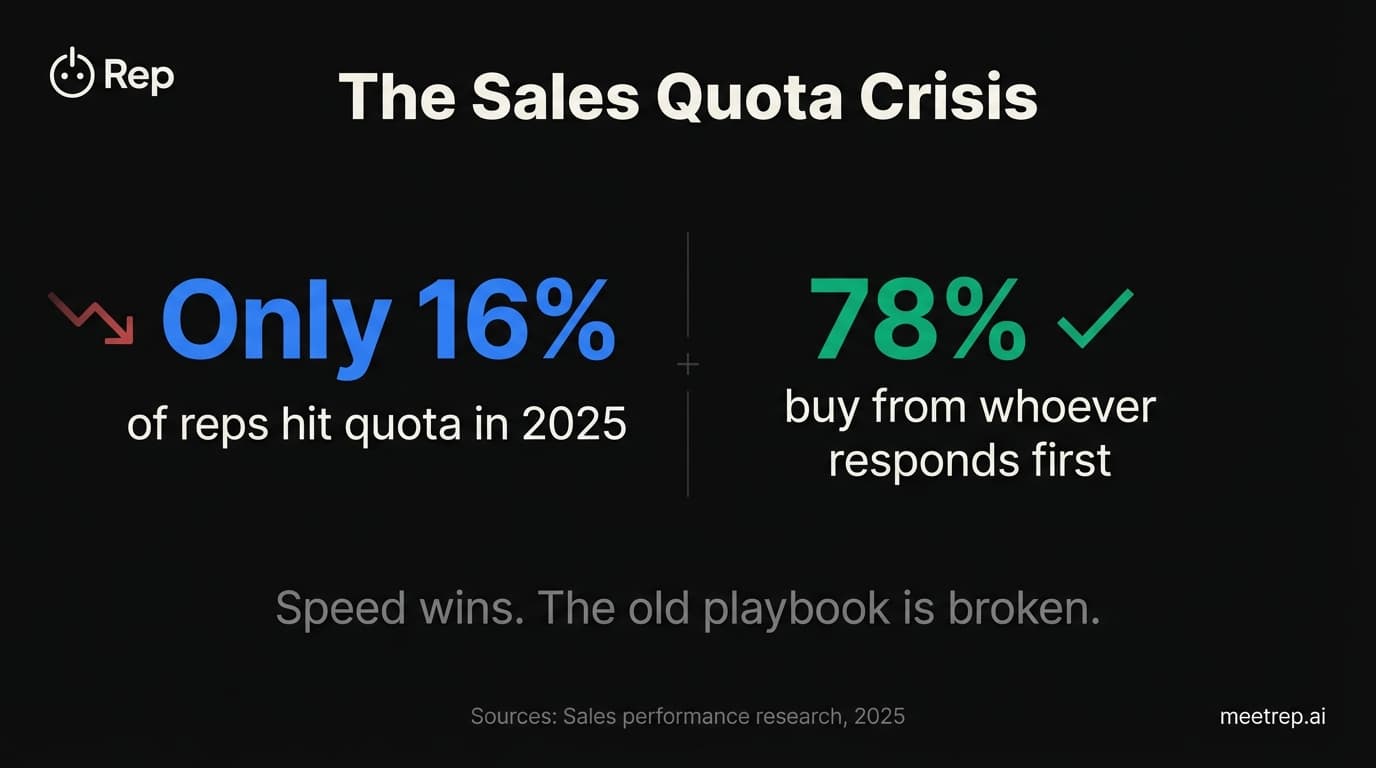
Why Autonomous Sales Software is the Future of B2B Sales (And Why the Old Playbook is Dead)
B2B sales is at a breaking point with quota attainment at 46%. Discover why autonomous 'Agentic AI' is the new standard for driving revenue and meeting the demand for rep-free buying.