Lead Generation Automation: Tools and Strategies That Actually Work

Executive Summary
- Lead generation automation delivers 544% ROI over three years—but only if you automate the right tasks
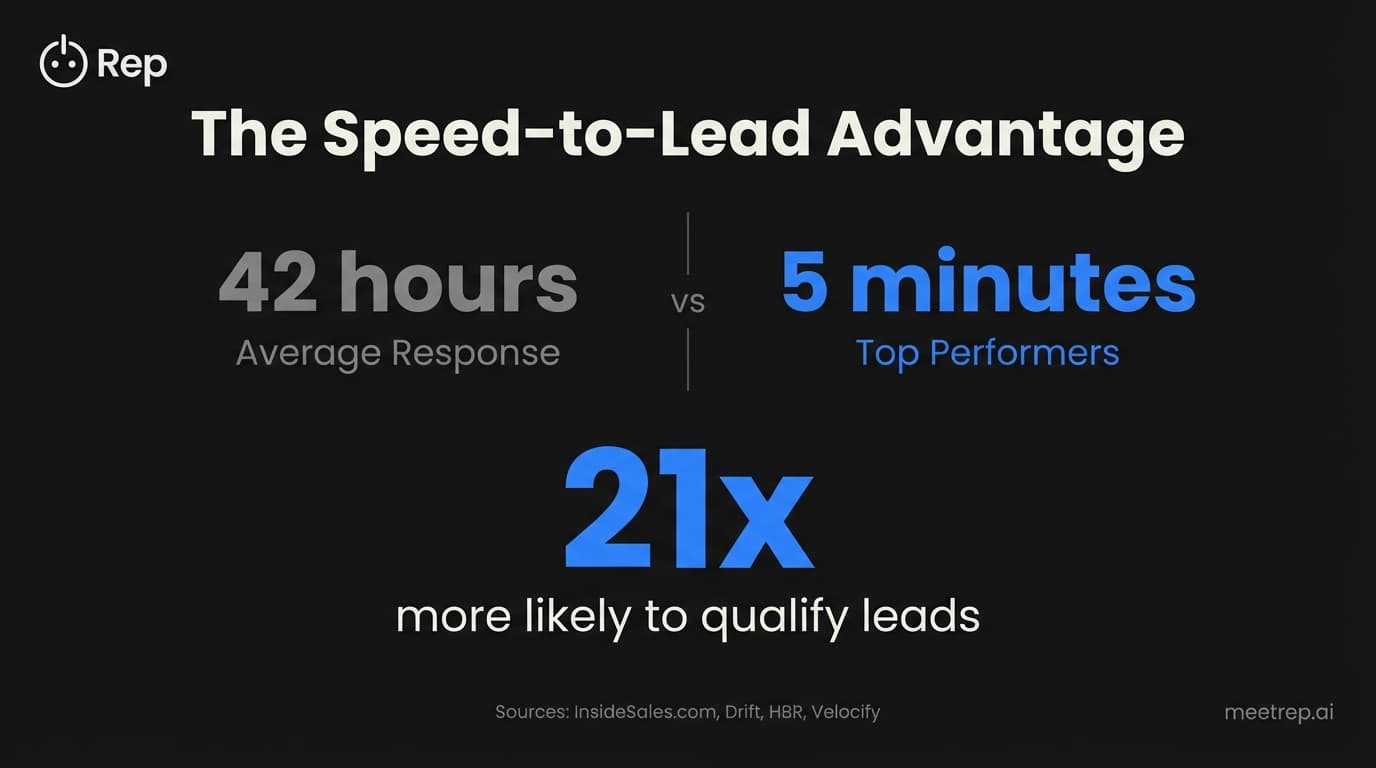
- Speed-to-lead is the most underrated metric: responding in 5 minutes makes you 21x more likely to qualify a lead
- Start with 7 high-impact automations before building complex sequences
- The human-AI hybrid isn't a compromise—it's optimal (75% of buyers will prefer human interaction by 2030)
Your competitors respond to leads in under 5 minutes. You respond in 42 hours. That's not a typo.
Lead generation automation has become the dividing line between teams that win and teams that wonder what happened. According to research from Drift, HBR, and Velocify, the average B2B company takes nearly two full days to respond to an inbound lead.
And here's the painful part: 78% of customers buy from the first company that responds, per Lead Connect research. You're not losing deals because your product is worse. You're losing because you're slow.
I've built lead generation automation at two companies now—first at GoCustomer.ai, then at Rep. What I've learned: most teams automate the wrong things. They build 47-step email sequences when they should be fixing their 47-hour response time.
This guide covers what actually moves the needle.
What lead generation automation actually means in 2026
Lead generation automation uses software and AI to identify, capture, qualify, and nurture potential customers without manual intervention. But here's where most definitions fall short: modern automation isn't just "set and forget" email sequences. It's intelligent systems that can research prospects, enrich data in real-time, and engage in actual conversations.
The market is massive. According to Grand View Research, marketing automation hit $6.65 billion in 2024 and will reach $15.58 billion by 2030. And 92% of marketers are already investing in AI, per HubSpot's 2025 State of Marketing Report.
But I'd argue there's a more important shift happening: the move from workflow automation to agentic AI. Traditional automation follows rules you set. Agentic AI reasons through problems and executes multi-step tasks autonomously—research, enrichment, personalization—without you scripting every decision.
That's why we built Rep to navigate products live during demos rather than play pre-recorded clips. The technology finally supports true autonomy.
Why manual lead generation is costing you more than you think
Manual lead gen creates three compounding problems.
First: wasted time. Sales reps spend only 28% of their week actually selling. The rest goes to data entry, research, and administrative work. Every minute on manual tasks is a minute not closing.
Second: missed opportunities. That 42-hour response time? It's not just slow. Research from InsideSales.com shows responding within 5 minutes makes you 21x more likely to qualify a lead versus waiting 30 minutes. And Velocify found that responding within 1 minute boosts conversions by 391%.
The Data: According to Drift and Velocify research, 55% of companies take 5+ days to respond to leads, and up to 73% of leads never get contacted at all.
Third: inconsistent quality. Without automation, data accuracy depends on whoever touched the record last. Industry benchmarks suggest up to 80% of leads are incomplete or inaccurate without systematic enrichment.
The math works against you. Here's what manual versus automated looks like:
| Factor | Manual Process | Automated Process | Impact |
|---|---|---|---|
| Response Time | 42 hours average | Under 5 minutes | 21x qualification rate |
| Rep Selling Time | 28% of week | 50%+ of week | 2x productivity |
| Lead Follow-up | 27% contacted | 100% engaged | 3.7x coverage |
| Data Accuracy | 80% incomplete | Enriched, verified | 5x quality |
| CAC | Baseline | 40% lower | Faster profitability |
Source: Drift/HBR/Velocify 2024-2025, U.S. Department of Commerce December 2025
And cold calling? Success rates collapsed to just 2.3% in 2025, according to Lureon's B2B SaaS Lead Generation Report. That's half the 2024 rate. The spray-and-pray playbook is dying.
The ROI case your CFO will actually approve
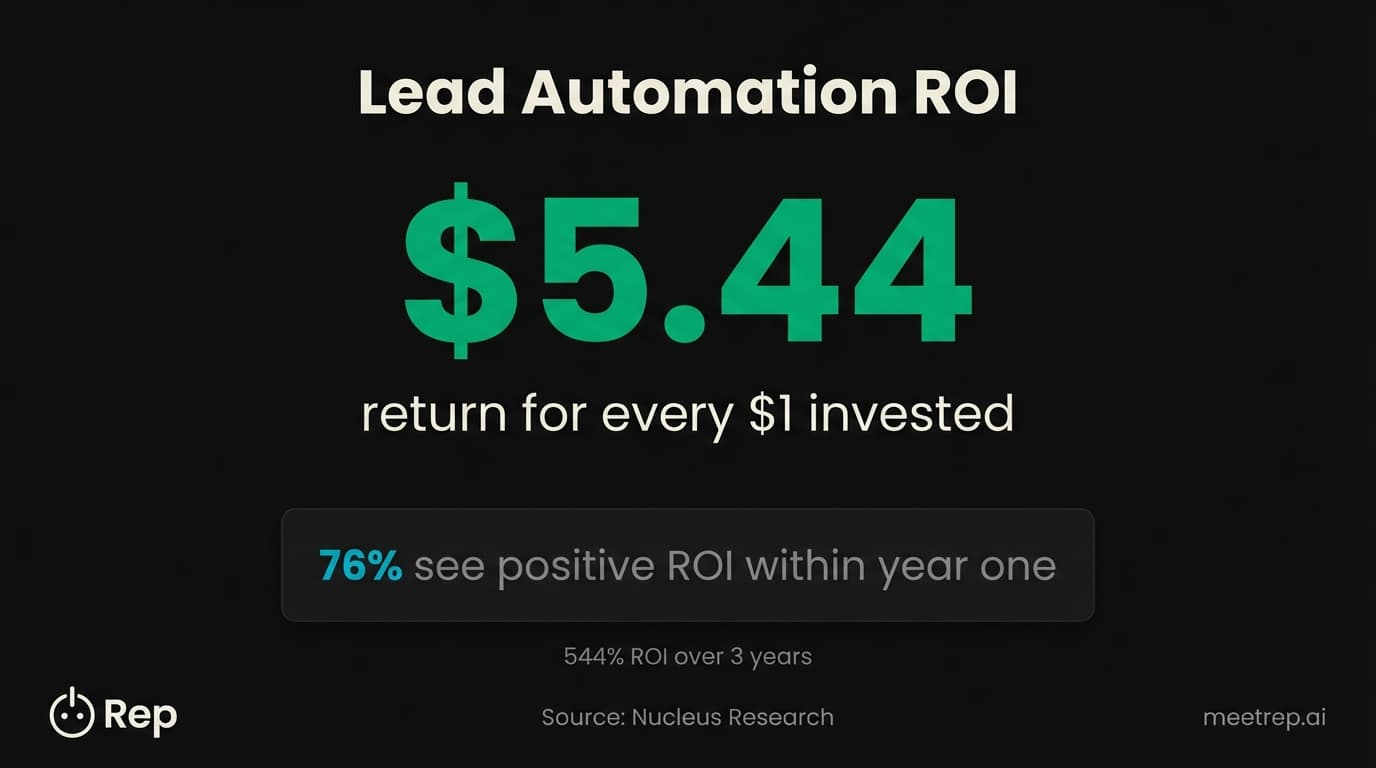
Here's the number that matters: $5.44 return for every dollar invested over three years, per Nucleus Research. That's 544% ROI.
Not in ideal conditions. Not for enterprise companies with dedicated ops teams. Across the market.
The Data:76% of companies see positive ROI within the first year, and most recoup their investment in under six months.
The Salesforce State of Sales Report (April 2024) found that 83% of sales teams using AI grew revenue, compared to 66% without. That's a 17-percentage-point advantage.
What does this look like in practice? Qlik implemented Salesloft and saw $14M in influenced pipeline per quarter. Time to first MQL for new hires dropped from 21 days to 7. Reply rates hit 39% on their best cadences.
Let me break down where the ROI actually comes from:
| ROI Driver | Improvement | Source |
|---|---|---|
| Customer acquisition cost | 40% reduction | U.S. Dept. of Commerce 2025 |
| Sales cycle time | 25% faster | U.S. Dept. of Commerce 2025 |
| AI agent cost vs. call centers | 30% more cost-effective | Solda.ai/McKinsey 2025 |
| Nurtured lead purchase size | 47% larger | Lureon/Annuitas 2025 |
| Nurtured lead cost | 33% lower | Lureon/Annuitas 2025 |
That's not theoretical. These are verified benchmarks from 2024-2025 research.
What we learned at GoCustomer: ROI doesn't come from automating everything. It comes from automating the right things. We saw teams with complex 30-step sequences underperform teams with 3-step sequences and sub-5-minute response times. Simplicity plus speed beats complexity.
Seven tasks you should automate first
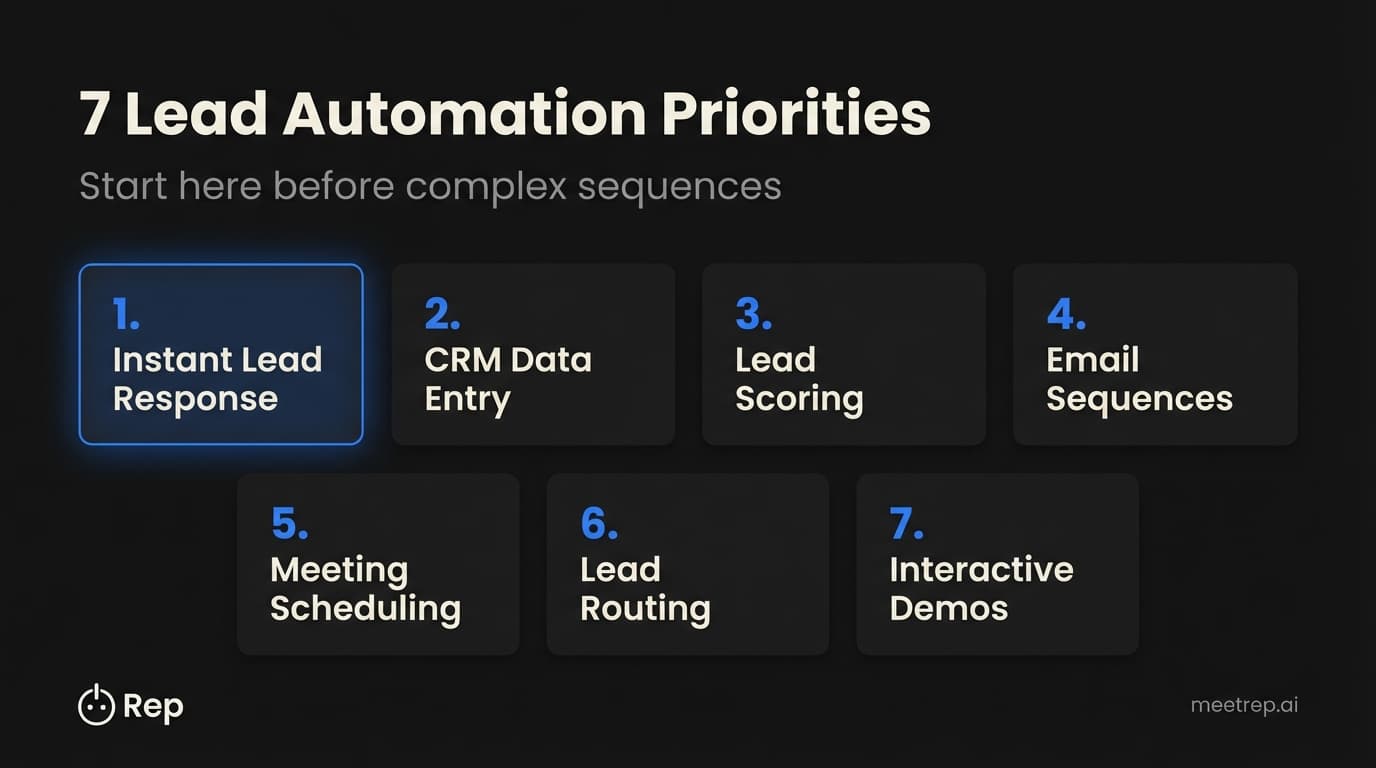
Start here. Not with a 47-email nurture sequence. These seven areas deliver the fastest time-to-value.
- Instant lead response. This is non-negotiable. When someone fills out a form, they should get meaningful engagement within 5 minutes—not a "we'll be in touch" autoresponder. Chatbots, instant routing, or AI agents that can actually hold conversations. The 21x qualification advantage comes from this single metric.
- CRM data entry. Reps shouldn't type. Every lead captured should automatically enrich with company data, contact information, and technographics. Tools like Clay and Apollo handle this.
- Lead scoring. Not every lead deserves equal attention. Score based on fit signals (company size, industry, tech stack) and engagement signals (pages visited, content downloaded, email opens). Route hot leads immediately, nurture warm leads automatically.
- Email sequences. But here's my take: shorter is better. The research supports this. Nurtured leads produce 47% larger purchases at 33% lower cost than non-nurtured prospects. But "nurture" doesn't mean "blast 12 emails." Context-aware, value-first sequences win.
- Meeting scheduling. Every click to book should be frictionless. Calendly-style scheduling removes the back-and-forth that kills momentum.
- Lead routing. When a lead qualifies, they should hit the right rep instantly. No manual assignment delays. No leads sitting in queues.
- Interactive demos. This one's underrated. Navattic's 2025 data shows the top 1% of interactive demos achieved 68.7% CTR increase—from 32.25% to 54.0%. Let prospects explore your product before the call. At Rep, we took this further: autonomous AI that joins video calls, shares its screen, and walks prospects through your actual product live. No more "let me schedule you with an AE for a demo."
My recommendation: Pick two of these. Get them working. Then add more. Teams that try to automate everything at once end up with expensive shelfware.
The human-AI hybrid: why pure automation isn't the answer
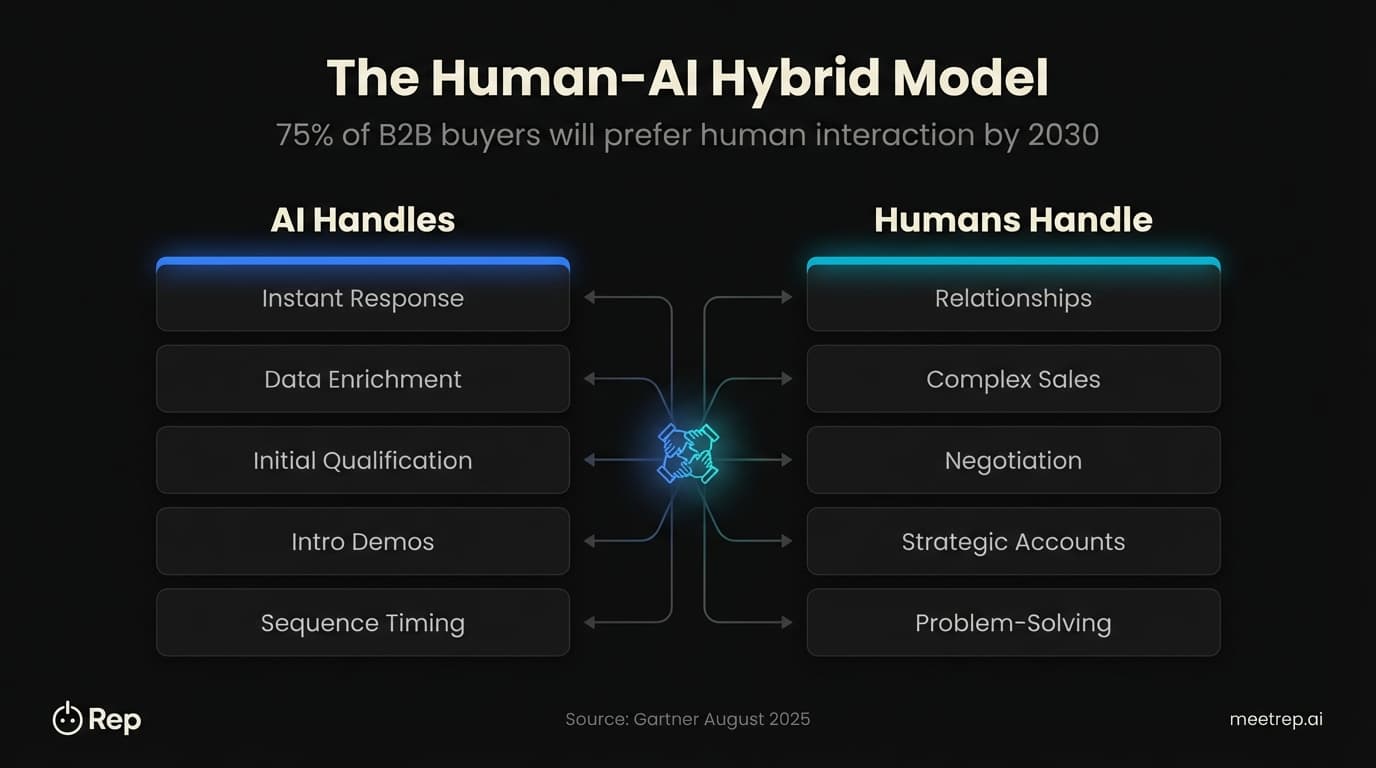
Here's a stat that should shape your entire strategy: by 2030, 75% of B2B buyers will prefer sales experiences with human interaction over AI, especially for complex transactions. That's from Gartner's August 2025 research.
At the same time, 92% of businesses plan to invest in generative AI within three years, per McKinsey.
Sounds contradictory. It's not.
The winning approach isn't human OR AI. It's AI handling research, qualification, and initial engagement while humans focus on relationship-building and complex problem-solving.
Think about it: 81% of sales teams are already implementing AI. And here's what they're finding—sales reps working with AI tools are 2.4x less likely to feel overworked. 68% of AI-enabled teams added headcount. AI isn't replacing reps. It's making them more effective.
Colleen Giblin, Principal Research Analyst at Gartner, put it this way: "While AI will continue to play a role in streamlining information gathering... the enduring value of human interaction is becoming more pronounced."
So what does the hybrid model look like?
| Stage | AI Handles | Humans Handle |
|---|---|---|
| Initial capture | Instant response, qualification questions | Complex exceptions |
| Research | Data enrichment, company intel | Strategic account mapping |
| First touch | Automated outreach, basic Q&A | Warm introductions, referrals |
| Demo | Intro demos, feature overviews | Complex use cases, negotiation |
| Nurture | Sequence management, timing | Relationship building |
| Close | Scheduling, reminders | Negotiation, contracts |
This is why Rep exists. We built autonomous demo capability because the intro demo—explaining what your product does—is perfect for AI. But the complex sale? The negotiation? The relationship? That's still human territory.
How to choose the right automation stack
Your stack should cover four categories. Here's what each includes and what tools actually work.
Category 1: Data & Enrichment (The Fuel)
ZoomInfo's own research shows SDRs save 18 minutes per prospect with good enrichment data. That adds up.
Category 2: Engagement (The Execution)
HubSpot and Salesforce lead the Gartner Magic Quadrant for all-in-one platforms. For pure sales engagement, Outreach and Salesloft are the standards. Budget-conscious? Lemlist and Instantly.ai offer solid cold email at under $100/month.
Category 3: Interactive Demos (The Hook)
This category has exploded. Navattic and Storylane handle clickable product tours. Consensus focuses on video demos. Labelbox saw a 30% increase in MQLs and 50% lift in CTR after implementing interactive demos.
And then there's autonomous demo—AI that actually joins calls and runs your product live. That's what we're building at Rep. It's a different category because prospects get real-time interaction, not pre-recorded walkthroughs.
Category 4: Intelligence (The Brain)
Gong and Chorus capture conversation intelligence. Paycor saw a 141% increase in deal wins after implementing Gong. The insight extraction is valuable, but the real win is coaching: understanding what your best reps do differently.
Cost Reality Check:
Average B2B SaaS CPL runs $198-208, according to 2024-2025 benchmarks from Flyweel. LinkedIn CPL averages $110—57% higher than Google Search. But LinkedIn generates 80% of B2B social media leads, per Oktopost research. Higher cost, higher quality.
What goes wrong (and how to avoid automation disasters)
I've seen teams blow up their automation. Here's what kills campaigns:
Bad data quality. If 60% of your contact data is wrong, your automation is just spam at scale. One team I talked to destroyed their sender reputation—it took 18 months to recover domain deliverability. The fix: start with verified data sources, monitor bounce rates religiously, and clean your database quarterly.
Over-automation. That Reddit user who paid $2,000/month for an "AI SDR" that booked zero demos? Not uncommon. The market is full of tools that promise autonomous prospecting but deliver robotic spam. The fix: human oversight at critical touchpoints. Review what's going out. Check reply sentiment.
Integration nightmares. Salesforce sync breaks. API limits hit. Data silos form. The fix: map your workflow before buying tools. Check that integrations actually work with YOUR setup, not just in the vendor's demo environment.
Team non-adoption. Expensive tools become shelfware when they're too complex. I've seen $6k/year platforms abandoned because nobody had time to learn them. The fix: start with pilot groups. Get champions. Roll out slowly.
The Data: Christine Moorman, Duke University Professor and founder of The CMO Survey, noted in Harvard Business Review: "Although companies invest considerably in marketing technology, it is often under-utilized, and its impact is modest."
The pattern I see: crawl, walk, run. Don't automate everything month one. Automate one process completely, prove it works, then expand.
Measuring what matters: KPIs for lead automation success
Track these. Ignore vanity metrics.
| KPI | Benchmark | Why It Matters |
|---|---|---|
| Speed-to-lead | Under 5 minutes | 21x qualification advantage |
| Lead-to-MQL rate | 10-15% (B2B SaaS) | Indicates lead quality + nurture effectiveness |
| Cost per lead | $198-208 (B2B SaaS) | Budget efficiency check |
| Email deliverability | 95%+ | Sender reputation health |
| Reply rate | 5-10% cold, 20%+ warm | Message-market fit |
| Demo completion rate | 54% (top performers) | Engagement depth |
| Pipeline velocity | 25% faster with automation | Deal acceleration |
Source: Flyweel 2024-2025, Navattic 2025, U.S. Dept. of Commerce 2025
Here's what most teams miss: speed-to-lead is the highest-leverage metric. Advanced implemented Salesloft and saw a 31% increase in BDR-generated leads, exceeding their 25% goal. The difference? They focused on response speed, not sequence length.
The tools exist. The ROI is proven. The question is execution.
My prediction: the teams that win in 2026 won't be the ones with the most sophisticated automation sequences. They'll be the ones with the fastest response times, the cleanest data, and the smartest human-AI handoffs.
Start with speed-to-lead. Automate your response to under 5 minutes. Then layer on everything else.
If you're curious what autonomous demos look like—where AI actually joins calls and navigates your product live—see how Rep works.

Nadeem Azam
Founder
Software engineer & architect with 10+ years experience. Previously founded GoCustomer.ai.
Nadeem Azam is the Founder of Rep (meetrep.ai), building AI agents that give live product demos 24/7 for B2B sales teams. He writes about AI, sales automation, and the future of product demos.
Frequently Asked Questions
Table of Contents
- What lead generation automation actually means in 2026
- Why manual lead generation is costing you more than you think
- The ROI case your CFO will actually approve
- Seven tasks you should automate first
- The human-AI hybrid: why pure automation isn't the answer
- How to choose the right automation stack
- What goes wrong (and how to avoid automation disasters)
- Measuring what matters: KPIs for lead automation success
Ready to automate your demos?
Join the Rep Council and be among the first to experience AI-powered demos.
Get Early AccessRelated Articles
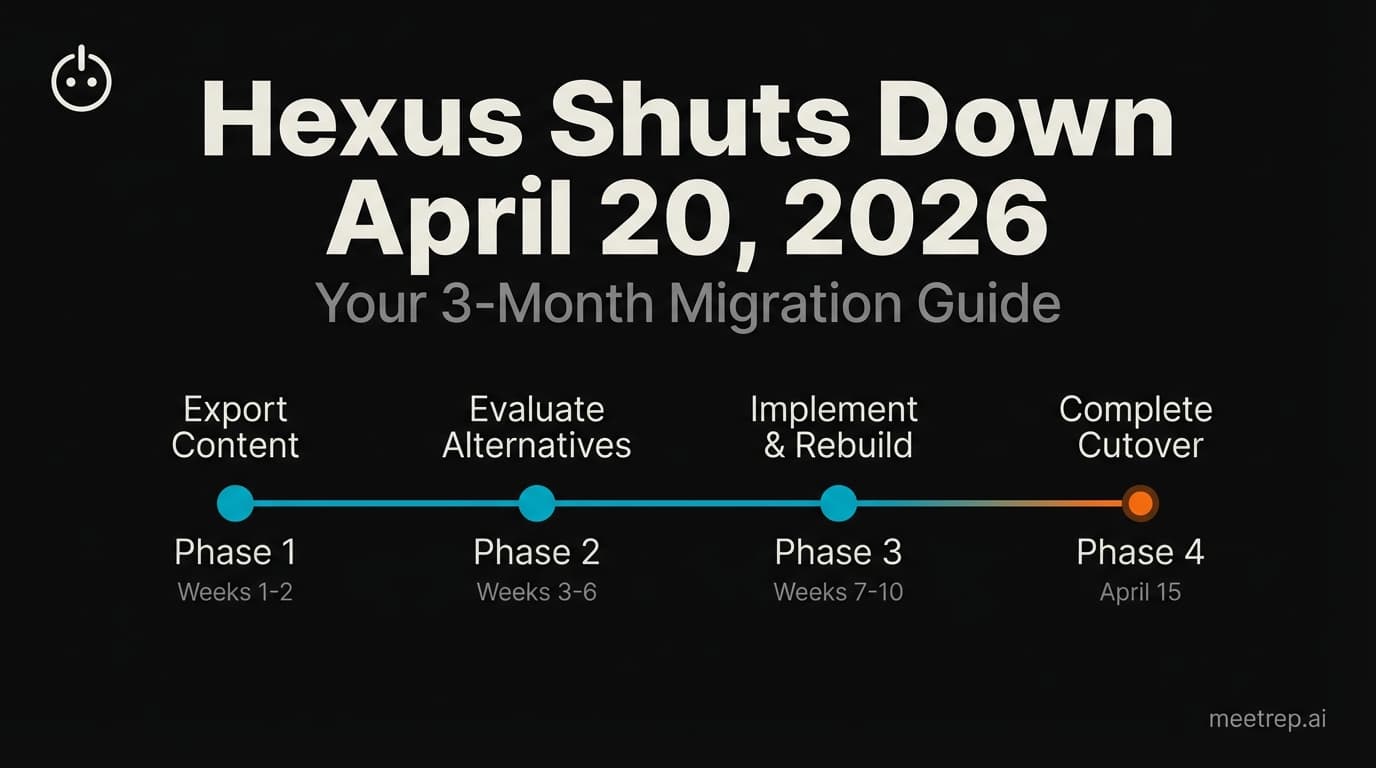
Hexus Acquired by Harvey AI: Congrats & What It Means for Demo Automation Teams
Hexus is shutting down following its acquisition by Harvey AI. Learn how to manage your migration and discover the best demo automation alternatives before April 2026.
Why the "Software Demo" is Broken—and Why AI Agents Are the Future
The traditional software demo is dead. Discover why 94% of B2B buyers rank vendors before calling sales and how AI agents are replacing manual demos to scale revenue.
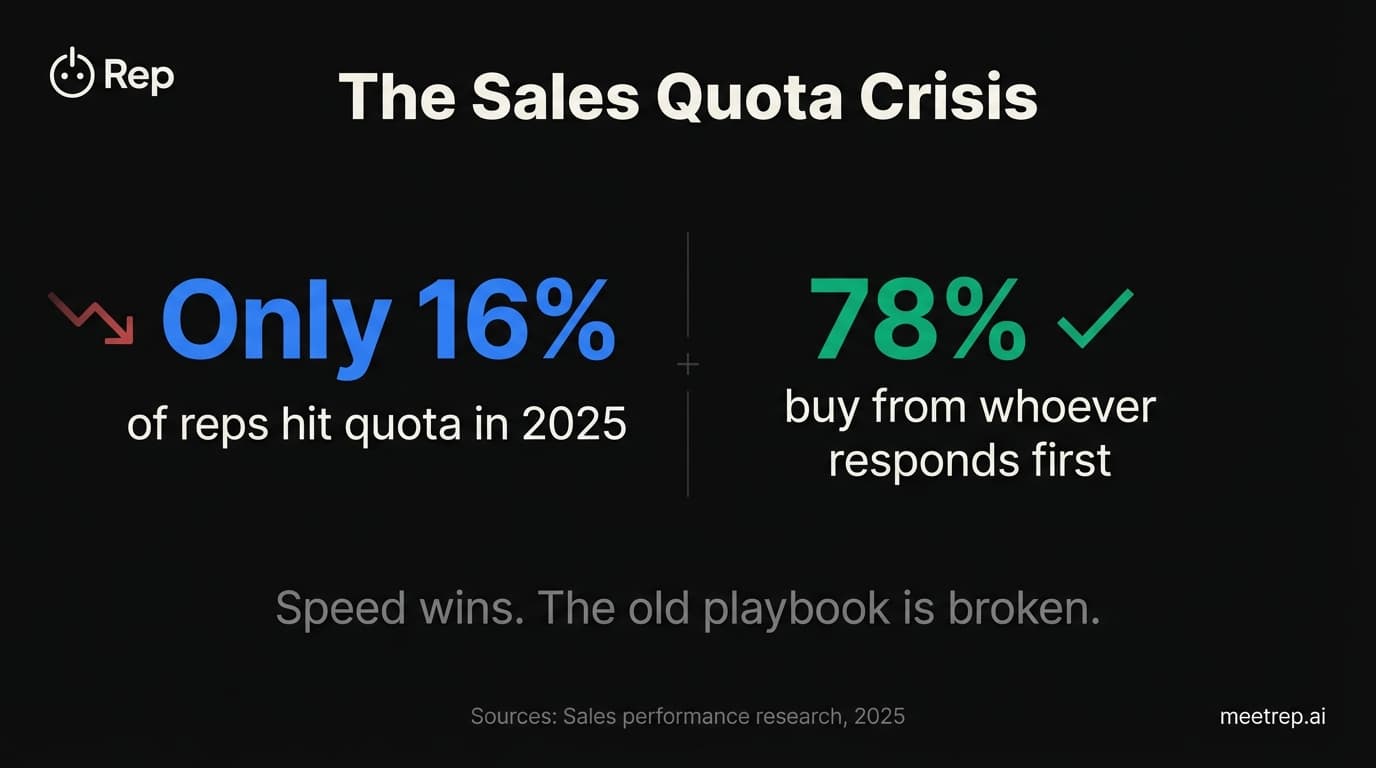
Why Autonomous Sales Software is the Future of B2B Sales (And Why the Old Playbook is Dead)
B2B sales is at a breaking point with quota attainment at 46%. Discover why autonomous 'Agentic AI' is the new standard for driving revenue and meeting the demand for rep-free buying.