How to Reduce Demo No-Shows by 80%

Executive Summary
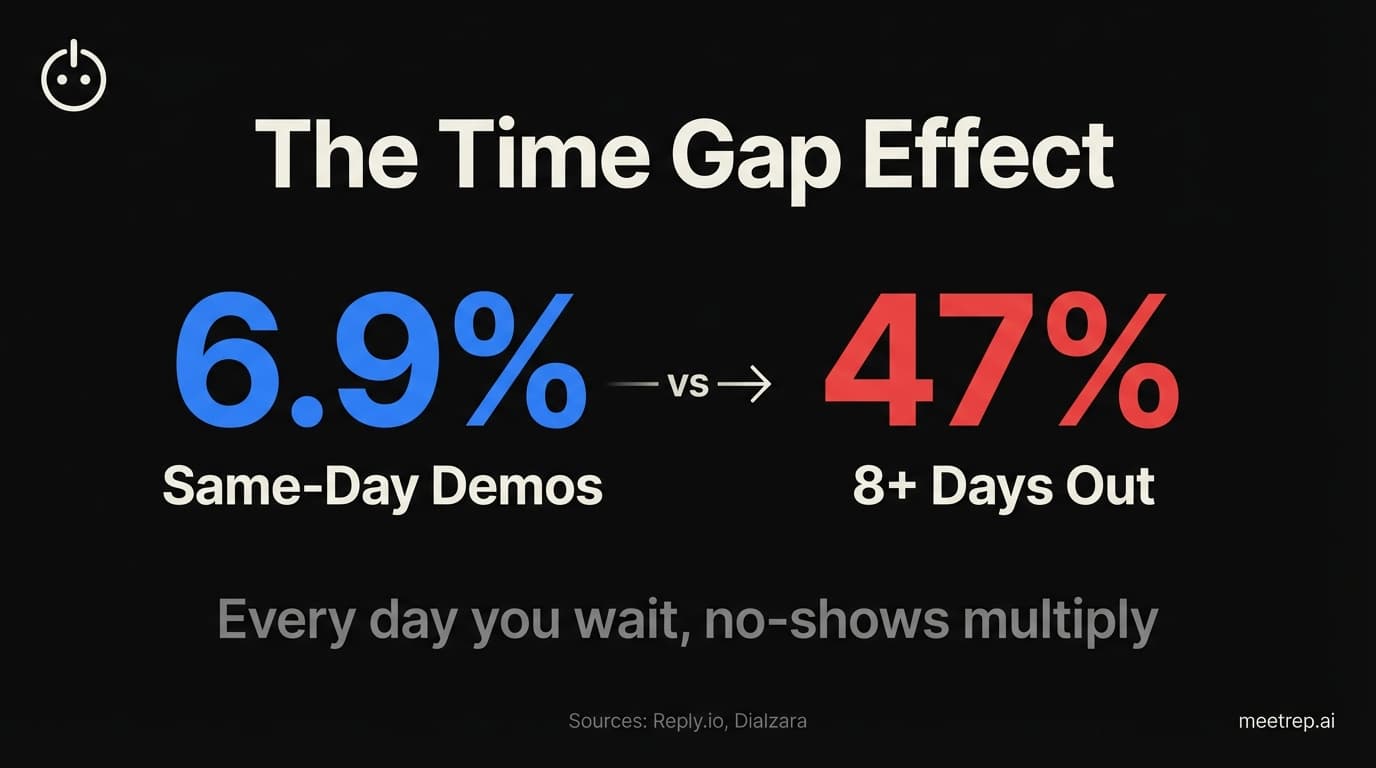
- Same-day demos have a 6.9% no-show rate. Demos booked 8+ days out hit 23-47%. Time is the primary factor.
- A 3-tier reminder system (24hr, 1hr, 1min) achieves under 5% no-shows—but only if you've also shortened the booking window.
- 30-minute slots have 12% higher attendance than 60-minute slots. Book for 3-5pm, not morning.
- AI-powered instant demos eliminate the scheduling gap entirely, showing 40% no-show reduction in early adopters.
Your demo no-show rate is quietly killing your pipeline. I don't mean that metaphorically. Every empty Zoom room represents $730 in burned marketing spend, an hour of your AE's time wasted, and a prospect who's probably already talking to your competitor.
Here's what most teams get wrong: they treat no-shows as a reminder problem. Send more emails. Add SMS. Maybe throw in a calendar confirmation. But 36% of revenue team members cite no-shows as their number one challenge—and they're already sending reminders.
The real enemy isn't forgetfulness. It's time. And I'm going to show you the data that proves it.
What's a "good" demo no-show rate in 2025?
A good demo no-show rate is under 15%, with top performers achieving 2-6.5%. Anything above 20% signals a process failure that needs immediate attention.
According to RevenueHero's December 2024 analysis of 6,428 B2B meetings, the overall B2B no-show rate averaged 6.5%. That's the benchmark. But here's where it gets interesting—industry variance is massive:
| Industry | No-Show Rate | Meetings Analyzed |
|---|---|---|
| Healthcare (B2B) | 0% | 179 |
| Developer Tools | 1.2% | 241 |
| IT & Security | 1.8% | 395 |
| Marketing Software | 4.59% | 522 |
| Real Estate | 15.1% | 714 |
| Education/E-Learning | 18.1% | 425 |
Developer tools teams achieve 1.2%. Education struggles at 18.1%. So before you panic about your numbers, know where you stand relative to your actual peers—not some generic "industry average."
Key Insight: If you're selling to developers, a 5% no-show rate is underperformance. If you're in education technology, getting to 12% might be a major win. Context matters.
The real cost of every no-show
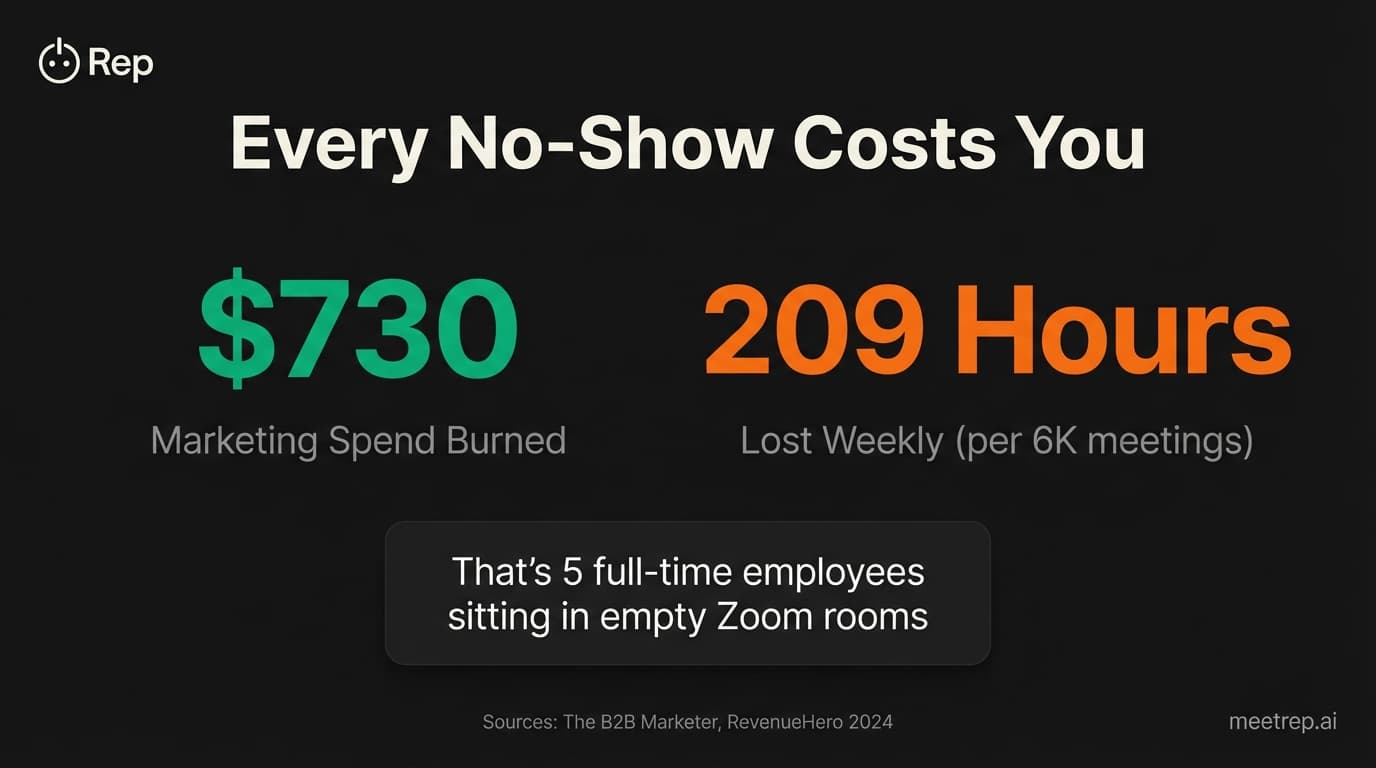
Each no-show costs far more than a missed meeting. The average cost per demo request is approximately £580 ($730 USD), according to analysis from The B2B Marketer. That's what you spent on marketing, ads, content, and sales time to get that person to request a demo in the first place.
When they don't show? That money vanishes.
In one week's sample of 6,428 meetings from the RevenueHero data, 419 no-shows resulted in 209.5 hours of lost sales time. That's five full-time employees doing nothing but sitting in empty Zoom rooms.
And here's the career angle that keeps sales leaders up at night: VP Sales average tenure is just 19 months. You don't have two years to experiment with no-show reduction. You need results this quarter.
The Data: 36% of revenue team members cite no-shows as their #1 challenge. This isn't a minor operational inefficiency—it's the thing eating your pipeline alive.
Source: Calendly 2024
Why prospects actually ghost your demos
Most sales content will tell you prospects no-show because they "forgot" or "got busy." That's partially true but misses the bigger picture.
Commure's 2024 analysis found that 88% of no-shows stem from scheduling conflicts or priority shifts—not forgetfulness. And Glencoco's research puts internal commitments at 60% of missed demos.
What does this mean? Reminders help, but they can't fix the underlying problem: the longer the gap between booking and demo, the more time for competing priorities to emerge.
Think about it. Your prospect booked a demo on Tuesday. They were genuinely interested—that's why they filled out the form. But the earliest slot you had was the following Thursday. In those 9 days:
- Their boss dropped an urgent project on their desk
- A competitor reached out with a faster response
- Their budget got frozen pending Q2 review
- They simply... lost the urgency
What we learned building Rep: When we designed our demo architecture, we obsessed over this gap. The prospect's interest peaks at the moment they hit "request demo." Every hour after that, intent decays. That's not a reminder problem—it's a physics problem. (Okay, maybe psychology. But it feels like physics.)
And here's the uncomfortable truth from Walnut/Rain Group: 58% of buyers believe sales meetings provide no value. When they're weighing your demo against their inbox? You lose.
The speed-to-demo correlation: this changes everything
I'm going to show you the single most important data point in this entire article.
Reply.io analyzed 2,900 meetings and found a dramatic correlation between scheduling delay and no-show rates:
| Time from Booking to Demo | No-Show Rate |
|---|---|
| Same day | 6.9% |
| Next day | 9.6% |
| 0-7 days | 12.4% |
| 8+ days | 23-47% |
Read that again. Same-day demos have a 6.9% no-show rate. Push it out more than a week? You're looking at 23-47%, according to extended analysis from Dialzara.
That's a 3.3x to 6.8x increase in no-shows just by making someone wait.
This is why I said most teams focus on the wrong thing. You can have the most sophisticated reminder sequence in the world. But if you're booking demos for 9 days out, you're fighting with one hand tied behind your back.
My recommendation: Treat "time-to-demo" as your primary diagnostic metric. Track the average number of days between booking and demo. If it's above 5 days, that's your first problem to solve—before you touch your reminder system.
The fix isn't complicated in theory: offer more availability. But in practice, your AEs are already stretched thin. Which brings us to the real innovation happening in this space.
How AI instant demos eliminate the gap entirely
What if the only way to guarantee a prospect shows up is to demo when they're already there?
That's the thesis behind AI-powered instant demos. Instead of the traditional flow—qualify → schedule → wait → hope they show → demo—you flip it: qualify → demo immediately → route to human if qualified.
The early data is compelling. Spara's case study with Fama (a background screening SaaS) showed:
- 40% reduction in demo no-shows
- 2.5x increase in qualified meetings
- +32% SQL conversion lift
How? When a prospect hits the demo request page, an AI agent engages immediately. It qualifies using ICP criteria, then delivers an interactive product walkthrough on the spot. The prospect sees your product while their interest is at peak. No scheduling friction. No 9-day wait. No competing priorities.
This is exactly why we built Rep. The core idea is simple: meet the prospect in the moment of peak interest with a live, interactive demo—not a form that schedules something for next week. The prospect clicks a link and gets an AI-guided product walkthrough. Right then.
Does this replace human sellers? No. The companies seeing results use AI for initial qualification and demonstration, then route genuinely interested prospects to AEs for deeper conversations. The AI handles the 60% of demos that historically ended in ghosting or quick disqualification anyway.
Key Insight: You can't send a reminder for a meeting that happens instantly. The "zero-lag" approach makes no-shows structurally impossible for the initial demonstration.
The 3-tier reminder system that actually works
If you can't eliminate scheduling gaps entirely (most teams can't, at least not immediately), here's the reminder system that achieves the best results.
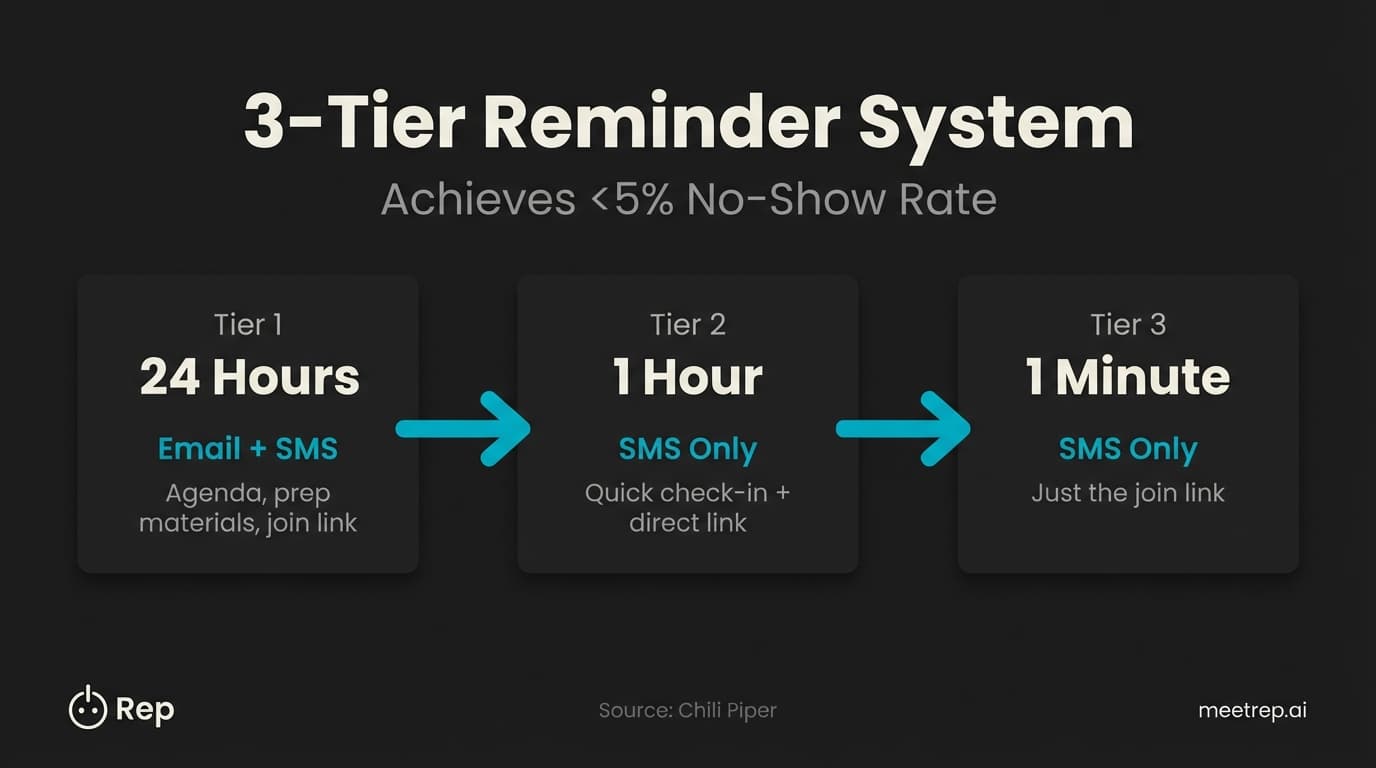
Chili Piper reports achieving under 5% outbound no-show rates with a 3-tier approach:
Tier 1: 24 hours before
- Channel: Email + SMS
- Content: Agenda, prep materials, join link
- Tone: Value-forward, not reminder-forward
Tier 2: 1 hour before
- Channel: SMS only
- Content: Brief check-in with direct join link
- Example: "Hey [Name], just checking in. Still good for our 2pm call? Join here: [link]"
Tier 3: 1 minute before
- Channel: SMS only
- Content: Just the join link
- Use for: High-value demos (>$50K ACV)
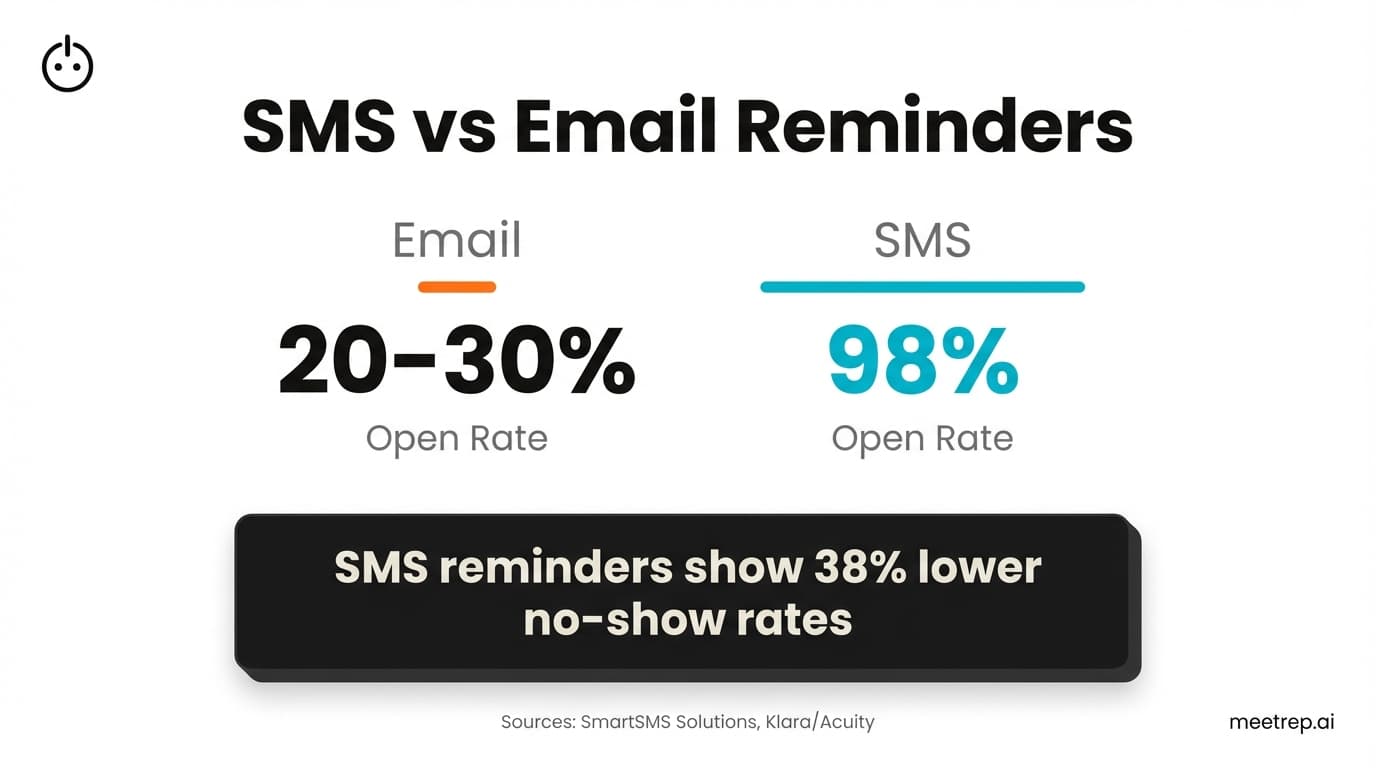
Why SMS? The numbers are stark. SmartSMS Solutions research shows 98% SMS open rates versus 20-30% for email. And 90% of texts get read within 3 minutes.
Real-world proof: SaaS Academy implemented 1-hour SMS reminders with a simple message—"Hey, just checking in. Are you still good for our call in one hour?"—and reduced no-shows by approximately 20%. The revenue impact? $90,000 in additional monthly revenue.
The Data: SMS reminders show 38% lower no-show rates compared to email-only approaches, according to Klara/Acuity research.
But here's my honest take: reminders are necessary but not sufficient. If you're sending a 24-hour reminder for a demo that was booked 10 days ago, you're polishing the brass on the Titanic. The 3-tier system works best when combined with aggressive same-day or next-day scheduling.
Meeting format: shorter is better
Gong Research Labs found that 30-minute meetings have 12% higher attendance than 60-minute slots. Why? Lower commitment anxiety.
Think about your own calendar. A 30-minute meeting feels easy to protect. A 60-minute block? That's a candidate for "I'll reschedule if something urgent comes up."
Pair this with Gong's timing data:
| Time Slot | No-Show Rate |
|---|---|
| 8-10am | 17-19% |
| 3-5pm | 14.68-15.4% |
Morning slots are the worst. People have their morning inbox explosion, their standup meetings, their coffee spilling on their keyboard. By 3pm, they've cleared the chaos. They can actually show up.
So: 30-minute demos, afternoon slots. This isn't revolutionary, but it's something most teams ignore when setting up their calendar availability.
The qualification factor most teams ignore
Not all leads are created equal. And Chili Piper's data on company size correlation is striking:
| Company Size (Employees) | Show Rate | No-Show Rate |
|---|---|---|
| 1-10 | 50% | 50% |
| 1,000+ | 90% | 10% |
Enterprise prospects are nearly twice as likely to show up. Why? Larger companies have more calendar discipline, more accountability for scheduled meetings, and less "putting out fires" chaos than a 5-person startup.
This doesn't mean you should ignore small companies. But it does mean you should adjust your approach:
- Enterprise leads: Priority scheduling, AE availability, high-touch confirmation
- SMB leads: Consider AI-first qualification, async demos as fallback, lower-friction scheduling
Look, if you're treating every lead identically regardless of company size, you're over-investing in the 50% show rate segment while potentially under-serving the 90% segment.
What to do when they ghost anyway
Even with everything optimized, some prospects will no-show. Here's the recovery playbook:
Minute 0-2: Wait. Don't panic-message at exactly the meeting time.
Minute 2: Send simultaneous email + SMS: "Just checking in—are you still able to join? [link]"
Hour 2-4: Friendly reschedule email. Assume good intent: "I noticed we missed connections today. These things happen—here's a link to grab another time." Include the original agenda to remind them why they booked.
Day 1-3: Re-engagement sequence across email, LinkedIn, and phone. Here's a stat that should change your behavior: Gong Labs found that leaving a voicemail increases email reply rates from 2.73% to 5.87%—a 2x improvement. Multi-channel matters.
After 3 attempts: Move to long-term nurture. Don't burn the bridge. They may be back in 3-6 months.
One thing I've noticed: most teams give up too early. A single "sorry we missed you" email isn't a real recovery attempt. It's a checkbox. The teams that recover 15-20% of no-shows work all three channels.
The 80% reduction in the headline isn't hyperbole. If you're currently booking demos 8+ days out (47% no-show) and switch to same-day scheduling (6.9% no-show), that's an 85% reduction right there. Add the 3-tier reminder system and optimized meeting formats, and the math works.
But here's my honest take after building in this space: most teams will implement better reminders and call it a day. The teams that win are the ones willing to rethink the fundamental assumption that demos need to be scheduled at all.
The prospect's interest is highest the moment they click "request demo." Every hour you make them wait, that interest decays. The question isn't how to remind them better—it's how to meet them in that moment.
That's exactly what we built Rep to do. If you want to see how an AI agent can deliver live product demos the instant a prospect expresses interest, check out how Rep works.

Nadeem Azam
Founder
Software engineer & architect with 10+ years experience. Previously founded GoCustomer.ai.
Nadeem Azam is the Founder of Rep (meetrep.ai), building AI agents that give live product demos 24/7 for B2B sales teams. He writes about AI, sales automation, and the future of product demos.
Frequently Asked Questions
Table of Contents
- What's a "good" demo no-show rate in 2025?
- The real cost of every no-show
- Why prospects actually ghost your demos
- The speed-to-demo correlation: this changes everything
- How AI instant demos eliminate the gap entirely
- The 3-tier reminder system that actually works
- Meeting format: shorter is better
- The qualification factor most teams ignore
- What to do when they ghost anyway
Ready to automate your demos?
Join the Rep Council and be among the first to experience AI-powered demos.
Get Early AccessRelated Articles
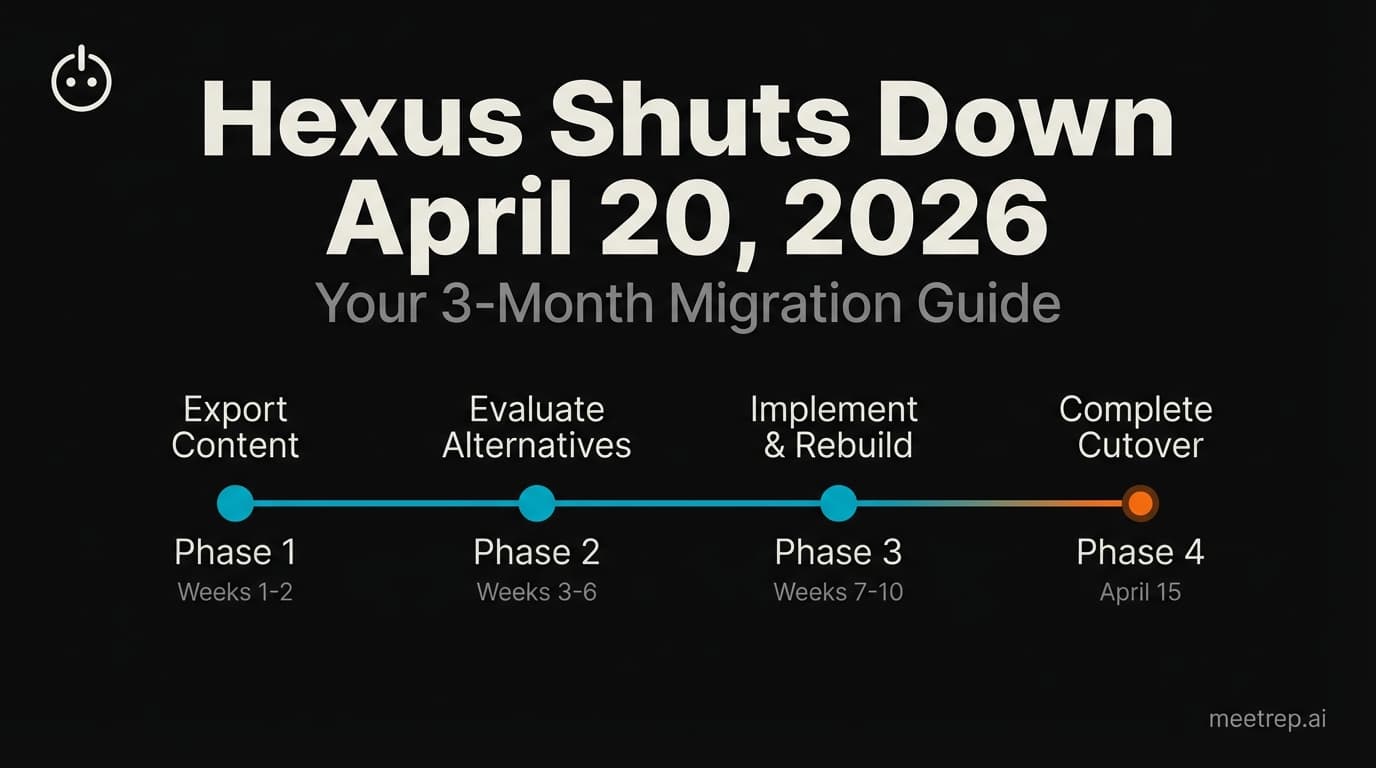
Hexus Acquired by Harvey AI: Congrats & What It Means for Demo Automation Teams
Hexus is shutting down following its acquisition by Harvey AI. Learn how to manage your migration and discover the best demo automation alternatives before April 2026.
Why the "Software Demo" is Broken—and Why AI Agents Are the Future
The traditional software demo is dead. Discover why 94% of B2B buyers rank vendors before calling sales and how AI agents are replacing manual demos to scale revenue.
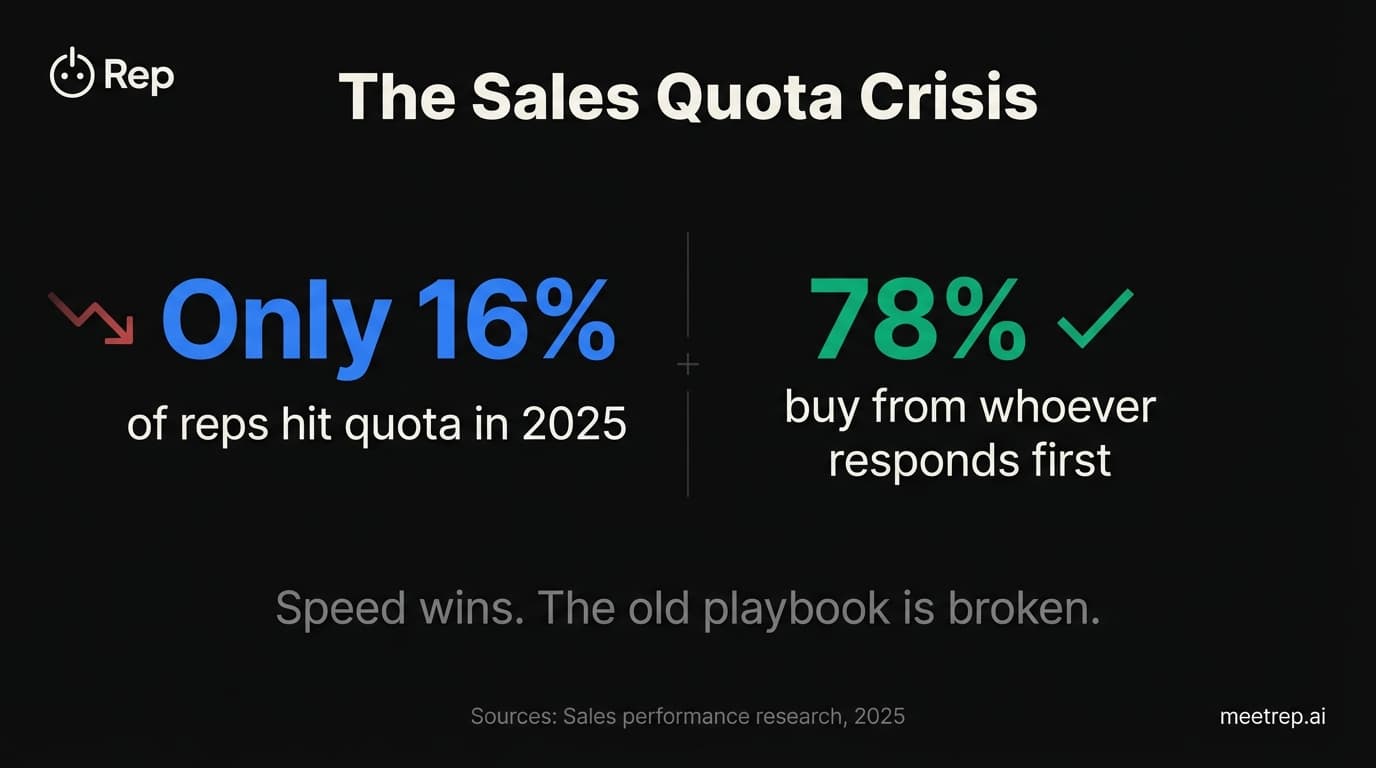
Why Autonomous Sales Software is the Future of B2B Sales (And Why the Old Playbook is Dead)
B2B sales is at a breaking point with quota attainment at 46%. Discover why autonomous 'Agentic AI' is the new standard for driving revenue and meeting the demand for rep-free buying.