How to Choose a B2B Lead Generation Agency (Without Wasting Budget)

Executive Summary
- Agency costs range from $3,000-$20,000/month; compare to in-house SDR costs of $110,000-$150,000/year
- Outsourcing typically saves 30-50% and ramps 3X faster—but only with the right partner
- Red flags: "guaranteed meetings" promises, black-box processes, no ICP deep-dive upfront
- Give agencies 90 days before judging results; expect setup to take 3-6 weeks
- Ask for case studies with conversion metrics, not just meetings booked
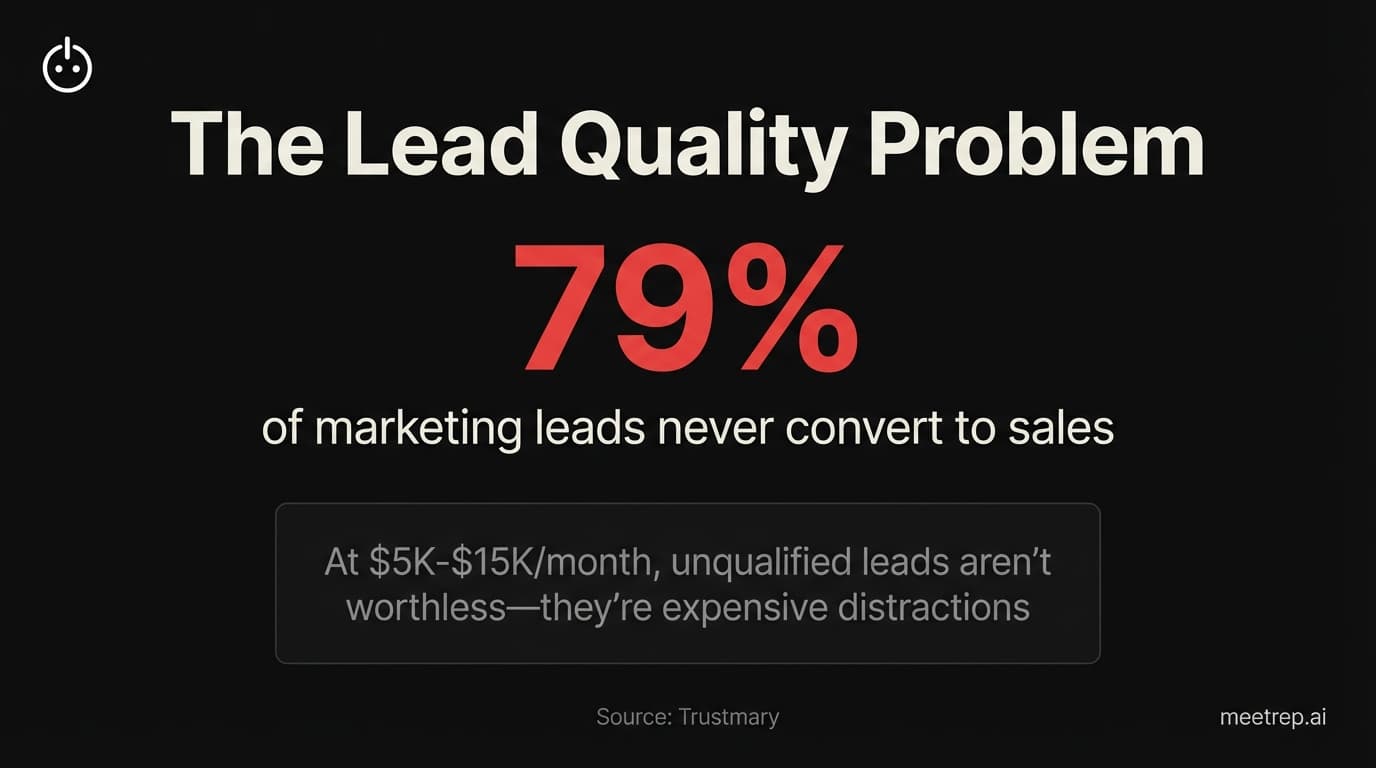
Here's a stat that should make you uncomfortable: 79% of marketing leads never convert to sales. That's not a data quality problem. That's a qualification problem.
And when you're paying a B2B lead generation agency $5,000 to $15,000 a month, those unconverted leads aren't just worthless—they're expensive distractions that pull your AEs away from deals that could actually close.
I've watched this play out from the other side. At GoCustomer, we built sales automation tools. We saw what happened when our customers paired our platform with agency partners. Some combinations worked beautifully. Others were disasters. The difference usually came down to one thing: whether the agency cared about lead quality or just hitting volume targets.
This guide will help you pick the right partner—or recognize when you should build in-house instead.
What does a B2B lead generation agency actually do?
A B2B lead generation agency is a specialized firm that identifies, attracts, and qualifies potential customers using data-driven outreach across email, LinkedIn, and phone. They don't replace your sales team. They fill your pipeline with qualified meetings so your AEs can focus on closing instead of prospecting.
That's the theory, anyway.
In practice, agencies vary wildly in what "qualified" means to them. Some are obsessed with hitting volume metrics. They'll book 30 meetings a month—and 25 will be with people who have no budget, no authority, or no actual need for your product.
Key Insight: The best agencies act like an extension of your team. The worst ones act like a meeting factory that bills by the pound.
Here's what most b2b sales lead generation companies actually deliver:
Core services:
- ICP development and refinement
- Multi-channel outreach campaigns (email, LinkedIn, cold calling)
- Lead qualification against your criteria
- Appointment setting with qualified prospects
- CRM integration and reporting
What they typically don't do:
- Close deals for you
- Handle product demos (though this is changing with AI)
- Own your sales strategy
- Build your brand long-term
The market for these services is growing fast—Business Research Insights projects it will hit $9.18B by 2035, up from $2.98B in 2025. But growth doesn't mean quality. More agencies entering the market means more variance in what you'll get.
How much does a lead generation agency cost?
Agency pricing breaks down into three main models: monthly retainers ranging from $3,000 to $20,000, cost-per-lead arrangements running $30 to $400 depending on your industry, and cost-per-appointment fees averaging $150 to $250. The right model depends on your deal size, sales cycle, and how much risk you want the agency to share.
Let me break this down with real numbers.
| Pricing Model | Typical Range | Best For | Watch Out For |
|---|---|---|---|
| Monthly Retainer | $3,000-$20,000 | Predictable budgeting, ongoing programs | Agencies coasting after month 2 |
| Cost Per Lead | $30-$400 | Testing new markets, variable budgets | Volume over quality incentives |
| Cost Per Appointment | $150-$250 | Direct ROI tracking | Agencies booking unqualified meetings |
| Hybrid | Varies | Balanced risk sharing | Complexity in tracking |
But here's what most comparison guides won't tell you: the sticker price isn't the real cost.
The Data: According to FirstPageSage's 2025 benchmarks, B2B SaaS companies pay an average of $237 per lead (blended across channels). Financial services? $653 per lead.
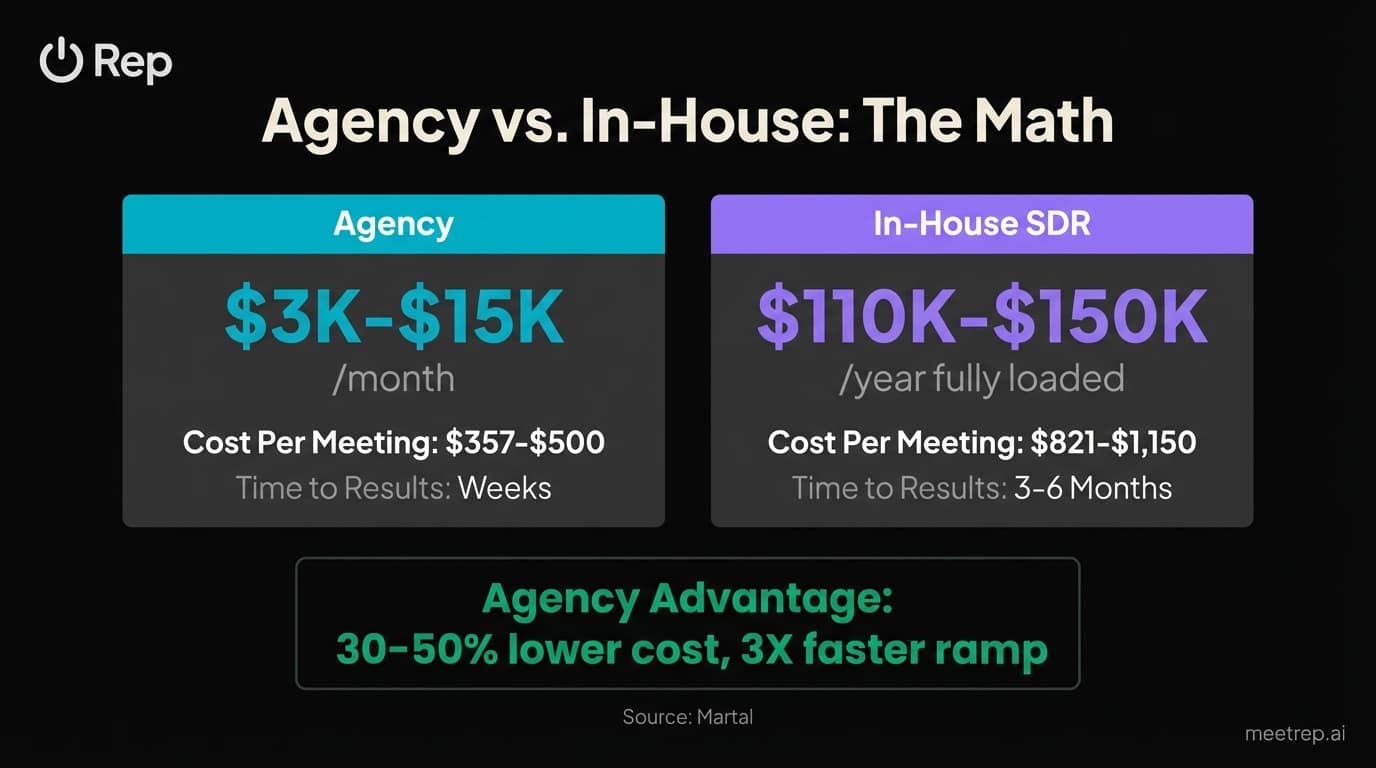
Now compare that to building in-house. A fully-loaded SDR costs $110,000 to $150,000 annually when you factor in salary, benefits, tools, and management overhead. That's before they've booked a single meeting.
The math often favors agencies—especially for the first year. Industry data suggests outsourcing reduces total sales costs by 30-50% compared to in-house teams. And outsourced teams ramp in weeks, not the 3-6 months it takes to hire and train an SDR internally.
But. (There's always a but.)
Those savings disappear if the agency delivers garbage leads. If your AEs waste 10 hours a week on calls that go nowhere, you're not saving money. You're paying twice.
When should you hire an agency vs build in-house?
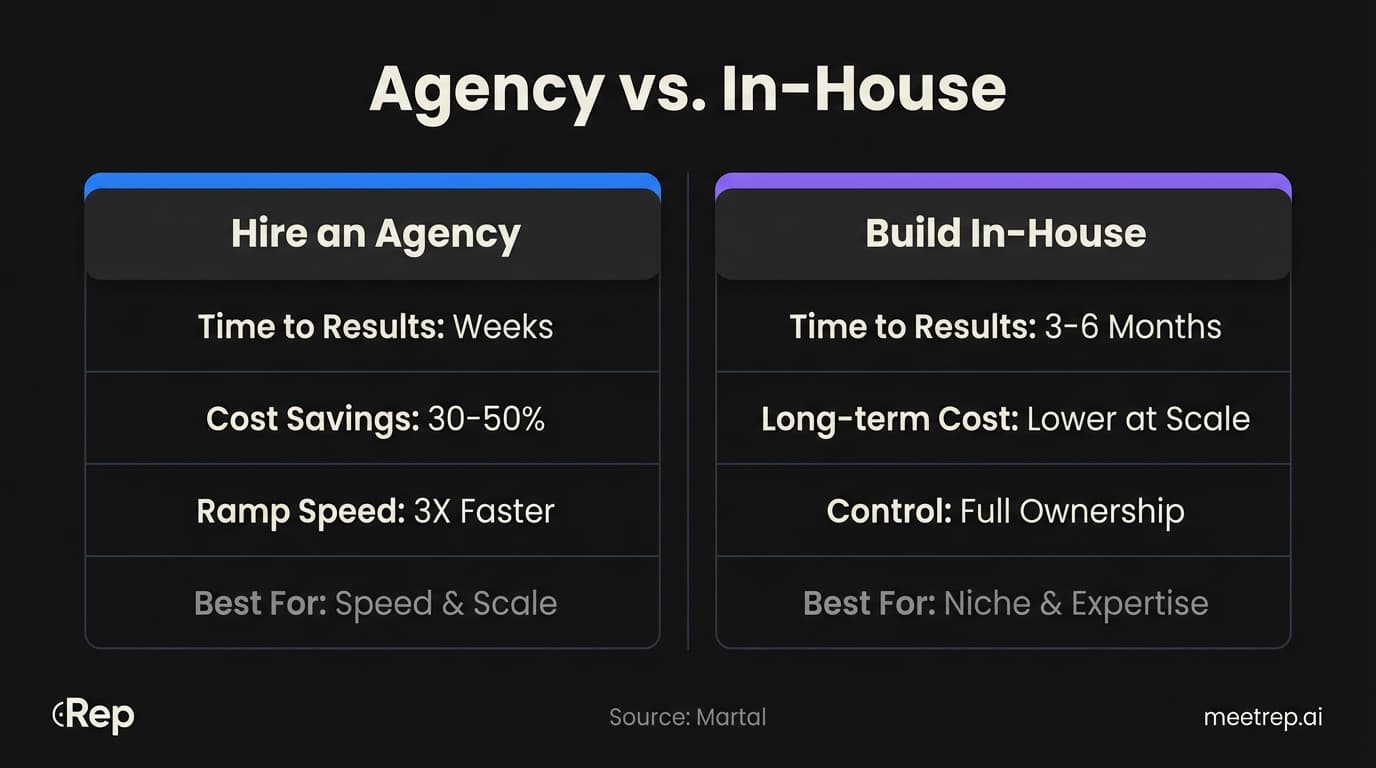
Choose an agency if you need speed, cost efficiency, or the ability to scale without hiring. Build in-house if you need maximum control, deep product expertise, or you're selling to extremely niche markets where outsiders will struggle to understand the specifics.
Look, this isn't a religious debate. It's a math problem with some qualitative inputs.
| Factor | Agency Wins | In-House Wins |
|---|---|---|
| Time to results | Weeks (proven systems) | 3-6 months (hiring + ramp) |
| Cost per meeting | $357-$500 | $821-$1,150 |
| Product expertise | Generic knowledge | Deep specialization |
| Brand control | Limited | Full |
| Scalability | Flex up/down easily | Requires hiring/firing |
| Long-term cost | Higher at scale | Lower at scale |
Key Insight:Companies with mature RevOps grow revenue 3X faster, according to Forrester. The model matters less than the execution.
Hire an agency when:
- You need pipeline in 60 days, not 6 months
- Your team lacks outbound expertise
- You're entering a new market or vertical
- You need to test messaging before committing to headcount
- You're scaling faster than you can hire
Build in-house when:
- Your product requires deep technical knowledge to explain
- Your ICP is extremely narrow (under 500 target accounts)
- You have the management bandwidth to train and retain SDRs
- You're playing a long game and want to own the process
At GoCustomer, we saw both approaches work. The deciding factor was almost always: does the founding team have time to manage either option properly? Agencies need management too. They just need different management.
Red flags that signal an agency will waste your budget
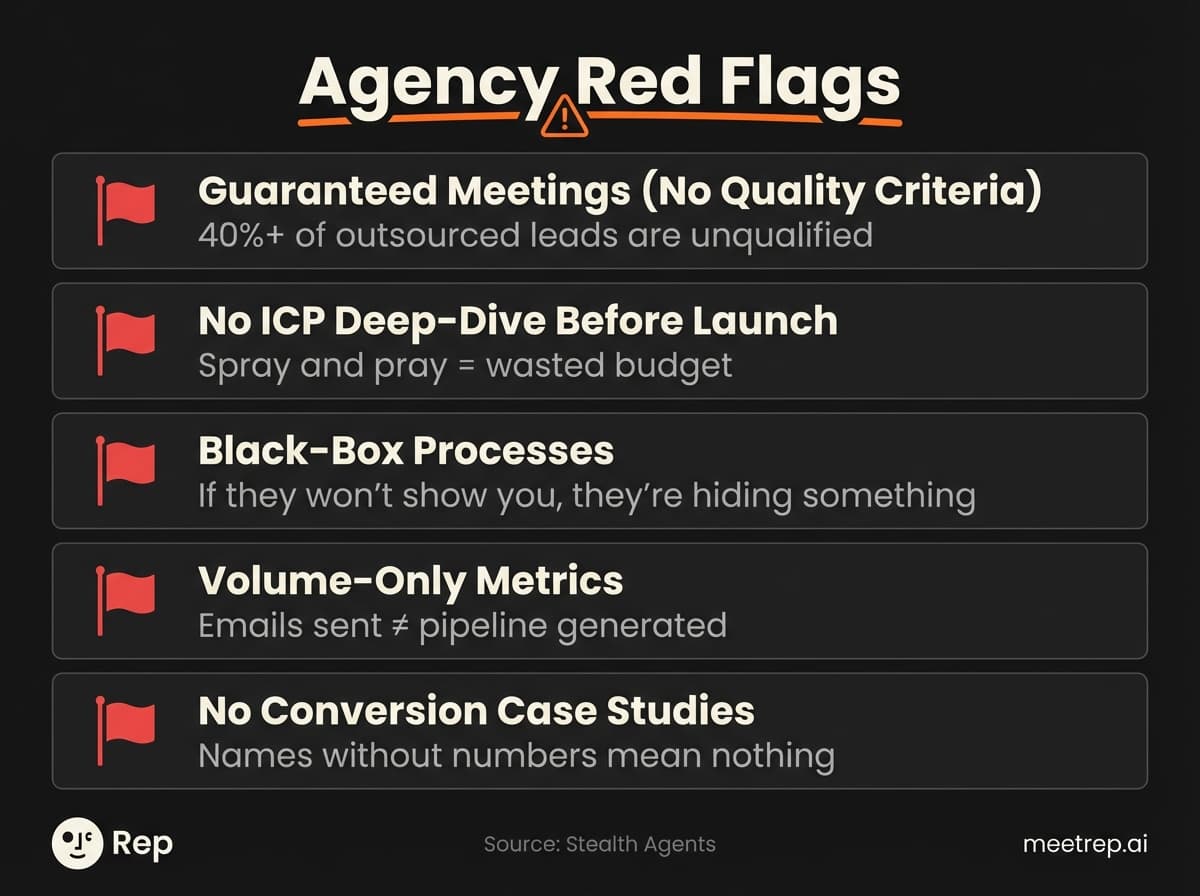
Avoid agencies that promise "guaranteed meetings" without clear qualification criteria, refuse to explain their process, or want to launch campaigns before deeply understanding your ICP. The market is shifting from black-box "done-for-you" services to transparent "done-with-you" partnerships—and the agencies still running black boxes are usually hiding something.
Let me be direct. I've seen these red flags sink partnerships over and over.
🚩 "We guarantee 20 meetings per month"
Sounds great. But guaranteed meetings without guaranteed quality is just guaranteed wasted time. According to Stealth Agents, 40% or more of outsourced leads are unqualified when agencies don't have strict filters. So ask: guaranteed meetings with whom? Matching what criteria?
🚩 No ICP deep-dive before launch
If an agency wants to start campaigns in week one, run. They're going to spray and pray with generic messaging. Good agencies spend 2-4 weeks understanding your product, your customers, and your competitors before sending a single email.
🚩 Black-box processes
"Trust us, we have a proprietary system." No. You should see exactly who they're targeting, what messages they're sending, and how they're qualifying responses. If they won't show you, assume they're hiding low-quality work.
Common mistake: Signing a 12-month contract before seeing any results. The best agencies will start with a 90-day pilot. If they won't, they're betting you'll be stuck paying even after you realize it's not working.
🚩 They charge by volume and resist quality metrics
An agency that only reports "emails sent" or "meetings booked" is optimizing for the wrong thing. You want conversion rates, show rates, and ideally, pipeline generated from their leads.
🚩 No case studies with conversion data
"We worked with Salesforce" means nothing. "We generated 42 meetings that converted to $1.2M in pipeline" means something. Ask for specifics or assume they don't have them.
How to evaluate an agency before signing (and after)
Request case studies with specific conversion metrics—not just meetings booked. Verify G2 and Clutch reviews independently. Ask about lead qualification criteria, data sources, and what happens to your data if you cancel. Establish 90-day milestone checkpoints with clear success metrics before signing anything.
Here's my evaluation framework, built from watching this process play out dozens of times:
Before you sign:
- Verify industry experience. Have they worked in your space? Can they name specific challenges in your market?
- Review case studies with teeth. You want conversion metrics: meeting-to-opportunity rate, pipeline generated, deal size. Not just vanity numbers.
- Check third-party reviews. G2 and Clutch reviews aren't perfect, but they're harder to fake than testimonials.
- Understand their qualification process. How do they verify budget, authority, need, and timeline? If they can't explain this clearly, they're not doing it.
- Ask about data sources. Where do they get their contact data? How do they verify it? Bad data destroys deliverability.
- Demand transparent reporting. You should have access to a dashboard showing activity, responses, and conversions in real-time.
- Clarify data ownership. If you cancel, do you keep the leads? The email templates? The outreach data?
- Assess cultural fit. Do they communicate the way you need? Are they responsive? This matters more than you think at month three.
The Data:84% of businesses fail to convert MQLs to SQLs. The agencies that beat this stat are the ones obsessing over qualification, not volume.
After you sign:
Set 90-day checkpoints with clear metrics. Month one is setup—don't expect much. Month two should show activity and early signals. Month three is when you should see real pipeline impact. If you don't, have a serious conversation.
What results to expect (and when)
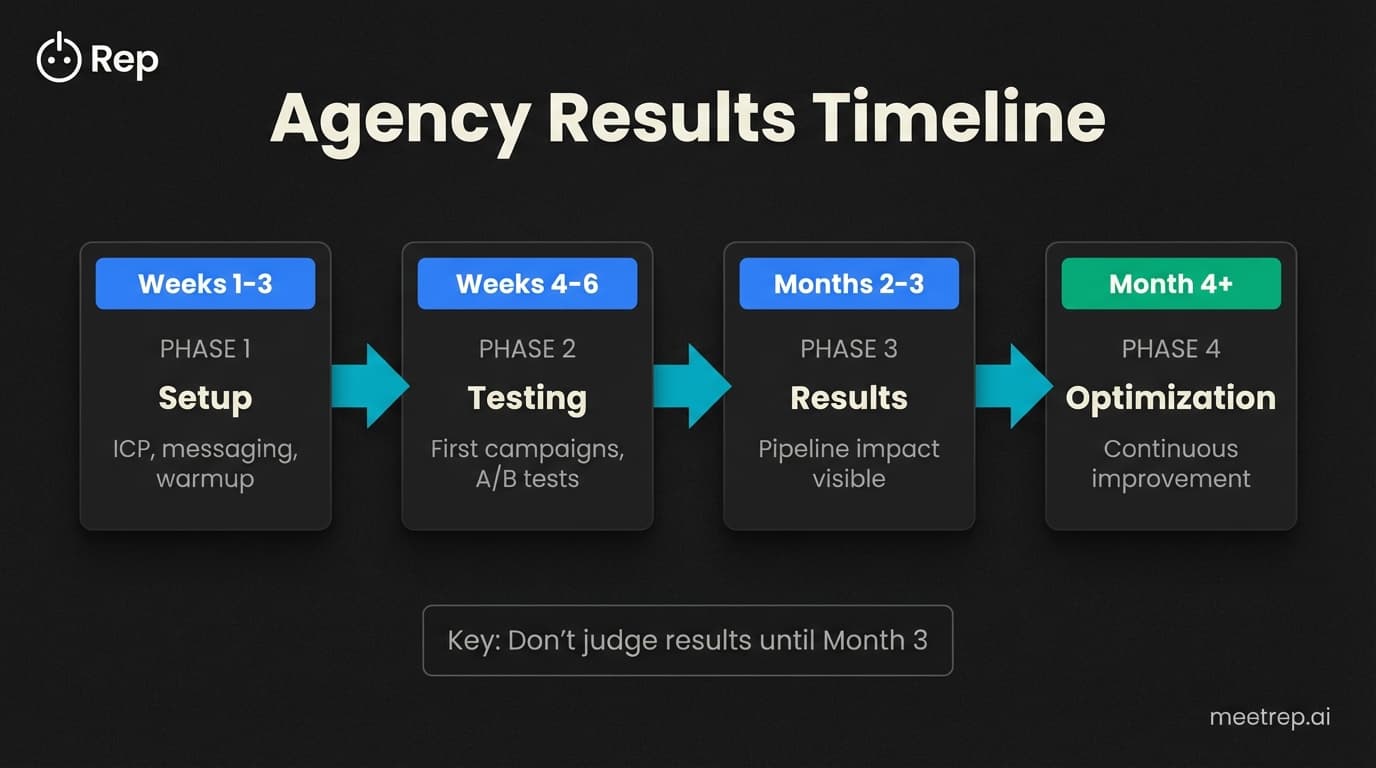
Expect 3-6 weeks for campaign setup and initial testing. Meaningful pipeline impact typically appears in month two or three. Agencies promising immediate results are almost always cutting corners on qualification—you'll pay for that later in wasted AE time and damaged domain reputation.
Here's a realistic timeline:
Weeks 1-3: Setup
- ICP deep-dive and messaging development
- List building and data verification
- Email infrastructure warmup (critical for deliverability)
- CRM integration
Weeks 4-6: Testing
- Initial campaigns launch
- A/B testing messaging and targeting
- First responses come in
- Qualification process starts
Months 2-3: Results
- Optimized campaigns at scale
- Regular meeting flow begins
- Pipeline attribution becomes visible
- You can start measuring real ROI
Month 4+: Optimization
- Continuous improvement based on data
- Expansion to new segments or channels
- Potential to reduce cost per meeting as efficiency improves
What we learned at GoCustomer: The companies that got the most from outbound lead generation agencies were the ones that stayed involved. Weekly check-ins. Reviewing call recordings. Giving feedback on lead quality. The "set it and forget it" customers almost always churned—either from us or from their agency.
Frankly, the worst time to hire an agency is when you need results yesterday. Bringing in a partner three weeks before end of quarter is a recipe for disappointment. The best time is when you have 90 days of runway and the bandwidth to actually partner with them.
Where agencies fall short (and how to fill the gaps)
Agencies are great at filling your calendar. They're usually not great at what happens after the meeting gets booked. The handoff from "meeting scheduled" to "deal closed" is where most agency partnerships lose value.
Think about it. An agency books a demo with a qualified prospect. Then what?
Your AE has to find time in their calendar. The prospect waits 3-5 days. When the call finally happens, the AE spends the first 10 minutes re-qualifying because they don't trust the agency's notes. By the time they get to the actual product, the prospect's enthusiasm has cooled.
This is where the technology is changing. We built Rep to handle exactly this gap—an AI agent that can conduct live product demos 24/7, so qualified leads don't sit waiting for a human calendar to open up. But whether you use a tool like Rep or optimize your internal process, you need to think about the full journey, not just the meeting booking.
The best agency partnerships include:
- Clear SLAs for lead handoff (how fast do they get to your AE?)
- Detailed qualification notes that AEs actually trust
- Feedback loops so agencies learn what "good" looks like for you
- Technology that removes friction between "meeting booked" and "demo delivered"
The B2B lead generation agency market isn't going anywhere. If anything, it's getting more sophisticated. But sophistication means nothing if the partnership isn't right for your specific situation.
My advice? Start with a 90-day pilot. Insist on transparent reporting. And judge agencies on what matters: qualified pipeline, not calendar invites.
If you're finding that even qualified meetings aren't converting because of demo scheduling friction, that's a different problem—and one that technology like Rep's autonomous demo platform is built to solve. But get the lead quality right first. Everything else builds on that foundation.

Nadeem Azam
Founder
Software engineer & architect with 10+ years experience. Previously founded GoCustomer.ai.
Nadeem Azam is the Founder of Rep (meetrep.ai), building AI agents that give live product demos 24/7 for B2B sales teams. He writes about AI, sales automation, and the future of product demos.
Frequently Asked Questions
Table of Contents
- What does a B2B lead generation agency actually do?
- How much does a lead generation agency cost?
- When should you hire an agency vs build in-house?
- Red flags that signal an agency will waste your budget
- How to evaluate an agency before signing (and after)
- What results to expect (and when)
- Where agencies fall short (and how to fill the gaps)
Ready to automate your demos?
Join the Rep Council and be among the first to experience AI-powered demos.
Get Early AccessRelated Articles
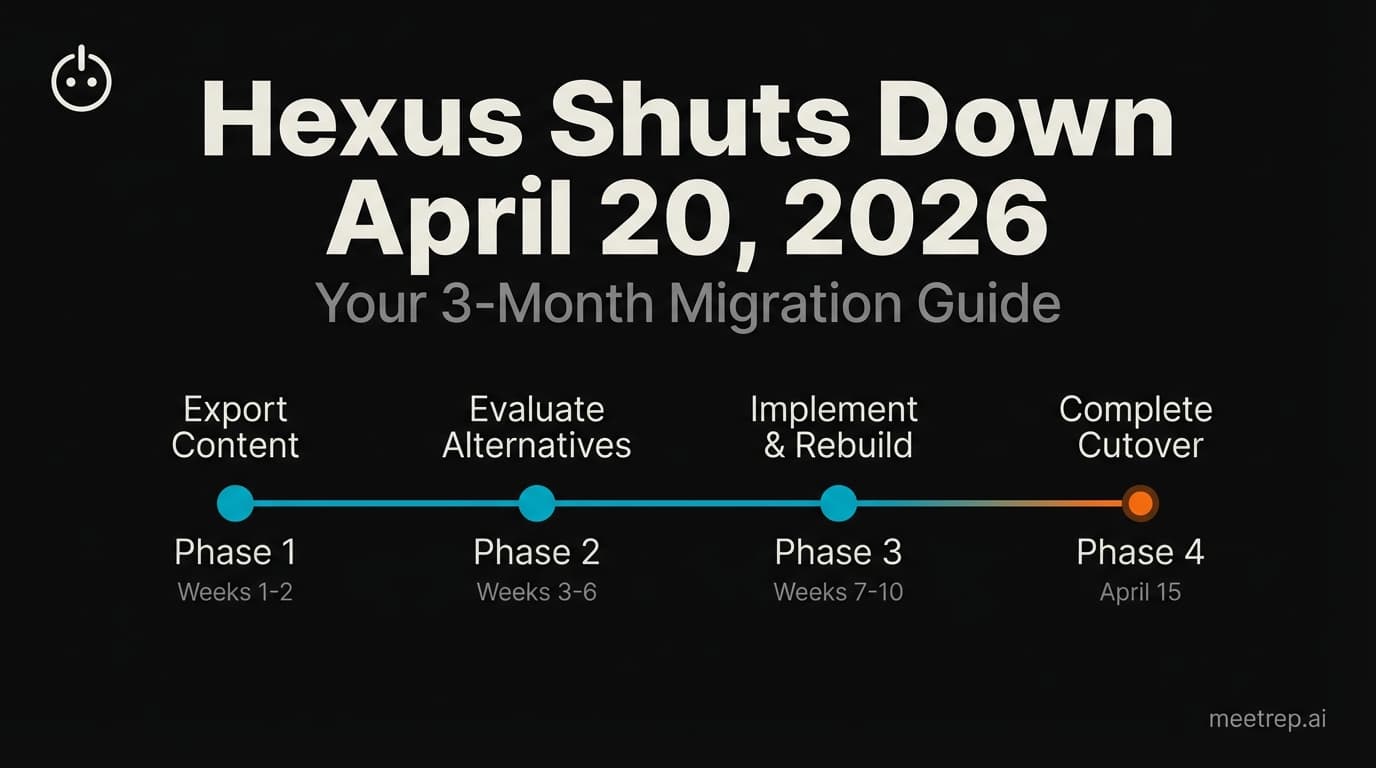
Hexus Acquired by Harvey AI: Congrats & What It Means for Demo Automation Teams
Hexus is shutting down following its acquisition by Harvey AI. Learn how to manage your migration and discover the best demo automation alternatives before April 2026.
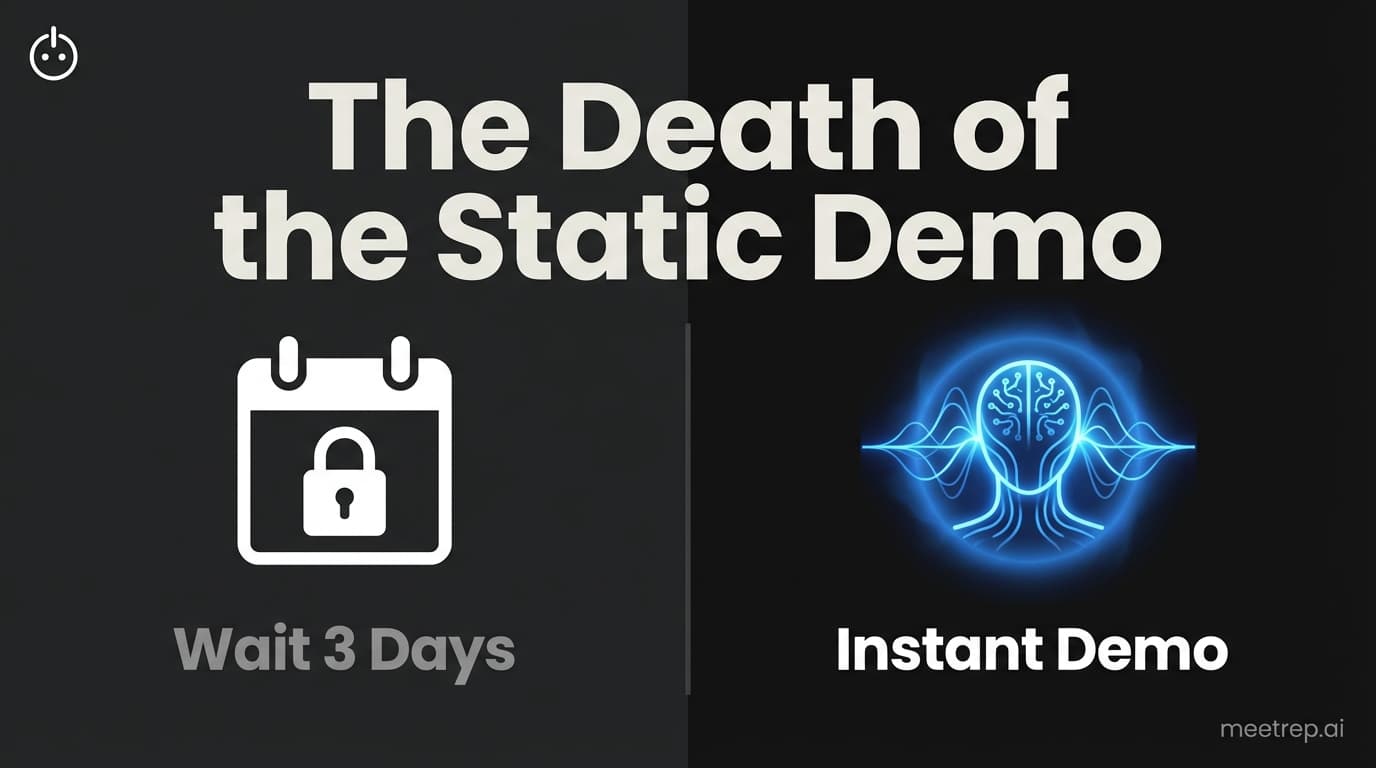
Why the "Software Demo" is Broken—and Why AI Agents Are the Future
The traditional software demo is dead. Discover why 94% of B2B buyers rank vendors before calling sales and how AI agents are replacing manual demos to scale revenue.
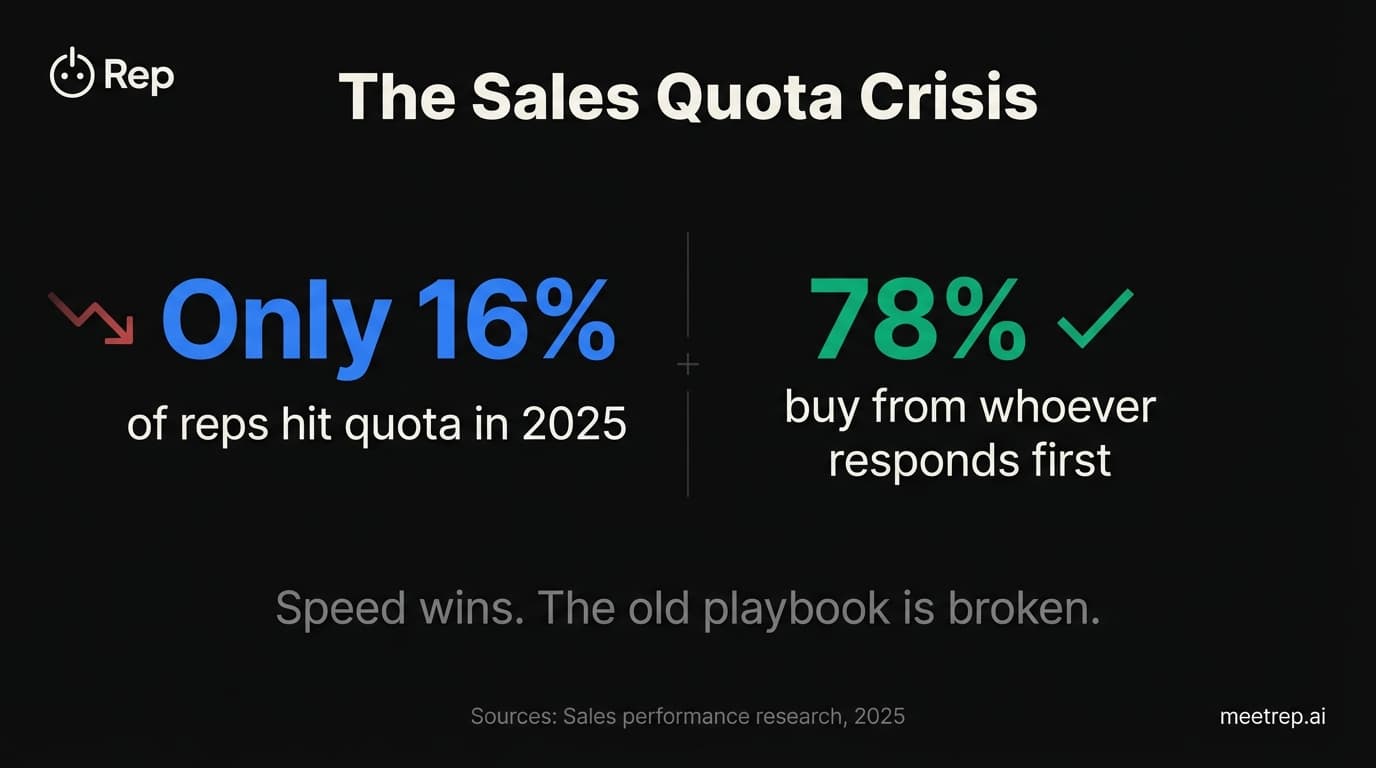
Why Autonomous Sales Software is the Future of B2B Sales (And Why the Old Playbook is Dead)
B2B sales is at a breaking point with quota attainment at 46%. Discover why autonomous 'Agentic AI' is the new standard for driving revenue and meeting the demand for rep-free buying.