Healthcare Demo Automation: How to Scale Without Breaking HIPAA

Executive Summary
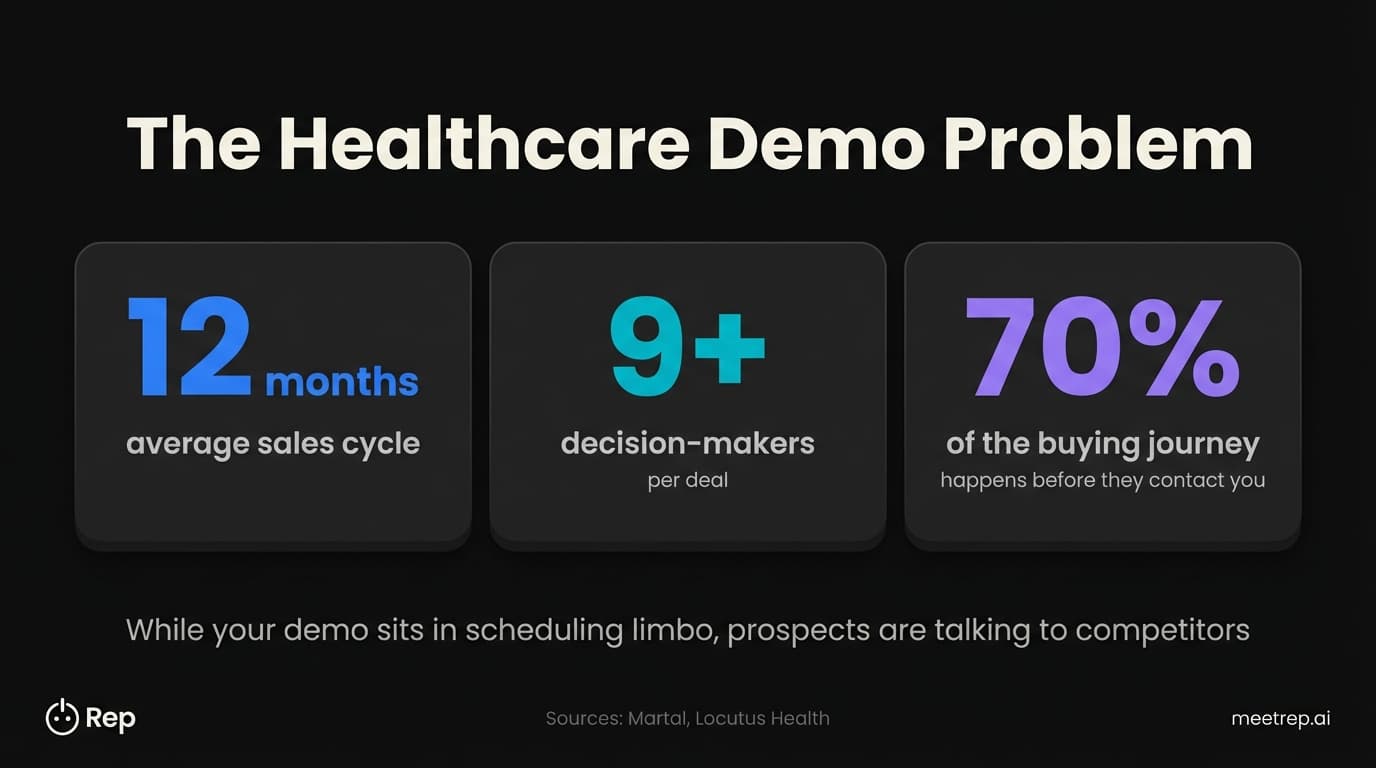
- Healthcare sales cycles average 12 months with 9+ decision-makers per deal
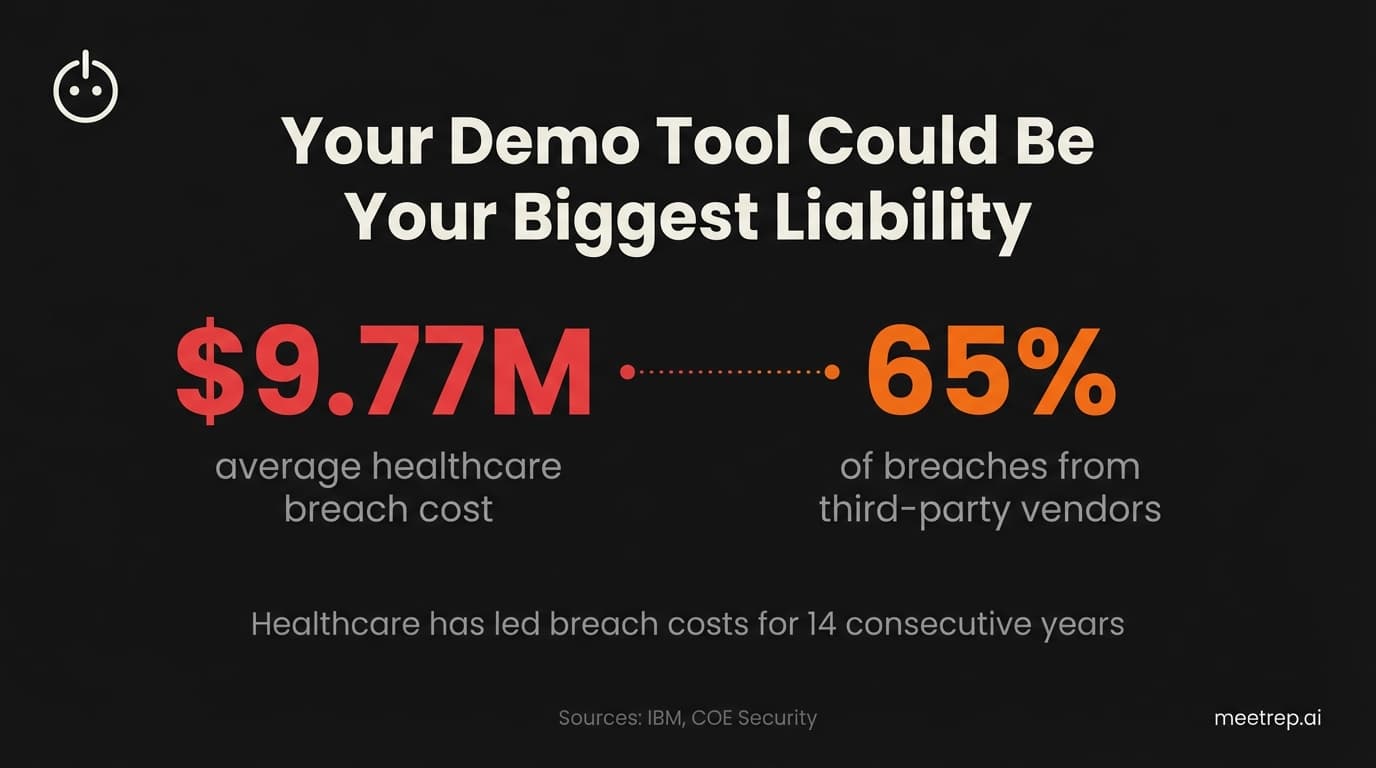
- 65% of healthcare data breaches come from third-party vendors—your demo tool could be a liability
- Real PHI should never enter demo environments; synthetic or de-identified data only
- Autonomous demos can actually improve compliance by eliminating human improvisation
- The demo tool itself doesn't need HIPAA certification if it never touches PHI
Your healthcare demo process is probably killing your pipeline right now.
I don't mean slowly. I mean actively. While your team waits for calendar availability across nine stakeholders, your prospect is 70% through their buying journey—talking to your competitors, not you. The average medical software deal takes 12 months to close. And every week your demo sits in scheduling limbo adds to that timeline.
At Rep, we built an autonomous demo platform because we watched this problem eat companies alive. But before you can automate healthcare demos, you need to understand why they're different from every other vertical. The compliance stakes change everything.
Why Healthcare Demos Are Different From Every Other Vertical
A healthcare demo isn't just a product walkthrough with extra steps. It's a compliance event.
Every healthcare software purchase involves an average of 9 decision-makers—clinical leads, IT, procurement, legal, compliance, finance, and usually the CISO. Each has different concerns. The clinician wants to see workflow fit. The CISO wants to know if your demo environment could expose their data. Legal wants to understand your BAA status.
And here's what makes it worse: 67% of healthcare organizations aren't ready for the 2025 HIPAA security updates. They're scared. Not of AI—of getting burned by another vendor that creates liability.
The Data: Healthcare data breaches cost an average of $9.77 million in 2024—the highest of any industry for 14 consecutive years. And 65% of those breaches trace back to third-party vendors. Your demo tool is a third party.
So when a VP Sales at a healthcare software company asks me about demo automation, the first question isn't "will AI sound natural?" It's "will this pass our prospects' security review?"
That's the right question.
What Is an Autonomous Healthcare Demo?
An autonomous healthcare demo is a live, interactive product demonstration delivered by an AI agent—not a pre-recorded video or click-through tour.
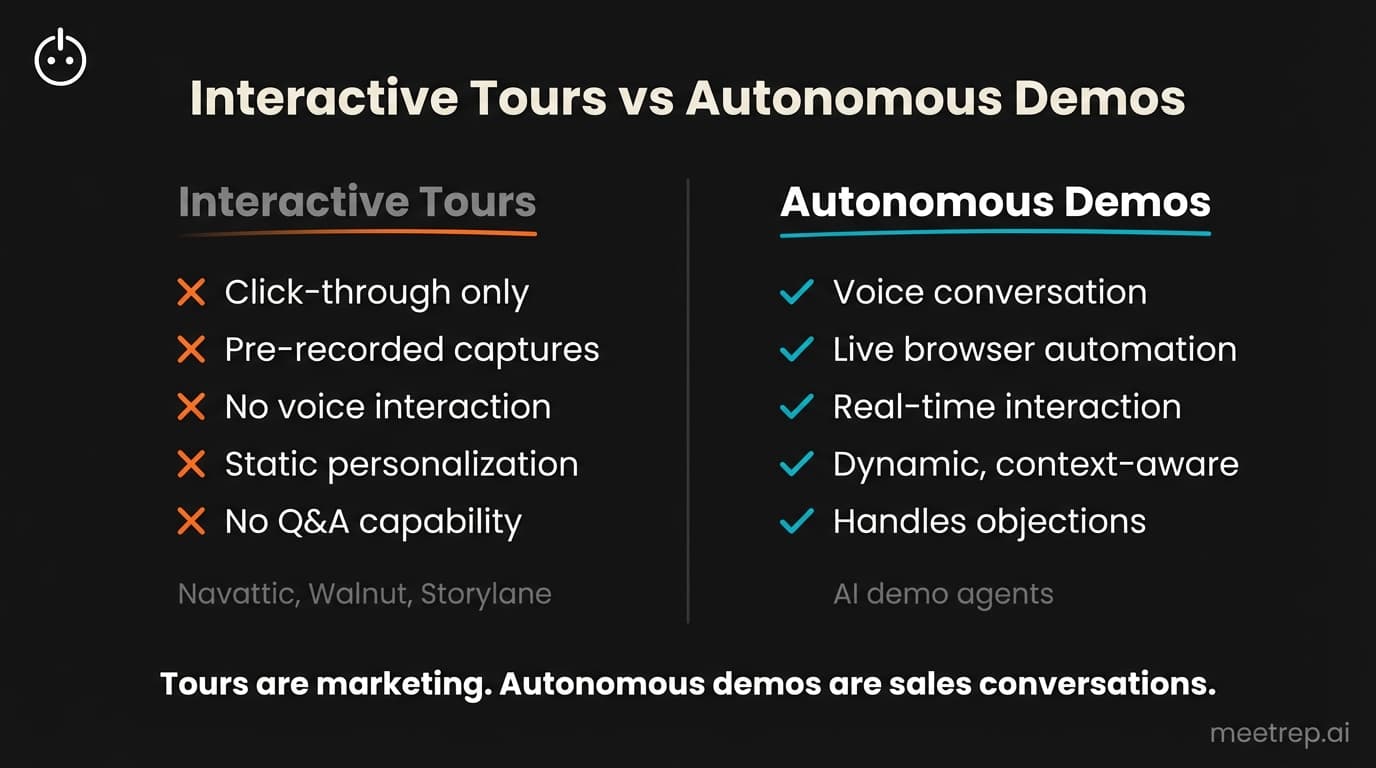
Here's the distinction that matters: Tools like Navattic, Storylane, and Walnut capture screenshots or HTML of your product and let prospects click through a guided tour. That's useful for marketing. But it's not a demo. There's no conversation. No objection handling. No adjusting based on what the prospect actually cares about.
An autonomous demo agent joins a video call, shares its screen, navigates your actual product interface, and talks with the prospect in real-time. Questions? It answers them. Objections? It addresses them. The prospect wants to see a specific feature? It pivots.
| Feature | Interactive Tour (Navattic, Walnut) | Autonomous Agent |
|---|---|---|
| Interaction Type | Click-through (silent) | Voice conversation |
| Navigation | Pre-recorded HTML capture | Live browser automation |
| Personalization | Static text replacement | Dynamic, context-aware responses |
| Q&A Capability | None (or text chat) | Real-time voice answers |
| Objection Handling | None | Trained responses |
| Best For | Top-of-funnel awareness | Mid-funnel qualification |
My take? Click-throughs are tours, not demos. And healthcare buyers don't need another tour. They need someone who can answer "how does this integrate with Epic?" at 11pm when they're finally reviewing vendors.
Key Insight:75% of B2B buyers prefer a rep-free experience for initial product exploration. They want to learn at their own pace—but they still want their questions answered. Autonomous demos give them both.
The HIPAA Reality: What Actually Needs to Be Compliant?
Here's where most people get confused. And I get it—HIPAA compliance discussions usually generate more heat than light.
The demo tool itself doesn't need to be "HIPAA compliant" if it never accesses, stores, or transmits Protected Health Information (PHI). The question isn't "is your demo platform certified?" It's "does PHI ever enter the demo environment?"
The Three Types of Demo Data
| Data Type | PHI Status | Compliance Requirement | Best For |
|---|---|---|---|
| Real PHI | Yes | Requires BAA, full HIPAA controls | Never use in demos |
| De-identified Data | No (if properly done) | Safe Harbor: remove 18 identifiers | Realistic demos without risk |
| Synthetic Data | No | None required | Cleanest option |
Real PHI in demos is generally prohibited for a simple reason: sales demonstrations don't fall under Treatment, Payment, or Healthcare Operations (TPO). You'd need explicit authorization from each patient whose data appears. That's not practical.
The solution? Your demo environment should run on synthetic data or properly de-identified data. Full stop.
Common Mistake: Many teams use "demo accounts" that still connect to production data. If your demo credentials can access any real patient information, you have a problem—regardless of what your demo tool claims.
When we built Rep, we designed the credential system to connect to isolated demo environments. Rep logs into your product using stored credentials, but what it sees is whatever you've put in that demo instance. If that instance contains only synthetic data? No PHI ever enters the equation.
How Autonomous Demos Can Actually Improve Compliance
This sounds counterintuitive. How does adding AI to healthcare demos make them more compliant?
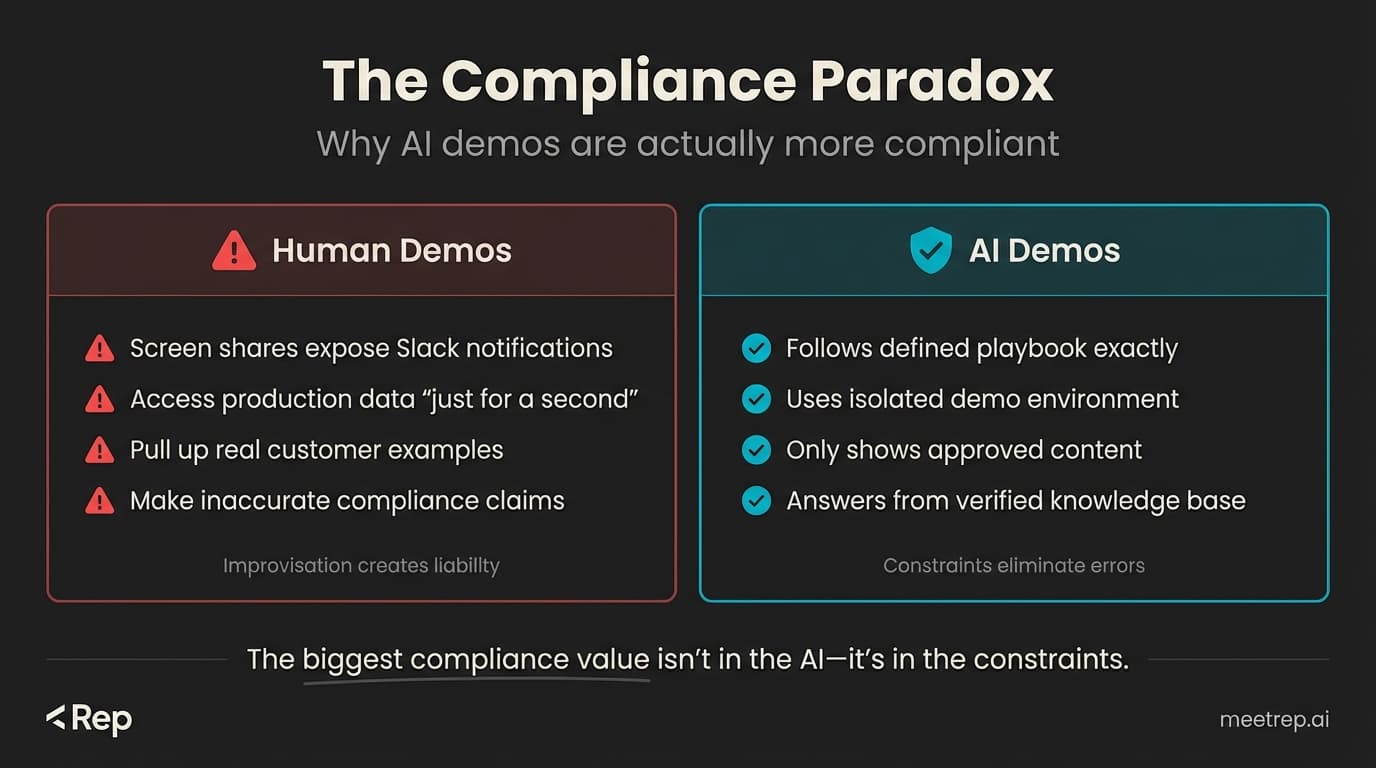
Because humans improvise. AI doesn't.
When your SDR gives a live demo, they might:
- Share their screen while Slack notifications pop up with client names
- Pull up a "real" customer example to impress the prospect
- Navigate into a production environment "just for a second"
- Make claims about features or compliance that aren't accurate
An autonomous agent does exactly what it's trained to do. Nothing more. It follows the playbook. It uses the demo environment you configured. It answers questions using the knowledge base you provided. There's no "let me just show you this real quick" moment that creates liability.
What we learned building Rep: The biggest compliance value isn't in the AI—it's in the constraints. By forcing demos through a defined playbook and isolated credentials, you eliminate the human errors that cause most demo-related compliance incidents.
This matters especially for the healthcare security questionnaire process. Procurement teams ask dozens of questions about how your sales process handles data. "We use an autonomous agent with isolated demo credentials and synthetic data" is a much cleaner answer than "our SDRs share their screens during Zoom calls."
What Healthcare Buyers Actually Want to See in Your Security Review
The security questionnaire is where healthcare deals go to die. 81% of organizations now require ISO 27001 certification from vendors. Missing certification doesn't slow deals—it kills them.
But the questionnaire isn't just about your product. It's about your entire sales process.
Here's what procurement teams typically ask about demos:
Data Handling:
- Does demo data contain PHI? (Answer: No—synthetic or de-identified only)
- How is demo environment isolated from production?
- Are demo credentials shared or role-specific?
Technical Controls:
- Is data encrypted in transit and at rest?
- What access controls exist on demo environments?
- Are demo sessions logged for audit purposes?
Third-Party Risk:
- What third-party tools are used in the demo process?
- Do those tools have BAAs in place (if they touch PHI)?
- What's the data retention policy?
Key Insight: The security questionnaire isn't trying to catch you. It's trying to reduce risk. If you can show that your demo process is designed to never expose PHI—through synthetic data, isolated environments, and constrained AI behavior—you're giving them what they need.
| Stakeholder | Primary Demo Concern |
|---|---|
| Clinical Lead | "Will this fit our workflow?" |
| CIO/CMIO | "How does this integrate with our EHR?" |
| CISO | "What data exposure does this create?" |
| Procurement | "Does this vendor meet our standards?" |
| Legal/Compliance | "What are the BAA requirements?" |
| Finance | "What's the total cost including implementation?" |
Each of these people needs to see something different. And with a 9-person committee, scheduling a single demo that works for everyone is a nightmare. Autonomous demos let each stakeholder engage on their schedule, seeing the aspects most relevant to their role.
The Real Cost of Slow Healthcare Sales Cycles
Let's talk numbers. Because the 12-month sales cycle isn't just annoying—it's expensive.
85% of health systems increased their IT budgets in 2024. The money is there. But 70% of the buying journey happens before prospects contact you. They're researching. Comparing. Building shortlists.
If you're not available when they're ready to look, you're not on the shortlist.
The Data:Interactive demos convert at 38%—52% higher than traditional screen-share demos. Why? Because prospects engage when they're ready, not when your calendar allows.
Here's what that means for pipeline:
Every week of demo scheduling delay extends your sales cycle. With 9 stakeholders, you're not scheduling one demo—you're scheduling multiple sessions across different time zones and shift schedules. Healthcare operates 24/7. Your sales team doesn't.
Autonomous demos flip this. The prospect clicks a link. The AI agent joins. Demo happens. Whether it's 2am or 2pm. Whether your team is in a conference or on vacation.
Look, I'm not saying human AEs become irrelevant. The high-stakes negotiations, the executive alignment, the contract discussions—that's where your team adds value. But the initial demo? The "show me what this does" moment? That doesn't need a human. And waiting for one is costing you deals.
How to Evaluate Demo Tools for Healthcare
Not every demo solution works for healthcare. Here's what to look for:
1. Demo Environment Isolation Does the tool connect to your actual product? If so, can you point it at an isolated demo instance with synthetic data? If the tool only captures screenshots, this matters less—but you also lose the ability to show real functionality.
2. Data Handling Transparency Ask directly: what data does this tool store? Transcripts? Recordings? Screen captures? Where is it stored? Who has access? If they can't answer clearly, walk away.
3. Voice vs. Silent Tours Healthcare demos require explanation. Integration questions. Workflow clarifications. A silent click-through won't cut it. Look for tools that can actually converse.
4. Credential Management How does the tool authenticate to your product? Are credentials encrypted? Can you use demo-specific accounts that never touch production data?
5. Audit Capabilities Can you see who accessed what, when? Healthcare prospects will ask about this. "We have full session logs with transcripts" is the right answer.
Here's what I've seen across healthcare software companies: the teams that win aren't necessarily the ones with the best product. They're the ones that remove friction.
85% of healthcare organizations are developing or adopting AI. The skepticism isn't about whether AI works—it's about whether it's safe. If you can demonstrate your product 24/7 without creating compliance liability, you've already separated yourself from most competitors.
The 12-month healthcare sales cycle isn't a law of nature. It's a symptom of friction. Autonomous demos that run on synthetic data, answer real questions, and pass security reviews can compress that timeline. My prediction: by the end of 2026, healthcare vendors without some form of autonomous demo capability will be at a measurable disadvantage in competitive deals.
We built Rep to handle exactly this problem. But regardless of what tool you use, the principle holds: demo earlier, demo faster, and never let PHI near your demo environment.

Nadeem Azam
Founder
Software engineer & architect with 10+ years experience. Previously founded GoCustomer.ai.
Nadeem Azam is the Founder of Rep (meetrep.ai), building AI agents that give live product demos 24/7 for B2B sales teams. He writes about AI, sales automation, and the future of product demos.
Frequently Asked Questions
Table of Contents
- Why Healthcare Demos Are Different From Every Other Vertical
- What Is an Autonomous Healthcare Demo?
- The HIPAA Reality: What Actually Needs to Be Compliant?
- How Autonomous Demos Can Actually Improve Compliance
- What Healthcare Buyers Actually Want to See in Your Security Review
- The Real Cost of Slow Healthcare Sales Cycles
- How to Evaluate Demo Tools for Healthcare
Ready to automate your demos?
Join the Rep Council and be among the first to experience AI-powered demos.
Get Early AccessRelated Articles
Hexus Acquired by Harvey AI: Congrats & What It Means for Demo Automation Teams
Hexus is shutting down following its acquisition by Harvey AI. Learn how to manage your migration and discover the best demo automation alternatives before April 2026.
Why the "Software Demo" is Broken—and Why AI Agents Are the Future
The traditional software demo is dead. Discover why 94% of B2B buyers rank vendors before calling sales and how AI agents are replacing manual demos to scale revenue.
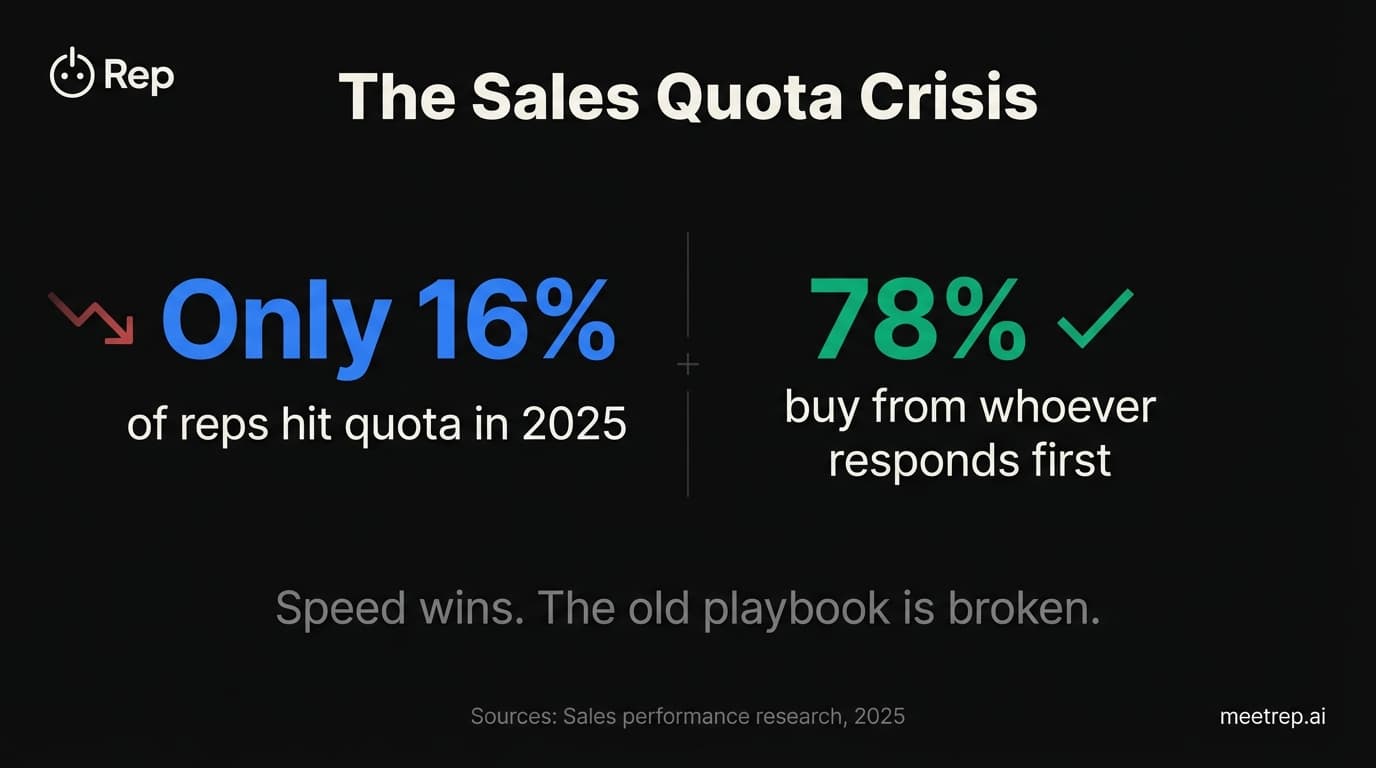
Why Autonomous Sales Software is the Future of B2B Sales (And Why the Old Playbook is Dead)
B2B sales is at a breaking point with quota attainment at 46%. Discover why autonomous 'Agentic AI' is the new standard for driving revenue and meeting the demand for rep-free buying.