Generative AI in Sales: Use Cases That Work and How to Implement Without Failing

Executive Summary
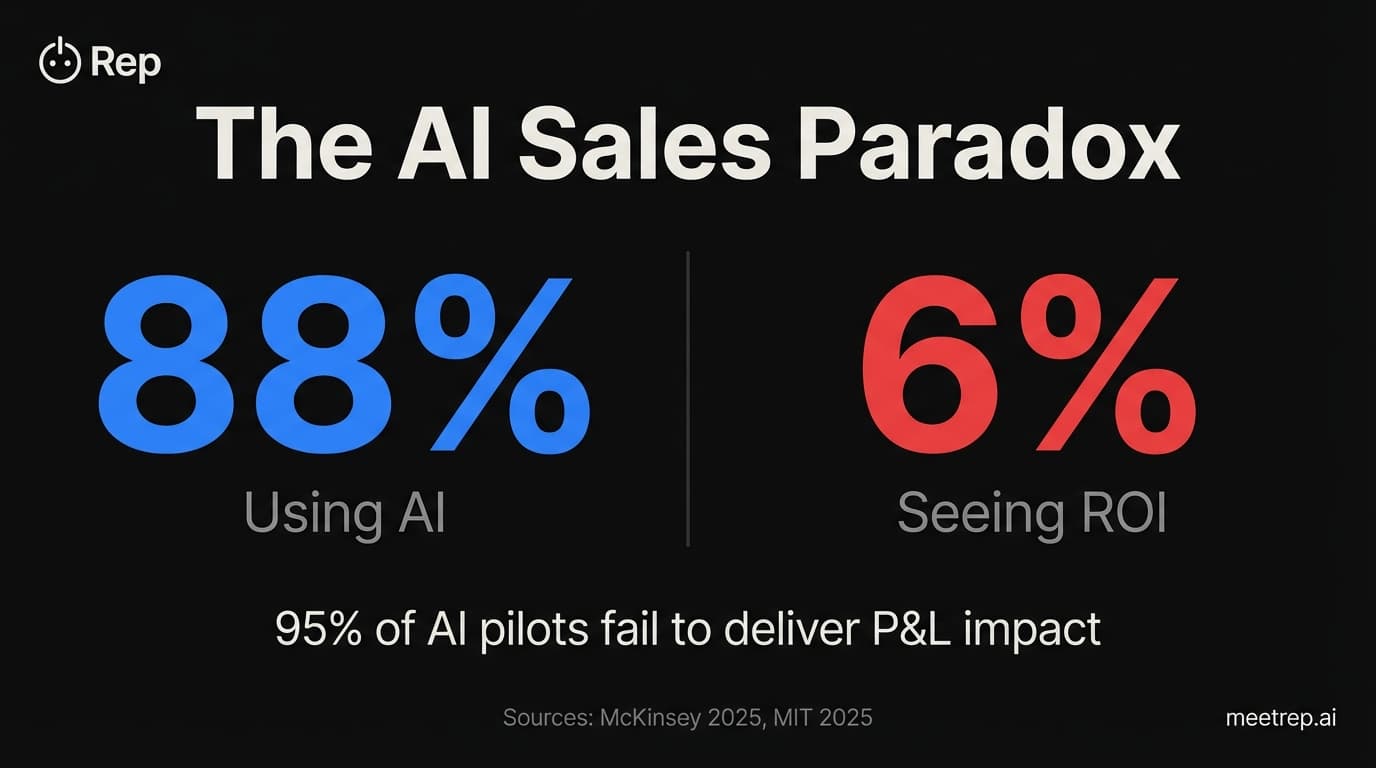
- 88% adoption, 6% ROI: Most companies use AI somewhere; only 6% see significant P&L impact (McKinsey 2025)
- 95% of pilots fail: Not because of bad technology, but because of poor data, unclear metrics, and workflow misalignment (MIT 2025)
- 77% revenue gap: Sellers who use AI frequently generate 77% more revenue than those who don't (Gong, analyzing 7.1M opportunities)
- Seven use cases consistently deliver ROI: Autonomous prospecting, demo automation, forecasting, conversational intelligence, personalized outreach, roleplay training, and CRM automation
Here's the uncomfortable truth about generative AI in sales: 88% of organizations are using it somewhere in their business. But only 6% are seeing significant ROI. And 42% of AI initiatives got scrapped entirely in 2025—up from 17% the year before.
If you've run an AI pilot that went nowhere, you're not alone. You're the majority.
I've been building sales automation tools for years—first at GoCustomer.ai, now at Rep. And I've watched this pattern repeat: teams buy promising AI tools, run pilots that show early wins, then watch everything stall before production. The technology works. The implementations don't.
What is generative AI in sales?
Generative AI in sales refers to AI systems that create new content—emails, proposals, call summaries, demo scripts—while analyzing customer data to predict outcomes and personalize outreach. Unlike traditional automation that follows rigid rules, gen AI adapts to context and generates human-like outputs at scale.
The technology has evolved fast. We've moved through three distinct phases:
2022-2023: Basic text generation. Sales teams used ChatGPT to draft emails and clean up notes. Useful, but limited.
2024-2025: Embedded copilots. Salesforce Einstein, Microsoft Copilot, HubSpot's Breeze—AI assistants built into the CRM. They wait for you to ask questions, then help.
2026: Agentic AI. AI systems that don't wait for prompts. They identify tasks, plan multi-step workflows, and execute them autonomously.
Key Insight: The shift from "copilot" to "agent" changes everything. Copilots assist. Agents execute. By 2027, 50% of companies using GenAI will deploy autonomous agents, according to Deloitte. And Gartner predicts AI agents will outnumber sellers 10x by 2028—yet fewer than 40% of sellers will report improved productivity.
More AI doesn't automatically mean more results. We'll get into why.
The 95% failure rate: Why most AI sales initiatives crash
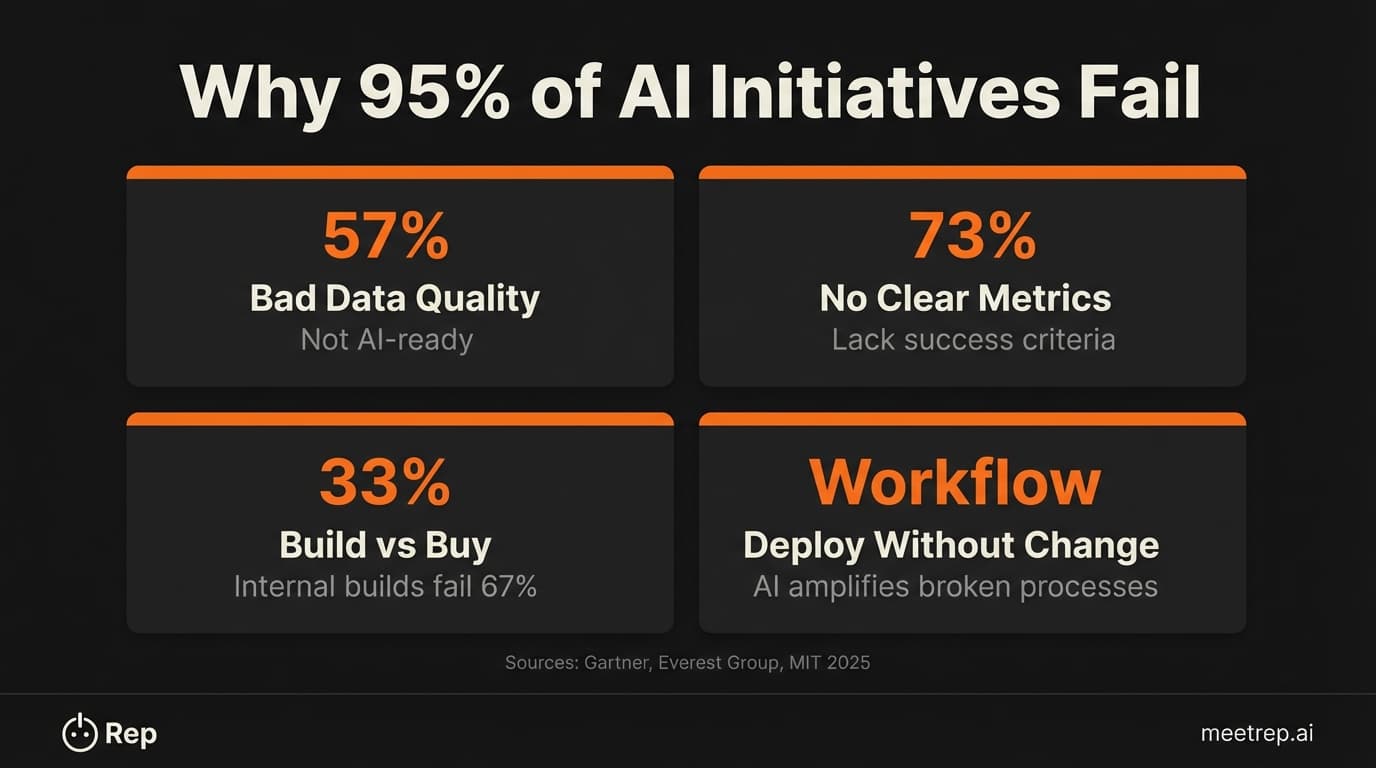
MIT's 2025 research found that 95% of generative AI pilots fail to deliver measurable P&L impact. Ninety-five percent.
This isn't a technology problem. It's an implementation problem.
The four failure modes
1. Bad data quality.57% of organizations aren't AI-ready because of poor data quality, according to Gartner. Your CRM is a mess. You can't train AI on garbage and expect gold.
2. No clear success metrics.73% of organizations lack clear success metrics for AI initiatives, per Everest Group. They launch pilots with vague goals like "improve efficiency." Then they can't tell if it's working.
3. Building instead of buying. Internal builds succeed only 33% of the time, compared to 67% with external partners. Unless AI is your core competency, you're probably better off partnering.
4. Treating AI like software deployment. Teams buy a tool, do a technical integration, and expect magic. But AI requires workflow redesign, not just deployment.
Common mistake: Buying AI tools without redesigning workflows. AI doesn't fix broken processes—it amplifies them.
IDC research shows the average company runs 37 proof-of-concept projects. Only 5 reach production. Only 3 succeed. This is pilot purgatory.
What the winners actually do: The 77% revenue gap
Gong Labs analyzed 7.1 million sales opportunities across 3,600+ companies. Their finding: sellers who frequently use AI generate 77% more revenue than those who don't.
That's not a marginal improvement. That's a different league entirely.
The Data: Teams using AI regularly generate 77% more revenue per rep and see 29% higher sales growth vs. peers. (Gong Labs, December 2025)
Salesforce found that 83% of AI-enabled teams see revenue growth, compared to 66% without AI. Bain reports 30%+ improvement in win rates from early AI deployments.
But here's what the numbers don't tell you: these winners aren't just using more AI. They're using it differently. They integrate AI into daily workflows—not as a side experiment. They focus on time recapture. Sales reps spend 70% of their time on non-selling tasks. Winners use AI to flip that ratio.
| Metric | AI Non-Users | Frequent AI Users | Gap |
|---|---|---|---|
| Revenue per rep | Baseline | +77% | (Gong) |
| Revenue growth rate | Baseline | +29% vs. peers | (Gong) |
| Teams seeing revenue growth | 66% | 83% | 17-point gap (Salesforce) |
| Time saved weekly | 0 | 12 hrs | (ZoomInfo) |
Seven use cases that actually generate ROI
Based on 2024-2026 research, these seven generative AI use cases in sales consistently show measurable returns:
1. Autonomous prospecting & research
AI agents that scrape, verify, and contextualize prospect data around the clock. Gartner projects 95% of seller research workflows will be AI-led by 2027. ZoomInfo Copilot users saw 42% increase in TAM and 46% increase in win rates.
2. Interactive demo automation
90% of B2B buyers now use AI for research before ever talking to a human. They expect instant product visibility—not a two-week wait for a scheduled demo. Demo automation tools can join calls and walk prospects through products live, filling the gap in the "zero-click" buyer era. This is the space we're building in at Rep.
3. Predictive forecasting
Traditional forecasting is terrible. Only 7% of sales teams achieve forecast accuracy of 90%+ using traditional methods. A Forrester study of Clari customers found 398% ROI over three years, 96% forecast accuracy, and 90% reduction in misallocated funds.
4. Conversational intelligence
AI that transcribes, summarizes, and analyzes sales calls. Paycor achieved 141% increase in closed-won deals using Gong's conversational intelligence for their 54 reps managing 3,000+ deals.
5. Hyper-personalized outreach
AI that generates context-aware emails using intent signals and firmographic data. Bain reports 30%+ win rate improvement from better-prepared sellers. But here's a warning: when every email sounds like a bot, you lose trust. Personalization at scale only works when it's actually personal.
6. Roleplay simulation & coaching
AI avatars that train reps on objection handling and pitch delivery. Reps can practice 10x more frequently than with human role-play, and feedback is instant.
7. CRM automation & data enrichment
AI that auto-logs calls, updates fields, and enriches contact data. This directly attacks the 70% of time spent on non-selling tasks. ZoomInfo users report saving 12 hours weekly.
| Use Case | Time Saved Weekly | ROI Signal | Risk Level |
|---|---|---|---|
| Autonomous Prospecting | 8-12 hrs | 42% TAM increase | Medium |
| Demo Automation | 6-10 hrs | Addresses 90% buyer AI usage | Low |
| Predictive Forecasting | 4-6 hrs | 398% ROI, 96% accuracy | Low |
| Conversational Intelligence | 3-5 hrs | 141% deal increase | Low |
| Personalized Outreach | 10-15 hrs | 30%+ win rate improvement | High |
| Roleplay Simulation | 2-4 hrs | Better objection handling | Low |
| CRM Automation | 12-15 hrs | 70% non-selling time reduced | Low |
The hidden cost of waiting
43% of sales reps now use AI—up from 24% in 2023. And LinkedIn data shows reps who use AI daily are 2x more likely to exceed quota.
The math is straightforward. If you're not using AI, you're half as likely to hit your number.
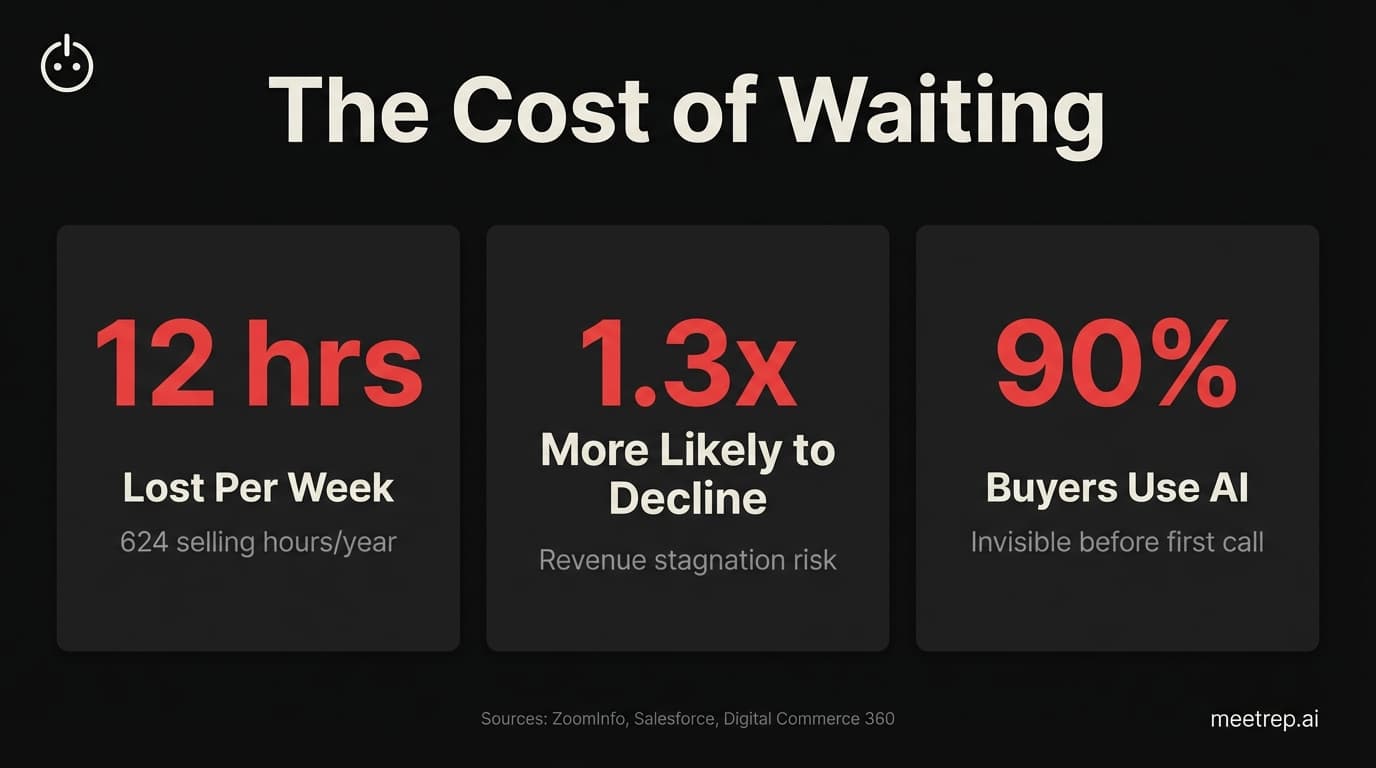
Revenue impact: Companies without AI are 1.3x more likely to see revenue stagnate or decline.
Time loss: Without AI automation, your reps lose 12 hours per week. That's 624 selling hours per rep per year.
Buyer invisibility:90% of B2B buyers use AI for research. If your team isn't AI-equipped, you're invisible before the first call ever happens.
McKinsey puts it bluntly: "The 12% of organizations not using AI are now clear outliers."
How to implement without becoming another statistic
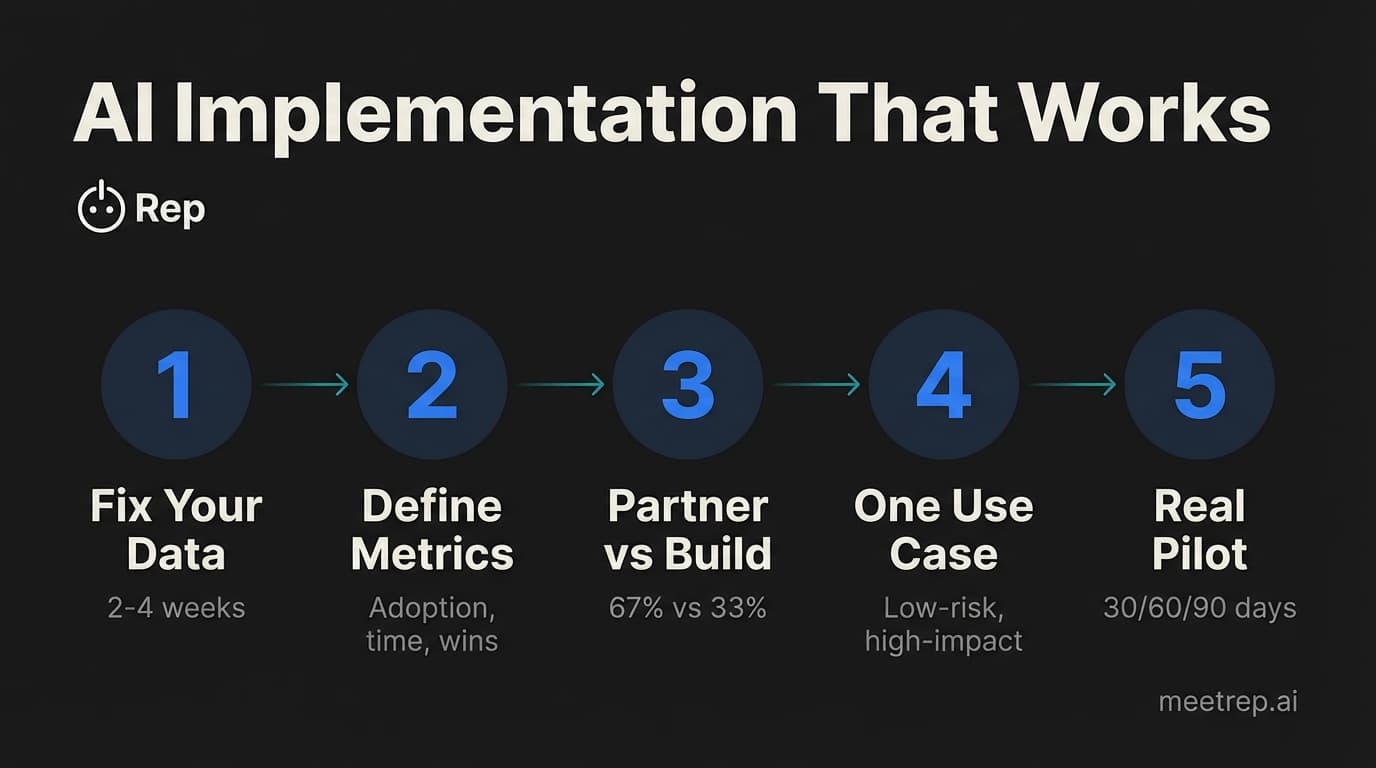
Here's what separates successful implementations from the 95% that fail.
Step 1: Fix your data first
57% of organizations fail because of poor data quality. This isn't sexy. It's essential. Audit contact completeness, account data freshness, duplicate records, and field consistency. Timeline: 2-4 weeks minimum before you buy anything.
Step 2: Define success metrics
73% of failed initiatives lack clear metrics. Don't be in that group. Define: adoption rate, time saved, win rate change, deal cycle length, revenue per rep. Write these down. Track weekly.
Step 3: Choose partner over build
Internal builds succeed 33% of the time. Vendor partnerships succeed 67%. Unless AI is your core competency, find a specialized vendor with proven customers.
Step 4: Start with one high-impact, low-risk use case
Pick ONE use case with fast feedback loops, low brand risk, and measurable ROI. My recommendation? Demo automation or conversational intelligence—not customer-facing email at scale.
Step 5: Run a real pilot (30/60/90 days)
Days 1-30: 5-10 rep pilot team, daily usage tracking, weekly feedback. Days 31-60: Measure against KPIs, expand if positive. Days 61-90: Full rollout decision based on data—or kill it. Don't drift into pilot purgatory.
| Company Size | Time to Initial Value | Time to Full Scale |
|---|---|---|
| Startups | 90 days | 3-4 months |
| Mid-Market | 90-120 days | 4-6 months |
| Enterprise | 6+ months | 9-12+ months |
If someone promises enterprise-wide AI transformation in 90 days, they're lying.
Will AI replace salespeople?
No. And the data is clear.
Only 7% of sales professionals believe AI reps are "the future." 48% say AI only handles repetitive tasks. 32% are actually more skeptical of AI than five years ago.
The winning model is hybrid intelligence. AI handles research, data entry, initial qualification, and call summarization. Humans handle relationship building, complex negotiations, and strategic problem-solving.
Sellers spend only 25% of their time actually selling. AI can reclaim a huge chunk of the other 75%—potentially doubling active selling time.
My recommendation: Think of AI as your best rep's digital twin handling the tasks they shouldn't be doing. The goal isn't fewer salespeople—it's salespeople who spend more time on what only humans can do.
The 88% of organizations using AI aren't all getting results. The 6% who see real ROI treated implementation as workflow transformation, not software deployment.
The technology works. We've seen that in the data—77% revenue gaps, 398% ROI, 141% deal increases. But those results require the right foundation: clean data, clear metrics, constrained use cases, and realistic timelines.
If you're evaluating where to start, demo automation is worth a look. It's a constrained workflow with fast feedback loops and clear time savings—exactly the profile for AI success. At Rep, we're building in this space because we believe it's one of the highest-impact applications for sales teams.
Don't wait for perfect. The cost of waiting is measurable. Pick one use case, run a real pilot, and join the 5% who scale successfully.

Nadeem Azam
Founder
Software engineer & architect with 10+ years experience. Previously founded GoCustomer.ai.
Nadeem Azam is the Founder of Rep (meetrep.ai), building AI agents that give live product demos 24/7 for B2B sales teams. He writes about AI, sales automation, and the future of product demos.
Frequently Asked Questions
Table of Contents
- What is generative AI in sales?
- The 95% failure rate: Why most AI sales initiatives crash
- What the winners actually do: The 77% revenue gap
- Seven use cases that actually generate ROI
- The hidden cost of waiting
- How to implement without becoming another statistic
- Will AI replace salespeople?
Ready to automate your demos?
Join the Rep Council and be among the first to experience AI-powered demos.
Get Early AccessRelated Articles
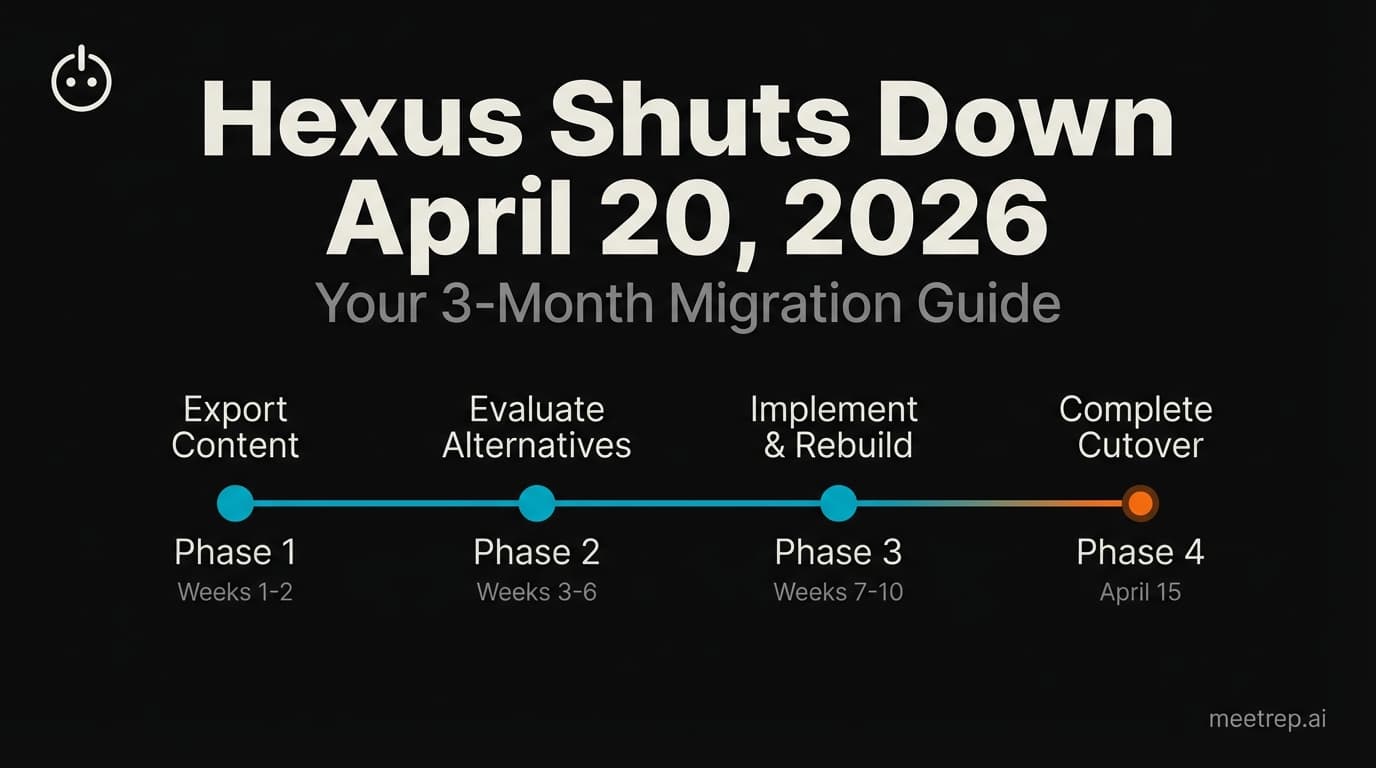
Hexus Acquired by Harvey AI: Congrats & What It Means for Demo Automation Teams
Hexus is shutting down following its acquisition by Harvey AI. Learn how to manage your migration and discover the best demo automation alternatives before April 2026.
Why the "Software Demo" is Broken—and Why AI Agents Are the Future
The traditional software demo is dead. Discover why 94% of B2B buyers rank vendors before calling sales and how AI agents are replacing manual demos to scale revenue.
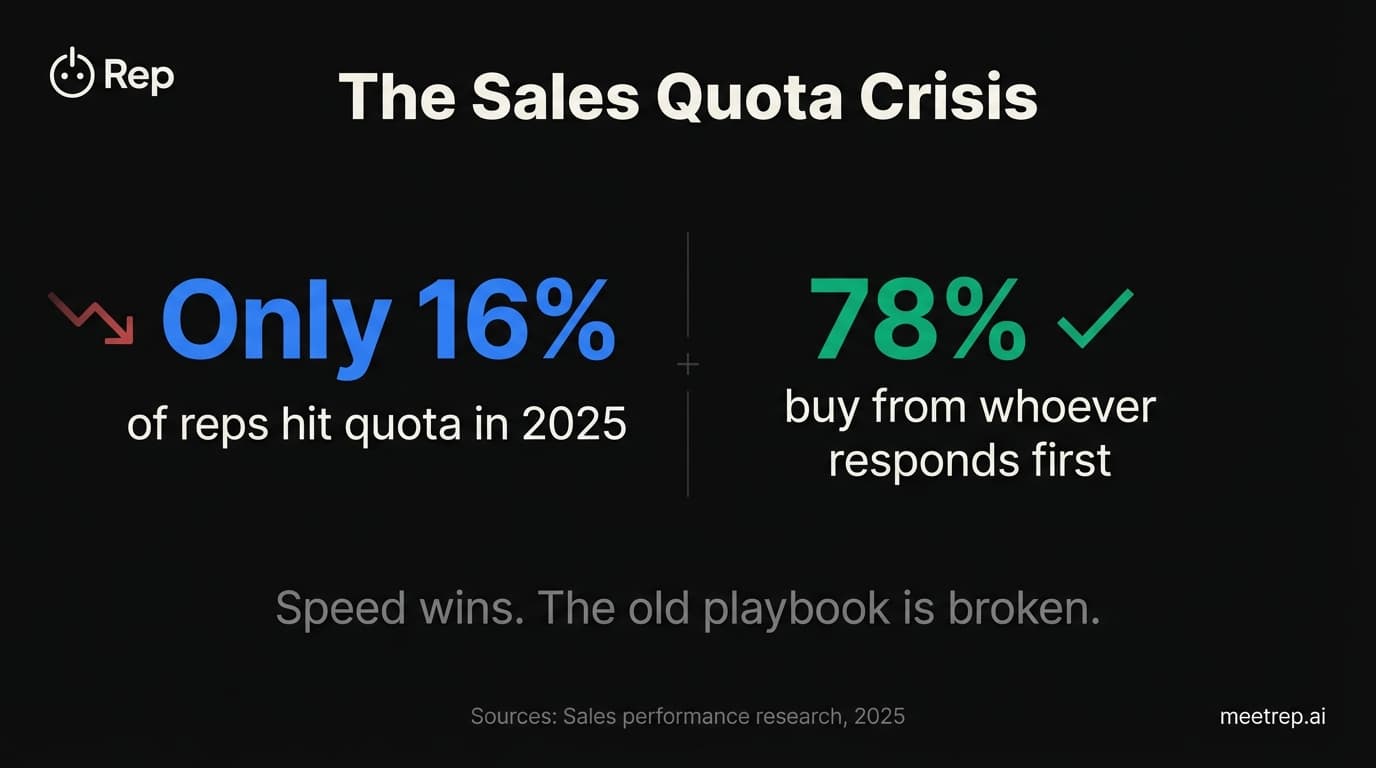
Why Autonomous Sales Software is the Future of B2B Sales (And Why the Old Playbook is Dead)
B2B sales is at a breaking point with quota attainment at 46%. Discover why autonomous 'Agentic AI' is the new standard for driving revenue and meeting the demand for rep-free buying.