The Founder's Playbook: Mastering Discovery Questions (Beyond BANT)

Executive Summary
- The Problem: Most discovery calls feel like police interrogations ("What's your budget?").
- The Fix: Stop checking boxes. Start "Inception." You need to uncover problems the prospect didn't know they had.
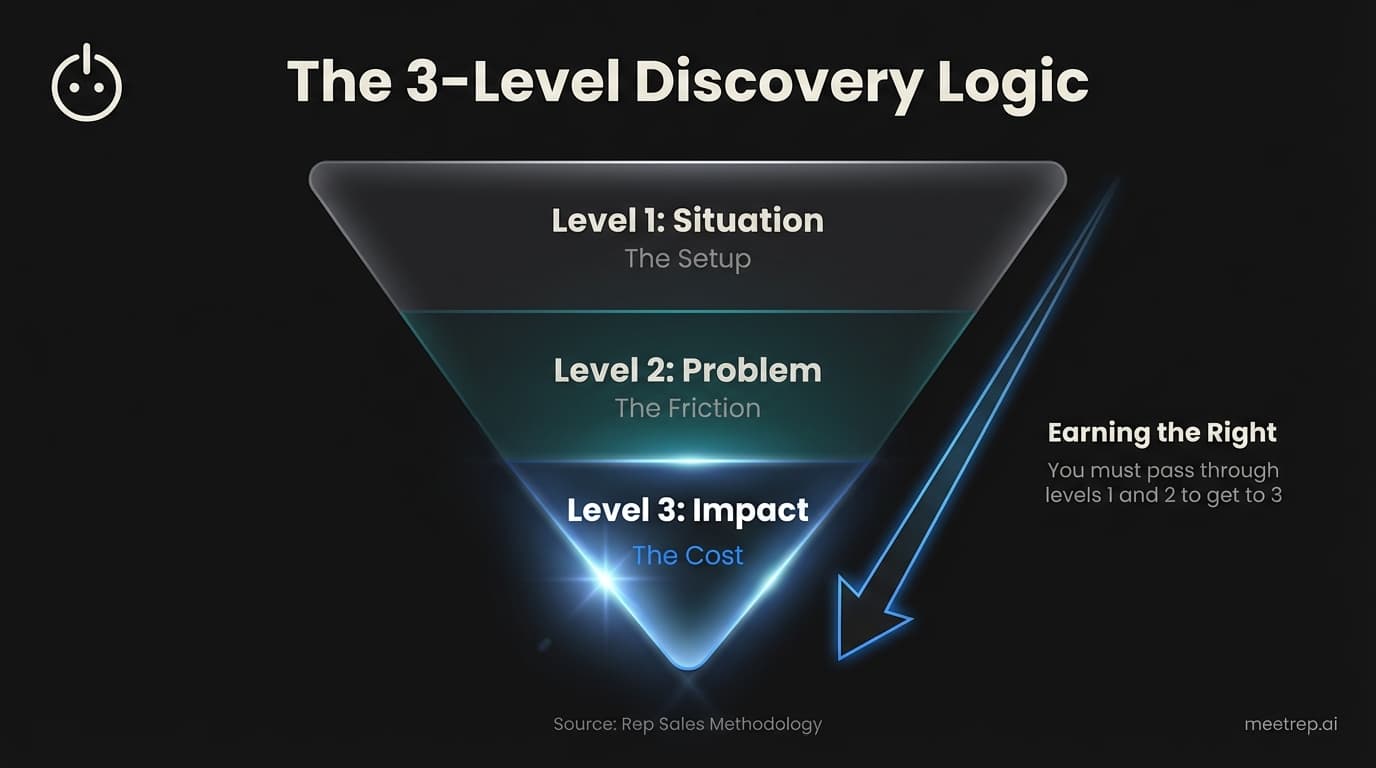
- The Method: We use a 3-Level Logic (Situation -> Problem -> Impact). This is the exact code we use to run our AI sales agents.
- The Loot: Scroll down for the 20 specific questions you can copy-paste today.
What Are Discovery Questions?
Discovery questions are open-ended prompts used by sales professionals to uncover a prospect's pain points, goals, and decision-making criteria.
Unlike simple qualification questions—which just check if a buyer is a fit for you—discovery questions build the business case for them.
But here's the nuance most people miss.
Good discovery isn't about data collection. It's about inception.
When you ask the right question, the prospect realizes a problem they didn't know they had. You aren't just learning about their world; you are reshaping how they see it.
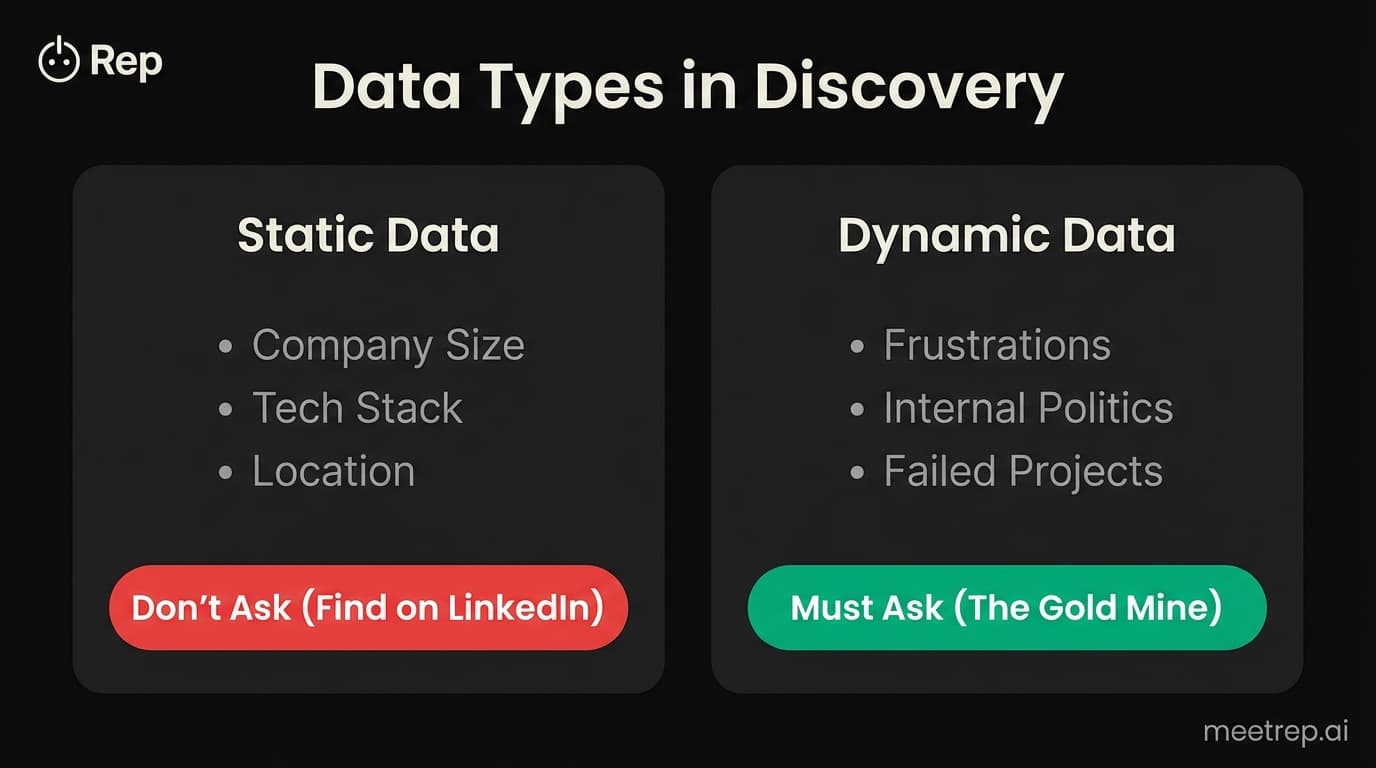
At Rep, we distinguish between two types of data:
- Static Data: Company size, tech stack, location. (Don't ask these questions—look them up on LinkedIn).
- Dynamic Data: Frustrations, internal politics, failed projects. (This is where you spend your time).
Common Mistake: Asking questions you could have answered with a Google search. If you ask "How many employees do you have?" in 2024, you've already lost credibility.
The Problem With Traditional Frameworks (RIP BANT)
For decades, sales teams used BANT (Budget, Authority, Need, Timing). It was simple. It was clean.
It is also completely broken for modern SaaS.
Why? Because BANT is seller-centric. It helps you decide if they are worth your time. But in the first 10 minutes of a call, the buyer doesn't care about your time. They care about their problem.
If you lead with "Do you have a budget allocated for this?", you signal that you are a transaction, not a consultant.
We realized this early at GoCustomer. We tried to automate qualification using strict BANT criteria. The result? Our conversion rates tanked. Prospects felt filtered, not understood.
Here is how we look at the evolution of discovery frameworks:
| Framework | Focus | Typical Question | Why it Fails Today |
|---|---|---|---|
| BANT | Qualification | "Do you have a budget?" | Feels like an interrogation. Buyers close up immediately. |
| MEDDIC | Deal Control | "Who signs the contract?" | Great for closing, but too heavy for early discovery. |
| SPIN | Pain/Implication | "How does that affect revenue?" | Strong, but can feel manipulative if scripted poorly. |
| GAP | Current vs Future | "Where do you want to be?" | The Winner. Focuses on the delta between A and B. |
My recommendation: Use GAP selling principles for early discovery. Focus on the distance between where they are (pain) and where they want to be (pleasure). Leave the budget talk for when you've proven the value.
The 3-Level Questioning Architecture
When we engineered the conversation logic for Rep's AI agents, we couldn't rely on intuition. We had to systematize "curiosity."
We built a three-level architecture. You should train your human SDRs on this exact same model.
Level 1: Situational Awareness (The Setup)
These establish the baseline. They are easy to answer and low friction.
- "Walk me through your current process for X."
- "What tools are you using to handle Y right now?"
Level 2: Problem Identification (The Friction)
These dig into what's broken. This is where emotion enters the chat.
- "What’s the most frustrating part of that process?"
- "How often does that break down?"
- "Why haven't you fixed this yet?"
Level 3: Impact Amplification (The Cost)
These are the money questions. They take a mild annoyance and turn it into a business emergency.
- "If you don't fix this by Q4, what happens?"
- "How is this affecting the team's morale?"
- "What is this costing you in terms of lost deals?"
Why we built Rep this way: If an AI jumps straight to Level 3, it sounds aggressive. "What is this costing you?" is rude if I haven't even asked what software you use. We programmed Rep to earn the right to ask Level 3 questions by navigating Levels 1 and 2 first.
20 Best Discovery Questions (Steal These)
I’ve organized these by the outcome you want. Don't use them as a script—that's a disaster waiting to happen. Use them as a menu.
Opening the Conversation
1. "I noticed you're overseeing [Project/Team]—what's top of mind for you this quarter?"Why it works: It proves you did your homework on LinkedIn.
2. "What triggered you to look into solutions like ours right now?"Why it works: Timing is everything. This uncovers the "why now."
3. "Usually when I speak to VPs of Sales, they're struggling with X or Y. Is that true for you, or is it something else?"Why it works: The "Negative Reverse" technique. It establishes you as a peer who talks to other VPs.
Uncovering Pain
4. "Can you walk me through how you currently handle [Process]?"
5. "On a scale of 1 to 10, how happy are you with that workflow?"
6. "What happens when [Process] breaks?"Why it works: It forces them to visualize the failure state.
7. "How much time is your team spending on this manual work per week?"
8. "What’s the one thing you wish you could change about your current setup?"
Amplifying Impact (The "So What?")
9. "If you don't solve this problem, what does that mean for your 2025 goals?"
10. "Who else in the organization feels the pain of this?"Why it works: This helps you map the account and find multi-threading opportunities.
11. "Have you tried to fix this before? Why didn't it work?"
12. "What is the cost of doing nothing?"
Qualifying (Subtly)
13. "Let's say we find the perfect solution. How does your company typically buy software like this?"Why it works: It asks about process, not authority. It's less threatening.
14. "Who else needs to sign off on this initiative?"
15. "Is there a specific timeline you're working toward?"
16. "Do you have a budget set aside, or would you need to build a business case to get it?"
The Magic Closers
17. "Based on what you've told me, it sounds like X is the priority. Did I get that right?"
18. "Is there anything I haven't asked that I should have?"
19. "If we could solve [Problem X], would that be worth a follow-up call?"
20. "What would make this call a complete waste of time for you?"Why it works: It's bold. It wakes them up.
How AI Is Changing Discovery
Here is the part where I get technical.
At Rep, we aren't just building a chatbot. We are building an autonomous agent that joins video calls. That means it has to "hear" discovery cues in real-time.
We learned that human SDRs often miss "soft signals."
- Prospect: "Yeah, the current tool is okay, I guess. It’s a bit slow."
- Average SDR: (Ignores it, moves to next question).
- Top Performer (and Rep): "Wait, you said it's 'a bit slow.' How slow? Like, coffee break slow? Or just annoying?"
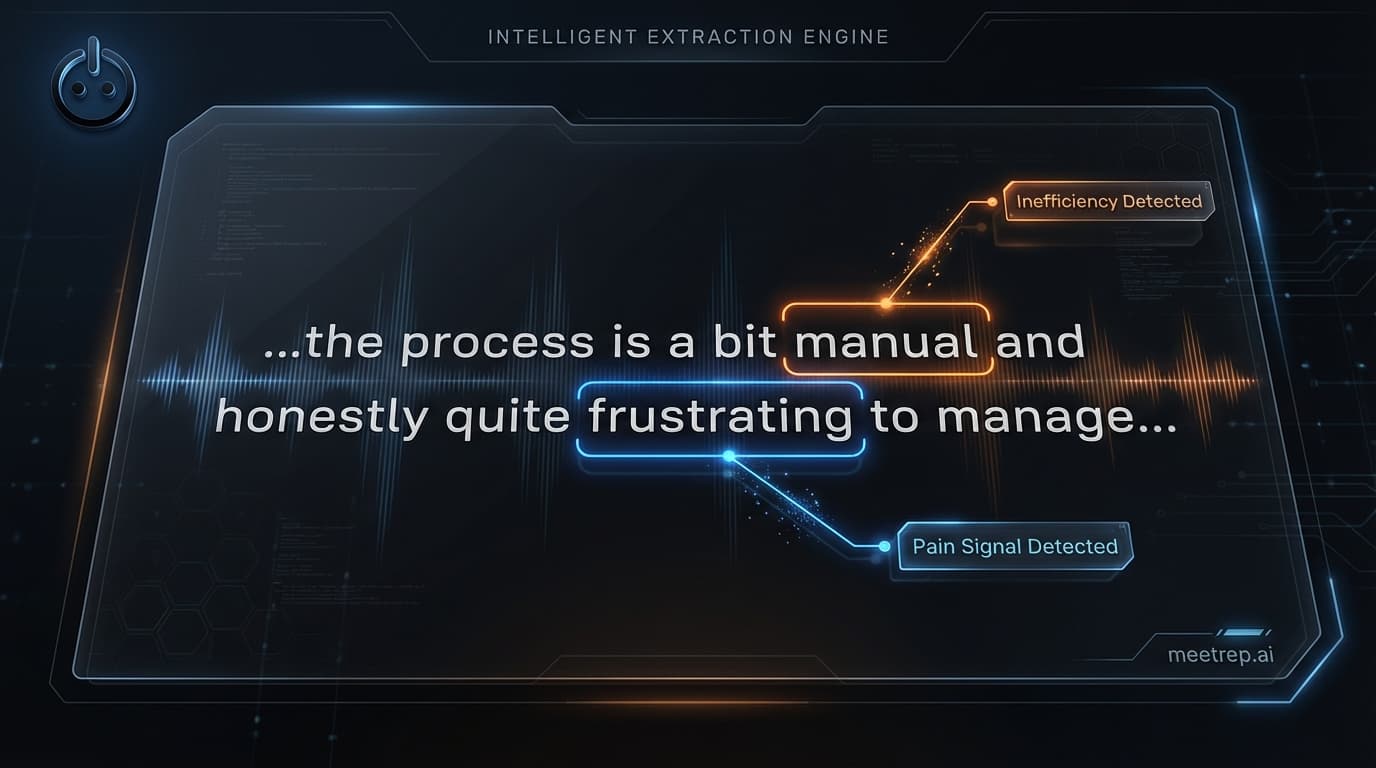
We trained Rep's "Intelligent Extraction Engine" to flag specific trigger words. When the AI hears these, it pauses the script and digs deeper.
The "Dig Deeper" Trigger List:
- "Manual"
- "Frustrating"
- "Tricky"
- "Sometimes"
- "Annoying"
- "Workaround"
Key Insight: Automation isn't about replacing the human connection; it's about ensuring consistency. Humans get tired. They forget to ask the follow-up. AI doesn't.
If you are managing a human team, you need to train them to be "extraction engines." Teach them to hunt for the emotional adjectives. That’s where the deal lives.
3 Mistakes That Kill Discovery Calls
In my experience, deals aren't lost because the product was bad. They are lost because the discovery was shallow.
1. The "Happy Ears" Syndrome
You hear one positive thing ("We love the idea of automation!") and you stop digging. You assume the deal is done. Fix: Be skeptical. Ask "Why now?" and "Why us?" Make them convince you.
2. The Feature Dump
The prospect mentions a problem, and you immediately vomit features. "Oh, you have scheduling issues? Let me show you our Calendar Integration v2.0!" Fix: Hold back. Acknowledge the pain. "That sounds incredibly frustrating. Tell me more about how that impacts your day." Then offer the solution later.
3. The Checklist Robot
Reading questions 1-10 in order, regardless of the answer. Fix: Active listening. If they answer Question 7 while answering Question 2, skip Question 7!
The Bottom Line
Great discovery isn't an interrogation. It's a collaboration.
If you leave a call and you know their budget but you don't know their fears, you failed. You have data, but you don't have a deal.
At Rep, we built our entire AI architecture around this belief. We taught our agents that the goal isn't to get through the script—it's to understand the human on the other side of the screen.
Whether you hire an AI agent or train your human team, the principle is the same: Be curious. Be specific. And for the love of sales, stop asking about BANT in the first five minutes.
Ready to see how an AI handles deep discovery? Watch Rep in action here.

Nadeem Azam
Founder
Software engineer & architect with 10+ years experience. Previously founded GoCustomer.ai.
Nadeem Azam is the Founder of Rep (meetrep.ai), building AI agents that give live product demos 24/7 for B2B sales teams. He writes about AI, sales automation, and the future of product demos.
Frequently Asked Questions
Table of Contents
- What Are Discovery Questions?
- The Problem With Traditional Frameworks (RIP BANT)
- The 3-Level Questioning Architecture
- 20 Best Discovery Questions (Steal These)
- How AI Is Changing Discovery
- 3 Mistakes That Kill Discovery Calls
- The Bottom Line
Ready to automate your demos?
Join the Rep Council and be among the first to experience AI-powered demos.
Get Early AccessRelated Articles
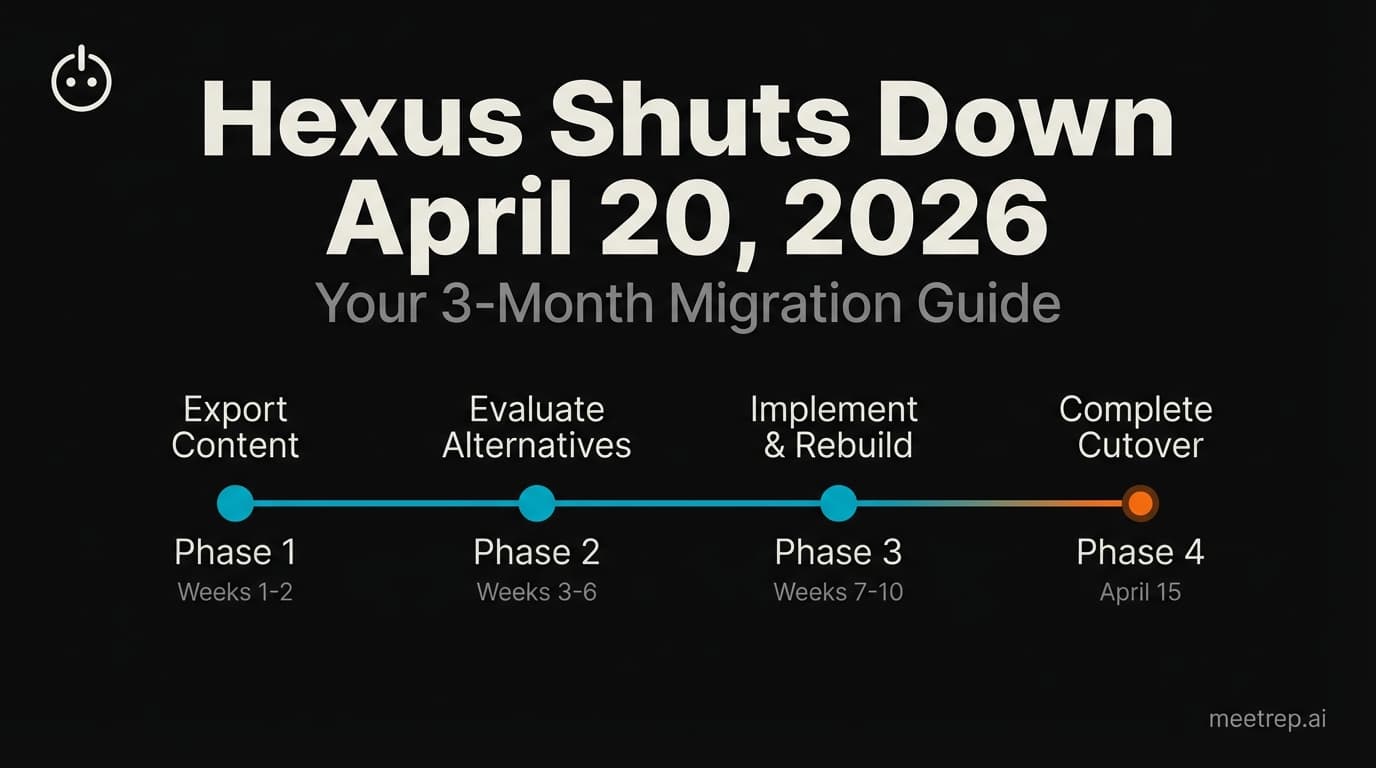
Hexus Acquired by Harvey AI: Congrats & What It Means for Demo Automation Teams
Hexus is shutting down following its acquisition by Harvey AI. Learn how to manage your migration and discover the best demo automation alternatives before April 2026.
Why the "Software Demo" is Broken—and Why AI Agents Are the Future
The traditional software demo is dead. Discover why 94% of B2B buyers rank vendors before calling sales and how AI agents are replacing manual demos to scale revenue.
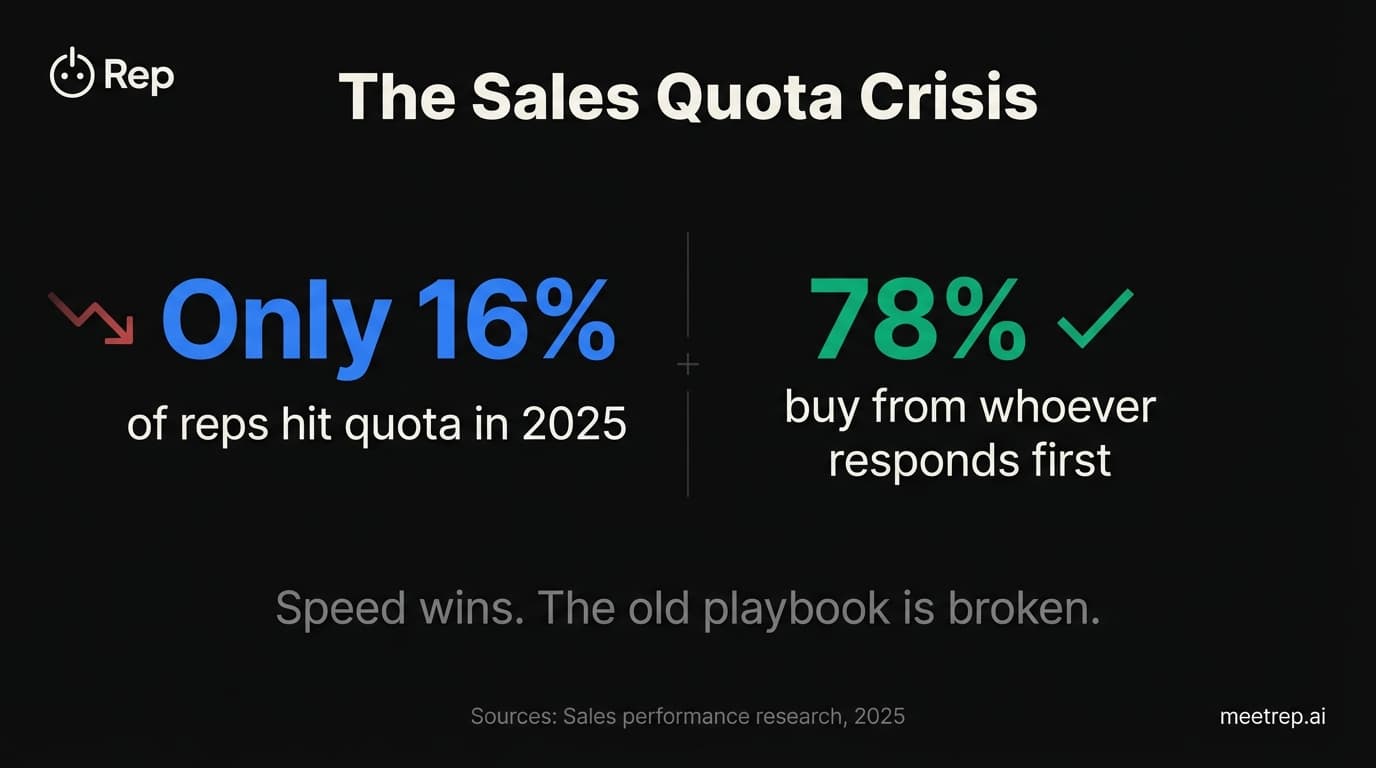
Why Autonomous Sales Software is the Future of B2B Sales (And Why the Old Playbook is Dead)
B2B sales is at a breaking point with quota attainment at 46%. Discover why autonomous 'Agentic AI' is the new standard for driving revenue and meeting the demand for rep-free buying.