For SE Leaders: Stop Burning Out Your Engineers on Intro Calls

Executive Summary
- 69% of SEs cite burnout as their #1 challenge, driven by a 40% year-over-year increase in demo volume
- 35% of demos go to unqualified prospects—that's one-third of your team's capacity wasted
- Intro demos (the "harbor tour") are the primary burnout driver, not complex technical work
- Top teams are cutting live call volume by 67% through demo automation without sacrificing quality
- The fix isn't more headcount—it's better filtering and autonomous handling of early-funnel demos
I want to share something that stopped me cold. Adil Aijaz, founder of HeySam and former SE leader, wrote this about his team: "I once sent one of my Sales Engineers to the emergency room. The work stress gave him crippling anxiety. He wasn't weak or over-dramatic. It really was that intense. He quit after six months."
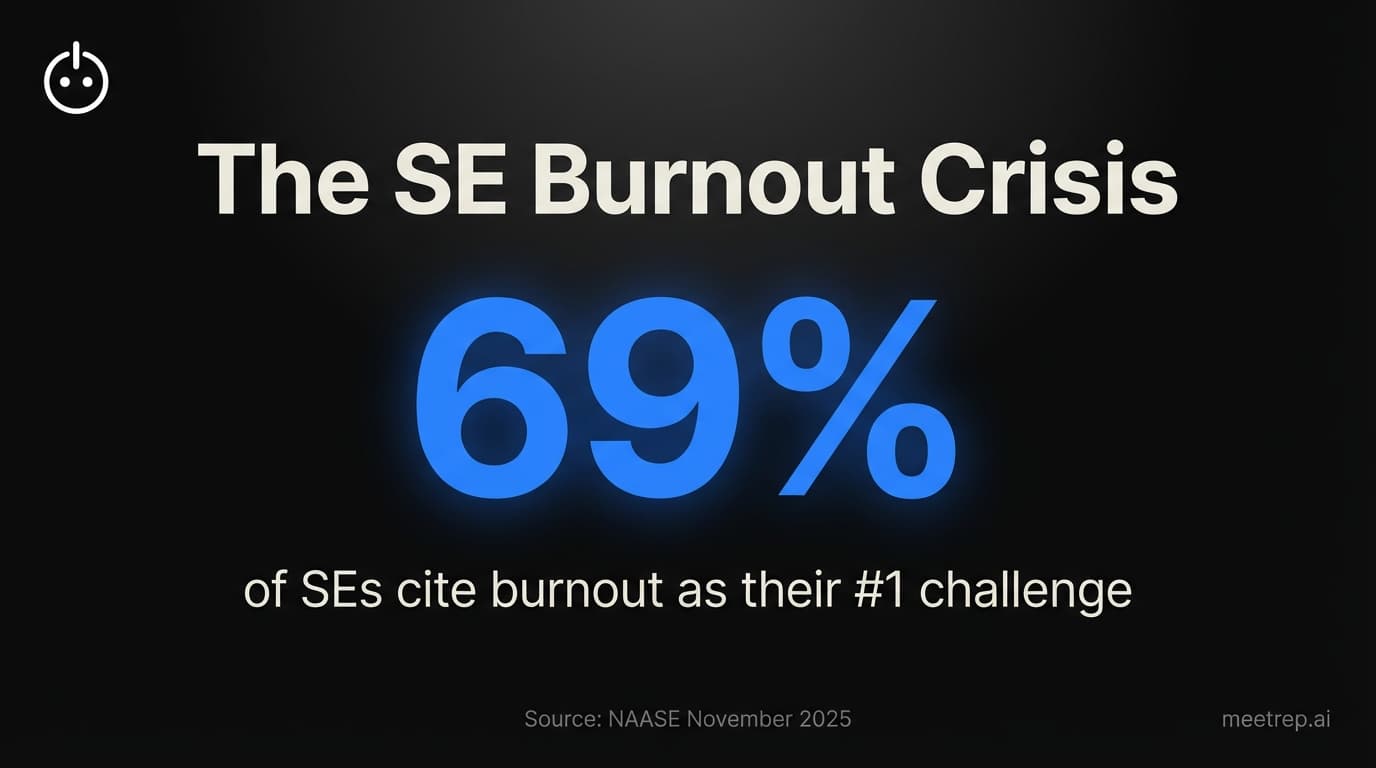
That's not an outlier. Sales engineer burnout has become a silent crisis. According to the North American Association of Sales Engineers (NAASE), 69% of early-to-mid-career SEs now cite workload and burnout as their single biggest challenge. Not comp. Not career growth. Workload.
And here's what most leaders miss: the problem isn't headcount. It's utilization. Specifically, it's intro demos—the repetitive, often unqualified calls that eat your team's capacity while adding almost no strategic value.
The silent crisis draining your presales team
Sales engineer burnout is chronic exhaustion specific to presales professionals. It's caused by repetitive demo cycles, constant context switching between deals, poor AE-to-SE ratios, buggy product environments, and being what one SE leader called "invisible victims"—their stresses go unrecognized by sales leadership who've never done the job.
This isn't general sales burnout. It's different. SEs carry both technical frustration and sales pressure simultaneously. They're expected to ramp faster than engineers while supporting more deals than anyone planned for.
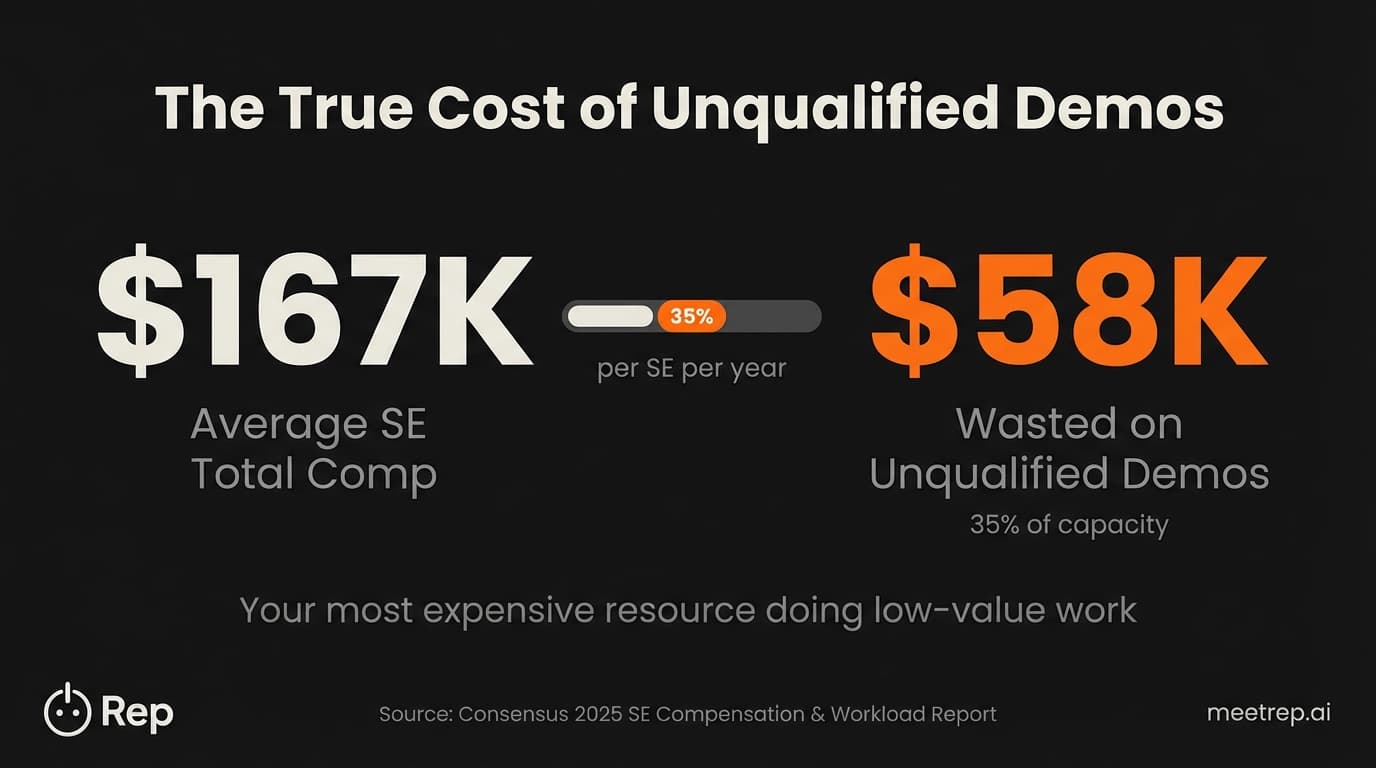
The Consensus 2025 SE Compensation & Workload Report puts hard numbers to the problem: 35% of demos are unqualified or underqualified. That means one-third of your expensive engineering capacity is spent on prospects who shouldn't be talking to an SE yet.
And the volume keeps climbing.
The Data: Demo requests increased 40% year-over-year according to Demostack and Presales Collective research from March 2025. Headcount didn't grow 40%. Your SEs absorbed the difference.
Meanwhile, 70% of sales deals require presales support, per the same Consensus report. Your team isn't optional—they're in nearly every deal. But they're drowning in the wrong work.
The harbor tour trap: Why intro calls are killing SE productivity
Let me define something. A "harbor tour" is SE slang for the generic, feature-dump demo that shows everything and customizes nothing. It's the intro call where an AE books a meeting, the SE shows up, walks through the standard deck, and hopes something sticks.
SEs hate it. They call themselves "demo monkeys" when trapped in this loop—jumping from call to call, giving the same presentation on repeat. No variety. No challenge. No strategic value.
Here's the brutal math.
If 35% of your demos are unqualified, and your average SE makes $167,000 in total comp (Consensus 2025 reports $123,946 base plus $43,337 commission), you're burning roughly $58,000 per SE per year on prospects who should never have reached them.
That's before we count the cost to morale.
Key Insight: Using a $167k technical resource to qualify leads is financial malpractice. Your SEs studied engineering to solve complex problems, not to give the same harbor tour 15 times a week.
The wait time problem makes it worse. Consensus and PreSales Collective data show that 67% of prospects wait 5+ business days for a demo. Some wait two weeks or more.
So your SEs are overworked, giving too many unqualified demos, while prospects wait a week to see your product. Everyone loses.
What actually causes SE burnout (and why it's different)
Let's break down what's driving this. I've organized these by how often they appear in SE community discussions and surveys.
The demo monkey loop
This is the top complaint. Repetitive demos with no variety create what SEs describe as a "doom loop." Call after call, same slides, same feature walkthrough. One Reddit poster described it as "the feeling that I could be replaced by a recording."
The problem isn't that demos are hard. It's that they're identical. And when your entire week is back-to-back calls with no space to go deep on complex deals, burnout follows.
Unsustainable AE-to-SE ratios
Most teams operate with 4-10 AEs per SE. The Consensus benchmark suggests 4:1 is healthy for complex products. But high-growth teams push to 6:1, 8:1, even 10:1.
| AE:SE Ratio | Burnout Risk | Sustainability |
|---|---|---|
| 4:1 | Moderate | Sustainable with good processes |
| 6:1 | High | Requires automation or strict qualification |
| 8:1+ | Critical | Only sustainable with significant demo automation |
When ratios stretch, SEs become the bottleneck. Every deal needs them. They can't say no. The calendar fills up.
The context-switching tax
SEs don't just do demos. They juggle discovery calls, POCs, post-sales training, support escalations, RFP responses, and internal product feedback sessions. Sometimes all in the same day.
Context switching has a cognitive cost that nobody measures. Jumping from a complex architecture discussion to a basic intro demo to a support escalation burns mental energy faster than focused work.
Buggy products turn SEs into apologists
This one hit home in the G2 reviews I read during research. One SE wrote: "Every customer interaction feels like walking into a minefield... constantly apologizing for issues I can't fix."
When demo environments crash or features break during live calls, the SE takes the hit. They become apologists rather than advocates. That wears people down.
The empathy gap
Here's a quote that keeps coming up: "Most sales leaders have never been SEs. They struggle to empathize with the stresses of the job."
Sales leadership often sees SEs as "support" rather than strategic. They don't understand why their technical team is stressed—after all, they're not carrying quota. But SEs carry something heavier: the technical win that makes every deal possible.
The Data:Vivun's October 2024 research found that 80% of the sales cycle is dedicated to achieving the technical win, yet less than 10% of RevTech investment targets this stage. SEs are under-tooled while being essential.
Warning signs your SEs are burning out
Watch for these signals. Burnout doesn't announce itself—it accumulates quietly until someone quits or ends up in the ER.
Performance signals:
- Declining demo quality (going through the motions)
- Increased POC failures
- Disengagement from discovery calls
- Avoiding customer interactions when possible
Attitude signals:
- Growing cynicism about product roadmaps
- Decreased participation in team activities
- "Demo monkey" jokes that sound less like jokes
Physical signals:
- Exhaustion complaints
- Anxiety symptoms
- Taking more sick days
If you're seeing three or more of these across your team, you have a burnout problem building. Don't wait for the resignation letter.
The hidden cost of SE burnout on deal velocity
This isn't just a people problem. It's a revenue problem.
When SEs are overloaded, deals slow down. That 67% of prospects waiting 5+ days for demos? Every extra day of wait time increases the chance a competitor intercepts the deal.
Forrester's State of Business Buying 2024 found that 86% of B2B purchases stall during the buying process. Your overloaded SEs are part of that stall.
And then there's the 80/10 problem I mentioned earlier. The technical win consumes 80% of the sales cycle. But less than 10% of revenue technology investment goes toward presales tooling. We spend fortunes on CRM, on outbound automation, on conversation intelligence. We leave SEs with a calendar full of harbor tours and hope they figure it out.
Key Insight: Burning out a senior SE costs roughly $200k in replacement expenses plus 6+ months of ramp time. That's before counting the deals that stall while you're hiring.
The solution: The Demo Qualified Lead (DQL) model
So what actually works? The teams I've studied and the problems we set out to solve with Rep point to one structural change: stop sending every demo request to a human.
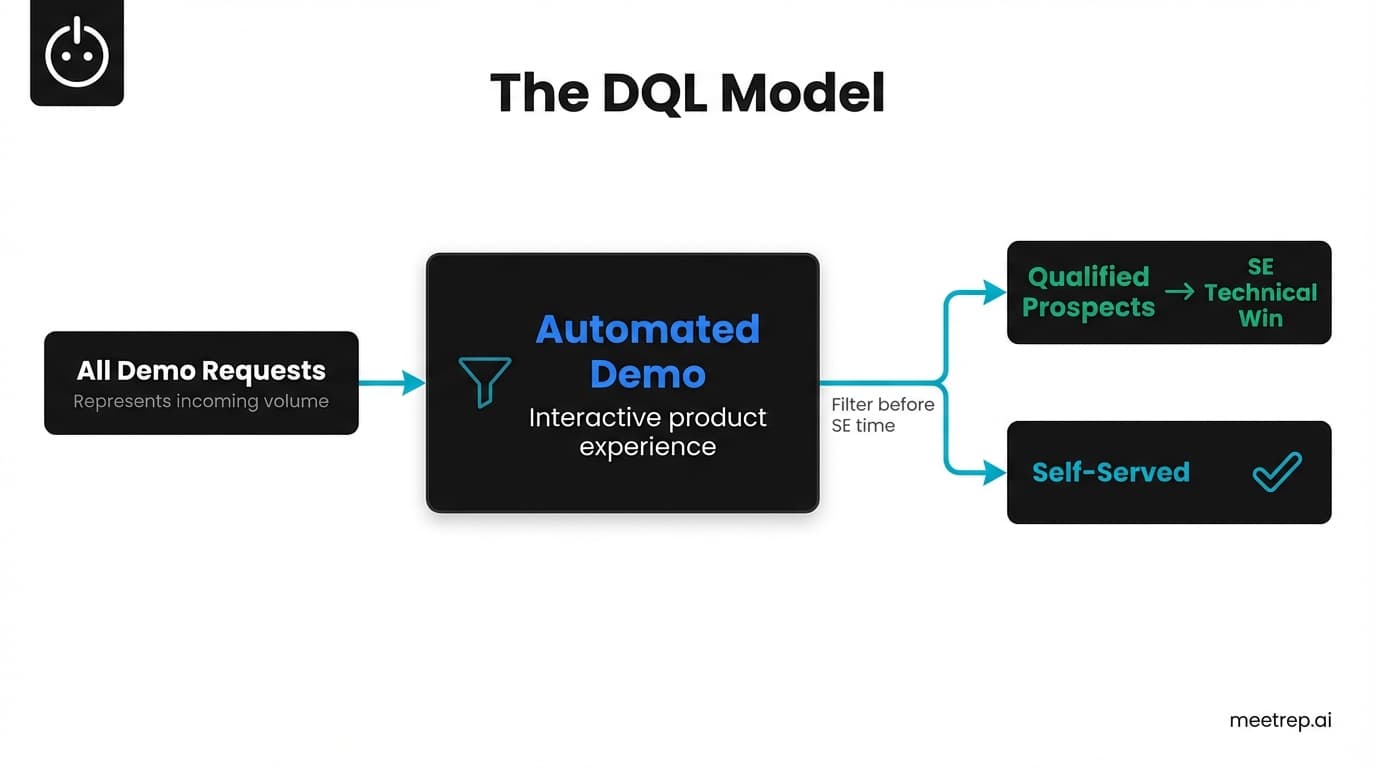
A Demo Qualified Lead (DQL) is a prospect who has already seen your product before they speak to an SE. They've watched an interactive demo, or engaged with an autonomous demo agent, or completed a self-serve product tour. When they reach your SE, they have context. They have real questions. They're not starting from zero.
This isn't about replacing SEs. It's about filtering. Send humans the demos that need humans.
Case Study: Unanet
Unanet, an ERP software company, faced the classic problem: SEs doing 15 demos per week, 70% unqualified, two-week wait times for buyers.
They implemented demo automation as a gatekeeper. The results:
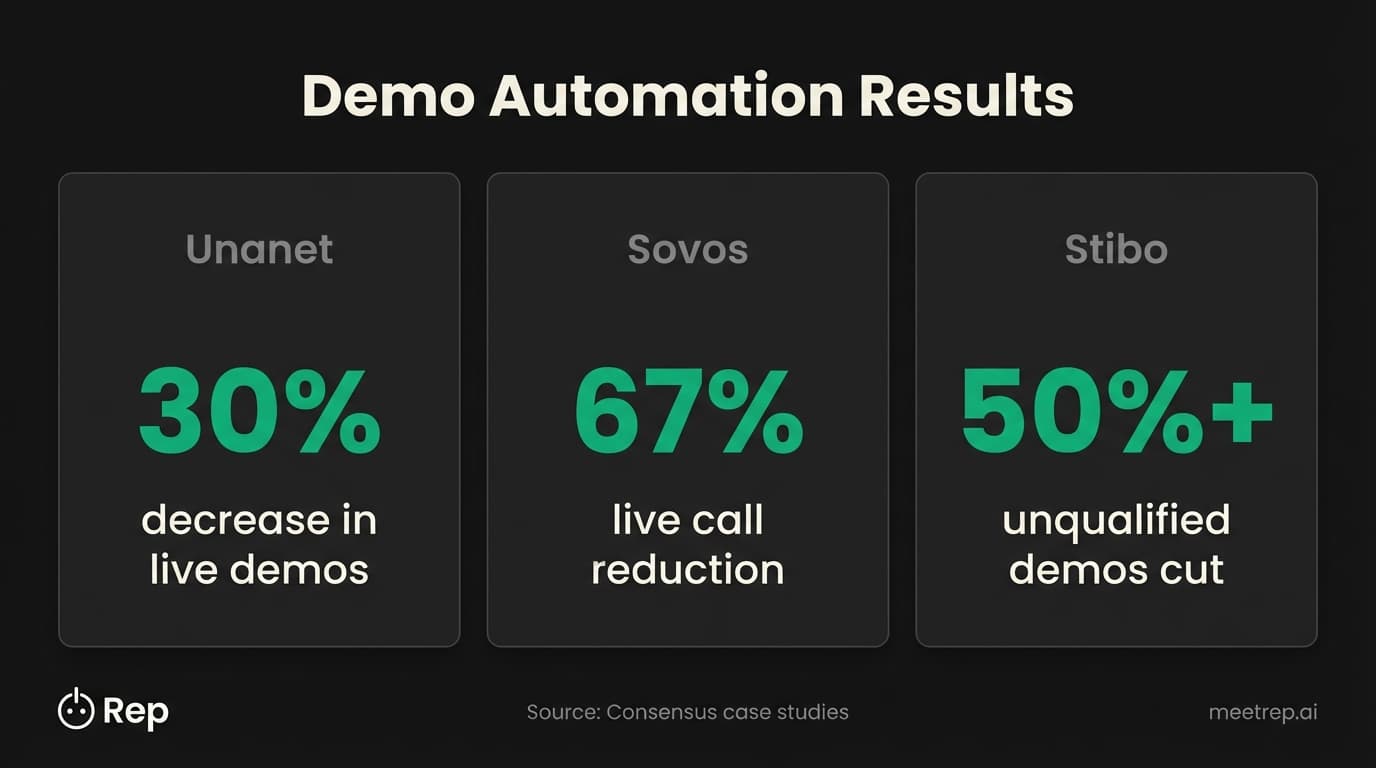
- 30% decrease in live demos
- $160,000 in revenue closed over nine months without any live SE engagement
- 60% of customers now see a demo before requesting a live call
The deals that reach SEs are better. The SEs are less burned out. And somehow, revenue went up.
Case Study: Sovos
Sovos, a tax compliance platform, had SEs showing up to 80% of sales calls. Half were unqualified or repetitive.
After automating intro demos:
- Live calls dropped by 67%
- SE specialization increased by 50%
That last point matters. When you free SEs from harbor tours, they reinvest that time in going deep on complex deals, building product expertise, becoming strategic assets instead of demo machines.
Case Study: Stibo Systems
Stibo Systems, a data management company, had high volumes of generic intro demos consuming SE time.
After implementation:
- Unqualified intro demos dropped by more than 50%
- SEs saved 10-15 hours per week each
What we learned building Rep: The reason we designed Rep to join video calls and walk through live product—rather than just sending pre-recorded click-through demos—is that buyers want a conversation, not a video. They have questions. They want to see specific features. An autonomous agent that can actually interact changes the experience from "watch this recording" to "let me show you exactly what you asked about."
From click-through to autonomous conversation
The demo automation market has evolved. Five years ago, "demo automation" meant pre-recorded videos or screenshot-based click-through tools. Useful, but limited.
The shift now is toward autonomous agents that can actually demonstrate product live. They join the video call. Share their screen. Move through your actual product interface. Answer questions in real-time.
The Data:Gartner predicts that 60% of B2B sales interactions will be handled by AI sales agents by 2028. That's not a typo—sixty percent within three years.
Why does this matter for SE burnout? Because the intro demo—the harbor tour—is exactly the kind of interaction that autonomous agents handle well. It's structured. It's repeatable. It doesn't require deep technical expertise or custom architecture discussions.
And 41% of demo views happen outside business hours, according to Consensus platform analytics. Your SEs aren't available at 10pm. An autonomous agent is.
Addressing the skepticism
I hear the objections. Let me tackle them directly.
"AI can't demo our complex product."
Fair point. And I'd agree that AI shouldn't handle your technical deep-dive with a solutions architect evaluating your API documentation. But the intro demo? The first touch where someone wants to understand what your product does? That doesn't require your most technical human.
The Sovos results show this working: after automation, their SEs increased specialization by 50%. They handled fewer calls, but higher-value calls.
"Buyers hate talking to bots."
Do they? Or do they hate waiting a week for a human?
When the choice is "talk to an AI right now" versus "wait 5+ days for a human," many buyers choose speed. Especially for initial exploration.
"We'll lose the human touch that closes deals."
You're not automating the close. You're automating the first touch. Strategic opportunities still get your best people. But those people are no longer exhausted from a week of harbor tours when the important call comes.
How to implement this without mutiny
Change management matters here. Your SEs might worry that automation means their jobs are disappearing.
The framing that works: "AI takes the trash so you can take the treasure."
Trash = unqualified intro calls, repetitive harbor tours, tire-kickers Treasure = technical wins, complex architecture discussions, strategic deals
When Sovos cut live calls by 67%, they didn't cut SE headcount. They reinvested SE time into specialization and complex deals. That's the pitch.
My recommendation: involve your SEs in the rollout. Let them help define what qualifies as a "harbor tour" versus a "strategic opportunity." They know the difference better than anyone.
Also worth noting: Gartner found that 41% of sellers are highly reluctant to change. Expect resistance. Address it by showing the math: "Here's how many unqualified calls you took last quarter. Here's what happens to your calendar when those go away."
What SEs actually need from leadership
Beyond automation, there are leadership practices that reduce burnout.
Clear career paths
The Consensus 2025 report showed an interesting asymmetry: 65% of SEs are hired externally, but 65% of SE managers are promoted internally. There's a path to leadership, but not everyone sees it.
Make the path visible. Product management, sales leadership, and solutions architecture are all common SE destinations. Help your team see beyond the current grind.
Engineering rotations
One practice I've seen work: have product engineering team members shadow SEs for a week. Let them see what happens in the field. It builds empathy for demo environment issues and creates internal advocates for fixing the bugs that embarrass SEs in front of customers.
Realistic ramp expectations
SEs take longer to ramp than AEs. They need to learn the product at a technical depth that takes time. Setting AE-like ramp expectations for SEs is a recipe for early burnout.
Matt Darrow, CEO of Vivun, put it well: "Technical sales is the strategic backbone of the sales cycle. In a world where buyers demand precision and speed, Sales Engineers are uniquely positioned to drive deal velocity and customer confidence. But to succeed, sales leaders must rethink how they equip these teams."
Your 30-day action plan
Here's what I'd do if I were running an SE team facing burnout.
Days 1-7: Audit
- Count how many demos your SEs gave last quarter
- Categorize by outcome: closed-won, closed-lost, still in pipeline, went nowhere
- Calculate what percentage were truly qualified
Days 8-14: Do the math
- What's your cost per demo? (SE time × hourly rate)
- What's your cost for unqualified demos?
- Build the business case for filtering
Days 15-21: Pilot
- Pick one product line or segment
- Implement a DQL requirement: prospects must engage with an automated demo before booking a live call
- Track conversion rates and SE feedback
Days 22-30: Measure
- Did demo quality improve?
- Did SE workload decrease?
- Did pipeline velocity change?
This isn't about replacing your team. It's about protecting them so they can do their best work on the deals that matter.
The SE burnout problem isn't going away on its own. Demo volume is up 40% year-over-year. Headcount isn't keeping pace. And your technical team is drowning in harbor tours that shouldn't require their expertise.
The fix starts with one realization: intro demos don't need your best engineers. They need consistent, available, patient product explanations that can happen at scale. Your SEs should be doing technical wins, not fighting calendar chaos.
We built Rep for exactly this problem—an AI that joins the video call, shares its screen, walks through your actual product, and has a real conversation with prospects. Not a recording. Not a click-through. A live demo, available 24/7, so your SEs can focus on the complex deals that actually need them.
The teams that figure this out will have happier engineers, faster deals, and a sustainable path through the 60% of B2B interactions that Gartner says will be AI-handled by 2028. The teams that don't will keep losing their best people to exhaustion.
Which one are you building?

Nadeem Azam
Founder
Software engineer & architect with 10+ years experience. Previously founded GoCustomer.ai.
Nadeem Azam is the Founder of Rep (meetrep.ai), building AI agents that give live product demos 24/7 for B2B sales teams. He writes about AI, sales automation, and the future of product demos.
Frequently Asked Questions
Table of Contents
- The silent crisis draining your presales team
- The harbor tour trap: Why intro calls are killing SE productivity
- What actually causes SE burnout (and why it's different)
- Warning signs your SEs are burning out
- The hidden cost of SE burnout on deal velocity
- The solution: The Demo Qualified Lead (DQL) model
- From click-through to autonomous conversation
- How to implement this without mutiny
- What SEs actually need from leadership
- Your 30-day action plan
Ready to automate your demos?
Join the Rep Council and be among the first to experience AI-powered demos.
Get Early AccessRelated Articles
Hexus Acquired by Harvey AI: Congrats & What It Means for Demo Automation Teams
Hexus is shutting down following its acquisition by Harvey AI. Learn how to manage your migration and discover the best demo automation alternatives before April 2026.
Why the "Software Demo" is Broken—and Why AI Agents Are the Future
The traditional software demo is dead. Discover why 94% of B2B buyers rank vendors before calling sales and how AI agents are replacing manual demos to scale revenue.
Why Autonomous Sales Software is the Future of B2B Sales (And Why the Old Playbook is Dead)
B2B sales is at a breaking point with quota attainment at 46%. Discover why autonomous 'Agentic AI' is the new standard for driving revenue and meeting the demand for rep-free buying.