For Sales Enablement: Deliver Perfect Demos Every Time

Executive Summary
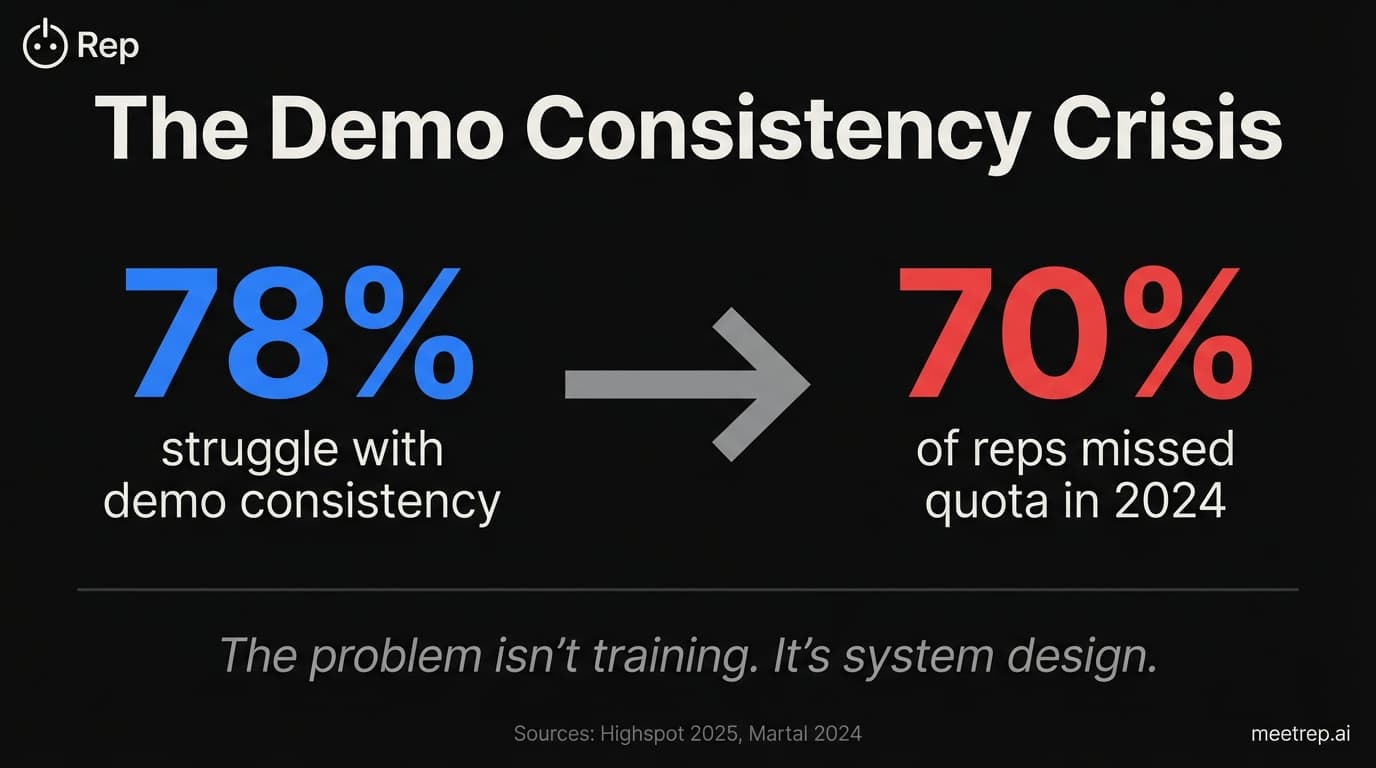
- 78% of orgs struggle with demo consistency—and it's killing deals
- Traditional training fails because 84% is forgotten within 90 days
- The fix isn't more training; it's systematizing your best rep's approach
- Teams with formal enablement see 49% higher win rates
- AI-powered playbooks now make "perfect demo every time" actually possible
Your best rep just nailed a demo. Perfect discovery questions. Smooth product navigation. Closed the deal in 23 days.
Now look at the rep sitting next to them. Same product. Same training. Same playbook. But their demos ramble. They skip discovery. And their deals die in the mid-funnel graveyard where 86% of B2B purchases now stall.
I've spent years building sales automation tools—first at GoCustomer.ai, now at Rep. And here's what I've learned about sales enablement demos: the problem isn't that your reps can't learn. It's that traditional enablement can't scale what makes your top performers great.
This guide shows you how to fix that.
Why Most Sales Enablement Demos Fail (The Real Problem)
Sales enablement demos fail because of inconsistency, not incompetence. Your reps know the product. They've sat through the training. But when they're live on a call, they drift. They skip discovery. They default to the "harbor tour"—that feature-by-feature walkthrough that bores prospects into ghosting you.
The data backs this up. According to Highspot's 2025 State of Sales Enablement Report, 78% of organizations still see performance struggles with consistency. And only 24% of leaders can confidently say their teams will hit quota.
The Data:70% of B2B sales reps missed quota in 2024. That's not a training gap. That's a systemic failure.
Here's what's actually happening in most organizations:
| Problem | Evidence | Impact |
|---|---|---|
| Demo inconsistency across reps | 78% struggle with consistency | Unpredictable deal outcomes |
| Training doesn't stick | 84% forgotten within 90 days | Constant retraining cycles |
| Reps can't add value | 58% of pipeline stalls for this reason | Deals die mid-funnel |
| Buyers are frustrated | 81% dissatisfied with interactions | Lost deals to competitors |
Source: Highspot 2025, Qwilr 2024, G2 2024, Sopro 2025
The root cause? You're trying to train humans to be consistent. But humans aren't built for consistency. They're built for adaptation—which is great for complex negotiations, but terrible for repeatable demo delivery.
The Mid-Funnel Crisis: Where Your Deals Actually Die
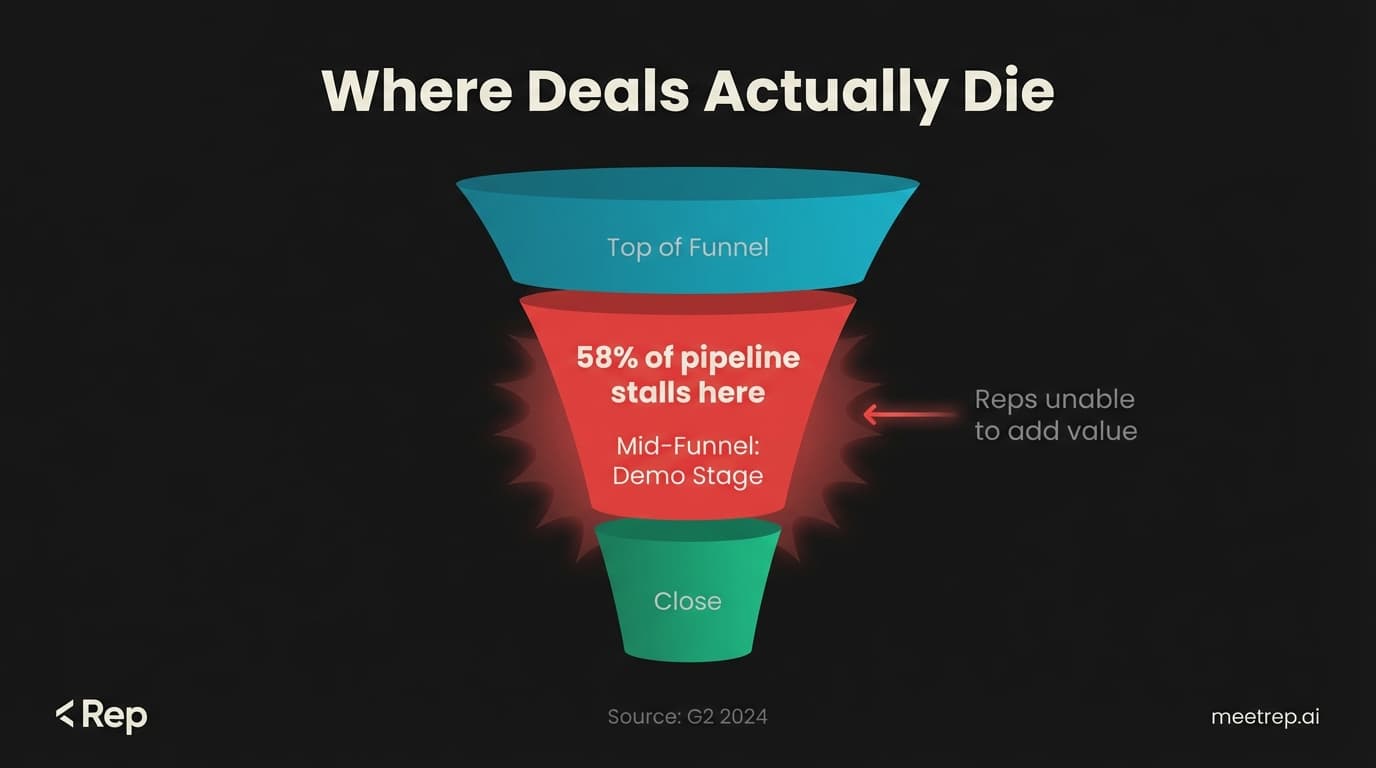
Most deals don't die at the top of your funnel. And they don't die during negotiation. They die in the middle—right where your demos happen.
G2's 2024 analysis found that 58% of pipeline stalls because reps are unable to add value during the sales process. Not because they're lazy. Not because they don't know the product. But because they can't consistently deliver the specific information each buyer needs to move forward.
This is the mid-funnel stall. And it's getting worse.
Buying committees have ballooned to 10-11 stakeholders for mid-market deals, and 15+ for enterprise. Each stakeholder wants different information. The CFO cares about ROI. The CTO wants technical architecture. End users want to see if it'll make their job easier. Your reps are supposed to satisfy all of them—often in a single demo.
Hot take: Your demo isn't competing with other demos. It's competing with your prospect's ability to research on their own. And right now, 75% of B2B buyers prefer a rep-free experience according to Gartner research cited by Sopro.
So what changed? Buyers got better at self-serve research. They show up to demos having already formed opinions. If your rep just walks through features they've already read about, you've wasted everyone's time.
Sound familiar?
What a Modern Sales Demo Playbook Actually Looks Like
A demo playbook isn't a script. Scripts make your reps sound like robots reading from a teleprompter. And prospects can tell.
A real playbook is a decision framework—a system that helps reps navigate demos based on what they discover, not what they memorized. The best playbooks capture how top performers think, not just what they say.
Here's what belongs in a playbook that actually gets used:
| Component | What It Contains | Why It Matters |
|---|---|---|
| Discovery Framework | Pre-demo questions organized by persona (CFO, CTO, end-user) | Can't customize demo without knowing pain points |
| Navigation Paths | Step-by-step product walkthroughs tied to specific pain points | Reps show relevant features, not everything |
| Talk Tracks | Natural conversation flows (not word-for-word scripts) | Sounds human while staying on message |
| Objection Index | Responses to 20+ common pushbacks with proof points | Reps don't freeze when objections hit |
| Case Study Bank | Industry-specific examples tagged for easy retrieval | Social proof matched to prospect's world |
| Next-Step Templates | Scheduling language and follow-up sequences | No fumbling at the close |
What we learned at GoCustomer: We tried building playbooks as static documents. PDFs that lived in Google Drive. Nobody used them. The reps who closed deals were the ones who'd internalized the content. Everyone else just winged it.
The fix wasn't better documentation. It was embedding the playbook into the demo itself—making it impossible to skip steps because the system guided the flow.
How to Build a Demo Playbook That Reps Will Actually Follow
Building a playbook is the easy part. Getting reps to use it consistently is where most enablement programs die.
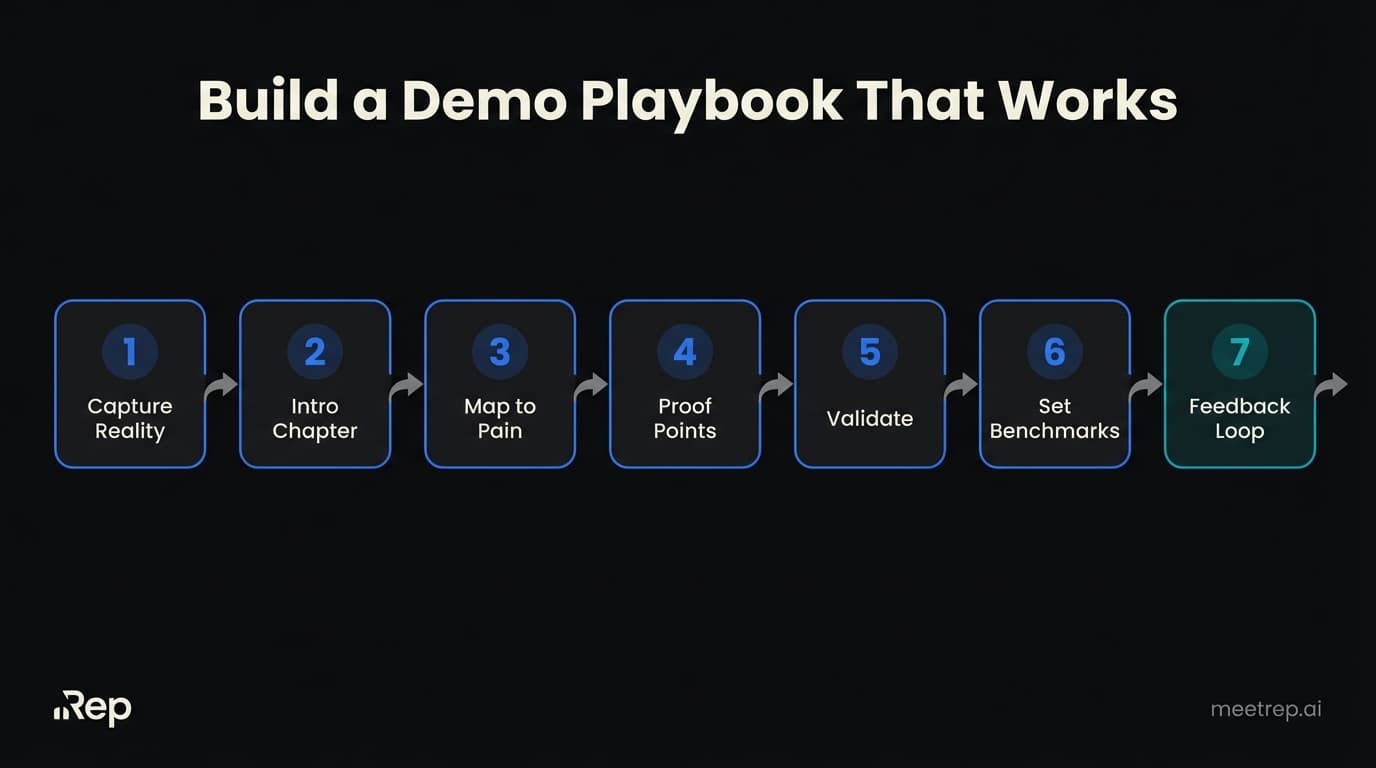
Here's the framework we've seen work:
1. Capture reality, not theory
Don't write playbooks from scratch. Record your top performer's demos. Watch what they actually do—not what they say they do. You'll find patterns they're not even aware of.
2. Structure with an intro chapter
Arcade's 2025 benchmark data shows a 72% increase in play rate when demos include an intro chapter that sets context. Your playbook should specify: open every demo by setting expectations and confirming what matters to this specific prospect.
3. Map navigation to pain points
Don't organize your playbook by features. Organize it by problems. "Prospect says they struggle with X → show them Y." This changes demos from feature tours to problem-solving conversations.
4. Build objection responses with proof
Every objection in your index needs: the objection, why it comes up, how to respond, and a proof point (stat, case study, or customer quote). Reps freeze when they don't have proof loaded.
5. Validate before deploying
Run the playbook through a test group. Have them flag gaps—questions they couldn't answer, transitions that felt awkward, features they needed but weren't mapped. Then iterate.
6. Set measurable benchmarks
What does "good" look like? Top B2B SaaS teams hit 20-30% demo-to-close rates according to Gong data cited by Monetizely. Track yours. If you're below 15%, your playbook has holes.
7. Create feedback loops
Playbooks aren't static. Review closed-won and closed-lost calls monthly. What worked? What didn't? Update the playbook based on data, not opinions.
The Data:Outreach's 2025 research found that opportunities closed within 50 days have a 47% win rate. After 50 days? It drops to 20% or lower. Your playbook needs to drive velocity, not just quality.
Why Training Alone Will Never Fix Demo Consistency
I'm going to say something that might annoy you if you've spent your career building training programs.
Training alone cannot solve demo consistency.
Here's why: 84% of sales training is forgotten within 90 days without reinforcement. You can run the best onboarding program in your industry. You can bring in expensive consultants. You can certify every rep on every module. And in three months, most of it is gone.
Meanwhile, average SaaS ramp time has hit 5.7 months—a 32% increase from 4.3 months in 2020. Your reps are taking longer to become productive, forgetting training faster, and operating in a market where buyers have less patience than ever.
This isn't a criticism of enablement professionals. It's a recognition that human memory has limits—and traditional training methods don't account for them.
My recommendation: Stop thinking about training as a knowledge transfer problem. Start thinking about it as an environment design problem. How do you build systems where reps can't help but follow best practices?
The teams I've seen solve this use three approaches in combination:
Live demonstration learning. New reps shadow top performers on real calls. Not role-plays—actual prospect conversations. They see how decisions get made in the moment.
Recording libraries. Every closed-won demo gets added to a searchable library. Reps can find examples of how to handle specific objections, navigate specific features, or close specific persona types.
In-the-flow reinforcement. Training content surfaces when reps need it—during call prep, during the demo itself, during follow-up. Not in a separate "learning portal" they'll never visit.
The goal isn't to make reps remember everything. It's to make the system remember for them.
The ROI of Getting Demos Right (Actual Numbers)
Let's talk about what's at stake.
Organizations with formal sales enablement strategies see 49% higher win rates on forecasted deals compared to those without. That's not a marginal improvement. That's the difference between hitting quota and mass layoffs.
And the data on unified platforms is even stronger. Highspot's 2025 research found that companies with unified enablement platforms are 42% more likely to improve win rates than those using fragmented tools.
Here's what actual companies have achieved:
| Company | Industry | What They Did | Results |
|---|---|---|---|
| Sovos | Tax Software | Deployed demo automation for initial calls | 67% reduction in live SE calls, 60% faster SMB sales cycle |
| Elsevier | Academic Publishing | Standardized discovery and demo process | 45% deal size growth, 35% faster closure |
| Canva | Technology | Scaled rep capacity with enablement platform | 60% boost in rep capacity, 6% revenue growth |
Sources: Consensus Case Study 2025, Gong Customer Stories
That Sovos result deserves attention. They didn't hire more Sales Engineers. They automated the initial demo—the overview that was eating their SE team's time. Now SEs focus on complex technical conversations while the routine stuff runs without them.
The Data:55% of organizations can't effectively drive their GTM initiatives due to bandwidth constraints. That's not a hiring problem. That's a capacity architecture problem.
How AI Changes the Demo Enablement Game
I'll be direct: I built Rep because I believe AI is the only way to actually solve demo consistency at scale.
Traditional enablement tries to train humans to be consistent. But humans aren't consistent. They get tired. They have off days. They forget training. They skip steps when they're rushing.
AI doesn't have those problems.
The shift happening right now—in 2025 and accelerating into 2026—is from "training humans to do demos" to "orchestrating AI to do the repetitive demos while humans handle complex deals."
90% of organizations now use AI to support GTM efforts. And teams with AI-powered training are 35% more likely to report increased average deal size.
But most "AI for sales" tools still require humans to run the demo. They help with call recording, coaching, or content suggestions. They don't actually do the demo.
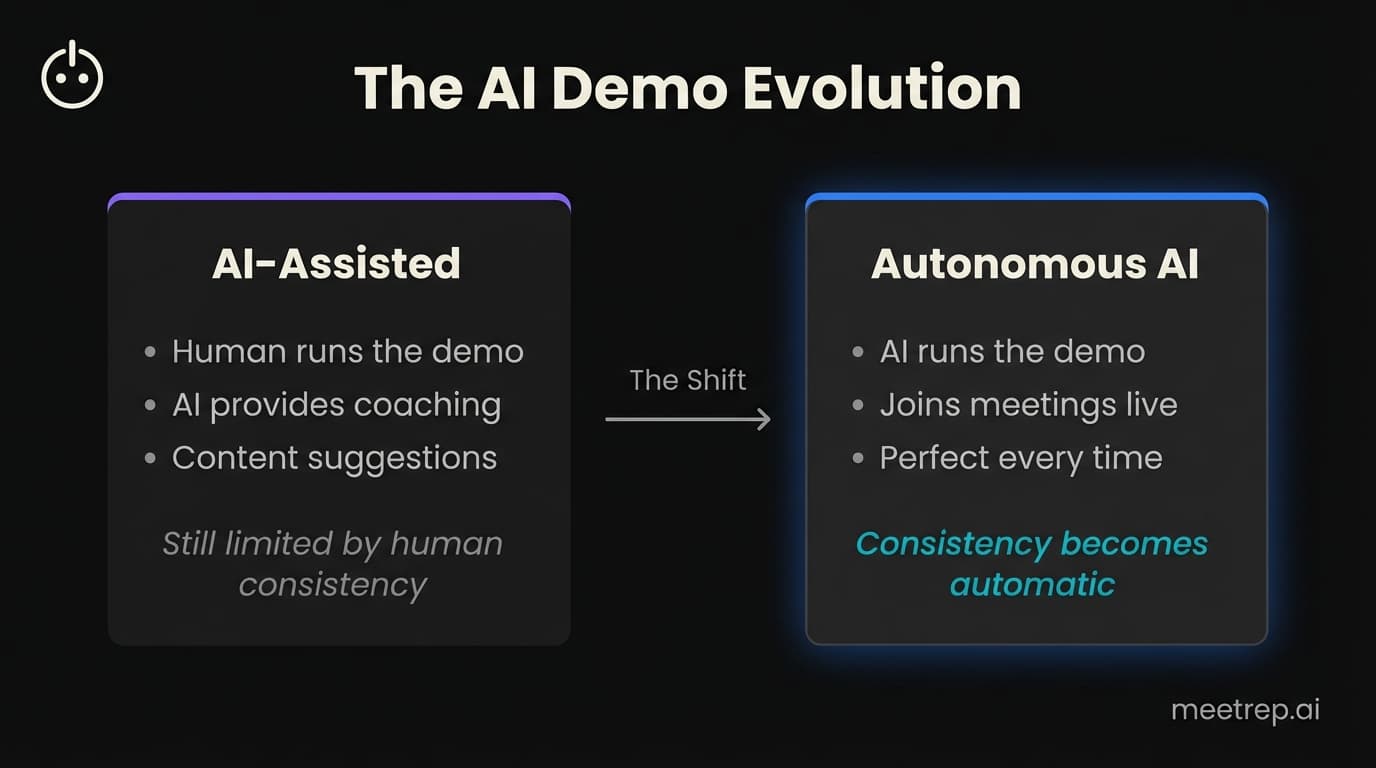
That's changing. The category distinction to understand is between:
AI-assisted demos: Human runs the demo, AI provides coaching, analysis, or content recommendations.
Autonomous demos: AI runs the demo—joins the meeting, shares screen, navigates product, answers questions, extracts insights.
At Rep, we built the second category. The AI agent joins a video call, shares its screen, walks through your actual product in real-time, and converses naturally with prospects. It learns from your top performers through live training sessions or uploaded recordings. And it delivers that playbook perfectly, every single time.
Is it right for every demo? No. Complex enterprise deals with technical deep-dives still need human SEs. But for the initial overview demo—the one that eats 30-50% of your team's time—autonomous AI changes the economics entirely.
Measuring Demo Effectiveness (The KPIs That Matter)
You can't improve what you don't measure. But most teams track the wrong metrics—demo volume instead of demo quality.
Here are the KPIs that actually predict revenue:
Demo-to-close rate. The percentage of completed demos that result in closed-won deals. Benchmark: 20-30% for top-performing B2B SaaS. If you're below 15%, your demos aren't qualifying or converting effectively.
Time to close. How long from first demo to signed contract? Remember: 47% win rate within 50 days drops to 20% after. Demo velocity matters more than most teams realize.
Discovery depth. Are reps uncovering pain points or just presenting? Track how many discovery questions get asked per demo. Deals with thorough discovery close at higher rates.
Playbook adherence. What percentage of your playbook's recommended steps actually happen in each demo? If adherence is low, your playbook is either wrong or impossible to follow.
SE leverage. For teams with Sales Engineers: how many qualified opportunities per SE? Sovos improved this by 67% through demo automation.
Build a dashboard tracking these monthly. Compare by rep, by segment, by lead source. The patterns will show you exactly where your playbook needs work.
Here's what I believe after building sales tools for years: the future of demos isn't training humans to be more consistent. It's designing systems where consistency is automatic.
Your top performer's approach can be captured, systematized, and delivered at scale—whether by better playbooks, smarter enablement platforms, or AI agents that execute perfectly every time. The teams winning in 2025 aren't just training harder. They're architecting their demo motion so that excellence is the default, not the exception.
The gap between your best rep and your average rep isn't talent. It's system design. Close that gap, and the math changes entirely.
If you want to see how autonomous demos work in practice, Rep can show you—24/7, with a live product walkthrough, run entirely by AI.

Nadeem Azam
Founder
Software engineer & architect with 10+ years experience. Previously founded GoCustomer.ai.
Nadeem Azam is the Founder of Rep (meetrep.ai), building AI agents that give live product demos 24/7 for B2B sales teams. He writes about AI, sales automation, and the future of product demos.
Frequently Asked Questions
Table of Contents
- Why Most Sales Enablement Demos Fail (The Real Problem)
- The Mid-Funnel Crisis: Where Your Deals Actually Die
- What a Modern Sales Demo Playbook Actually Looks Like
- How to Build a Demo Playbook That Reps Will Actually Follow
- Why Training Alone Will Never Fix Demo Consistency
- The ROI of Getting Demos Right (Actual Numbers)
- How AI Changes the Demo Enablement Game
- Measuring Demo Effectiveness (The KPIs That Matter)
Ready to automate your demos?
Join the Rep Council and be among the first to experience AI-powered demos.
Get Early AccessRelated Articles
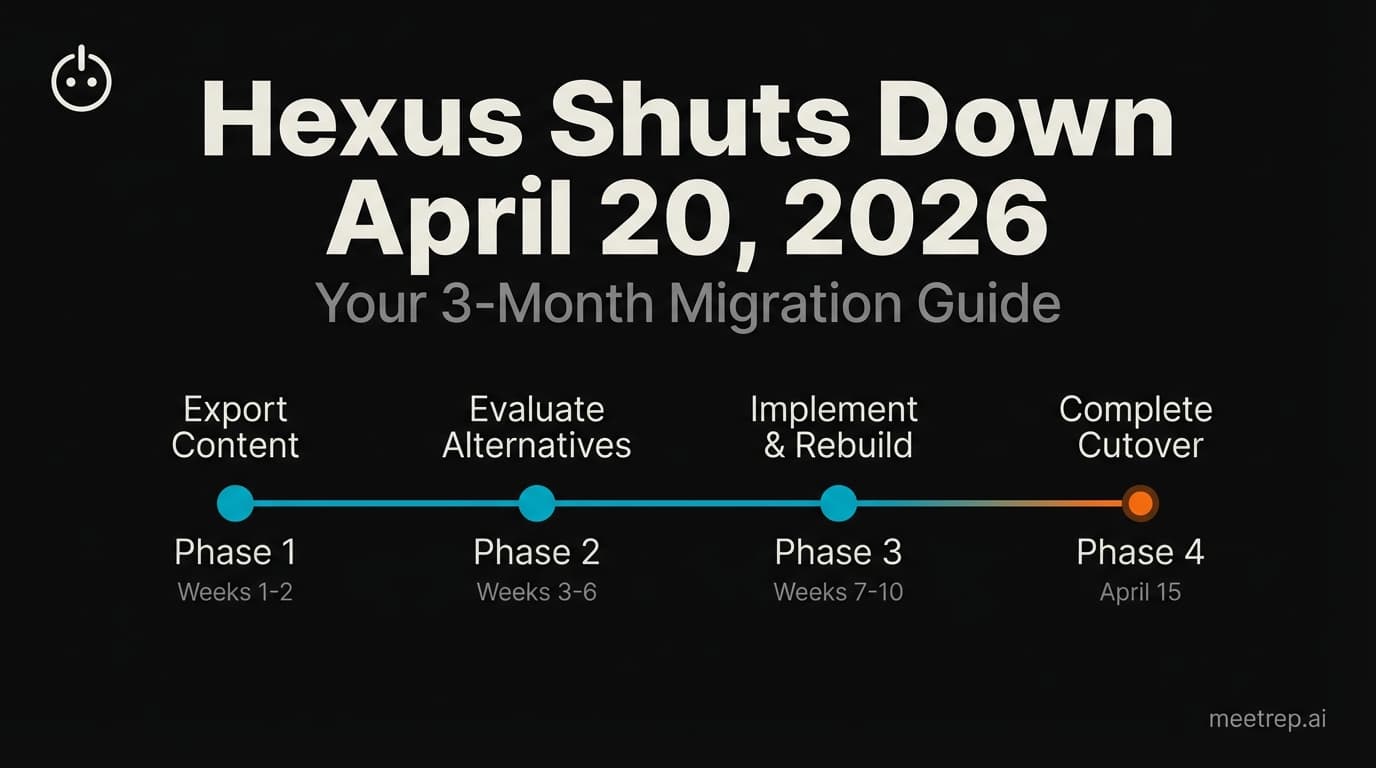
Hexus Acquired by Harvey AI: Congrats & What It Means for Demo Automation Teams
Hexus is shutting down following its acquisition by Harvey AI. Learn how to manage your migration and discover the best demo automation alternatives before April 2026.
Why the "Software Demo" is Broken—and Why AI Agents Are the Future
The traditional software demo is dead. Discover why 94% of B2B buyers rank vendors before calling sales and how AI agents are replacing manual demos to scale revenue.
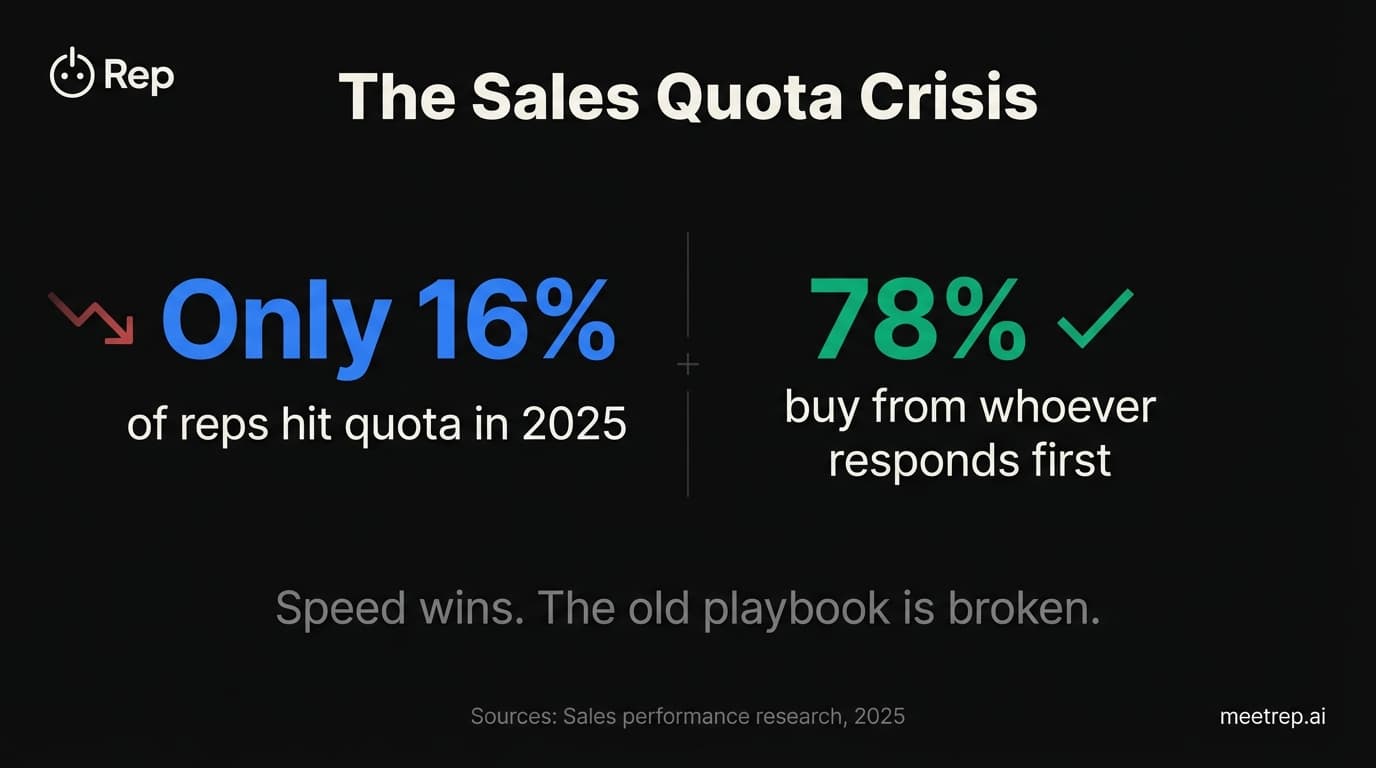
Why Autonomous Sales Software is the Future of B2B Sales (And Why the Old Playbook is Dead)
B2B sales is at a breaking point with quota attainment at 46%. Discover why autonomous 'Agentic AI' is the new standard for driving revenue and meeting the demand for rep-free buying.