Fintech Demo Strategy: The Compliance-First Playbook for 2025

Executive Summary
- 94% of buyers research with LLMs before talking to sales—if you're not available instantly, you've already lost
- The Air AI FTC lawsuit shows why "human replacement" positioning is legally dangerous
- Fintech leads in demo automation (12.9% of users), but compliance-first architecture is non-negotiable
- Real ROI exists: TBI Bank generates $1M+ monthly from autonomous agents; Ramp attributes 15% of leads to product tours
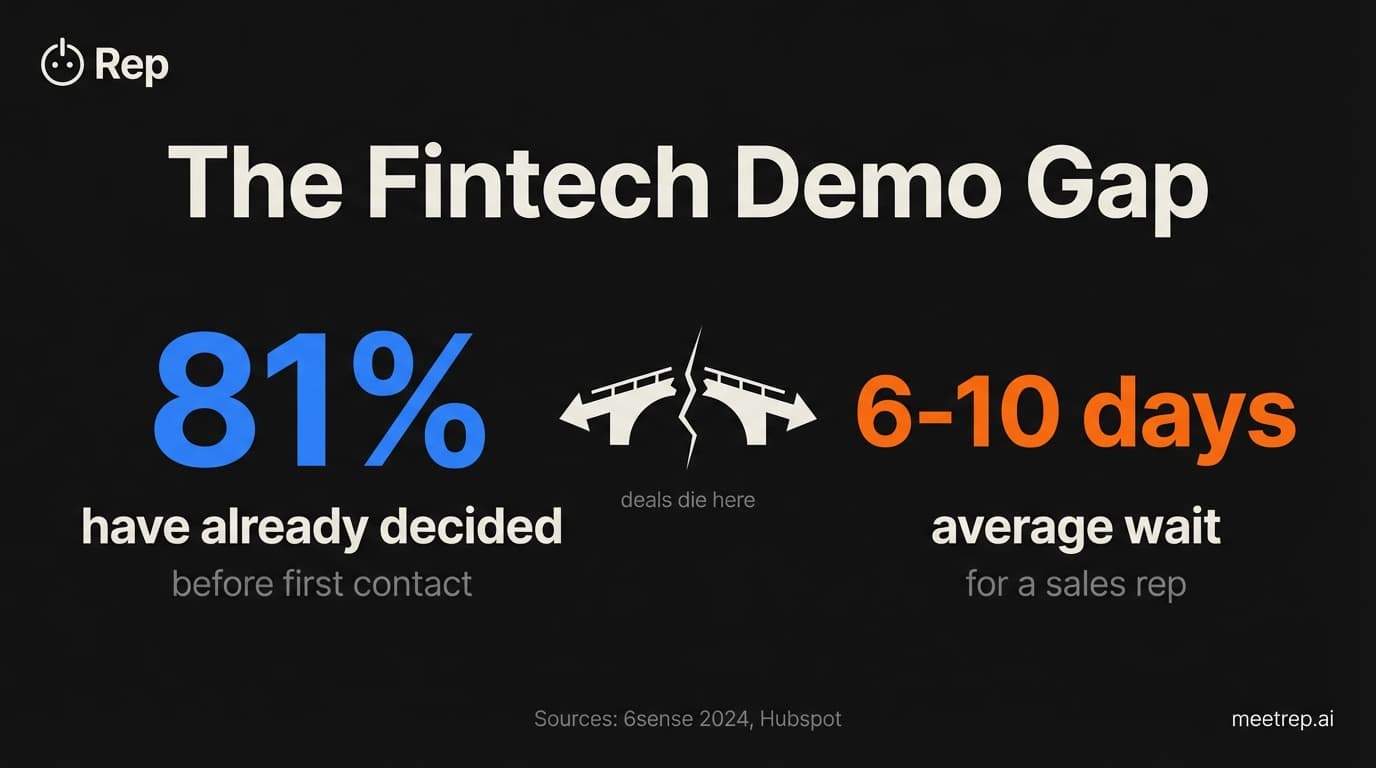
The fintech demo is broken. Your buyers are researching with AI—94% of B2B buyers now use LLMs during their buying process—but you're still making them wait 6-10 days for a sales rep. By then, they've already picked a favorite.
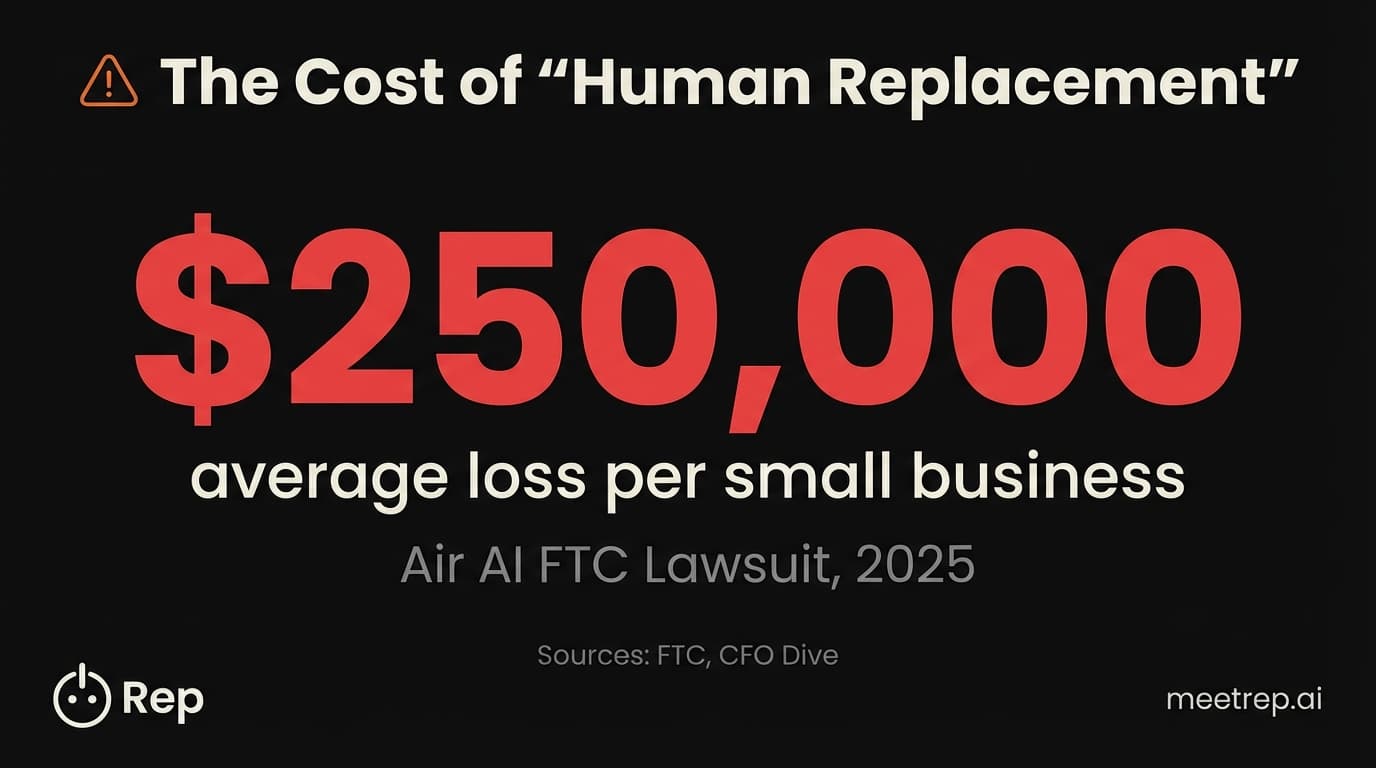
Meanwhile, the regulatory walls are closing in. Air AI just got hit with an FTC lawsuit for promising "human replacement" and cost their customers $250,000 per small business. The company that promised autonomous sales agents became a cautionary tale.
I'm building Rep, an autonomous demo platform. And I'll be honest: the current state of AI demos in financial services scares me. Not because the technology doesn't work—it does. But because most companies are implementing it wrong.
Here's how to do it right.
What Is a Fintech Demo (And Why It's Different)
A fintech demo is an interactive product demonstration of financial technology software that must demonstrate core functionality while adhering to strict regulatory requirements. Unlike standard SaaS demos, fintech demos require multiple compliance stakeholders, longer sales cycles, and constant vigilance around what gets said—because anything stated during the demo can become regulatory liability.
The numbers tell the story. According to Gartner, buying committees in financial services typically include 6-10 decision-makers. Madison Logic research shows these journeys average over 12 months. And here's what really hurts: your sales team only gets 17% of that journey in actual vendor meetings.
So when a prospect finally gets to your demo? That's not the beginning of their evaluation. That's the end. 81% of buyers already have a preferred vendor at time of first contact.
Key Insight: Fintech demos aren't persuasion—they're validation. By the time prospects reach you, they're checking whether you match the criteria they've already established.
This changes everything about how you should approach demos. You're not convincing. You're confirming.
Why Fintech Buyers Have Already Decided Before Your Demo
Your prospects are doing research you'll never see. And they're doing it with AI.
The 6sense 2024 Buyer Experience Report found that 94% of B2B buyers now use LLMs during their buying process. They're asking ChatGPT to compare vendors. They're using Perplexity to understand compliance requirements. They're researching at 11pm when your sales team is asleep.
But here's the friction: Hubspot research shows buyers wait 6-10 days on average just to speak with a sales rep. That's 6-10 days where they're forming opinions without you.
I think about this gap constantly when building Rep. The time between "prospect is interested" and "prospect talks to a human" is where deals die. Not because the product is wrong. Because the timing is wrong.
| Stage | What Buyer Is Doing | What Vendor Is Doing |
|---|---|---|
| Research (83% of journey) | Using LLMs, reading reviews, comparing vendors | Nothing—unaware prospect exists |
| Request demo | Submitting form, waiting | Processing lead, scheduling |
| Wait period (6-10 days) | Losing momentum, researching competitors | Assuming prospect will wait |
| First call | Already has preferred vendor | Finally engaging |
The math doesn't work. If 81% have already picked a favorite before first contact, and you're making them wait almost two weeks, you're fighting uphill.
What we learned building Rep: The demo request isn't the start of the sales process anymore. It's closer to the end of the evaluation. By the time someone asks for a demo, they've done their homework. They want confirmation, not education.
The Air AI Disaster: What "Human Replacement" Really Costs
Let me tell you about the lawsuit that should be on every fintech sales leader's wall.
In August 2025, the FTC sued Air AI—a company that promised AI voice agents could "replace" human sales reps. The results? Their customers lost an average of $250,000 per small business. The company's crime wasn't that the technology failed. It was that they marketed it wrong.
According to CFO Dive's coverage, FTC Bureau Director Christopher Mufarrige said: "Companies that market AI-related tools with false promises of unrealistic investment returns and guaranteed refunds harm hardworking small business owners."
The lesson isn't "don't use AI for demos." The lesson is "don't pretend AI is human, and don't promise what it can't deliver."
Hot take: The phrase "human replacement" should be banned from your sales vocabulary. Not because AI can't handle demos—it can. But because the legal and reputational risk of that positioning is career-ending.
And the hallucination problem is real. Research from Drainpipe.io found that 47% of enterprise AI users admitted to making at least one major business decision based on hallucinated (false) content. In fintech, a hallucinated interest rate or compliance claim isn't just embarrassing—it's potentially illegal.
This is why compliance-first architecture isn't a nice-to-have. It's the whole game.
The Real Cost of Compliance Friction
Compliance isn't just your legal team's problem. It's a revenue problem.
The numbers are staggering. FinTech Global reports that global spending on financial crime compliance hit $206 billion per year. Luthor AI's research shows 93% of fintechs find BSA/AML compliance challenging.
But here's what kills me: the cost of NOT being compliant is 2.71x higher than the cost of compliance programs, according to Flagright analysis. Companies penny-pinch on compliance and pay triple in fines.
And compliance friction directly kills deals. Signicat research via Flagright found that 70% of customers abandon onboarding if it exceeds 20 minutes. Every extra form, every extra verification step, every delay—you're bleeding prospects.
The Data: Non-compliance costs 2.71x more than maintaining compliance programs. Companies that skip proper governance pay triple when things go wrong. (Source: FinTech Global via Flagright)
So when you're evaluating demo automation, the question isn't "does it save time?" The question is "does it create compliance risk that costs more than the time saved?"
Fintech Is Already Leading Demo Automation (Are You Behind?)
Here's something that surprised me: fintech is actually ahead of the curve on demo automation.
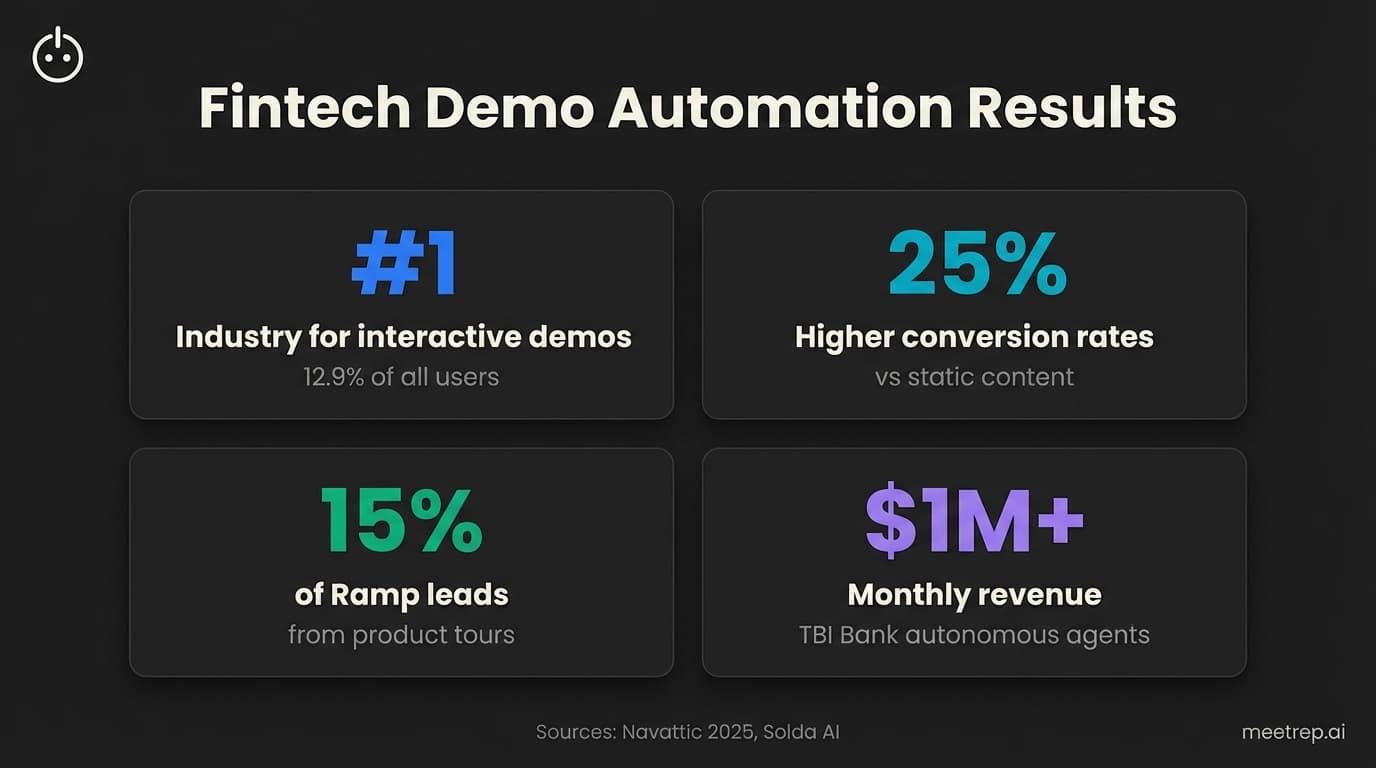
Navattic's 2025 State of Interactive Demo report found that fintech is the #1 industry for interactive demo usage, representing 12.9% of all users. The same report shows these demos deliver 25% higher conversion rates and 35% more time on page.
The top 1% of demos achieve 84.4% engagement and 54% click-through rates. And there's been a 68.7% increase in click-through rates year-over-year.
Real companies are seeing real results:
Ramp (B2B fintech) attributes 15% of their website leads to Navattic product tours. Their AEs report these leads have "higher propensity to convert."
Sovos (tax compliance) cut live calls by two-thirds using Consensus demo automation. Customers now come to live calls with specific questions instead of needing basic education.
TBI Bank reported over $1 million in additional monthly revenue using autonomous voice agents through Solda AI, processing 10,000 leads daily with 30% lower costs than traditional call centers.
Key Insight: Fintech companies using interactive demos see 25% higher conversion rates than those relying on static content or sales-only demos. (Source: Navattic 2025)
So the question isn't whether demo automation works in fintech. It demonstrably does. The question is whether your implementation has the compliance architecture to avoid becoming the next cautionary tale.
The 3 Pillars of Compliance-First Autonomous Demos
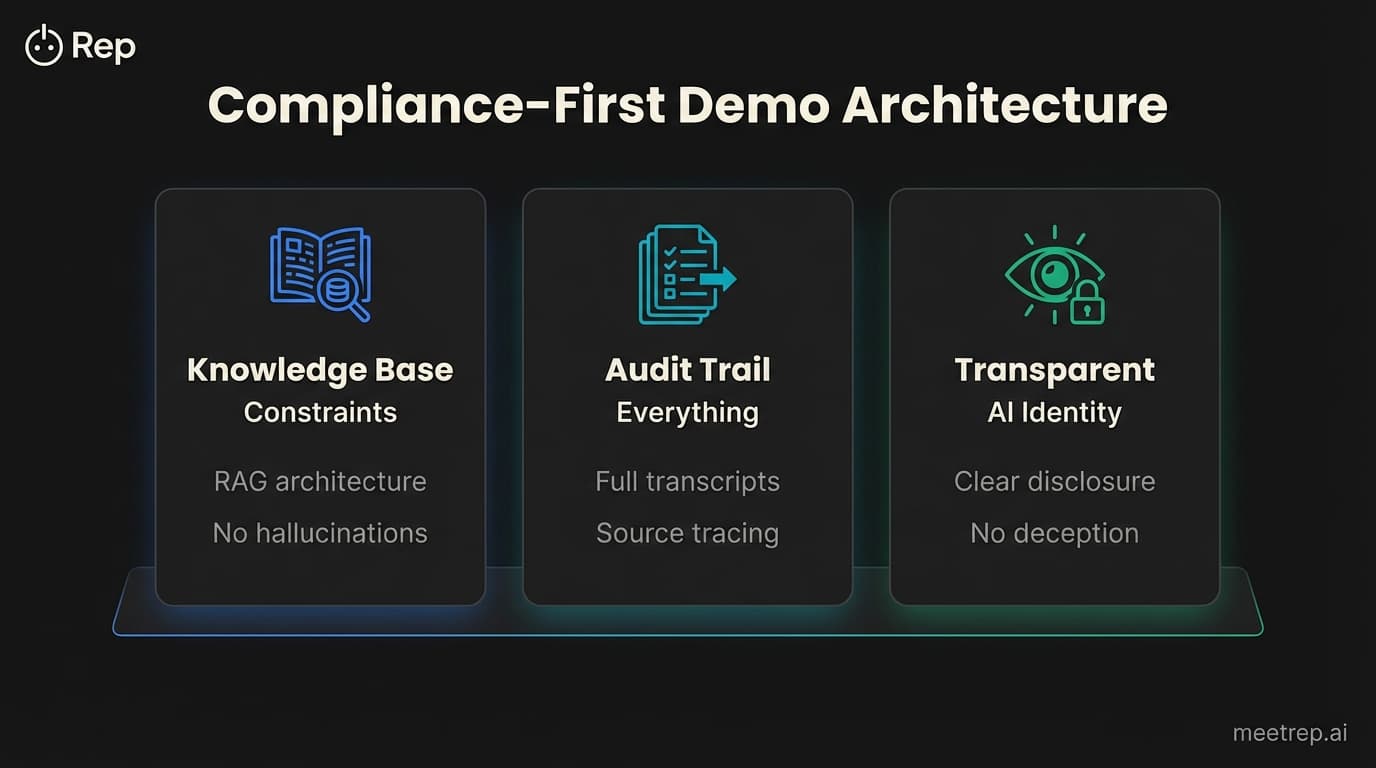
After building in this space for years—first at GoCustomer.ai, now at Rep—I've landed on three non-negotiables for autonomous demos in regulated industries.
Pillar 1: Strict Knowledge Base Constraints
Your AI agent should only speak from approved content. Period.
This means RAG (Retrieval-Augmented Generation) architecture that grounds every response in your verified knowledge base. No creative improvisation on compliance topics. No making up interest rates. No inventing features.
When we built Rep, this was the first architectural decision. The agent retrieves information from your documentation, training sessions, and approved content. If the answer isn't in the knowledge base, the agent says so instead of hallucinating.
The 0.7% hallucination rate in even the best LLMs (Gemini 2.0 Flash) means zero tolerance for ungrounded responses in fintech contexts.
Pillar 2: Audit Trail Everything
If a regulator asks "Why did the AI say that?"—you need an answer.
Every interaction should be logged. Every response should be traceable to its source content. Every session should have a complete transcript with timestamps.
At Rep, we capture full transcripts, extraction of key points (action items, pain points, questions asked), and the ability to review exactly what the agent said and why. Not because we're paranoid. Because that's the minimum for operating in regulated environments.
Pillar 3: Transparent AI Identity
Don't fake humanity. Seriously.
The Air AI lawsuit centered partly on failure to disclose AI identity. That's not just a legal risk—it's a trust risk. When prospects discover they were talking to AI they thought was human, they don't think "wow, that AI was good." They think "I was deceived."
Position your AI as competent, not human-replacing. "Our AI can show you the product and answer questions from our documentation" is defensible. "Our AI is just like talking to a rep" is lawsuit bait.
What we learned building Rep: Transparency about AI identity actually increases trust, not decreases it. Prospects appreciate knowing upfront. And when the AI is genuinely helpful, they don't care that it's not human.
Measuring Demo ROI in Regulated Environments
You need benchmarks. Here's what good looks like.
| Metric | Industry Benchmark | Top Performers |
|---|---|---|
| Demo-to-meeting conversion | 30% without scheduling | 66.7% with instant scheduling |
| Financial software demo-to-meeting | 61.19% | — |
| Interactive demo engagement | Average | 84.4% (top 1%) |
| Click-through rate | Average | 54% (top 1%) |
| Leads from product tours | — | 15% (Ramp) |
The Chili Piper benchmark report shows the biggest conversion lift comes from instant scheduling—going from 30% to 66.7% demo-to-meeting conversion just by removing the scheduling friction.
But in fintech, you also need to track compliance-specific metrics:
- Time from demo request to compliance approval
- Demo content accuracy (spot-check AI responses against approved content)
- Regulatory incident rate (how often does a demo create compliance follow-up)
- Audit response time (can you produce session records on demand?)
If you can't measure these, you can't manage the risk.
How to Choose Demo Automation for Fintech
Not all demo platforms are built for regulated industries. Here's how I'd evaluate them.
Questions to ask every vendor:
- Where does the AI get its information? Look for knowledge base grounding, not general LLM responses.
- Can you produce audit trails? Session transcripts, response sources, timestamps—you need all of it.
- How do you handle questions outside the knowledge base? The right answer is "the AI acknowledges it doesn't know." The wrong answer is "the AI figures it out."
- What compliance certifications do you have? Ask for specific certifications, not "we take security seriously."
- Can the AI show the product, or just talk about it? There's a big difference between voice agents that describe features and systems that actually navigate your product visually.
| Capability | Interactive Tours (Navattic, Walnut) | Voice Agents (Solda, 11x) | Visual + Voice (Rep) |
|---|---|---|---|
| 24/7 availability | ✓ | ✓ | ✓ |
| Real-time Q&A | ✗ | ✓ | ✓ |
| Shows actual product | ✓ | ✗ | ✓ |
| Handles complex questions | ✗ | ✓ | ✓ |
| Session audit trails | Limited | Varies | ✓ |
The gap in the market is clear: interactive tours can't answer questions. Voice agents can't show the product. That's why we built Rep to do both—the AI joins a video call, shares its screen, navigates your actual product, and answers questions from your knowledge base.
The fintech demo is at an inflection point. Buyers are researching with AI at 11pm, but most sales teams still make them wait a week for a human. That gap is where deals die.
But the solution isn't "replace humans with AI" as Air AI learned the hard way. It's compliance-first autonomy—AI that shows your product, answers from your knowledge base, logs everything, and never pretends to be something it's not.
At Rep, that's exactly what we're building: autonomous demos that combine voice conversation with live product visualization, grounded in your approved content. Not because it's cool technology. Because it's the only architecture that makes sense for regulated industries.
If you're evaluating demo automation for fintech, I'd love to show you how we handle the compliance-first approach. See Rep in action—and yes, the demo itself is run by our AI. Seemed fitting.

Nadeem Azam
Founder
Software engineer & architect with 10+ years experience. Previously founded GoCustomer.ai.
Nadeem Azam is the Founder of Rep (meetrep.ai), building AI agents that give live product demos 24/7 for B2B sales teams. He writes about AI, sales automation, and the future of product demos.
Frequently Asked Questions
Table of Contents
- What Is a Fintech Demo (And Why It's Different)
- Why Fintech Buyers Have Already Decided Before Your Demo
- The Air AI Disaster: What "Human Replacement" Really Costs
- The Real Cost of Compliance Friction
- Fintech Is Already Leading Demo Automation (Are You Behind?)
- The 3 Pillars of Compliance-First Autonomous Demos
- Measuring Demo ROI in Regulated Environments
- How to Choose Demo Automation for Fintech
Ready to automate your demos?
Join the Rep Council and be among the first to experience AI-powered demos.
Get Early AccessRelated Articles
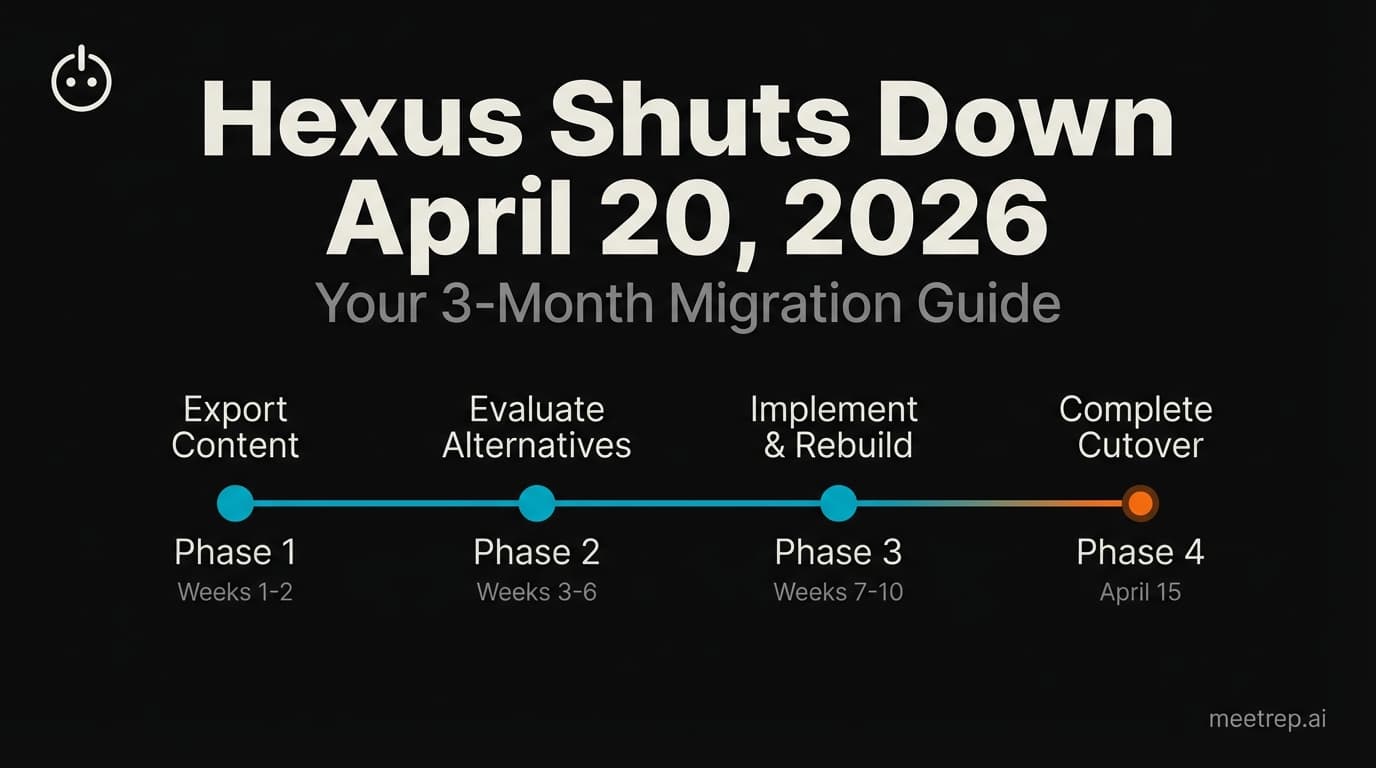
Hexus Acquired by Harvey AI: Congrats & What It Means for Demo Automation Teams
Hexus is shutting down following its acquisition by Harvey AI. Learn how to manage your migration and discover the best demo automation alternatives before April 2026.
Why the "Software Demo" is Broken—and Why AI Agents Are the Future
The traditional software demo is dead. Discover why 94% of B2B buyers rank vendors before calling sales and how AI agents are replacing manual demos to scale revenue.
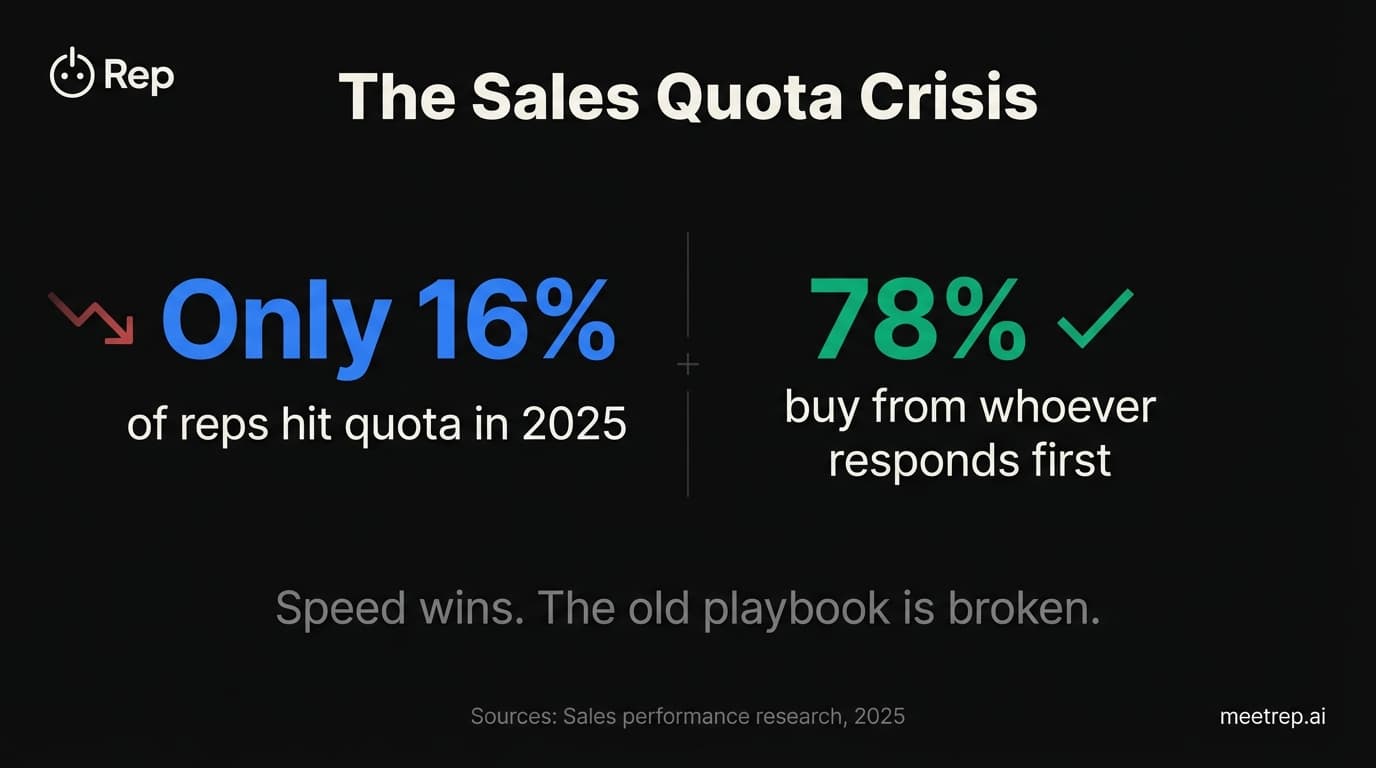
Why Autonomous Sales Software is the Future of B2B Sales (And Why the Old Playbook is Dead)
B2B sales is at a breaking point with quota attainment at 46%. Discover why autonomous 'Agentic AI' is the new standard for driving revenue and meeting the demand for rep-free buying.