E-commerce Demo Strategy: The Shift to Autonomous Demos and What It Means for Sales Leaders

Executive Summary
- 61% of B2B buyers now prefer a rep-free buying experience (Gartner June 2025)
- 36% of B2B software companies cut SDR headcount in 2025—the highest reduction of any sales role
- Retailers using AI agents grew 32% faster during Cyber Week 2025
- Interactive demos generate 6x higher conversion rates, but autonomous demos take it further with live navigation and voice
- The winning strategy is hybrid: AI handles discovery and qualification, humans close complex deals
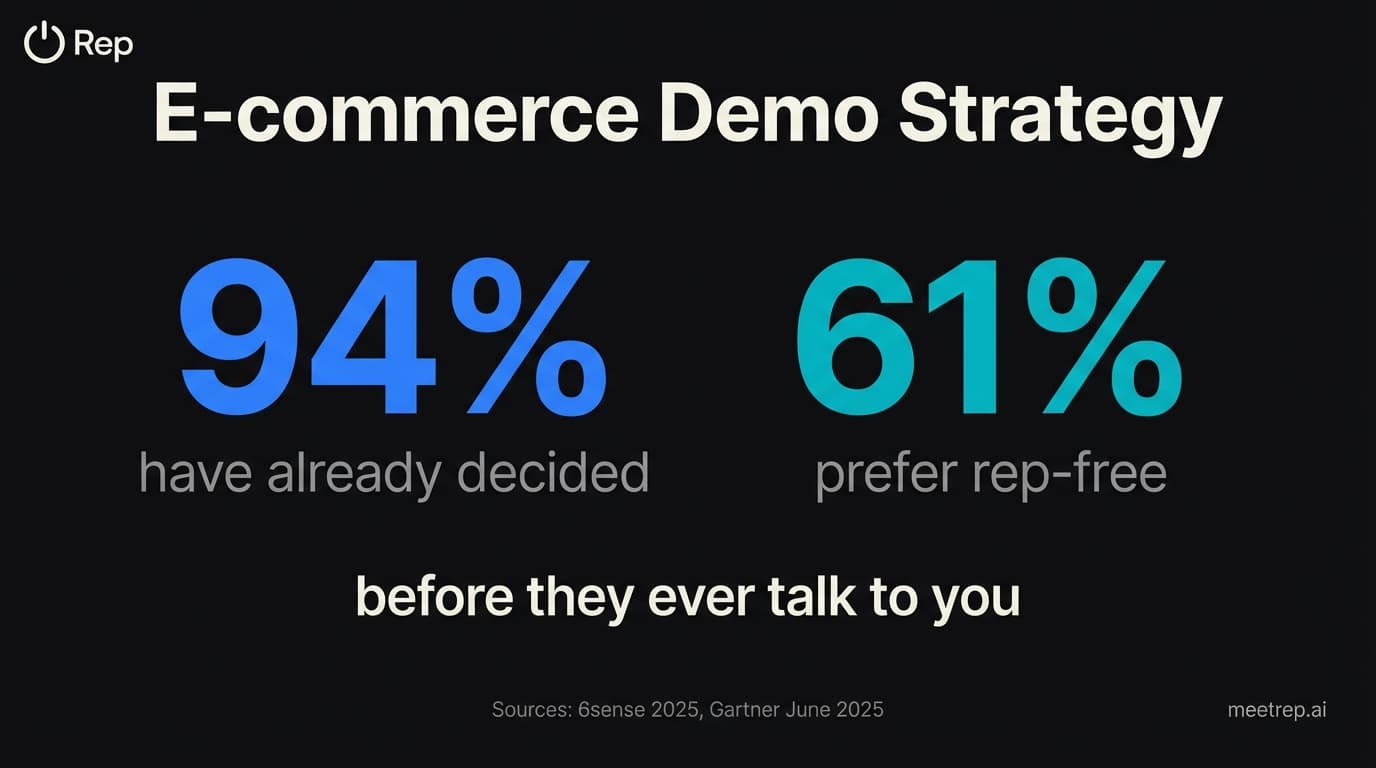
Here's the uncomfortable truth about your ecommerce demo process: 94% of buyers have already ranked their shortlist before they ever talk to your team. That's not a typo. According to 6sense's 2025 research, the vast majority of your prospects have made up their minds—and you weren't even in the room.
I've spent the last several years building sales automation products, first at GoCustomer.ai and now at Rep. And the pattern I keep seeing is this: sales leaders know their ecommerce demo process doesn't scale. But they're stuck between hiring more reps (expensive, slow) and watching deals slip away.
This post breaks down what's actually working in 2026. Not theory. Not vendor hype. Real data on autonomous demos, the 61% who want a rep-free experience, and how to build a demo strategy that doesn't require linear headcount growth.
What Is an E-commerce Demo (And Why Most Are Broken)?
An ecommerce demo is a product demonstration that shows an e-commerce platform's features, functionality, and user experience to prospects. Demos range from pre-recorded videos and interactive click-throughs to live presentations with sales engineers to fully autonomous AI-powered experiences.
But here's the problem. Most ecommerce software demos still follow a model designed for a different era.
Think about how your team handles demo requests today. A prospect fills out a form. An SDR reaches out to schedule. Calendars get compared. A week passes. Maybe two. By the time the actual demo happens, your prospect has already watched three competitor videos and formed an opinion.
And they might not even want your rep on the call.
The Data:Gartner's June 2025 survey found that 61% of B2B buyers now prefer a "rep-free" buying experience. That's not "might consider"—that's their stated preference.
The response from sales orgs? Pretty dramatic. SaaStr's 2025 analysis showed that 36% of B2B software companies decreased their SDR/BDR headcount in 2025—the highest reduction percentage among all sales roles surveyed.
So what's filling the gap? That's where autonomous demos come in.
The Rise of Autonomous Demos: From Click-Throughs to AI Agents
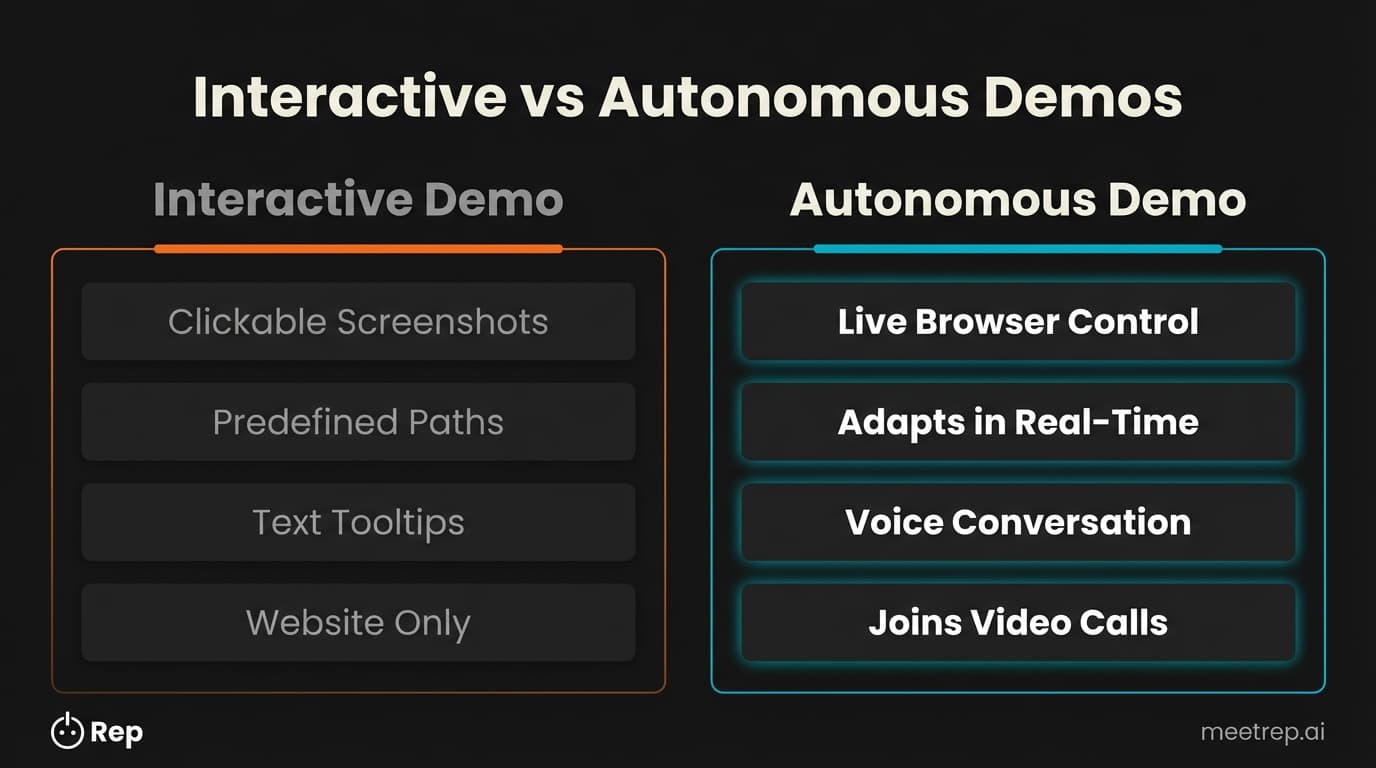
Autonomous demos represent a fundamental shift from passive content to active AI agents. Unlike traditional interactive demos (click-through screenshots with tooltips), autonomous demos use AI to navigate live software environments, join video calls with voice interaction, and adapt in real-time to prospect questions.
The distinction matters more than most people realize.
Traditional interactive demo tools—Navattic, Walnut, Consensus in their original form—capture screenshots of your product and let prospects click through predefined paths. They're useful. They scale. But they're fundamentally passive.
Autonomous demos powered by what's being called "Agentic AI" do something different. They control a real browser. They navigate your actual product in real-time. They speak with natural voice. And they handle objections using your knowledge base.
Hot take: Most interactive demo tools are stuck in 2023 thinking. Click-through screenshots served a purpose, but the market has moved. When Salesforce reported that AI agents influenced $67 billion in global sales during Cyber Week 2025 alone—accounting for 20% of all orders—it became clear that passive content isn't enough anymore.
| Feature | Interactive Demo (Click-Through) | Autonomous Demo (AI Agent) |
|---|---|---|
| Format | Clickable screenshots, predefined paths | Live browser navigation |
| Interaction | Text tooltips, hotspots | Voice conversation, natural language |
| Environment | Static snapshot | Real-time, live product |
| Intelligence | Pre-scripted | Context-aware, adapts to questions |
| Availability | Website embed | Website + joins video calls |
| Best For | Self-service discovery | Complex Q&A, live demonstrations |
What surprised me when we started building Rep was how much the "live" part matters. Prospects don't just want to see features—they want to ask "what if" questions and watch the answer unfold in real-time.
Why E-commerce Platforms Need a Different Demo Approach
E-commerce platform sales involve high stakes, multiple stakeholders, and complex technical requirements. The demo isn't just a feature tour—it's a proof point for a business-critical decision that affects revenue, operations, and customer experience.
Here's what makes e-commerce demos uniquely challenging:
The stakeholder problem is severe.Gartner's May 2025 research found that 74% of B2B buyer teams demonstrate "unhealthy conflict" during the decision process. When you're selling Shopify Plus, BigCommerce Enterprise, or Salesforce Commerce Cloud, you're not convincing one person. You're trying to align a CTO who cares about architecture, a CMO who cares about flexibility, and a CFO who cares about total cost.
A single demo can't do that. Period. But a scalable demo strategy that lets different stakeholders explore different angles? That's a different story.
The stall rate is brutal. According to Forrester's December 2024 research, 86% of B2B purchases stall during the buying process. That's not "take a while." That's "stop entirely."
When your demo process requires scheduling a human for every stakeholder who wants to see the platform, you're creating friction. And friction, at 86% stall rates, means lost deals.
Key Insight: The rep-free preference isn't about buyers hating humans. It's about buyers hating friction. When a director of e-commerce wants to show your platform to their VP at 9pm before a budget meeting, they can't wait for your SDR's calendar to open up.
What the Data Actually Shows About Demo Effectiveness
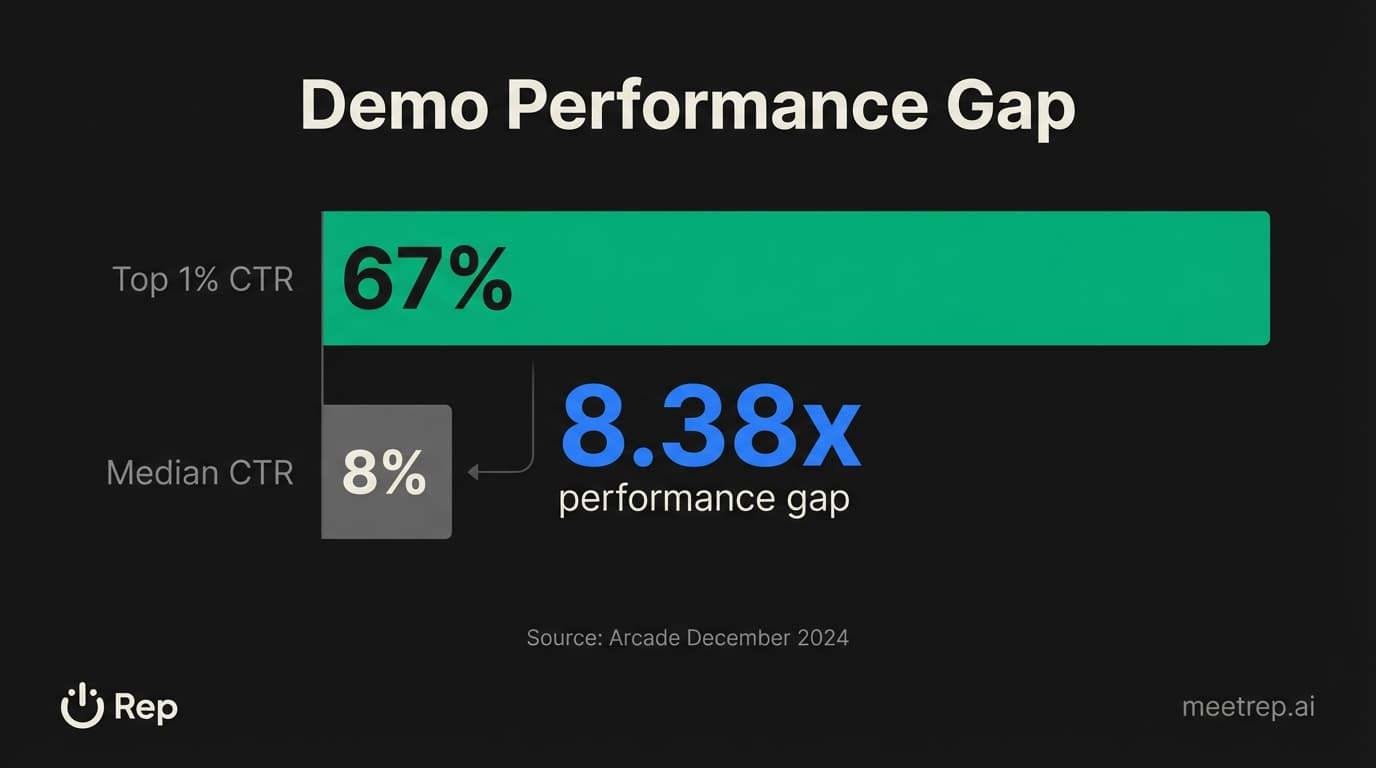
Interactive and autonomous demos dramatically impact conversion rates and sales velocity—when done well. The performance gap between top-performing demos and average ones is enormous, suggesting most teams are underinvesting in demo quality.
Let me share the numbers that actually matter.
Navattic's 2025 State of Interactive Product Demo report found that prospects viewing interactive demos are 6x more likely to convert compared to those who don't. But the impact goes beyond conversion. Prospects who view demos progress to sales calls 2 weeks faster and generate 3x higher demo-to-opportunity conversion rates when accessing demos through organized demo centers versus isolated pages.
But here's what really caught my attention: Arcade's December 2024 analysis showed that top 1% performing demos achieve 67% click-through rates versus 8% median. That's an 8.38x performance gap between the best and the average.
Most teams are leaving massive conversion improvements on the table. Not because demos don't work—they clearly do—but because most demos aren't very good.
| Metric | Result | Source |
|---|---|---|
| Conversion lift from interactive demos | 6x more likely to convert | Navattic 2025 |
| Sales cycle acceleration | 2 weeks faster to calls | Navattic 2025 |
| Demo-to-opportunity (demo centers vs. isolated) | 3x higher | Navattic 2025 |
| Top 1% CTR vs. median | 67% vs. 8% (8.38x gap) | Arcade Dec 2024 |
| AI agent revenue influence (Cyber Week 2025) | $67 billion, 20% of orders | Salesforce Dec 2025 |
| Sales growth with AI agents vs. without | 32% faster | Salesforce Dec 2025 |
The Salesforce data is particularly striking for e-commerce leaders. During Cyber Week 2025, retailers using branded AI agents grew 32% faster than peers without them. That's not a marginal improvement. That's competitive separation.
The Hybrid Model: Why "Rep-Free" Doesn't Mean "Human-Free"
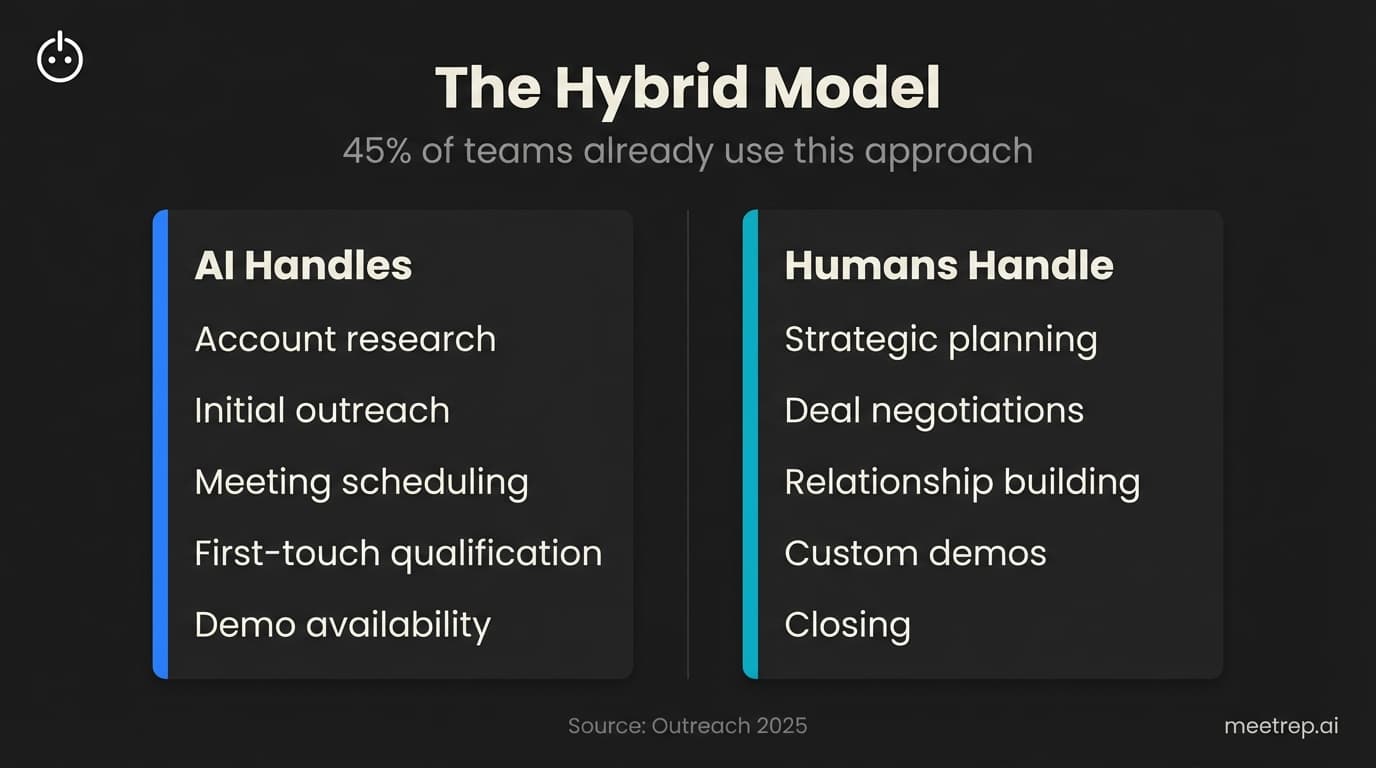
The most effective demo strategy combines autonomous AI for scale with human expertise for complex moments. Data shows that while 61% prefer rep-free experiences, deals completed with digital tools plus human reps are 1.8x more likely to be high-quality.
This seems contradictory. Stay with me.
The Gartner 2024 research showing 1.8x higher deal quality with hybrid approaches (digital tools + human rep) doesn't contradict the 61% rep-free preference. It explains it.
Buyers don't want humans gone. They want humans deployed at the right moments.
What we learned building Rep: When we designed Rep's architecture, we deliberately built it for handoff, not replacement. The AI handles initial demos and answers product questions. But for complex negotiations, custom pricing discussions, or executive alignment—that's when humans add irreplaceable value.
The math works out like this:
- Discovery phase: 83% of buyers want this to be self-service (G2 March 2024)
- Evaluation phase: Autonomous demos available 24/7 let stakeholders explore on their schedule
- Decision phase: Human expertise for negotiation, customization, relationship building
This is why the 36% SDR reduction stat doesn't mean sales teams are shrinking overall. It means the mix is changing. Fewer people doing repetitive first-touch demos. More people doing strategic closing work.
How to Evaluate Autonomous Demo Solutions for E-commerce
Evaluating autonomous demo technology requires assessing AI capability, integration depth, training flexibility, and fit with your existing sales process. The wrong choice creates more problems than it solves—Gartner predicts 40% of Agentic AI implementations will fail by 2027 due to architecture mismatches.
I'll be direct about what to look for. My recommendation is to evaluate across these five dimensions:
1. Live navigation vs. captured screenshots
Can the tool actually navigate your product in real-time? Or is it stitching together pre-recorded clips? For e-commerce platforms with dynamic inventories, pricing rules, and configuration options, live navigation matters. Ask for a demo of their demo tool and watch whether it's controlling a real browser or playing back recordings.
2. Voice and conversation capability
Does the AI just show things, or can it discuss them? Prospects ask "what if" questions. They want to understand edge cases. A tool that can only execute a predefined script won't handle the "but what about our specific situation" questions that dominate e-commerce platform evaluations.
3. Integration with your stack
How does it connect to your CRM? Can it sync sessions and insights to Salesforce or HubSpot? Demo tools that create data silos become adoption blockers.
4. Training approach
How do you teach it your product? Some tools require extensive manual configuration. Others offer "watch and learn" modes that can generate playbooks from observing a single human-led demo session. The faster your team can get from "we bought this" to "it's handling demos," the faster you see ROI.
5. Hallucination prevention
This is critical and often overlooked. What stops the AI from making up features or capabilities? Ask specifically how the tool constrains responses to verified knowledge. AI that confidently states wrong information about your e-commerce platform will damage deals and brand trust.
Common mistake: Evaluating demo tools based on the demo tool vendor's own demo. Of course their AI gives great demos about their product. The question is whether it can give great demos about your product, with your complexity, for your buyers.
Real Results: What Companies Are Seeing with Autonomous Demos
B2B SaaS companies and e-commerce retailers are reporting substantial results from demo automation and AI agents, though most published case studies are from vendors rather than independent research.
I want to be careful here. Most available case studies come from demo tool vendors (including competitors and ourselves). I'll share what's been published, but you should weight vendor case studies appropriately.
Why this matters: In my experience, the vendor case study caveat is something most content in this space glosses over. The numbers are real, but they're cherry-picked success stories. Your mileage will vary based on implementation quality, product complexity, and team adoption.
B2B SaaS platform case studies:
Klue, a competitive intelligence platform, reported $1M in new pipeline and $100K in closed-won revenue after implementing Navattic's demo hub, with 3x demo-to-opportunity conversion rates and 52% completion rates.
Wrike, the work management platform, reported a 65% increase in paid conversions, 2,100+ hours saved annually, and 35% reduction in live demo volume after implementing Consensus and Arcade.
Searchlight, an AI hiring platform, attributed over $3M in new business pipeline to interactive demos—33% of their total pipeline—with completion rates above 60%.
E-commerce/retail AI agent results:
NutraBio, a supplements retailer, reported 11.46% sales increase and 10% higher average order value after implementing Rep's behavioral AI agent.
THEY New York, a sustainable footwear brand, reported 3.2x conversion rate increase and 14x ROI from proactive behavioral engagement.
K2, an automotive parts retailer, reported 10x higher conversion rates in chat sessions and 80% reduction in support tickets.
The pattern across all these: demo automation works when it removes friction without removing capability. The moment it feels like a downgrade from talking to a real person, you've lost the value.
The shift toward autonomous ecommerce demos isn't about technology preference. It's about math.
When 94% of buyers have formed opinions before talking to you, when 86% of deals stall from friction, and when competitors using AI agents are growing 32% faster—the question isn't whether to adopt autonomous demos. It's how fast you can get there.
At Rep, we built our platform around a specific belief: the best demo is one that combines AI scale with human capability. The AI handles availability, consistency, and initial qualification. Your team handles the moments that actually require human judgment.
If you want to see how autonomous demos work in practice—where an AI agent actually joins a call, shares its screen, and navigates a live product while answering questions—you can try Rep yourself. No scheduling required. Which, if you've read this far, you probably appreciate.

Nadeem Azam
Founder
Software engineer & architect with 10+ years experience. Previously founded GoCustomer.ai.
Nadeem Azam is the Founder of Rep (meetrep.ai), building AI agents that give live product demos 24/7 for B2B sales teams. He writes about AI, sales automation, and the future of product demos.
Frequently Asked Questions
Table of Contents
- What Is an E-commerce Demo (And Why Most Are Broken)?
- The Rise of Autonomous Demos: From Click-Throughs to AI Agents
- Why E-commerce Platforms Need a Different Demo Approach
- What the Data Actually Shows About Demo Effectiveness
- The Hybrid Model: Why "Rep-Free" Doesn't Mean "Human-Free"
- How to Evaluate Autonomous Demo Solutions for E-commerce
- Real Results: What Companies Are Seeing with Autonomous Demos
Ready to automate your demos?
Join the Rep Council and be among the first to experience AI-powered demos.
Get Early AccessRelated Articles
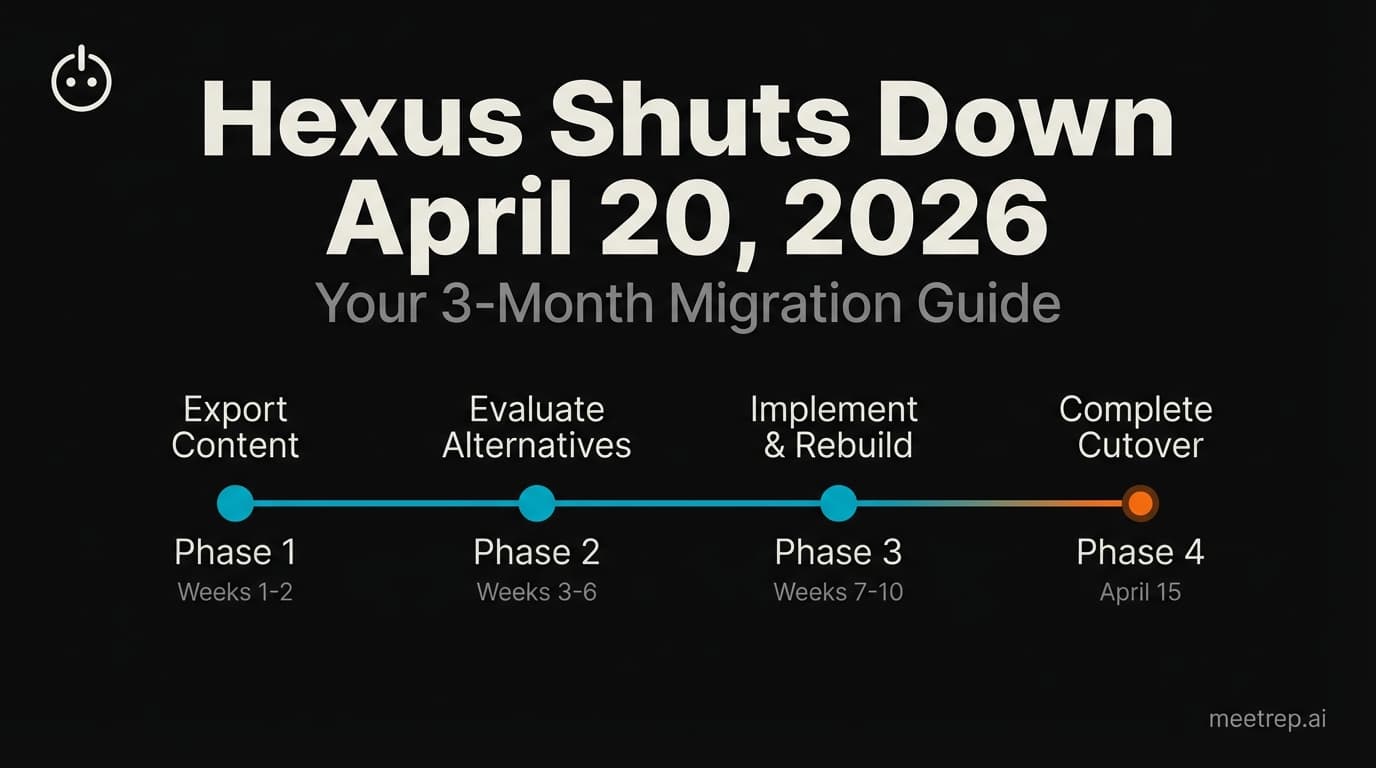
Hexus Acquired by Harvey AI: Congrats & What It Means for Demo Automation Teams
Hexus is shutting down following its acquisition by Harvey AI. Learn how to manage your migration and discover the best demo automation alternatives before April 2026.
Why the "Software Demo" is Broken—and Why AI Agents Are the Future
The traditional software demo is dead. Discover why 94% of B2B buyers rank vendors before calling sales and how AI agents are replacing manual demos to scale revenue.
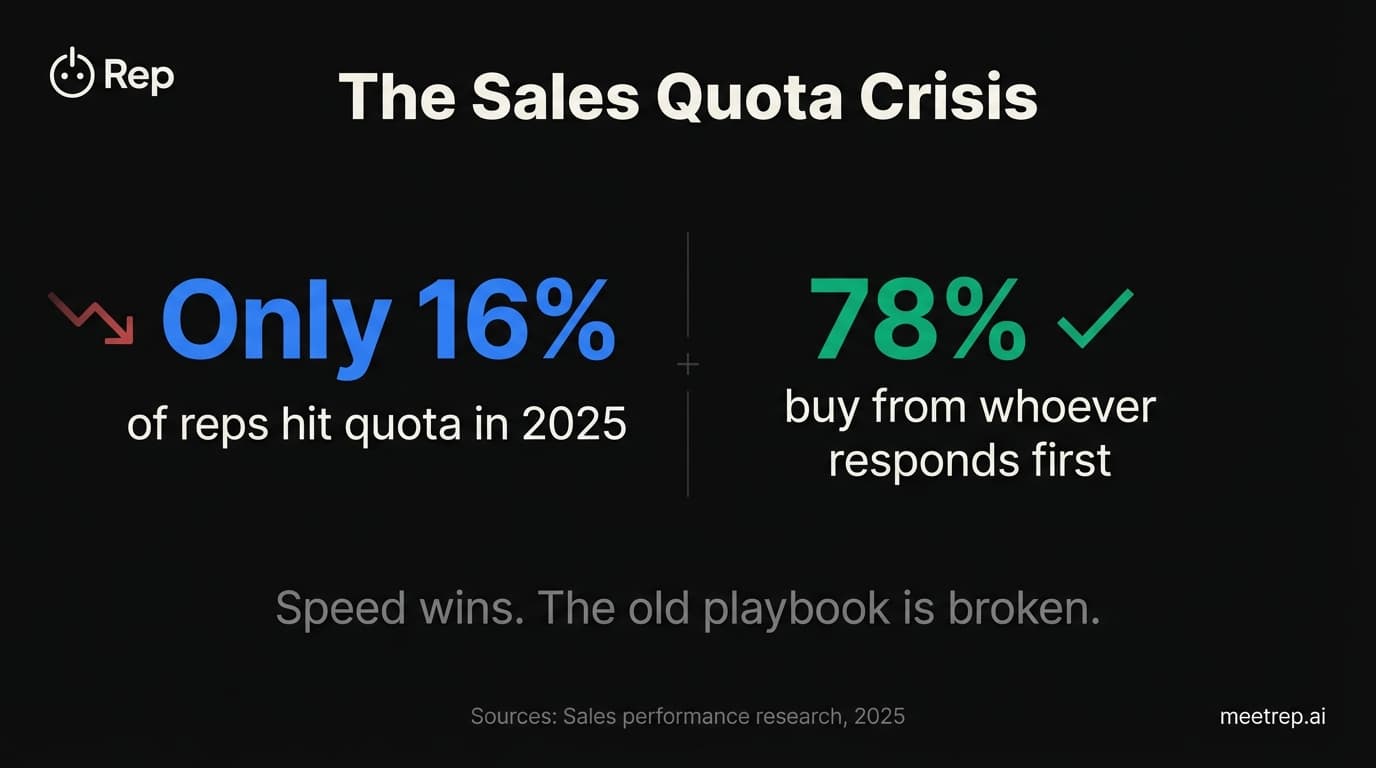
Why Autonomous Sales Software is the Future of B2B Sales (And Why the Old Playbook is Dead)
B2B sales is at a breaking point with quota attainment at 46%. Discover why autonomous 'Agentic AI' is the new standard for driving revenue and meeting the demand for rep-free buying.