Demo to Lead Conversion: How to Turn More Demos Into Qualified Pipeline

Executive Summary
- The B2B average demo-to-close rate is 25%. SaaS hits 30%, SMB 32%, Enterprise just 18%
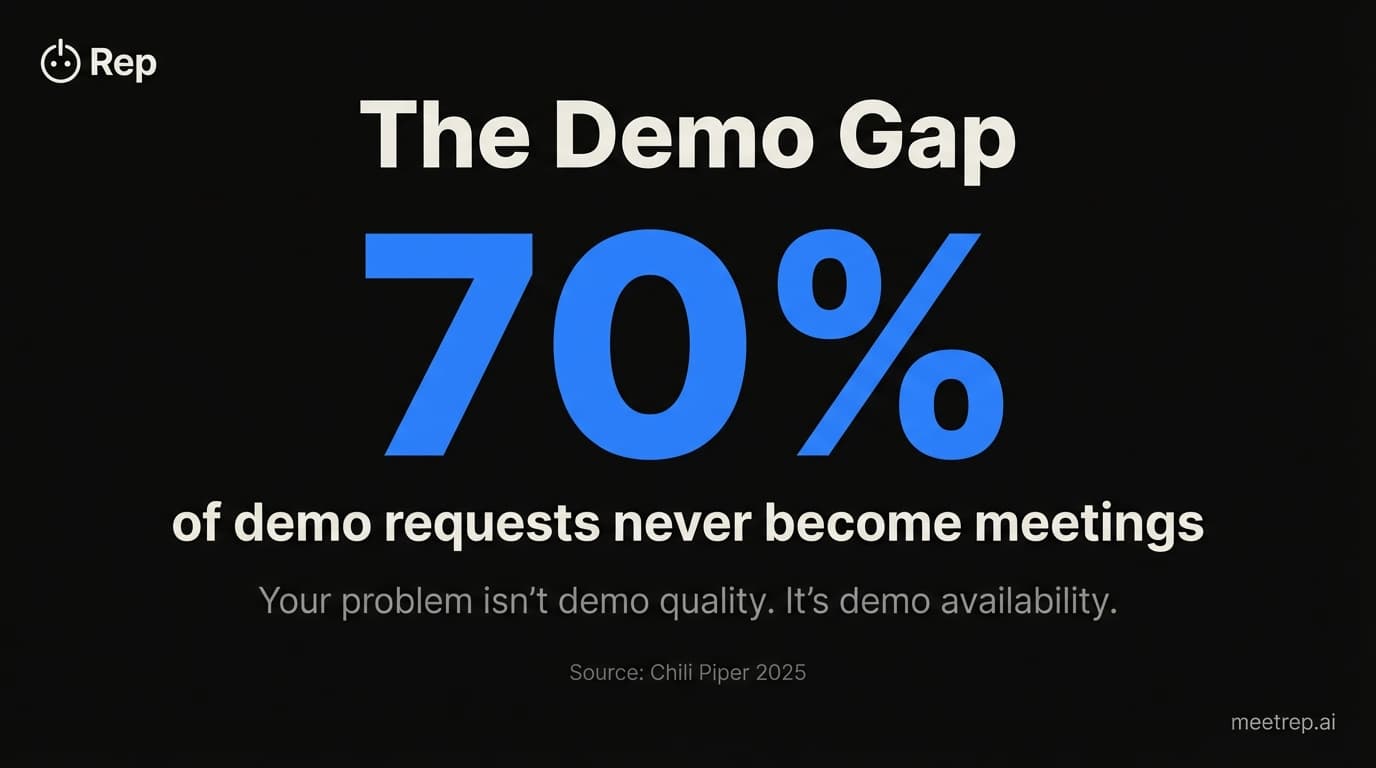
- 70% of demo requests never become meetings without automation—that's your real problem
- Same-day scheduling doubles conversion from ~30% to 66.7%
- 41% of meetings get booked after hours, when your team isn't available
- Speed beats polish. Responding within 5 minutes makes you 21x more likely to qualify the lead
Your team ran 100 demo requests last month. How many became qualified pipeline?
If you're like most B2B companies, the answer is uncomfortable. And it's not because your demos are bad. It's because 70% of those requests never even became meetings. They died in scheduling limbo—lost to slow response times, timezone gaps, and the black hole between form submission and calendar invite.
I've seen this pattern destroy pipeline at company after company. When we built sales automation tools at GoCustomer.ai, we learned that demo quality matters far less than most teams think. What actually kills your demo to lead conversion? Availability. Speed. The gap between "I want to see this" and "let me show you."
Here's what the data actually says about fixing it.
What Demo to Lead Conversion Actually Means (And Why Most Teams Measure It Wrong)
Demo to lead conversion measures the percentage of product demonstrations that successfully convert into qualified sales opportunities or closed deals. In practical terms, it's the ratio that tells you how effectively your team turns product interest into real pipeline—and ultimately, into revenue. The 2026 B2B average sits at 25% demo-to-close, though this varies significantly by segment.
But here's the problem: that definition hides three completely different metrics that teams constantly confuse.
The first is form-to-meeting rate—what percentage of demo requests actually result in a scheduled meeting. This is where 70% of most companies' pipeline disappears, according to Chili Piper's 2025 analysis of 4 million form submissions.
The second is demo-to-opportunity rate—what percentage of completed demos turn into qualified pipeline. RevenueHero's benchmarks put healthy rates at 60-70%, great at 70-80%, and elite at 90%+.
The third is demo-to-close rate—what percentage of demos eventually become closed-won revenue. This is the number most often cited, and the one with the clearest benchmarks.
| Metric | What It Measures | Healthy Range |
|---|---|---|
| Form-to-Meeting | Demo requests → Scheduled meetings | 50-66% with automation |
| Demo-to-Opportunity | Completed demos → Qualified pipeline | 60-80% |
| Demo-to-Close | Completed demos → Closed-won deals | 25-35% (varies by segment) |
When someone asks "what's your demo conversion rate?" without specifying which metric, you're already in trouble. I've watched teams celebrate a 40% "demo conversion rate" that was actually demo-to-opportunity, while their form-to-meeting rate sat at 28%.
Key Insight: Before optimizing demo conversion, define which metric you're tracking. Form-to-meeting is usually the biggest leak—and the easiest to fix.
The 2026 Benchmarks: Where Does Your Team Actually Stand?
Based on Optifai's 2025 benchmark study of 939 B2B companies, the average demo-to-close rate is 25%. But that average hides massive variation by segment and deal size.
| Segment | Demo-to-Close Rate | Why |
|---|---|---|
| SMB | 32% | Faster decisions, fewer stakeholders |
| Mid-Market | 25% | Balanced complexity |
| SaaS Average | 30% | Tech buyers move faster |
| Enterprise | 18% | Complex buying committees |
That Enterprise number surprised me when I first saw it. We assume enterprise sales teams—with their dedicated SEs, polished demos, and longer sales cycles—would convert better. They don't.
But here's what's actually happening. Enterprise deals involve more stakeholders, longer evaluation periods, and more opportunities for the deal to stall. Forrester's 2024 research (11,352 purchase influencers surveyed) found that 86% of B2B purchases stall during the buying process.
The demo isn't the problem. Everything that happens after it is.
The Data: According to Optifai's analysis of 939 B2B companies, interactive demos convert at 38% versus just 18% for generic screen shares—a 111% improvement.
The "Demo Gap": Where 70% of Your Pipeline Disappears
I call it the Demo Gap. It's the space between when a prospect requests a demo and when they actually see your product. And it's where most of your pipeline goes to die.
Chili Piper's 2025 data puts the number at roughly 70% of demo requests never resulting in a meeting without automation. Seventy percent. That's not a leak. That's a flood.
So what's killing those requests?
Response time.GreetNow's industry data shows that responding within 5 minutes makes you 21x more likely to qualify versus waiting 30 minutes. Every hour you wait, conversion drops.
Scheduling friction. Back-and-forth emails to find a time. Prospects getting distracted. Calendars that don't sync. The excitement that drove them to click "request demo" fades fast.
Timezone gaps. This one's underrated. RevenueHero's platform data shows 41% of meetings get booked after business hours. If your team isn't available at 10pm when a prospect in Singapore is ready to buy, someone else's team will be.
What we learned at GoCustomer: Speed beats polish. We spent months refining our demo flow when we should have focused on demo availability. The teams that win aren't running better demos—they're running more demos, faster.
The No-Show Problem (And Why Same-Day Demos Fix It)
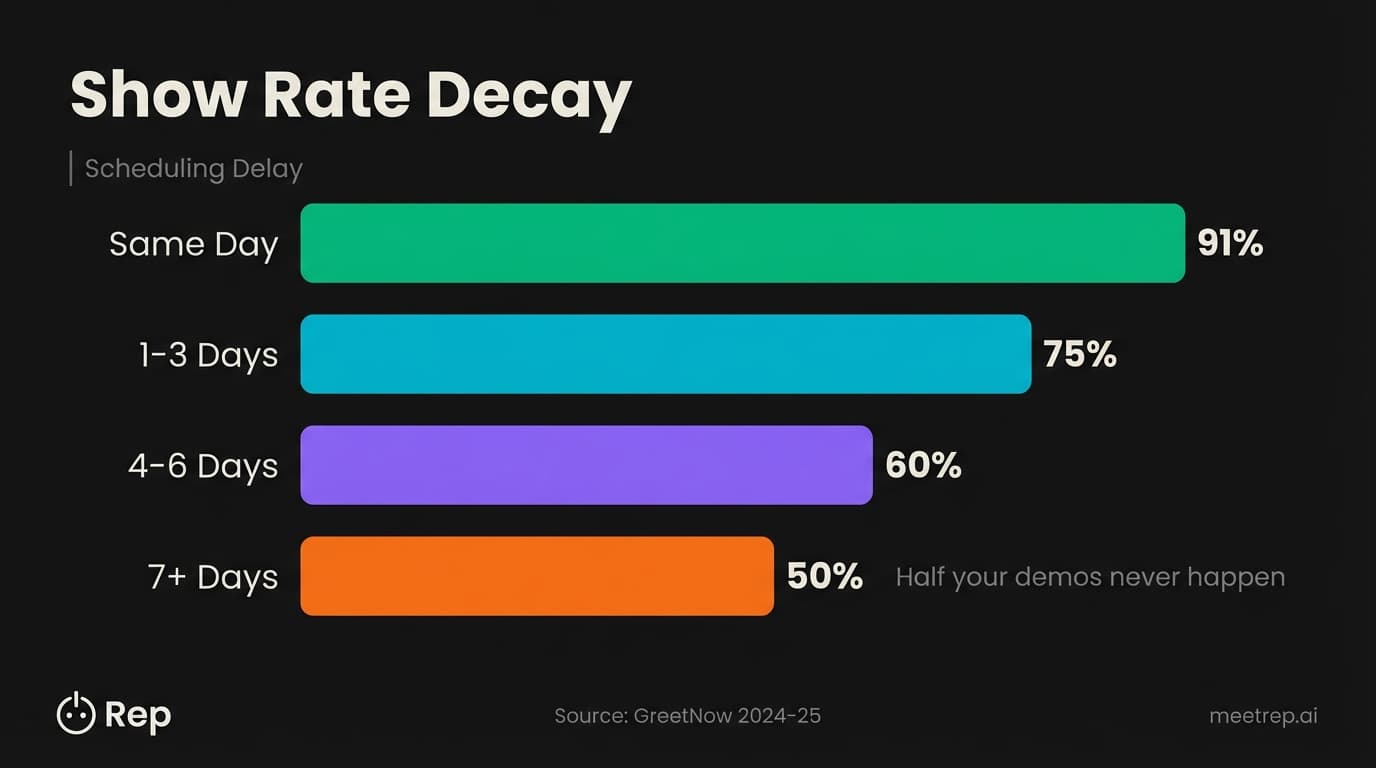
Here's a pattern I've seen kill countless deals: prospect requests demo on Monday, earliest available slot is Thursday, prospect ghosts.
The data backs this up. According to GreetNow's analysis, show rates drop to 45-55% if the demo is scheduled 7+ days out. Same-day demos? 88-94% show rates.
| Scheduling Delay | Show Rate |
|---|---|
| Same day | 88-94% |
| 1-3 days | 70-80% |
| 4-6 days | 55-65% |
| 7+ days | 45-55% |
RevenueHero's December 2024 benchmark across 6,428 meetings found an overall 6.5% no-show rate—but that's heavily influenced by teams with strong instant-scheduling practices. The variance is huge. Healthcare hit 0% no-shows. Education struggled at 18.1%.
Every no-show costs real money. When an AE blocks 30 minutes for a demo that doesn't happen, that's time they could have spent closing a deal that actually showed up. Multiply that across your team, across a month. The no-show tax adds up fast.
Common mistake: Teams invest in demo quality (better slides, better talk tracks, better product environments) while ignoring demo availability. A mediocre demo that happens immediately beats a polished demo that happens in a week—because the polished demo probably won't happen at all.
Why 80% of Your Revenue Requires 5+ Touches (And 48% of Reps Give Up After Zero)
Demos rarely close on their own. The first demo is the beginning of a conversation, not the end of one.
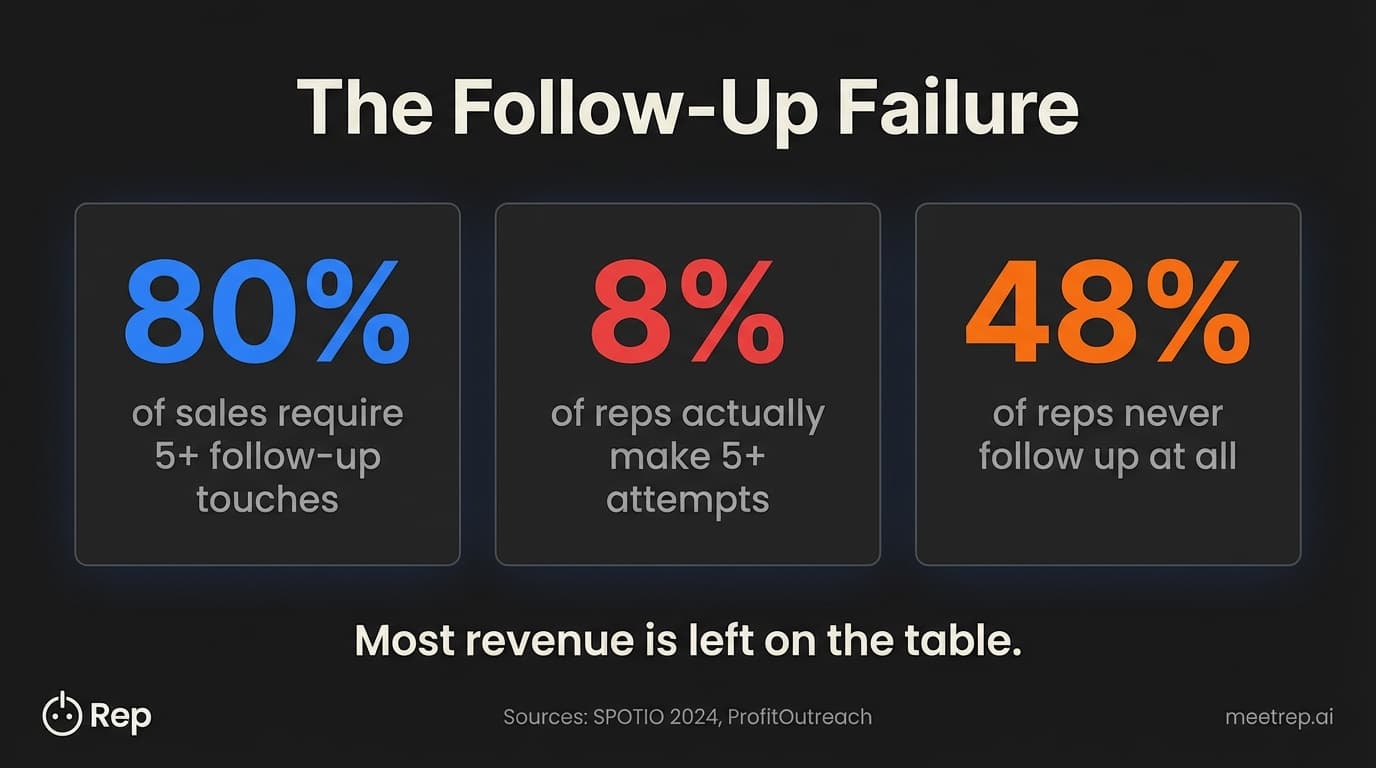
SPOTIO's 2024 analysis found that 80% of sales require 5+ follow-up touches. But here's the gut-punch: only 8% of reps actually make 5+ attempts.
It gets worse. According to ProfitOutreach's compilation, 48% of sales reps never make a follow-up attempt at all.
This is the demo-to-pipeline killer that nobody wants to talk about. Your demo could be perfect. Your product could be exactly what the prospect needs. But if nobody follows up, it dies anyway.
The math is brutal:
- 80% of revenue needs 5+ touches
- 48% of reps make zero follow-up attempts
- Only 8% hit the 5+ threshold
You're leaving most of your revenue on the table.
My view on this: Follow-up failure is why demo automation matters beyond just the demo itself. Tools like Gong and Chorus capture conversation context. AI can surface action items automatically. The follow-up can start before the AE even leaves the call. At Rep, we've focused on automatic extraction of pain points, questions, and next steps—because reps are terrible at documentation when they're exhausted from back-to-back demos.
How to Actually Improve Your Demo Conversion Rate (Framework)
Enough problems. Here's what works, based on the data and what I've seen implementing demo automation at GoCustomer and now Rep.
1. Enable same-day scheduling. This single change can double your form-to-meeting rate. Chili Piper's data shows 66.7% conversion with instant scheduling versus ~30% without. Tools like Chili Piper, RevenueHero, or Calendly make this straightforward.
2. Deploy interactive demos for self-serve discovery. Interactive demos convert at 38% versus 18% for generic screen shares, according to Optifai's research. Platforms like Navattic, Walnut, and Storylane let prospects explore before (or instead of) scheduling live time.
3. Cover after-hours windows. 41% of meetings book outside business hours. If you only offer demos during US working hours, you're invisible to a huge chunk of interested buyers. Autonomous demo tools—like what we're building at Rep—can run live demos 24/7 by joining video calls, sharing screens, and walking prospects through your actual product in real-time.
4. Respond within 5 minutes. The 21x qualification improvement isn't a typo. Set up instant alerts. Route high-intent requests to available reps immediately. If nobody's available, automation should take over.
5. Build follow-up into your system. Don't rely on rep discipline. Automate action item capture. Set up mandatory follow-up sequences. Use conversation intelligence to identify deals at risk of stalling.
6. Ungate your demos.Navattic's 2025 State of Demo report (28,000 demos analyzed) found that 71% of top-performing demos are ungated, with 10% higher engagement. Let people see your product before you demand their contact info.
| Tactic | Impact | Source |
|---|---|---|
| Same-day scheduling | 2x form-to-meeting | Chili Piper 2025 |
| Interactive demos | +111% conversion | Optifai 2025 |
| <5 minute response | 21x qualification | GreetNow 2024-25 |
| Ungated demos | +10% engagement | Navattic 2025 |
| 24/7 availability | Capture 41% after-hours | RevenueHero 2024-25 |
Real Results: What Actual Companies Have Achieved
Theory is nice. Results are better.
Wrike (project management, enterprise) deployed demo automation through Consensus and saved 2,100 FTE hours annually while reducing live demos by 35%. Their solution consultants could finally focus on high-value deals instead of repetitive walkthroughs.
Flagsmith (developer tools) used interactive demos through HowdyGo and saw a 1.7x increase in app signups with a 90%+ demo completion rate. For technical buyers, instant access beat scheduled calls.
CommandBar (user assistance platform) implemented SEO-optimized interactive demos and achieved 340% growth in organic leads along with 200% sales growth.
Hunters (cybersecurity) used Demostack sandbox environments and cut their sales cycle from 9 months to 4 months—a 50% reduction.
These aren't small improvements. And they didn't come from making demos prettier. They came from making demos faster, more accessible, and more automated.
Key Insight: The companies winning at demo conversion aren't obsessing over demo quality. They're obsessing over demo availability and speed. Quality matters—but only after you solve the access problem.
The demo to lead conversion problem isn't about running better demos. It's about running more demos, faster, with persistent follow-up. The 70% demo request leakage is fixable. Same-day scheduling doubles conversion. After-hours coverage captures the 41% of prospects who aren't on your timezone.
At Rep, we built autonomous demo agents specifically because we saw this gap kill too many deals at GoCustomer. Your best AE can only run so many demos per day. An AI agent that joins calls, shares its screen, and walks prospects through your product? That runs 24/7.
And if that seems aggressive—good. The teams hitting 32%+ demo-to-close aren't playing it safe. They're closing the gap before competitors even respond.
See how Rep handles live demos autonomously at meetrep.ai.

Nadeem Azam
Founder
Software engineer & architect with 10+ years experience. Previously founded GoCustomer.ai.
Nadeem Azam is the Founder of Rep (meetrep.ai), building AI agents that give live product demos 24/7 for B2B sales teams. He writes about AI, sales automation, and the future of product demos.
Frequently Asked Questions
Table of Contents
- What Demo to Lead Conversion Actually Means (And Why Most Teams Measure It Wrong)
- The 2026 Benchmarks: Where Does Your Team Actually Stand?
- The "Demo Gap": Where 70% of Your Pipeline Disappears
- The No-Show Problem (And Why Same-Day Demos Fix It)
- Why 80% of Your Revenue Requires 5+ Touches (And 48% of Reps Give Up After Zero)
- How to Actually Improve Your Demo Conversion Rate (Framework)
- Real Results: What Actual Companies Have Achieved
Ready to automate your demos?
Join the Rep Council and be among the first to experience AI-powered demos.
Get Early AccessRelated Articles
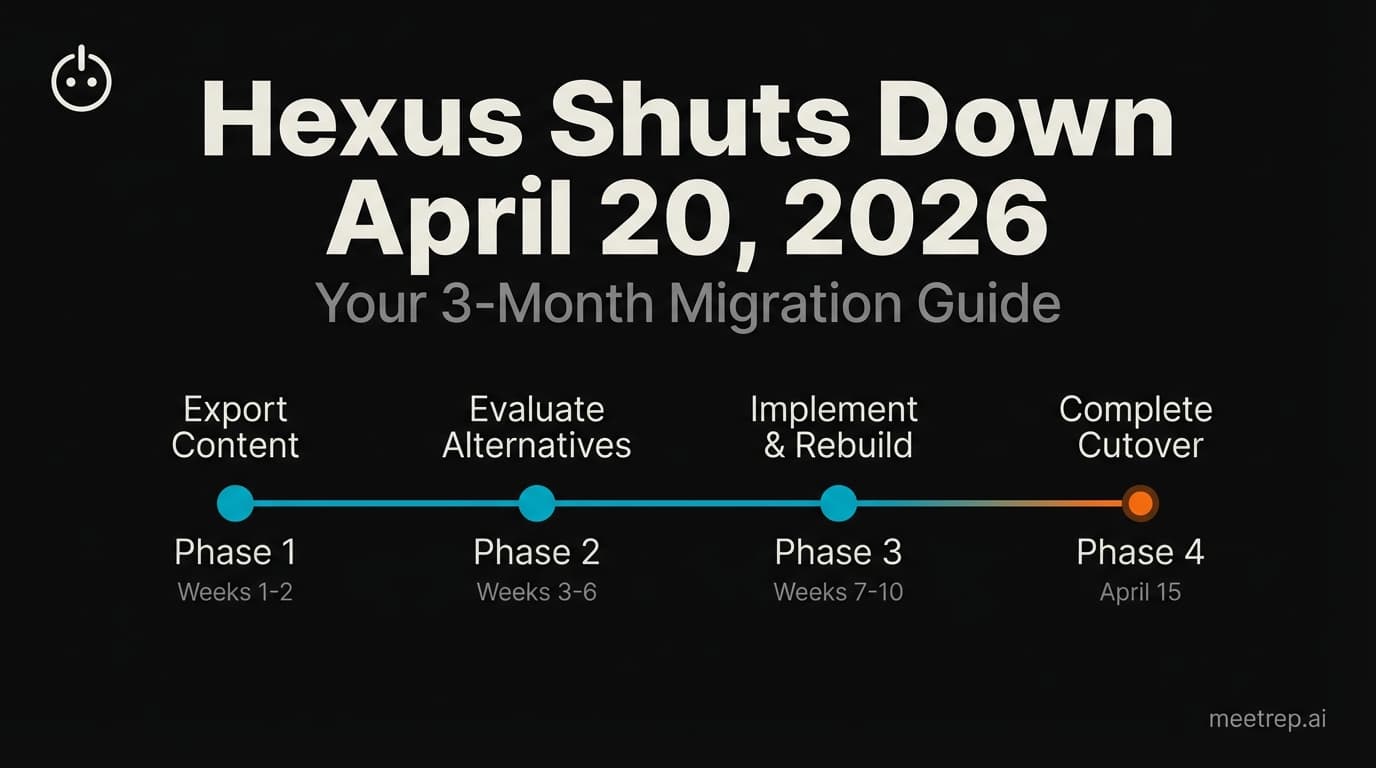
Hexus Acquired by Harvey AI: Congrats & What It Means for Demo Automation Teams
Hexus is shutting down following its acquisition by Harvey AI. Learn how to manage your migration and discover the best demo automation alternatives before April 2026.
Why the "Software Demo" is Broken—and Why AI Agents Are the Future
The traditional software demo is dead. Discover why 94% of B2B buyers rank vendors before calling sales and how AI agents are replacing manual demos to scale revenue.
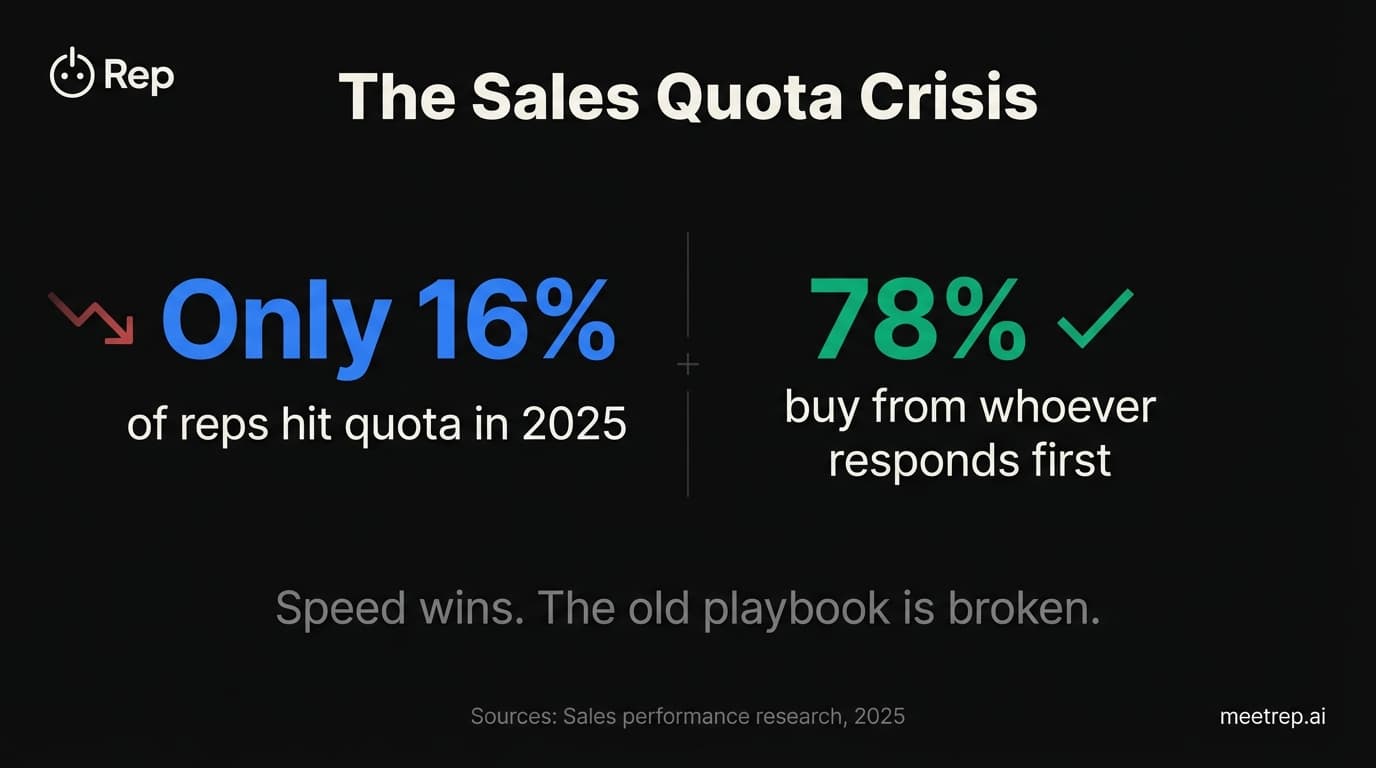
Why Autonomous Sales Software is the Future of B2B Sales (And Why the Old Playbook is Dead)
B2B sales is at a breaking point with quota attainment at 46%. Discover why autonomous 'Agentic AI' is the new standard for driving revenue and meeting the demand for rep-free buying.