Demo-to-Close Rates by Industry: 2026 Benchmarks That Actually Matter

Executive Summary
- The B2B demo-to-close average is 25%—meaning 75% of demos fail to close within 90 days (Optifai 2025, N=939 companies)
- Rates vary wildly: SaaS (30%), SMB (32%), sub-$10K deals (35%) vs Enterprise (18%), $100K+ deals (15%)
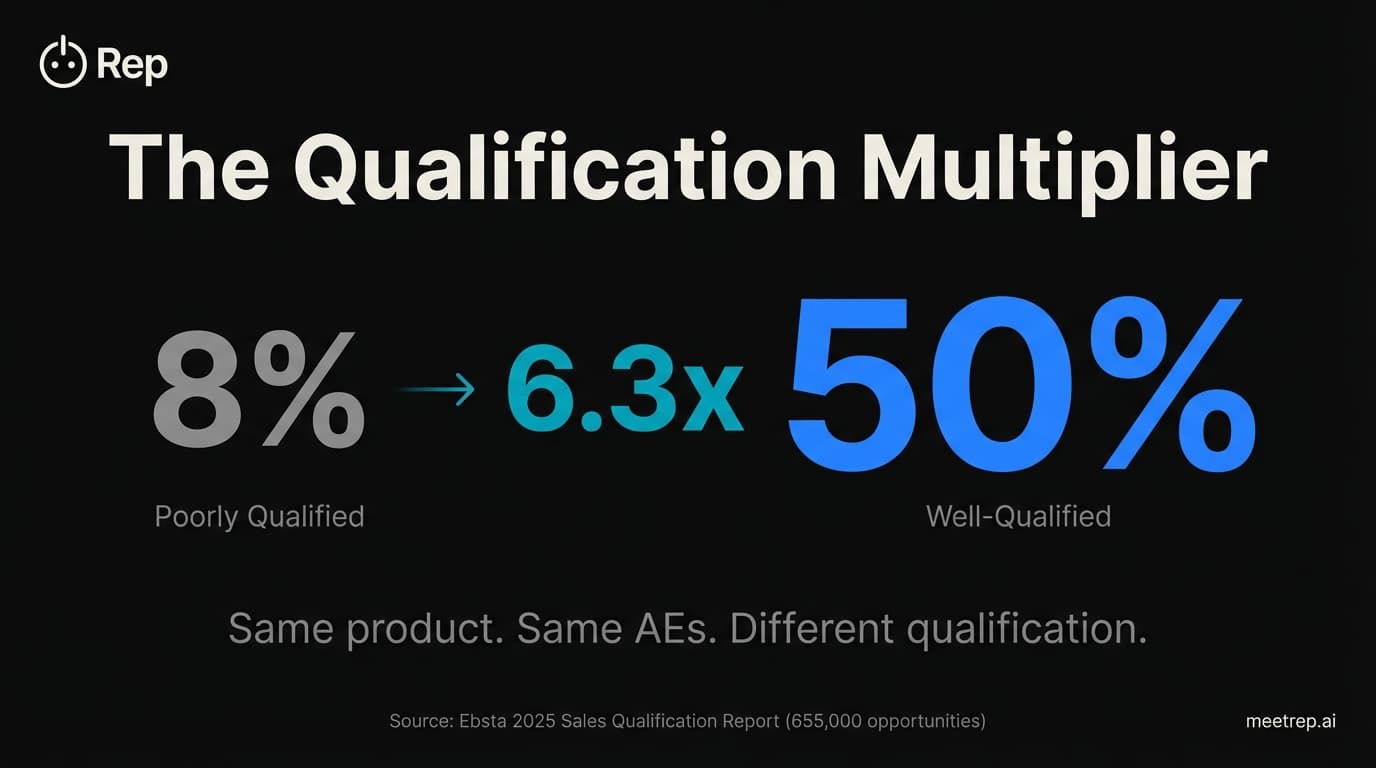
- The 6.3x qualification multiplier: well-qualified deals close at 50%, poorly qualified at just 8%
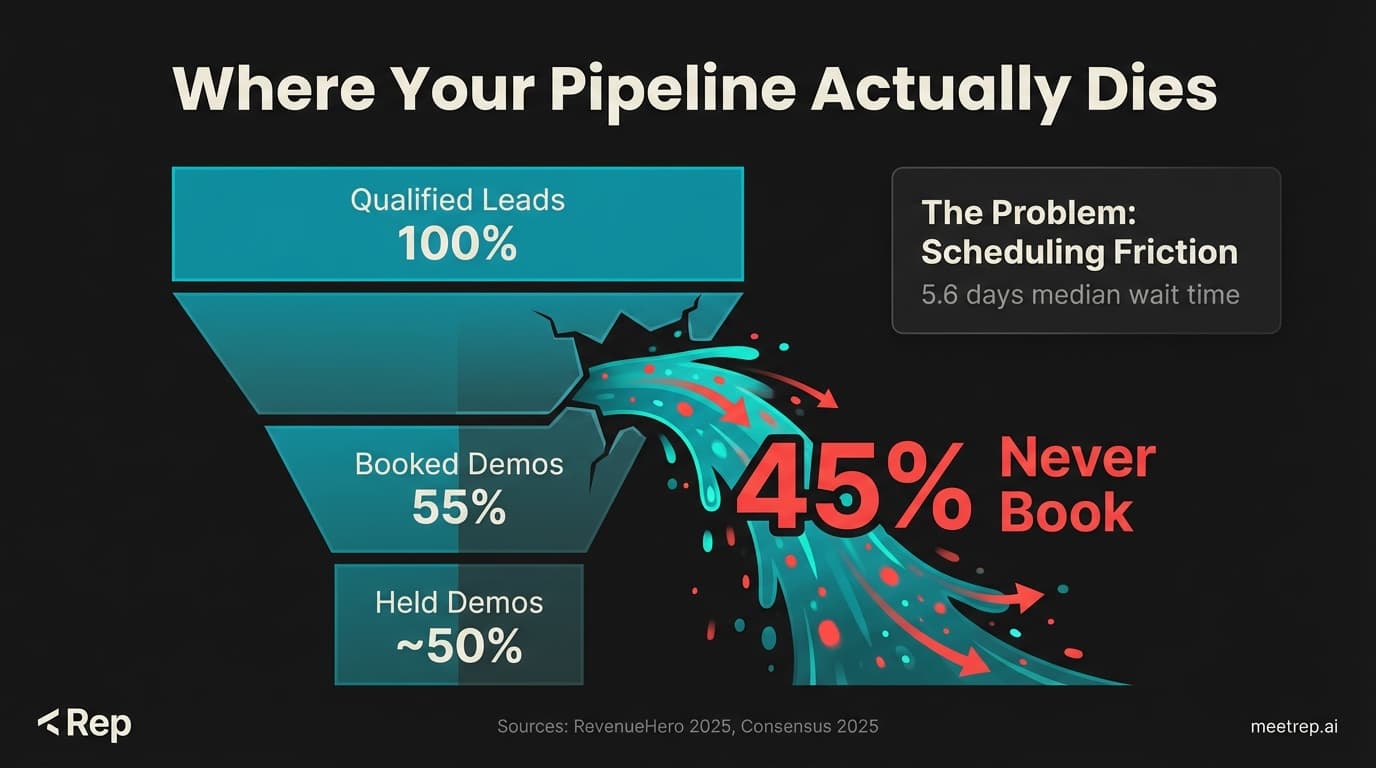
- 45% of qualified leads vanish before demos even happen—scheduling friction kills more deals than bad demos
Three out of four demos fail. That's not pessimism. That's the math.
When I look at demo conversion benchmarks across nearly a thousand B2B companies, the baseline is clear: 25% of product demos result in closed deals within 90 days. The other 75%? Wasted calendars, burned rep hours, and pipeline that evaporated somewhere between "great meeting" and ghosted.
But here's what most benchmark articles won't tell you: that 25% average is almost useless for your planning. SaaS companies see 30%. Manufacturing sits at 20%. Enterprise deals close at 18% while SMB hits 32%. Using a single number across all contexts is how forecasts miss by 40%.
I've spent years building sales automation tools—first at GoCustomer.ai, now at Rep. And I've learned that the demo itself is rarely the problem. The real issue is what happens before anyone shares their screen.
What is demo-to-close rate and why the 25% baseline matters
Demo-to-close rate measures the percentage of product demos that result in closed deals within a defined period, typically 90 days. It's the metric that isolates your AE's effectiveness—separate from lead generation, SDR qualification, and everything else in your funnel. The B2B average is 25%, according to Optifai's 2025 Sales Ops Benchmark analyzing 939 companies. For every four demos your team runs, one becomes revenue. The other three don't.
This metric is different from "lead-to-close," which includes everything from first touch to signed contract. Demo-to-close specifically measures: did the meeting convert?
The Data: According to Optifai's analysis of 939 B2B companies in Q1-Q3 2025, the overall demo-to-close rate is 25%. Their methodology used CRM data from Salesforce, HubSpot, and Pipedrive, combined with conversation intelligence from Gong and Chorus, with a 90-day conversion window.
Why does this matter for 2026 planning? Because 67% of sales reps don't expect to meet quota this year, and 84% missed last year (Salesforce State of Sales 2024). If your team is running demos at below-benchmark rates without knowing it, your forecast is fiction.
But don't panic if your number looks low. That 25% average hides enormous variation.
Demo conversion benchmarks by industry: not all demos are equal
Industry matters more than most teams realize. A 22% close rate might be failing in SaaS but crushing it in manufacturing.
Based on Optifai's 2025 benchmark data:
| Industry | Demo-to-Close Rate | What This Means |
|---|---|---|
| SaaS | 30% | 70% of demos fail to close |
| Consulting | 24% | 76% of demos fail to close |
| Professional Services | 22% | 78% of demos fail to close |
| Manufacturing | 20% | 80% of demos fail to close |
| B2B Average | 25% | 75% of demos fail to close |
Source: Optifai Sales Ops Benchmark 2025 (N=939 companies)
SaaS leads at 30%. That's partly product—software demos are contained, repeatable, and buyers can often see value in 30 minutes. Manufacturing at 20% reflects longer sales cycles, more stakeholders, and demos that often require customization.
There's variation within industries too. RevenueHero's 2025 data shows real estate software hitting 93.84% lead qualification rates while healthcare software languishes at 52.11%. Same "software" category. Completely different dynamics.
Honestly, I should mention: verified demo-to-close benchmarks for healthcare tech, fintech, and legal tech specifically don't exist in the 2024-2025 data I've found. If you're in those verticals, use the 20-25% range as a starting point, but track your own numbers religiously.
How deal size changes everything
Here's where the single benchmark really falls apart.
The relationship between deal size and demo success rate is almost perfectly inverse. Bigger deals, lower conversion. It's not that your enterprise AEs are worse. It's that $100K+ decisions involve more stakeholders, longer evaluations, and procurement processes that add months.
| Annual Contract Value | Demo-to-Close Rate | Typical Cycle | Demos to Close |
|---|---|---|---|
| Under $10K | 35% | 15-30 days | ~3 demos |
| $10K-$50K | 28% | 30-60 days | ~4 demos |
| $50K-$100K | 22% | 60-90 days | ~5 demos |
| $100K+ | 15% | 90-180 days | ~7 demos |
Source: Optifai Sales Ops Benchmark 2025; cycle data from ThriveStack 2025
This has real implications. If you're holding your enterprise team to SMB metrics, you're setting them up for failure. And if you're forecasting enterprise deals like they'll close in 30 days, you're lying to your board.
What we learned at GoCustomer: We used to track one blended conversion number. It was meaningless. Our SMB motion closed at 34%, and our enterprise motion closed at 16%. Same product. Same team. Completely different games. Once we segmented, our forecasting accuracy jumped almost overnight.
Company size shows the same pattern. SMB prospects (1-50 employees) convert at 32%. Enterprise (201+ employees) converts at 18%. That's a 14-point gap. Miss this distinction, and your pipeline model is garbage.
The 45% drop-off nobody talks about
Most teams obsess over the demo itself. Demo training. Demo scripts. Demo follow-up.
But the biggest leak isn't in the demo. It's before the demo.
According to RevenueHero's 2025 State of Demo Conversion, only 54.56% of qualified leads actually book a meeting. That means 45% of your qualified pipeline vanishes between "yes, I want a demo" and "actually showing up."
Forty-five percent.
Where do they go? Scheduling friction. The median wait time for demos is 5.6 days, with 38% of prospects waiting 6+ days, according to Consensus research. By then, they've either found a competitor or lost interest.
And it gets worse. Reply.io's analysis of 2,900 meetings found that demos scheduled 8+ days out have a 23% no-show rate. Same-day bookings? Just 6.9%.
| Funnel Stage | Conversion | Loss Rate | The Killer |
|---|---|---|---|
| Lead → Qualified | 60-70% | 30-40% fail qualification | Criteria issues |
| Qualified → Booked | 54-67% | 33-46% never book | Scheduling friction |
| Booked → Held | 77-93% | 7-23% no-show | Time lag |
| Held → Closed Won | 25% | 75% don't close | Demo quality + follow-up |
Sources: RevenueHero 2025; Reply.io 2024-2025; Optifai 2025
You're losing half your qualified pipeline before a rep even says hello. That's not a demo problem. That's a scheduling problem.
Key Insight: The best demo training in the world can't fix a prospect who never shows up. Speed to meeting is the highest-leverage improvement most teams can make—yet it gets almost no attention compared to demo skills.
The 6.3x qualification multiplier
If there's one number that changed how I think about demo metrics, it's this one.
Ebsta's 2025 Sales Qualification Report, analyzing 655,000 opportunities, found that well-qualified deals close at 50%. Poorly qualified deals close at 8%.
That's a 6.3x difference.
Read that again. Same product. Same AEs. Same demo. But qualification determines whether you're playing a 50% game or an 8% game.
Most teams accept the 8% rate without realizing it. They take every meeting. They demo for anyone who asks. And they wonder why conversion is low.
The Data: According to Ebsta's analysis of 655,000 opportunities, well-qualified deals are 6.3x more likely to close than poorly qualified ones (50% vs 8%). This is the single biggest lever in the entire demo-to-close equation.
What does "well-qualified" actually mean? The RAIN Group's 2024 research showed top performers achieve 72% win rates versus 47% for average sellers. The difference? Rigorous qualification using frameworks like MEDDIC, multi-stakeholder engagement (6.7+ contacts by discovery), and willingness to disqualify bad-fit opportunities early.
I know the pressure to fill pipeline. "Every meeting is an opportunity." But the math says otherwise. Better to run 10 demos at 50% than 50 demos at 8%.
Interactive vs traditional demos: the 111% gap
Demo format affects demo success rate more than most teams realize.
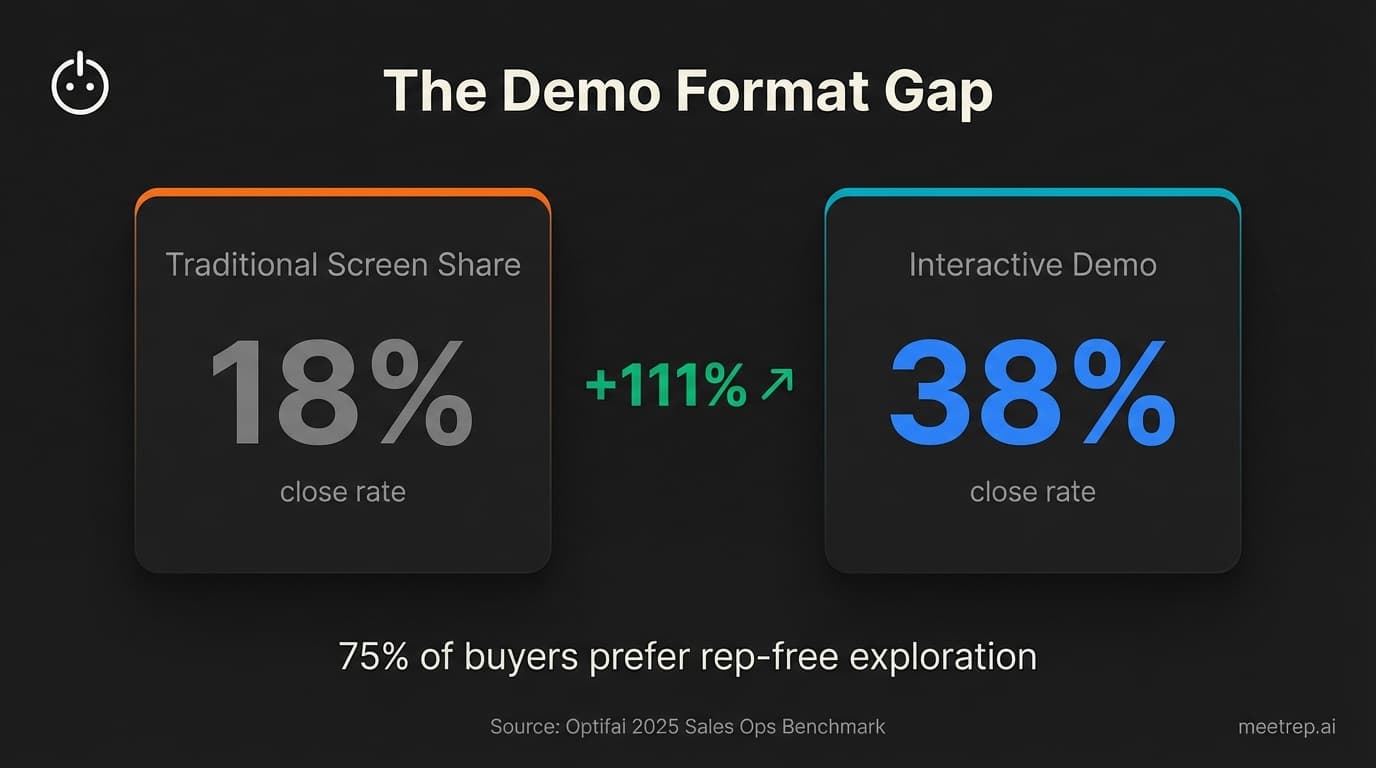
According to Optifai's benchmark, interactive demos achieve a 38% close rate. Generic screen shares hit just 18%. That's a 111% improvement.
Why? Three reasons.
First, buyers want control. Dock's 2025 research, drawing on Gartner and Salesforce data, found that 75% of buyers prefer sales experiences without reps. They spend only 17% of their purchase process interacting with sales at all. Interactive demos let them explore on their terms.
Second, engagement compounds. Navattic's 2025 data shows that top-performing interactive demos achieve 84.4% engagement rates and 54% CTA click-through. The average? 32% engagement. What gets attention gets remembered.
Third, interactive demos work when you're asleep. The 5.6-day scheduling lag disappears when prospects can explore your product at 2am. No calendar coordination. No time zones. No waiting.
My recommendation: If you're still running generic screen shares as your primary demo format, you're leaving money on the table. Interactive demos—whether self-guided product tours or AI-powered conversations—outperform traditional demos by a wide margin. The data is clear.
What top performers do differently
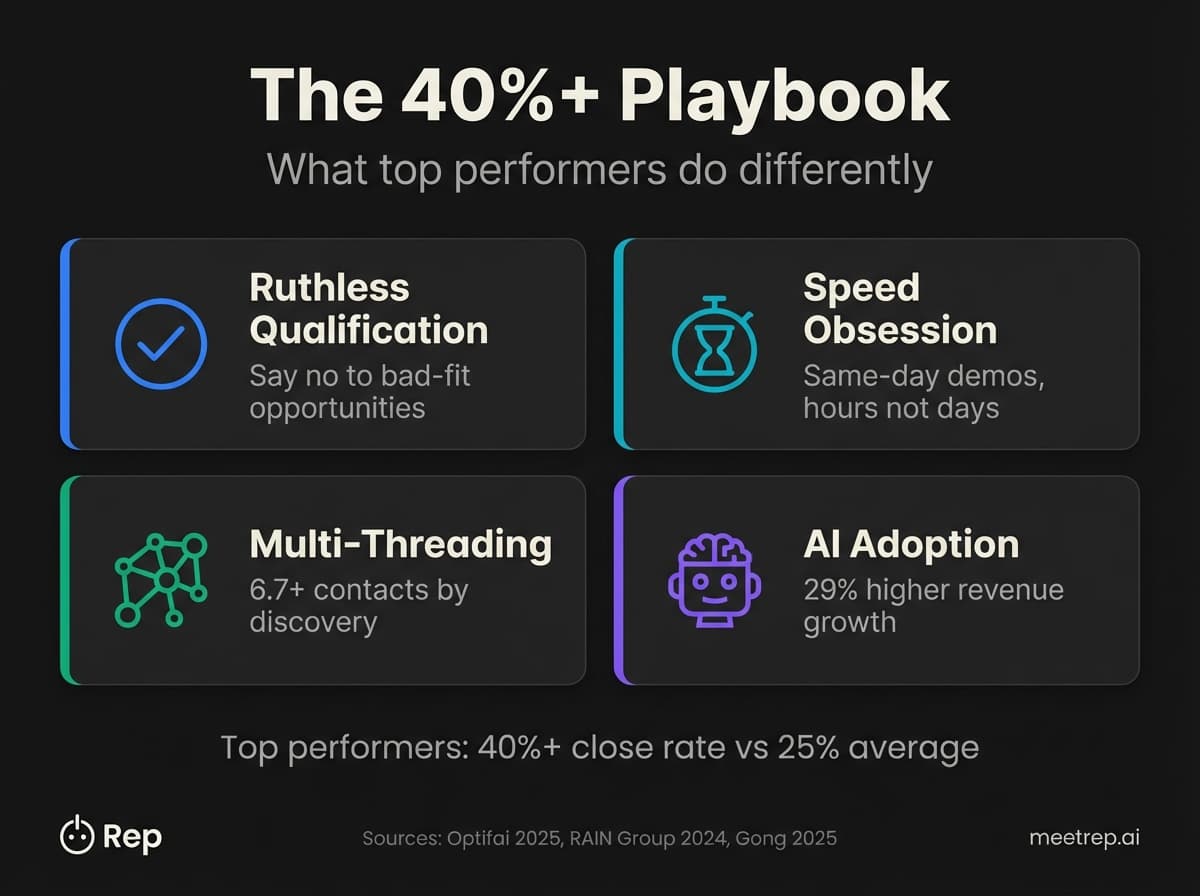
Top performers hit 40%+ demo-to-close rates, according to Optifai's data. That's 15 points above average. So what separates them?
It's not charisma. It's not better decks. It's process.
RAIN Group's 2024 research surveyed 488 buyers across 25 industries, representing $4.2 billion in purchases. Top performers closed 72% of proposed deals versus 47% for other sellers.
The patterns:
Ruthless qualification. They say no. A lot. They'd rather have 10 highly-qualified opportunities than 50 maybes. The 6.3x multiplier means this math works.
Speed obsession. They follow up in hours, not days. They offer same-day demos when possible. They know the 23% no-show rate for delayed meetings.
Multi-threading.Gong's research shows successful deals have 6.7+ contacts engaged by discovery. Top performers don't rely on a single champion who might leave or get overruled.
AI adoption. Companies using AI in their sales process see 29% higher revenue growth, according to Gong's State of Revenue 2025. That's not marginal. Top performers are using AI for qualification, follow-up, and yes—increasingly for demos themselves.
The common thread? They fix problems upstream. Better qualification. Faster scheduling. More stakeholders. They don't try to close bad opportunities harder. They stop accepting bad opportunities in the first place.
How to calculate and improve your demo-to-close rate
Calculating demo conversion is straightforward. Improving it is harder.
The formula:
Demo-to-Close Rate = (Closed Deals ÷ Demos Delivered) × 100
To get an accurate number:
- Define your conversion window (90 days is industry standard)
- Count demos completed, not scheduled (exclude no-shows)
- Track closed-won deals that received demos within that window
- Segment by deal size, industry, and company size for actual insight
Once you have your baseline, here's where to focus:
Fix qualification first. This has 6.3x more impact than demo improvements. Implement MEDDIC or a similar framework. Actually disqualify bad fits. Watch your close rate jump.
Kill scheduling friction. That 45% drop-off between qualification and meeting is pure waste. Offer instant scheduling. Provide self-service demo options for initial exploration. Make it easy to say yes.
Segment your benchmarks. Stop using one number. Track SMB versus enterprise separately. Track by ACV band. Track by lead source. Generic metrics produce generic (wrong) forecasts.
Speed up time-to-demo. Move from 5.6 days to same-day where possible. The 23% → 6.9% no-show improvement alone is worth the effort.
Offer rep-free options. 75% of buyers want to explore without talking to sales first. Interactive demos, product tours, or AI-powered conversations let qualified prospects self-educate before (and sometimes instead of) booking a live call.
At Rep, we built around this last insight. Prospects can get a live, interactive demo from an AI agent at any hour. It handles qualification, answers questions, and either closes interest or routes hot leads to human AEs. The 45% drop-off largely disappears when the "scheduling" step is just clicking a link.
The 25% benchmark is real. So is the 75% failure rate.
But here's my take after building sales tools for years: the industry focuses on the wrong 75%. We train reps on demo delivery when most lost deals were unqualified from the start. We analyze demo recordings when half the pipeline died in scheduling purgatory.
The teams winning in 2026 aren't demoing harder. They're qualifying ruthlessly, scheduling instantly, and letting buyers explore on their terms. Whether that means rigorous MEDDIC adoption, instant scheduling tools, or AI-powered demos that work at 2am—the pattern is the same. Fix the process before the performance.
If you're benchmarking your team against these numbers and finding gaps, start with qualification. It's the 6.3x multiplier nobody talks about. Then tackle scheduling friction. Only then worry about the demo itself.
For teams looking to eliminate scheduling lag entirely, AI demo platforms like Rep let prospects get live product walkthroughs around the clock—no calendar coordination, no waiting, no 45% drop-off.

Nadeem Azam
Founder
Software engineer & architect with 10+ years experience. Previously founded GoCustomer.ai.
Nadeem Azam is the Founder of Rep (meetrep.ai), building AI agents that give live product demos 24/7 for B2B sales teams. He writes about AI, sales automation, and the future of product demos.
Frequently Asked Questions
Table of Contents
- What is demo-to-close rate and why the 25% baseline matters
- Demo conversion benchmarks by industry: not all demos are equal
- How deal size changes everything
- The 45% drop-off nobody talks about
- The 6.3x qualification multiplier
- Interactive vs traditional demos: the 111% gap
- What top performers do differently
- How to calculate and improve your demo-to-close rate
Ready to automate your demos?
Join the Rep Council and be among the first to experience AI-powered demos.
Get Early AccessRelated Articles
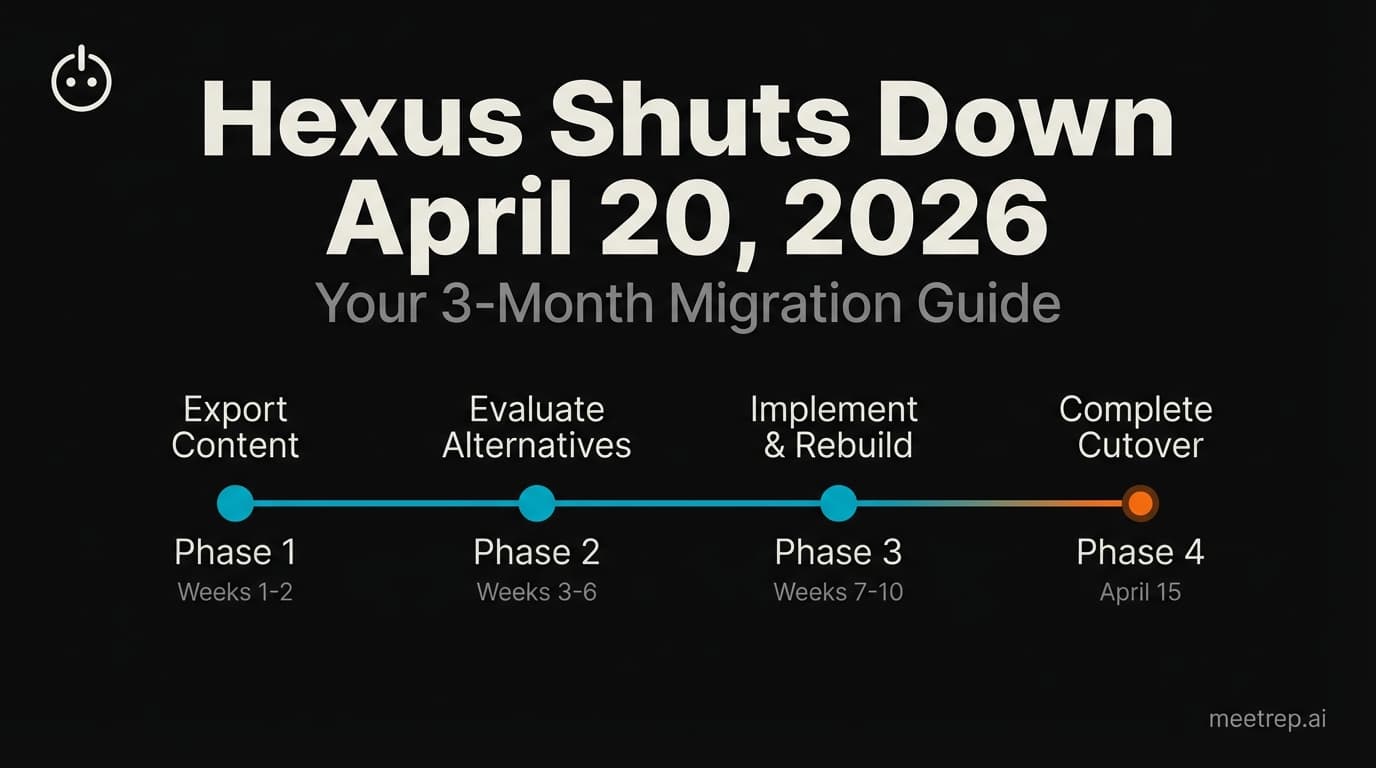
Hexus Acquired by Harvey AI: Congrats & What It Means for Demo Automation Teams
Hexus is shutting down following its acquisition by Harvey AI. Learn how to manage your migration and discover the best demo automation alternatives before April 2026.
Why the "Software Demo" is Broken—and Why AI Agents Are the Future
The traditional software demo is dead. Discover why 94% of B2B buyers rank vendors before calling sales and how AI agents are replacing manual demos to scale revenue.
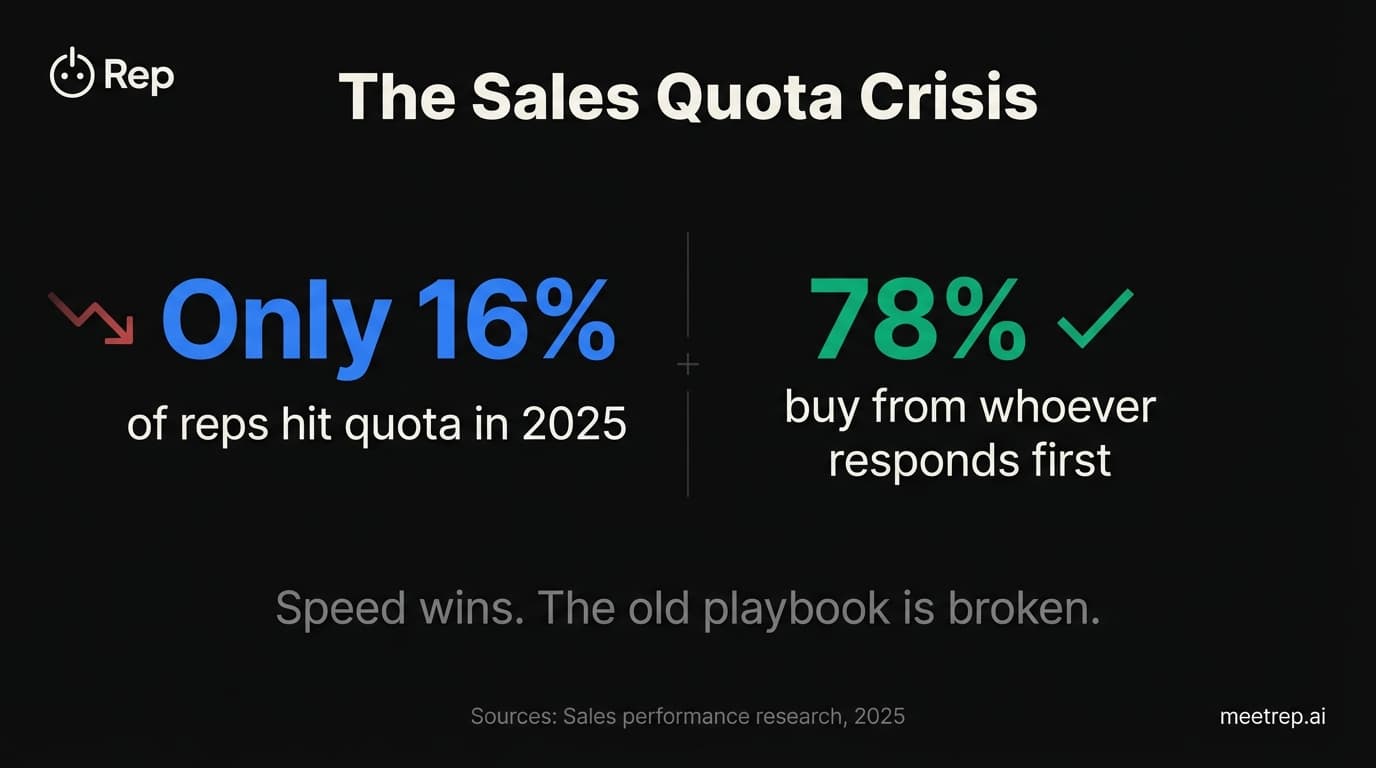
Why Autonomous Sales Software is the Future of B2B Sales (And Why the Old Playbook is Dead)
B2B sales is at a breaking point with quota attainment at 46%. Discover why autonomous 'Agentic AI' is the new standard for driving revenue and meeting the demand for rep-free buying.