Demo Presentation: The 7-Step Structure That Actually Converts

Executive Summary
- The Tell-Show-Tell framework outperforms linear "feature dump" demos by 3.2x on deal conversion
- 81% of sales pros have lost a deal specifically due to a bad demo—structure is the fix
- Keep each demo segment under 5 minutes (attention drops sharply after)
- Process-focused demos beat outcome-focused demos according to peer-reviewed research
- Send your agenda 24 hours in advance to cut no-shows from 24.5% to 6.5%
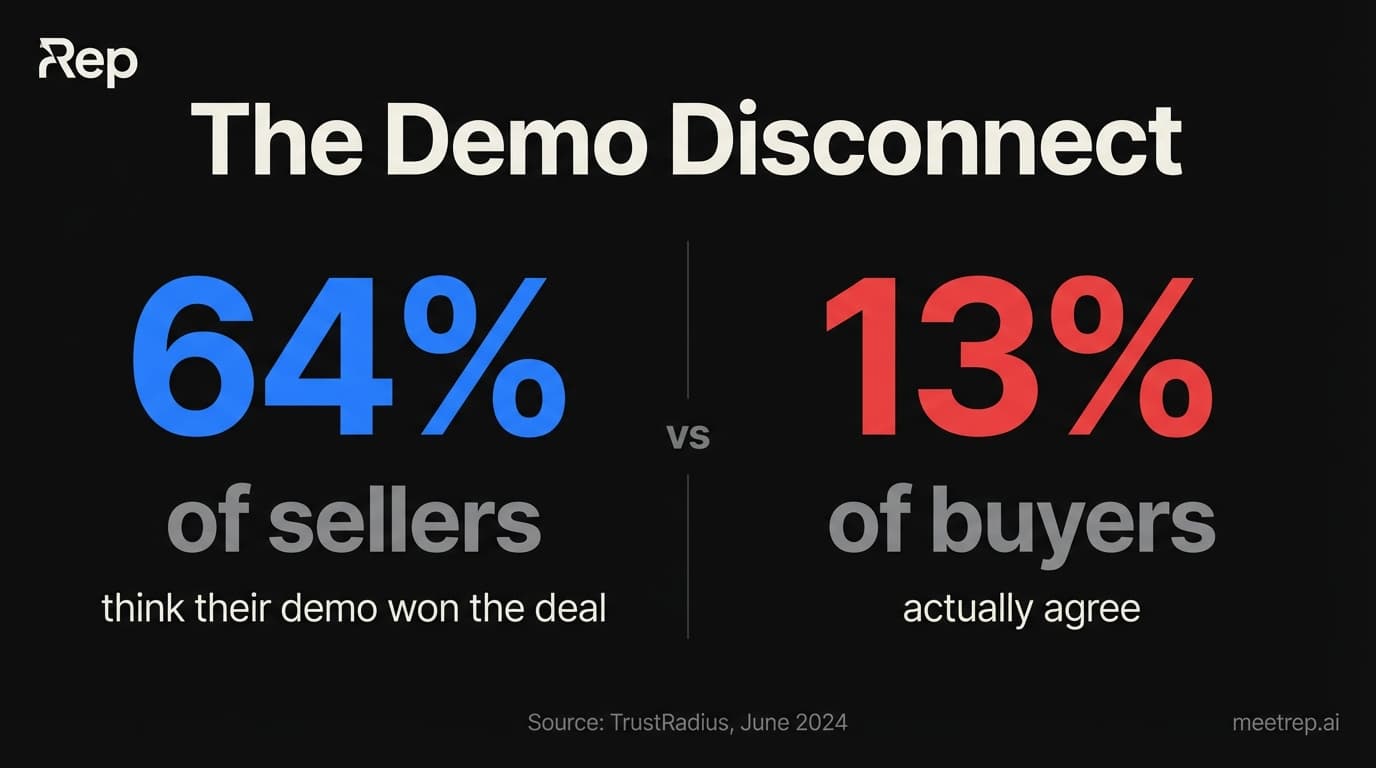
Here's an uncomfortable truth: 64% of sellers think their demos win deals. Only 13% of buyers agree.
That gap? It's costing you pipeline.
I've seen this disconnect firsthand. At GoCustomer.ai, we watched customers struggle with demos that felt polished but didn't convert. Now at Rep, we've studied what separates demos that close from demos that flop. The difference isn't charisma or product knowledge. It's structure.
According to TrustRadius's 2024 research, 71% of buyers who use demos say they're the most influential resource in their purchase decision. But Walnut's 2025 Buyer Report found that 97% say a bad demo could kill the sale entirely.
The stakes are binary. Get your demo presentation structure right, and you've got your most powerful sales weapon. Get it wrong, and you're actively pushing deals to competitors.
What Is a Demo Presentation?
A demo presentation is a structured walkthrough of your product designed to prove value to a specific prospect. It combines visual demonstration with verbal explanation to show—not just tell—how your solution solves their problem.
But here's what most people get wrong: a demo isn't a product tour. It's not a feature showcase. And it's definitely not a slideshow with screenshots.
The best demos feel like a conversation where you happen to have a screen share open. You're solving a problem together, not performing a monologue.
There are several demo presentation formats, and they convert at wildly different rates:
| Demo Type | Best For | Conversion Rate | Key Advantage |
|---|---|---|---|
| Live 1:1 Demo | Enterprise, complex products | 38% (interactive approach) | Real-time Q&A, max personalization |
| Interactive Demo | Website, self-service | 24.35% vs 3.05% traditional | Hands-on, 24/7 availability |
| Pre-recorded Video | Awareness, scale | ~15-20% | Consistent, no scheduling |
| Group Webinar | Product launches | Lower (per JAMS research) | Efficient for many prospects |
Source: Optifai 2025, Storylane + Factors.ai Oct 2024
The format matters. But structure matters more.
The Demo Disconnect: Why Most Presentations Fail
The Data: Only 13% of buyers cite "demo blew us away" as their reason for choosing a vendor. Yet 64% of sellers believe their demo is what won the deal. This perception gap is measurable—and it's costing you. (TrustRadius June 2024)
I'll be honest. That 13% stat surprised me when I first saw it.
We spend hours preparing demos. We practice our transitions. We build beautiful demo environments. And buyers... mostly don't care?
Not exactly. They care deeply about demos—71% say it's their most influential resource. What they don't care about is watching you click through menus and describe features they could read about on your website.
The Reprise/Revenue Brew survey from August 2025 found that 81% of sales professionals have lost a deal specifically because of a bad demo. Not because of pricing. Not because of competition. Because of the demo itself.
So what's going wrong?
Three things, mostly:
First, the discovery gap. According to the 2025 Presales Landscape Report, 39% of SEs report that AEs don't share discovery information soon enough. You can't personalize a demo when you don't know what problems you're solving. You end up showing everything and hoping something sticks.
Second, environment fragility. The same report found that 46% of salespeople skip showing complex features because they're "too fragile" to demo live. Think about that. Nearly half of reps are hiding their best capabilities because they don't trust the demo environment.
Third, the Harbor Tour. This is industry slang for showing every feature in the order they appear in your navigation menu. It's the demo equivalent of a boat tour that points out every building whether you care or not. "And over here we have the dashboard. And here's the settings page. And here's our reporting module..."
I've given Harbor Tour demos. We all have. They feel thorough. They feel professional. And they absolutely kill deals because they're not about the prospect—they're about your product.
The Tell-Show-Tell Framework That Actually Works
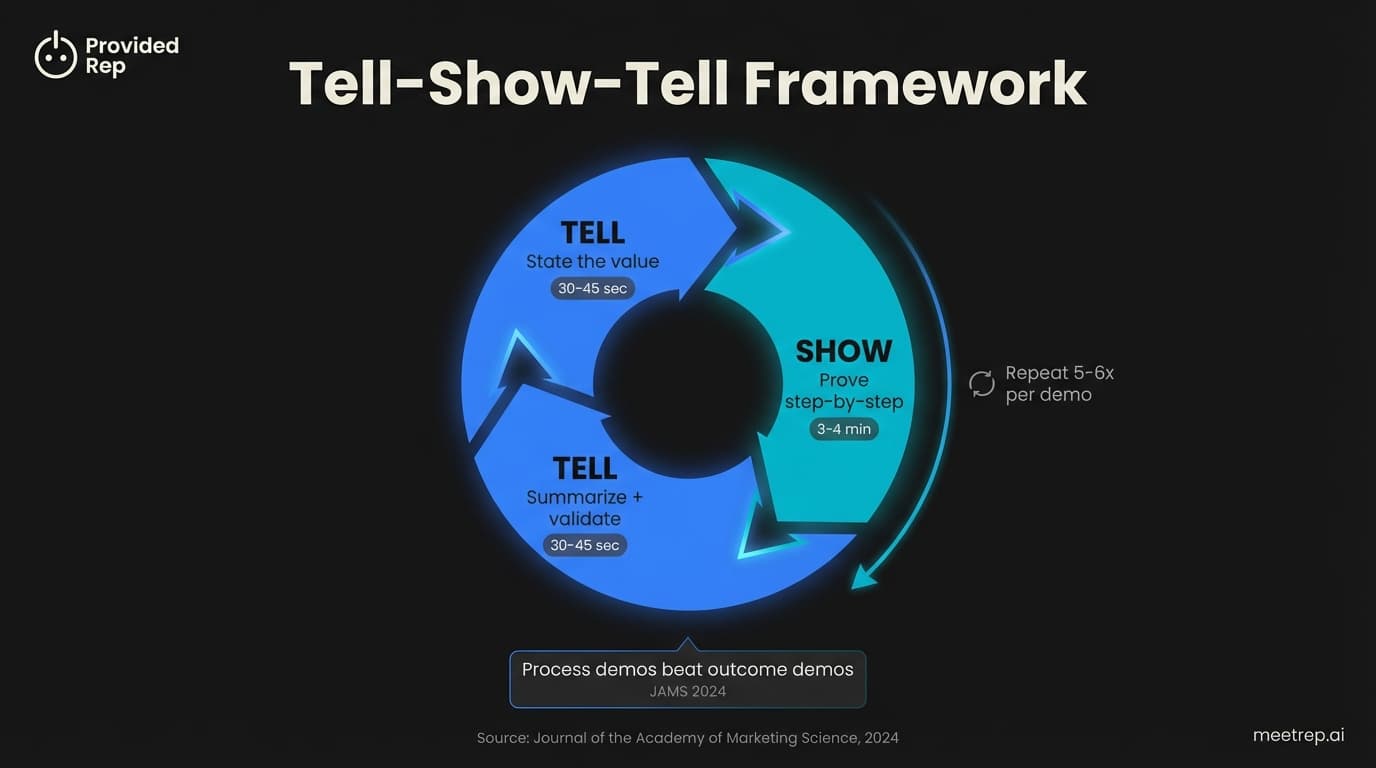
Key Insight: Peer-reviewed research from the Journal of the Academy of Marketing Science (2024) found that process-focused demos consistently outperform outcome-focused demos across 5 separate studies. Step-by-step beats "here's the final result" every time. (JAMS 2024)
The Tell-Show-Tell framework is the antidote to the Harbor Tour. It's used by 2Win! Global, taught in Great Demo! methodology, and backed by academic research.
Here's how it works:
Tell (Context): State the specific value you're about to demonstrate. Not "let me show you our reporting," but "I'm going to show you how to cut your monthly reporting time from 8 hours to 45 minutes."
Show (Proof): Navigate the product step-by-step to prove what you just claimed. This is where most demos fail—they show the outcome (a finished report) instead of the process (how you built it). The JAMS research is clear: showing the process is more persuasive than showing the result.
Tell (Impact): Summarize what they just saw and connect it back to their business. "What you just saw saves your team 7 hours every month. Does that match the workflow challenge you mentioned?"
Then repeat. Each Tell-Show-Tell cycle is what practitioners call a "Value Vignette"—a self-contained story within your demo.
The key constraint: keep each vignette under 5 minutes. Attention drops off hard after that. A 30-minute demo should be 5-6 vignettes, not one long monologue.
| Phase | What You Do | Time | Example |
|---|---|---|---|
| Tell | State the value | 30-45 sec | "I'll show you how to reduce audit prep by 50%" |
| Show | Navigate step-by-step | 3-4 min | Walk through the actual workflow, explaining each click |
| Tell | Summarize impact | 30-45 sec | "That's 4 hours back every week. Sound valuable?" |
At Rep, we built our autonomous demo agents to execute this framework automatically. The AI states the value, navigates the product live via browser automation, and recaps the impact. It's not magic—it's just structure, executed consistently.
7 Steps to Structure Your Demo Presentation
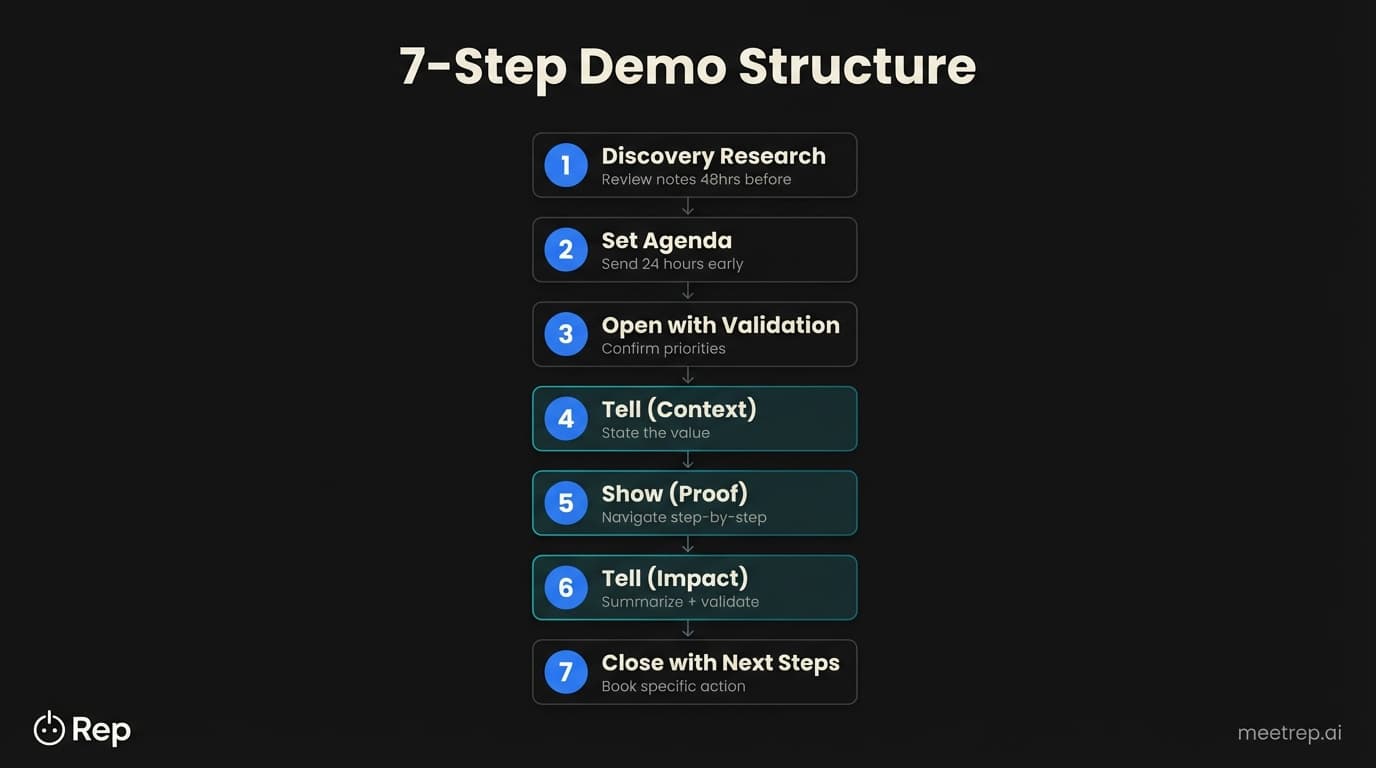
This is the framework we recommend. It works for live demos, recorded demos, and interactive demos. The format changes; the structure doesn't.
Step 1: Discovery Research
Don't demo blind. Review discovery notes, LinkedIn profiles, and any information about the prospect's specific challenges. The Reprise report found that 39% of SEs don't get this information soon enough—if that's you, push your AEs for better handoffs 48 hours before the call.
Step 2: Set the Agenda (24 Hours Early)
Send a brief agenda the day before. What you'll cover, how long it'll take, what decisions you hope to make together. RevenueHero's December 2024 research found that no-show rates hit 24.5% when demos are booked 7+ days out—but drop to 6.5% average with proper pre-call engagement.
Step 3: Open with Rapport and Validation
Start by confirming what you know. "Based on our earlier conversation, your main challenge is X. Is that still the priority, or has anything changed?" This serves two purposes: it shows you listened, and it lets you pivot if priorities shifted.
Step 4: Tell (Context)
Before touching your product, state what value you're about to prove. Be specific. "In the next 4 minutes, I'll show you how to cut your audit preparation from a full day to about 2 hours."
Step 5: Show (Proof via Process)
Navigate the product step by step. Narrate what you're doing and why. "First, I'm clicking into the audit module. Now I'm selecting the date range—notice it auto-pulls the relevant transactions. Next, I'll generate the summary..."
This is where the JAMS research matters. Don't skip to the finished result. Show the journey.
Step 6: Tell (Impact) + Validation Question
Summarize and check in. "What you just saw saves roughly 6 hours per audit cycle. Does that feel material for your team?" Pause. Let them respond. This isn't rhetorical—their answer tells you if you're on track.
Step 7: Close with Concrete Next Steps
Don't end with "any questions?" End with a specific next step. "Based on what you've seen, the logical next step is [technical deep-dive / POC / executive review]. I have Tuesday at 2pm or Thursday at 10am available. Which works better?"
Chili Piper's 2025 research found that 66.7% of qualified submissions book meetings when next steps are clear—versus 30% industry average when they're vague.
Common mistake: Ending demos with "I'll send over some materials and we can reconnect next week." That's not a next step. That's a slow death for your deal. Book something specific before you hang up.
How Long Should Your Demo Presentation Be?
Individual demo segments should stay under 5 minutes. Total demo length varies:
- SMB deals: 15-20 minutes total
- Mid-market: 25-35 minutes total
- Enterprise: 40-60 minutes total
But here's what matters more than total length: structure.
A 30-minute demo should not be one continuous walkthrough. It should be 5-6 Tell-Show-Tell vignettes, each addressing a different pain point or capability. This gives natural breakpoints for questions and keeps attention high.
Navattic's 2025 State of Interactive Product Demo report found that interactive demos average 2.1 minutes per engagement, with top performers achieving 84.4% engagement rates. Short, focused, and structured beats long and comprehensive every time.
One more data point that changed how I think about this: the JAMS 2024 research also found that individual viewing outperforms group viewing for purchase intent. When buying committees average 10-11 people (per 6sense's 2024 research), you can't always control this. But when you can offer a stakeholder their own focused demo instead of a group session, do it.
What Kills Demo Presentations (And How to Avoid It)
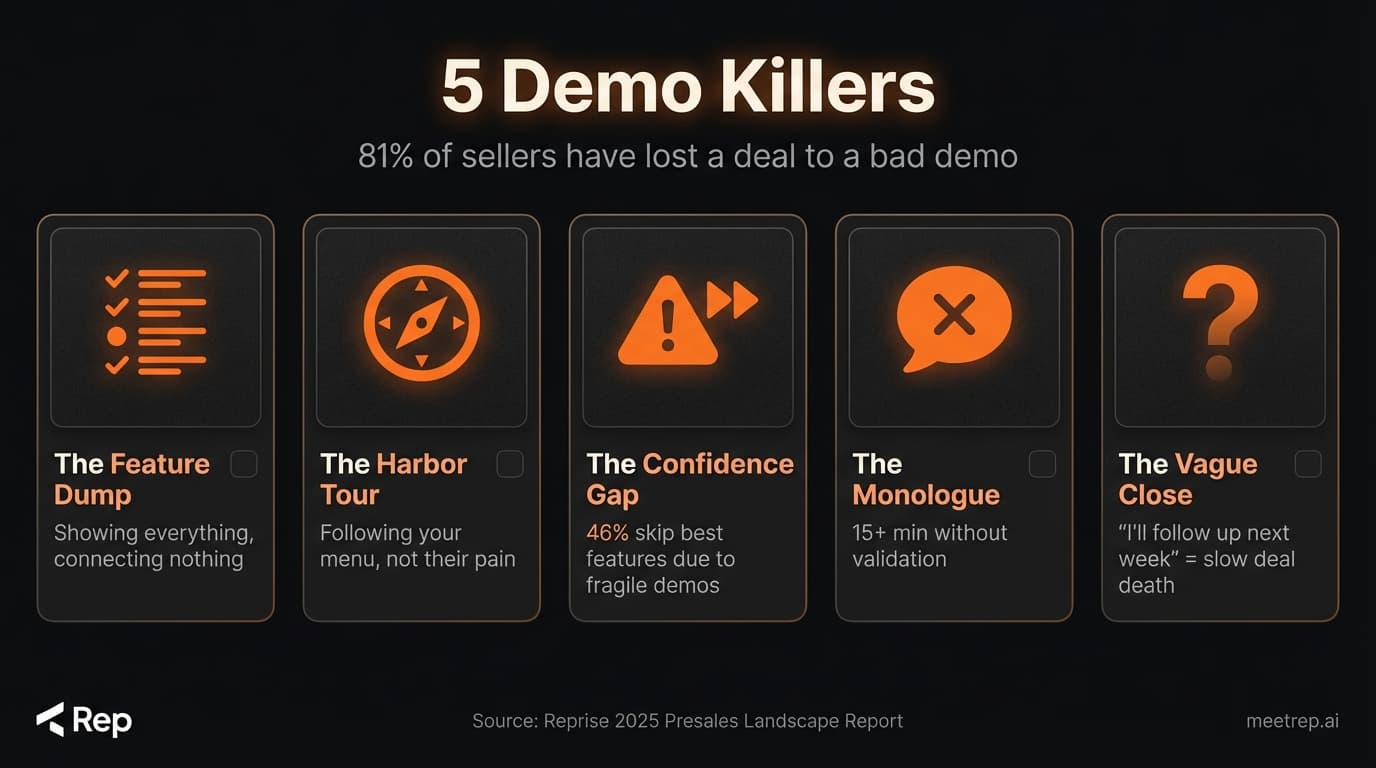
I've watched a lot of demos fail. At GoCustomer, we interviewed churned customers about what went wrong. At Rep, we analyzed why prospects didn't convert. The failure patterns are remarkably consistent.
The Feature Dump
Showing capabilities without connecting them to stated problems. This is the Harbor Tour in action. The fix: only show features that address pain points from discovery. If you don't have discovery notes, do discovery at the top of the call.
The Confidence Gap
Skipping your best features because the demo environment is unreliable. According to Reprise's 2025 data, 46% of salespeople do this. The fix: either invest in stable demo infrastructure, use overlay tools like Saleo or Demostack, or consider autonomous demo solutions that handle the technical complexity.
The Monologue
Talking for 15 minutes without pausing for input. Prospects check out. They're not sure if this is relevant to them. They start reading emails. The fix: build validation questions into every Tell-Show-Tell cycle. "Does this match your workflow?" forces engagement.
The Vague Close
"Let me know if you have any questions." "I'll follow up next week." These aren't next steps. They're slow deal death. The fix: propose a specific action with specific timing before you end the call. Always.
The No-Show Spiral
Booking demos far out and watching them evaporate. RevenueHero found no-show rates hit 24.5% at 7+ days. The fix: confirm 24 hours before, send pre-demo materials, and consider instant-availability options for initial interest.
Real Examples: Companies Getting Demo Structure Right
I want to share some specific examples from companies that have published their results.
Sovos (tax compliance software) implemented structured demo automation through Consensus and saw a 67% reduction in live SE calls and 60% faster SMB sales cycles. Their average demo view time dropped to 11 minutes because prospects got focused, relevant content instead of everything-and-the-kitchen-sink tours. (Source: Consensus, September 2025)
Gainsight (customer success platform) deployed Demostack for personalized demo environments and achieved a 25% increase in win rate plus an 8% improvement in close-win rates overall. Response time for personalized demos went from days to under an hour. (Source: Demostack Q3 2024)
Hunters (cybersecurity) used sandbox demo environments and cut their sales cycle by 50%—from 9 months to 4 months. Both enterprise and SMB deals now close in the same timeframe because buyers can explore the product on their terms without waiting for SE availability. (Source: Demostack)
My recommendation: Structure first, tools second. The best demo platform in the world won't save a Harbor Tour. But a solid Tell-Show-Tell framework will convert even with basic screen sharing. Get the structure right, then consider how technology can help you scale it.
The Future of Demo Presentations
Here's what I'm watching.
Gartner's November 2025 report predicts AI agents will outnumber human sellers 10:1 by 2028. But they also predict that fewer than 40% of sellers will report AI agents actually improving productivity. The gap between those numbers tells me implementation quality will matter more than adoption speed.
At Rep, we're building for this future. Our autonomous agents join video calls, share their screen, and navigate your actual product live—executing Tell-Show-Tell with consistency that humans can't match at scale. The AI states the value, shows the process step-by-step via browser automation, and summarizes the impact. Every time. 24/7.
But I don't think AI replaces human demos for complex enterprise deals. Not yet, and maybe not ever. What it does is handle the repetitive MOFU demos—the initial interest, the first look, the "is this worth my time" evaluation—so your human sellers can focus on strategic, high-value conversations.
The structure stays the same either way. Tell-Show-Tell works for humans. It works for AI. It works because it's built around how buyers actually process information, not around how sellers want to present.
The data is clear. 71% of buyers say demos are their most influential resource. 97% say a bad one kills the deal. The gap between a demo that converts and one that flops isn't talent or charm—it's structure.
Tell-Show-Tell works. The 7-step framework works. Now you have the blueprint.
My prediction: within two years, the best sales teams will use AI to handle every initial demo while reserving human sellers for complex, strategic conversations. The structure won't change. Just who (or what) executes it.
If you want to see what structured, autonomous demos look like in practice, Rep is built for exactly this. But whether you use AI or not, start with the framework. Your next demo is your next opportunity to prove—not just claim—that you can solve your prospect's problem.

Nadeem Azam
Founder
Software engineer & architect with 10+ years experience. Previously founded GoCustomer.ai.
Nadeem Azam is the Founder of Rep (meetrep.ai), building AI agents that give live product demos 24/7 for B2B sales teams. He writes about AI, sales automation, and the future of product demos.
Frequently Asked Questions
Table of Contents
- What Is a Demo Presentation?
- The Demo Disconnect: Why Most Presentations Fail
- The Tell-Show-Tell Framework That Actually Works
- 7 Steps to Structure Your Demo Presentation
- How Long Should Your Demo Presentation Be?
- What Kills Demo Presentations (And How to Avoid It)
- Real Examples: Companies Getting Demo Structure Right
- The Future of Demo Presentations
Ready to automate your demos?
Join the Rep Council and be among the first to experience AI-powered demos.
Get Early AccessRelated Articles
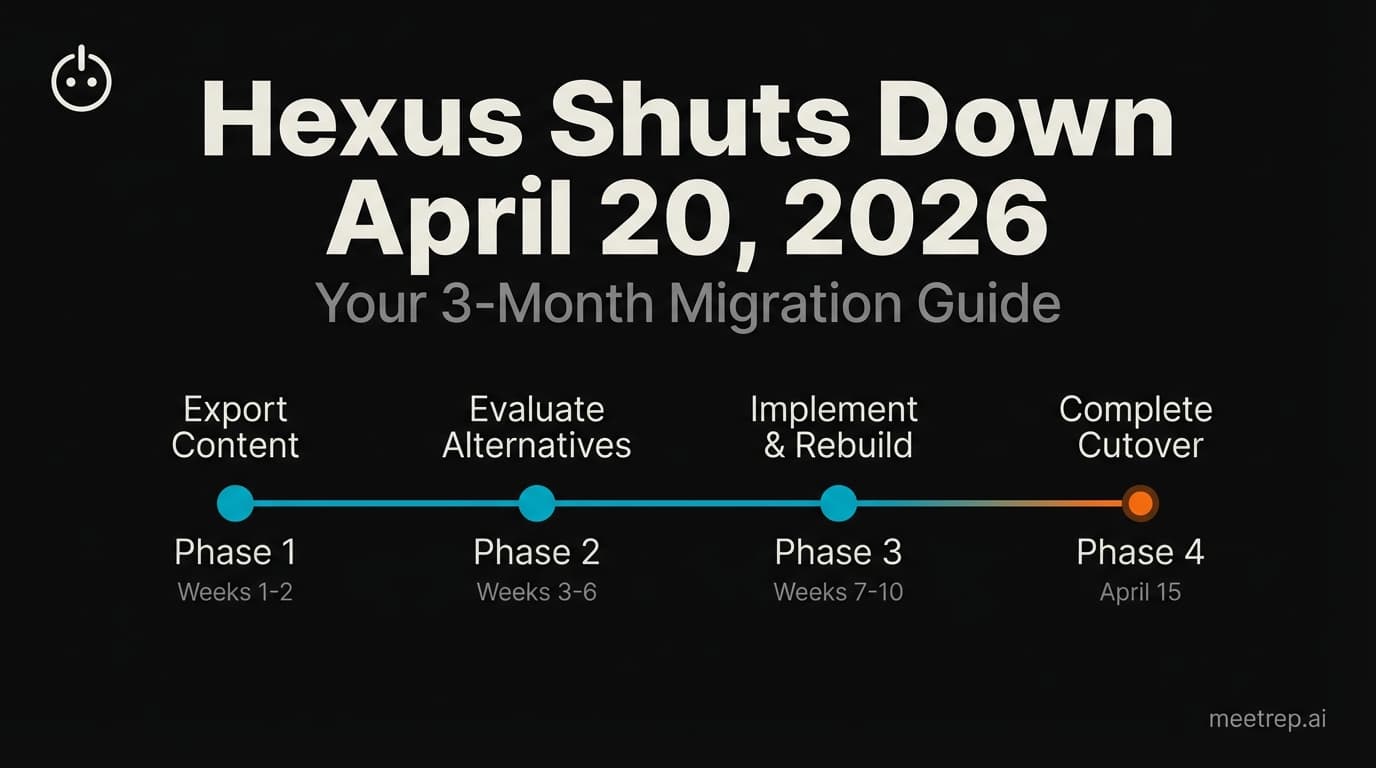
Hexus Acquired by Harvey AI: Congrats & What It Means for Demo Automation Teams
Hexus is shutting down following its acquisition by Harvey AI. Learn how to manage your migration and discover the best demo automation alternatives before April 2026.
Why the "Software Demo" is Broken—and Why AI Agents Are the Future
The traditional software demo is dead. Discover why 94% of B2B buyers rank vendors before calling sales and how AI agents are replacing manual demos to scale revenue.
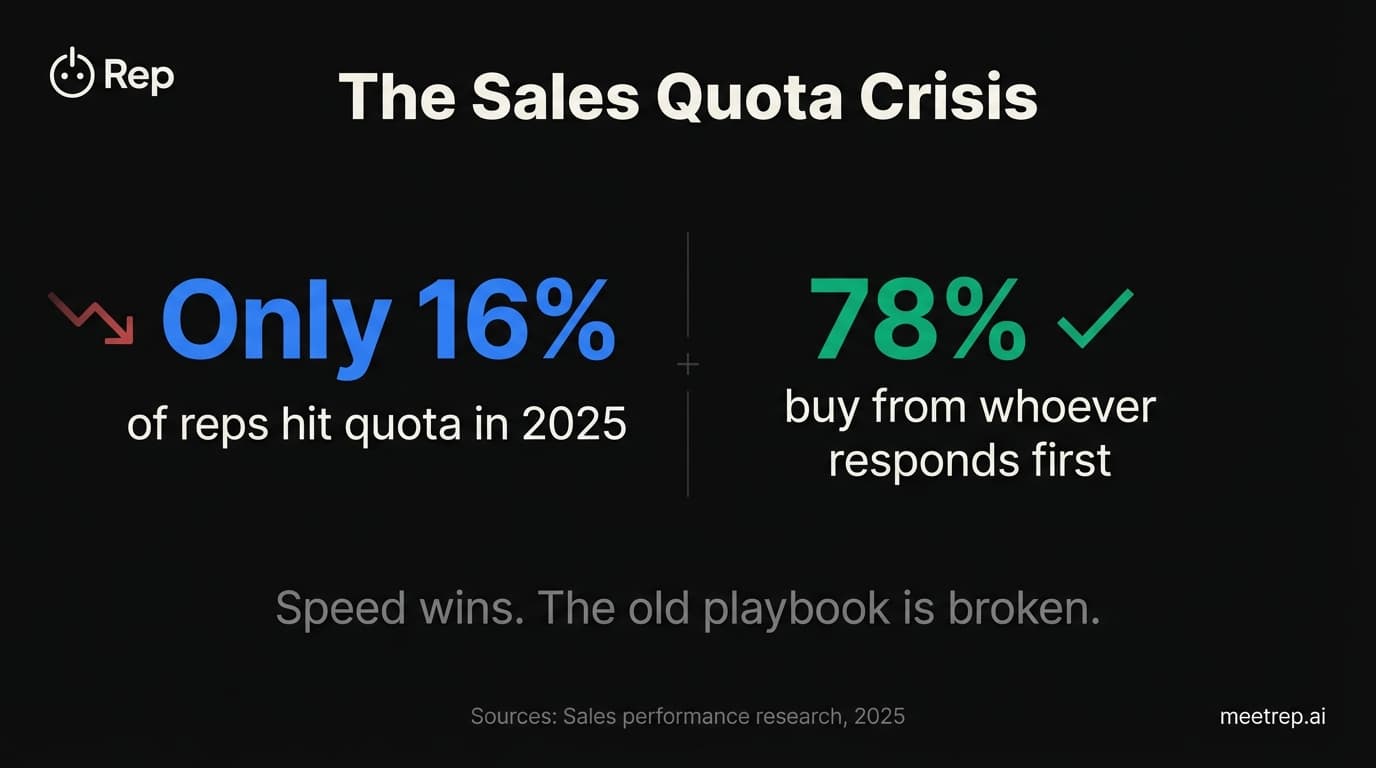
Why Autonomous Sales Software is the Future of B2B Sales (And Why the Old Playbook is Dead)
B2B sales is at a breaking point with quota attainment at 46%. Discover why autonomous 'Agentic AI' is the new standard for driving revenue and meeting the demand for rep-free buying.