Customer Success Demos at Scale: How to Drive Expansion Without Burning Out Your Team

Executive Summary
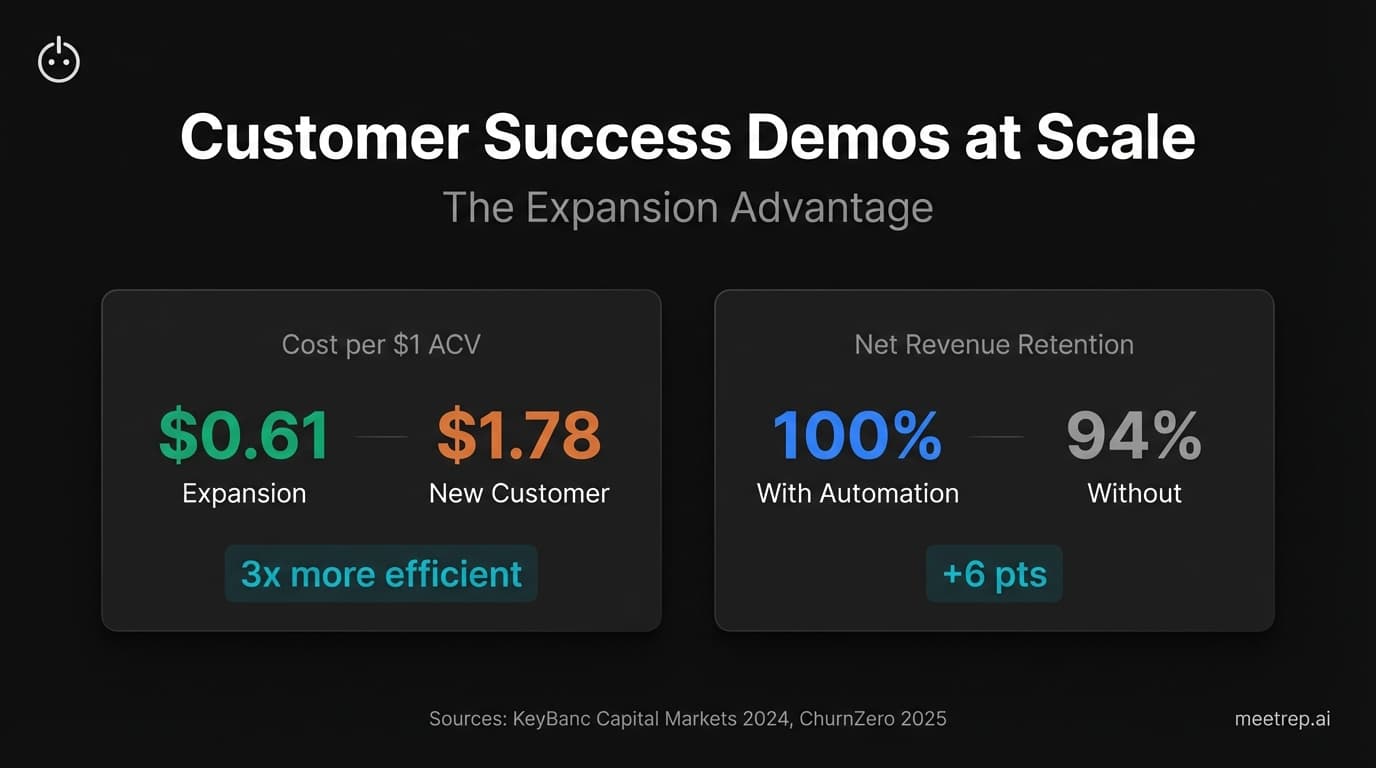
- Expansion now drives 40% of new ARR for companies above $15M—yet most CS teams can't scale demos to their long-tail accounts
- Expansion costs $0.61 per $1 ACV vs $1.78 for new customers. You're leaving 3x efficiency on the table.
- Teams using CS automation achieve 100% NRR vs 94% without—a 6-point lift
- The fix: AI-powered demos triggered by expansion signals, not quarterly calendars
Your board wants 110% NRR. Your team is drowning. And somewhere in your customer base, hundreds of accounts are quietly hitting usage limits, bumping into feature gates, and wondering what else your product can do—while your CSMs are too buried in their top 30 accounts to notice.
This is the expansion gap. And it's costing you millions.
I've spent years building sales automation tools, first at GoCustomer.ai and now at Rep. Here's what I've learned: the answer isn't more headcount. It's smarter customer success demos—delivered at scale, triggered by signals, and personalized to each account's actual usage. Let me show you how.
What Are Customer Success Expansion Demos?
Expansion demos are interactive product demonstrations delivered to existing customers to show them features they're not using, highlight new capabilities, or introduce complementary products. Unlike initial sales demos that educate from scratch, expansion demos build on what customers already know—using their usage data, their pain points, and their specific workflow to personalize every interaction.
Here's why they matter now more than ever.
For companies with $15M-30M+ ARR, 40% of growth now comes from expansion—up from 30% in 2021, according to ChartMogul's 2024 SaaS Retention Report. And for companies above $50M ARR? That number climbs to 60%, per High Alpha's 2025 benchmarks.
The Data: Expansion costs just $0.61 per $1 of ACV, compared to $1.78 for new customer acquisition. That's 3x more cost-efficient. Every expansion demo you don't deliver is money you're paying triple to chase elsewhere. — KeyBanc Capital Markets Private SaaS Survey 2024
But here's the problem. Your CSMs can't deliver demos at scale. They're drowning.
The Coverage Gap: Your Long-Tail Is Leaving Money on the Table
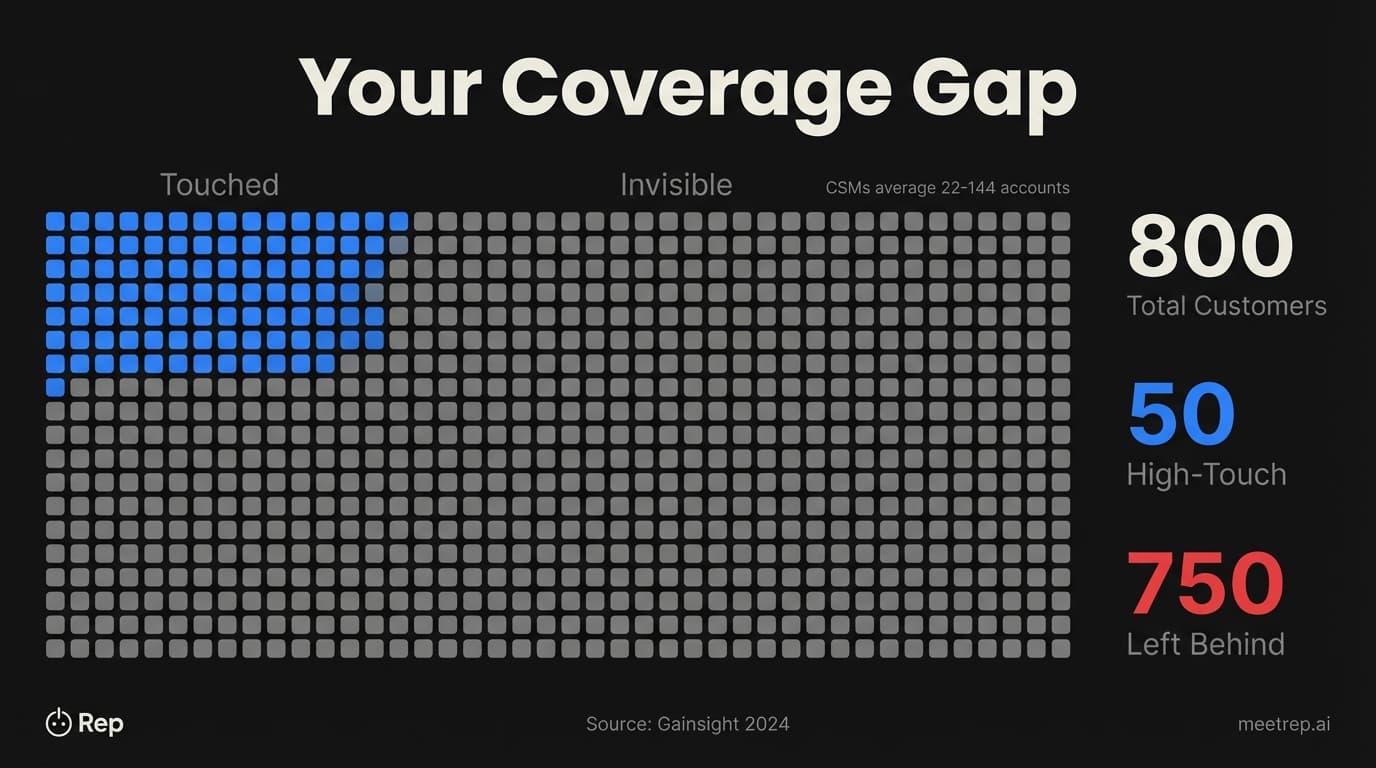
Let me paint a picture you probably recognize.
High-touch CSMs average 22 accounts. Mid-touch? 49. Low-touch? 144. That's according to Gainsight's 2024 benchmark data.
So let's do the math. Say you have 800 customers. Your team touches maybe 50 with any real depth. What happens to the other 750?
They get a quarterly email. Maybe a QBR if they're lucky. And somewhere in that long tail, accounts are hitting 80% of their seat limits, clicking on locked features, and googling your competitors—because nobody showed them what they're already paying for.
Only 40% of CSMs say their workload is realistic, according to ChurnZero's 2024 CSM Confidential Report. And 83% are still using Excel to manage their book of business, per Custify's 2024 survey. This isn't a people problem. It's a coverage problem.
Common mistake: Treating your QBR as your expansion strategy. It's not. QBRs are checkboxes. The real expansion opportunities are happening between QBRs—when customers hit usage thresholds, when they try locked features, when they complain about manual workarounds. If you're waiting for the quarterly review to surface these, you're already too late.
Why Click-Through Demos Aren't Enough for CS Expansion
Here's where I'll take a stance that might ruffle some feathers.
Tools like Walnut, Navattic, and Arcade are great for what they do—creating click-through product tours that prospects can explore on their own. For acquisition, they work. Interactive demos deliver 7.9x higher website conversion (24.35% vs 3.05%), according to Factors.ai's 2024 study.
But expansion is different.
Your existing customers don't need a guided tour. They need answers. "How does this integrate with the workflow I've already built?" "What's the price difference between my plan and Enterprise?" "Can you show me how this would work with my specific data?"
Click-through demos can't answer those questions. They're passive. They require the customer to initiate. And they can't adapt to verbal objections in real-time.
What we learned building Rep: When we architected Rep, we made a deliberate choice: voice plus video, not click-through. You can't demo software over a phone call—customers need to see the screen. But you also can't answer objections with a pre-recorded tour. Expansion demos require conversation. That's the gap we're solving.
My recommendation for the ideal expansion demo:
- Detects signals (usage thresholds, feature-gate clicks, health score shifts)
- Reaches out proactively ("I noticed you're trying to export data—that's a Pro feature. Want me to show you how it works?")
- Shows the product visually while talking through the value
- Answers questions live ("What's the pricing?" "How does this compare to my current plan?")
- Handles simple upgrades or escalates complex deals to humans
That's not a tour. That's a conversation.
The Five Expansion Demo Scenarios Every CS Team Must Master
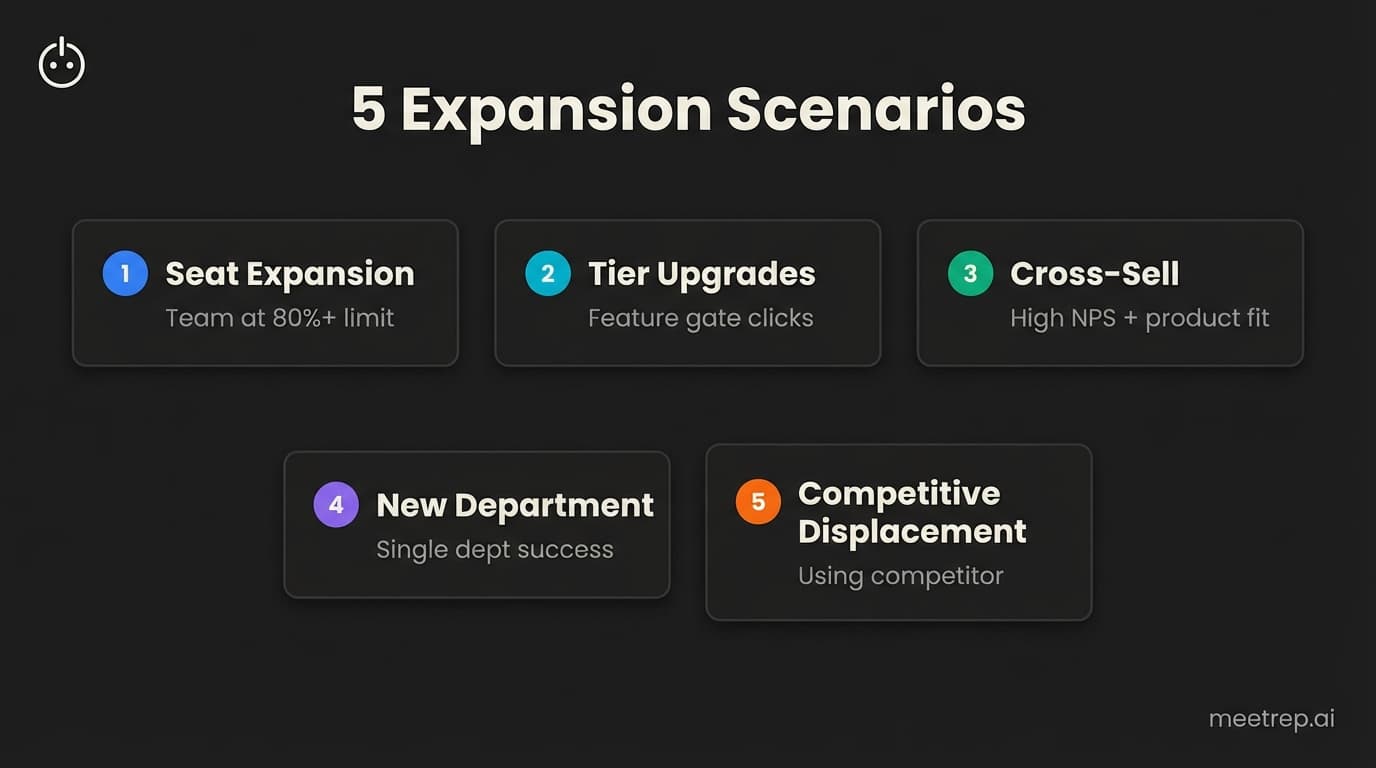
Not all expansion opportunities look the same. Here are the five scenarios where customer success demos drive the most revenue:
Scenario 1: Seat Expansion (Same Team, More Users)
Trigger: Team is at 80%+ of seat limit; multiple users sharing logins.
Demo focus: Collaborative features—permissions, shared dashboards, team workflows.
What the AI says: "I see your team is at 9 out of 10 users and some folks are sharing logins. Let me show you how adding seats opens up real-time collaboration and admin controls."
Scenario 2: Tier Upgrades (Advanced Features)
Trigger: Customer repeatedly clicks on feature gates. Three attempts at "Advanced Analytics" in a month.
Demo focus: The specific features they've tried to access.
What the AI says: "You've clicked on Advanced Analytics four times this month. Let me walk you through what it does and how it solves the reporting problem you mentioned in your last support ticket."
Scenario 3: Cross-Sell (Complementary Products)
Trigger: High NPS, successful with core product, industry fit for add-on.
Demo focus: Adjacent problems the customer has mentioned.
What the AI says: "Your reporting in Product A is strong. Companies in your industry also use our Product B to automate the workflow you're doing manually. Here's a five-minute walkthrough."
Scenario 4: New Department Expansion
Trigger: Single department using product; other teams have similar needs.
Demo focus: Department-specific use cases for the new stakeholder.
Challenge: New contacts = cold relationships. Need to rebuild trust.
Solution: AI reaches out to new contacts with department-specific demos, then books intro calls for CSMs to close.
Scenario 5: Competitive Displacement
Trigger: Customer mentions using a competitor for an adjacent function.
Demo focus: Head-to-head comparison.
What the AI says: "I see you're using [Competitor] for scheduling. Let me show you how our built-in scheduler does the same thing plus [unique advantage], so you can consolidate tools."
How to Scale Expansion Demos: A 7-Step Playbook
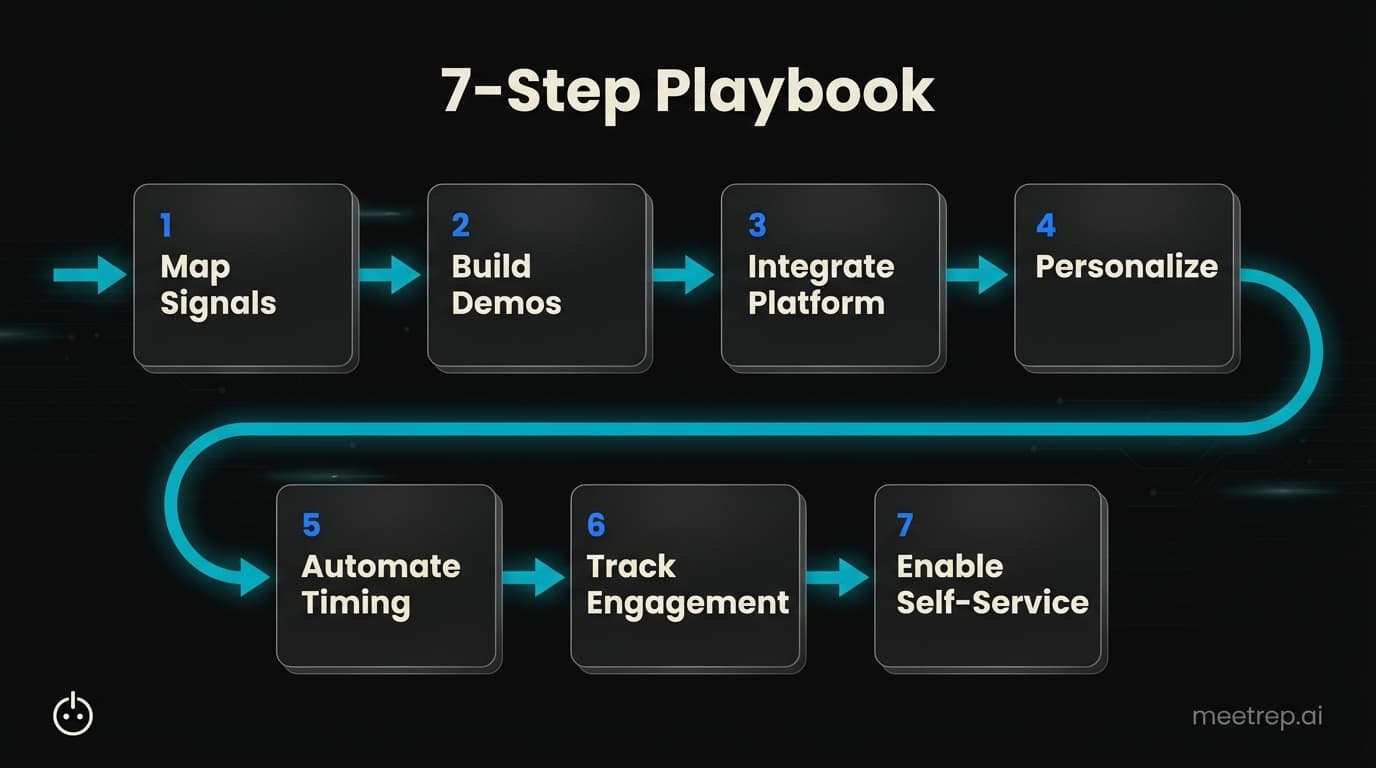
Here's the tactical playbook for CS teams ready to automate expansion demos.
Step 1: Map your expansion signals. Identify the triggers that indicate expansion readiness: usage thresholds (80%+ of limits), feature-gate clicks (3+ attempts), health score improvements, renewal proximity (90-120 days out). Customers are 3x more likely to upgrade in month two vs month nine, per ChartMogul data cited by CRO Club. Early signals matter.
Step 2: Build modular demo content. Create reusable demos for each scenario—tier upgrades, seat expansion, add-on modules, cross-sell products. Keep them under 10 minutes. 50% of automated demos are viewed the same day they're sent, according to Consensus. Short and targeted wins.
Step 3: Integrate with your CS platform. Connect demo triggers to Gainsight, ChurnZero, or Totango. Pull health scores, usage data, and renewal dates. The automation should know which customers are ready before your CSMs do.
Step 4: Personalize with customer data. Inject account-specific details automatically—current plan tier, usage patterns, industry vertical. Personalized demos increase conversion by up to 40%, according to Gartner data cited by Monetizely.
Step 5: Automate the timing. Trigger demos when signals appear, not on fixed schedules. Customer hits 80% of API limit? Demo fires within an hour, not at next month's QBR.
Step 6: Track engagement. Monitor demo views, completion rates, and feature interest. Benchmark: top performers see 20-30% demo-to-close conversion vs under 10% for underperformers, per Gong.io data.
Step 7: Enable self-service access. Embed expansion demos in your customer portal. Link them in renewal emails. Include them in QBR decks. Let customers explore on their own terms.
Key Insight: The companies crushing NRR aren't waiting for customers to ask about upgrades. They're detecting signals and proactively showing value before the customer even realizes they need more.
Manual vs Automated Expansion Demos: The Real Comparison
Let's be honest about what you're trading off.
| Factor | Manual CSM Demos | Automated AI Demos |
|---|---|---|
| Scalability | Limited by headcount (22-144 accounts per CSM) | Entire customer base simultaneously |
| Cost per demo | High (CSM salary + prep time + opportunity cost) | Low (marginal cost after setup) |
| Consistency | Varies by CSM experience and energy level | 100% consistent messaging |
| Timing | Reactive to CSM availability (24-48 hour response) | Instant when signals appear |
| Personalization | High potential (but time-intensive) | Moderate-high (data-driven, automated) |
| Analytics | Manual notes in Salesforce, maybe | Full engagement visibility |
| Availability | Business hours, timezone-dependent | 24/7/365 |
| Best for | Enterprise accounts, complex custom solutions | SMB/mid-market, standardizable use cases, long-tail |
The point isn't to replace your CSMs. It's to free them. Let automation handle the repetitive tier-upgrade conversations so your humans can focus on strategic enterprise expansions and executive relationships.
Teams using CS automation platforms average 100% NRR compared to 94% without, according to ChurnZero's 2025 Customer Revenue Leadership report. That 6-point lift? That's the difference between growing and dying slowly.
Overcoming the "AI Will Damage Relationships" Fear
I hear this objection constantly. "Our customers will feel like we're pawning them off to a robot."
But here's what the data actually shows.
Speed is service. Customers would rather get an instant, helpful answer than wait 48 hours for a human who might be rushed anyway. At Rep, we've seen implementations achieve 96% automated resolution with 99% CSAT in the OLLY case study. That's not "good enough for a robot." That's better than most human benchmarks.
Look, the key is knowing what AI should handle vs what humans must:
AI handles well:
- Simple tier upgrades (Basic to Pro)
- Seat additions
- Feature unlocks with transparent pricing
- "What does this feature do?" questions
- Booking meetings for complex deals
Humans required:
- Enterprise custom contracts
- Multi-product bundle negotiations
- C-suite stakeholder management
- Churn risk combined with expansion opportunity
What we learned at GoCustomer: Automation without personalization creates worse outcomes than no automation at all. My experience has shown that the trick is using customer data—their usage, their industry, their history—to make every automated interaction feel like it was built for them. That's when AI augments trust instead of eroding it.
As Brian Smith, GVP Global Renewal Management at DocuSign, said at Gainsight Pulse 2025: "This isn't about replacement; it's about job enhancement."
Measuring Success: The Metrics That Actually Matter
Track these weekly:
- Demo engagement rate: % of triggered recipients who view
- Completion rate: % who finish the demo
- Feature interest heatmap: Which sections get the most attention
Track these monthly:
- Demo-to-expansion conversion: Benchmark 20-30% for top performers
- Expansion ARR attributed to demos: vs CSM-sourced, product-led
- CSM time savings: Should see 10+ hours/week freed up
Track this quarterly:
- NRR impact: Compare automated demo recipients vs control group
The ultimate goal? Close the gap between your current NRR and the 113-120% top-quartile benchmark that McKinsey's November 2025 analysis shows commands 24x EV/Revenue multiples vs 5x for bottom quartile.
The stakes are clear. Top-quartile NRR companies command 24x revenue multiples. Bottom quartile? 5x. And the difference isn't talent or luck—it's coverage.
Your long-tail customers are hitting feature limits right now. They're clicking on locked features right now. They're wondering if they should upgrade right now. The only question is whether you'll be there when it happens, or whether they'll figure it out on their own (or worse, figure out your competitor's product instead).
At Rep, we built AI demo agents specifically for this problem—voice plus video, triggered by signals, personalized to each account. But whatever tools you choose, the principle holds: expansion at scale requires automation. Your CSMs are too good to waste on repetitive tier-upgrade conversations. Free them to do what humans do best. Let AI handle the rest.

Nadeem Azam
Founder
Software engineer & architect with 10+ years experience. Previously founded GoCustomer.ai.
Nadeem Azam is the Founder of Rep (meetrep.ai), building AI agents that give live product demos 24/7 for B2B sales teams. He writes about AI, sales automation, and the future of product demos.
Frequently Asked Questions
Table of Contents
- What Are Customer Success Expansion Demos?
- The Coverage Gap: Your Long-Tail Is Leaving Money on the Table
- Why Click-Through Demos Aren't Enough for CS Expansion
- The Five Expansion Demo Scenarios Every CS Team Must Master
- How to Scale Expansion Demos: A 7-Step Playbook
- Manual vs Automated Expansion Demos: The Real Comparison
- Overcoming the "AI Will Damage Relationships" Fear
- Measuring Success: The Metrics That Actually Matter
Ready to automate your demos?
Join the Rep Council and be among the first to experience AI-powered demos.
Get Early AccessRelated Articles
Hexus Acquired by Harvey AI: Congrats & What It Means for Demo Automation Teams
Hexus is shutting down following its acquisition by Harvey AI. Learn how to manage your migration and discover the best demo automation alternatives before April 2026.
Why the "Software Demo" is Broken—and Why AI Agents Are the Future
The traditional software demo is dead. Discover why 94% of B2B buyers rank vendors before calling sales and how AI agents are replacing manual demos to scale revenue.
Why Autonomous Sales Software is the Future of B2B Sales (And Why the Old Playbook is Dead)
B2B sales is at a breaking point with quota attainment at 46%. Discover why autonomous 'Agentic AI' is the new standard for driving revenue and meeting the demand for rep-free buying.