Can AI Replace Sales Reps? Here's What It Can and Can't Do

Executive Summary
- AI won't replace salespeople—salespeople using AI will replace those who don't
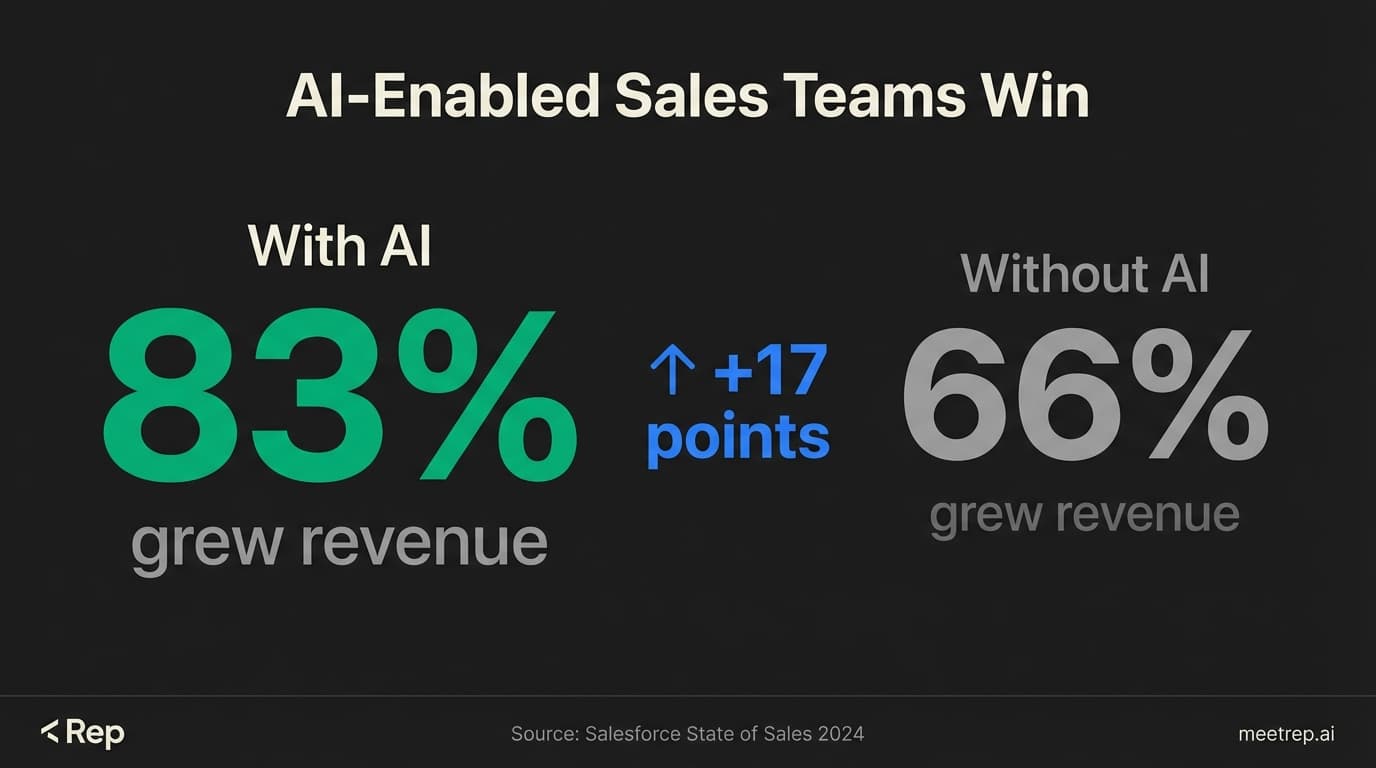
- 83% of AI-enabled sales teams grew revenue vs. 66% without (Salesforce 2024)
- AI handles: research, admin, outbound volume, 24/7 response
- Humans handle: trust, complex negotiations, enterprise deals, emotional intelligence
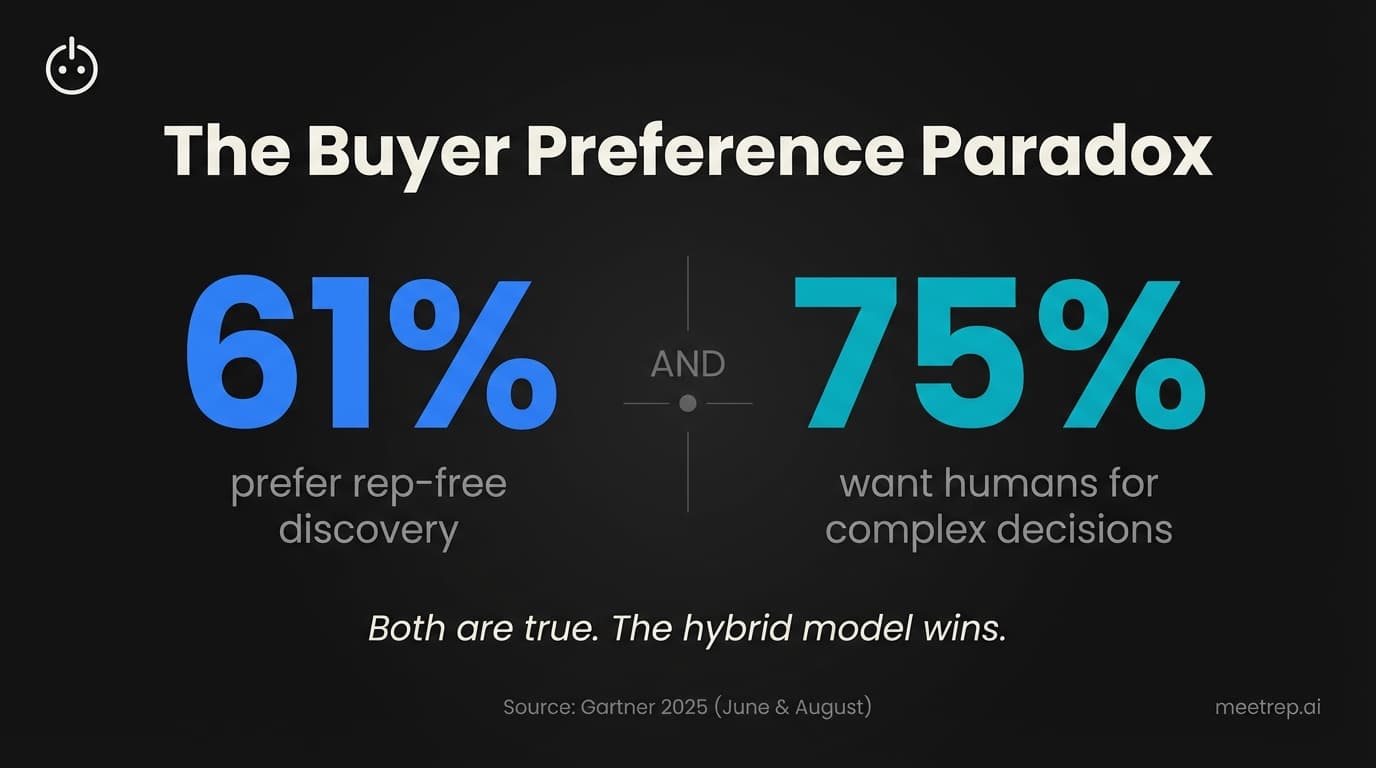
- The hybrid model wins because buyers want both—61% prefer rep-free discovery, but 75% still want humans for complex decisions
Every sales rep I talk to asks me the same question: Will AI replace sales reps and take my job?
I get it. The headlines are terrifying. AI SDRs that work 24/7. Autonomous agents closing deals. Gartner predicting AI agents will outnumber sellers 10x by 2028. If you're not anxious, you're not paying attention.
But here's what I've learned from building sales automation tools at GoCustomer.ai and now at Rep: the question itself is wrong. AI isn't coming for salespeople. It's coming for specific tasks. And the salespeople who figure out which tasks to hand off—and which to hold onto—will dominate the next decade.
The Short Answer: AI Is Transforming Sales, Not Replacing Salespeople
No, AI will not fully replace sales reps. But it is completely changing what salespeople do every day—and which roles survive.
According to Salesforce's 2024 State of Sales Report, 81% of sales teams are either experimenting with or have fully implemented AI. And the results are clear: teams using AI grew revenue at 83%, compared to 66% for teams without. That's a 17-point gap.
But here's what those numbers don't tell you: the AI isn't closing deals. It's eliminating the grunt work so humans can focus on what actually moves the needle.
Key Insight: The question isn't "AI vs. humans." It's "which tasks for which?" The hybrid model wins because it matches how buyers actually want to buy—fast self-service for discovery, human connection for decisions.
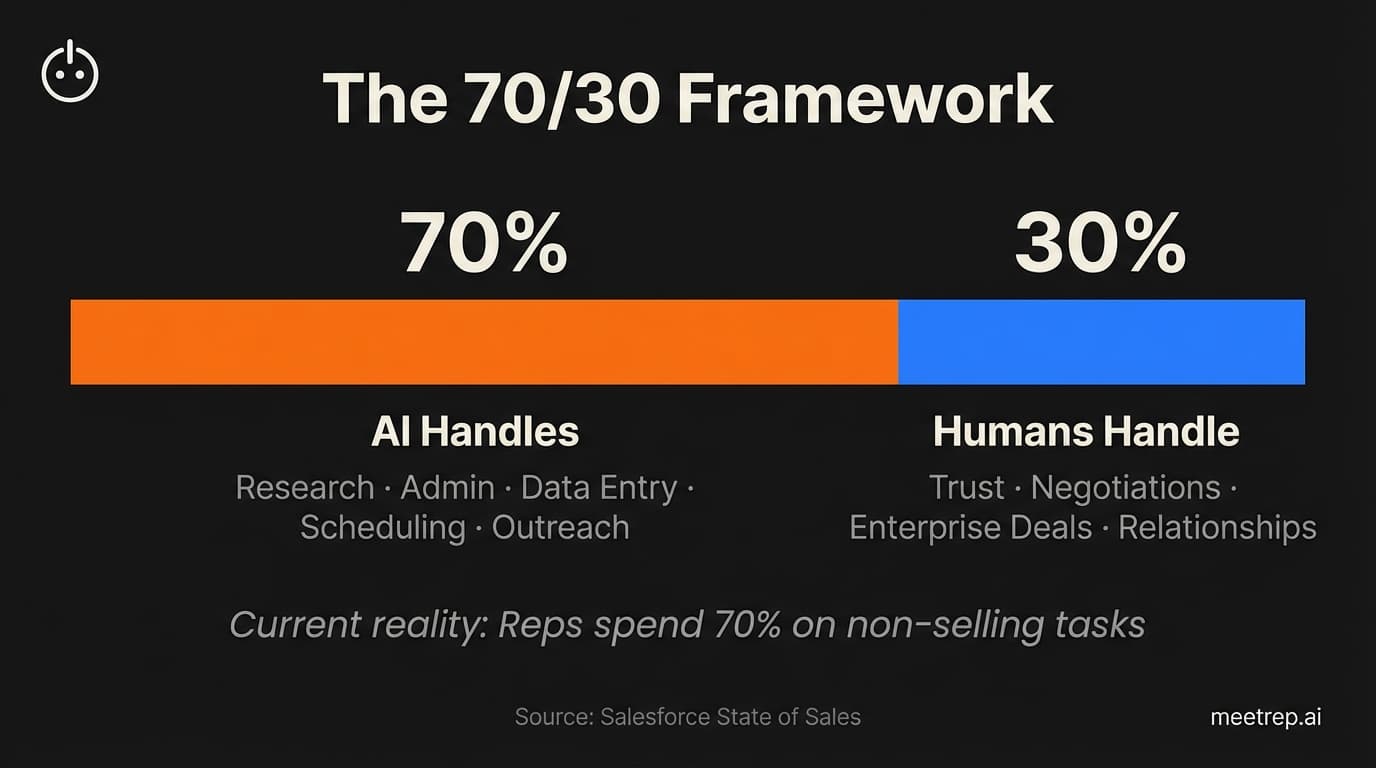
Think of it like this. Sales reps currently spend 70% of their time on non-selling tasks—data entry, research, scheduling, CRM updates. That's insane. AI can handle most of that. What it can't handle is reading the room when a CFO is hesitating, or working through the politics of a six-person buying committee.
Jason Lemkin from SaaStr calls this the "Mech-AE"—Account Executives armored with AI tools that handle the administrative burden, making them superhuman sellers. I think that's exactly right.
What AI Can Actually Do in Sales (The Productivity Gains Are Real)
Let's get specific. Here's what AI does well today—not in theory, but in practice:
- Score and prioritize leads using dozens of data points per prospect, reducing qualification time from hours to minutes
- Generate personalized outreach at 10-40x human volume using intent signals and firmographic data
- Automate CRM data entry, capturing meeting notes and interactions without manual logging
- Handle 24/7 inbound response and meeting scheduling—this matters more than people realize
- Research prospects automatically by pulling information from hundreds of sources
- Analyze conversation patterns through tools like Gong to identify what's working
- Deliver product demos on demand through AI agents that can share screens and walk prospects through your product live
The Data:64% of sales reps save 1-5 hours weekly through AI automation (HubSpot 2024). That's a full workday back every two weeks. And 75% of salespeople who exceeded quota used AI (LinkedIn/Ipsos 2024).
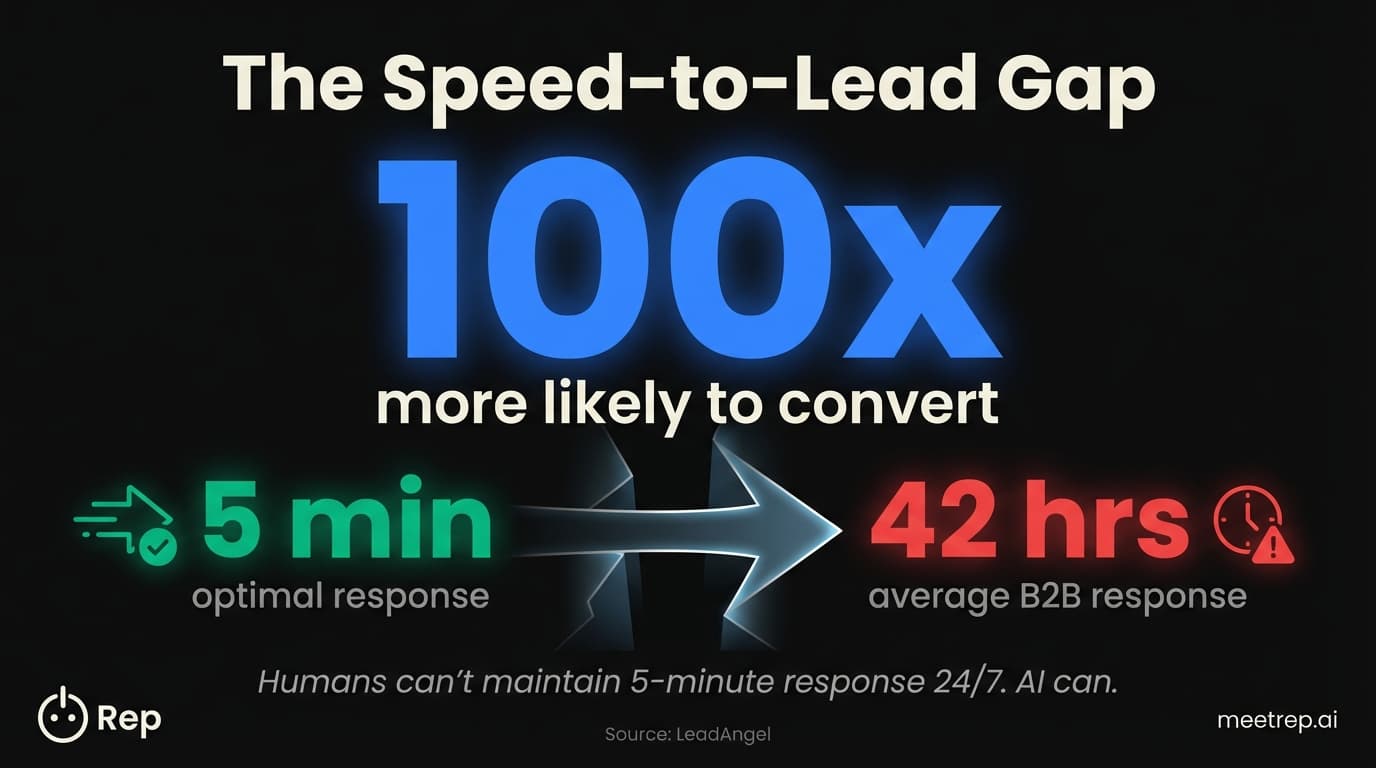
The speed-to-lead data alone is compelling. Leads are 100x more likely to convert if contacted within 5 minutes versus 30 minutes. But the average B2B response time is still 42 hours. Humans can't physically maintain 5-minute response times 24/7. AI can.
That's why we built Rep to handle inbound demo requests around the clock. Not because AI is better than humans at demos—it's not. But because a prospect requesting a demo at 11pm shouldn't have to wait until Tuesday for a response.
What AI Cannot Do: The Human Skills That Remain Irreplaceable
Here's where the AI hype falls apart. And I say this as someone building AI tools for sales.
AI cannot build trust. It cannot read the emotional subtext when a buyer says "we need to think about it." It cannot work through the politics of a buying committee where the VP of Engineering wants your product but the CFO is blocking budget.
The research backs this up. Gartner's August 2025 study found that by 2030, 75% of B2B buyers will still prefer sales experiences that prioritize human interaction. Not because they're anti-technology—but because complex decisions require what Gartner calls "contextual intelligence" that AI simply doesn't have.
| Capability | AI Performance | Human Performance | Who Wins |
|---|---|---|---|
| Outreach volume | 3,000+ emails/month | 75-285 emails/month | AI |
| 24/7 availability | Yes | No | AI |
| Response time | Under 1 minute | 42 hours average | AI |
| Trust building | Cannot replicate | Essential for complex deals | Humans |
| In-person closing | Cannot perform | 3x higher conversion | Humans |
| Complex negotiation | Cannot read emotional signals | Essential for enterprise | Humans |
| Multi-stakeholder politics | Cannot work through | Required for $250K+ deals | Humans |
And here's a stat that surprised me: in-person sales still close at 3x the rate of virtual meetings according to data from Toast and SaaStr. Even in our digital-first world, physical presence matters for high-stakes deals.
What we learned at Rep: We intentionally designed for handoff, not replacement. Rep handles the demo—showing the product, answering knowledge-base questions, qualifying interest. But the moment a prospect is ready for a real conversation? They get connected to a human AE. We tried fully autonomous demos early on. The drop-off was brutal. Buyers wanted to talk to someone.
Which Sales Roles Are Most at Risk (And Which Are Safe)
Not all sales roles face the same risk. Deal size is the clearest predictor of AI displacement.
| Deal Size | Risk Level | What's Happening |
|---|---|---|
| Under $10K | High | Transactional, script-based. AI can handle most of this. |
| $10-50K | Medium | AI qualifies, humans close. The "Mech-AE" model. |
| $50-250K | Low | Human-led, AI-assisted. Complex enough to need relationships. |
| $250K+ | Very Low | Humans required. Multi-stakeholder, strategic, political. |
McKinsey's November 2025 State of AI report found that 32% of organizations expect AI-related workforce reductions of 3% or more in the next year. Those reductions won't be evenly distributed. Transactional SDRs handling high-volume, low-complexity outreach face the most pressure.
But here's the flip side: Salesforce still employs over 450 SDRs. IBM has 3,200+ BDRs. Enterprise companies aren't eliminating these roles—they're evolving them. The SDRs who remain are the ones using AI to work smarter, not the ones doing exactly what AI can do.
The Cautionary Tales: What Happens When Companies Go Full Replacement
Honestly, I want to be upfront about the failures too. They're instructive.
Klarna made headlines in 2024 announcing their AI assistant was doing the work of 700 customer service agents. By mid-2025? They were rehiring humans. Why? According to Forbes, the AI interactions were lower quality. Customers "like talking to people" for complex issues. The cost savings weren't worth the customer experience hit.
Lattice tried a different approach. In July 2024, they announced "Digital Workers" would be treated as employees in their HR system—with employee records, managers, even onboarding. The backlash was immediate and brutal. They scrapped the plan within days. The lesson? Positioning matters. AI as tool, good. AI as colleague, creepy.
Common mistake: Rushing AI implementation without strategy. Forrester predicts that active selling time will actually decrease by 10% in 2025 for companies that don't implement AI thoughtfully—because reps end up spending more time managing AI tools than selling.
And Gartner's November 2025 prediction cuts both ways: AI agents will outnumber sellers 10x by 2028, but fewer than 40% of sellers will report that AI actually improved their productivity. More AI doesn't automatically mean better results.
How Top Salespeople Are Adapting Right Now
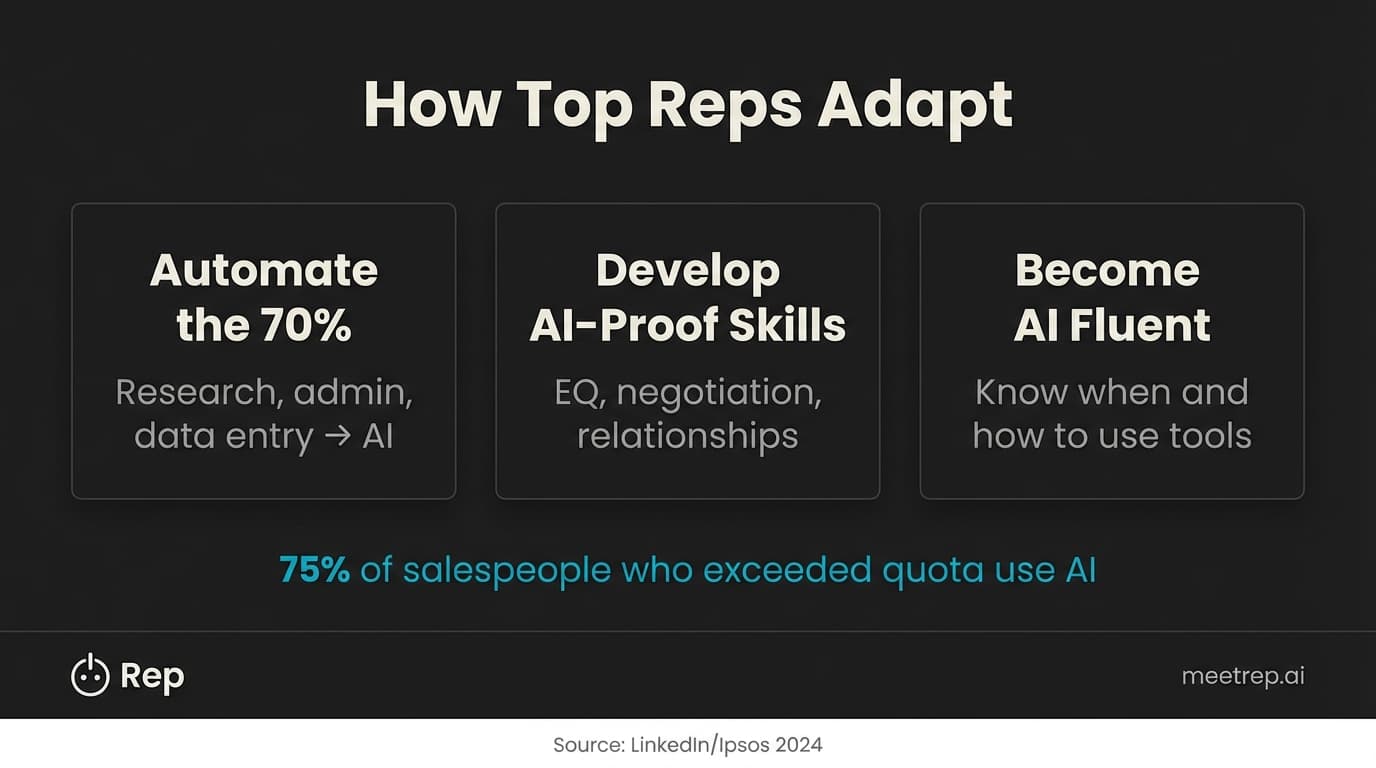
So what should you actually do? Here's what I'm seeing from reps who are thriving.
They're using AI for the 70%, humans for the 30%. All that non-selling time—research, admin, data entry, scheduling—goes to AI. The time freed up goes to relationship building, complex negotiations, and strategic account management.
They're developing skills AI can't replicate. Emotional intelligence. Creative problem-solving. The ability to challenge buyer assumptions and reframe needs. Multi-stakeholder management. These aren't soft skills anymore. They're survival skills.
They're becoming AI fluent. Not building AI—but knowing when to use which tools, how to evaluate output quality, and how to course-correct when AI gets it wrong. The reps I talk to who exceed quota don't just use AI. They use it intentionally.
As one practitioner put it in research from UserGems: "A hybrid approach works best—AI for the heavy lifting and humans for the finesse." That matches everything I've seen.
The Buyer Preference Paradox: Why the Hybrid Model Wins
Here's what most articles miss. Two stats that seem contradictory but actually tell the whole story:
61% of B2B buyers prefer a rep-free buying experience—for discovery and research (Gartner June 2025).
And yet: 75% of B2B buyers will prefer human interaction by 2030 for complex decisions (Gartner August 2025).
Both are true. Buyers want to research at 11pm without waiting for a sales rep. But they also want to talk to a human before signing a $200K contract. The companies that win give them both.
That's exactly why tools like Rep exist—to handle the rep-free discovery experience (24/7 demos, instant answers, no scheduling friction) while making it easy to hand off to a human when the prospect is ready for a real conversation.
My prediction? We're three years into a ten-year transition. The sales job automation shift isn't sudden—it's gradual. And the salespeople who start adapting now will have a massive advantage over those who wait until it's obvious.
The future of sales isn't AI versus humans. It's AI plus humans, each doing what they do best. And if you're a salesperson reading this, that's genuinely good news. Your job isn't going away. But it is changing. And the ones who change with it—using AI as a force multiplier rather than viewing it as a threat—will be the ones writing their own tickets.
Want to see what AI-human handoff looks like in practice? See how Rep handles autonomous demos—and hands off to your team when prospects are ready to talk.

Nadeem Azam
Founder
Software engineer & architect with 10+ years experience. Previously founded GoCustomer.ai.
Nadeem Azam is the Founder of Rep (meetrep.ai), building AI agents that give live product demos 24/7 for B2B sales teams. He writes about AI, sales automation, and the future of product demos.
Frequently Asked Questions
Table of Contents
- The Short Answer: AI Is Transforming Sales, Not Replacing Salespeople
- What AI Can Actually Do in Sales (The Productivity Gains Are Real)
- What AI Cannot Do: The Human Skills That Remain Irreplaceable
- Which Sales Roles Are Most at Risk (And Which Are Safe)
- The Cautionary Tales: What Happens When Companies Go Full Replacement
- How Top Salespeople Are Adapting Right Now
- The Buyer Preference Paradox: Why the Hybrid Model Wins
Ready to automate your demos?
Join the Rep Council and be among the first to experience AI-powered demos.
Get Early AccessRelated Articles
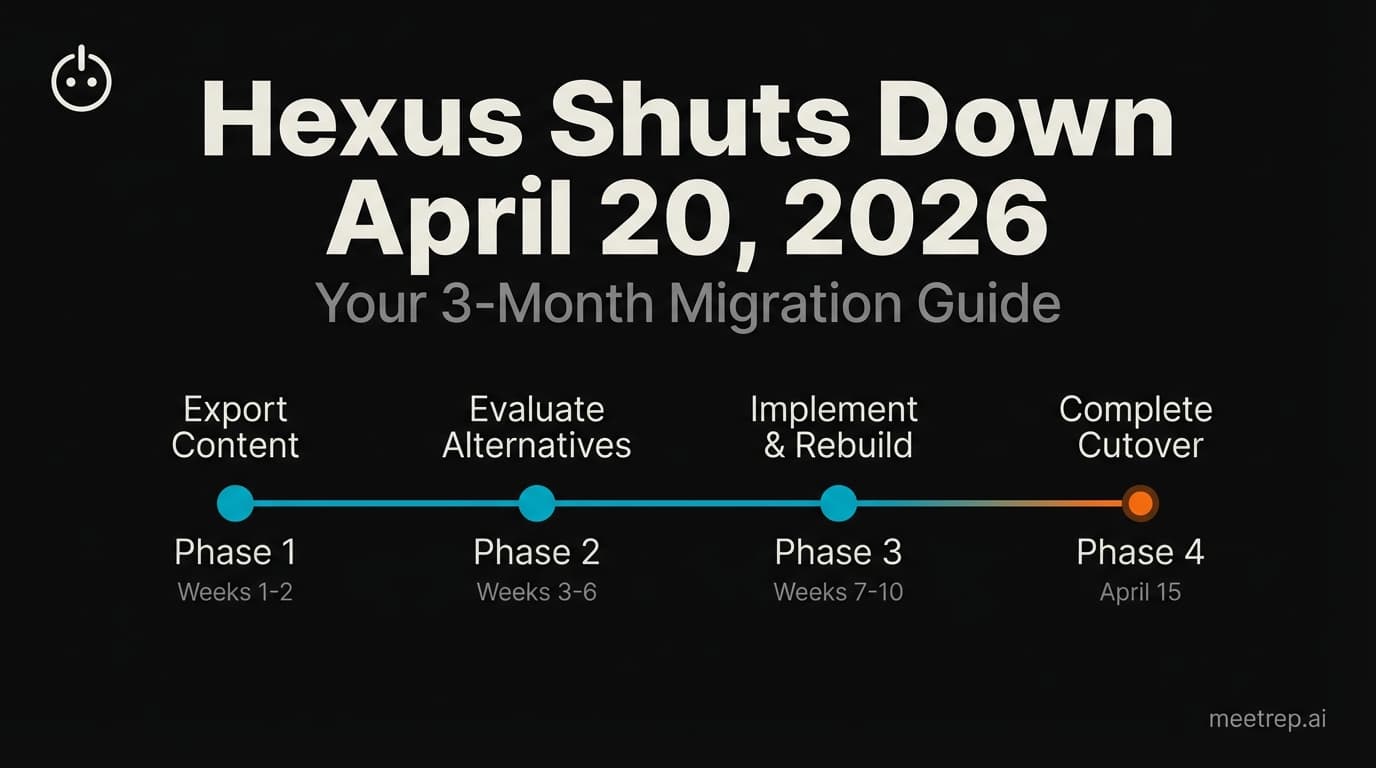
Hexus Acquired by Harvey AI: Congrats & What It Means for Demo Automation Teams
Hexus is shutting down following its acquisition by Harvey AI. Learn how to manage your migration and discover the best demo automation alternatives before April 2026.
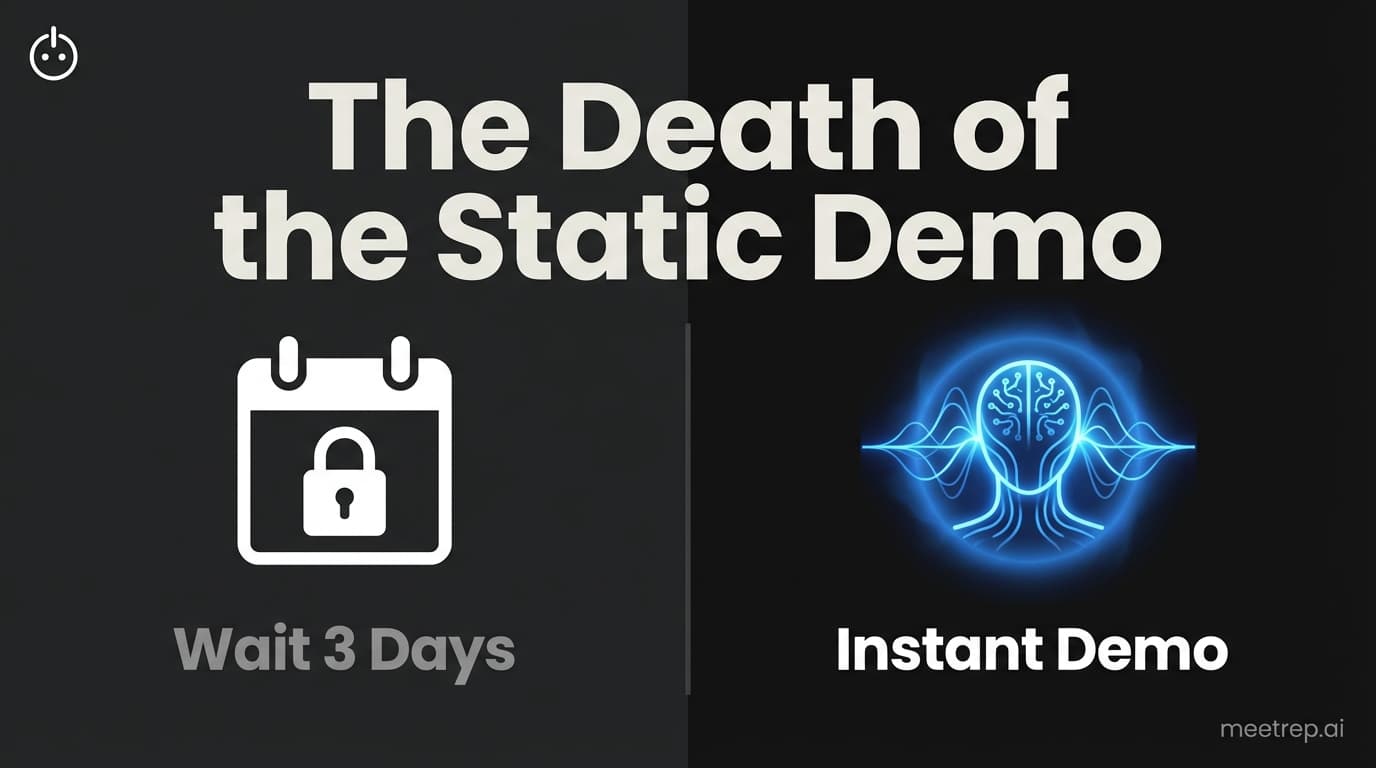
Why the "Software Demo" is Broken—and Why AI Agents Are the Future
The traditional software demo is dead. Discover why 94% of B2B buyers rank vendors before calling sales and how AI agents are replacing manual demos to scale revenue.
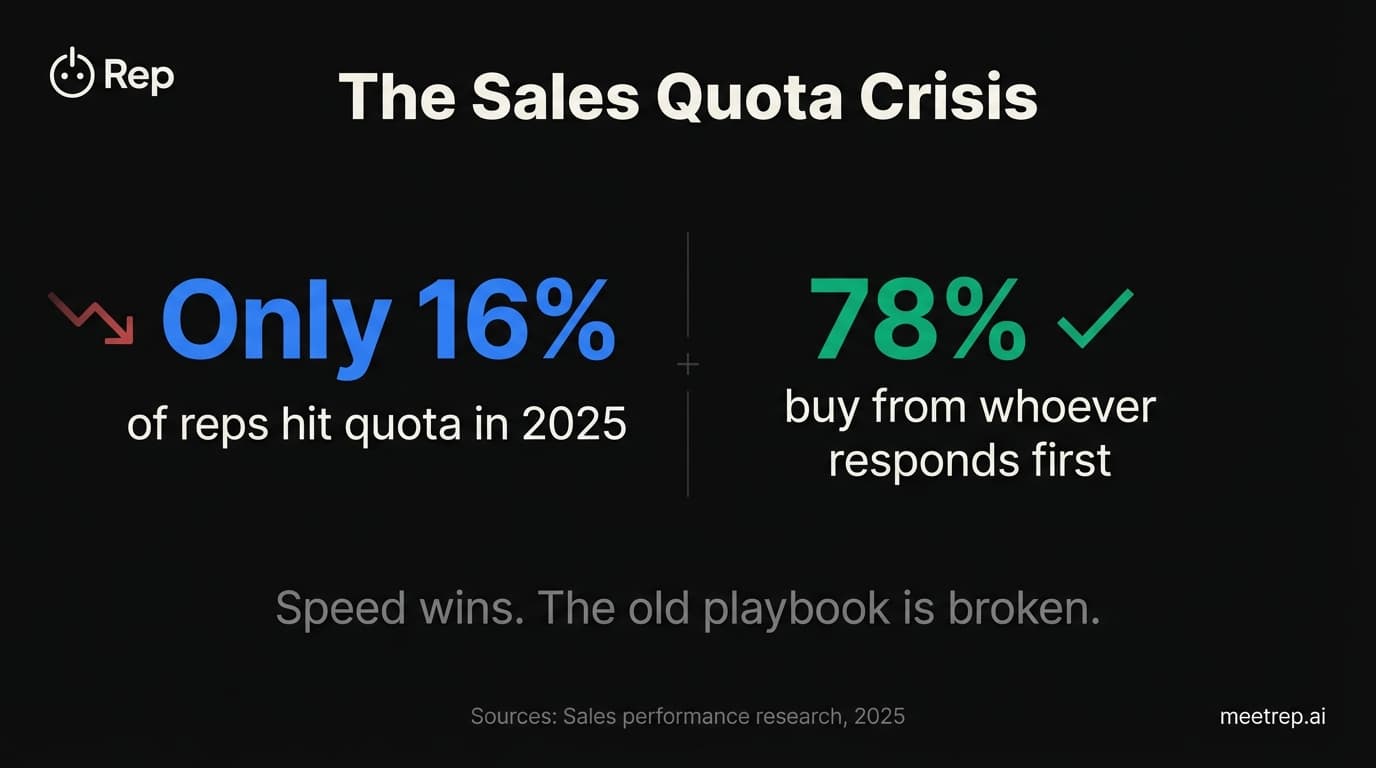
Why Autonomous Sales Software is the Future of B2B Sales (And Why the Old Playbook is Dead)
B2B sales is at a breaking point with quota attainment at 46%. Discover why autonomous 'Agentic AI' is the new standard for driving revenue and meeting the demand for rep-free buying.