Best Product Demo Software 2026: Complete Buyer's Guide

Executive Summary
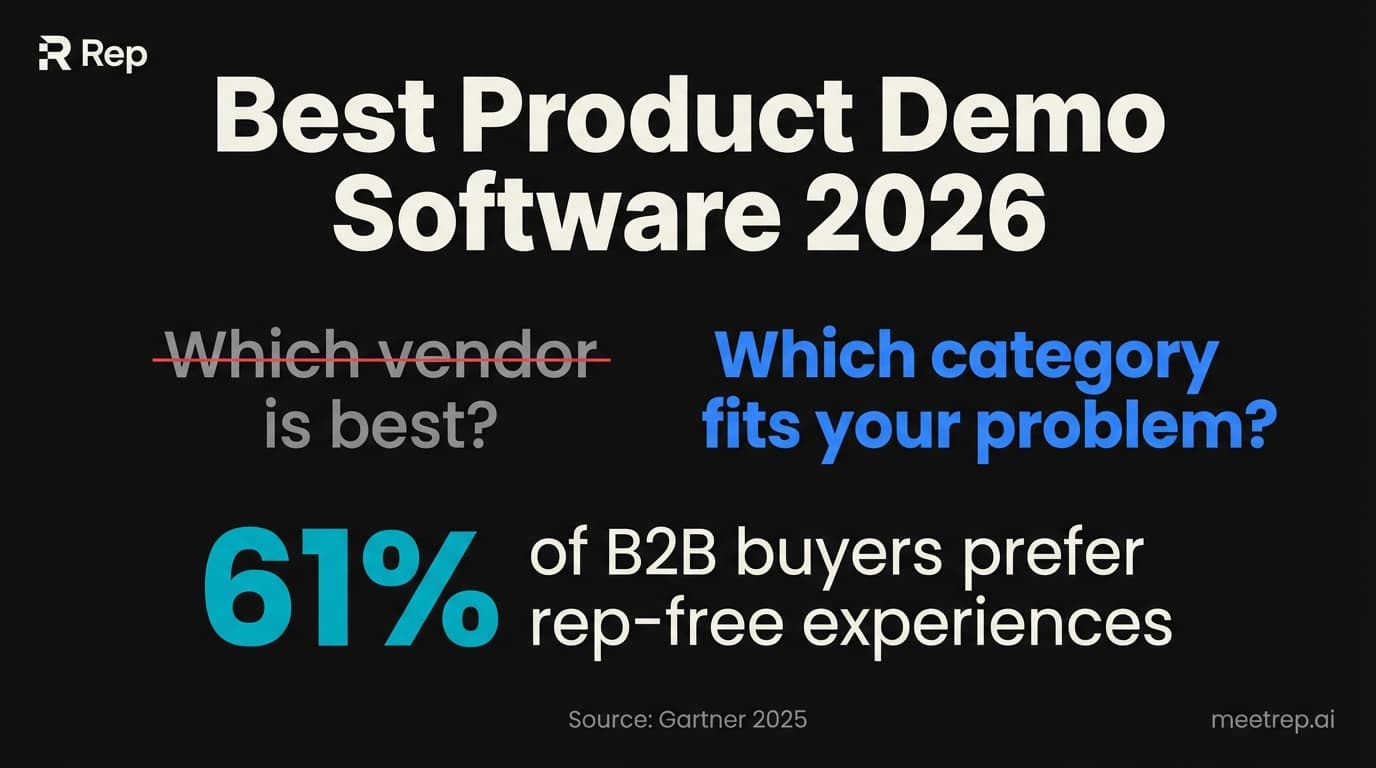
- The shift: 61% of B2B buyers prefer rep-free buying. Your demo strategy needs to adapt.
- Five categories exist: Screenshot-based tours, product clones, video demos, AI agents, and data overlays. Each solves different problems.
- Category > Vendor: Picking the wrong category guarantees failure. Navattic vs. Demostack isn't a fair comparison—they're built for completely different use cases.
- The data: Interactive demos cut sales cycles by up to 30%. Ramp generates 15% of leads from product tours alone.
Your "Request a Demo" button is killing deals.
Here's why: 94% of buying groups now rank their vendor shortlist before ever contacting sales. By the time a prospect fills out your form, they've already decided whether you're a contender. And if your competitors let them see the product instantly while you're asking them to wait three days for a calendar slot? You've lost.
I've spent years building product demo software—first at GoCustomer.ai, now at Rep. I've watched this market evolve from basic screen recordings to AI agents that join video calls autonomously. The tools have changed dramatically. But the biggest mistake buyers make hasn't changed at all: they pick a vendor before they pick a category.
This guide won't give you a simple "best demo software" answer. Because that's the wrong question. I'll show you the five distinct categories of product demo software, when each one makes sense, and how to avoid the expensive mistake of choosing the wrong type entirely.
What Is Product Demo Software?
Product demo software is technology that helps sales teams create, deliver, and track product demonstrations for prospects—without requiring engineering resources or live rep availability for every interaction.
But that definition hides the real story. This category has fractured into five distinct tool types, each built for fundamentally different problems.
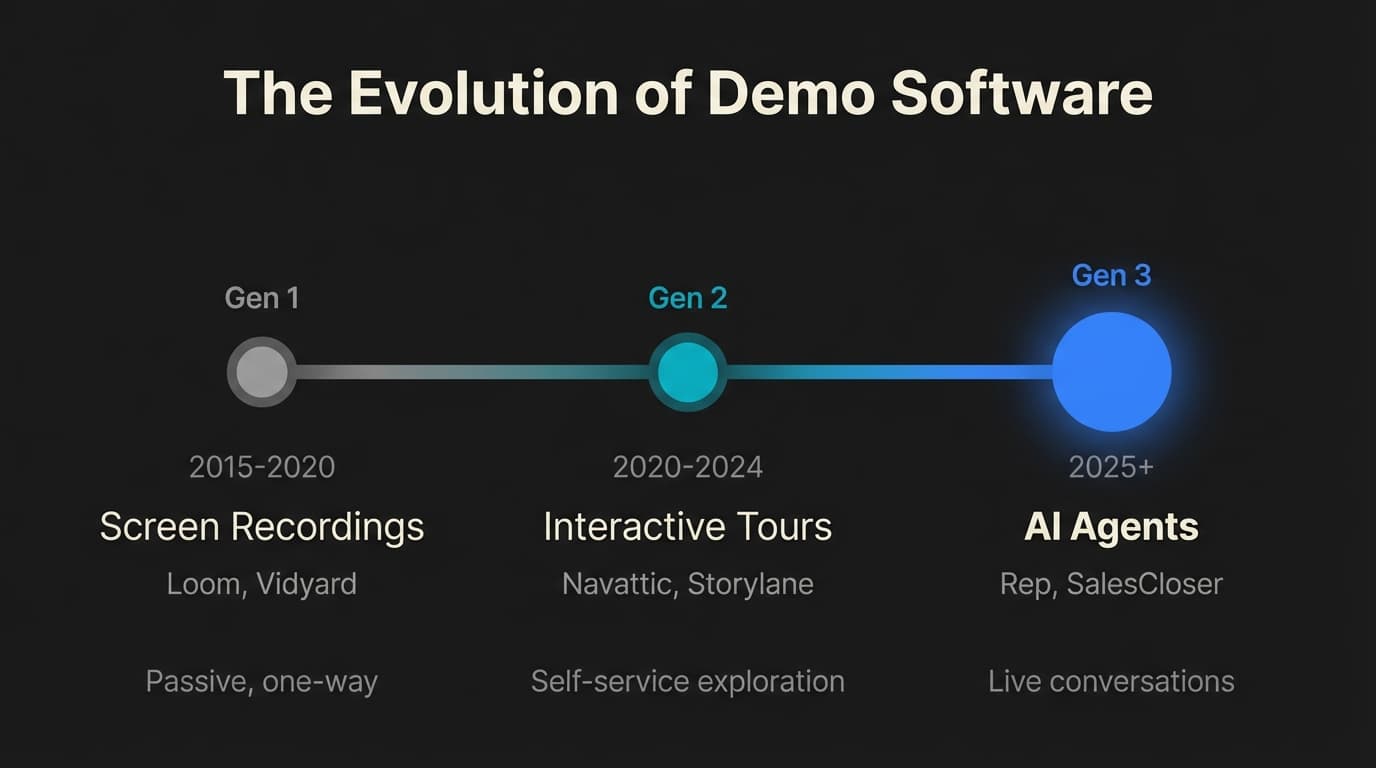
The evolution looks like this:
Gen 1 (2015-2020): Screen recordings. Loom, Vidyard. One-way videos you'd email to prospects. Simple but passive—most buyers wouldn't finish watching them.
Gen 2 (2020-2024): Interactive tours. Navattic, Storylane, Walnut. Clickable simulations prospects could explore themselves. Engagement jumped because buyers could control the experience.
Gen 3 (2025+): Autonomous AI agents. Rep, SalesCloser.ai. AI that joins video calls, shares its screen, walks through your actual product, and has real conversations with prospects. Not static. Not pre-recorded. Live.
Here's my take: most "product demo software" comparisons are useless because they compare tools from different generations and categories. That's like comparing a bicycle to a Tesla because they both have wheels.
Key Insight: The category you choose matters more than which vendor you pick within that category. A great screenshot tool will still fail if your product needs live technical demos. A powerful clone platform is overkill if you just need website embeds.
The 5 Types of Demo Software (And When Each Wins)
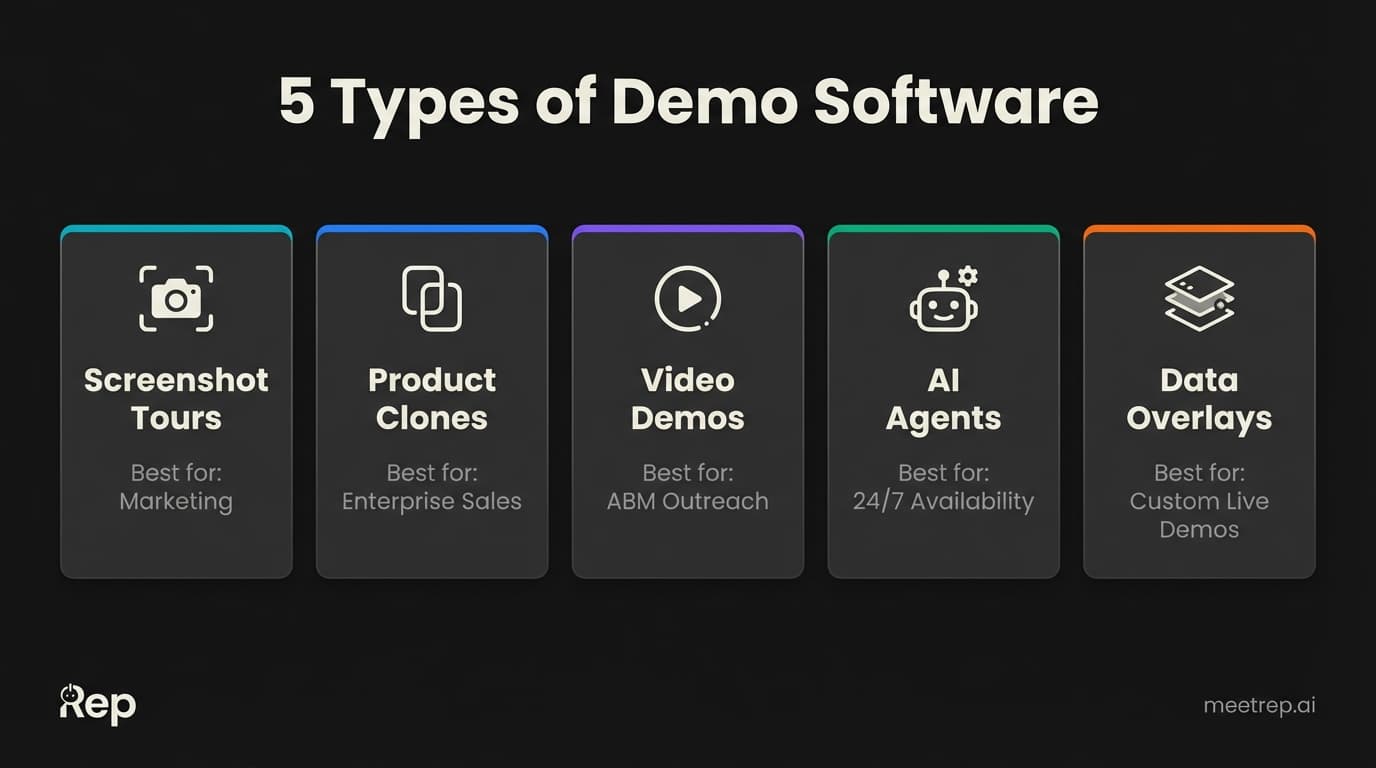
Before I list specific tools, you need to understand what you're actually choosing between.
| Demo Type | Best For | How It Works | Typical Cost | Example Tools |
|---|---|---|---|---|
| Interactive (Screenshot) | Marketing teams, PLG, website embeds | Captures screenshots, adds click hotspots, creates guided tours | $500-2,000/mo | Navattic, Storylane, Arcade, Supademo |
| Interactive (Clone) | Enterprise sales, SE teams, complex products | Creates full product replicas with real functionality | $20K-100K/year | Demostack, Reprise, Walnut |
| Video Demo | Personalized outreach, ABM, async follow-ups | Records video walkthroughs (sometimes with interactivity) | $50-500/user/mo | Consensus, Vidyard, Loom |
| Live AI Agent | 24/7 availability, inbound qualification, SDR automation | AI joins video calls, navigates live product, has real conversations | Contact vendor | Rep, SalesCloser.ai |
| Data Overlay | Custom live demos, prospect-specific scenarios | Overlays realistic data on your production environment | $15K-50K/year | Saleo |
The Data:Top-performing demos achieve 67% CTR compared to an 8% average. The difference isn't just the tool—it's whether you picked the right type of tool for your use case.
Let me break down each category with specific recommendations.
Best Screenshot-Based Demo Tools for Marketing Teams
If your goal is website conversion—letting visitors explore your product before they talk to sales—screenshot-based tools are your answer.
Navattic leads the category for analytics. Ramp uses Navattic and attributes 15% of all leads to their product tours. The analytics are genuinely useful: you can see exactly which features prospects care about before your SDRs ever pick up the phone.
Storylane wins on ease of use. Marketing teams without technical resources can create demo videos and product tours in hours, not weeks. If speed to launch matters more than deep analytics, start here.
Arcade takes a different approach—you record yourself using the product, and it converts the recording into an interactive demo. Good for teams that already have great product video examples and want to make them clickable.
Supademo is the lightweight option. Fastest creation time, lowest price point. If you need something basic on your website tomorrow, this works.
Who should NOT use screenshot tools: Enterprise sales teams with complex products. If your demo requires showing 20+ features, multiple user roles, or dynamic data, these tools will feel limiting. You'll spend more time maintaining outdated screenshots than actually selling.
Best Product Clone Platforms for Sales Engineers
When prospects need to see real functionality—not just pictures of it—you need full product clones.
Demostack is the category leader for complex products. Synack (cybersecurity) reduced demo prep from 100+ hours to 10 hours using Demostack's cloning technology. Gainsight saw a 25% increase in win rates. These aren't vanity metrics. They're from named companies with real implementations.
Reprise focuses heavily on security and compliance. If your enterprise buyers have strict requirements about what can be shown in demos, Reprise addresses that directly.
Walnut offers no-code personalization. Your AEs can customize demos for specific prospects without waiting on Solutions Engineering.
What I've learned building in this space: the implementation matters as much as the tool. Clone platforms require someone to build and maintain the demo environment. Budget 4-8 weeks for setup, not the "2 days" some vendors claim.
What we learned at GoCustomer: Tools that reps don't actually use waste 100% of your budget. Before you buy a clone platform, make sure your SE team has capacity to build content. A $50K platform with zero demos is just expensive shelfware.
Best Video Demo Tools for Personalized Outreach
Video demos haven't disappeared. They've specialized.
Consensus pioneered demo automation—sending personalized demo videos at scale. When you need to reach 50 stakeholders at an enterprise account with slightly customized walkthroughs, Consensus handles that workflow.
Vidyard is the broader video platform. If your use case goes beyond demos (sales prospecting, customer success, internal training), Vidyard's breadth makes sense.
Loom is everywhere. Atlassian owns it now. For quick app demo video recordings to send in email follow-ups, Loom is hard to beat on simplicity. But it's not built for sales tracking and analytics the way Consensus is.
When video beats interactive: ABM campaigns where personalization matters more than interactivity. Following up after a live demo with a "here's what we covered" recording. Internal champion enablement—giving your buyer a video demo they can share with their CFO.
Best AI Demo Agents: The 2026 Frontier
This is where I have the most direct experience. And the most opinions.
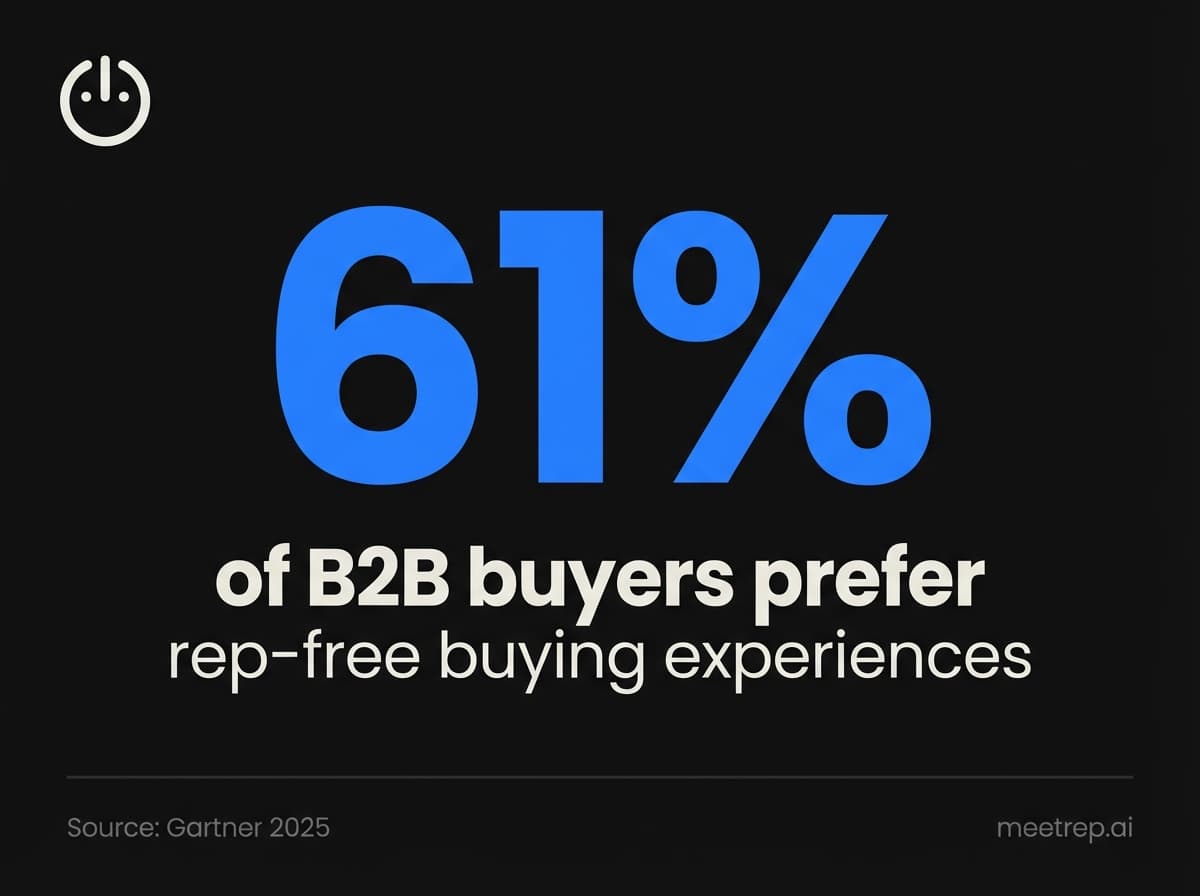
61% of B2B buyers now prefer a rep-free buying experience. They want to see your product when they're ready—which might be 2am their time. But interactive tours can't answer questions. Video demos can't adapt to what the prospect cares about.
AI demo agents solve this. They join video calls. Share their screen. Navigate your actual product live. Have real conversations.
Rep (full disclosure: I'm the founder) is what we built to address this specific gap. Rep joins meetings as an AI participant, controls a real browser showing your product, and talks with prospects using voice AI. It handles the discovery calls and initial demos that used to consume your SDR team's entire day.
SalesCloser.ai takes a similar approach with a stronger multi-language focus.
I'll be direct about limitations: AI agents are best for discovery and qualification. They're not replacing your senior AE on a six-figure negotiation. They're replacing the first-touch on unqualified inbound that was eating 15 hours of SDR time per week anyway.
My recommendation: If your bottleneck is demo availability—prospects want to see the product but your team is at capacity—AI agents unlock 24/7 coverage without hiring. If your bottleneck is demo quality or complex technical selling, that's a different problem.
How to Choose the Right Demo Software: 7-Step Framework
Stop asking "what's the best demo software?" Start asking "what problem am I actually solving?"
- Identify your primary bottleneck. Is it website conversion? Demo prep time? Scheduling availability? Rep bandwidth? Each bottleneck points to a different category.
- Assess your product complexity. Simple SaaS (5-10 core features) works with screenshot tools. Complex platforms (20+ features, multiple user roles) need clones or live AI.
- Know your team's technical capacity. No developers available? Stick to no-code options like Storylane or Walnut. Have dedicated SE resources? Clone platforms become viable.
- Map where demos fit in your funnel. Top-of-funnel awareness = website embeds (Navattic). Middle-funnel evaluation = leave-behind demos (Consensus). Late-stage technical validation = live demos with clones (Demostack) or AI (Rep).
- Check integration requirements. Your CRM, sales engagement platform, and marketing automation need to connect. Siloed demo data is useless demo data.
- Verify analytics capabilities. Can you see which features prospects actually clicked? How long they spent on each section? Actionable insights vs. vanity metrics like "demo views."
- Calculate true total cost. Sticker price is maybe 50% of what you'll spend. Add implementation time, training, content creation, and ongoing maintenance. A "$500/month" tool with 40 hours of monthly content maintenance isn't cheap.
| If Your Problem Is... | You Need... | Look At... |
|---|---|---|
| Low website conversion | Screenshot-based tours | Navattic, Storylane |
| Demo prep consuming SE time | Product clones | Demostack, Walnut |
| Prospects wanting demos at 2am | AI demo agents | Rep |
| Personalized ABM outreach | Video automation | Consensus, Vidyard |
| Boring live demo data | Data overlays | Saleo |
What the ROI Data Actually Shows
I'm skeptical of most ROI claims in this space. But some data points are too consistent to ignore.
Interactive demos reduce sales cycles by up to 30%. Gainsight measured this directly before and after implementing Demostack.
Prospects reach sales calls 2 weeks faster after viewing interactive demos vs. the old "request a demo and wait" model.
83% of AI-enabled sales teams saw revenue growth compared to 66% without AI—that's a 1.3x multiplier. This isn't demo-specific, but it shows the broader impact of AI in sales workflows.
The cost of doing nothing? Your reps spend only ~30% of their time actually selling. The other 70% is admin, scheduling, prep, and repetitive demos. Every hour not reclaimed is revenue you're leaving behind.
The Data:75% of B2B buyers would switch suppliers for a better online buying experience. The question isn't whether to improve your demo process. It's whether to do it before or after your competitor does.
The product demo software market in 2026 looks nothing like it did five years ago. Static screenshots gave way to interactive tours. Tours are giving way to AI agents. And buyers—demanding instant access and rep-free exploration—are driving all of it.
My prediction: within two years, the companies still forcing prospects through "request a demo" gates will see their pipeline dry up. The 61% who prefer rep-free buying aren't waiting for your calendar to free up. They're evaluating your competitors who let them in immediately.
So pick your category. Pick your tool. And stop losing deals before they even start.
Want to see what autonomous AI demos actually look like? Rep runs live demos 24/7—no scheduling required.

Nadeem Azam
Founder
Software engineer & architect with 10+ years experience. Previously founded GoCustomer.ai.
Nadeem Azam is the Founder of Rep (meetrep.ai), building AI agents that give live product demos 24/7 for B2B sales teams. He writes about AI, sales automation, and the future of product demos.
Frequently Asked Questions
Table of Contents
- What Is Product Demo Software?
- The 5 Types of Demo Software (And When Each Wins)
- Best Screenshot-Based Demo Tools for Marketing Teams
- Best Product Clone Platforms for Sales Engineers
- Best Video Demo Tools for Personalized Outreach
- Best AI Demo Agents: The 2026 Frontier
- How to Choose the Right Demo Software: 7-Step Framework
- What the ROI Data Actually Shows
Ready to automate your demos?
Join the Rep Council and be among the first to experience AI-powered demos.
Get Early AccessRelated Articles
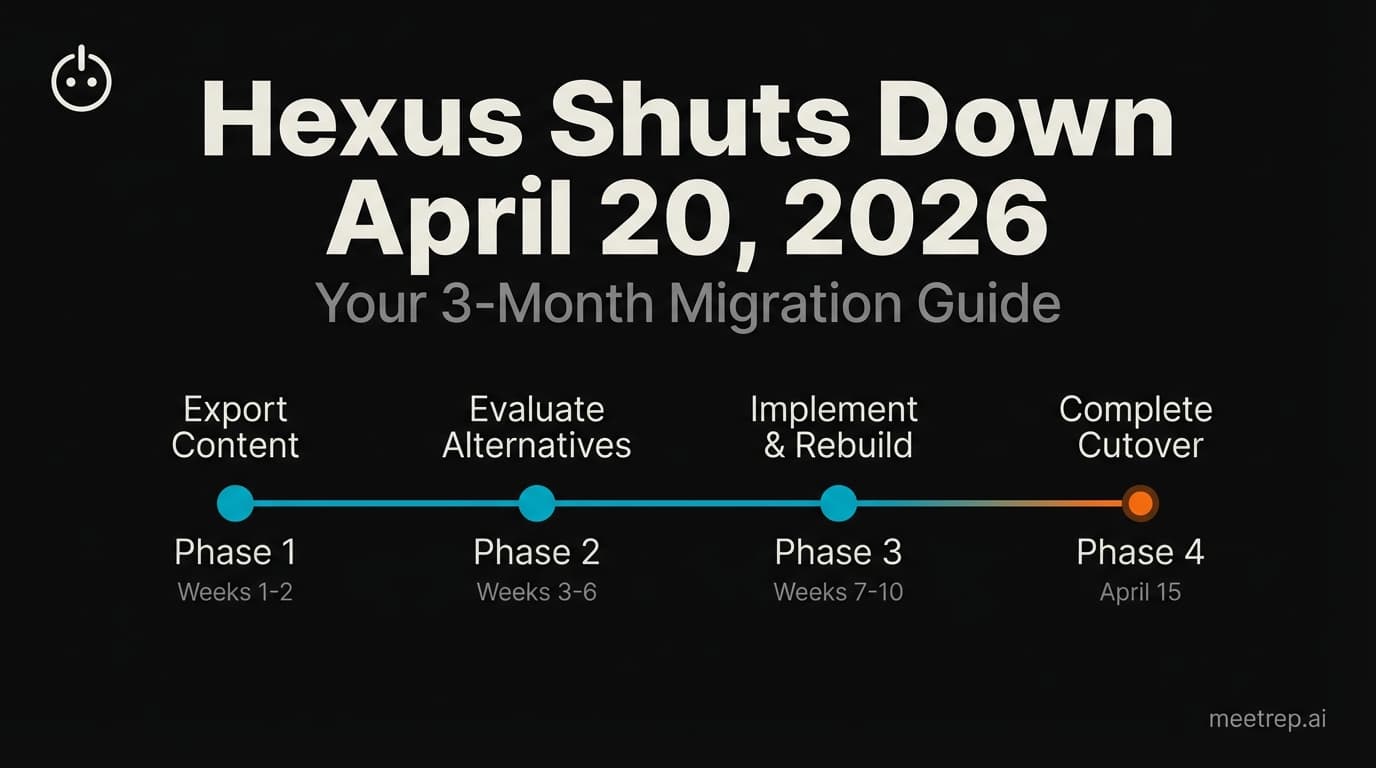
Hexus Acquired by Harvey AI: Congrats & What It Means for Demo Automation Teams
Hexus is shutting down following its acquisition by Harvey AI. Learn how to manage your migration and discover the best demo automation alternatives before April 2026.
Why the "Software Demo" is Broken—and Why AI Agents Are the Future
The traditional software demo is dead. Discover why 94% of B2B buyers rank vendors before calling sales and how AI agents are replacing manual demos to scale revenue.
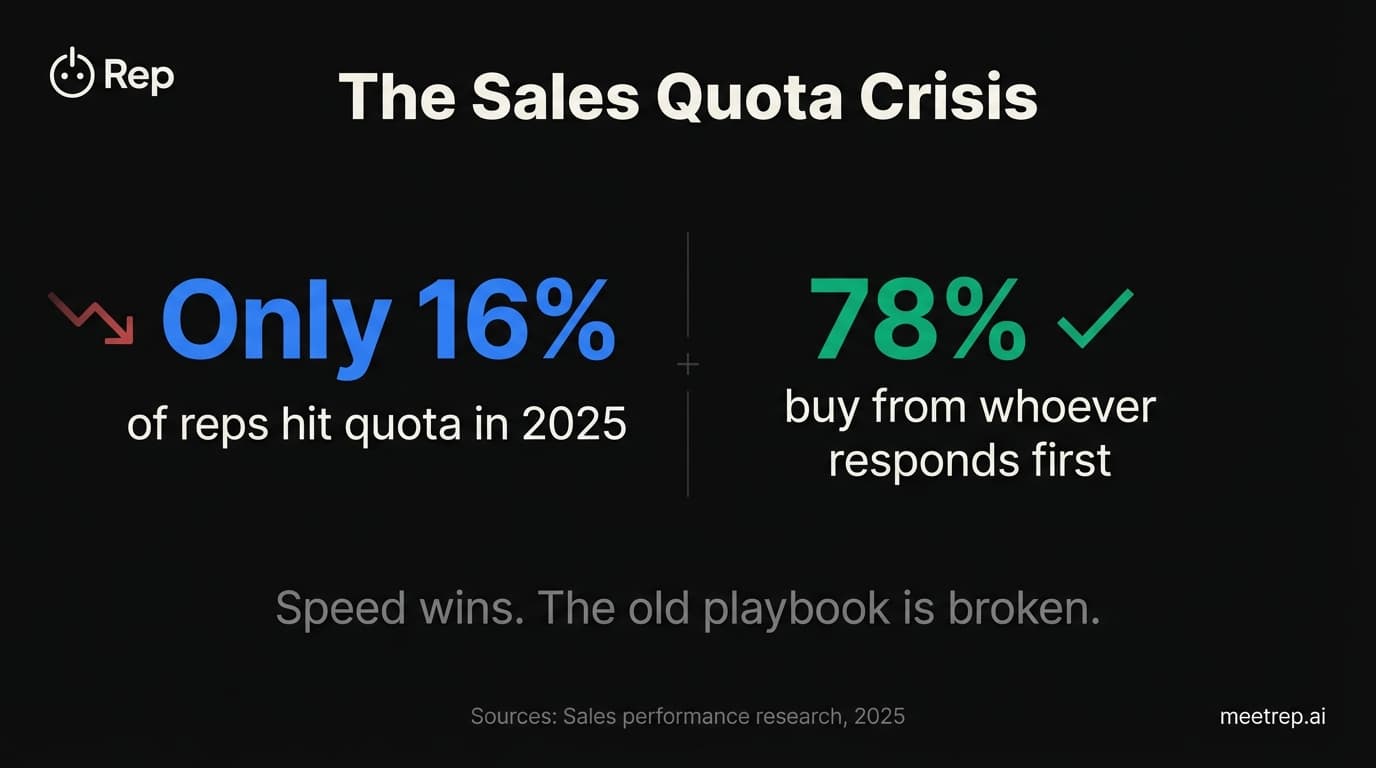
Why Autonomous Sales Software is the Future of B2B Sales (And Why the Old Playbook is Dead)
B2B sales is at a breaking point with quota attainment at 46%. Discover why autonomous 'Agentic AI' is the new standard for driving revenue and meeting the demand for rep-free buying.