Best Email Outreach Tools for Sales Teams in 2026

Executive Summary
- Apollo.io wins for all-in-one prospecting + outreach (275M+ contact database built in)
- Instantly.ai dominates high-volume sending at flat pricing ($37-358/mo for unlimited mailboxes)
- Salesloft/Outreach.io are enterprise-grade—but overkill and overpriced for most teams
- Email warmup is now mandatory. Skip it and you'll burn your domain within weeks.
- Budget $25-50/seat/month for solid tools. Enterprise platforms run $100-160/seat.
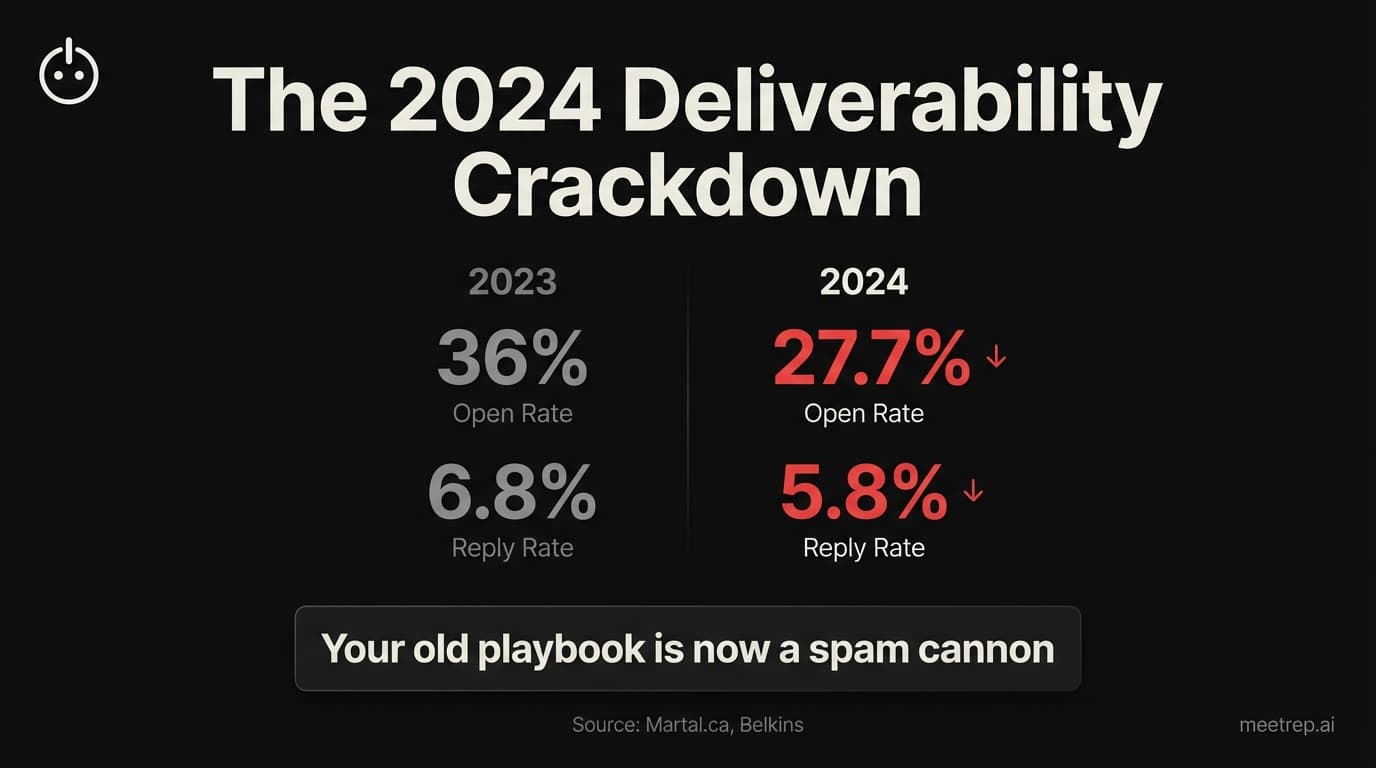
Mark Cuban has invested tens of millions from cold emails. Some turned into unicorns. But that was before Google and Yahoo torched deliverability in 2024. Open rates dropped from 36% to 27.7% in a single year. Reply rates fell to 5.8%—down from 6.8% the year before.
The email outreach tools that worked two years ago? Many are now spam cannons burning domains.
I've built sales automation software. At GoCustomer.ai, I watched deliverability make or break campaigns daily. The tools that win now aren't the flashiest—they're the ones with serious infrastructure under the hood. This guide covers what actually works, what it really costs, and how to deploy without destroying your sender reputation.
What Are Email Outreach Tools and Why Do They Matter Now?
Email outreach tools are software platforms that automate personalized cold email campaigns at scale. They handle sequencing, follow-ups, deliverability management, and engagement tracking—letting sales teams prospect efficiently without manual copy-paste chaos.
Here's why the right tool matters more than ever.
36% of B2B companies cut SDR headcount in 2025, according to SaaStr and Emergence Capital research. That's the highest reduction among all sales roles. The teams left standing need to do more with less. Manual outreach doesn't scale.
And the inbox has gotten hostile. Google's February 2024 enforcement means spam complaint rates above 0.3% get you blocked. The margin for error is gone.
The Data: Cold email reply rates dropped 15% year-over-year to 5.8% in 2024. Teams not adapting are losing 1 in 7 potential conversations they would have had a year ago. Source: Belkins analysis of 16.5 million emails
But here's what doesn't get said enough: 61% of B2B decision-makers still prefer email over other outreach methods. The channel works. The execution has to change.
So which tools actually help you execute?
How We Evaluated These Tools
I'm not going to pretend I ran A/B tests across all ten platforms for six months. Nobody does that, and anyone who claims otherwise is lying.
Here's what I actually did:
- Analyzed G2 and Capterra reviews focusing on SDR team use cases, not solopreneurs
- Verified pricing directly from vendor sites (January 2026)
- Pulled performance data from the largest studies available—Belkins' 16.5 million email analysis, MailerLite's 3.6 million campaigns, Instantly's 2026 benchmark report
- Included only case studies with named companies and specific results
- Calculated true costs at team scale (5, 10, 25 seats)—not the "starting at" marketing nonsense
What I looked for:
| Criteria | Why It Matters |
|---|---|
| Deliverability infrastructure | Warmup, rotation, authentication—this makes or breaks you |
| True team pricing | Hidden costs kill ROI |
| CRM integration depth | Salesforce/HubSpot sync must be bidirectional |
| Personalization capabilities | AI writing, variables, spintax |
| Analytics granularity | Can managers see rep-level performance? |
No tool paid for placement here. I have no affiliate relationships with any of these vendors.
Quick Comparison: 10 Best Email Outreach Tools
Before the deep dives, here's the breakdown. Find your category, then scroll to the detailed review.
| Tool | Best For | Starting Price | Database | G2 Rating | Warmup |
|---|---|---|---|---|---|
| Apollo.io | All-in-one prospecting + outreach | $49/user/mo | 275M+ contacts | 4.8/5 (7,000+ reviews) | Yes |
| Instantly.ai | High-volume agency sending | $37/mo | No | 4.9/5 | Yes (unlimited) |
| Smartlead.ai | Agency scale + API access | $33/mo | No | 4.8/5 | Yes (unlimited) |
| Lemlist | Creative personalization | $39/user/mo | No | 4.5/5 | Yes |
| Saleshandy | Budget-conscious teams | $25/user/mo | No | 4.6/5 | Yes |
| Salesloft | Enterprise revenue orchestration | Custom (~$100-160/seat) | No | 4.5/5 (3,400+ reviews) | Add-on |
| Outreach.io | Enterprise revenue orchestration | Custom (~$100-160/seat) | No | 4.3/5 (3,400+ reviews) | Add-on |
| Reply.io | Multi-channel sequences | $49/user/mo | 140M+ contacts | 4.6/5 | Yes |
| Woodpecker | Simple interface, beginners | $29/user/mo | No | 4.3/5 | Yes |
| Mailshake | Teams needing phone dialer | $44/user/mo | No | 4.6/5 | Yes |
Now let's get specific.
The 10 Best Email Outreach Tools: Detailed Reviews
1. Apollo.io — Best All-in-One Platform
At a Glance:
- Best for: Teams wanting prospecting AND outreach in one platform
- Pricing: $49-119/user/month
- G2 Rating: 4.8/5 from 7,000+ reviews
- Standout: 275M+ contact database eliminates need for separate data provider
Apollo combines what usually requires two tools: a B2B database (like ZoomInfo) and an outreach platform (like Outreach). That consolidation matters.
The database is genuinely massive—275 million contacts with email verification built in. You're not paying for data separately, then importing it, then hoping the emails are valid. It's integrated.
The Data: Mutiny used Apollo.io to increase outbound revenue by 200%+ within 90 days. They also saw a 70% increase in email open rates. Outbound now accounts for ~40% of their closed-won revenue, up from under 15% previously. Source: Apollo.io Magazine, April 2024
What works well:
- Built-in database eliminates data provider costs
- Sequences with automatic enrollment from saved searches
- Intent data showing which accounts are actively researching solutions
- Chrome extension for prospecting directly from LinkedIn
What doesn't:
- Credit system gets expensive at scale (exports and emails consume credits)
- Advanced features (buying intent, conversation intelligence) only in higher tiers
- Learning curve is real—this isn't a "set up in an hour" tool
Pricing reality: The $49/month starter sounds reasonable. But that's per user. At 10 seats with Professional tier features most teams need, you're at $790/month. And credit overages add up fast if you're prospecting aggressively.
My recommendation: Apollo is genuinely the best choice if you're currently paying separately for ZoomInfo/Lusha + a sending tool. The consolidation saves money and workflow friction. If you already have solid data, look elsewhere.
2. Instantly.ai — Best for High-Volume Sending
At a Glance:
- Best for: Agencies and teams sending at serious scale
- Pricing: $37-358/month (flat fee, not per-seat)
- G2 Rating: 4.9/5
- Standout: Unlimited mailbox rotation at flat monthly pricing
Instantly built its reputation on one thing: letting you send a lot of emails without burning domains. The unlimited mailbox rotation isn't marketing speak—it's the actual architecture.
You connect as many sending accounts as you want (they recommend buying secondary domains specifically for outreach). Instantly distributes your sends across all of them, keeps complaint rates low on each individual mailbox, and handles warmup automatically.
What works well:
- Unlimited mailboxes means true scale without per-inbox costs
- Warmup network is one of the largest (they claim billions of emails sent)
- Simple UI—far less complex than enterprise platforms
- Lead management and basic CRM functionality included
What doesn't:
- No built-in database (you need Apollo, Clay, or another data source)
- Analytics are basic compared to Outreach/Salesloft
- Limited multi-channel—this is an email tool, not a full engagement platform
- Support quality varies based on reviews
Pricing reality: This is where Instantly wins. At the Hypergrowth tier ($97/mo), you get unlimited mailboxes for your whole team. Compare that to per-seat tools at similar price points where you're paying $97 for one user.
My recommendation: If you have clean data from another source and need to send volume without drowning in per-seat costs, Instantly is hard to beat. Agencies running campaigns for multiple clients especially—the math just works better here.
3. Smartlead.ai — Best for Agencies Needing API Access
At a Glance:
- Best for: Agencies with technical capabilities wanting automation
- Pricing: $33-143/month
- G2 Rating: 4.8/5
- Standout: Powerful API for custom workflow automation
Smartlead occupies similar territory to Instantly—high-volume sending with unlimited mailboxes. The difference is the API.
If you're an agency building custom workflows, integrating with client systems, or automating campaign creation, Smartlead's API access lets you do things Instantly doesn't easily support.
What works well:
- API enables serious automation
- White-label options for agencies
- Unified inbox for managing replies across accounts
- Competitive pricing with unlimited warmup
What doesn't:
- Steeper learning curve than Instantly
- Newer platform with less established track record
- Some users report deliverability inconsistencies in reviews
Pricing reality: Starts lower than Instantly ($33 vs $37) but feature differences at each tier matter. Compare the specific capabilities at your expected volume.
My recommendation: Choose Smartlead over Instantly if you need API access or white-labeling. Otherwise, Instantly's slightly larger warmup network and simpler interface edge it out for most teams.
4. Lemlist — Best for Creative Personalization
At a Glance:
- Best for: Teams wanting to stand out with video and image personalization
- Pricing: $39-159/user/month
- G2 Rating: 4.5/5
- Standout: Video emails, personalized images, custom landing pages
Lemlist started the personalized image trend—automatically inserting prospect names into screenshots, logos into images, or faces into video thumbnails. In a sea of text-only cold emails, this stands out.
What works well:
- Image personalization actually works and gets attention
- Video embedding with personalized thumbnails
- Custom landing pages per prospect
- Solid deliverability with lemwarm
What doesn't:
- Per-seat pricing gets expensive at scale
- Video/image features have learning curve
- The personalization can feel gimmicky if overdone
- No built-in database
Pricing reality: At $69/user/month for the features most teams want, a 10-person team pays $690/month. That's 7x what you'd pay for Instantly's unlimited team plan.
My recommendation: Lemlist makes sense if creative differentiation is your strategy and you have small-to-mid teams. Large SDR orgs should look elsewhere—the per-seat math doesn't work.
5. Saleshandy — Best Budget Option
At a Glance:
- Best for: Cost-conscious teams needing solid fundamentals
- Pricing: $25-89/user/month
- G2 Rating: 4.6/5
- Standout: Lowest entry price among serious contenders
Saleshandy won't wow you with unique features. It does the basics well at a price that makes sense for teams not ready to invest heavily.
What works well:
- Genuinely affordable starting price
- Email warmup included (not all budget tools include it)
- Unified inbox for reply management
- Simple sequence builder
What doesn't:
- Limited advanced personalization
- Analytics are basic
- Fewer integrations than larger platforms
- No database included
Pricing reality: A 10-seat team on the $49/user tier pays $490/month. That's less than a single enterprise Outreach license.
My recommendation: If budget is your primary constraint and you need warm outreach capability, Saleshandy delivers without the premium price. Don't expect enterprise features.
6. Salesloft — Best Enterprise Revenue Orchestration
At a Glance:
- Best for: Large sales orgs wanting AI-powered workflow automation
- Pricing: Custom (estimated $100-160/seat/month)
- G2 Rating: 4.5/5 from 3,400+ reviews
- Standout: Gartner Peer Insights Customers' Choice 2024
Salesloft and Outreach are the two heavyweights. They've both evolved from "sales engagement" tools into what Forrester now calls "Revenue Orchestration Platforms"—systems that unify data across the entire revenue lifecycle.
The Data: Organizations using Salesloft realized 3.3x ROI and 50% higher conversion from engagement to opportunity, according to a Forrester TEI study commissioned by Salesloft.
The Qlik case study shows enterprise-scale results: 96% BDR adoption, 67% faster qualification (21 days → 7 days), ~$14 million in influenced pipeline, and $800K directly attributed to cadence activity.
What works well:
- Deep Salesforce/HubSpot integration
- Conversation intelligence and call recording
- Deal forecasting and pipeline management
- AI-powered prioritization of tasks
What doesn't:
- Pricing is opaque and expensive
- Implementation takes months, not days
- Overkill for teams under 20 reps
- Complexity creates adoption challenges
Pricing reality: You won't find prices on their website. Based on industry sources, expect $100-160 per seat per month, plus implementation fees. A 25-person team could easily spend $50K+ annually.
My recommendation: Salesloft makes sense for enterprise teams with 50+ reps who need conversation intelligence, forecasting, and complex workflow automation. For everyone else, you're paying for capabilities you won't use.
7. Outreach.io — Best for Deep Salesforce Integration
At a Glance:
- Best for: Enterprise teams deeply invested in Salesforce ecosystem
- Pricing: Custom (estimated $100-160/seat/month)
- G2 Rating: 4.3/5 from 3,400+ reviews
- Standout: Most mature revenue orchestration platform
Outreach was the original sales engagement platform. They've had years to build Salesforce integration depth that competitors still can't match.
The Data: Amplitude consolidated from five separate sales platforms into Outreach, achieving $600K+ in annual savings from tech stack simplification.
What works well:
- Deepest Salesforce integration available
- Most established platform with largest customer base
- AI content generation and suggestions
- Extensive training and certification programs
What doesn't:
- Complexity frustrates new users (common G2 feedback)
- Implementation timelines are long
- Pricing is enterprise-only
- Innovation has slowed as they've matured
Pricing reality: Same ballpark as Salesloft—$100-160/seat. The total cost depends heavily on implementation scope and add-on modules.
My recommendation: Choose Outreach over Salesloft if Salesforce integration depth is your priority. Otherwise, the platforms are similar enough that pricing and implementation experience should drive your decision.
8. Reply.io — Best Multi-Channel with Built-In Database
At a Glance:
- Best for: Teams wanting email, calls, and LinkedIn in one platform
- Pricing: $49-89/user/month
- G2 Rating: 4.6/5
- Standout: 140M+ contact database plus multi-channel sequences
Reply combines a contact database (smaller than Apollo's but still substantial) with multi-channel automation—email, calls, LinkedIn, WhatsApp.
What works well:
- Built-in database saves separate data costs
- True multi-channel sequences, not just email
- AI assistant for writing and personalization
- Reasonable pricing for the feature set
What doesn't:
- Database is smaller than Apollo (140M vs 275M)
- LinkedIn automation requires careful compliance consideration
- Per-seat pricing adds up at scale
Pricing reality: At the Professional tier ($89/user), a 10-seat team pays $890/month—getting database + outreach + multi-channel for roughly what Apollo charges for just the first two.
My recommendation: Reply hits a sweet spot for mid-market teams wanting everything in one platform without enterprise complexity. The database + multi-channel combo at this price point is hard to beat.
9. Woodpecker — Best for Beginners
At a Glance:
- Best for: Small teams wanting simplicity over features
- Pricing: $29-69/user/month
- G2 Rating: 4.3/5
- Standout: Easiest learning curve in the category
Woodpecker won't win any feature comparisons. That's not the point. It's deliberately simple, making it ideal for teams deploying cold email for the first time.
What works well:
- Genuinely easy to learn and use
- Solid deliverability fundamentals
- Team management features included
- Integrates with major CRMs
What doesn't:
- Limited personalization options
- Basic analytics
- No database
- Fewer integrations than larger platforms
Pricing reality: Straightforward per-seat pricing without hidden complexity. What you see is what you pay.
My recommendation: Woodpecker is the "Honda Civic" of email outreach tools. Reliable, affordable, gets the job done without flash. Perfect for teams just starting; you'll likely outgrow it within 12-18 months.
10. Mailshake — Best for Email + Phone Combo
At a Glance:
- Best for: Teams running combined email and calling campaigns
- Pricing: $44-99/user/month
- G2 Rating: 4.6/5
- Standout: Built-in phone dialer for hybrid sequences
Mailshake added a phone dialer to its email platform, making it one of the few tools that handles both channels natively without Salesloft/Outreach pricing.
The Data: Acme Advisors & Brokers achieved 97% more appointments, a 30% reply rate, and 65% open rate using Mailshake on a 206-contact targeted campaign.
What works well:
- Phone dialer included (most tools charge extra or don't have it)
- Lead catcher for organizing prospects by engagement
- Data Finder for basic prospecting
- Simple campaign builder
What doesn't:
- Dialer quality doesn't match dedicated calling tools
- Per-seat pricing at scale
- Email features less sophisticated than Lemlist or Apollo
Pricing reality: The Sales Engagement tier at $99/user includes the dialer. For teams needing both channels, this beats buying separate tools.
My recommendation: If phone + email matters and you're not ready for Salesloft pricing, Mailshake is your answer. Pure email teams have better options.
Deliverability: The Make-or-Break Factor Nobody Wants to Talk About
Here's what most "best tools" lists skip: you can pick the perfect tool and still fail if you ignore deliverability infrastructure.
After Google's February 2024 enforcement, the rules changed:
| Requirement | Threshold | Consequence |
|---|---|---|
| Spam complaint rate | Under 0.3% (target <0.1%) | Blocking and blacklisting |
| Authentication | SPF, DKIM, DMARC mandatory | Emails go to spam |
| Unsubscribe link | One-click required | Deliverability penalties |
The Data:Spam complaints triple by the 4th follow-up, jumping from 0.5% baseline to 1.6%. Each additional touchpoint exponentially increases your risk of domain damage.
What you actually need to do:
- Buy secondary domains for outreach. Never send cold email from your primary business domain. When (not if) a domain gets flagged, you need it to be expendable.
- Warm up for 2-4 weeks before launching. No shortcuts. Tools like Instantly and Lemlist include warmup, but you have to actually use it. Start with 5-10 emails/day and increase gradually.
- Set up SPF, DKIM, and DMARC. If these acronyms mean nothing to you, get someone technical involved. This is non-negotiable in 2026.
- Limit follow-ups. The data shows 4-7 touchpoints is optimal. 58% of replies come on Step 1; 42% from follow-ups. Going beyond 4 touchpoints means you're risking domain health for diminishing returns.
What we learned building GoCustomer: Deliverability infrastructure is the unglamorous foundation that makes everything else work. We watched clients burn domains in weeks by skipping warmup or sending too aggressively. The tools that emphasize this (Instantly, Smartlead) understand what actually matters.
What This Really Costs: Pricing at Team Scale
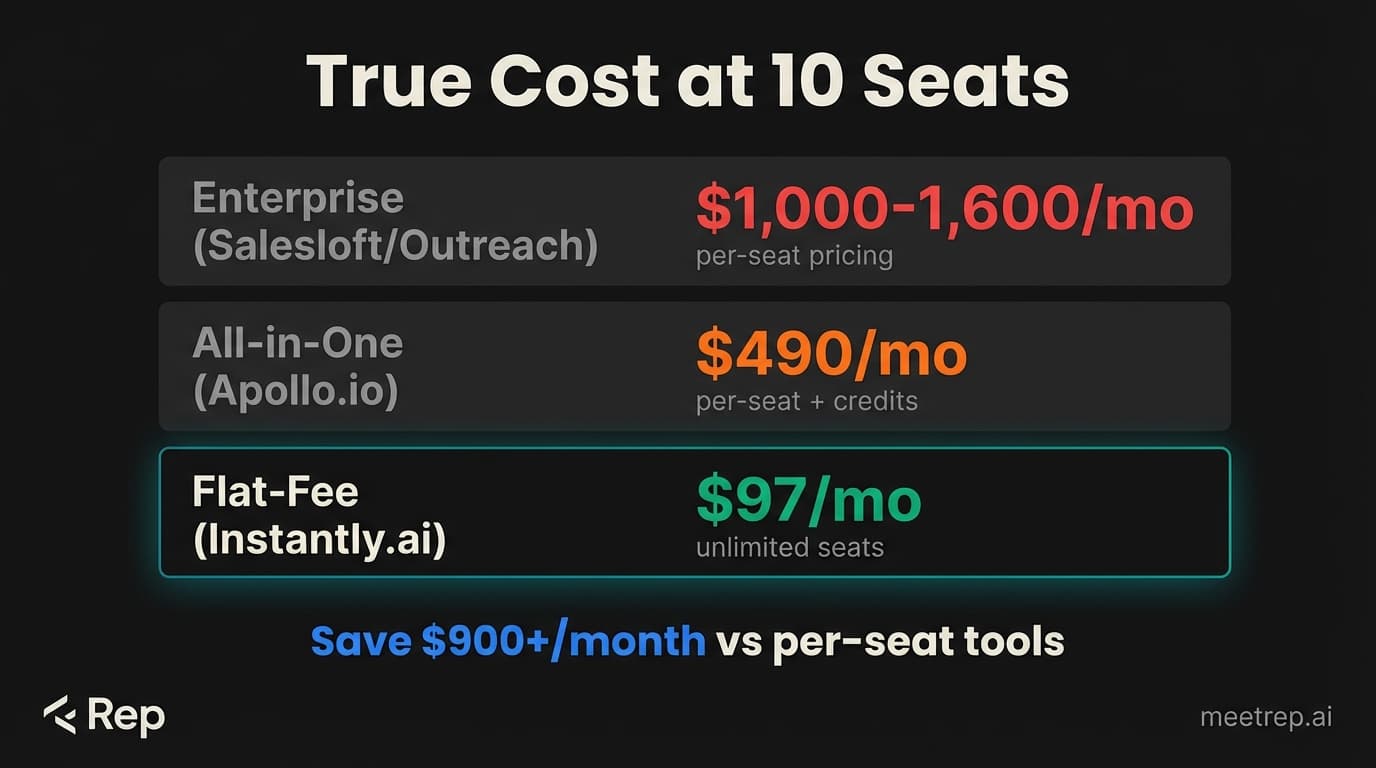
"Starting at $29/month" is meaningless. Here's what these tools actually cost for real teams:
| Tool | 5 Seats | 10 Seats | 25 Seats | Key Cost Driver |
|---|---|---|---|---|
| Instantly.ai | $97/mo | $97/mo | $97-358/mo | Flat fee (unlimited users on lower tiers) |
| Smartlead.ai | $69/mo | $143/mo | $143/mo | Tiered by features, not seats |
| Apollo.io | $245/mo | $490/mo | $1,225/mo | Per-seat + credit overages |
| Lemlist | $345/mo | $690/mo | $1,725/mo | Per-seat, gets expensive fast |
| Saleshandy | $125/mo | $250/mo | $625/mo | Per-seat, straightforward |
| Salesloft | ~$500-800/mo | ~$1,000-1,600/mo | ~$2,500-4,000/mo | Custom pricing + implementation |
| Outreach.io | ~$500-800/mo | ~$1,000-1,600/mo | ~$2,500-4,000/mo | Custom pricing + implementation |
The hidden costs nobody mentions:
- Credit overages (Apollo, some others): Prospecting aggressively? You'll blow through credits.
- Data provider (Instantly, Smartlead, most others): Add $50-300/month if the tool doesn't include a database.
- Implementation (Salesloft, Outreach): Expect $5-15K for proper enterprise deployment.
- Training/ramp time: The complex tools take 2-4 weeks to learn. That's productivity lost.
My recommendation: Most mid-market teams (10-30 SDRs) are overpaying for Salesloft or Outreach when Apollo or Reply would serve them better at 1/3 the cost. The enterprise platforms make sense at 50+ seats with complex workflow requirements. Below that threshold, you're buying features you won't use.
Implementation Roadmap: Deploying Without Destroying Quota
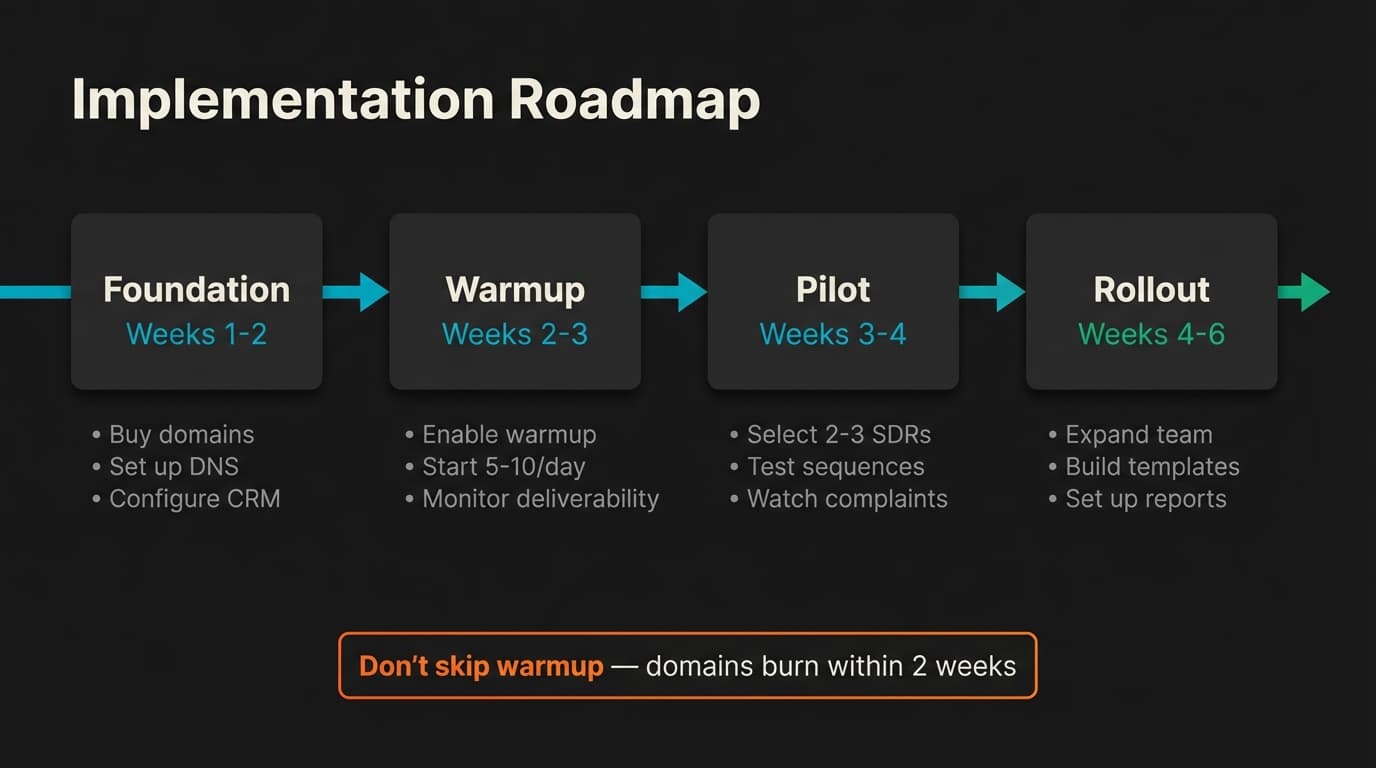
Switching tools mid-quarter is a recipe for disaster. Here's a realistic timeline:
Week 1-2: Foundation
- Purchase secondary domains (3-5 minimum)
- Set up DNS authentication (SPF, DKIM, DMARC)
- Provision mailboxes (1 per SDR + 2-3 for warmup pool)
- Configure CRM integration and field mapping
- Import existing templates and sequences
Week 2-3: Warmup
- Enable warmup on all mailboxes (don't skip this)
- Start with 5-10 emails/day, increase 20% daily
- Monitor deliverability metrics
- Target: 97%+ inbox placement before launching
Week 3-4: Pilot
- Select 2-3 SDRs for pilot group
- Build 2 test sequences (4-7 touchpoints each)
- Target small list (50-100 prospects)
- Monitor complaint rates obsessively (stay under 0.3%)
Week 4-6: Rollout
- Expand to full team in phases
- Establish template library with approved messaging
- Set up manager dashboards and reports
- Document sequence best practices
Common mistake: Starting campaigns before warmup completes. We've seen this destroy domains within two weeks. The urgency to hit quota isn't worth rebuilding sender reputation for months afterward.
Targeting discipline matters. The data is clear: targeting 1-2 contacts per company yields 7.8% reply rates, while 10+ contacts drops to 3.8%. Spray-and-pray cuts your results by more than half AND increases spam risk.
The Timing Advantage Most Teams Miss
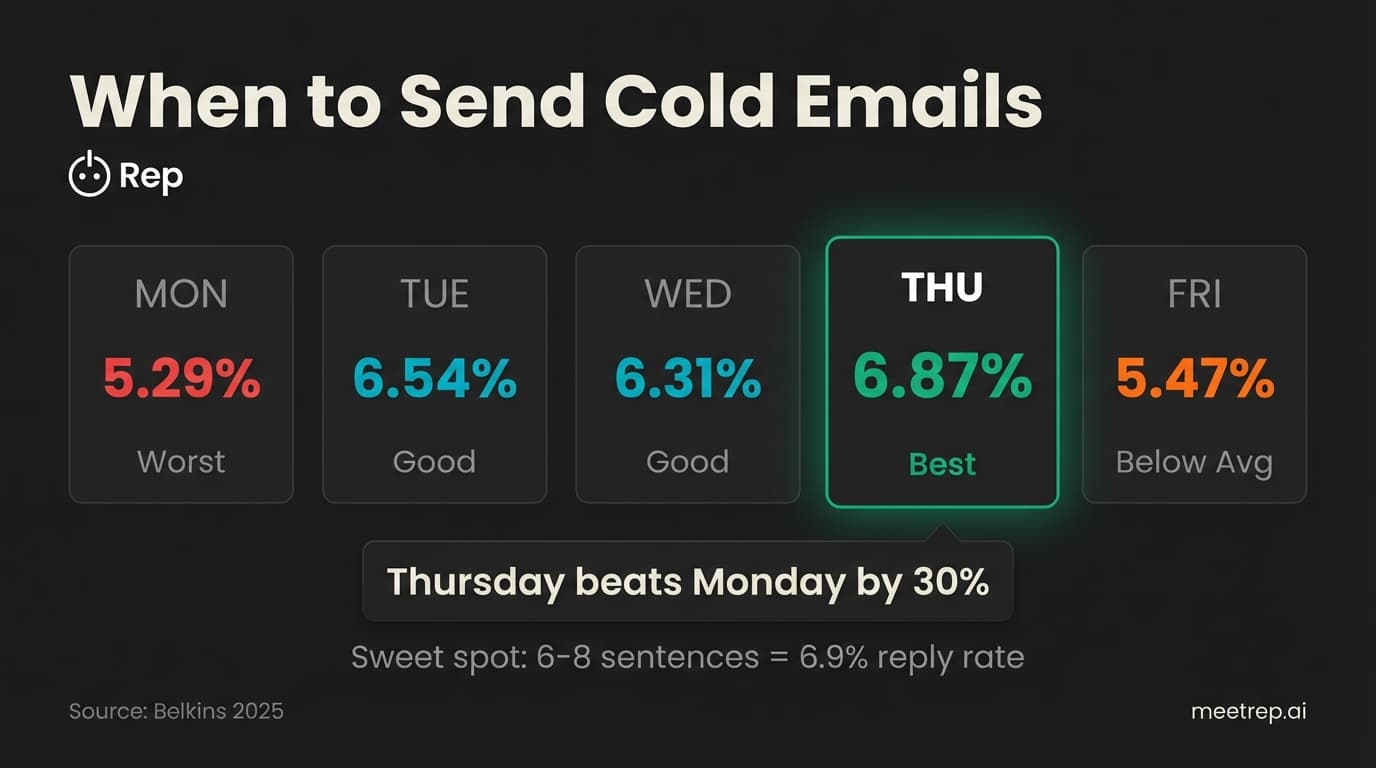
When you send matters almost as much as what you send.
| Day | Reply Rate | Index |
|---|---|---|
| Thursday | 6.87% | Best |
| Tuesday | 6.54% | Good |
| Wednesday | 6.31% | Good |
| Friday | 5.47% | Below avg |
| Monday | 5.29% | Worst |
Source: Belkins 2025 analysis
Thursday outperforms Monday by 30%. That's meaningful.
And email length? 6-8 sentences hit the sweet spot with a 6.9% reply rate and 42.67% open rate. Go past 13 sentences and reply rates drop to 3.8%.
Short. Specific. Thursday.
What Happens After Outreach Works?
Here's the problem nobody discusses: successful email outreach creates a demo bottleneck.
Your SDRs send thousands of emails. Open rates look good. Reply rates hit target. Meetings get booked. And then... everyone waits for calendar slots with AEs who are already overloaded.
With 36% of companies cutting SDR headcount, the teams left can't handle the volume when outreach actually performs. Prospects who requested a demo on Tuesday shouldn't wait until next Thursday because your AE calendar is packed.
This is why we built Rep. When your outreach campaigns generate demo requests at 2am or over the weekend, Rep joins the video call, shares its screen, walks through your product, and qualifies the prospect—without pulling an AE from their pipeline work.
The email tools get the meeting on the calendar. Rep makes sure you don't lose deals to scheduling friction.
Your outreach stack handles the top of funnel. The question is what happens when it works.

Nadeem Azam
Founder
Software engineer & architect with 10+ years experience. Previously founded GoCustomer.ai.
Nadeem Azam is the Founder of Rep (meetrep.ai), building AI agents that give live product demos 24/7 for B2B sales teams. He writes about AI, sales automation, and the future of product demos.
Frequently Asked Questions
Table of Contents
- What Are Email Outreach Tools and Why Do They Matter Now?
- How We Evaluated These Tools
- Quick Comparison: 10 Best Email Outreach Tools
- The 10 Best Email Outreach Tools: Detailed Reviews
- Deliverability: The Make-or-Break Factor Nobody Wants to Talk About
- What This Really Costs: Pricing at Team Scale
- Implementation Roadmap: Deploying Without Destroying Quota
- The Timing Advantage Most Teams Miss
- What Happens After Outreach Works?
Ready to automate your demos?
Join the Rep Council and be among the first to experience AI-powered demos.
Get Early AccessRelated Articles
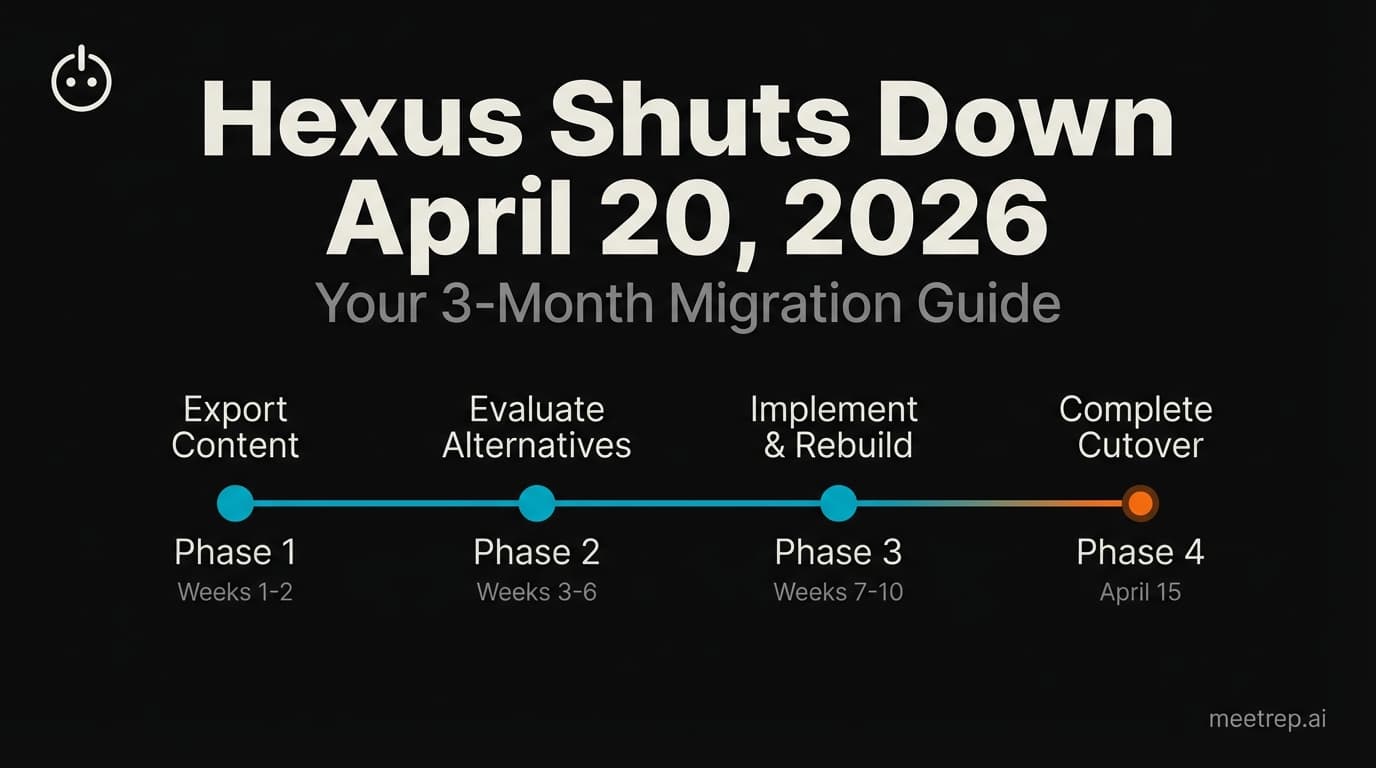
Hexus Acquired by Harvey AI: Congrats & What It Means for Demo Automation Teams
Hexus is shutting down following its acquisition by Harvey AI. Learn how to manage your migration and discover the best demo automation alternatives before April 2026.
Why the "Software Demo" is Broken—and Why AI Agents Are the Future
The traditional software demo is dead. Discover why 94% of B2B buyers rank vendors before calling sales and how AI agents are replacing manual demos to scale revenue.
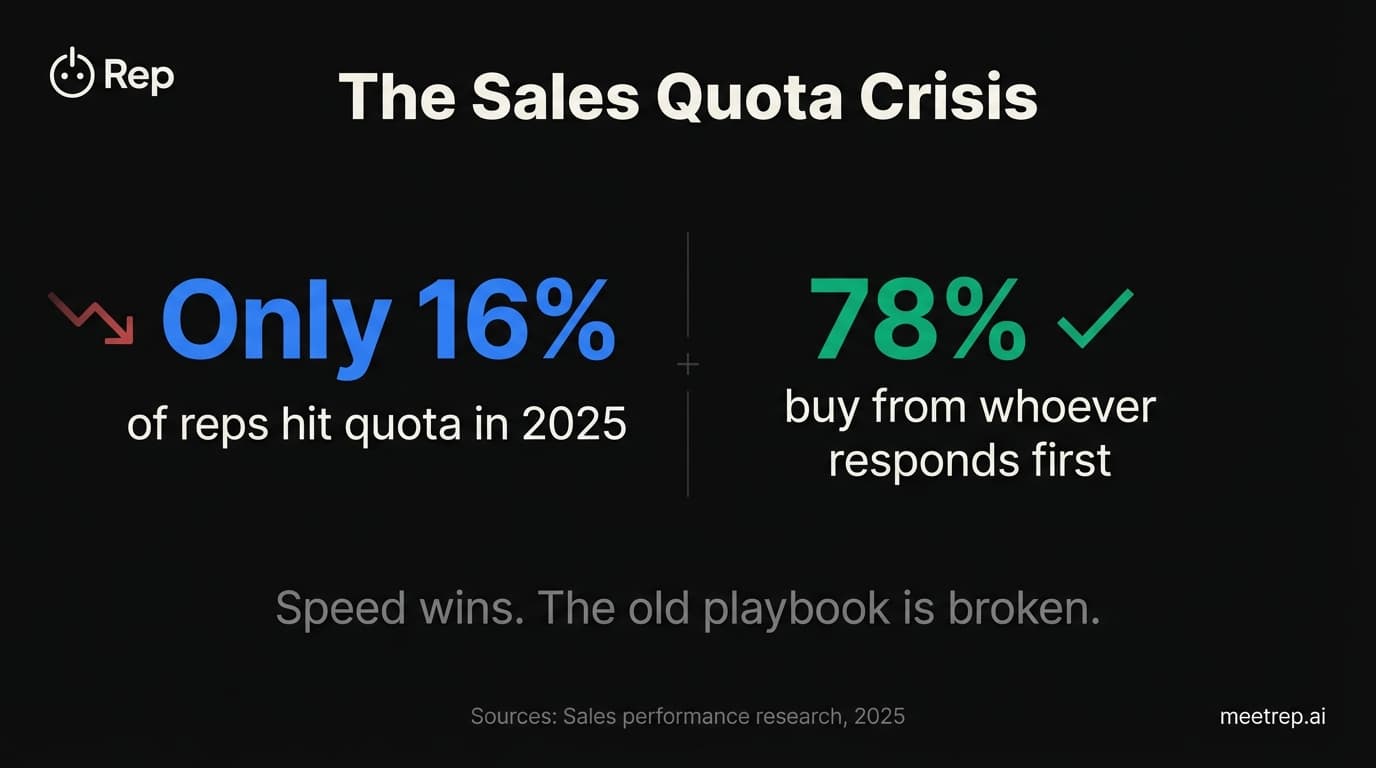
Why Autonomous Sales Software is the Future of B2B Sales (And Why the Old Playbook is Dead)
B2B sales is at a breaking point with quota attainment at 46%. Discover why autonomous 'Agentic AI' is the new standard for driving revenue and meeting the demand for rep-free buying.