Best Demo Platforms For Multi-Stakeholder Sales: The 2026 Guide to Scaling Presales

Executive Summary
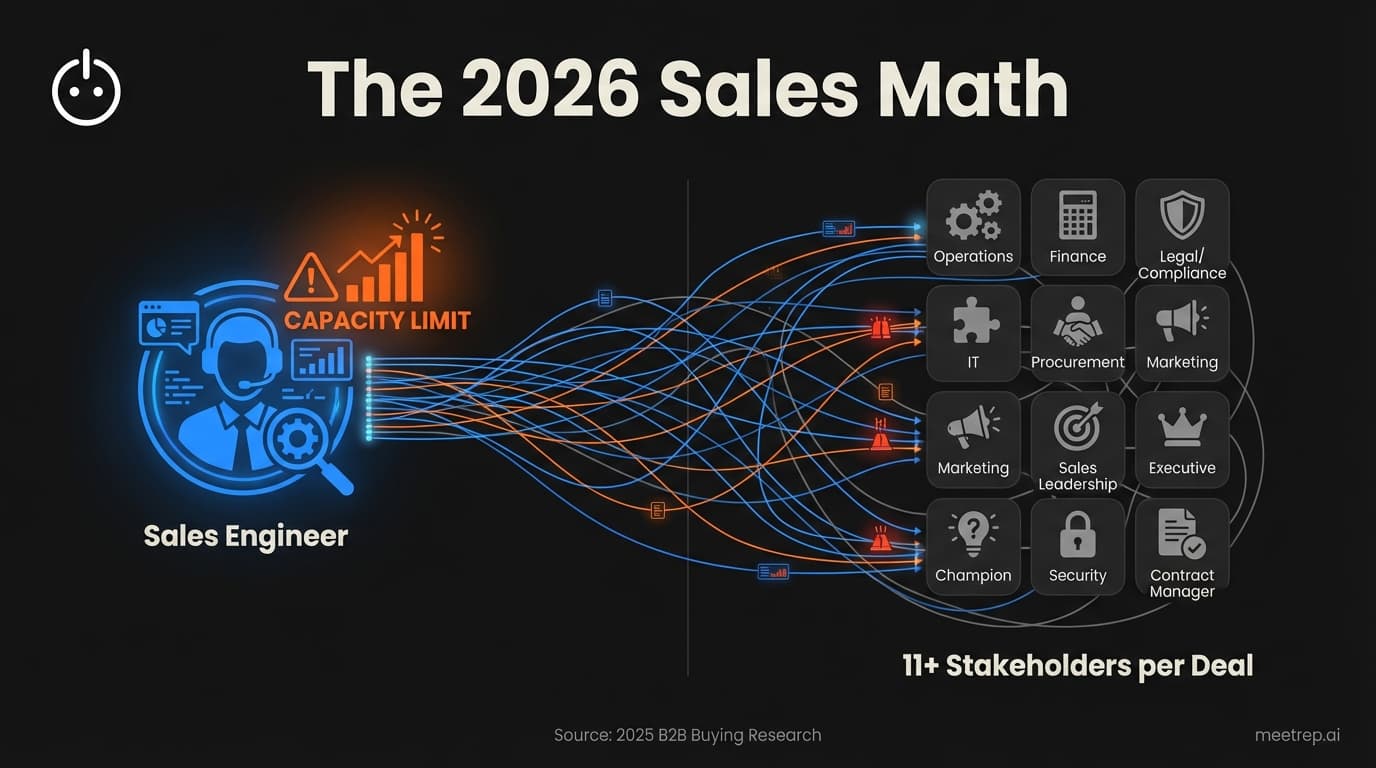
- The Problem: Buying groups now average 10+ stakeholders. You can't demo to them all live.
- The Old Way: "Click-through" screenshot tours (Navattic) are great for marketing, but they don't sell complex software.
- The New Way: Autonomous Agents (Rep) use Agentic AI to navigate live software and speak to prospects, 24/7.
- The Hybrid Strategy: Use Navattic for your website, Consensus for async video, and Rep to replace the live "Intro Demo."
The math on your sales engineering team’s calendar just doesn't add up anymore.
According to verified research from early 2025, the average B2B buying group has ballooned to 10 or 11 stakeholders. In complex enterprise deals, that number can hit 22 people.
If your SEs are trying to demo to every single one of those people live, you are already losing.
You simply cannot hire enough engineers to cover that volume. Not without burning cash and blowing up your CAC (Customer Acquisition Cost).
I saw this firsthand building GoCustomer.ai. We had a great product, but the sheer friction of scheduling "the demo" killed momentum. By the time we aligned calendars for three people, the other seven had lost interest. Today, with 22% of engineering leaders reporting critical burnout, throwing more bodies at the problem isn't just expensive—it's dangerous.
You need technology that multiplies your team, not just supports them.
This guide breaks down the best demo platforms available in 2026, from the static "click-through" tools you know to the new wave of Autonomous AI Agents (like what we’re building at Rep) that are actually changing the game.
The "Stall" Crisis: Why Multi-Stakeholder Deals Fail
The "stall" is the moment a qualified deal goes dark because the buying group can't reach a consensus. It is the single biggest killer of pipeline in 2026.
Why does this happen?
Because 86% of B2B purchases stall during the buying process.
Usually, this happens because your internal Champion can't explain your product as well as you can. When you give a live demo to a Champion, you're betting everything on their ability to remember what you said and repeat it perfectly to their CFO, CTO, and End Users.
They usually can't. They forget the nuance. They botch the technical answers.
In my experience, buyers are doing 80% of their research before they ever talk to you. They want answers now, not next Tuesday at 2 PM when your SE is finally free. If you gate your product behind a human schedule, you're losing deals to competitors who don't.
The Data: According to Sopro's 2025 prospecting report, 86% of B2B purchases stall, and 81% of buyers are dissatisfied with their chosen provider due to expectation mismatches.
The 4 Types of Demo Tech (Defining the Category)
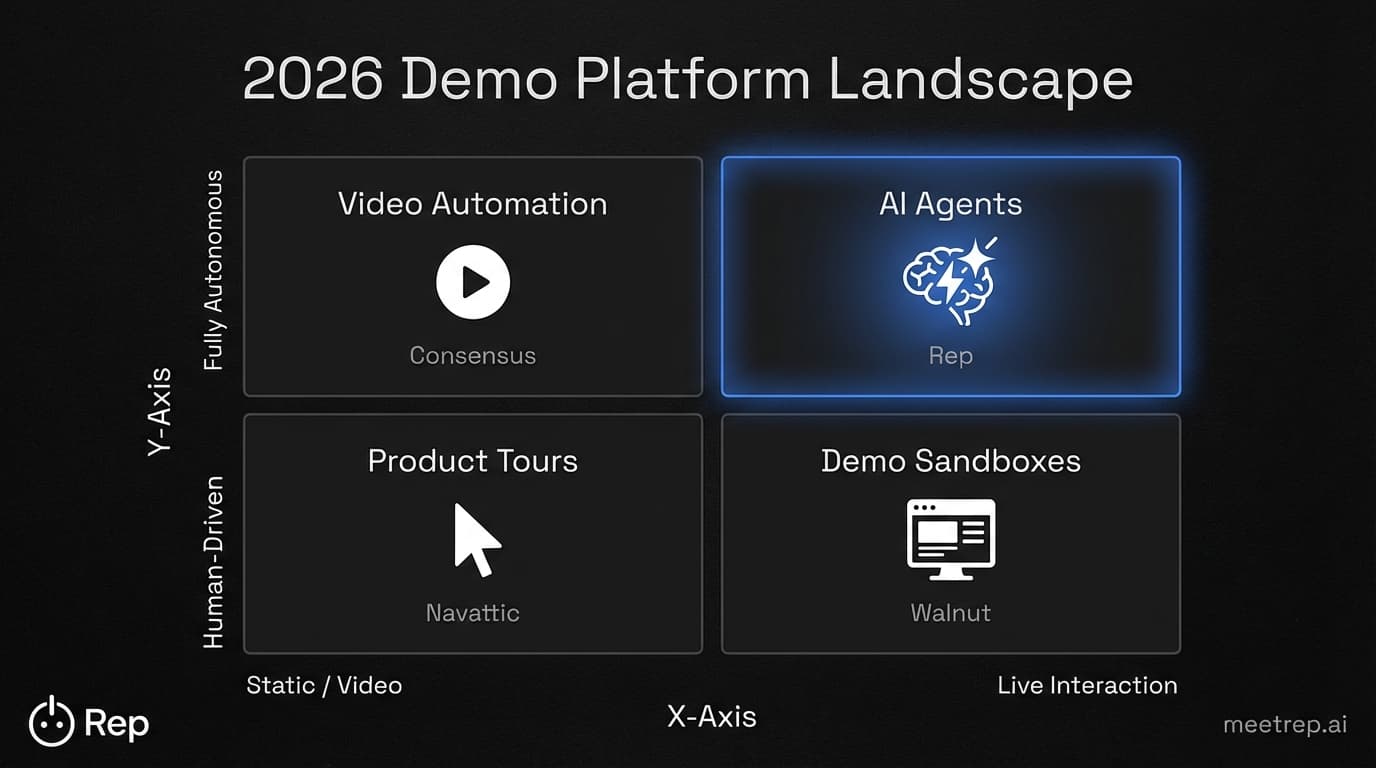
Before we rank the tools, we need to be precise about definitions. The term "demo automation" is thrown around loosely. It usually refers to four very different technologies.
1. Interactive Product Tours (The "Click-Throughs")
These tools capture screenshots of your product and stitch them into a guided slideshow.
- Examples: Navattic, Storylane.
- Best For: Marketing website embeds (Top of Funnel).
- The Reality: These aren't demos. They are brochures. They lack the "live" feel and cannot handle complex logic or voice interaction.
2. Video Demo Automation (The "Watch Parties")
These platforms create personalized video experiences where stakeholders watch a pre-recorded demo that branches based on their choices.
- Examples: Consensus.
- Best For: Asynchronous stakeholder education.
- The Reality: Great for broad coverage, but passive. It's watching TV, not having a conversation.
3. Live Demo Sandboxes (The "Safe Spaces")
These tools clone your product into a stable, bug-free environment for your AEs to use during live calls.
- Examples: Demostack, Walnut.
- Best For: AEs who need to give live demos without crashing the prod environment.
- The Reality: They solve the "buggy demo" problem, but they don't solve the "time" problem. A human still has to drive.
4. Autonomous AI Agents (The "Digital Hires")
This is the new category emerging in 2025/2026. These are AI agents that join video calls, speak with a human voice, and navigate the live product browser autonomously.
- Examples: Rep.
- Best For: Live, interactive, voice-based demos at scale.
- The Reality: This is the only category that actually replicates the SE resource, rather than just helping them.
Key Insight: If a tool requires your SE to be awake and logged in to work, it is enablement, not automation. True automation works while your team sleeps.
Top Platforms Compared (2026)
Here is how the top players stack up when your goal is handling multi-stakeholder deals.
| Platform | Category | Best For | Main Weakness |
|---|---|---|---|
| Rep | Autonomous Agent | Live Interaction. Replaces the "Intro Demo" entirely with an AI that speaks and navigates. | New category; requires training the agent on your product flow. |
| Consensus | Video Automation | Broad Reach. sending a video link to 10 stakeholders to watch on their own time. | Passive. Prospects can't ask questions or deviate from the video path. |
| Navattic | Product Tours | Website Teasers. Embedding a "try it now" button on your homepage. | Static. It's screenshots, not software. Zero voice capabilities. |
| Walnut | Demo Sandbox | AE Enablement. Creating perfect, personalized scripts for humans to present. | Not autonomous. Requires a human presenter. |
| Demostack | Demo Sandbox | Enterprise Stability. Cloning complex environments so they don't break. | High setup effort. Still requires a human driver. |
1. Rep (Best for Live, Autonomous Interaction)
I'm biased, obviously. I founded Rep because I was tired of the trade-off between "scalable" (videos) and "effective" (live calls).
Rep is an Autonomous AI Sales Agent. It joins Zoom/Google Meet calls, shares its screen, and navigates your actual product browser. It speaks with prospects using natural voice AI, answers their questions, and handles objections.
Why it wins for multi-stakeholder deals: When you have 11 stakeholders, getting them on a call is impossible. With Rep, you send a link. The CTO can join at 8 AM. The CFO can join at 8 PM. They both get a live, interactive demo tailored to their questions, and all that data syncs back to your CRM.
The Tech Difference: Most "AI" tools are just wrappers around ChatGPT that generate text. Rep uses Agentic AI. It doesn't just talk; it acts. It clicks buttons, fills forms, and navigates the DOM (Document Object Model) of your application just like a human user would.
Why we built Rep this way: Buyers hate "fake" environments. They want to see the real product respond to real inputs. Rep navigates live software, which builds trust faster than any screenshot ever could.
2. Consensus (Best for Asynchronous Video)
Consensus is the leader in video-based automation. They pioneered the "Demolytics" concept—tracking exactly who watched what.
The Good: Their tracking is phenomenal. If you send a demo to a Champion, Consensus tells you when they forward it to the Legal team. You can see that Legal watched the "Security" section three times. That is gold for an account executive trying to multithread a deal.
The Bad: It’s still a video. If a prospect has a specific question that isn't in the pre-recorded track ("Hey, does this integrate with our legacy Oracle db?"), the video can't answer. The conversation stops until a human intervenes.
3. Navattic (Best for Marketing Websites)
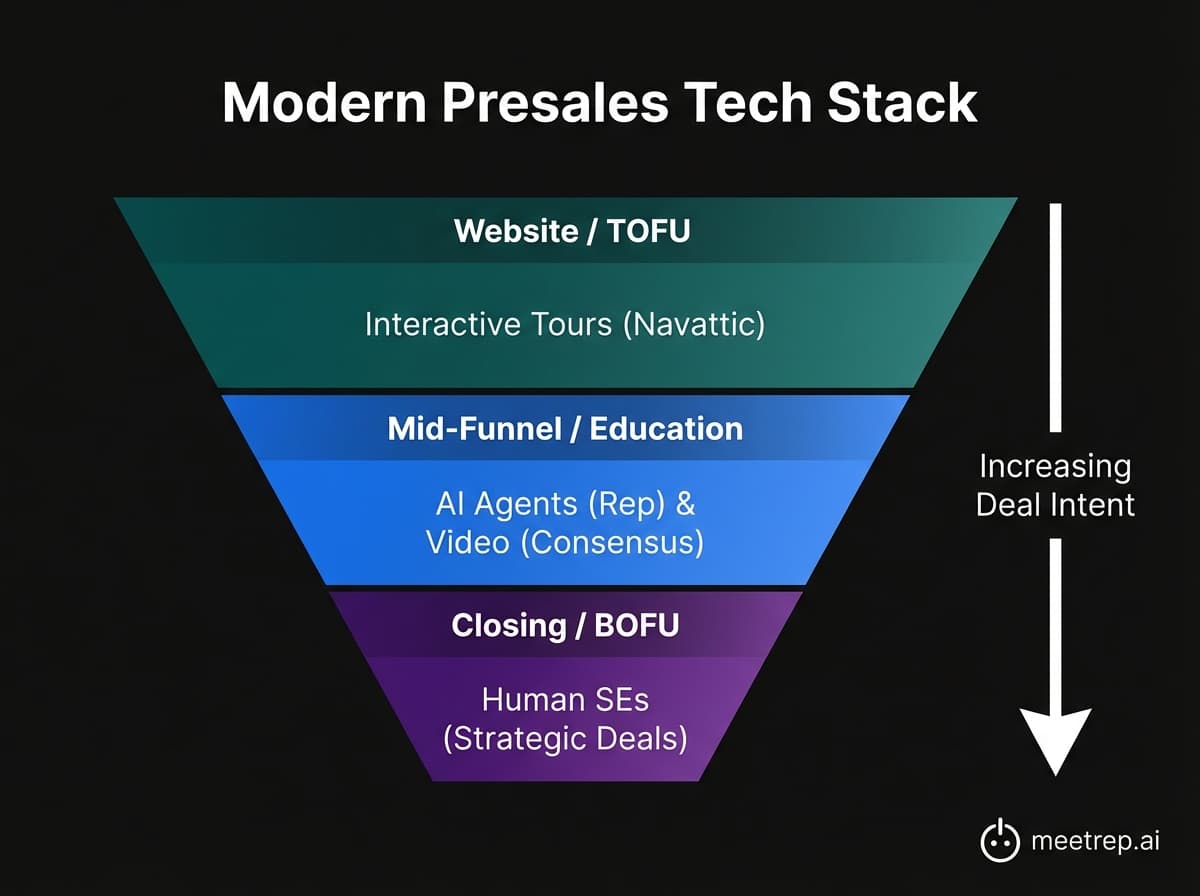
Navattic is the standard for "interactive product tours." You've seen these—you click a button on a website, and it opens a captured version of the software with tooltips guiding you.
The Good: It is incredibly low friction. No login, no scheduling. For Top of Funnel (TOFU) engagement, it’s unbeatable. It gets people to feel the product instantly.
The Bad: It breaks down in the Mid-Funnel (MOFU). Once a buyer is serious, they want to see the real thing, not a screenshot. They want to test edge cases. Navattic can't do that.
My recommendation: Use Navattic on your homepage to capture leads. Use Rep or Consensus in the mid-funnel to work the deal. They solve different problems.
Why "Agentic AI" is the Future of Presales
You’re going to hear the term "Agentic AI" a lot in 2026. It’s important to understand what it actually means, because vendors are already trying to wash their products in it.
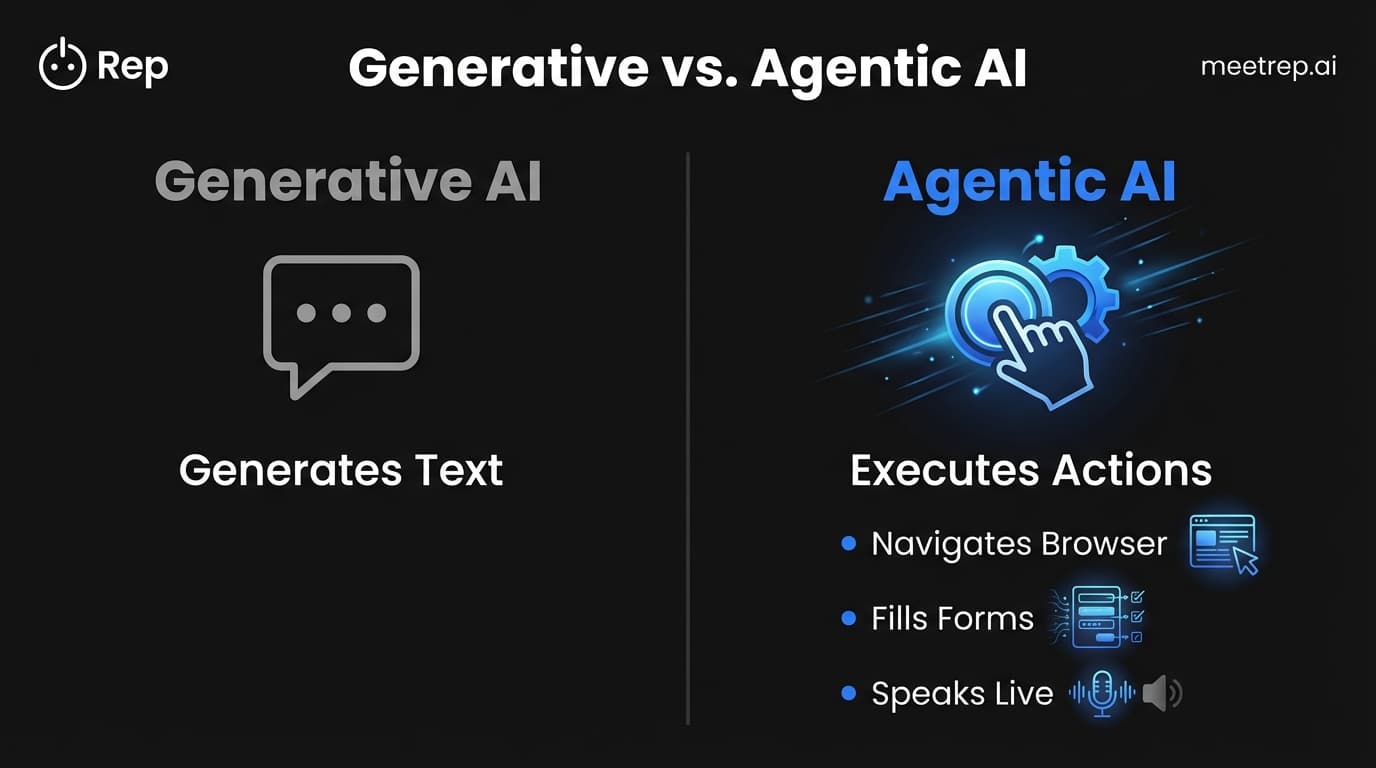
"Agentic" means the AI has agency. It can act.
- Chatbots (Generative AI): Can write text. "Here is a summary of the feature."
- Agents (Agentic AI): Can use tools. "I will navigate to the settings page, click the API tab, and generate a token for you."
This isn't sci-fi. It's the current market trajectory.
Gartner predicts that by 2028, 60% of B2B seller interactions will occur via AI-driven conversational interfaces. That isn't referring to ChatGPT writing emails. It refers to agents that can co-sell.
We are entering a world where your "first hire" in a new region won't be a person. It will be an AI agent that speaks the local language, knows the product perfectly, and never sleeps.
The Data: The global market for AI agents is projected to hit $7.92 billion in 2025 and grow to over $236 billion by 2034. This isn't a fad. It's an infrastructure shift. Source:Salesmotion / SuperAGI, Sept 2025
Evaluating the ROI: Don't Let the "Demo Tax" Kill You
Sales engineering is expensive. It is one of the highest cost centers in a B2B org.
When you use highly paid engineers to do repetitive "Harbor Tours" (generic intro demos), you are paying a "Demo Tax." You are burning cash and burning out talent.
70% of sales deals require presales support. If you have 100 opportunities, and your SEs can only handle 50, you are capping your revenue.
The ROI of a demo platform isn't just "time saved." It's capacity created.
- Consensus creates capacity by letting prospects self-educate via video.
- Rep creates capacity by acting as a digital employee that takes the calls your humans shouldn't.
Hot take: Stop measuring "demos per week" as a productivity metric for SEs. It encourages bad behavior. Measure "revenue influenced per hour." An SE spending 10 hours giving the same intro demo is wasting company money.
Don't Let Your Calendar Be Your Growth Ceiling
We are past the point where "hiring more people" is the only solution to scale. The buying groups are too big. The calendars are too crowded. And frankly, the burnout risk is too high.
My advice? Audit your demo volume.
Look at how many "intro" calls your senior SEs are taking. If that number is above zero, you have a problem.
You need to decouple your ability to sell from your ability to stay awake. Whether you choose video automation like Consensus or an autonomous agent like Rep, the goal is the same: give the buyer what they want, when they want it, without burning out your team.
If you want to see what a truly autonomous demo looks like—one that speaks, navigates, and sells while you sleep—meet Rep.

Nadeem Azam
Founder
Software engineer & architect with 10+ years experience. Previously founded GoCustomer.ai.
Nadeem Azam is the Founder of Rep (meetrep.ai), building AI agents that give live product demos 24/7 for B2B sales teams. He writes about AI, sales automation, and the future of product demos.
Frequently Asked Questions
Table of Contents
- The "Stall" Crisis: Why Multi-Stakeholder Deals Fail
- The 4 Types of Demo Tech (Defining the Category)
- Top Platforms Compared (2026)
- Why "Agentic AI" is the Future of Presales
- Evaluating the ROI: Don't Let the "Demo Tax" Kill You
- Don't Let Your Calendar Be Your Growth Ceiling
Ready to automate your demos?
Join the Rep Council and be among the first to experience AI-powered demos.
Get Early AccessRelated Articles
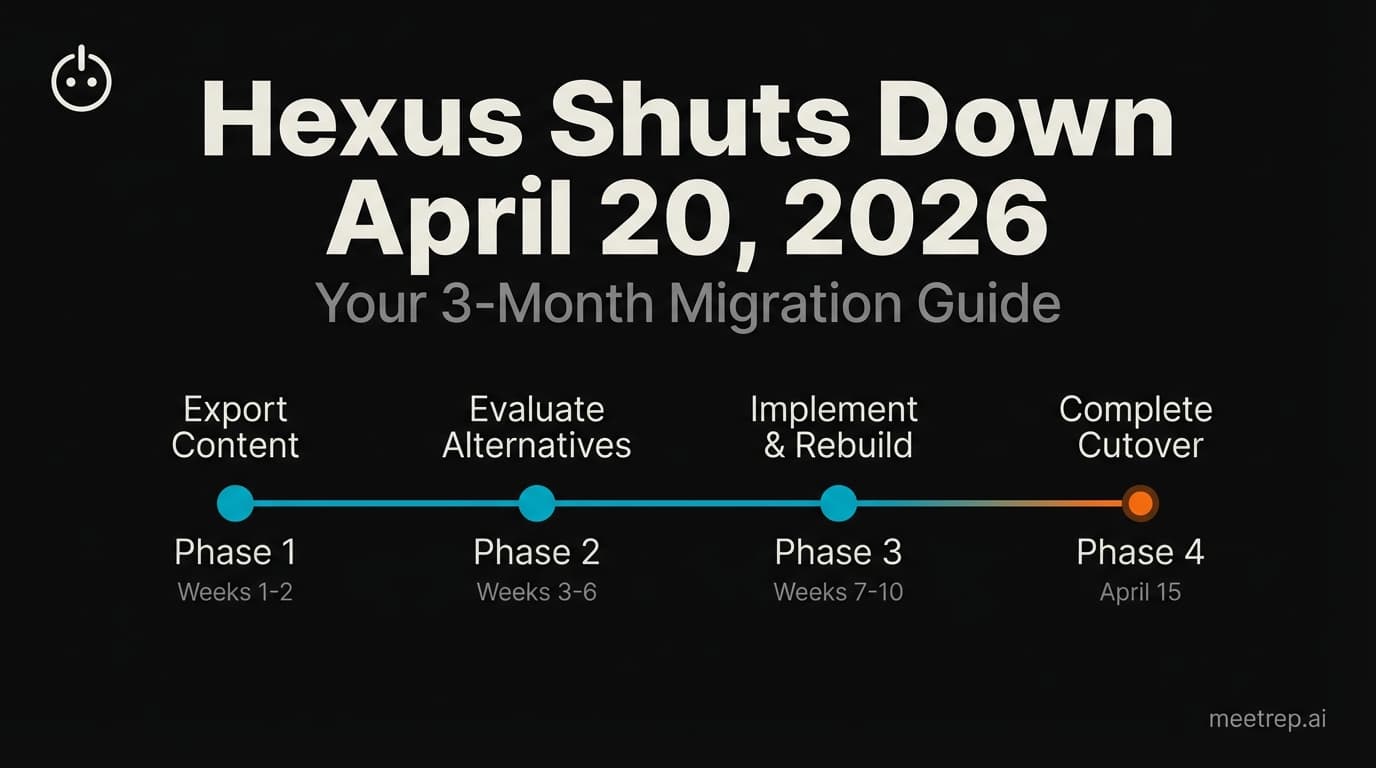
Hexus Acquired by Harvey AI: Congrats & What It Means for Demo Automation Teams
Hexus is shutting down following its acquisition by Harvey AI. Learn how to manage your migration and discover the best demo automation alternatives before April 2026.
Why the "Software Demo" is Broken—and Why AI Agents Are the Future
The traditional software demo is dead. Discover why 94% of B2B buyers rank vendors before calling sales and how AI agents are replacing manual demos to scale revenue.
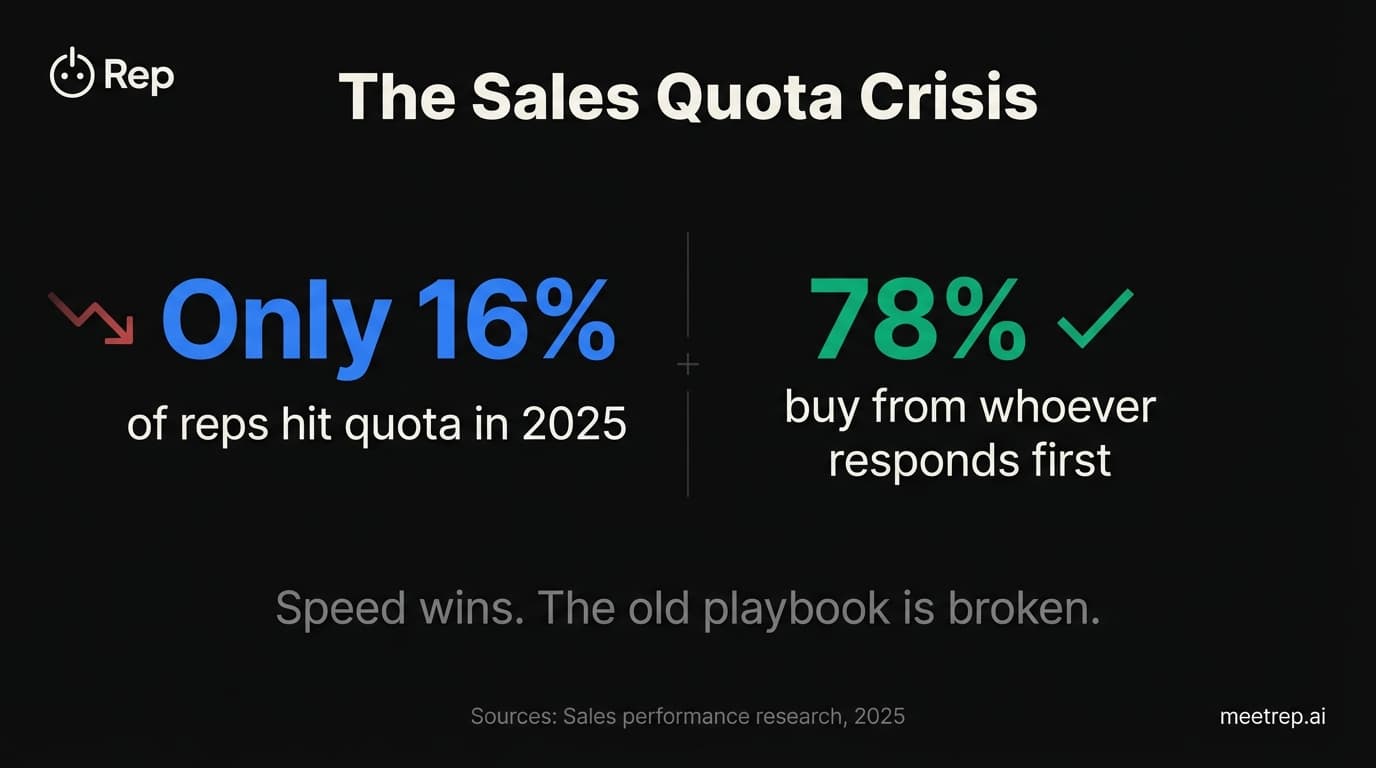
Why Autonomous Sales Software is the Future of B2B Sales (And Why the Old Playbook is Dead)
B2B sales is at a breaking point with quota attainment at 46%. Discover why autonomous 'Agentic AI' is the new standard for driving revenue and meeting the demand for rep-free buying.