BANT, MEDDIC, and GPCTBA: Sales Qualification Frameworks Compared

Executive Summary
- BANT works for transactional sales under $10K ACV—52% of sales pros still trust it, despite "BANT is dead" rhetoric
- MEDDIC is the enterprise standard (73% of $100K+ SaaS companies use it) and delivers 18% higher win rates—but takes 3.6 months to master
- GPCTBA aligns with consultative, inbound selling but lacks effectiveness data
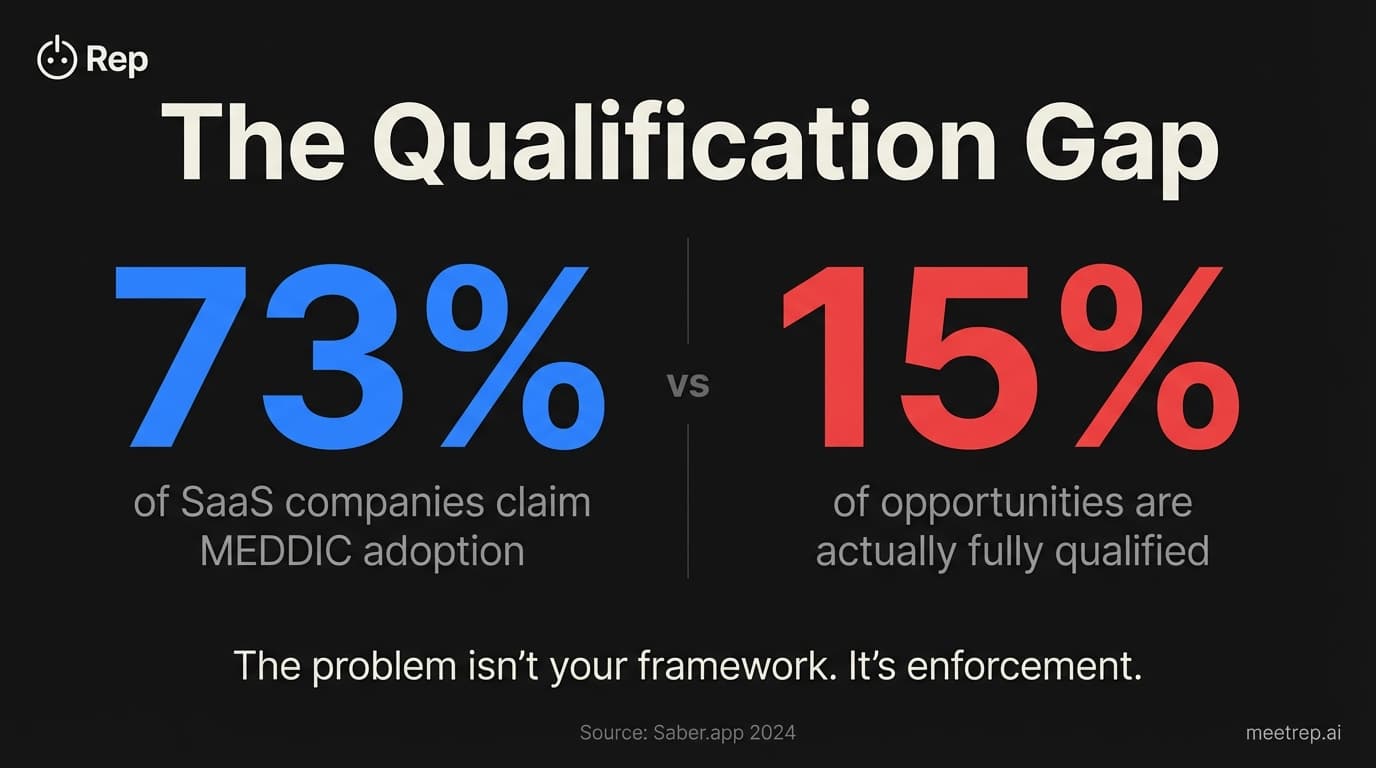
- The real problem: Only 15% of opportunities get fully qualified even when teams claim to use MEDDIC
- The answer isn't picking the right framework—it's enforcing whatever framework you choose
Here's a stat that should keep sales leaders up at night: 91% of sales organizations missed their quota expectations in 2024. Not individual reps. Entire organizations.
The diagnosis? 67% of lost sales trace back to poor lead qualification. Reps are spending their time on deals that were never going to close.
Sales qualification frameworks exist to solve this problem. But picking the wrong one—or picking the right one and watching your team ignore it—makes things worse. I've seen this play out firsthand. When we built GoCustomer.ai, we learned that the framework matters less than whether anyone actually uses it.
This guide compares the three dominant frameworks: BANT, MEDDIC, and GPCTBA. I'll show you which fits your sales motion, why most implementations fail, and what actually moves the needle.
What Is a Sales Qualification Framework?
A sales qualification framework is a set of criteria your team uses to determine whether a lead is worth pursuing. It's the filter between "showed interest" and "likely to buy." Without one, reps chase every opportunity equally—burning 1,393 hours per year on leads that will never close.
The three frameworks that dominate B2B sales each take a different approach:
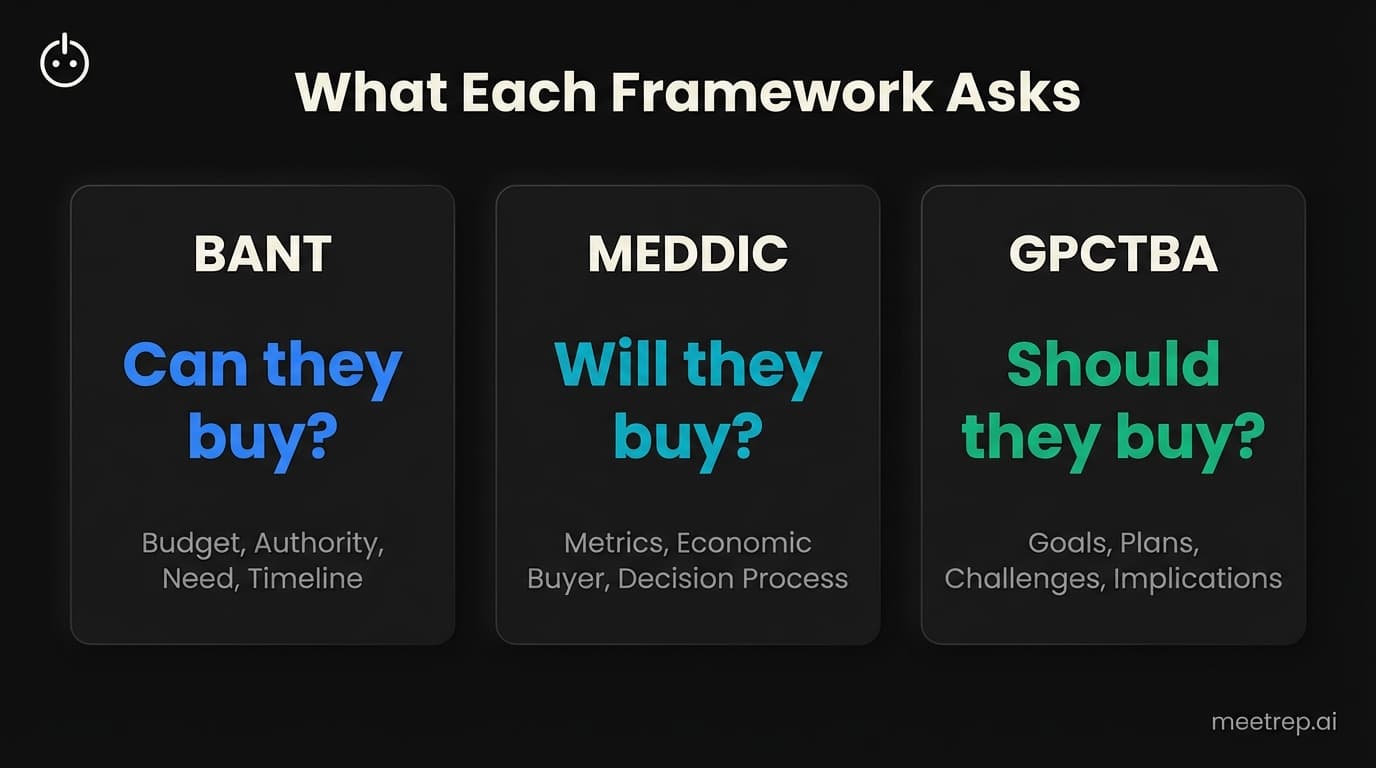
- BANT (Budget, Authority, Need, Timeline) asks: Can they buy?
- MEDDIC (Metrics, Economic Buyer, Decision Criteria, Decision Process, Identify Pain, Champion) asks: Will they buy, and how?
- GPCTBA/C&I (Goals, Plans, Challenges, Timeline, Budget, Authority, Consequences & Implications) asks: Should they buy?
Same goal. Different philosophies. And wildly different training requirements.
Key Insight: Lead qualification became the #1 seller challenge in 2025, with 24% of reps citing it as their top pain point. The framework you choose—and how consistently you execute it—directly impacts whether your team hits quota.
BANT: The Foundational Framework
BANT was born at IBM in the 1950s. It's simple: qualify leads based on Budget, Authority, Need, and Timeline. Four questions. Quick disqualification. Move on.
Here's what surprises most people: 52% of sales professionals still find BANT reliable. That's according to Gartner, not some dated survey. Another 41% value its flexibility.
So why does everyone keep saying BANT is dead?
Because they're using it wrong.
What BANT Gets Right:
BANT excels at fast disqualification. When you're processing high volumes of inbound leads, you need to quickly separate "ready to buy" from "just browsing." BANT does this in minutes.
It's also dead simple to train. New SDRs can execute BANT on day one. No 3-month ramp. No certification programs. Just four questions.
What BANT Gets Wrong:
BANT assumes a single decision-maker holds the budget. That worked in 1955. It doesn't work when B2B buying committees average 10-11 stakeholders, and enterprise deals involve 15 or more.
The budget-first approach also backfires with modern buyers. Opening with "What's your budget?" signals transactional intent. It kills trust before you've built any.
The Data:36% of sales professionals specifically value BANT for timeline planning—it helps forecast when deals will actually close. That's not nothing.
My Verdict on BANT:
BANT isn't dead. It's just scoped wrong. Use it for:
- Transactional sales under $10K ACV
- Short sales cycles (under 60 days)
- Single or few decision-makers
- High-velocity, low-touch motions
Don't use it for enterprise deals. You'll qualify opportunities that stall later because you never mapped the buying committee.
MEDDIC: The Enterprise Standard
MEDDIC came out of PTC in the 1990s, created by Jack Napoli and Dick Dunkel. Napoli famously claimed MEDDIC helped him achieve a 90%+ close rate. Whether you believe that or not, the framework stuck.
Here's what MEDDIC covers:
- Metrics: What quantifiable outcomes does the buyer expect?
- Economic Buyer: Who actually controls the budget?
- Decision Criteria: What standards will they use to evaluate you?
- Decision Process: What steps and stakeholders are involved?
- Identify Pain: What specific problem is driving this purchase?
- Champion: Who inside the account will advocate for you?
Two variants have emerged: MEDDICC (adds Competition) and MEDDPICC (adds Paper Process for procurement steps plus Competition). MEDDPICC has become the preferred version for enterprise deals in 2024-2025 because it prevents late-stage stalls from legal and procurement surprises.
The Numbers Behind MEDDIC:
The adoption stats are clear. 73% of SaaS companies above $100K ARR use MEDDIC. It's the de facto standard in enterprise software.
And it works—when executed properly:
| Metric | Impact | Source |
|---|---|---|
| Win rate improvement | +18% | Saber.app 2024 |
| "No decision" reduction | -52% | Saber Mar 2025 |
| Deal size increase | +24% | Saber.app 2024 |
That last one matters. 40-60% of deals are lost to "no decision"—the status quo wins. MEDDIC specifically attacks this by forcing reps to identify Pain and Champion early. If there's no urgent problem and no internal advocate, the deal dies.
The MEDDIC Problem Nobody Talks About:
Here's the catch. Only 15% of opportunities are fully qualified with MEDDIC despite widespread adoption claims.
Read that again. Three-quarters of companies say they use MEDDIC. But only 15% of deals actually have all the MEDDIC fields completed.
Why? The framework takes 3.6 months to reach proficiency. When pipeline pressure mounts, reps skip the Metrics conversation. They never identify the Champion. They advance deals that "feel" qualified but aren't.
What we learned at GoCustomer: When we looked at CRM data from early customers, the pattern was obvious. Required fields were empty. Pipeline "hygiene" meetings happened after the fact, not during qualification. The framework existed on paper. Adherence was abysmal.
My Verdict on MEDDIC:
MEDDIC delivers results—but only if you invest in training and enforcement. Use it for:
- Enterprise deals over $50K ACV
- Sales cycles longer than 6 months
- Multiple stakeholder environments
- Strategic, high-consideration purchases
The training burden is real. Plan for 3-4 months before reps execute it consistently. And build enforcement into your CRM—opportunities shouldn't advance stages with empty MEDDIC fields.
GPCTBA/C&I: The Consultative Approach
GPCTBA/C&I came from HubSpot as part of their inbound sales methodology. It flips the traditional qualification order by starting with the prospect's Goals rather than your qualification needs.
Here's the breakdown:
- Goals: What quantifiable objectives is the prospect trying to achieve?
- Plans: What strategies do they already have in place?
- Challenges: What obstacles are preventing goal achievement?
- Timeline: When do they need to achieve these goals?
- Budget: What resources are available?
- Authority: Who makes the decision?
- Consequences & Implications: What happens if they don't act (Consequences) vs. what success looks like (Implications)
That last piece—C&I—is the secret weapon. It forces explicit articulation of the cost of inaction. This activates loss aversion, which is a stronger motivator than potential gains.
Where GPCTBA Shines:
The framework positions you as an advisor, not a vendor. By opening with "What are you trying to achieve?" rather than "What's your budget?", you reduce defensiveness. Prospects feel like you're trying to help them succeed, not extract a purchase.
This matters for inbound leads. They've already self-selected by requesting a demo or downloading content. They don't want to be interrogated. They want guidance.
The Honest Problem with GPCTBA:
I have to be transparent here. I couldn't find any quantitative effectiveness data for GPCTBA from 2024-2026 sources. No win rate studies. No adoption percentages. No ROI comparisons.
HubSpot promotes it heavily (obviously), but independent validation is thin. That's not a dealbreaker—but it means you're taking it on faith that the consultative approach converts.
My Verdict on GPCTBA:
GPCTBA makes sense for:
- Consultative, inbound sales motions
- Mid-market deals ($25K-$100K ACV)
- Product-led growth where understanding user goals drives expansion
- HubSpot CRM users (native support helps adherence)
Skip it if you need quantified proof to convince leadership. And don't use it for high-velocity transactional sales—the discovery process takes too long.
Head-to-Head: BANT vs MEDDIC vs GPCTBA
Stop debating which framework is "best." The right answer depends on your sales motion.
| Factor | BANT | MEDDIC/MEDDPICC | GPCTBA/C&I |
|---|---|---|---|
| Origin | IBM (1950s) | PTC (1990s) | HubSpot (2010s) |
| Best For | Transactional / SMB | Enterprise / Complex B2B | Consultative / Inbound |
| Ideal Deal Size | Under $10K ACV | Over $50K ACV | $25K-$100K ACV |
| Sales Cycle | Under 60 days | 6+ months | 3-6 months |
| Training Time | 1-3 days | 3.6 months | 2-4 weeks |
| Win Rate Impact | Baseline | +18-25% | No data |
| Complexity | Low (4 criteria) | High (6-8 criteria) | High (7 criteria) |
| Key Focus | Budget & Timeline | Decision Process & Metrics | Goals & Implications |
| Adoption | 52% trust it | 73% of $100K+ SaaS | No data |
| Primary Risk | Shallow discovery | Training burden | Time-intensive |
My recommendation: Don't pick one. Use BANT as your initial filter (first 15 minutes of discovery), then graduate qualified opportunities to MEDDIC for deeper qualification. This gives you speed without sacrificing depth.
Why Frameworks Fail (The Execution Gap)
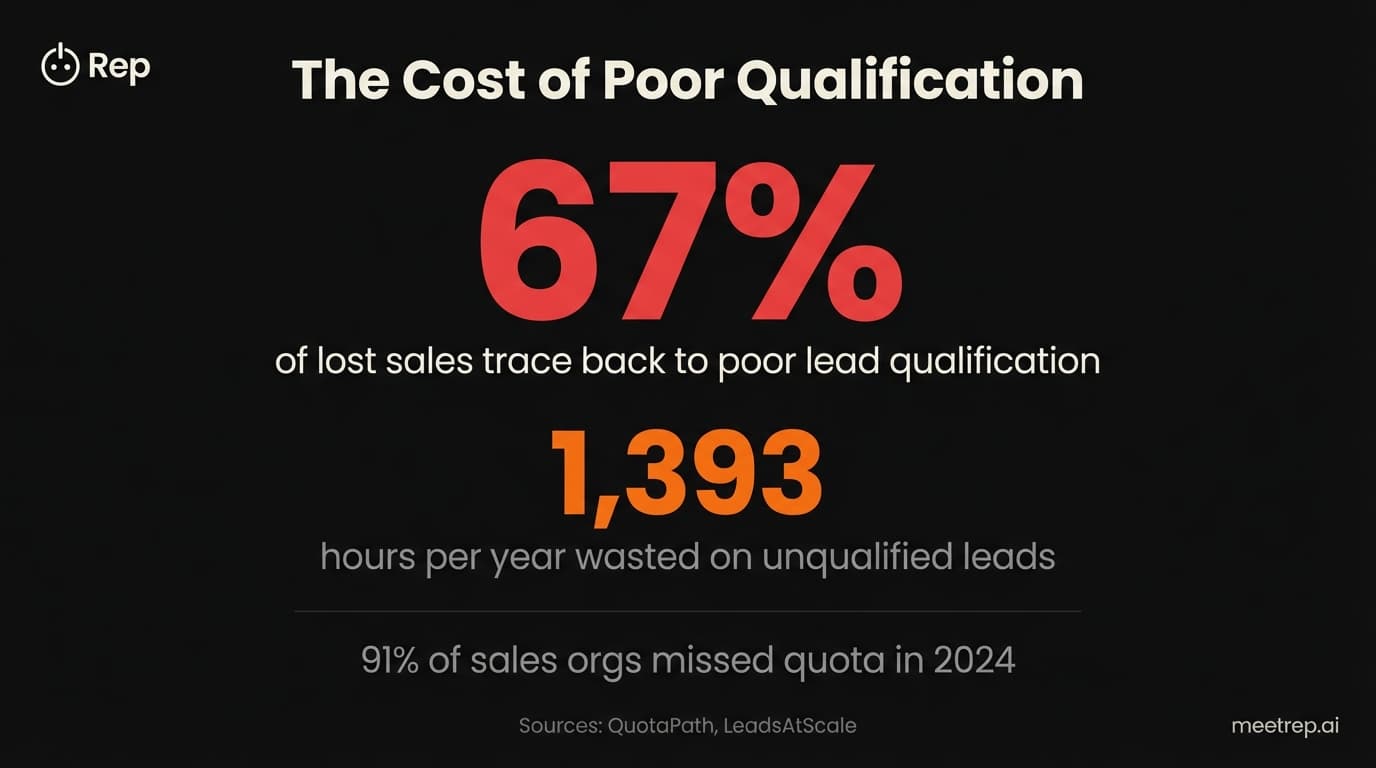
Here's the uncomfortable truth. The 91% quota miss rate happened while these frameworks existed. Companies had BANT. They had MEDDIC. They still missed.
Why?
Because only 15% of opportunities are fully qualified. The framework isn't the bottleneck. Adherence is.
What Causes Adherence Collapse:
- Pipeline pressure kills discovery. When quota deadlines loom, reps rush deals forward. The Metrics conversation gets skipped. The Champion is never identified.
- Cognitive overload during calls. Reps juggle listening, note-taking, relationship-building, and framework execution simultaneously. Something gives.
- No enforcement mechanism. CRMs accept empty fields. If a rep closes an opportunity without documenting the Economic Buyer, there's no technical blocker.
- Training decay. The 3.6-month MEDDIC proficiency curve assumes ongoing coaching. That often doesn't happen.
The result? Reps burn 1,393 hours per year on deals that should have been disqualified.
Key Insight: The framework matters less than whether your team actually uses it. Build enforcement into your systems. Make empty fields a pipeline blocker. And measure qualification completion rate as a leading indicator.
How AI Is Changing Qualification
The adherence problem is why AI qualification tools are gaining traction. AI doesn't forget to ask about the Economic Buyer. It doesn't skip Metrics under pressure. It executes the framework consistently, every time.
The data supports the shift. 81% of sales teams are now experimenting with or have fully implemented AI. And 83% of AI-adopting teams grew revenue compared to 66% without AI.
What AI Qualification Actually Looks Like:
AI agents can handle initial qualification conversations—collecting BANT criteria through interactive demos, chat, or voice before human reps get involved. Unqualified leads never enter AE pipelines.
At Rep, we see this from the demo side. When prospects go through an AI-hosted live demo, Rep captures pain points, questions, and engagement signals automatically. That data can inform downstream qualification without requiring reps to manually extract it.
The early results are promising. Organizations using AI demo automation report 6-8x higher conversion rates with product-qualified leads versus traditional MQLs.
This isn't about replacing human judgment. It's about automating the repetitive parts of qualification so reps focus on the deals that actually need human attention.
Which Framework Should You Choose?
Let me make this simple.
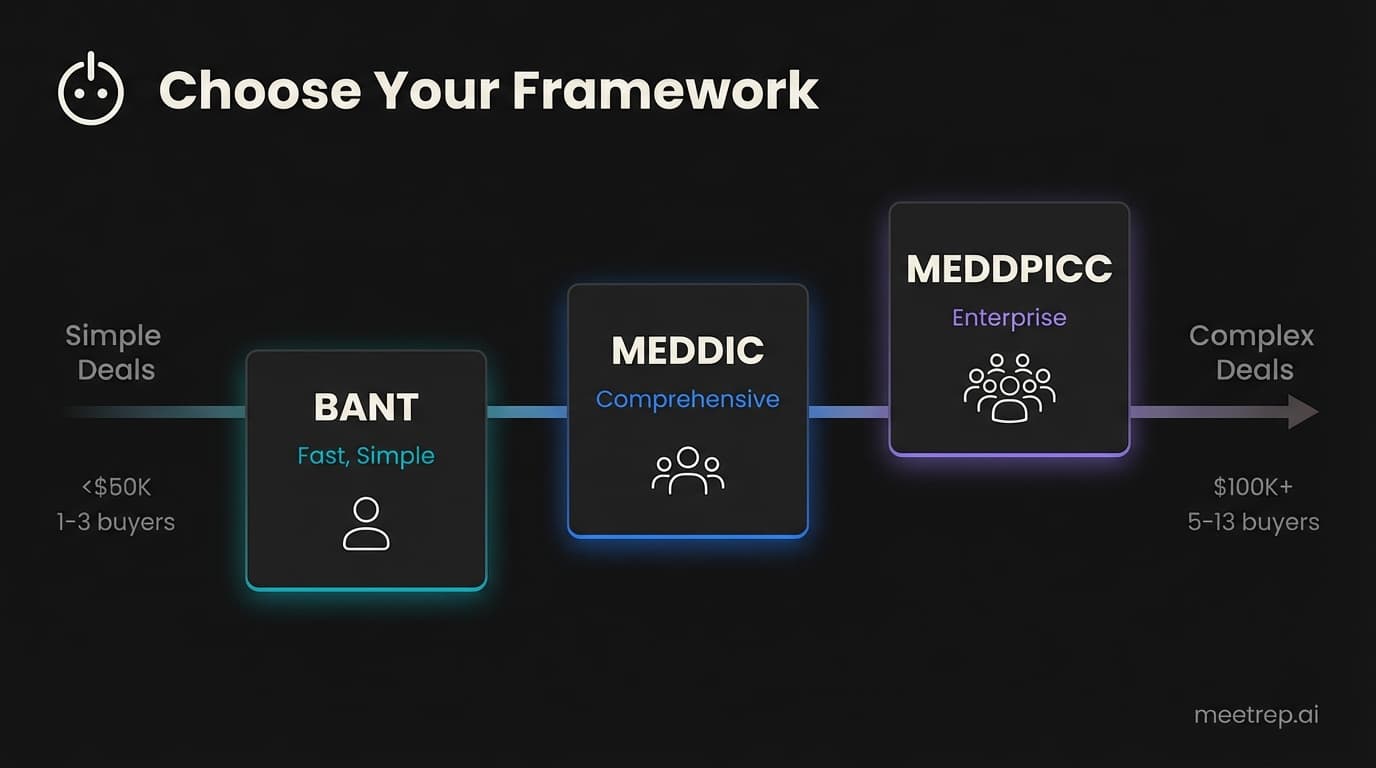
If your average deal is under $10K ACV and closes in under 60 days: Use BANT. The simplicity matches the sale. Don't overcomplicate it.
If your average deal exceeds $50K ACV with 6+ month cycles: Use MEDDPICC. Yes, the training investment is real. But 18% higher win rates and 24% larger deals justify it.
If you're running consultative, inbound sales with heavy marketing involvement: Consider GPCTBA. The goal-first approach aligns with how inbound leads want to be treated.
If you're growing and your deal sizes are increasing: Start with BANT for initial filtering, then train your team on MEDDIC for qualified opportunities. This hybrid approach gives you speed without sacrificing depth.
And regardless of which framework you pick: measure qualification completion rate. If that number isn't above 80%, your framework choice doesn't matter. Adherence is your actual problem.
The framework debate misses the point. 91% of organizations missed quota while all these frameworks existed. The problem isn't which acronym you pick. It's whether your team actually executes it.
At Rep, we're building tools that help automate the qualification signals that emerge during demos—capturing pain points, questions, and engagement without requiring reps to manually document everything. But the foundation still matters. Pick a framework that fits your sales motion. Enforce it through your systems. And measure adherence as aggressively as you measure pipeline.
The teams that figure this out will close more. The rest will keep wasting 1,393 hours per year wondering why qualified deals keep dying.
→ See how Rep captures qualification signals during live demos

Nadeem Azam
Founder
Software engineer & architect with 10+ years experience. Previously founded GoCustomer.ai.
Nadeem Azam is the Founder of Rep (meetrep.ai), building AI agents that give live product demos 24/7 for B2B sales teams. He writes about AI, sales automation, and the future of product demos.
Frequently Asked Questions
Table of Contents
- What Is a Sales Qualification Framework?
- BANT: The Foundational Framework
- MEDDIC: The Enterprise Standard
- GPCTBA/C&I: The Consultative Approach
- Head-to-Head: BANT vs MEDDIC vs GPCTBA
- Why Frameworks Fail (The Execution Gap)
- How AI Is Changing Qualification
- Which Framework Should You Choose?
Ready to automate your demos?
Join the Rep Council and be among the first to experience AI-powered demos.
Get Early AccessRelated Articles
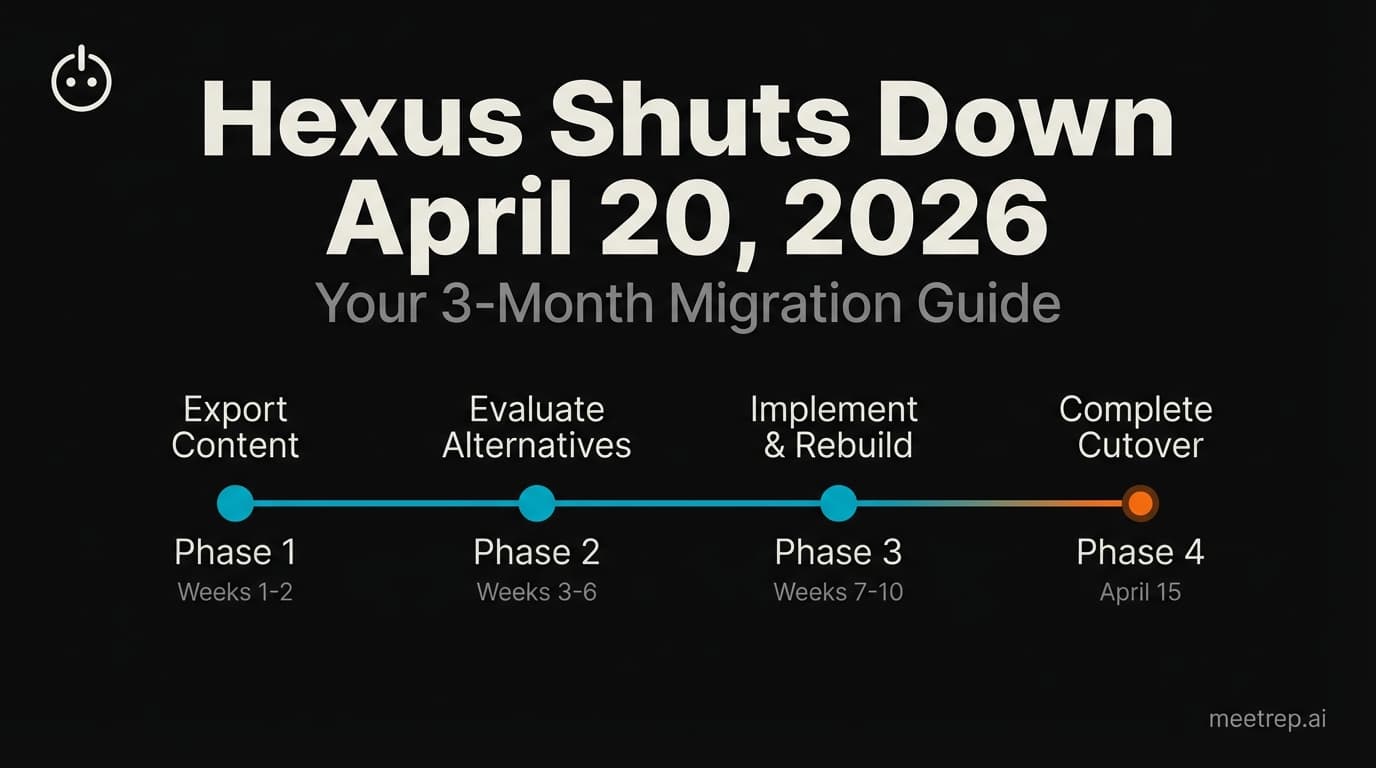
Hexus Acquired by Harvey AI: Congrats & What It Means for Demo Automation Teams
Hexus is shutting down following its acquisition by Harvey AI. Learn how to manage your migration and discover the best demo automation alternatives before April 2026.
Why the "Software Demo" is Broken—and Why AI Agents Are the Future
The traditional software demo is dead. Discover why 94% of B2B buyers rank vendors before calling sales and how AI agents are replacing manual demos to scale revenue.
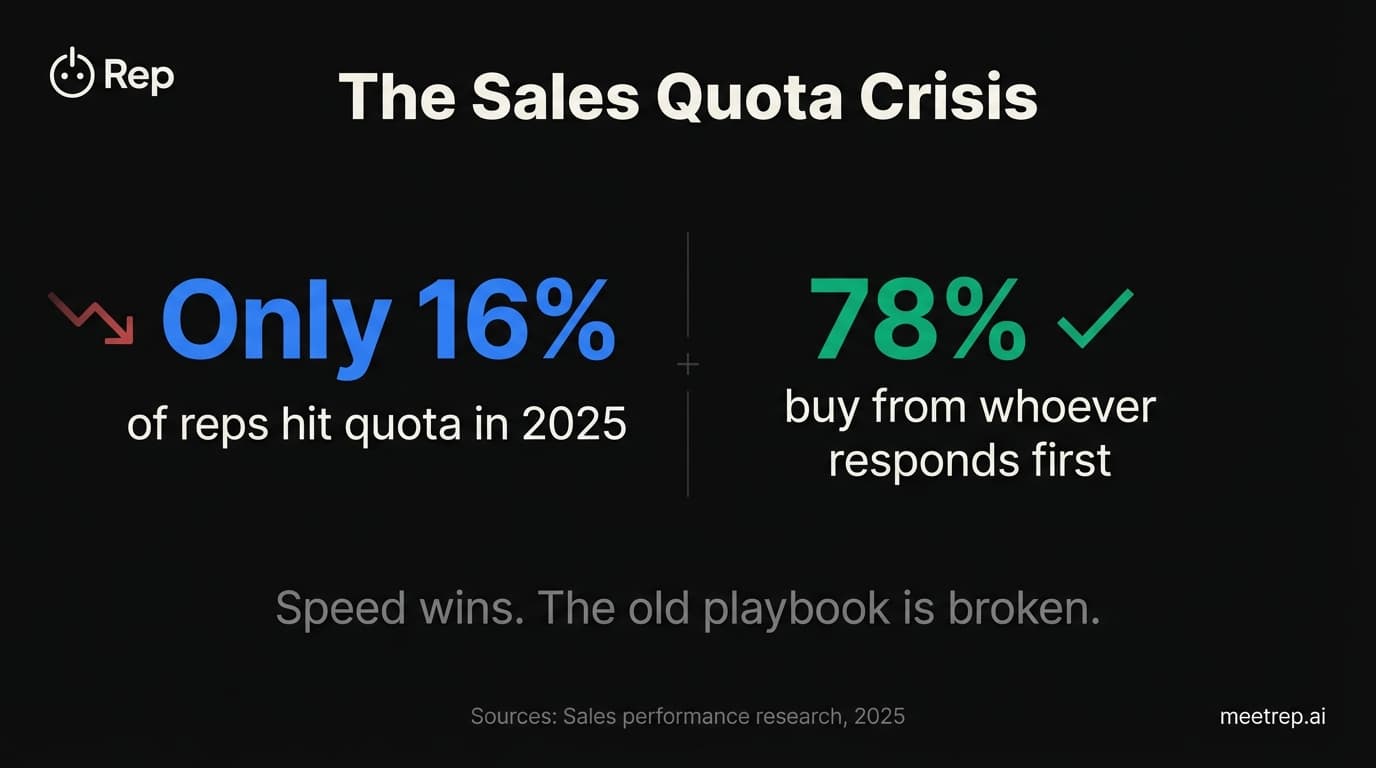
Why Autonomous Sales Software is the Future of B2B Sales (And Why the Old Playbook is Dead)
B2B sales is at a breaking point with quota attainment at 46%. Discover why autonomous 'Agentic AI' is the new standard for driving revenue and meeting the demand for rep-free buying.