B2B Sales Questions: The Complete Question Bank for Every Stage of the Sale

Executive Summary
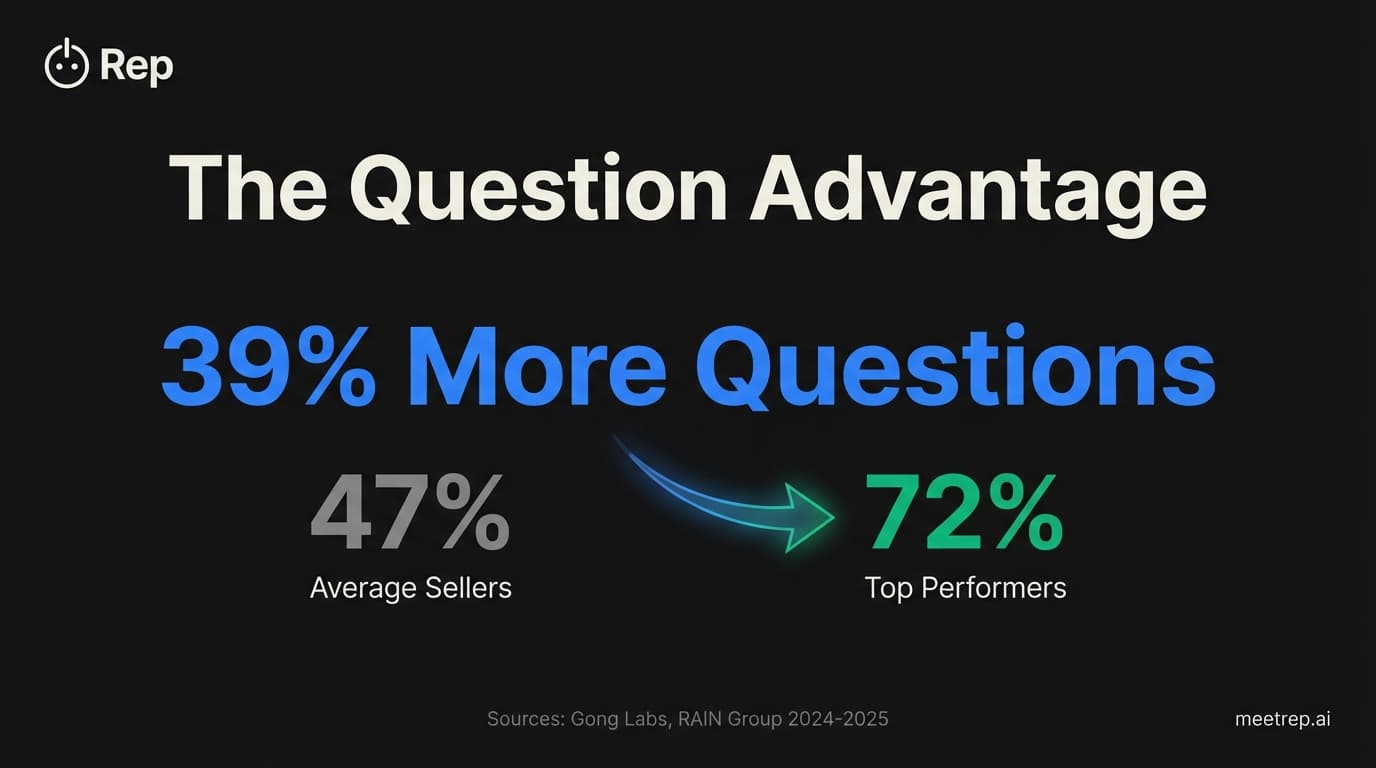
- Top performers ask 39% more questions during discovery — question quality is the #1 differentiator
- 58% of buyer meetings fail to deliver value, which creates a massive opportunity for reps who ask better questions
- 86% of B2B purchases stall during the buying process, often due to poor discovery and qualification
- Choose your framework based on deal complexity: BANT for SMB/transactional, MEDDIC for enterprise, SPICED for SaaS
- 13 stakeholders now involved in average B2B deals — multi-threading questions are essential
Most reps ask the wrong questions. Or they ask the right questions at the wrong time. Or they don't ask enough questions at all.
The data backs this up. According to Gong Labs research, top-performing sales reps ask 39% more questions during discovery calls than their peers. That's not a small edge. That's the difference between crushing quota and scrambling to explain another missed quarter.
Having built sales tools at GoCustomer and now at Rep, I've watched thousands of discovery calls. The pattern is clear: reps who ask better questions close more deals. Not because they're smoother talkers. Because they actually understand what the prospect needs before they pitch.
This guide gives you 50+ B2B sales questions organized by sales stage — from first-touch discovery through close. Questions that work in 2025, not recycled advice from a decade ago.
Why do B2B sales questions actually matter?
B2B sales questions are the strategic, open-ended questions you ask business prospects to uncover pain, qualify opportunities, and move deals forward. They're not small talk. They're the mechanism that separates deals that close from deals that stall.
And right now, most deals stall.
Forrester's 2024 research found that 86% of B2B purchases stall during the buying process. Eighty-six percent. That's not a pipeline problem. That's a qualification problem. Reps are advancing deals that were never real to begin with.
The Data: According to RAIN Group's 2024-2025 analysis, top-performing sellers have a 72% average win rate compared to just 47% for other sellers. That 25-point gap? It comes down to how they run discovery.
Here's what separates top performers from everyone else:
| Behavior | Top Performers | Average Performers |
|---|---|---|
| Questions per discovery call | 39% more | Baseline |
| Win rate | 72% | 47% |
| Thorough needs discoveries | 58% more likely | Baseline |
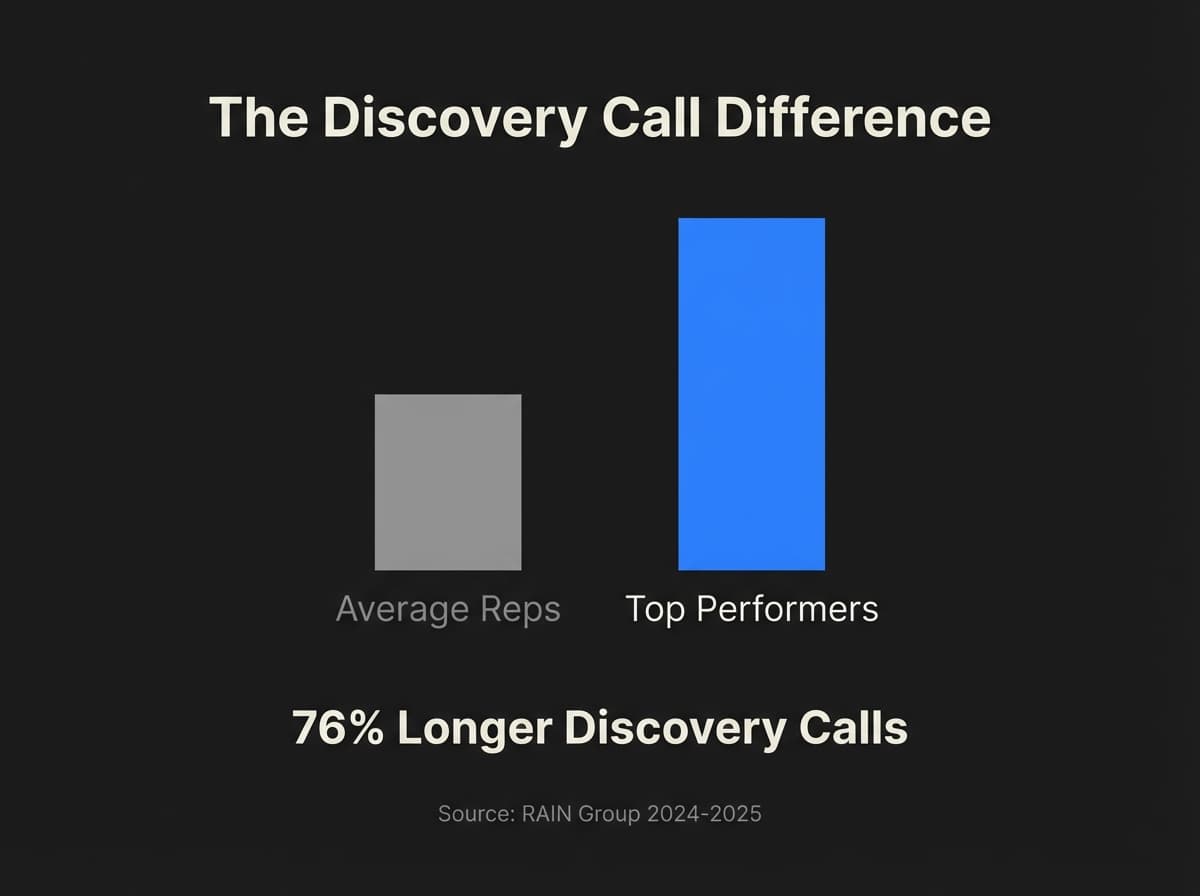
| Discovery call length | 76% longer | Baseline |
The pattern is obvious. Better discovery leads to better outcomes. But most reps rush through it.
I get why. Discovery feels like the part before the real selling starts. You want to get to the demo, the pitch, the close. At GoCustomer, we made this mistake early. We optimized for getting to the demo faster. Win rates dropped. When we slowed down and improved our qualifying questions, they rebounded.
Discovery questions that uncover real pain
Discovery questions help you understand the prospect's current state, their problems, and why those problems matter now. Without solid discovery, you're pitching blind.
The goal isn't to ask a lot of questions. It's to ask the right ones. Here are 15 discovery questions that actually work:
Pain Identification Questions:
- "What triggered your search for a solution right now?"
- "Walk me through what happens when this problem occurs."
- "What have you already tried to fix this?"
- "How is this issue affecting other parts of the business?"
- "If nothing changes in the next 6 months, what happens?"
Current State Questions: 6. "How are you handling this today?" 7. "What tools or processes are you currently using?" 8. "Where does your current approach fall short?" 9. "How much time does your team spend on this each week?" 10. "What's the manual workaround you've built?"
Impact Questions: 11. "Can you put a number on what this problem costs you?" 12. "How does this affect your team's ability to hit their goals?" 13. "What opportunities are you missing because of this?" 14. "Who else in the organization feels this pain?" 15. "What would solving this free your team up to do?"
What we learned at GoCustomer: The question "What triggered your search right now?" was our highest-signal discovery question. The answer revealed urgency (or lack of it) immediately. No urgency? The deal would stall. Every time.
Notice what these questions have in common. They're open-ended. They start with "what," "how," "walk me through." They force the prospect to talk, not just answer yes or no.
And here's the thing most reps miss: RAIN Group found that 58% of buyer meetings fail to deliver value. Your prospect has probably sat through three mediocre discovery calls this week. If you ask the same generic questions, you blend in. Ask questions that make them think, and you stand out.
Qualifying questions that save you time
Qualifying questions determine whether a deal is worth pursuing. This is where most reps get lazy — and where the 86% stall rate comes from.
Good qualification isn't about checking boxes. It's about finding the deals with real momentum and real fit. Here are 12 qualifying questions organized by what they uncover:
ICP Fit Questions:
- "How many people on your team would use this?"
- "What does your current tech stack look like?"
- "What's your timeline for making a decision?"
- "Is this a priority for this quarter, or more of a future initiative?"
Budget Questions: 5. "Do you have budget allocated for this, or would we need to build a case?" 6. "What's the approval process look like for purchases like this?" 7. "Have you invested in similar solutions before? What happened?"
Authority Questions: 8. "Who else needs to be involved in this decision?" 9. "If you were to move forward, who signs off?" 10. "Walk me through how decisions like this have been made before."
Urgency Questions: 11. "Is there an event or deadline creating pressure to decide?" 12. "What happens if this project doesn't happen this quarter?"
Common mistake: Asking about budget too early feels pushy. Asking too late wastes everyone's time. The sweet spot? After you've established genuine pain and before you've invested hours in demos and proposals.
Here's a hard truth: RAIN Group reports that 44% of sales leaders say they're losing more deals to "no decision" than ever before. That's not competitive losses. That's deals dying because the prospect just... stopped.
Better qualification catches these earlier. The question "Is this a priority for this quarter, or more of a future initiative?" sounds simple. But it separates real deals from tire-kickers faster than any BANT checkbox.
Budget and authority questions without sounding pushy
Budget and authority questions are awkward. Ask them wrong, and you sound like you only care about the money. Ask them right, and you show you're a professional who values everyone's time.
The key? Frame them around the decision process, not the money.
Economic Buyer Identification:
- "Who owns the budget for initiatives like this?"
- "Is there a finance review for purchases of this size?"
- "What criteria will the final decision-maker use to evaluate options?"
Budget Allocation: 4. "How does this initiative compare to other priorities competing for budget?" 5. "If we can demonstrate ROI, is there flexibility in the timeline?" 6. "What would need to be true for this to get funded this quarter?"
Decision Process Mapping: 7. "What does your procurement process look like?" 8. "Are there legal or security reviews we should plan for?"
Key Insight:Forrester's 2024 data shows an average of 13 people are now involved in B2B buying decisions. If you're only talking to one person, you're not talking to the deal.
That 13-person stat changed how I think about sales. At GoCustomer, we'd close the "decision maker" and then watch deals die in procurement. The real decision wasn't one conversation. It was 13 conversations we weren't part of.
Which brings us to multi-threading.
Questions that reveal the decision process
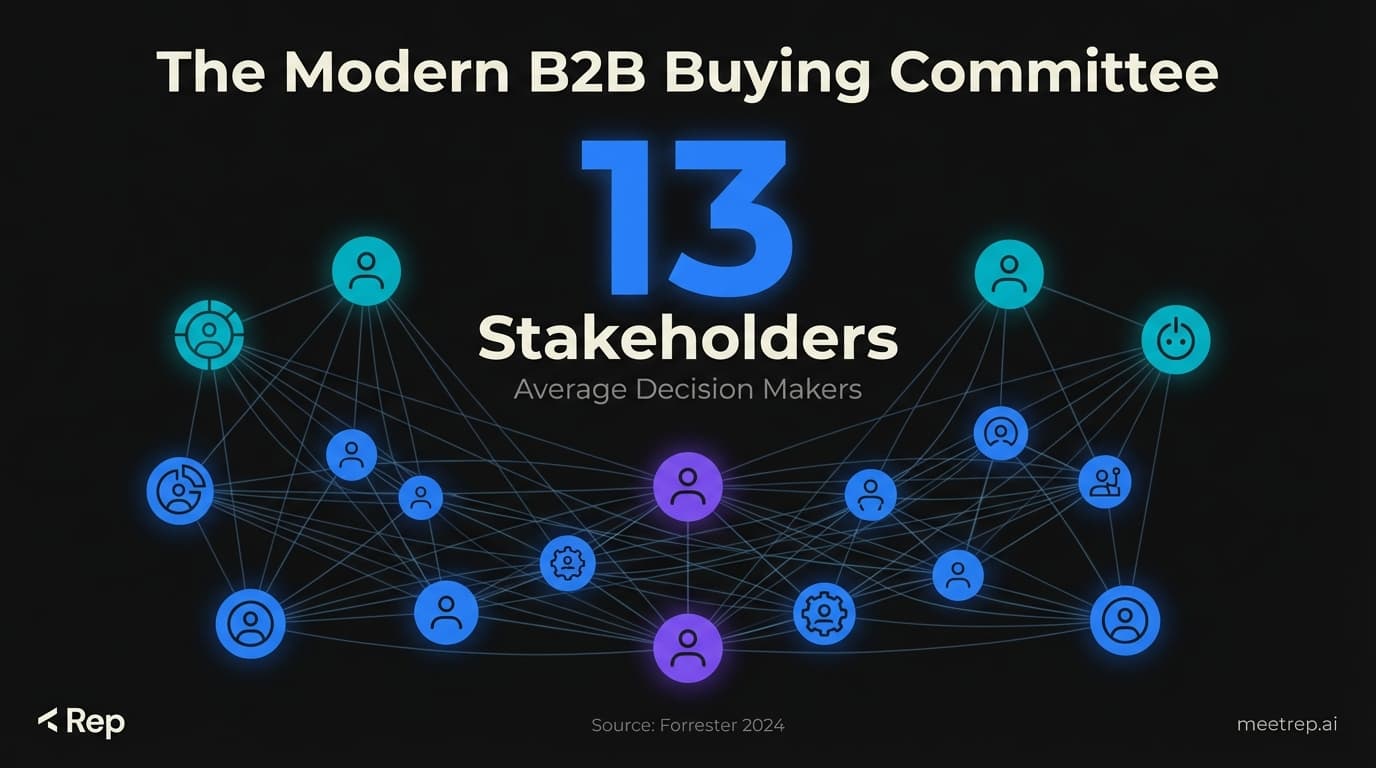
With 13 stakeholders involved, single-threaded deals are dead deals walking. You need to understand the full decision process and get access to the people who matter.
Champion Identification:
- "Who else on your team is most affected by this problem?"
- "Is there someone internally who's been pushing for a solution?"
- "Who would be your go-to person to help evaluate options?"
Stakeholder Mapping: 4. "Walk me through who would need to be comfortable with this decision." 5. "Are there teams that would be impacted by implementing this?" 6. "Who might have concerns or objections we should address early?"
Buying Committee Questions: 7. "If you were to recommend us, what would you need to show your team?" 8. "What's the biggest objection you'd expect from [specific stakeholder]?"
The Data:Gong's 2025 analysis found that bringing up competition early in enterprise deals increases your odds of winning by 32%. Don't avoid the competition question — use it to understand who else they're considering.
Here's a question that's worked well for us: "What other solutions are you evaluating, and what do you like about them?" It sounds risky. But it gives you intel you can't get any other way. And it shows confidence. You're not afraid of the comparison.
BANT vs MEDDIC vs SPICED: Which framework should you use?
Every sales org debates qualification frameworks. Here's my take: they all work. The question is which one fits your deal type.
| Framework | Best For | Core Questions | When to Use |
|---|---|---|---|
| BANT | SMB, transactional, <$50K deals | Budget, Authority, Need, Timeline | Fast sales cycles, clear decision-makers |
| MEDDIC | Enterprise, >$100K deals | Metrics, Economic Buyer, Decision Criteria, Decision Process, Identify Pain, Champion | Complex buying committees, long cycles |
| SPICED | B2B SaaS, recurring revenue | Situation, Pain, Impact, Critical Event, Decision | Subscription models, retention matters |
My hot take: BANT isn't dead. The people saying BANT is outdated are usually selling enterprise methodology training. For a $15K deal with a 2-week sales cycle and one decision-maker? BANT is fine. Overthinking it slows you down.
But for enterprise? MEDDIC exists for a reason. Google Cloud uses it to train 15,000+ sales reps, according to Yoodli. When you're dealing with 13 stakeholders and 6-month cycles, you need the structure.
SPICED is newer and built for SaaS. The "Critical Event" component is the key addition — it forces you to find the trigger that creates urgency. No critical event? No urgency. No urgency? The deal stalls.
What we learned at GoCustomer: We switched from BANT to SPICED midway through year two. The critical event question alone improved our forecast accuracy. We stopped counting deals that didn't have real deadlines.
Common questioning mistakes that kill deals
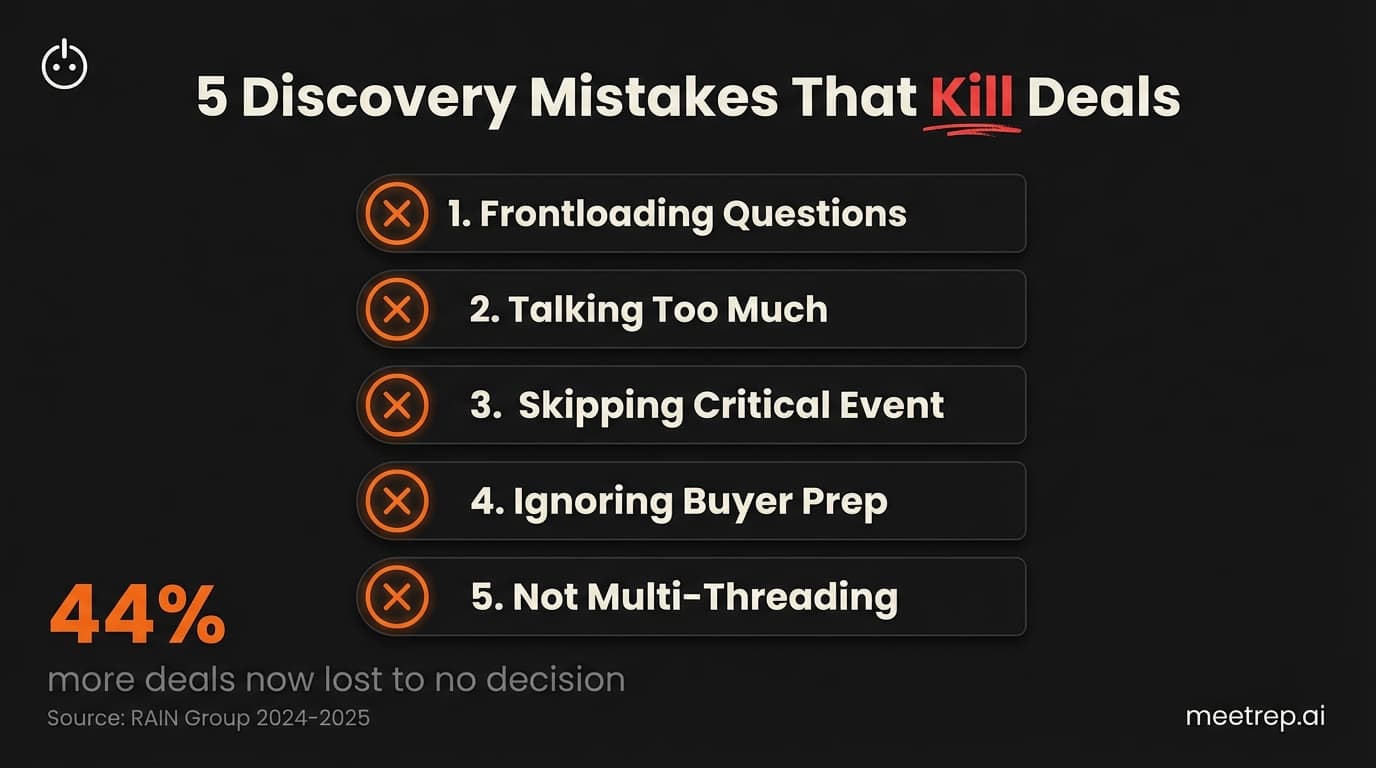
Knowing what to ask is only half the battle. How and when you ask matters just as much.
Frontloading questions. Dumping 10 questions in the first 5 minutes feels like an interrogation. Distribute questions throughout the call. Ask, listen, follow up, then ask something new.
Talking too much. Top performers run discovery calls that are 76% longer than average. But they're not talking more — they're letting the prospect talk more. Your job is to ask, then shut up.
Skipping the critical event. "What's driving the timeline on this?" is the most underused question in sales. Without a critical event, deals drift. According to RAIN Group, sales leaders report 44% more deals lost to "no decision." Critical event questions catch these early.
Not adjusting for the buyer's prep level. Here's what's changed: Forrester found that 95% of buyers plan to use AI tools in their purchase decisions. Your prospect might have already asked ChatGPT about your category. They might have watched competitor demos. Your questions need to account for what they already know.
Ask: "What research have you already done on solutions like this?" It respects their time and reveals where they are in the process.
Ignoring non-selling time.Salesforce's 2024 State of Sales found that reps spend 70% of their time on non-selling tasks. If you don't nail discovery the first time, you'll waste hours circling back. One focused discovery call beats three scattered ones.
How to prepare for any discovery call
Preparation separates good discovery from great discovery. Here's the checklist I use:
Before the call:
- Research the company (funding, news, tech stack, competitors)
- Research the person (role, tenure, LinkedIn activity)
- Identify 3-5 hypothesis pains based on their segment
- Prepare questions that test those hypotheses
- Know what disqualifies them (so you can exit early if needed)
During the call:
- Open with context: "I did some research and noticed [X]. Is that accurate?"
- Let them correct you — it gets them talking
- Take notes on exact phrases they use (use their language back to them)
- Don't pitch until you've confirmed real pain
After the call:
- Summarize what you heard in writing
- Identify gaps — what don't you know yet?
- Plan next steps based on what you learned
Today's buyers arrive more informed than ever. Some prospects have already interacted with AI-powered product demos before talking to you. Solutions like Rep give prospects 24/7 access to interactive demos, which means they might already understand your competitor's features in detail. Your discovery questions need to account for this — ask what they've already evaluated, what demos they've seen, and what questions those experiences left unanswered.
The questions you ask determine the deals you close. That's not a motivational statement. It's what the data shows — 39% more questions, 25-point win rate advantage, 76% longer discovery calls. The math is clear.
But here's what I think most question-bank content gets wrong: it gives you static lists without context. Real discovery adapts based on what you learn. The best reps don't memorize questions — they internalize principles and adjust on the fly.
Start with the questions in this guide. Test which ones work for your market. Throw out the ones that don't land. Build your own playbook based on what actually moves deals forward.
And if you want to see how AI can handle the demo part of the equation — giving prospects 24/7 access to live, interactive product demonstrations — see how Rep works.

Nadeem Azam
Founder
Software engineer & architect with 10+ years experience. Previously founded GoCustomer.ai.
Nadeem Azam is the Founder of Rep (meetrep.ai), building AI agents that give live product demos 24/7 for B2B sales teams. He writes about AI, sales automation, and the future of product demos.
Frequently Asked Questions
Table of Contents
- Why do B2B sales questions actually matter?
- Discovery questions that uncover real pain
- Qualifying questions that save you time
- Budget and authority questions without sounding pushy
- Questions that reveal the decision process
- BANT vs MEDDIC vs SPICED: Which framework should you use?
- Common questioning mistakes that kill deals
- How to prepare for any discovery call
Ready to automate your demos?
Join the Rep Council and be among the first to experience AI-powered demos.
Get Early AccessRelated Articles
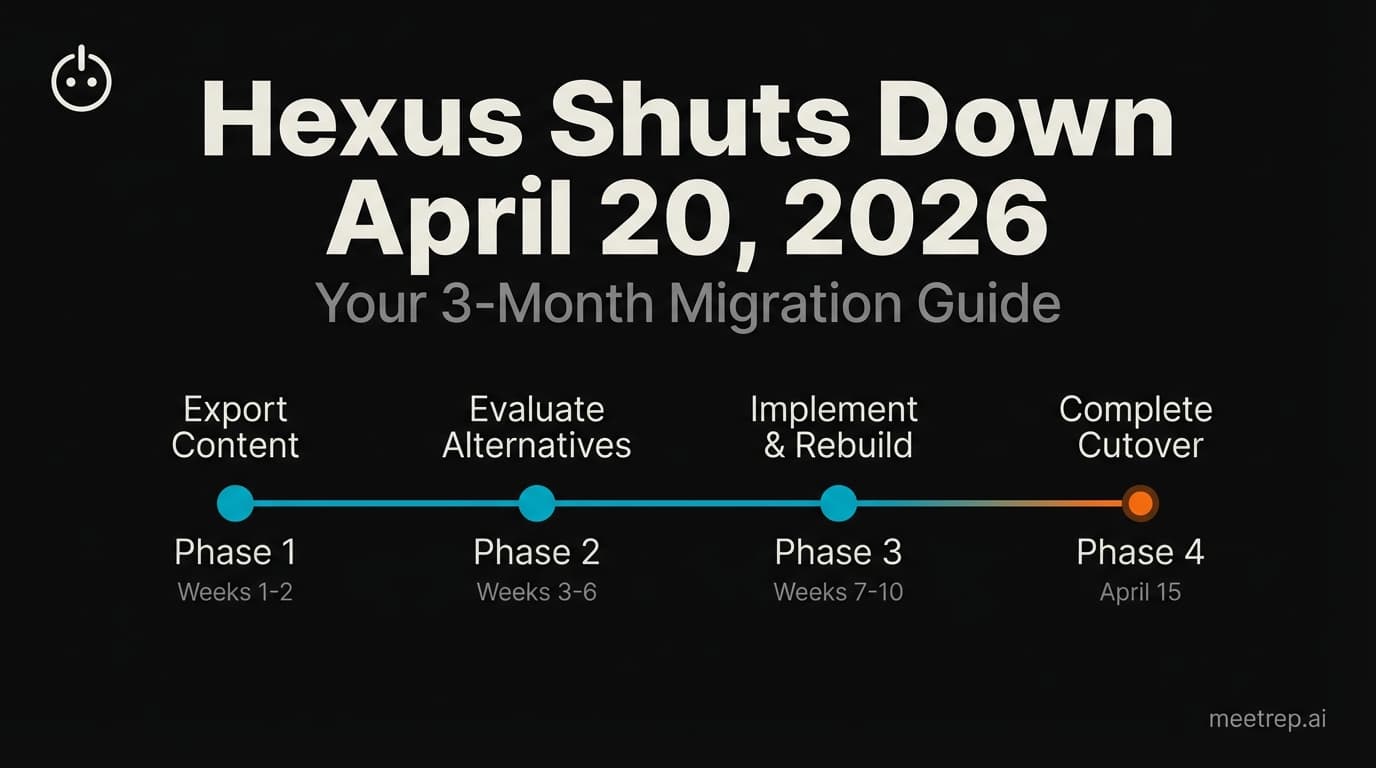
Hexus Acquired by Harvey AI: Congrats & What It Means for Demo Automation Teams
Hexus is shutting down following its acquisition by Harvey AI. Learn how to manage your migration and discover the best demo automation alternatives before April 2026.
Why the "Software Demo" is Broken—and Why AI Agents Are the Future
The traditional software demo is dead. Discover why 94% of B2B buyers rank vendors before calling sales and how AI agents are replacing manual demos to scale revenue.
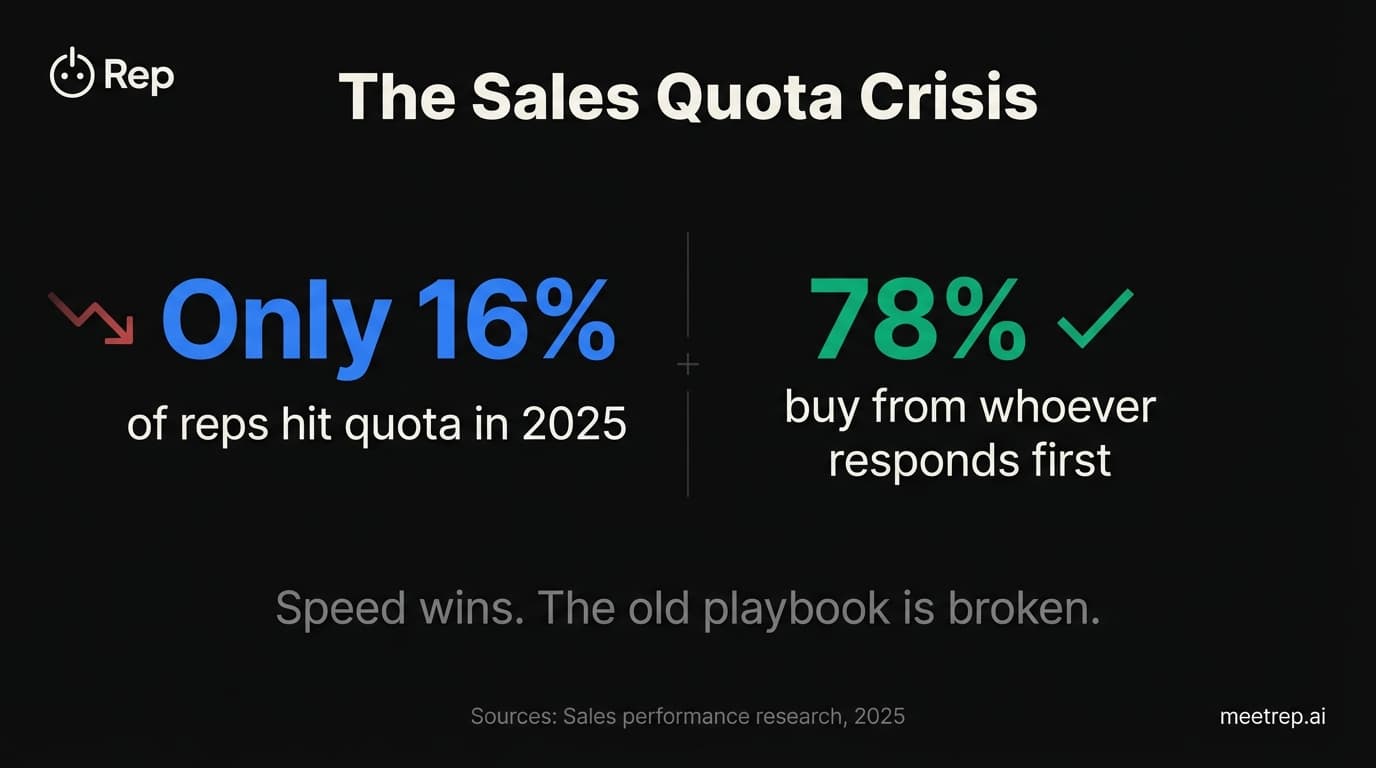
Why Autonomous Sales Software is the Future of B2B Sales (And Why the Old Playbook is Dead)
B2B sales is at a breaking point with quota attainment at 46%. Discover why autonomous 'Agentic AI' is the new standard for driving revenue and meeting the demand for rep-free buying.